Molly and I have been straightening up the flat this weekend, taking short breaks here and there as well. It is really fantastic to be engaged to a professional artist and art teacher for numerous reasons. Molly has a range of medium she works in, including custom mosaics, piano playing and teaching piano, guitar and ukulele playing, mastering the Swedish folk art of Dalmål, and on and on. Of all these mediums, included in a short YouTube video below is Molly’s rendition of Feist’s 1-2-3-4 (the Sesame Street version is linked to here as well). One of the many spectacular reasons that live performance is, well, spectacular has to do with the direct interaction that stage performers have with their environment and the audience. It’s an exchange. Of course, I have recorded and uploaded Molly’s impromptu performance on the YouTubes (thereby digitizing and preserving it in some kind of digital cloud space and time). But it is a slice of the reality that took place. Part of this reality is the unforeseen, as when a BNSF train horn rolling through downtown Fargo let loose about 0:43 and 0:57 in the video. Then a breeze decided to shut the door at about 1:01 in the video. But again, this is live, DIY, living room flat performance. And the band, and life, plays on.
Tag Archives: North Dakota
When the Eagle Statue Landed in Bismarck
I dropped into Bismarck yesterday, and after having breakfast with my folks this morning I decided to visit downtown Custer Park. It is beautiful outside.
The park itself is a kind of border between the historic western edge of downtown Bismarck and one of the historic residential areas. To the south is Elks Aquatic Center, and just to the east is a Dairy Queen. You can see how this is triangulated and primed to be a serious summer hangout for those on summer vacation.
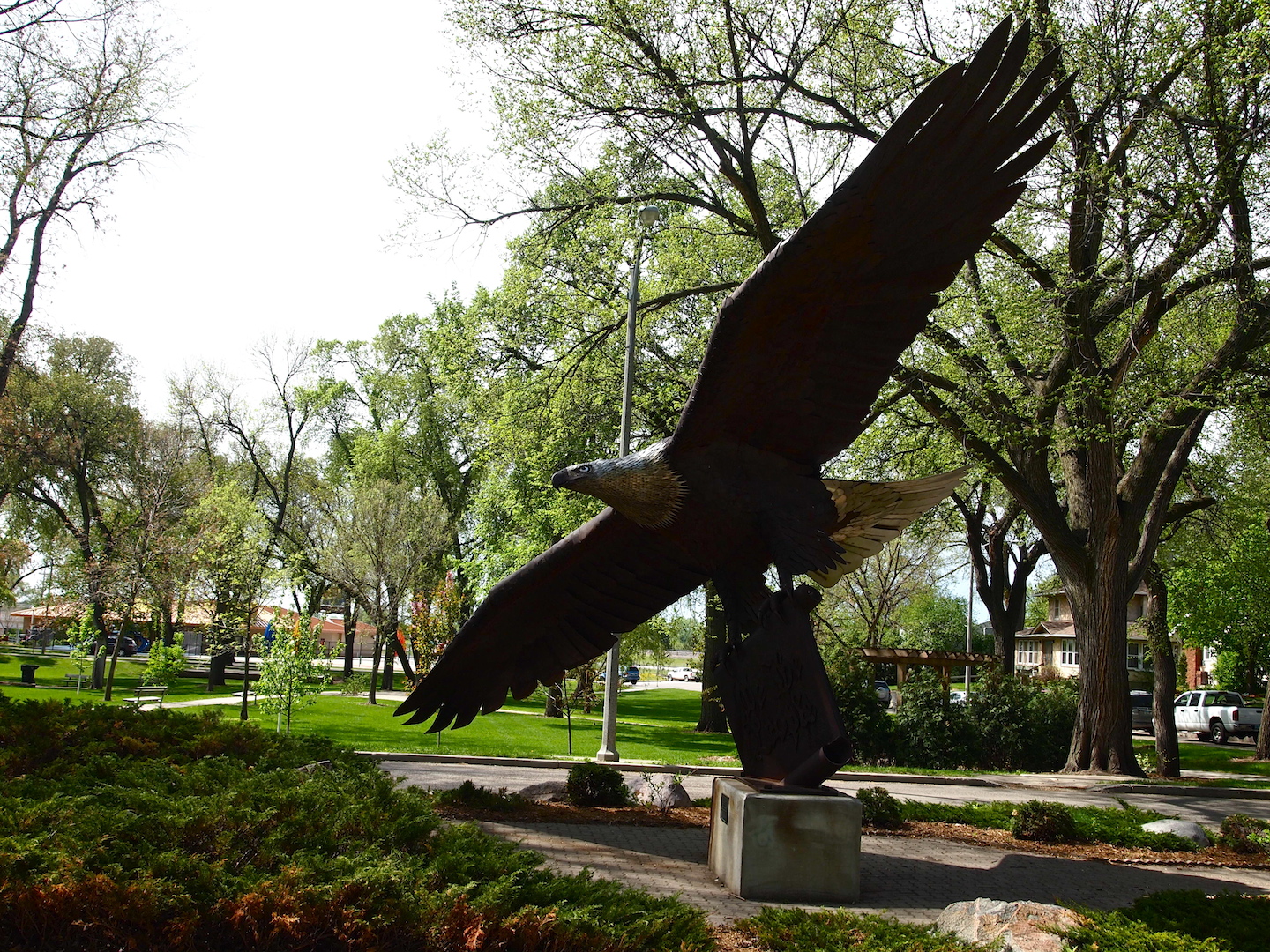
While at Custer Park, I also visited the huge metal eagle sculpture. This eagle was dedicated in 1988 (or thereabouts), and I have a vague recollection of my cub scout troop being at the dedication. At that time, when the sculpture was new and sans rust, we were told how the eagle would take on a more eagle-like color because the metal would oxidize and rust over time. This is about all I recall, but every time I drive by the eagle, I think of that dedication.
On this Memorial Day weekend, it seemed fitting to take and post a couple pics of this winged statue, as it is swooping into the park with a handbill that reads “We the People…”
The dedication plaque below reads as follows:
This sculpture was dedicated to commemorate the bicentennial anniversary of the constitution of the united states of America on October 1, 1988.
Commissioned by: Bismarck Park District
Funding Provided by: Fraternal Order of the Eagles, Bismarck, Aerie No. 2237
Sculptor: Tom Neary
Design Assistant: Wayne Pruse
Today, artists have pushed metal sculptures in different directions, now using found metal objects to craft works of industrial public art. Here is a link to some of that at the University of Montana in Missoula, and some more from Lemmon, South Dakota.
Memorial Weekend
It’s Friday evening and Molly and I are sitting on the living room futon which now faces west. It points us in the direction of a screen porch, and beyond this we can see the youthful spring green of deciduous trees and leaves set against a background of grayish-blue sky. A storm is brewing out west for sure. You can smell it. Something to do with the ozone.
We live in pre-WWI construction, so we are also treated to a kind of pre-WWII sense of place. I haven’t been able to put words to the smell, but the smell I’m smelling reminds me of my late Grandma Christy’s house on the 700 block of North 4th Street in Bismarck, North Dakota. That house, too, was built prior to the First World War. Anything built before the Second World War has this sense of smell and place to it. The homes and apartments all have hard wood floors, radiator heating, and super tall ceilings. They were built before the invention and ascent of conditioned air.
So now that it is Memorial Day Weekend, I thought I would post the epitome of Americana. I love this stuff. Baseball and cowboy charcoal grilled burgers. Memorial Day weekend is a grand extension of Decoration Day, a Civil War day of remembrance.
This evening also got me thinking a bit about all the German-Americans that poured into the United States when, in the words of Lt. Aldo Raine, people were getting out of Europe while the getting was good. Massive religious and political upheavals in the 19th century (this is the most focused brush stroke I’m going to use right now) induced hundreds of thousands of Europeans to simply leave Europe. They crossed the Atlantic and poured in the United States. A large swath of these immigrants came from Germany, or German-speaking countries (I have often hypothesized that the reason Germany started two big ones in the same century had to do with this intellectual emigrant drain from the previous century). And the Germans, when they arrived in the United States, took up numerous causes. In some cases they played baseball. And in other cases they agitated for emancipation. I like to imagine that they also grilled burgers, too. Baseball and burgers. Happy Memorial Day.
Historic Movie Theaters: Restoring the Walla Walla
Today in the Forum News Service, Ryan Bakken reported on the rehabilitated movie theater in Mayville, North Dakota. It got me thinking a bit about how we are witnessing numerous historic movie theaters get an updated restart in communities across the northern Great Plains (and elsewhere).
The movie theater is an important place, allowing a community of movie goers to engage, as we say, in a collective experience. This gives us points of reference in conversation — “Hey, you remember that line from ‘Walter Mitty’?” — and it also allows us to explore and ponder our own humanity. It is different, of course, from live theater, where there is always a direct interaction between actresses/actors and the audience. But the theater idea is the same: bringing together a group of people to take in a performance, or a spectacle. Life is a stage, after all.
Beyond Mayville, here are a couple more theaters in smaller North Dakota communities, to add to Bakken’s great write-up of Mayville. The Roxy theater is located in Langdon, North Dakota, just north-northwest of the long-since abandoned Nekoma ICBM missile defense concrete pyramid (it would be good to watch “Dr. Strangelove” at the Roxy some day). I snapped a photo of this Roxy in February 2014. It is up and running, having been brought back to life by the community in and around Langdon.

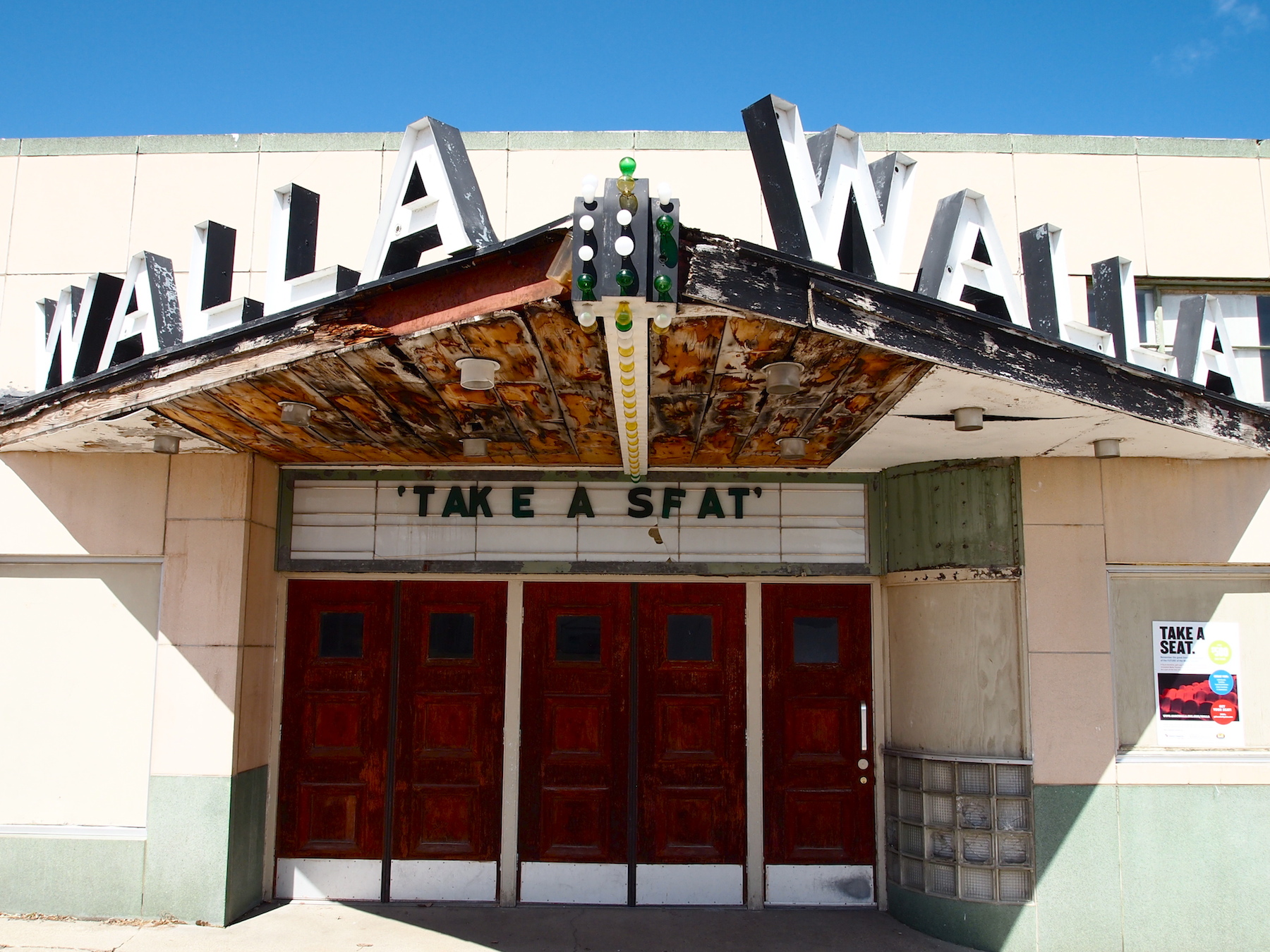
The historic 1949 Walla Walla Theater in Walhalla, North Dakota. It was placed on the National Register of Historic Places in 2010, and the regional arts community is crowd-sourcing funds for its 21st century rehabilitation.
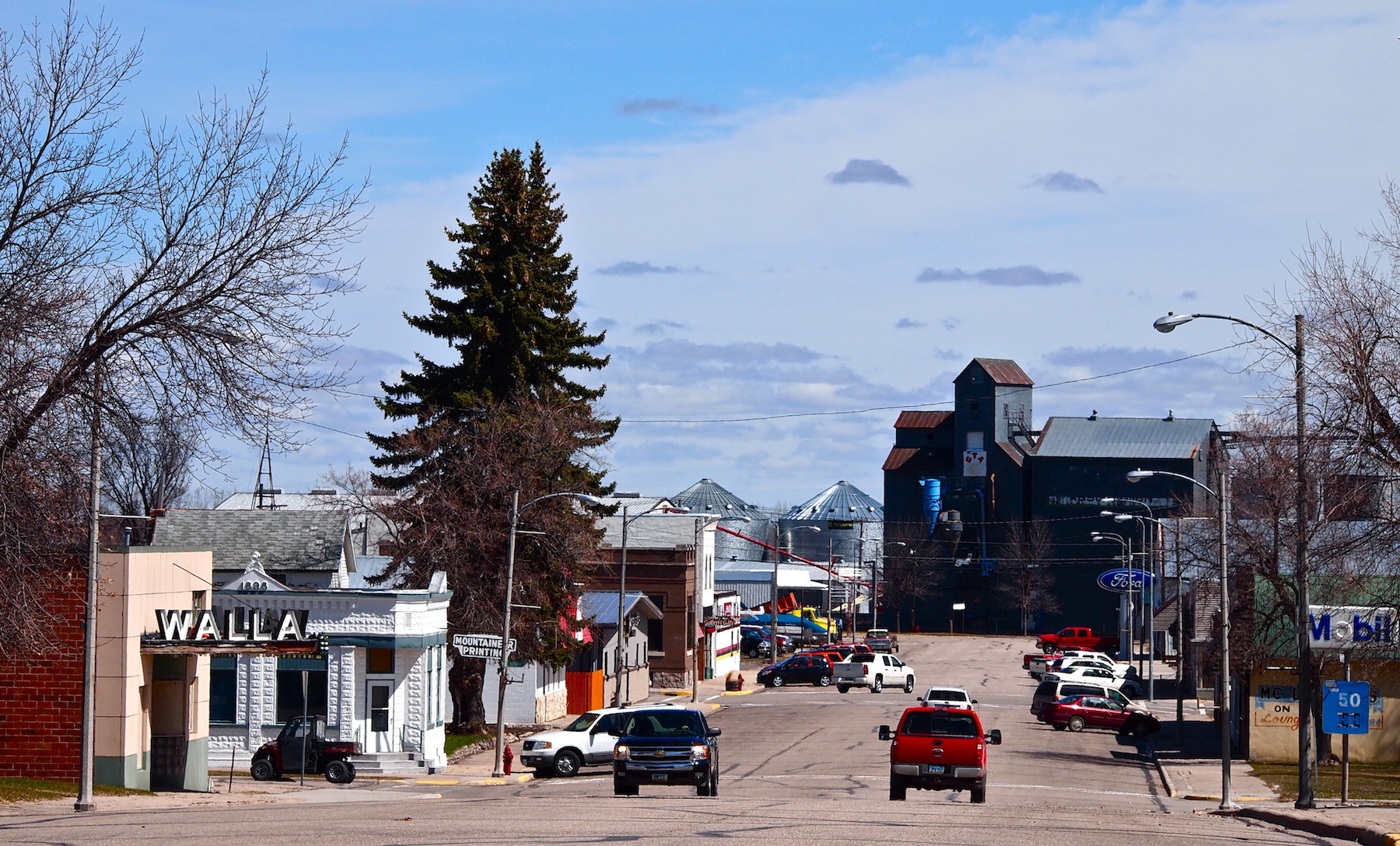
And here is the Walla Walla theater in Walhalla, North Dakota. Built shortly after the end of WWII in 1949, this theater was justly placed on the National Register of Historic Places in 2010. The Gorge Arts & Heritage Council (Facebook page here) is in the midst of crowd-sourcing funds to bring this theater back to life. This is a good idea. If you want to take pocket-book action, click on this link here for more information.
I was thinking today how much I enjoy these old time movie houses, and how the smaller the town, the more I enjoy them. I like the way that old time movie marquee stretches way out over the pedestrian sidewalk, acting as both a visual lure and a way to bring passersby under its influence. It is a much different feeling than when driving by more modern suburban theaters in our hermetically sealed automobiles. In addition to this, the old time theater is added value to any town, at least so the evening outing option isn’t always a default to the local tavern (not that there’s anything wrong with that, but you know what I mean). Yes, theater regularly plays out in local taverns. But it’s good to have the option to spend an evening in a defined theater proper.
Following ET in New Mexico from North Dakota
Throughout last week I’ve been following the media trail of four friends — Andrew Reinhard, Richard Rothaus, Bill Caraher, and Bret Weber — who were mustered into a modern archaeological dig in New Mexico. The goal was to dig up a pile of ET Atari games that were buried after the craptacular game hit the shelves in 1983. When this game hit the shelves, it signaled the beginning of the end for Atari, as Atari lost (according to the Wikipedia page) over a half-billion dollars after buying the rights from Spielberg; over-producing a terrible game; and banking on the idea that customers would rip them from the shelves. They did, to a degree. But the video gamers returned them for a refund as well.
So I kept up with the social media and stories, noting to myself that the archaeology of ET Atari games was more popular than the actual 1983 game. I was also happy to read that Caraher made Rolling Stone. Check it out in the link here. CNN covered the story too. Daniel Politi of Slate.com also covered the story, as did Dominic Rushe of The Guardian, and NPR’s Morning Edition ran a story here. Eric Mack of Forbes covered Andrew Reinhard here (well, the picture is of Andrew). And The Onion covered it here.
The more local Fargo Forum ran a story on it here, too. And you can get direct, unadulterated coverage of the ET dig from Bill Caraher’s blog here. So while holding down the bunker in North Dakota, and while reading these stories, I would often take sips from the ET glass pictured here. The glass comes from my fiancée’s sister’s Valley City home. I think it was a thrift store find some time ago. I still have to set down and get an official oral history.
Pre-gaming for FX’s “Fargo” Premiere at The Fargo Theater in Downtown Fargo
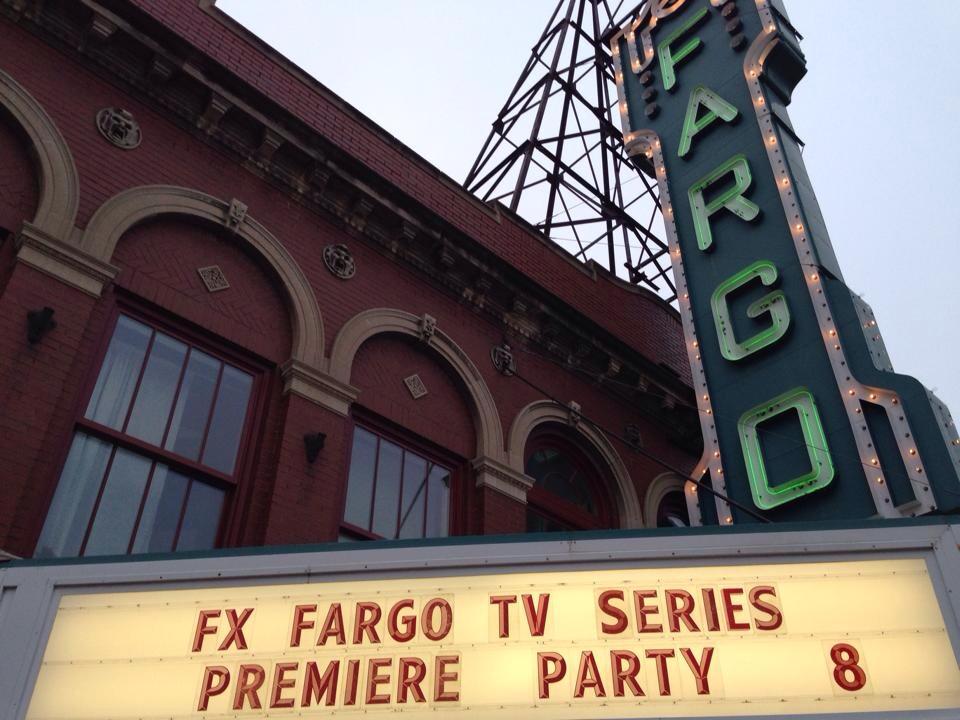
As the title of this blog entry suggests, since Molly and I live in historic downtown Fargo, we (like many Fargoans) decided to host a pre-game get-together before the 9:00PM (CST) sharp showing of FX’s “Fargo” television series at The Fargo Theater in downtown Fargo, North Dakota. Yes, a kind of Fargo-Fargo-Fargo post-modernity, or something along those lines. My mind is still reeling about the implications, since every North Dakotan knows that the glorious Coen brothers film Fargo was almost entirely filmed in Minnesota. You betcha. But that is less and less transparent the further one is from Fargo. So I am convinced and know that some kind of global Fargo diaspora has developed, and is only reshaped and pushed in different directions with this television series. It’s kind of like when someone who is born in Chicago with Irish genealogy listens to modern Irish music and says, “I’m Irish.” Actually, it’s not anything like that. Nevermind. On to the Fargo evening, though.
Yesterday evening Molly picked me up after work and we made it back to our apartment in just enough time for two things to happen before company arrived: we decided that I would make this fancy hot dish recipe while Molly would straighten up the dining and living room. It worked dontchaknow. Guests started pouring in our door just after 7:00PM, and there was much back-slapping and guffawing. Since we were celebrating Fargo and midwestern and northern Great Plains culture, there was also large amounts of passive-aggressive acknowledgement, and commands phrased as questions punctuated with a “then” at the end; as in, “Do you want to pass the hot dish then?”
The conversation flowed, as did the hot dish and jello salads last night. So much that I didn’t get a chance to snap any photos of the event. But several friends did. I pulled a few of the photos from the social media this evening. That is why you get a picture of the hot-dish spread, taken by Molly. The other photos are from our highly trained professional photographer friend, Holly Anderson Battocchi (yes, her Italian-American husband Dante lives in Fargo too). At the end of our get-together, one large group left the pre game Fargo-Fargo-Fargo get-together to take in the FX “Fargo” premiere. A smaller group (that’s us) decided to stay behind at our apartment. We rationalized us not attending “Fargo” by saying we don’t need to see “Fargo” because we are and live and create Fargo, everyday. Aw, geez.
Dungeness Crab and North Dakota Walleye
Over the weekend I located some Dungeness crab at the Costco in West Fargo, North Dakota. To clear it up for non-Fargoans and non-North Dakotans, yes, Fargo is large enough to have a West Fargo (perhaps an idea for a second Coen Brothers film entitled West Fargo, which Molly says is on the east coast of North Dakota). The crab was so sensibly priced that I couldn’t avoid it. A small contingent — Mira McLain and Ben Simonson — from Valley City, North Dakota, came as well, bringing fresh-caught North Dakota walleye and sauger. Aunt Chris McLain also joined us, as did Matthew Trefz and Karis Thompson.
While eating the crab, I noted a couple things: first, fresh crab eaten in the middle of North America almost confuses one’s sense of place. It’s something that tastes like the ocean but it is so far removed from that locale. So if you’re in Fargo, or Ohio, and if you locate delicious and sensibly priced Dungeness crab, go for it. You get to taste the ocean while on a sea of prairie.
The second thing the royal we noted was that eating whole crab is an event: it takes patience and effort, and plenty of melted butter. Up to this point in time, the lot of us were land-lubbers the most if not the majority of our lives. Sure, one or two of us had the occasional deep-sea fishing experience, but that was more exotic than frequent.
Like I said, Ben, who often squeezes 25 hours of ice fishing into his 24-hour vacation days, brought the North Dakota walleye and sauger. And the feast was just that, a combination of steamed crab from the Pacific Northwest and North Dakota freshwater fish, fried up on the spot to absolute perfection. Aunt Chris provided a homemade fudge and ice cream desert, something she learned from her mother. Heritage dinners are real, and they often involve statements such as, “My mother used to make this.” I thought about that, and how the Sunday evening meal created a memory we could someday look back on 20 years from now.
Note: Twenty-four hours later, a March 31-April 1 blizzard is going full tilt. I just wanted to document it all. Here’s a video short of Matt Trefz offering a balanced assessment of Dungeness crab.
Weekend in Montana
I’m currently blogging from downtown Bozeman, Montana, after Molly and I hit up Chico Hot Springs (click here for a history of Chico Hot Springs) last night and earlier today, visiting her uncle in Livingston, and a scattering of her family in Paradise Valley. While at Chico we relaxed, and reflected on how Molly’s late father, Harley, loved this place. Harley grew up in Livingston, and Molly explained how her dad used to love taking summer time dips in the Yellowstone River throughout his entire life.
Of that Yellowstone, yes: the mountain runoff feeds it direct. This water meets up with the upper Missouri River near the Montana-North Dakota border. For the long hydrology of it all, this water eventually empties into the Mississippi near St. Louis, and then it runs to the Gulf of Mexico. It’s nice to catch it fresh up here in the glorious Rockies, though.
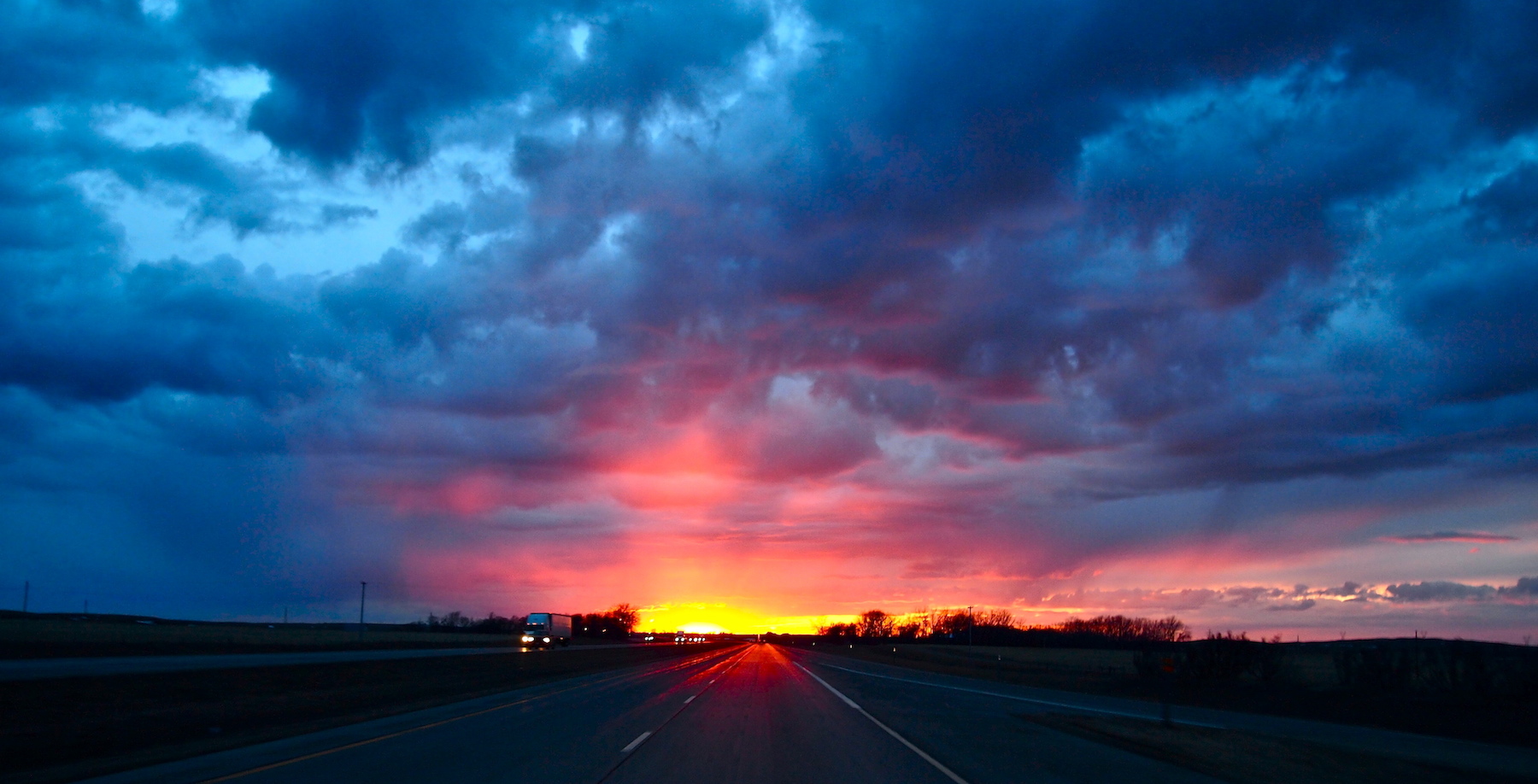
Here are a couple photos from when we left Fargo up to Bozeman. The above photo is the evening sky from March 20, 2014, around the Crystal Springs exit on I-94 in North Dakota. What the photo didn’t catch (or what we just observed rather than photographing) was the sun reflecting off the aqua blue of the melting ponds (kind of like a light turquoise, and highly reflective from the couple inches of water on the surface of the ice).
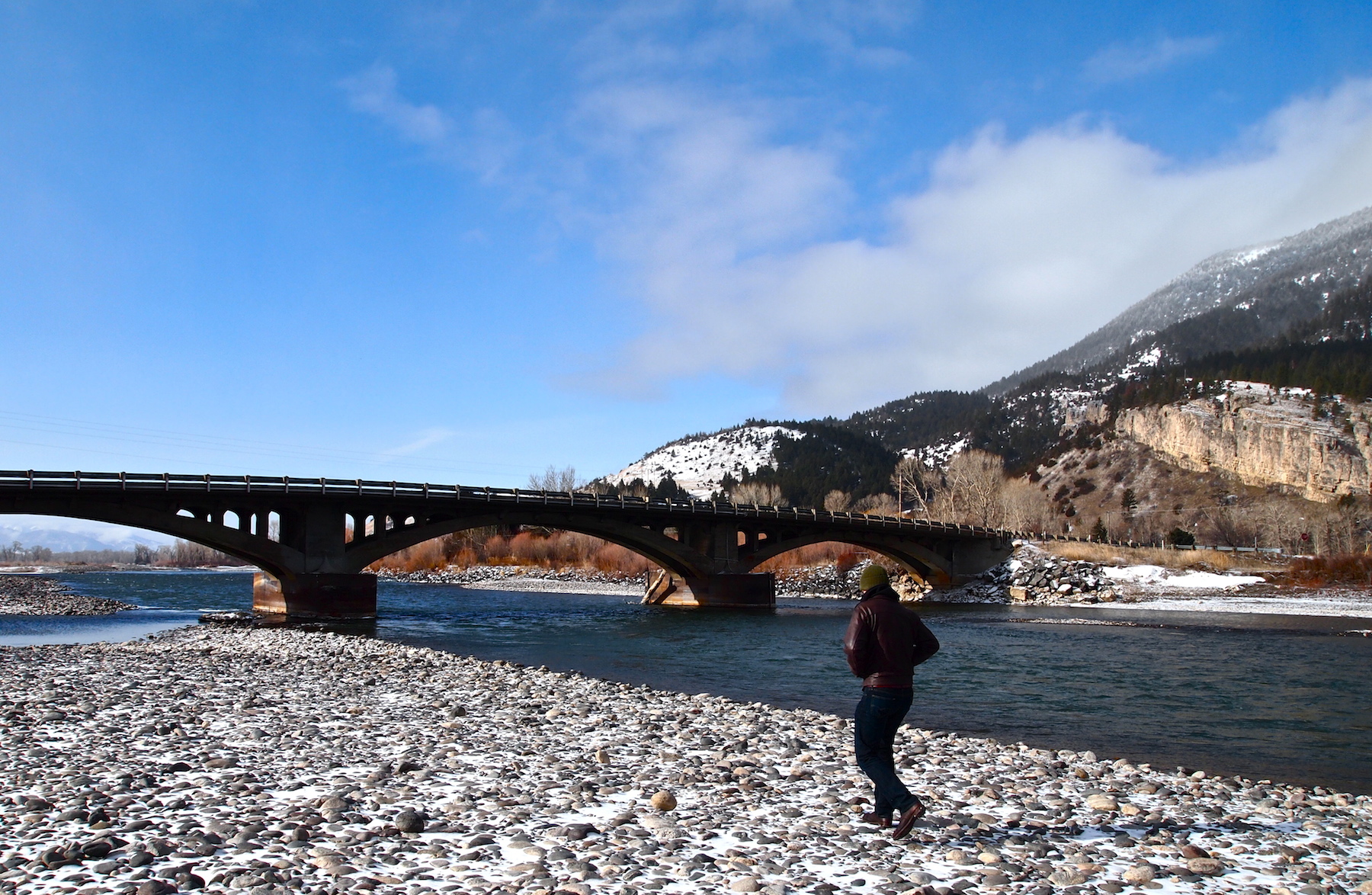
The middle photo is the Yellowstone River from earlier this morning, and the final is from downtown Livingston, Montana. If you visit Livingston, go to Gil’s Goods for food. It is good at Gil’s. I think tonight we’ll try to track down one more hot springs dip, this at the Bozeman Hot Springs. Yes: make a vacation out of the hot springs scattered throughout our glorious American West. It is good for the muscles and spirit.
Nice Write-Up on Theodora Bird Bear
This is a great write-up on Mandan-Hidatsa Theodora Bird Bear, linked here, and on the complexities of life in the Bakken of western ND. She currently keeps the books for a church, this after spending 19 years working for Indian Health Services. I have had the privilege of hearing her speak about the living history and genealogical attachment to the landscape (every word deliberately chosen and delivered to the audience with respect for herself and others). This was last year, January 2013, before the ND Industrial Commission.