
I’m taking a couple minutes here in the Morton Mandan Public Library, June 19, 2026, 5:01PM (central), to memorialize in a blog post the Northern Plains Juneteenth events that just started to unfold outside at Dykshoorn Park, Mandan, Morton County, North Dakota. Or thoughts of this particular Juneteenth. Some weeks ago, while on a work assignment in Niagara Falls National Heritage Area, our working group site visited the Niagara Falls Underground Railroad Heritage Center in Niagara Falls, New York. During the visit, our gracious and knowledgeable interpretive guides noted that just across the river, in Canada, the Juneteenth equivalent would be Emancipation Day, on August 1st, to observe the day in 1834 which arrived through the Slavery Abolition Act of 1833, making the practice of enslaving human beings illegal across the British Empire, including colonies such as Canada. Canada’s House of Commons voted unanimously on March 24, 2021, to designate August 1 as Emancipation Day. There’s a whole official Canadian government write up on it linked here.
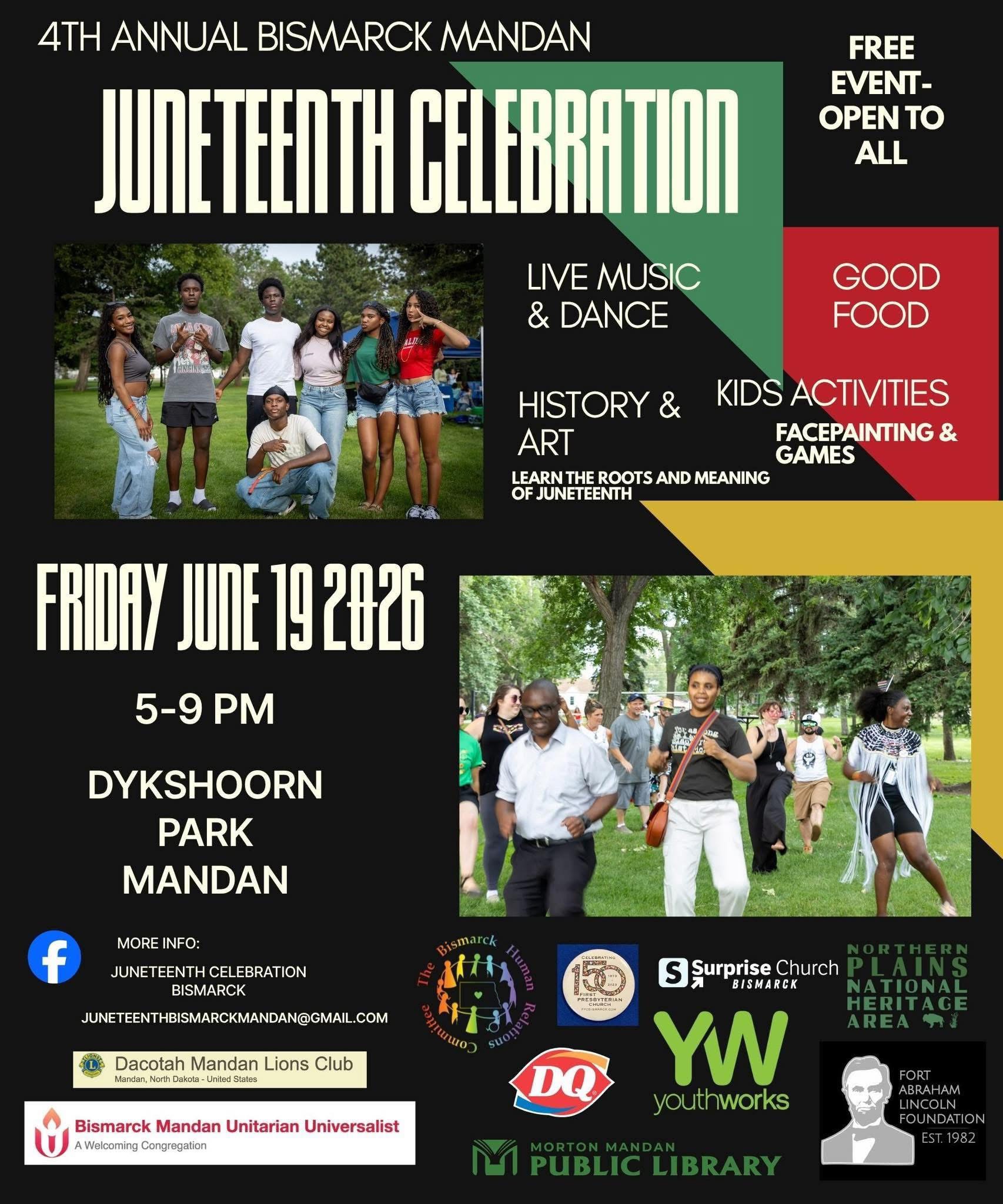
Historians of the Great Plains have crafted rather sophisticated arguments and narratives about how culture unfolded in different ways on the Great Plains and in the North American West north and south of the 49th parallel. It kind of has me wondering how a narrative that straddles this imaginary geopolitical boundary might work and unfold: Juneteenth in America, which has its origins in Galveston, Texas, circa 1865. And Emancipation Day throughout the British Empire, which included Canada starting in 1834.
As of now, at 5:18PM, I don’t have much more to write about this. Other than the usual latest peer reviewed biographies and histories one reads on topics, this in particular leaning me towards that of Charles Sumner, Thaddeus Stevens, and President Grant’s struggle with reconstruction and beating back and down the racially charged terrorist insurgencies throughout the post-Civil War South. Of this latter topic, Lt. Col. George Custer proved effective as a federal enforcer, leading the Union’s 7th Cavalry into the South to put down and suppress the KKK. I better get back to the present and go find a bit of food at this lovely Juneteenth celebration on the Northern Plains.


Leave a Reply