
This is a great write-up on Mandan-Hidatsa Theodora Bird Bear, linked here, and on the complexities of life in the Bakken of western ND. She currently keeps the books for a church, this after spending 19 years working for Indian Health Services. I have had the privilege of hearing her speak about the living history and genealogical attachment to the landscape (every word deliberately chosen and delivered to the audience with respect for herself and others). This was last year, January 2013, before the ND Industrial Commission.
Tag Archives: North Dakota
Visiting Dickinson State University

Left to right, Historian Frank Varney, Aaron Barth, and Political Scientist Steven Doherty on the campus of Dickinson State University, western North Dakota.
Yesterday Dickinson State University (via Frank Varney) invited me to speak about a component of research concerning how and why the US-Dakota Wars (1862-1864) were remembered at the turn of the 19th century throughout the Minnesota River Valley and on the northern Great Plains. It was great to get west of the upper Missouri River and spend some time with Varney and other fellow history and humanities nerds. I like this topic — thinking about how the US-Dakota Wars were remembered — because it mitigates what I call historical anxiety. I’ve thought about this phrase for a while, and loosely define it as that anxious feeling of not knowing how and why something happened in a particular place in time. A way to mitigate historical anxiety is to head into the archives and cobble together a narrative from the disparate bits and pieces. Through this I’ve been able to understand why the US-Dakota Wars were memorialized the way they were at the turn of the 19th century.
I’m using this, in turn, to push the way in which we think about the US-Dakota Wars today: largely as genocide, the word invented and deployed by Raphael Lemkin first in 1944. At the root, genocide comes from the Greek genos, which roughly means people or tribe; and the Latin cide, which means killing. Don’t take my word for it, though: visit Sully and Sibley in their own words. One humanistic universal I pitched out there to the group was that if the United States concerns (as it should) itself with genocide taking place today in Syria, and in other parts of the world, the U.S. should also concern itself with and consider the genocide that took place in our own past. Otherwise it just gets awkward, as the question will invariably come up time and again. So we can either chat and consider this, or just pretend like it doesn’t exist. If we pursue the latter, it just ends up leading to long bouts of awkward, uncomfortable silence. More on all this scholarship later, at least as it applies to the US-Dakota Wars, and the broader 19th-century Anglosphere.
Just a real quick warranted amplification of Varney’s work (he is in the midst of preparing a second volume that builds off his first monograph), General Grant and the Rewriting of History: How the Destruction of General William S. Rosecrans Influenced Our Understanding of the Civil War (Savas Beatie, 2013). Click on that link. If you enjoy history, or have thought deeply or superficially (there are only so many hours in a day) about memoirs, or Grant’s memoirs, definitely give it a go.
Wind Turbine Mosaic in Langdon, North Dakota

Some of the 20th century Cold War missile public art in Langdon, North Dakota. The Langdon Elementary School is immediately behind this missile.
Molly and I are now back in Fargo, having returned from a couple days in Langdon, northeastern North Dakota. To my right is a small pincer sized Cypriot coffee (I trucked back a couple bags of the stuff upon finishing my eastern Mediterranean archaeological trench supervisory work in June 2012, some details of that here and here and here), and on the stove is a long link of smoked garlic Langdon Locker sausage (sides include grated horseradish, stone ground mustard, ketchup). Oranges are also going to make an appearance for breakfast.
While in Langdon, though, Molly was on a special assignment with the Langdon public school system and the Northern Lights Arts Council. Her colleague and friend, Mindi Paulson, had an idea a couple months ago to co-lead an art project that would produce a mural for the entrance of the Langdon Elementary School. They decided to reflect the built landscape, or the wind turbine field immediately southeast of Langdon. The interesting thing about this 21st century wind turbine field is that it surrounds abandoned 20th century Cold War ICBM architecture, namely the Stanley R. Mickelson Safeguard Complex. In running errands here and there while in Langdon, and in viewing 20th century missile architecture in Langdon, I got to thinking about the perceptual shift in the Langdon landscape.
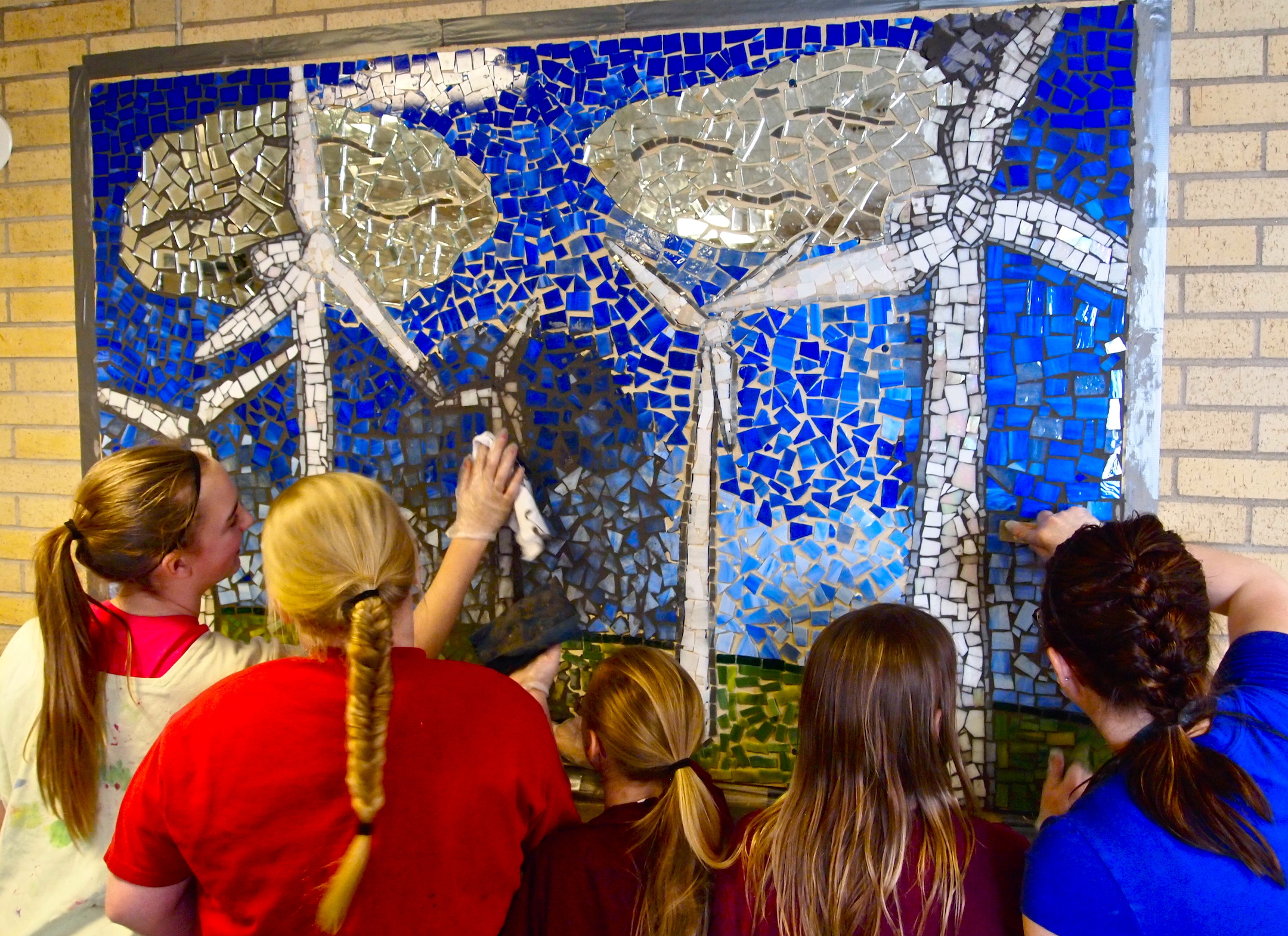
Teacher Mindi Paulson (far right) leads students in grouting the public wind turbine mosaic at the Langdon Elementary School.
Last century, at least up until the fall of the Berlin Wall and the dissolution of the USSR, the public art projects in Langdon understandably amounted to potential nuclear holocaust, a byproduct of many things: competing D.C. and Moscow ideologies, Eisenhower’s military industrial complex, Cold War anxiety, eventual acceptance, and so on. David Mills has a lengthy monograph on this subject.
And this century, instead of massive Federal military infrastructure projects that reflect potential nuclear Armageddon, we get architecture that reflects and generates green, renewable energy. And you can see how it bears on the public art projects. So today students learn about wind turbines and the hands-on of making wind turbine murals. Last century the public art was a different story. In the discipline of history, we call that a perceptual shift or an intellectual turn. Or something like that.

Teacher Mindi Paulson explains the process of grouting to the students as Molly McLain grouts.
Langdon Locker
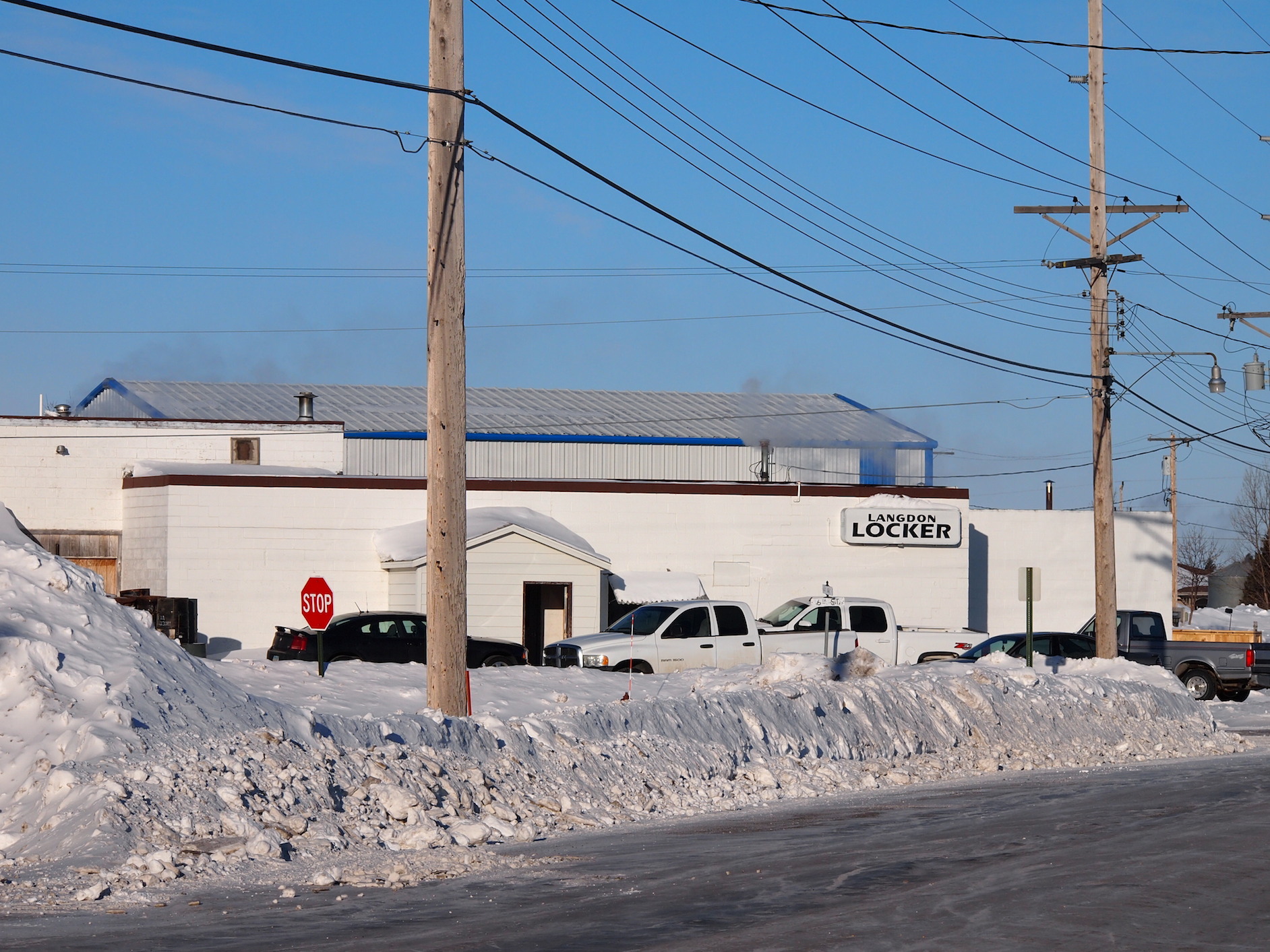
Langdon Locker, 324 6th St., Langdon, Cavalier County, North Dakota, on the morning of February 27, 2014.
This morning just after the sunrise, the car thermometer registered something like -18° F in Langdon, northeastern North Dakota. I’m on detail up here for a couple days, dissertating (a verb in grad school) and so on. But before getting started on that, I decided to track down the famous Langdon Locker, home of the famous Langdon Locker Sausage (caps is warranted).
This, says Tom Isern, is the greatest sausage in all of North Dakota. I once pressed Isern to explain why it was the best, and he (paraphrased) chalked it up to preparation and texture. I think the texture reminded him a bit of sausage production around and near his historic family farm in western Kansas. It is no surprise that certain smells and foods activate otherwise hibernating memory files within our brains.

Langdon Locker.
In any case, I tracked down the Langdon Locker. Then I tracked down an ATM. Then I returned to Langdon Locker and purchased one of their regular staples, the smoked garlic pork sausage. It is locally made, and goes for just over $4 for one-and-a-half pounds. There are rumors that this sausage is available through distributors in Fargo. But there is something fun about getting the stuff at the source too.
Harley McLain
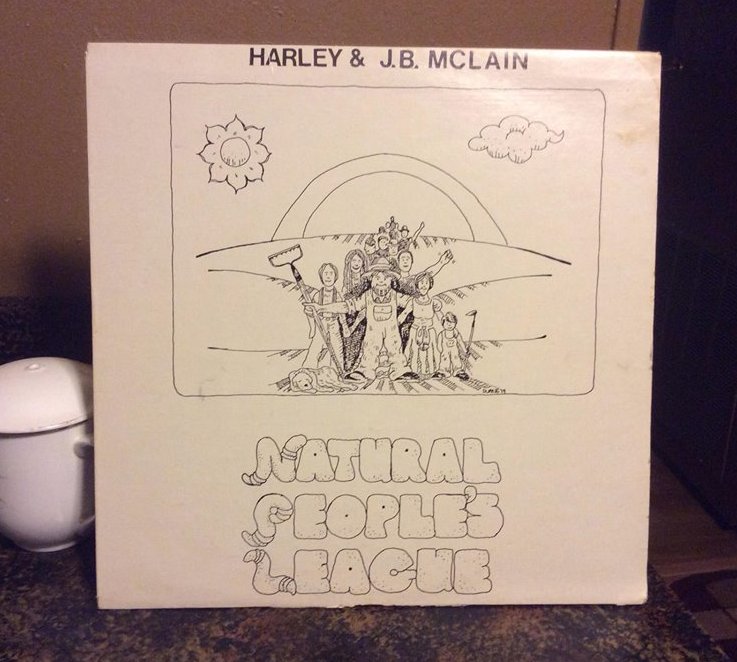
In 1979-1980, JB and Harley McLain (brothers) wrote, played and cut this album in Hollywood. It appropriated the “NPL” acronym, but replaced the Non-Partisan League with the Natural People’s League. Note the earthworms that make up the “NPL.” Photo by Darren King.
If you haven’t yet caught the passing of Harley McLain, here are some links on stories that The Bismarck Tribune, The Fargo Forum, and News Dakota have put together. Please take the time to read them. They are beautifully written. While I have only known Harley since 2012, it appears that the entire northern Great Plains has known him since at least the 1960s. This is testament to his beautiful soul.
I was thinking the other day about a photo of a younger Harley with his wife, Julie. In the photo Harley’s shirt read, “Question Authority.” He did that, of course. It made me think about how in Harley’s questioning of authority, he himself became his own author. In that, he believed in the state of North Dakota, and therefore the country and world (I’m convinced that he still does from the other side). He believed in it so much that he decided to speak up about a variety of issues, and with his particular charm and wit.
Tracy Potter, after hearing about Harley’s passing, remembered his good friend on Facebook. Tracy said,
Sad news today from Molly McLain. Her father, my friend, Harley McLain rejoined his beautiful wife Julie yesterday. Harley was a remarkable man, who had more influence on North Dakota with his guerrilla theatre approach to politics than many much more serious reformers. Out of his campaigns and legal action, North Dakota’s corrupt ballot structure (which Harley argued offended his “poetic sensibilities”) was ruled unconstitutional by Federal courts, giving us the modern, rotating ballot. Always fun, always interesting, and always the kindest, gentle heart. I’ll miss him.

Harley McLain, circa 2007. Photo by Logan Hanson.
Today and tomorrow and forever, we will continue recounting Harley stories and memories. They bring simultaneous tears and laughs. Harley impressed himself upon anyone who was within his range. Darren King, a slaying upright bassist and family friend of the McLain’s, said:
A couple of days ago North Dakota lost one of its great dreamers, political activists, songwriters, fathers, and forward thinkers. I look forward to jamming again someday Harley. Thanks for helping to raise me.
In conversations around the McLain family table last night, between JB McLain, Chris McLain, Molly McLain, Mira McLain, Matthew McLain, and Ben Simonson, we figured out that Harley, during his life, hung out with Allen Ginsberg, Hunter Thompson, potentially Keith Richards (happening into one another on some boat in the Mediterranean), and for a short time he lived down the street from one if not all of the Ramones. And these were just the individuals we pegged around the table last night. The list by no means is exhaustive.
The most important thing about Harley is that he would treat these individuals the same way he would treat anyone else: without pretension, with respect, and ready for insight and humor and give-and-take conversation. Harley loved people. He loved individuals. If you look at someone who knew Harley, you’re looking a bit at the man himself.
Bless you, Harley McLain. Thank you for the wonderful family you and Julie gave to North Dakota. And to use a bit of Scandinavian subtlety, I’m particularly fond of Molly.
From a sunny Valley City, North Dakota, Aaron L. Barth.
Bakken Oil Train Photo
A photo from a couple weeks ago of a BNSF train facing west with Bakken oil cars in tow. This was taken just east of Moorhead, Minnesota. If the train cars are going east, they are carrying oil. If they are going west, they are returning to pick more oil up.

New Americans from Sudan
 Last Sunday, as we on the northern Great Plains were enjoying our 357th blizzard of the winter, Molly and I drove down to southern Fargo to oblige an invite from the First Sudanese Lutheran Church of Fargo, North Dakota. We went to chat with this recently-arrived growing group of New Americans. They put out a huge spread of Sudanese food, too, prepared by no less than 3 Sudanese mothers the night prior.
After the benefit supper, on the drive home, I couldn’t help but think about the processes of global population movements in world history. This invariably led me to think about our grandparents and great grandparents and great-great grandparents who poured into the United States in the 19th century: think today about navigating immigration (the New American Sudanese are here because they are getting away from a lot of this, and a cease-fire update on that here too), finding transportation, learning about car and health insurance, learning a new language, and getting up to speed with the societal customs inherent to America’s increasingly industrial society, all while trying to keep a foot in the old ways too (this is why today we see things like the Sons of Norway, German-Russian, and Three Crowns organizations).
Some of the New Americans expressed an interest in future home ownership, and the gears in my brain started moving: “Who might be able to chat with these folks about the processes and options of home loans and real estate?…” These folks have jobs and they want to continue raising families. Homes are important for going about this. I was so wrapped up in conversation and getting filled up with Sudanese food (the delicious Sambusas were flowing like wine) that I didn’t get a chance to take a photo. But I do have this handy 2013 year-end reflection that I picked up.
Welk Homestead and German-Russian Interest

The spike in visits to my personal blog resulted from a post on the German-Russian Lawrence Welk homestead in Emmons County, North Dakota.
Just a couple days ago I looked at the blogging stats for a short piece I did on the Welk Homestead, this posted on January 21, 2014. I know that I’m interested in local history the world over, meaning that wherever I go, I want to know what happened before. But I also know that just because I’m interested in something doesn’t mean others are interested in it too. In the case of the Welk Homestead, though, and in the case of this blog (which, at this point in time, has a regular audience of 46), the number of views skyrocketed when I made some historical links between Welk and the German-Russians, and the State Historical Society of North Dakota acquiring the homestead.
Over at NDSU’s Center for Heritage Renewal and the Heritage Trails Facebook page, we’ve been chatting about the styles of various German-Russian vernacular architecture in North Dakota. On January 21, I posted my Welk/German-Russian blog to the Heritage Trails Facebook page, and this generated some feedback. It went like this, a comparative conversation between a German-Russian home north of Kulm, LaMoure County, southeastern North Dakota and that of the Hutmacher Complex just southwest of Killdeer, Dunn County, west-central North Dakota.
Janinne Paulson: “Great photo, Aaron!”
Suzzanne Kelley: “Interesting that this [Kulm] family added the L-porch, as did the Hutmachers [near Killdeer]. We’ve found that the porch corners created problems for maintaining the roof structure; here, they have TWO places for problems with erosion from convergent lines of run-off. Just wondering how that worked for them.”
Aaron Barth: “Was the L-porch used as a separate mud room, and perhaps as the initial entry to keep the cold out of the main home in the winter?”
Suzzanne Kelley: “Yes, which I suppose is what made the addition not only viable but necessary, despite the pitfalls of seaming an addition onto the original structure.”
Aaron Barth: “Not freezing to death is probably better than a leaky roof.”
Tom Isern: “OK, I just now studied this photo, and it’s evident this [Kulm] dwelling has an earthen roof, like the Hutmacher house, except this one uses some milled lumber for rafters. Also, it appears to me the earthen roof is composed of sods. This is different from what we tried with restoration of the Hutmacher roof. Recently we acquired evidence indicating that sods indeed were used in the Hutmacher case. So now we have to explore that further, and, I suspect, recalibrate. Also, I think Suzzanne is being kind, as usual. I think the L built onto the long house is a design mistake, vernacular though it may be, sure to cause water problems eventually.”
Aaron Barth: “We need an NSF grant to let someone live in the Hutmacher and a German-Russian east Missouri River home for a year and a half. I’m only 23% kidding…”
Richard Rothaus: “TV series.”
The temps in North Dakota, while we were (and still are) blogging and social-media-ing about this, have been sustained sub-zero, described by international meteorologists as some kind of Polar Vortexing. We don’t let the weather discourage us. But it does make us think about how 19th century inhabitants of the northern Great Plains survived, perceived of, described and thrived during the winters. Earthen homes are excellent for this, though, whether Dakota, Lakota, Nakota, Mandan-Hidatsa, or German-Russian. Want to learn how folks survived in pre-industrial times? Listen to the local history.
Winterscape Driving

Our view of winter driving before the sun set.
Typed out on Saturday, January 25, 2014:
Since Molly and I are driving in a borderline blizzard, at night, back from Bismarck to Fargo, and since she’s driving, I thought I’d type out some descriptions here while riding shotgun. We’re just passing Casselton, where the famous mushroom cloud rose up out of the northern Great Plains winterscape a little more than a month ago. It’s nearly pitch black here in the car, the only illumination coming from the buttons and dials on the dashboard and headlights from oncoming traffic in the northern, west-bound lane.
We’re keeping it at a steady 60mph, snow blowing thicker and thicker south-to-north across the road. More urgent travelers are passing us in the left lane. When they pass, they kick up the snow starting to drift in the left-lane, and it creates a kind of rooster tail that the wind immediately sweeps north. Beyond the interstate off in the prairie it is nearly pitch black. The illuminated billboards on the right side of the road emerge in the distance out of the blowing snow. As we approach they glow increasingly brighter. In this blowing snow at night, just as we pass the billboards, you can see how they create drift. As the wind hits the flat surface it swirls, and the blowing snow curls up over the top of the signage. All of this is brightened by the billboard flood lights.
On the radio is Garrison Keillor’s Prairie Home Companion. Of course, those of us who live on the prairie know Garrison gets his best material from our hour-to-hour reality. It’s good stuff. And we appreciate him for it.
We just passed I-94 Exit 343, and the lights of Fargo brighten, creating that orange pinkish hue through the blowing snow. This grows in intensity the closer we get. That you’re reading this blog entry means we safely made the Saturday night drive. Good weekend to you all.
German-Russian Migration to the Northern Great Plains
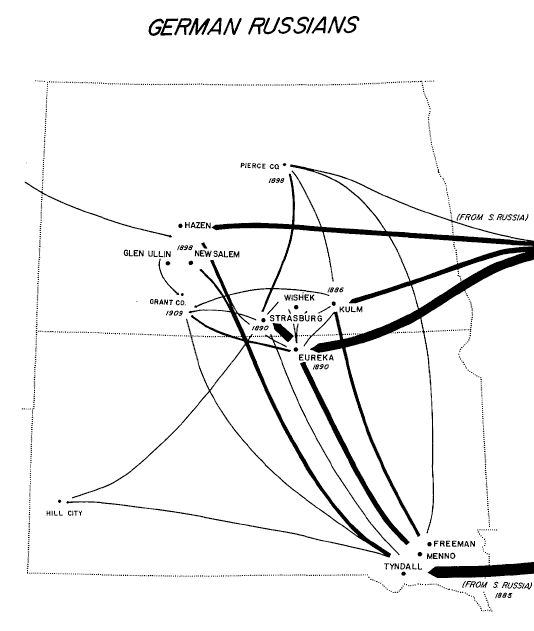
This last week while revisiting John C. Hudson’s 1976 article, “Migration to an American Frontier” in Annals of the Association of American Geographers, Vol. 66, No. 2, pp. 242-265, I came across this photo of German-Russian vernacular architecture. As the caption says, this is from 1894, taken right around Kulm, LaMoure County, North Dakota — the county just east of Emmons County, where the Welk German-Russian homestead is located (recent articles on that here, here, and here).
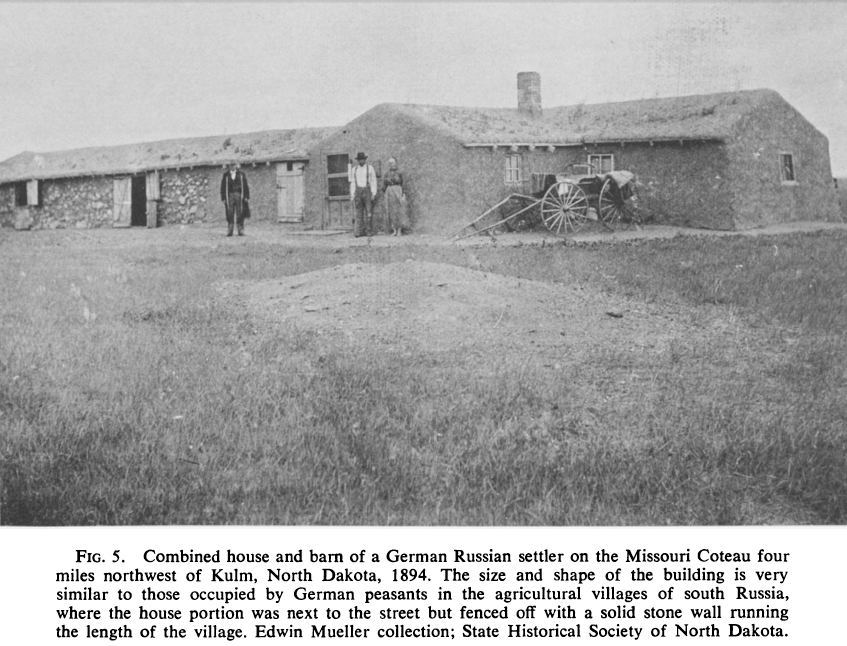
The Welk homestead, in turn, is just down the road from Braddock, Emmons County, North Dakota, where my great grandfather Barth homesteaded and farmed. Barth was an Ohio-German imbedded amongst the German-Russians, something not as difficult to pull off as it might sound. Anyhow, below is also a map of the German-Russian migration to the Dakotas, at least as it played out just before and after the turn of the 19th century.
Aaron Barth


