Tag Archives: North Dakota

Daughters of Norway, Fargo Chapter

Yesterday, late afternoon, I texted Sean Burt to see if he wanted to meet up for some long-overdue conversation at Würst Bier Hall in downtown Fargo, North Dakota. After he confirmed, I bundled up and started my southward trek down the east side of North Broadway. Along the way I noticed a woman taking a picture of the historic First Lutheran church. I asked if she was getting a good picture, and we chatted just a bit, and she said she was up from California for a meeting. I noted that she was a committed meeting-goer, coming from California to a Fargo winter for a meeting. Here is how the conversation roughly played out:

Aaron: “California is a long way to come for a meeting.”

Californian: “Yeah, but it’s worth it: a bunch of us just met here at First Lutheran about re-igniting the Daughters of Norway chapter here in Fargo.”

Aaron: “Ah, good deal. My great grandparents were Swede, and there’s a lot of continuity worth sharing throughout Scandinavia. Are you ethnic Norwegian?”

Californian: “No, I’m Polish.”

Aaron: “Oh, I see. Is your husband Norwegian?”

Californian: “No, he’s Algerian.”

Aaron: “Oh, I see. That makes sense. Well here’s my card. Let me know if and how I can help you in the future.”

So I was satisfied with having met an ethnic Pole from California who just finished a meeting in Fargo about firing up the Daughters of Norway once again. Heritage groups are fun that way. It’s only a matter of getting involved.


Memory Groups

It’s closing in on 7:28AM as I type, and I thought I’d do a quick recap of this last week. Just yesterday evening on my walk home from NDSU campus, I was thinking how much more exciting blog posts on exploding trains are in contrast to posts about napping. Yet when it comes down to it, and if I’d have a choice, I’d rather read up on nap studies than exploding trains, since the former — naps — are much more likely to affect and influence a larger cross-section of society than, say, oil trains that explode near Casselton, North Dakota. Both are important. But I tend to enjoy figuring out how to find and make the otherwise mundane and boring (naps, or even a German-Russian homestead) interesting than focusing on the also important mushroom clouds rising up out of the northern Great Plains winter prairiescape.

Anyhow, I just confirmed a couple lecture-talks this semester at universities within the region, and these talks will build off published research on, broadly speaking, how and why the US-Dakota Wars have been remembered for the last 150 years in the Dakotas and Minnesota. I’m perpetually fascinated by this topic of memory. I suppose one reason is that by looking at how and why groups remember an event is just as informative as the actual event itself. And maybe even more. By studying these groups, we’re able to unpack the cultural, social and political set of ethos that various memory groups brought to bear on the interpretation of historical events.

These groups, in turn, are responsible for advancing the general topics in history that we know today. There is, for another example, the world historical event of the Second World War. But there are also the memory groups — in this case led by Tom Brokaw (also from South Dakota), Tom Hanks, and the late Stephen Ambrose — who study, popularize, and consider America’s involvement in the Second World War. These memory groups have reasons for studying what they study, and I want know the philosophy and technics behind it — the why and the how.


Brief Thoughts On Sherman Alexie’s 2007 Novel

Earlier this morning I just finished Sherman Alexie’s novel, The Absolutely True Diary of a Part-Time Indian (Little, Brown & Company, 2007). It is excellent, and it pushed my mind in a variety of directions. This is what a novel is supposed to do, of course: an exploration of ideas through fictional narrative. The phrase “That’s a novel idea” smacks of this definition. Novels are real handy, too, since they operate under a kind of “fictional” rubric, giving the author lee-way to subjectively discuss real life issues and ideas. Because it’s fiction, though, it isn’t true — but it is. This is why the fiction section is arguably more truthful than the non-fiction section (which too is truthful, but with more distance).

So I thought about that while reading the work. I also thought about how this novel was originally passed along from Karis Thompson to Molly, my girlfriend, and then to me. The novel, on the local scene, is slowly crawling northward through downtown Fargo, North Dakota. It is leaving a trail of ideas in its wake. A bunch of us will have to get together to chat about what this novel means to all of us.

Alexie WhiteWhile reading this novel, I also-also thought about sustained broken treaties, the creation of the reservation system, about how the main character in this novel deals with historical trauma, and how the Dawes Act was and is seriously problematic. Then while reading this I thought about a segment of Richard White’s The Middle Ground: Indians, Empires, and Republics in the Great Lakes Region, 1650-1815 (Cambridge University Press, 1991). In the introduction, one of the parts I have underlined, with the words “This is good” scribbled in the margins, is this:

…the middle ground. The middle ground is the place in between: in between cultures, peoples, and in between empires and the nonstate world of villages. It is a place where many of the North American subjects and allies of empires lived… On the middle ground diverse peoples adjust their differences through what amounts to a process of creative, and often expedient, misunderstandings. People try to persuade others who are different from themselves by appealing to what they perceive to be the values and practices of those others… (White, 1991: xxvi)

This brings up the point that there is no such thing as purity in culture. The question or thought is a fallacy from the beginning. And this also means that since there is no such thing as cultural purity, then there is no such thing as cultural death, or a culture that is dead. Alexie demonstrates this through his novel, about a Spokane reservation kid perceiving of himself as living in two worlds: the Native reservation world, and the non-Native reservation world.

It also gives rise to the idea about how much emphasis we humans put on geopolitical boundaries. When we cross the boundary, say, between northeast Italy and southern Austria, we’ll note that people don’t suddenly stop speaking Italian after we cross south-to-north into Austria. What we do note is that while the line is distinct on a map, it isn’t so clear on the ground and in reality.

So those are my short thoughts on Alexie’s novel today. And I wanted to share that and get it down on this here blog. Back to technical writing and revising.


When CNN Airs Your YouTube Train Explosion Video

One week ago I drove from Fargo to Casselton, North Dakota, to take in first hand what happened with the train explosion. Details of that outing are linked to here. The next morning I checked my e-mail in-box, and CNN’s Justin Lear had a message waiting for me. He wondered if it was okay for CNN to use my YouTube video. My thought was, “Yeah. Sure.” So I e-mailed him back, we corresponded briefly, and eventually CNN put my video on their page. Click here to see what it looked like.

When you blog exploding or burning trains, this is what happens to your blog's site visitation.

When you blog exploding or burning trains, this is what happens to your blog’s site visitation.

The footage also got me thinking a bit about how Lear might have come across the video in the first place, this through the computational algorithms built by the internet folks (at Microsoft, Google, and so on). If you happen to be within photographic range of exploding trains, or the burning aftermath of exploding trains, and you upload this footage to YouTube, there’s a good chance Justin Lear will get a hold of you.

I think, perhaps, the most enjoyable footage had to do with the on-the-spot local narration from North Dakotans who caught footage of the actual explosion. If you click on this link and go to 0:24 seconds, you’ll hear through-and-through NoDaker commentary: “There it goes,” and this followed by “There it goes.” Phonetically, it sounds like this: “Der it goeas.” And while this makes us smile, this is the reflection of a North Dakota dialect (played up pretty heavily in the movie Fargo — thank you Coen brothers). The sound of it is completely disarming, and you can hear our Scandinavian and German-Russian great grand-parents within it.


Winter Oil Explosion in Casselton, North Dakota

At mile marker 340 on I-94 looking west.

At mile marker 340 on I-94 looking west. Oil plume just to the left of the signage on the horizon stretching south.

This afternoon while following up on a US-Dakota War historiographic line of research in the library at North Dakota State University, I received a few texts from a friend that read, “KFGO News says 7 oil tanker cars on fire, many have exploded near Casselton.” More went up after this text. This raised my eyebrow. It’s not often that oil tanker cars blow up in North Dakota, and my first thought was, “I sure hope this wasn’t in downtown Casselton.” I was thinking I would just stay in the library, but I also thought about how seeing something first hand is different from seeing it on the flatscreen. Historians are fanatics about primary sources. “Might as well make a contribution,” I thought.

A horizontal smoke from the oil explosion in Casselton, North Dakota.

A horizontal smoke from the oil explosion in Casselton, North Dakota. The setting sun just dipped behind it.

Molly and I drove out west of Fargo on I-94 to Casselton, about a 20 minute ride one way. Here are some of the raw observations: when we started in Fargo, the temperature was -3°F, and when we finished up in Casselton it read -5°F. Sun dogs were also out to the right and left of the sun. Wind was steady out of the north. As we left Fargo, the sun was setting and snow wisped north-south over the interstate. By mile marker 340, we discerned that the horizontal haze in the distance was indeed produced by the burning oil. Since the wind was blowing hard from the north, this horizontal streak stretched south over the horizon. In the flat Red River Valley of the north, this means that the streak stretched south and was visible for a very, very long way. The setting sun dropped behind this streak, some photos of which are included.

I took the exit off of I-94 into Casselton, and we drove north on Highway 18 that runs south-north through town. I eventually parked the car in a parking lot just to the northeast of where the east-west railroad tracks intersect the north-south Highway 18. This is raw video from that:

Here are some subjective thoughts from the outing: I’m uncertain if anyone was hurt, or worse. I hope not. We all hope not. I also thought about the variety of apartments, residences and businesses along these railroads. Molly and I live two blocks north of one of these rail lines. I have friends that live right along them. And what about our neighbors to the north who went through something much worse than this in October 2013 in Quebec. Then I thought of how this will certainly be politicized in

Photo looking west toward the oil fire in Casselton, North Dakota.

Photo looking west toward the oil fire in Casselton, North Dakota.

numerous ways. Then I thought about how the world — all of us — have been born into a culture that relies on petroleum. It’s kind of a cultural inertia, something America, the West and the world has been increasingly addicted to at least since the turn of the 19th century. It seems that until oil becomes expensive enough, there will not be a massive enough cultural effort to harness other energy sources. We see signs of it, of course, with wind turbines and the hydroelectric. But it’ll be a while before all of these other alternatives eclipse petroleum. That’s kind of the way with the petroleum industrial complex. There is plastic all around us, too.

Anyhow, stay safe in Casselton, all. Looks like they may have already started evacuating the entire village…


Northern Great Plains Shu Mai

OLYMPUS DIGITAL CAMERAAlthough this blog leans toward history updates, I like to give food entry updates every now and then. Yesterday I determined to make east Asian steamed dumplings. The main factor of dumpling preparation is making the dough. This requires about 1 part boiling water to 3 parts flour, as the boiling water brings out the elasticity in the dough. I used North Dakota State Mill organic flour. After adding the boiling water, I mixed it with a wood spoon until the dough was cool enough to mix by hand.

The recipe in front of me also called for ground pork, but instead of that I used local goat shank that I had in the freezer. The goat meat came from County Line Meats, this just south of Jamestown. Since the recipe called for 2 minced garlic cloves, I added 5. Also into my dumpling mix went minced chives, onion, carrot, ginger, and a dash of rice wine vinegar, cane sugar, ground pepper, mint and soy sauce.

All this filling gets centered in the middle of the thin dough sheets I rolled out. Then a systematic pinching of the dough around the perimeter forms up these dumplings, almost into the shape of little pies. I dropped these into the bamboo steamer, but after laying down a layer of cabbage. I didn’t have Napa cabbage handy, so I used standard issue Euro-American cabbage. The dumplings were great, and since the goat, flour and cabbage were local, I decided they were Northern Great Plains-Chinese fusion dumplings.

The next dumplings I make are going to be an appropriated recipe we recently had in New Zealand. They were wontons filled with minced lamb, onion and mint. They came with a mint dipping sauce too. They were spectacular. It’ll be easy enough to re-create goat-mint shu mai. Everyone should do this. It’s not difficult.


Autumn to Winter in Fargo

This is a quick post, something that has been on my mind during my walks to and from campus at North Dakota State University. I have been walking past a historic apartment building about the corner of College Street and 11th Avenue North for years now. The sturdy brick construction caught my eye a couple years ago. I also appreciate its aesthetics. As autumn began to give way to winter this year, I thought I’d snap a couple photos at seasonal intervals to post later — which is now — on this here blog. The first was taken at some point in August-September, 2013. The second was taken after the first big snowfall. Here are the two photos of my own, followed by the GoogleEarth photo.

Autumn

Winter

GoogleEarth


Minneapolis Winter Walk

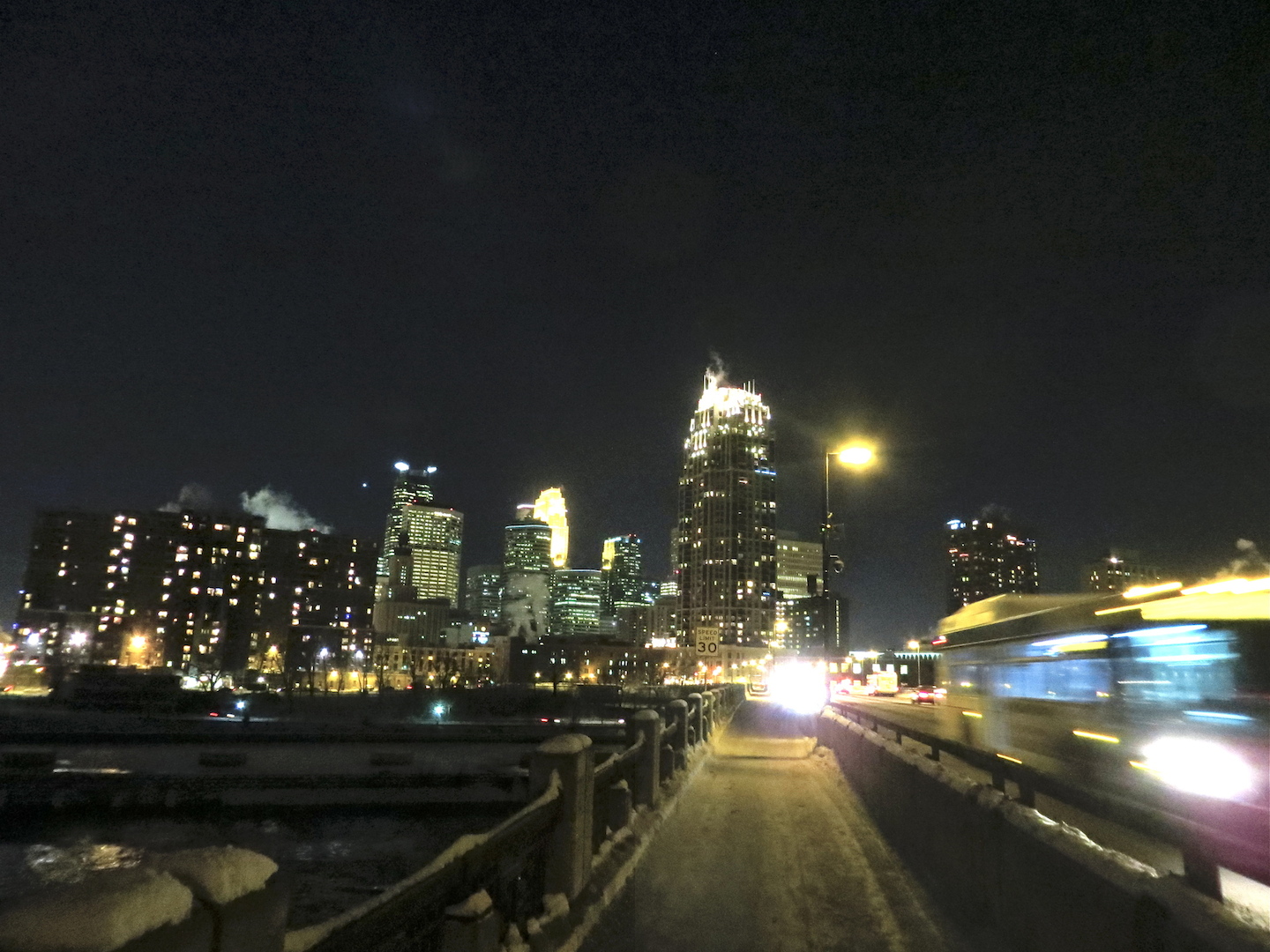
Downtown Minneapolis, looking southwest from the Central Avenue NE bridge. The reflection from the Mississippi River is visible in the lower-left corner of this photo.

Downtown Minneapolis, looking southwest from the Central Avenue NE bridge. The reflection from the Mississippi River is visible in the lower-left corner of this photo.

Yesterday (12/09/2013), between the late-afternoon and the early evening, I caught up a bit with friend and colleague (Brett Ewald) in Dinkytown, Minneapolis-St. Paul, and after I had to get to downtown Minneapolis proper. I thought about riding some kind of public transportation, but since I normally wear outdoor winter gear, it seemed just as good to walk. The temps were hovering around 0°F.

My typical winter gear run-down is as follows: a wool sweater, this over an undershirt and collared shirt. Exterior layers include a down-filled wool coat, a thermal neck warmer, a merino wool scarf, leather choppers, a thick Carhartt winter cap, merino wool socks, and a pair of classic Sorel winter boots. I think I’ve had these Sorel winter boots for about two decades now, purchasing them long ago at a hardware-tractor supply store in Bismarck, North Dakota.

Back to Minneapolis for the walk, though. It was rush hour, and I worked out that it would take just a little more time walking than by any other means. I’m glad I walked. I went northwest from Dinkytown on 4th Street SE, took a left at 11th Avenue SE, and followed this up to Central Avenue NE where I turned left. Traffic intensified at this intersection, as I was again on a main artery.

From there I crossed the bridge, one of the many that spans the Mississippi. I noticed while walking across this bridge that the temperature warmed up a bit. This warmth came from the Mississippi River — the frigid water not as frigid as the exhilarating air. It was also humbling to hear the mighty roar of that water, and this induced a sensation that was similar to what I felt while looking at the verticality of the glacial fjords of New Zealand. The water reflected the neon Gold Medal Flour sign, among others. Whenever I see agricultural industry in Minneapolis-St. Paul, it reminds me about North Dakota history, and why NoDakers banded together to form a state bank and state mill. I also think about how Minneapolis-St. Paul, one of nature’s metropolises, is a distillation of the agrarian world. The city would not have been possible without all the agricultural and natural resources from the Dakotas.

The Mississippi River reflects the neon Gold Medal Flour signage (among other signs). Photo taken from the Central Avenue NE bridge, view to the south.

The Mississippi River reflects the neon Gold Medal Flour signage (among other signs). Photo taken from the Central Avenue NE bridge, view to the south.

Anyhow, after crossing the Central Avenue bridge I was in downtown Minneapolis proper. I turned right on to 1st Street, and I occasionally gazed up toward all the windows in the various high-rises and skyscrapers, noting several Christmas trees framed by their large picture windows. I imagined that a good majority of these folks had jobs as high-powered lawyers, executive officers, banking executives, and Wall Street types. Perhaps they were affiliated with the Timberwolves, Vikings, Wild, or Twins, too? Perhaps. This is why it’s not uncommon to hear the phrase, “big time Minneapolis and good old St. Paul.” A couple bundled up Minneapolisians emerged with their dogs here and there from the ground floor of these skyscrapers for a brief walk around the block to let the dog take care of evening business.

From 1st Street I turned left onto Marquette Avenue, and headed southwest to my destination near the corner of Marquette Avenue and 9th Street South. I think the walk totaled approximately 2 miles, or about 24-25 city blocks. I think the only other piece of cold weather gear I’ll invest in are a pair of light thermal underwear.


Dissertation Update

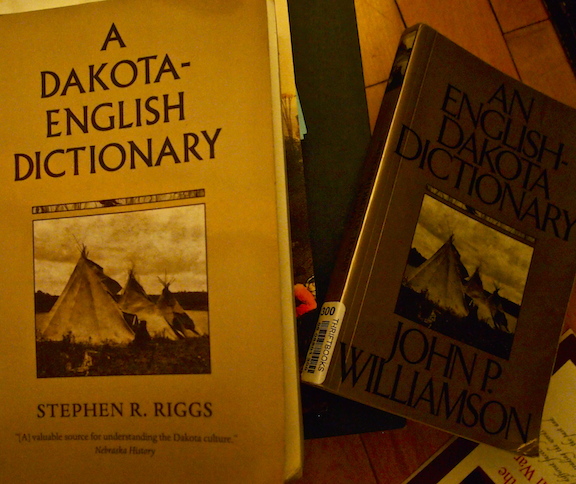
Dakota LanguageToday is Friday the 6th of December, it is approximately -11°F, I am looking out beyond the laptop screen through a south-facing window to the light blue snowscape, the time when the approach of the sun-rise appears eminent. I plan on finishing my opening dissertation chapter (which might turn into an introduction) that deals with the public remembrance of the US-Dakota Wars. One of the main thrusts in this disquisition is to look at not only how various generations have remembered and memorialized the US-Dakota Wars, but to piece together why.

I chatted with an engineer about this a couple days ago, albeit briefly, and I found in myself another reason that I hadn’t articulated so well: whenever we, the royal we, are frustrated with the way things are, sometimes it helps to track the history so as to see how we got where we are today. This doesn’t necessarily mean we will agree with it, but one doesn’t have to agree with something in order to understand it. To my right on the floor is a stack of published monographs on world and public history — historiography (or the history of history) having spoken to and shaped what we know today.

I also picked up and have so far read the introduction of Denise Meringolo, Museums, Monuments, and National Parks: Toward a New Genealogy of Public History (U of Massachusetts Press, 2012) from the dutiful Inter Library Loan-ists at NDSU. A couple months ago Bill Caraher and I were chatting at Laughing Sun in Bismarck, and he suggested I check it out. It is good. More on that later, either in blog or dissertation form. To my left is Stephen R. Riggs, A Dakota-English Diectionary and John P. Williamson, An English-Dakota Dictionary. I continuously re-re-rediscover that language, or the study of it, provides insights into the past, as do oral traditions and oral histories. But okay, enough of all this blogging for now. I’m just going to get after finishing this draft. Happy Friday to you.


Dakota for Blizzard: Icamnatanka

Since it is snowing now and we’re bracing for a blizzard on the northern Steppes of North America, it seems appropriate to look at and unpack the Dakota word for these storm systems. Dakota, after all, was one of the original languages of the Dakotas and Minnesota.

Blizzard in Dakota is icamnatanka, prounced roughly as ih-cha-mnah-tan-ka. In the case of icamnatanka, the word is a combination of two slightly smaller Dakota words. The first is icamna, which means “to blow, bluster, storm, drive, as wind and snow.” Mna in the word icamna is related to yumna. The yu in yumna expresses causation in some way. Thus the entire word yumna denotes a causation that means to rip a seam with scissors, or to rip a seam in anyway by pulling.

The second word in icamnatanka might be a bit more familiar. The word tanka means large or great. It is easy by now to see how icamnatanka comes to denote blizzard. It is a large or great blowing, blustering storm driven by wind. And mna is a word also connected to ripping at the seams. If we use our historical imaginations, we can envision a Dakota, Lakota or Nakota on the northern Great Plains in what we know today as early December. When an icamnatanka would strike, this blizzard would indeed bluster and blow snow through or rip at any kind of seam, whether in a tipi, earth lodge or through the seam of a hide-garment.

I posted a short version of this to social media the other day and a good friend, Dakota Goodhouse, texted me and said, “The Lakota use ichamna for snow storm or blizzard too, but use Iwoblu for severe blizzard.” The variations in language are mind-blowing. In the paraphrased words of John K. Cox at North Dakota State University, to learn a second language means that one learns to grow the other half of their brain. This is true.

Anyhow, as I continue the joyous struggle to learn second languages, it has always seemed to make more sense to me when individual words are unpacked. And by “joyous struggle” I mean just that: learning languages, at least for myself, is difficult. But I’m up for the task. To understand another word and language is to begin to understand another culture. Language is so very connected to culture, and is the way a culture describes itself, immediate surroundings, and the world. When one opens a language they open up a new way of seeing yesteryear, today, and even tomorrow.

The unpacking of icamnatanka came by way of help from one of Clifford Canku‘s Dakota Language I worksheets, and A Dakota-English Dictionary by Stephen R. Riggs (Minnesota Historical Society Press, 1992). Riggs started developing the dictionary in the 1830s with Samuel W. and Gideon H. Pond, and Thomas S. Williamson. They worked directly with Michael Renville, David Grey Cloud, James Garvie, and Walking Elk, a Yankton tribal leader.

This blog entry has been cross-posted at North Dakota State University’s Center for Heritage Renewal here and here.