Tag Archives: Music

Glenn Ohrlin Landscape Memory

I’ve gone down the spelunking rabbit hole of western Americana, drover (aka, cowboy) folk music and culture, and have in front of me Glenn Ohrlin The Hell-Bound Train: A Cowboy Songbook (University of Illinois Press, 1973). The foreword is by Archie Green, and he gives a couple touch points of Glenn’s seasons of life. Born in Minneapolis on October 26, 1926, Glenn’s dad was a Swedish immigrant who worked farm labor in the rural, and transitioned to house painting in the growing metropole of Minneapolis-Saint Paul. Glenn’s mother was second generation Norwegian Minnesotan. So Glenn’s birthday comes two years after Clell Gannon’s Songs of the Bunch Grass Acres is published in 1924, and he (Glenn) represents the transition of 2nd to 3rd wave cowpoke western Americana.

Without going too far into the rest, here are some surviving material culture (aka, “STUFF”) nodes of this all.

First. Within this 1973 U of Illinois Press monograph is a super thin record (33 1/3 RPMs) with just a couple of Glenn Ohrlin’s songs on it. We have a record player. So may try to play this. But this is the second record I’ve seen now in these U of Illinois Press publications on western Americana drover life from the 1970s. Good stuff.

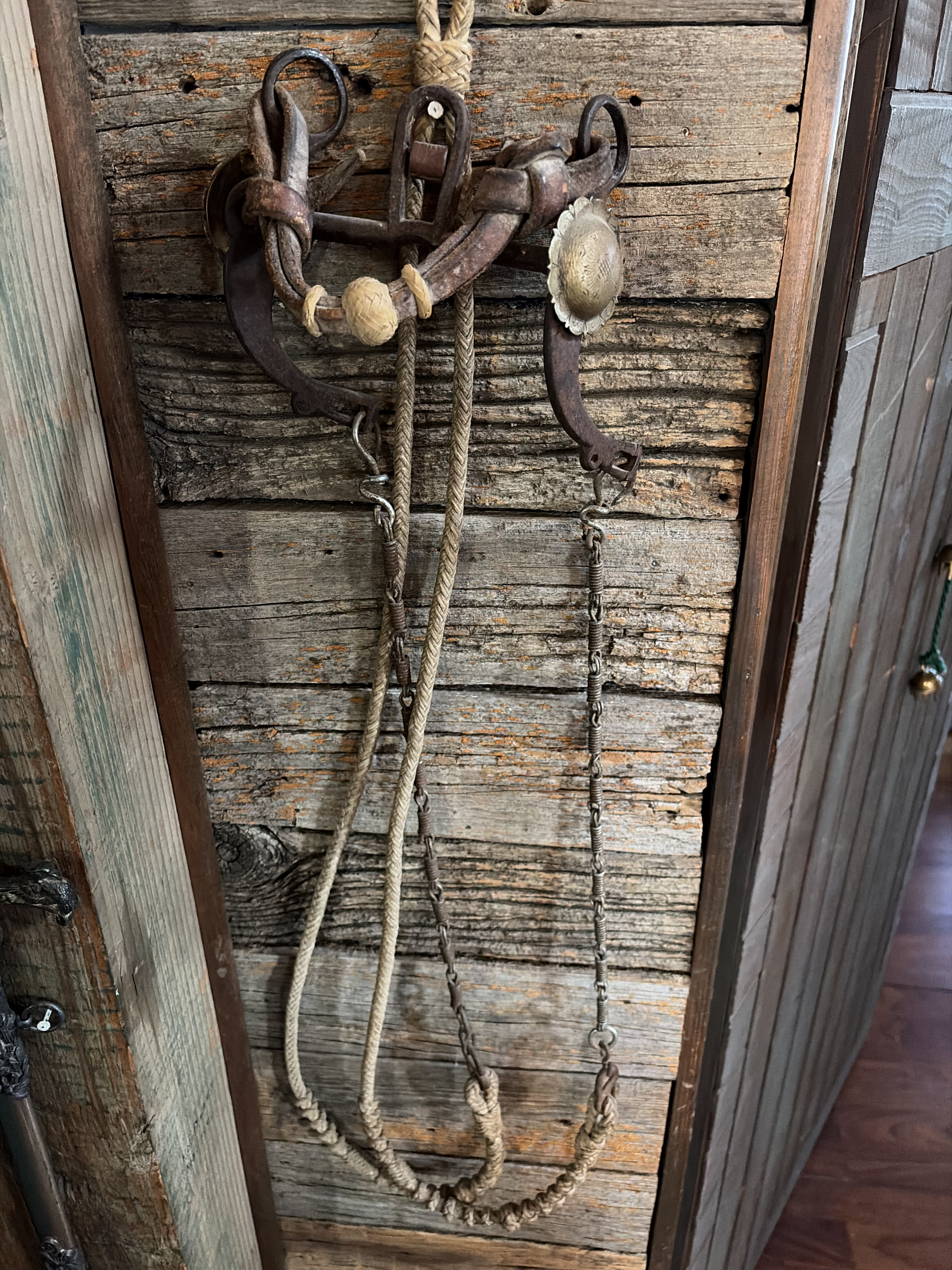
Second. Shadd Piehl, a couple weeks ago, mentioned that he knew Glenn Ohrlin, and Glenn on occasion would visit his family place (Walter and Becky Piehl’s) around Minot and Velva, North Dakota. Because Glenn’s sister had some kind of connection with the Minot and Velva area. So that transitioned into Shadd telling me he, at his house, has some of Glenn’s horse tack hanging on a wall. My eyebrows raised at that and I asked Shadd if he would mind sending me a picture of the horse tack. Relics and history is only alive if we talk about it in the present, no? So below is a photo of said horse tack of Glenn Ohrlin’s. Perhaps we’ll look to curate it indefinitely in a Northern Plains west-Missouri River cowboy bar.
Molly and Me: Singing on Sunday

Molly and I have been straightening up the flat this weekend, taking short breaks here and there as well. It is really fantastic to be engaged to a professional artist and art teacher for numerous reasons. Molly has a range of medium she works in, including custom mosaics, piano playing and teaching piano, guitar and ukulele playing, mastering the Swedish folk art of Dalmål, and on and on. Of all these mediums, included in a short YouTube video below is Molly’s rendition of Feist’s 1-2-3-4 (the Sesame Street version is linked to here as well). One of the many spectacular reasons that live performance is, well, spectacular has to do with the direct interaction that stage performers have with their environment and the audience. It’s an exchange. Of course, I have recorded and uploaded Molly’s impromptu performance on the YouTubes (thereby digitizing and preserving it in some kind of digital cloud space and time). But it is a slice of the reality that took place. Part of this reality is the unforeseen, as when a BNSF train horn rolling through downtown Fargo let loose about 0:43 and 0:57 in the video. Then a breeze decided to shut the door at about 1:01 in the video. But again, this is live, DIY, living room flat performance. And the band, and life, plays on.


Local Music Memoirs

This morning I dropped into The Bismarck Tribune‘s website and noticed a front web-page article on Jim McMahon. Anyone who is remotely connected with the Bismarck-Mandan or University of Mary music scene knows Jim, and they also know about his optimistic and upbeat commitment to professional and informal music. This article got me thinking a bit about how I started formal music percussion training in the 5th grade under the direction of Randy Salzer at Grimsrud Elementary in Bismarck. I knew I was interested in percussion (or what I called “drumming”) for a variety of reasons beyond the mimicry of AnimalTommy Lee, or Keith Moon (among others). So in my earlier years I asked my mom and dad about drumming, and they responded immediately. My mom came from a musical family, so it was not only an easy sell, it was encouraged. Her dad, my Grandpa Christy, was an administrator in a musicians union in post-WWII Rapid City, South Dakota. My mom has childhood stories about any variety of musicians being put up at her home in Rapid City (music being played in the house till the wee hours as well). This is kind of the way with musicians, whether professionally trained or auto-didactics (or both, which often is the case).

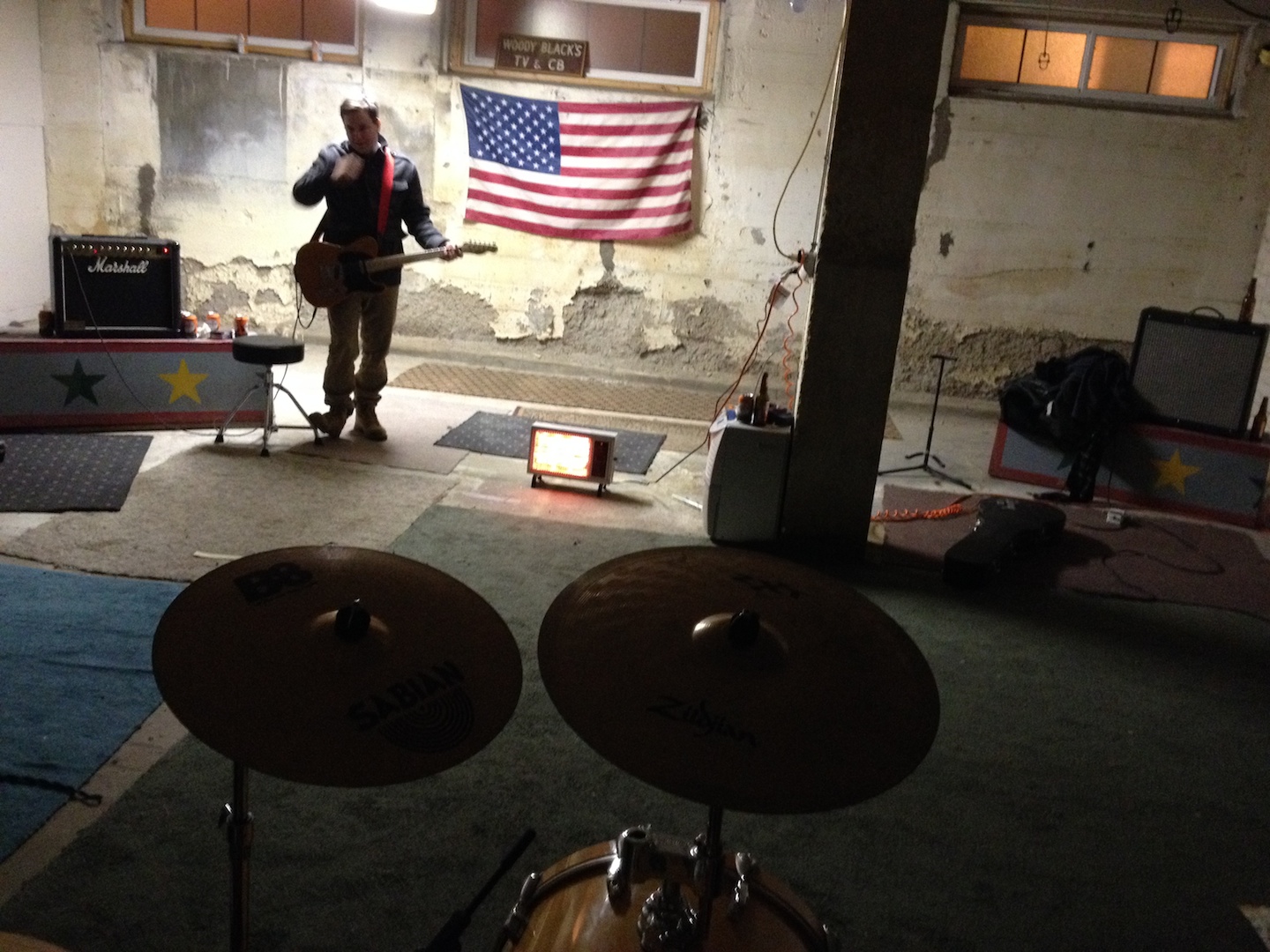
From behind the drums in the Les Dirty Frenchmen practice room. Photo from December 2013.

From behind the drums in the Les Dirty Frenchmen practice room. Photo from December 2013.

Nonetheless, the story on Jim McMahon reminded me of the 5th grade, and lugging what at the time was a gigantic snare drum to school before the start of classes. I think we had something like 20 minutes or so of time with our professionally trained teacher, and he taught us the basics of quarter, eighth, sixteenth and thirty-second notes, paradiddles, flams, and rim shots. As my 5th-12th grade matriculation continued, I found the percussion avenues of other instruments, including the timpani. Today, just down the road in Fargo, I like to know that if Todd or Troy (Reisenauer) asked me to drop a timpani solo into a Les Dirty Frenchmen song, I’d be able to do that, no problem.

And here’s another thing that Randy Salzer and Jim McMahon (and Robert Pesky, Brad Stockert, Scott Prebys, and professionally trained musical educators in general) plant within their students, whether they know it or not: training one to act on stage in front of small and large groups. Think about it: it is a rarity to play any song to perfection (which is one of the original socio-cultural gripes that punk had toward the music industry). But anyone can receive training to know that when you sense a screw-up, just push on. Instead of obsessing over the mess-up, embrace and own it. This is what in the arts and humanities we call a “transferable skill.” We can use it in other disciplines, and even as a life ethos. There is a psychology to it, and the more one performs, the better they get at their work, and the better they get at interpreting this to larger audiences on stage, both formally and informally. That’s what Shakespeare said, anyhow, about how life is a stage. It’s much more than sound and fury signified by nothing, though. It is, in fact, about how our actions today — the musical training of students — have unforeseen effects. Or unforeseen repercussions (hey, it’s a blog post about percussion). In every conversation I can think of, Jim has been perpetually open to different ideas that encourage and cultivate the local music culture of Bismarck-Mandan. So I just wanted to end this by saying nice work, Jim. Nice work indeed.