Tag Archives: South Dakota

Clellification for Halloween, 2024

I’m currently working on a project with Bill Caraher who is the pilot of The Digital Press at University of North Dakota. For a year, or beyond a year now, Caraher and I have been thinking about Clell Gannon, and Gannon’s 1924 publication, Songs of the Bunch Grass Acres (SoBGA). I’m working on revisions from a first draft submitted to The Digital Press, and after letting editorial comments sit with me for a while, I have decided to recalibrate a bit of the original narrative. Like it is the case with many texts, the more you read, revisit, and think about SoBGA, the more the text starts speaking to the reader in different ways. The recalibration of the first draft will look something like this:

  1. Clell Gannon intellectually situates (indirectly and directly) his 1924 SoBGA into the current of Romanticism. And not the romanticism that you’re thinking about. Like he’s not poeming (poem is now a verb) the reader to go pick flowers and let your feelings rather than your brain dictate your moment to moment actions. Rather, in the original intellectual vein of Romanticism (which was a counter balance to the, ahem, Enlightenment), he’s saying (I’m paraphrasing here), Hey, this northern plains and Great Plains and Western Americana place we all live in: this place is completely worth living in. And not only is it worth living it, it deserves our contemplation, and this place is deserving of a sustained relationship with us.
  2. Who else did Clell Gannon roll with at this time? He was a mover and shaker. Also one who was a joy to be around. Thoughtful. And nothing that is in his writings, or others who have written about him, suggests he was a chest thumper. He was friends with Russell Reid and George Will (son of Oscar Will and his vegetable seed empire). The same Russell Reid who acted as secretary of the State Historical Society of North Dakota for decades: when it evolved from the basement of one of the buildings on the State Capitol Grounds eventually to the building that today houses the State Library. Clell would likely lose his mind (in a good way) if he saw the geothermal-heated footprint of today’s State Historical Society of North Dakota, and in-motion expansion of the Military Wing.
    • Clell was unable to physically make the requirements to be mustered into World War I. I do wonder what contributions he might suggest for interpretive exhibits in the 21st military wing following the Great War of the 20th century? Might they have read something along the lines of what Willa Cather spoke of in 1922? “…the world broke in two in 1922 or thereabouts…” In 1922, Cather had seen veterans return from the Great War, and as returned veterans, they were told (not even really told) to navigate the ascent of the industrial capitalistic roaring 20s.
  3. In conversations with Shadd Piehl (ahem, recognized poet of the American West, cowboy poet, teacher, listener, encourager of the written and spoken word, and former bronc rider, etc), Piehl noted that Clell reminded him of the poem American Names that Stephen Vincent Benét set down in 1927, or 3 years after publication of SoBGA. So the revisions of this draft will take into greater account a couple other datum points, including Willa Cather and Stephen Vincent Benét.
  4. Clell Gannon’s introduction (very short) of SoBGA is good.
    • In the first paragraph he sets out his flag of love of regional place. Not nationalistic love. But of the regions within this nation: northern plains. Great Plains. American West.
    • The second paragraph is on about poetic structure, meter to be exact, and with a sampling of how a west of the Mississippi River person pronounces “coyote”: say ki’ot, Clell instructs, as two syllables. Don’t get all sophisticated and say “ki’ot’eee.” Don’t do that. Nobody would ever do that. Use two syllables to say coyote, and the meter of the poems will flow.
    • The third paragraph calls out Florence Harriet Davis, librarian in 1924 of what would have been the beautiful Carnegie Library in Bismarck (it was completely razed in the 1970s or 1960s for progress. Poetically, a parking ramp is located there today.). Who is Florence? In a word search in the Library of Congress searchable newspaper database, she surfaces here and there in Bismarck Tribune articles.
    • Clell’s final poem in SoBGA is to Hazel Dell Gannon, who at 17 years old passed away in what Clell describes as Grand Valley, South Dakota. Maybe she was preparing to attend teachers college? Or something? I Google’d Grand Valley, and the closest thing that surfaces is place names in Lincoln County, southeastern South Dakota.
    • Clell signs off on his short introduction with “Bismarck-by-the-river, North Dakota.” Today, in 2024, this is another great reminder to readers to recenter their view of North Dakota’s capital city as one that is a river city as well. Clell understood the importance of the Missouri River to the early history of the region and, eventually, to the state.

Okay, that’s all the Clell-ification I have for the moment. Gotta get after the other items for this Thörsdag, October 31, 2024, Halloween Day (the pumpkins were carved last night).


Washington, DC and Dakota Territory: Then and Now

US Dakota WarsA Washington, D.C.-Minnesota and Dakota Territory historical note: the US Capitol cast iron dome approached final construction at the same time that the US-Dakota Wars unfolded in Minnesota and Dakota Territory from 1862-1864. On December 2, 1865, the “Statue of Freedom” was placed on top of the US Capitol dome. To bring this into the present, The Smithsonian’s National Museum of the American Indian (SNMAI) has a Dakota-US War of 1862 exhibit up through December 29, 2015. This is a bulletin that speaks to that outside of the SNMAI’s entrance. The US Capitol’s cast iron dome in the distance is undergoing a much needed preservation/rehabilitation update. Here in the Dakotas, we are undergoing a much needed reappraisal of the US-Dakota Wars.


Punk Archaeology and Dissertation Progress

In the last week, the Punk Archaeology movement — specifically Bill Caraher — pushed a digital button and sent the first Punk Archaeology reader into the digital and hard copy world. It is the first of its kind, and the first publication from The Digital Press at the University of North Dakota-Grand Forks. You can download the Punk Archaeology reader here, for free. Or you can purchase it in hard copy by clicking on this Amazon link here. Sometimes it’s just nice to have both. Yesterday I read that if you want a hard copy, but you don’t want to pay for it, Caraher will fax it to you. But I’m not sure if he was being 34% or 94% serious with that statement. Nonetheless, the reader is published. And it is dedicated to our late friend, Joel Jonientz.

Now, with that business cleared off the table, I wanted to get some thoughts down on a dissertation chapter I’ve been outlining. I am in the process of dissertating (now a verb), and I find that reading, thinking, analyzing and writing thoughts down is the best way to capture said thoughts. Broadly speaking, my dissertation concerns how and why the US-Dakota wars have been remembered on the northern Great Plains for the last 150+ years. The Public Historian published an article of mine on this in the August 2013 issue, (Caraher reviewed it here) and it covered the narrative tension surrounding how and why Whitestone Hill has been remembered: between 1901 and 1914, there was a kind of push and pull between ND US Congressman Thomas Marshall and the more reflective Episcopalian Reverend Aaron M. Beede, PhD.

I’m creating a chapter that looks at the historical landscape of South Dakota, and how early members of South Dakota’s State Historical Society sought to shape and influence how the US-Dakota Wars would be remembered in SD. This takes me to Doane Robinson, and his early 20th-century A History of the Dakota, or Sioux Indians. I am particularly interested in Doane’s background, and the culture he was swimming in: we are all swimmers in a particular culture at a particular time, and this no doubt influences the way we act and decide to act, whether we swim with or against the current.

I know Doane hailed from Sparta, Wisconsin (not far from Portage, where Frederick Jackson Turner hailed from), and he took a shot at farming in Minnesota after the Civil War. This would have put him well within range of the psychological terror-stories of the “Sioux Uprising” that seem to persist in the Minnesota River Valley to this day (full disclosure: my Swedish great-great grandparents were in Willmar, Minnesota around this antebellum, Civil War and post-Civil War time; and I’m supposed to be related to some famous Mattson Civil War hero from Minnesota, too).

Because Doane was in this area, I’m thinking this is one of the reasons Doane came to shape the narrative in the way he did: according to Doane and his friends, the Dakota didn’t have “civilization” until he and other non-Natives arrived (this is how Doane and others understood their world, and it is the historian’s job to understand how historical actors understood their world). I think Jonathan Lear has carved out some of the best intellectual territory in considering the implications of “civilization” and ethics and philosophy, and what happens when one culture collides with another, and how individual players navigated that.

Okay, though. I am going to sit down with Doane’s work this week for analysis and further writing. The key to finishing a dissertation, book, or monograph is to write. Nothing is ever going to be great or formed up in the first or even 5th draft. Keeping at it is the only way it will come to something. With that said, I have to go meet some historians for breakfast now, and that means this post has come to an end.


Dakota Language Update

This morning I have returned to selecting one Dakota word to learn, ideally every morning, the idea being to create for myself a type of vocabulary for unpacking more of the US-Dakota Wars. Language is the way in which we perceive and see our world. So by understanding another language, such as Dakota, one can start arriving at new perceptions in the infinite quest of knowledge (we have these brains, so we might as well put them to use).

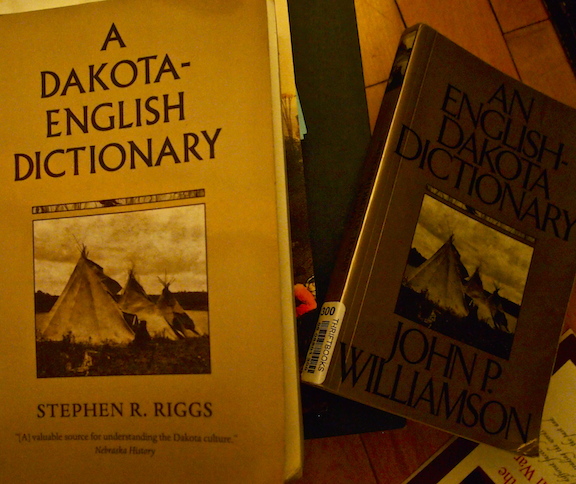
I am using two dictionaries to accomplish this, and uploading the Dakota word and English definitions to Cobo cards. The dictionaries are Stephen R. Riggs, A Dakota-English Dictionary (first published in 1890; Minnesota Historical Society Press, 1992), and John P. Williamson, An English-Dakota Dictionary (first published in 1902; Minnesota Historical Society Press, 1992).

Like any deliberate language study, I use the English-Dakota dictionary to first locate the word. So if I look up “anxiety,” it takes me to Caŋ-te´-ši-ča. I use the Dakota-English dictionary to unpack the larger Dakota word of Caŋ-te´-ši-ča: large words are, after all, combinations of shorter words. By unpacking the large words, and defining them in the smaller portions, one can start learning the basics and foundations of the language. This, my friends, is a transferrable skill.

Yesterday morning I decided on the word “Anxiety,” and today I picked the word “Hero.” Here is what definitions the dictionaries turned up:

Caŋ-te´-ši-ča = to be sad, sorrowful, or anxious. I need to unpack this word a bit more. I will log some more time on that this evening, or tomorrow morning.

Itaŋ-caŋ-ka = Hero. The breakdown of Itaŋcaŋka, according to Riggs’ dictionary, is along the defined lines of someone who is “fire-steel,” and who is on a, or your, side. Okay. That makes sense. Fire-steel by your side. Here is the breakdown below.

Itaŋ, adv. of taŋ; on the side. From this we get the word mitaŋtaŋhaŋ, which means at my side.

Caŋka, n., a fire-steel.


The Welk Homestead

Miller Welk Painting 1930A couple weeks ago Molly and I, along with my parents, took a Sunday trip to the homestead of Lawrence Welk. To be more specific, this was the homestead of Welk’s parents in rural Emmons County, south-central North Dakota. The homestead is just south of Braddock, North Dakota, the place where my great grandpa Barth established his homestead and family. The Barth’s were Ohio-Germans imbedded within this larger German-Russian migration group.

Earlier this afternoon I stopped by North Dakota State University’s German-Russian Heritage Collection to pick up a Gary P. Miller reproduction print from 1930. It is what today we might call a mash-up: Miller painted Welk and his Hollywood roadster into the Emmons County homestead setting. In an effort to unfurl this print, I placed four of books at the edges. It seemed fitting to deliberately use Plains Folk: North Dakota’s Ethnic History;  Prairie Mosaic: An Ethnic Atlas of Rural North DakotaPrairie Peddlers: The Syrian-Lebanese in North Dakota; and The Quartzite Border: Surveying and Marking the North Dakota-South Dakota Boundary, 1891-1892.

The Welk homestead today is undergoing continued rehabilitation. One can get a guided tour of the original sod homestead, and a couple outbuildings and the summer kitchen. This latter building, the summer kitchen, still speaks to the utilitarian sensibilities often inherent in North Dakotans: the summer kitchen kept the heat out of the otherwise cool sod home in the June, July and August months. It was straight-forward practicality that German-Russians brought with them when they migrated to North America from Odessa, Russia. Within Miller’s 1930 print, the summer kitchen is center-right in the reproduction, and the sod house is just to the left.


When the Eagle Statue Landed in Bismarck

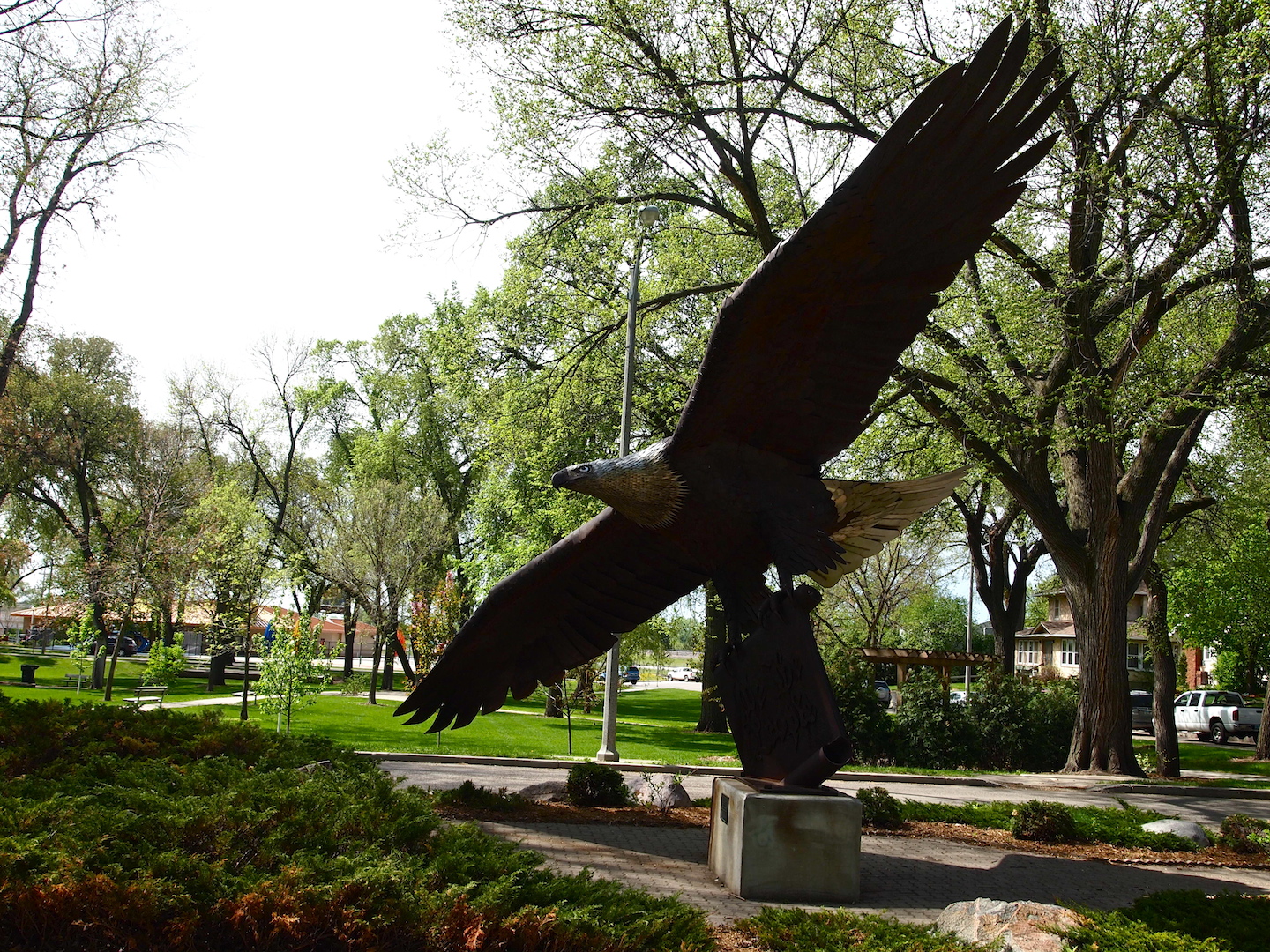
The eagle statue in Custer Park, Bismarck, North Dakota. View to the south.

The eagle statue in Custer Park, Bismarck, North Dakota. View to the south.

I dropped into Bismarck yesterday, and after having breakfast with my folks this morning I decided to visit downtown Custer Park. It is beautiful outside.

The park itself is a kind of border between the historic western edge of downtown Bismarck and one of the historic residential areas. To the south is Elks Aquatic Center, and just to the east is a Dairy Queen. You can see how this is triangulated and primed to be a serious summer hangout for those on summer vacation.

While at Custer Park, I also visited the huge metal eagle sculpture. This eagle was dedicated in 1988 (or thereabouts), and I have a vague recollection of my cub scout troop being at the dedication. At that time, when the sculpture was new and sans rust, we were told how the eagle would take on a more eagle-like color because the metal would oxidize and rust over time. This is about all I recall, but every time I drive by the eagle, I think of that dedication.

On this Memorial Day weekend, it seemed fitting to take and post a couple pics of this winged statue, as it is swooping into the park with a handbill that reads “We the People…”

OLYMPUS DIGITAL CAMERA

Neary’s “weld” signature from 1988 at the base of the eagle statue.

The dedication plaque below reads as follows:

This sculpture was dedicated to commemorate the bicentennial anniversary of the constitution of the united states of America on October 1, 1988. 

Commissioned by: Bismarck Park District

Funding Provided by: Fraternal Order of the Eagles, Bismarck, Aerie No. 2237

Sculptor: Tom Neary

Design Assistant: Wayne Pruse

Today, artists have pushed metal sculptures in different directions, now using found metal objects to craft works of industrial public art. Here is a link to some of that at the University of Montana in Missoula, and some more from Lemmon, South Dakota.


German-Russian Migration to the Northern Great Plains

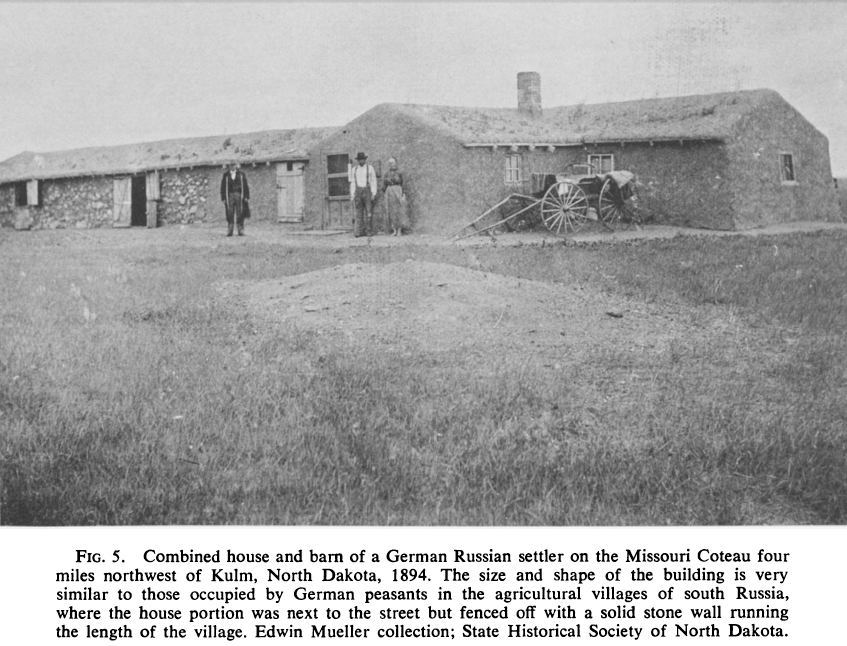
This last week while revisiting John C. Hudson’s 1976 article, “Migration to an American Frontier” in Annals of the Association of American Geographers, Vol. 66, No. 2, pp. 242-265, I came across this photo of German-Russian vernacular architecture. As the caption says, this is from 1894, taken right around Kulm, LaMoure County, North Dakota — the county just east of Emmons County, where the Welk German-Russian homestead is located (recent articles on that here, here, and here).

1894 Sod House Kulm, ND

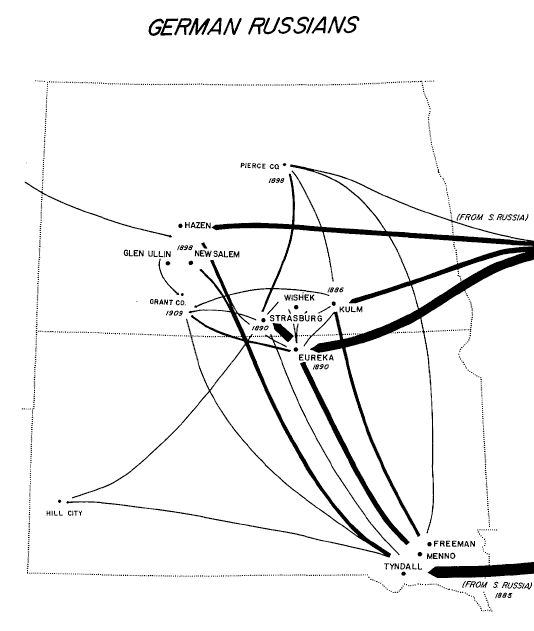
The Welk homestead, in turn, is just down the road from Braddock, Emmons County, North Dakota, where my great grandfather Barth homesteaded and farmed. Barth was an Ohio-German imbedded amongst the German-Russians, something not as difficult to pull off as it might sound. Anyhow, below is also a map of the German-Russian migration to the Dakotas, at least as it played out just before and after the turn of the 19th century.

German Russian Migration


Memory Groups

It’s closing in on 7:28AM as I type, and I thought I’d do a quick recap of this last week. Just yesterday evening on my walk home from NDSU campus, I was thinking how much more exciting blog posts on exploding trains are in contrast to posts about napping. Yet when it comes down to it, and if I’d have a choice, I’d rather read up on nap studies than exploding trains, since the former — naps — are much more likely to affect and influence a larger cross-section of society than, say, oil trains that explode near Casselton, North Dakota. Both are important. But I tend to enjoy figuring out how to find and make the otherwise mundane and boring (naps, or even a German-Russian homestead) interesting than focusing on the also important mushroom clouds rising up out of the northern Great Plains winter prairiescape.

Anyhow, I just confirmed a couple lecture-talks this semester at universities within the region, and these talks will build off published research on, broadly speaking, how and why the US-Dakota Wars have been remembered for the last 150 years in the Dakotas and Minnesota. I’m perpetually fascinated by this topic of memory. I suppose one reason is that by looking at how and why groups remember an event is just as informative as the actual event itself. And maybe even more. By studying these groups, we’re able to unpack the cultural, social and political set of ethos that various memory groups brought to bear on the interpretation of historical events.

These groups, in turn, are responsible for advancing the general topics in history that we know today. There is, for another example, the world historical event of the Second World War. But there are also the memory groups — in this case led by Tom Brokaw (also from South Dakota), Tom Hanks, and the late Stephen Ambrose — who study, popularize, and consider America’s involvement in the Second World War. These memory groups have reasons for studying what they study, and I want know the philosophy and technics behind it — the why and the how.


Dissertation Update

Dakota LanguageToday is Friday the 6th of December, it is approximately -11°F, I am looking out beyond the laptop screen through a south-facing window to the light blue snowscape, the time when the approach of the sun-rise appears eminent. I plan on finishing my opening dissertation chapter (which might turn into an introduction) that deals with the public remembrance of the US-Dakota Wars. One of the main thrusts in this disquisition is to look at not only how various generations have remembered and memorialized the US-Dakota Wars, but to piece together why.

I chatted with an engineer about this a couple days ago, albeit briefly, and I found in myself another reason that I hadn’t articulated so well: whenever we, the royal we, are frustrated with the way things are, sometimes it helps to track the history so as to see how we got where we are today. This doesn’t necessarily mean we will agree with it, but one doesn’t have to agree with something in order to understand it. To my right on the floor is a stack of published monographs on world and public history — historiography (or the history of history) having spoken to and shaped what we know today.

I also picked up and have so far read the introduction of Denise Meringolo, Museums, Monuments, and National Parks: Toward a New Genealogy of Public History (U of Massachusetts Press, 2012) from the dutiful Inter Library Loan-ists at NDSU. A couple months ago Bill Caraher and I were chatting at Laughing Sun in Bismarck, and he suggested I check it out. It is good. More on that later, either in blog or dissertation form. To my left is Stephen R. Riggs, A Dakota-English Diectionary and John P. Williamson, An English-Dakota Dictionary. I continuously re-re-rediscover that language, or the study of it, provides insights into the past, as do oral traditions and oral histories. But okay, enough of all this blogging for now. I’m just going to get after finishing this draft. Happy Friday to you.


Dakota for Blizzard: Icamnatanka

Since it is snowing now and we’re bracing for a blizzard on the northern Steppes of North America, it seems appropriate to look at and unpack the Dakota word for these storm systems. Dakota, after all, was one of the original languages of the Dakotas and Minnesota.

Blizzard in Dakota is icamnatanka, prounced roughly as ih-cha-mnah-tan-ka. In the case of icamnatanka, the word is a combination of two slightly smaller Dakota words. The first is icamna, which means “to blow, bluster, storm, drive, as wind and snow.” Mna in the word icamna is related to yumna. The yu in yumna expresses causation in some way. Thus the entire word yumna denotes a causation that means to rip a seam with scissors, or to rip a seam in anyway by pulling.

The second word in icamnatanka might be a bit more familiar. The word tanka means large or great. It is easy by now to see how icamnatanka comes to denote blizzard. It is a large or great blowing, blustering storm driven by wind. And mna is a word also connected to ripping at the seams. If we use our historical imaginations, we can envision a Dakota, Lakota or Nakota on the northern Great Plains in what we know today as early December. When an icamnatanka would strike, this blizzard would indeed bluster and blow snow through or rip at any kind of seam, whether in a tipi, earth lodge or through the seam of a hide-garment.

I posted a short version of this to social media the other day and a good friend, Dakota Goodhouse, texted me and said, “The Lakota use ichamna for snow storm or blizzard too, but use Iwoblu for severe blizzard.” The variations in language are mind-blowing. In the paraphrased words of John K. Cox at North Dakota State University, to learn a second language means that one learns to grow the other half of their brain. This is true.

Anyhow, as I continue the joyous struggle to learn second languages, it has always seemed to make more sense to me when individual words are unpacked. And by “joyous struggle” I mean just that: learning languages, at least for myself, is difficult. But I’m up for the task. To understand another word and language is to begin to understand another culture. Language is so very connected to culture, and is the way a culture describes itself, immediate surroundings, and the world. When one opens a language they open up a new way of seeing yesteryear, today, and even tomorrow.

The unpacking of icamnatanka came by way of help from one of Clifford Canku‘s Dakota Language I worksheets, and A Dakota-English Dictionary by Stephen R. Riggs (Minnesota Historical Society Press, 1992). Riggs started developing the dictionary in the 1830s with Samuel W. and Gideon H. Pond, and Thomas S. Williamson. They worked directly with Michael Renville, David Grey Cloud, James Garvie, and Walking Elk, a Yankton tribal leader.

This blog entry has been cross-posted at North Dakota State University’s Center for Heritage Renewal here and here.