Tag Archives: Great Plains History

Flag Day and Thoughts on Art and Growing Gardens

On Thursday evening (06/12/2014), Molly and I strolled down to the Plains Art Museum to hear Sandra Menefee Taylor speak about her exhibit, Heart/Land: Sandra Menefee Taylor’s Vital Matters. This exhibit is on the 3rd floor of the Plains, at 704 First Avenue North in downtown Fargo, just in case you’re in the area and want to visit. Two things among many stand out as I think back on taking in the talk and the exhibit.

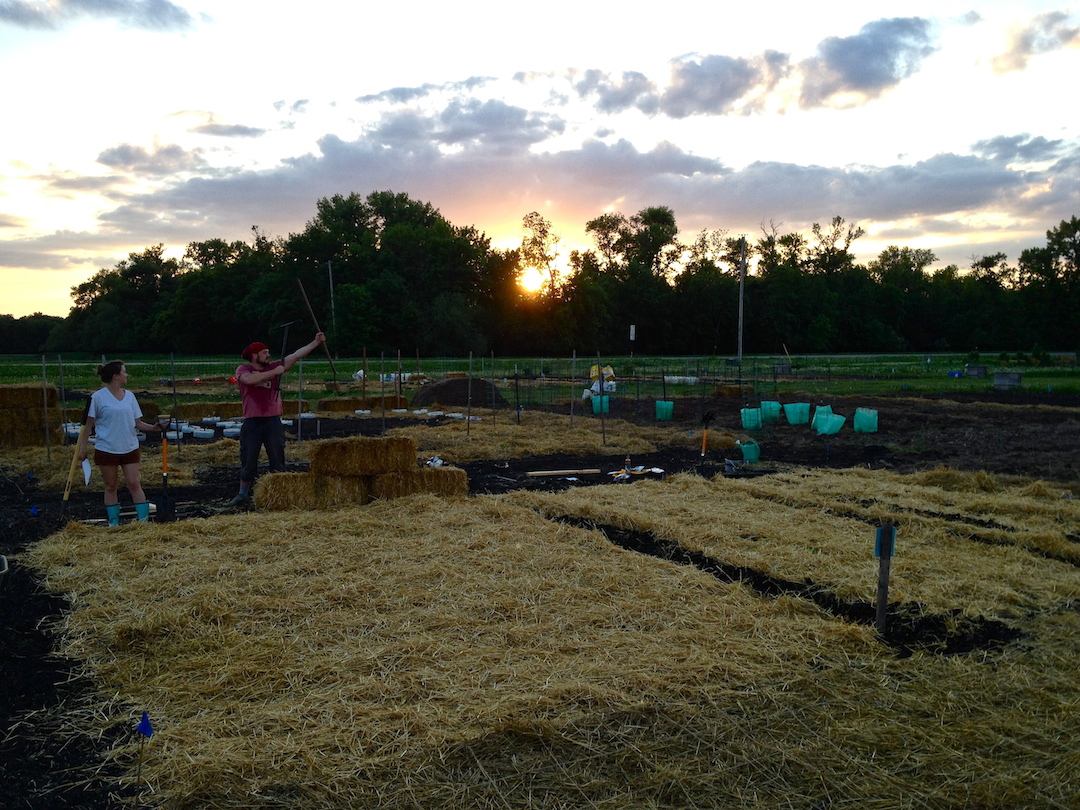
Planting at our Probstfield Farm plot in early June 2014. View to the west, the setting sun dropping behind the trees.

Planting at our Probstfield Farm plot in early June 2014. View to the west, the setting sun dropping behind the trees.

The first was an all too brief conversation with Abby Gold about farming, or gardening, at the historic Probstfield Farm just north of Moorhead, Minnesota. Molly and I, and two of our friends, decided to go in on a small community garden plot, the idea being that the four of us can more easily tend to such a garden than two or one of us.

I told Abby that when one has a garden, or a farm, one is suddenly paying more attention to weather patterns, especially rain. If we don’t have rain for more than a day and a half, then it means someone has to go and irrigate: literally one of us has to coordinate with the others, and say, “Okay, we’ll run up to the farm this evening, walk over to the watering station with buckets, and haul water back to our plot and gently water each row.” This, in turn, means that we are connected to the soil and land, at least if we want a harvest (and at least if we want to harvest beans so we can pickle them).

I said all this (more or less) to Abby, with the broader idea of how gardens are healthy for the psychology and soul. If I did not have a garden like this, irrigation would not cross my mind, and I would not pay as close attention to rain patterns as well. This garden, too, is bringing Molly and I, and our two friends, closer together, since we are privileged with the obligation of caring for our small rows of crops. We are a team.

The second point that stands out in my mind from Thursday evening was brought up during Sandra Taylor’s talk. It dealt with four ways in which one might consider approaching life. The four ways are as follows (and it turns out a lot of us already carry out these ways, but it’s nice to have someone articulate them):

  1. Show up. Be on time. I’ll add even another point: be early.
  2. Pay attention to what is going on in front of you. I’ll also add: research and think about what will go on in front of you, and then actively pay attention when it is happening.
  3. Speak the truth, and do so without judgment. I’ll add: we can tell the truth all the time, and we can do so without judging. It does not have to become entangled in emotion, or polemics, or name calling, and so on.
  4. Be open to the infinite range of un-intended outcomes. Or don’t be attached to a particular outcome. Things will never play out the way we think they will. So we might as well remind ourselves of that, and carry on.

Okay, I’ll end there. I just wanted to set this down and float it out there into the blogosphere. Happy weekend all. It’s Flag Day by the way, too.


D-Day 70th

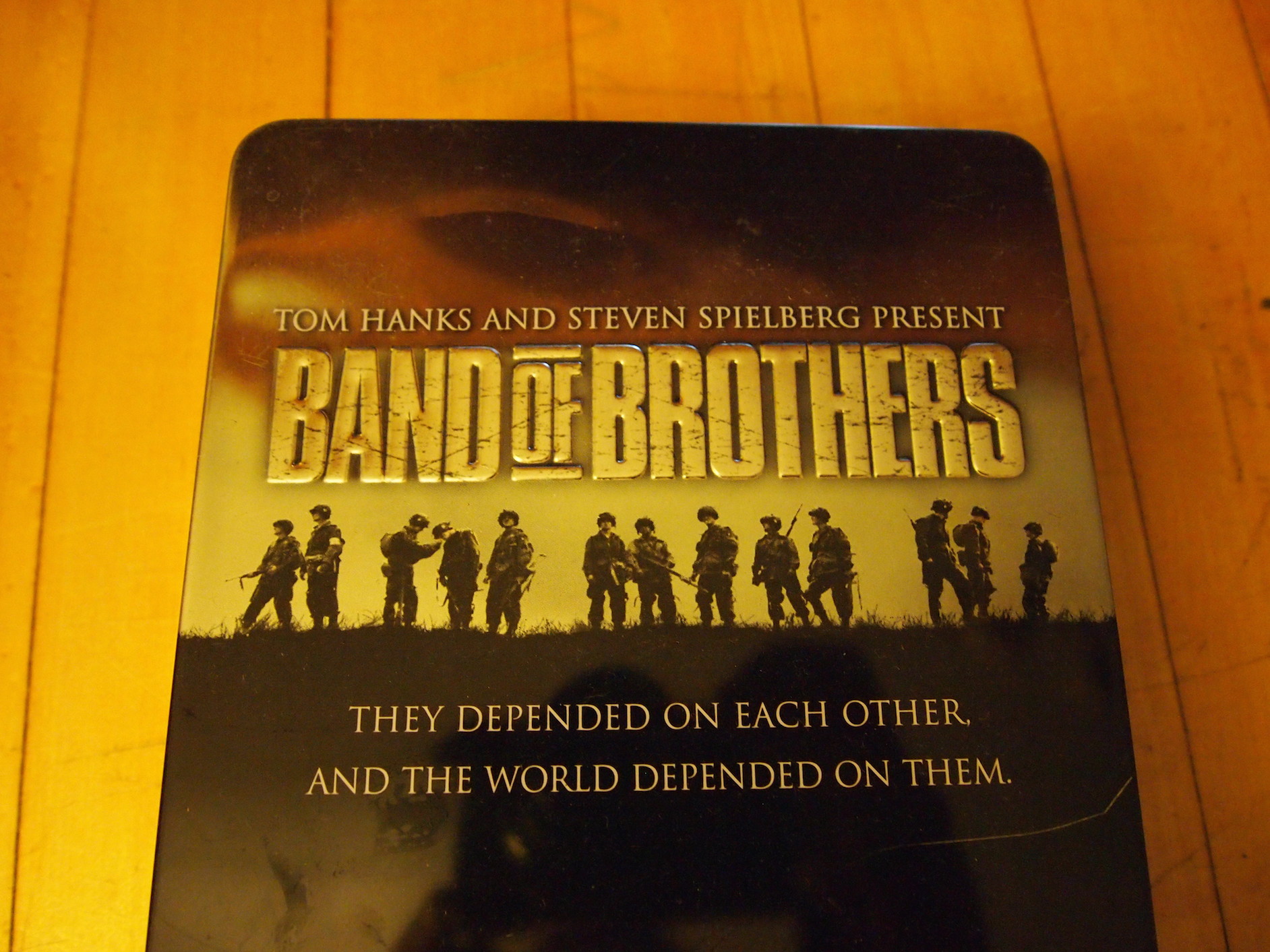
OLYMPUS DIGITAL CAMERAIt is June 5, 2014, which means it is one day away from the 70th anniversary of Operation Overlord, or D-Day. This also means that either this evening or tomorrow evening I’m going to fire up Tom Hanks and Steven Spielberg’s rendition of Stephen Ambrose’s 1992, Band of Brothers (2001).

I’m also drawn to thinking about what my late Grandpa Barth and his brother (my great uncle Charles “Bud” Barth) did during WWII. They both came from a farm near rural Braddock, North Dakota. During the war, Grandpa Barth was shipped to the central Great Plains to build bombers (I remember him talking about how he was charged with buffing the glass bubbles for the bombers). And Uncle Bud was sent to Army training, eventually becoming a front line medic in the Battle of the Bulge. Bless those for blessing us. I think that’s about all I got for now.


When the Eagle Statue Landed in Bismarck

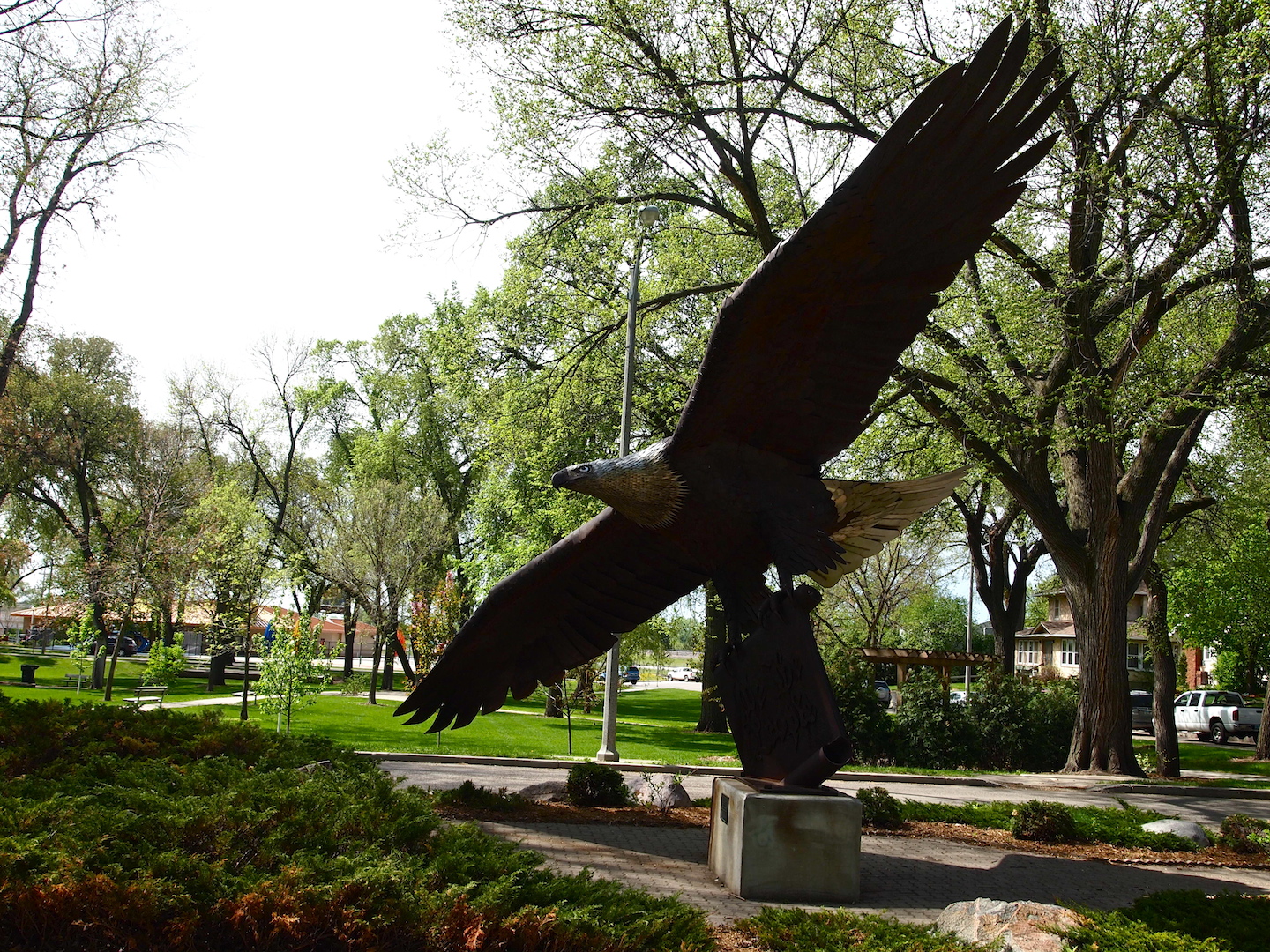
The eagle statue in Custer Park, Bismarck, North Dakota. View to the south.

The eagle statue in Custer Park, Bismarck, North Dakota. View to the south.

I dropped into Bismarck yesterday, and after having breakfast with my folks this morning I decided to visit downtown Custer Park. It is beautiful outside.

The park itself is a kind of border between the historic western edge of downtown Bismarck and one of the historic residential areas. To the south is Elks Aquatic Center, and just to the east is a Dairy Queen. You can see how this is triangulated and primed to be a serious summer hangout for those on summer vacation.

While at Custer Park, I also visited the huge metal eagle sculpture. This eagle was dedicated in 1988 (or thereabouts), and I have a vague recollection of my cub scout troop being at the dedication. At that time, when the sculpture was new and sans rust, we were told how the eagle would take on a more eagle-like color because the metal would oxidize and rust over time. This is about all I recall, but every time I drive by the eagle, I think of that dedication.

On this Memorial Day weekend, it seemed fitting to take and post a couple pics of this winged statue, as it is swooping into the park with a handbill that reads “We the People…”

OLYMPUS DIGITAL CAMERA

Neary’s “weld” signature from 1988 at the base of the eagle statue.

The dedication plaque below reads as follows:

This sculpture was dedicated to commemorate the bicentennial anniversary of the constitution of the united states of America on October 1, 1988. 

Commissioned by: Bismarck Park District

Funding Provided by: Fraternal Order of the Eagles, Bismarck, Aerie No. 2237

Sculptor: Tom Neary

Design Assistant: Wayne Pruse

Today, artists have pushed metal sculptures in different directions, now using found metal objects to craft works of industrial public art. Here is a link to some of that at the University of Montana in Missoula, and some more from Lemmon, South Dakota.


Memorial Weekend

Memorial Day weekend burger grill.

Memorial Day weekend burger grill.

It’s Friday evening and Molly and I are sitting on the living room futon which now faces west. It points us in the direction of a screen porch, and beyond this we can see the youthful spring green of deciduous trees and leaves set against a background of grayish-blue sky. A storm is brewing out west for sure. You can smell it. Something to do with the ozone.

We live in pre-WWI construction, so we are also treated to a kind of pre-WWII sense of place. I haven’t been able to put words to the smell, but the smell I’m smelling reminds me of my late Grandma Christy’s house on the 700 block of North 4th Street in Bismarck, North Dakota. That house, too, was built prior to the First World War. Anything built before the Second World War has this sense of smell and place to it. The homes and apartments all have hard wood floors, radiator heating, and super tall ceilings. They were built before the invention and ascent of conditioned air.

My latest archaeological find of Minnesota Twins propaganda.

My latest archaeological find of Minnesota Twins propaganda.

So now that it is Memorial Day Weekend, I thought I would post the epitome of Americana. I love this stuff. Baseball and cowboy charcoal grilled burgers. Memorial Day weekend is a grand extension of Decoration Day, a Civil War day of remembrance.

This evening also got me thinking a bit about all the German-Americans that poured into the United States when, in the words of Lt. Aldo Raine, people were getting out of Europe while the getting was good. Massive religious and political upheavals in the 19th century (this is the most focused brush stroke I’m going to use right now) induced hundreds of thousands of Europeans to simply leave Europe. They crossed the Atlantic and poured in the United States. A large swath of these immigrants came from Germany, or German-speaking countries (I have often hypothesized that the reason Germany started two big ones in the same century had to do with this intellectual emigrant drain from the previous century). And the Germans, when they arrived in the United States, took up numerous causes. In some cases they played baseball. And in other cases they agitated for emancipation. I like to imagine that they also grilled burgers, too. Baseball and burgers. Happy Memorial Day.


When CNN Airs Your YouTube Train Explosion Video

One week ago I drove from Fargo to Casselton, North Dakota, to take in first hand what happened with the train explosion. Details of that outing are linked to here. The next morning I checked my e-mail in-box, and CNN’s Justin Lear had a message waiting for me. He wondered if it was okay for CNN to use my YouTube video. My thought was, “Yeah. Sure.” So I e-mailed him back, we corresponded briefly, and eventually CNN put my video on their page. Click here to see what it looked like.

When you blog exploding or burning trains, this is what happens to your blog's site visitation.

When you blog exploding or burning trains, this is what happens to your blog’s site visitation.

The footage also got me thinking a bit about how Lear might have come across the video in the first place, this through the computational algorithms built by the internet folks (at Microsoft, Google, and so on). If you happen to be within photographic range of exploding trains, or the burning aftermath of exploding trains, and you upload this footage to YouTube, there’s a good chance Justin Lear will get a hold of you.

I think, perhaps, the most enjoyable footage had to do with the on-the-spot local narration from North Dakotans who caught footage of the actual explosion. If you click on this link and go to 0:24 seconds, you’ll hear through-and-through NoDaker commentary: “There it goes,” and this followed by “There it goes.” Phonetically, it sounds like this: “Der it goeas.” And while this makes us smile, this is the reflection of a North Dakota dialect (played up pretty heavily in the movie Fargo — thank you Coen brothers). The sound of it is completely disarming, and you can hear our Scandinavian and German-Russian great grand-parents within it.


Dissertation Update

Dakota LanguageToday is Friday the 6th of December, it is approximately -11°F, I am looking out beyond the laptop screen through a south-facing window to the light blue snowscape, the time when the approach of the sun-rise appears eminent. I plan on finishing my opening dissertation chapter (which might turn into an introduction) that deals with the public remembrance of the US-Dakota Wars. One of the main thrusts in this disquisition is to look at not only how various generations have remembered and memorialized the US-Dakota Wars, but to piece together why.

I chatted with an engineer about this a couple days ago, albeit briefly, and I found in myself another reason that I hadn’t articulated so well: whenever we, the royal we, are frustrated with the way things are, sometimes it helps to track the history so as to see how we got where we are today. This doesn’t necessarily mean we will agree with it, but one doesn’t have to agree with something in order to understand it. To my right on the floor is a stack of published monographs on world and public history — historiography (or the history of history) having spoken to and shaped what we know today.

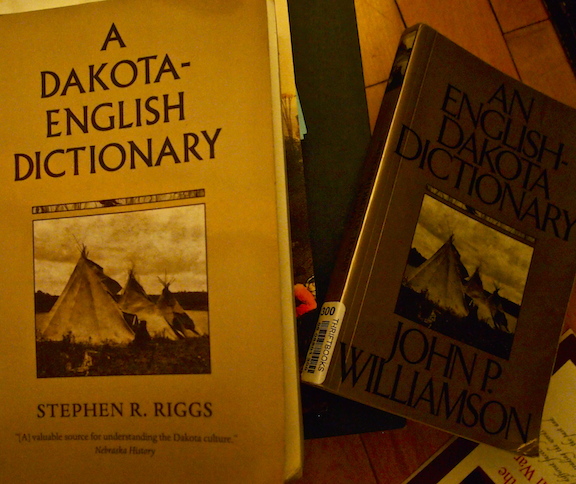
I also picked up and have so far read the introduction of Denise Meringolo, Museums, Monuments, and National Parks: Toward a New Genealogy of Public History (U of Massachusetts Press, 2012) from the dutiful Inter Library Loan-ists at NDSU. A couple months ago Bill Caraher and I were chatting at Laughing Sun in Bismarck, and he suggested I check it out. It is good. More on that later, either in blog or dissertation form. To my left is Stephen R. Riggs, A Dakota-English Diectionary and John P. Williamson, An English-Dakota Dictionary. I continuously re-re-rediscover that language, or the study of it, provides insights into the past, as do oral traditions and oral histories. But okay, enough of all this blogging for now. I’m just going to get after finishing this draft. Happy Friday to you.


Rough World Historical Thoughts on Castle Larnach

Castle Larnach, Dunedin, NZ.

Castle Larnach, Dunedin, NZ.

There are two items to blog about today. The first is the short record as to what we did yesterday, and the second is what is on the itinerary for today. They blend together, as life does, and I’ll try to make sense out of that below. Of the former:

Yesterday morning Matthew, Molly and I walked a couple blocks to the center of downtown Dunedin, to what I’ve been calling the undisputed octagon (because the city center was laid out like an octagon; not because it has any association with Ultimate Fighting). I learned quickly to watch for the little green man, an indicator that lets pedestrians know when it is a guarded time to cross the street. We also found a grand little breakfast shop. One contrast between NZ and ‘merica is that restaurants and cafes are, generally, a bit more spendy than the States. But this is offset by the reality that NZ servers are paid a greater wage than State-side servers, and this also means that when in NZ one is not expected to tip.

Also, the breakfast was delicious. Matt had French toast and Molly and I split a breakfast of egg, toast, bacon and sausage. It was a very traditional breakfast, at least if one grows up on the northern Great Plains of North America. In many ways NZ is like a parallel universe to the English-speaking Atlantic World, which in turn gives a person pause as to the influence the 18th– and 19th– century Great British world had on the globe. This is going to be a point of conversation for the second item today, which is the Writing Histories of Empire and Colonialism, this put on at St. Margaret’s College at the University of Otago, Dunedin.

Castle Larnach stairwell, from the top floor looking down.

Castle Larnach stairwell, from the top floor looking down.

One of the aims of this history workshop is to bat around and consider ideas about how to write solid global history. One of the potential problems with writing world history is that one is dealing with a large topic, and there is always a danger of saying nothing in an attempt to say everything. So this is why we don’t do that. Instead, a different way to go about it, at least as I’m sitting here and typing, is to 1) work in topics of 3s and 4s; 2) give the reader a personal element to fixate on; and 3) carry a theme/thesis that runs through the entire historical essay or monograph — this, arguably, can be a model for any writer’s workshop.

So to return to the first blogging topic for today: I’m thinking a bit about yesterday afternoon, when we all visited, had high tea, and took an afternoon stroll at and of Castle Larnach, a late-19th century industrial Victorian “home.” While wandering through this castle, I thought about simultaneously how great a view one had from the top of the castle tower and about the excessive absurdity of this kind of built la-la land. I say la-la land because castles, in their original utilitarian form, were built as defensive positions, often in an attempt to protect the feudal lord and local populace when mean outsiders wanted to be mean to the said lord, baron and locals.

In the case of Castle Larnach, this banker and politician made a ton of money off the New Zealand and Australian gold fields, and then decided to conceive of himself as some kind of varietal noble. It reminds me of super late-19th century castles in America, such as the James J. Hill home in St. Paul, Minnesota. It is these sorts of industrial wealth concentrations that, after the turn of the 19th century, Progressive Republicans such as Theodore Roosevelt thundered against, or sought to break up. (Out of this period in world history, we get self-validating, hyper-dodgy theses that the über-rich came up with, such as Social Darwinism and the Social Gospel — we’re rich because either nature or God made us rich). The notion here, though, is to consider how or if a world historical theme is reflected on the local level. Then, in theory, readers might think of their own regional histories as being both local and global.
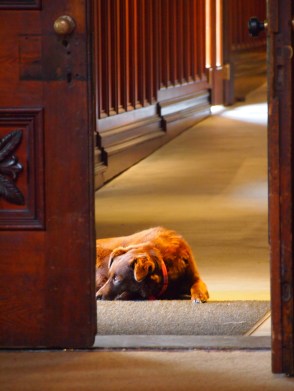
Fern, the exhausted and super friendly castle dog at Castle Larnach. Nothing gets by Fern. Not that she cares, though.

Fern, the exhausted and super friendly castle dog at Castle Larnach. Nothing gets by Fern. Not that she cares, though.

Another point to consider is that the James J. Hill home, and this Scottish castle in Dunedin, could not be sustained for any length of time, at least not by a singular family. Today they have turned into public historical enclaves, administered by private or public entities, and the public has access to them in ways that they wouldn’t have in their original historic context.

Anyhow, and moving along, I’m excited to get after this first day’s seminar/workshop. All of the world history workshop attendees are required to read three different essays which, of course, I did on the flight over. The readings include Linda Colley, The Ordeal of Elizabeth Marsh (2007), Maya Jasanoff, Liberty’s Exiles: The Loss of America and the Remaking of the British Empire (2011), and Tony Ballantyne, “On Place, Space and Mobility in Nineteenth-Century New Zealand” in the New Zealand Journal of History, 45, 1 (2011). But enough about all this. It’s almost 8:00AM Dunedin time, and we need to track down this thing in Australia and NZ called breakkie.

Green Spaces at North Dakota State University

I’ve been in conversation with some friends and colleagues on the campus of North Dakota State University (NDSU) as to where the latest proposed STEM APE (Area of Potential Effect) should be located and, eventually, built. Thus far, NDSU administration is leaning toward putting the important STEM center just to the east of the Memorial Union, requiring the bulldozers to first knock out some historic trees (yes, such ecology exists) and the beautiful and quaint historic Nelson building on campus. So NDSU is now circulating a kind of after-the-proposed-planning-fact survey to gauge student interest.

This is how I answered a couple questions on page 2 of the survey, and I also provided them with all of my contact information.

1) In our broader culture where horizontal asphalt parking lots and strip malls are the norm, it seems not only important but paramount to ensure that North Dakota State University protects historically green, recreational spaces at the heart of our campus. Theodore Roosevelt carved out national green spaces throughout the American West so that the American population could re-create themselves by being in and connecting with the grasses, trees and shrubs. This is where we get the word recreation: our ability to return to natural or artificial landscapes to, as they say, get away from it all, if but momentarily. This is another reason why Island Park in downtown Fargo was created, as well as large green spaces on the eastern seaboard of the United States (take New York’s Central Park as a prime example).

2) The Elm trees within the proposed STEM APE are historical hybrids, a variety resistant to the Dutch Elm disease that nearly wiped out the entire American Elm species in North Dakota. The American Elm, by the way, is the state tree of North Dakota. There is a bit of irony at play every time North Dakota State University obliterates, or proposes to obliterate, a piece of its local ecological history. We as a state have so few trees to begin with. Why not just build the STEM building in a parking lot, or a place on campus where there aren’t any trees? By doing this, it would increase the verticality of the campus while simultaneously preserving green space.

I encouraged them to get a hold of me if they want a proper study of their proposed APE(s). This, in turn, would help guide decision making so that the best possible construction solution could be arrived at. Who knows what will come of this. It is their call. We hope they make the right decision.


Traditional Native Food Systems

Sahnish AgricultureIt has been a couple years now that I have served on the board of the North Dakota Humanities Council. It is incredible in the sense that a board member is brought within range of all that this NEH-funded council does. While great ideas abound, sometimes we are only logistically able to make it to a sampling of the events around the state. If it was somehow possible for the council to be funded where board members could quit their day-jobs, we indeed would be present at each and every event. But unfortunately my landlord, cell phone provider, and the bill issuers in general refuse to accept my historical articles, papers and daily blogs as payment for their services. Thus, I have to keep at my day job to keep the lights on around here which in turn keeps me from some of the great NDHC programs.

A couple days ago, I received a thank you from Dr. Wanda Agnew of United Tribes Technical College (an institution that has one of the most renowned global pow-wows every year). Dr. Agnew said the “funds provided by the North Dakota Humanities Council gave us the opportunity to make the Key Ingredient American By Food Exhibit and Special event OUTSTANDING!” The goal of this event was to connect the UTTC campus populace, Tribal Sovereign Nations, and folks in the Bismarck-Mandan area with ideas about traditional Native food systems, deepening the understanding of how pre-Industrial agriculture, farming and gardening worked. It has only been in the last 125 years or so (out of at least 6,000) that homo sapiens have increasingly industrialized what we shovel into our mouths. I have thought about and acted on this in recent years.

Lakota AgricultureIn any case, within this blog are the three hand-bill diagrams Dr. Agnew sent along with the thank-you that point to how food, culture and humanity intersect with three different tribal systems (oyate) on the northern Great Plains. They are the Anishinaabe, Lakota, and Sahnish. We are leaving September and heading into October, so note how the traditional calendars describe the seasons: for the Lakota, September-October is the time when trading with other tribes occurs, when buffalo berries are gathered, and when the earth experienced its hard frost and went into hibernation. For the Anishinaabe, chokecherries and wild potatoes and cranberries would be gathered, and deer would be hunted (which also coincides with our modern deer hunting season). For the Sahnish, this time of year marked the corn and harvest ceremonies. Okay, off to start the charcoal grill. Happy weekend to you.

Anishinaabe Agriculture


Notes from Whitestone Hill: August 24, 2013

Last week I returned from the National Archives in DC, and over the weekend I attended and was one of the speakers for the 150th Whitestone Hill observances not too far south of Kulm, in Dickey County, southeastern North Dakota. There has been much said about Whitestone Hill (it is a piece of genocide in American history), and much more to be said too. I have a forthcoming article in The Public Historian (“Imagining a Battle at a Civil War Mistake: The Public History of Whitestone Hill, 1863-2013” Vol. 35, No. 3, August 2013) that concerns the remembrance of this site, and this induced me to note, at least to myself, how history is never final.

During the August 24, 2013 day of observances, I took some notes, photos, and video. Here is a link to the line-up. I thought I’d share some more notes from the day here, but they are not exhaustive (I tried to scribble when I could). Kevin Locke opened the observances around 9:00AM with a Native prayer, and he spoke to the temporality of life. He described this in Dakota and Lakota language, and also noted a word that defined something that was fleeting, a philosophical universal of life. Also, the essence of the word “Dakota” means peace, ally, friend.

Under the tent, the morning at Whitestone Hill. Ladonna is speaking at left.

Under the tent, the morning at Whitestone Hill. Ladonna is speaking at left.

Also: Frogs were everywhere at the site that morning. With every couple steps, a couple little jumps would happen in the grass below. Upon closer inspection, you could see the little frogs. This, of course, provided untold of amusement for youngsters and biologists, and basically any of us city types who don’t regularly get to see frogs in this kind of battalion strength.

I caught up with a good friend, Dakota Goodhouse, and he said he arrived a little late because his son asked him to have breakfast. Note: having breakfast with your son is a good idea, especially if your son wants to.

One of the coolest things ever, especially at these sites and on our northern Great Plains, is coming upon a tipi. Even better, coming upon more than one tipi. And even better-better, coming upon one tipi, and the raising of another. Here is a short video of that. There is a charcoal marker on the top of the last tipi pole, the one where the canvas is fixed to and hoisted up (in pre-canvas days, before Euro-American industrialization nearly wiped out every last bison, these bison hides would be used). Notice the kind of community that simply “happens” with the raising of a tipi.

It’s akin to the pre-Industrial raising of a barn, or relocating a Mongolian ger from one pasture to the next: everyone gets involved, either directly or in supportive spirit. There are smiles everywhere as well. Architecturally the tipi is so fascinating because its verticality rises right out of the horizontal landscape that is the Great Plains. It gets your attention for sure. The new east-facing elevation of the State Historical Society of North Dakota has a brilliant entryway with, impressionistically, a tipi-looking piece of modern art. I think it is excellent.

Tipis at Whitestone Hill, August 24, 2013.

Tipis at Whitestone Hill, August 24, 2013. Note the verticality in contrast to the horizontal landscape of the Great Plains. Everyone should raise more tipis.


Understandable resistance to the name of Whitestone Hill as a "battlefield."

Understandable resistance to the name of Whitestone Hill as a “battlefield.” Photo from August 24, 2013.