Tag Archives: Great Plains History

Dissertation Update

Dakota LanguageToday is Friday the 6th of December, it is approximately -11°F, I am looking out beyond the laptop screen through a south-facing window to the light blue snowscape, the time when the approach of the sun-rise appears eminent. I plan on finishing my opening dissertation chapter (which might turn into an introduction) that deals with the public remembrance of the US-Dakota Wars. One of the main thrusts in this disquisition is to look at not only how various generations have remembered and memorialized the US-Dakota Wars, but to piece together why.

I chatted with an engineer about this a couple days ago, albeit briefly, and I found in myself another reason that I hadn’t articulated so well: whenever we, the royal we, are frustrated with the way things are, sometimes it helps to track the history so as to see how we got where we are today. This doesn’t necessarily mean we will agree with it, but one doesn’t have to agree with something in order to understand it. To my right on the floor is a stack of published monographs on world and public history — historiography (or the history of history) having spoken to and shaped what we know today.

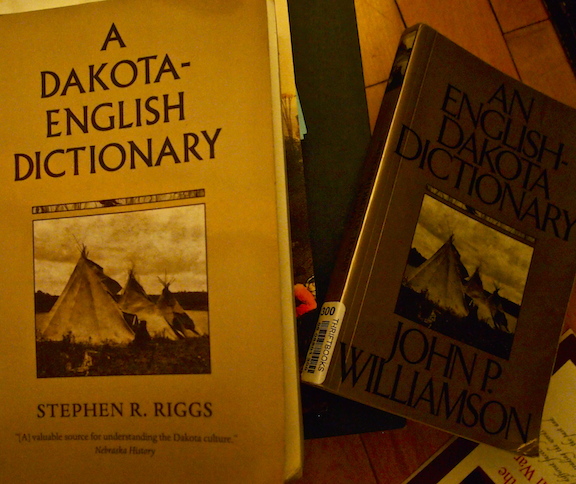
I also picked up and have so far read the introduction of Denise Meringolo, Museums, Monuments, and National Parks: Toward a New Genealogy of Public History (U of Massachusetts Press, 2012) from the dutiful Inter Library Loan-ists at NDSU. A couple months ago Bill Caraher and I were chatting at Laughing Sun in Bismarck, and he suggested I check it out. It is good. More on that later, either in blog or dissertation form. To my left is Stephen R. Riggs, A Dakota-English Diectionary and John P. Williamson, An English-Dakota Dictionary. I continuously re-re-rediscover that language, or the study of it, provides insights into the past, as do oral traditions and oral histories. But okay, enough of all this blogging for now. I’m just going to get after finishing this draft. Happy Friday to you.


Rough World Historical Thoughts on Castle Larnach

Castle Larnach, Dunedin, NZ.

Castle Larnach, Dunedin, NZ.

There are two items to blog about today. The first is the short record as to what we did yesterday, and the second is what is on the itinerary for today. They blend together, as life does, and I’ll try to make sense out of that below. Of the former:

Yesterday morning Matthew, Molly and I walked a couple blocks to the center of downtown Dunedin, to what I’ve been calling the undisputed octagon (because the city center was laid out like an octagon; not because it has any association with Ultimate Fighting). I learned quickly to watch for the little green man, an indicator that lets pedestrians know when it is a guarded time to cross the street. We also found a grand little breakfast shop. One contrast between NZ and ‘merica is that restaurants and cafes are, generally, a bit more spendy than the States. But this is offset by the reality that NZ servers are paid a greater wage than State-side servers, and this also means that when in NZ one is not expected to tip.

Also, the breakfast was delicious. Matt had French toast and Molly and I split a breakfast of egg, toast, bacon and sausage. It was a very traditional breakfast, at least if one grows up on the northern Great Plains of North America. In many ways NZ is like a parallel universe to the English-speaking Atlantic World, which in turn gives a person pause as to the influence the 18th– and 19th– century Great British world had on the globe. This is going to be a point of conversation for the second item today, which is the Writing Histories of Empire and Colonialism, this put on at St. Margaret’s College at the University of Otago, Dunedin.

Castle Larnach stairwell, from the top floor looking down.

Castle Larnach stairwell, from the top floor looking down.

One of the aims of this history workshop is to bat around and consider ideas about how to write solid global history. One of the potential problems with writing world history is that one is dealing with a large topic, and there is always a danger of saying nothing in an attempt to say everything. So this is why we don’t do that. Instead, a different way to go about it, at least as I’m sitting here and typing, is to 1) work in topics of 3s and 4s; 2) give the reader a personal element to fixate on; and 3) carry a theme/thesis that runs through the entire historical essay or monograph — this, arguably, can be a model for any writer’s workshop.

So to return to the first blogging topic for today: I’m thinking a bit about yesterday afternoon, when we all visited, had high tea, and took an afternoon stroll at and of Castle Larnach, a late-19th century industrial Victorian “home.” While wandering through this castle, I thought about simultaneously how great a view one had from the top of the castle tower and about the excessive absurdity of this kind of built la-la land. I say la-la land because castles, in their original utilitarian form, were built as defensive positions, often in an attempt to protect the feudal lord and local populace when mean outsiders wanted to be mean to the said lord, baron and locals.

In the case of Castle Larnach, this banker and politician made a ton of money off the New Zealand and Australian gold fields, and then decided to conceive of himself as some kind of varietal noble. It reminds me of super late-19th century castles in America, such as the James J. Hill home in St. Paul, Minnesota. It is these sorts of industrial wealth concentrations that, after the turn of the 19th century, Progressive Republicans such as Theodore Roosevelt thundered against, or sought to break up. (Out of this period in world history, we get self-validating, hyper-dodgy theses that the über-rich came up with, such as Social Darwinism and the Social Gospel — we’re rich because either nature or God made us rich). The notion here, though, is to consider how or if a world historical theme is reflected on the local level. Then, in theory, readers might think of their own regional histories as being both local and global.

Fern, the exhausted and super friendly castle dog at Castle Larnach. Nothing gets by Fern. Not that she cares, though.

Fern, the exhausted and super friendly castle dog at Castle Larnach. Nothing gets by Fern. Not that she cares, though.

Another point to consider is that the James J. Hill home, and this Scottish castle in Dunedin, could not be sustained for any length of time, at least not by a singular family. Today they have turned into public historical enclaves, administered by private or public entities, and the public has access to them in ways that they wouldn’t have in their original historic context.

Anyhow, and moving along, I’m excited to get after this first day’s seminar/workshop. All of the world history workshop attendees are required to read three different essays which, of course, I did on the flight over. The readings include Linda Colley, The Ordeal of Elizabeth Marsh (2007), Maya Jasanoff, Liberty’s Exiles: The Loss of America and the Remaking of the British Empire (2011), and Tony Ballantyne, “On Place, Space and Mobility in Nineteenth-Century New Zealand” in the New Zealand Journal of History, 45, 1 (2011). But enough about all this. It’s almost 8:00AM Dunedin time, and we need to track down this thing in Australia and NZ called breakkie.


Green Spaces at North Dakota State University

I’ve been in conversation with some friends and colleagues on the campus of North Dakota State University (NDSU) as to where the latest proposed STEM APE (Area of Potential Effect) should be located and, eventually, built. Thus far, NDSU administration is leaning toward putting the important STEM center just to the east of the Memorial Union, requiring the bulldozers to first knock out some historic trees (yes, such ecology exists) and the beautiful and quaint historic Nelson building on campus. So NDSU is now circulating a kind of after-the-proposed-planning-fact survey to gauge student interest.

This is how I answered a couple questions on page 2 of the survey, and I also provided them with all of my contact information.

1) In our broader culture where horizontal asphalt parking lots and strip malls are the norm, it seems not only important but paramount to ensure that North Dakota State University protects historically green, recreational spaces at the heart of our campus. Theodore Roosevelt carved out national green spaces throughout the American West so that the American population could re-create themselves by being in and connecting with the grasses, trees and shrubs. This is where we get the word recreation: our ability to return to natural or artificial landscapes to, as they say, get away from it all, if but momentarily. This is another reason why Island Park in downtown Fargo was created, as well as large green spaces on the eastern seaboard of the United States (take New York’s Central Park as a prime example).

2) The Elm trees within the proposed STEM APE are historical hybrids, a variety resistant to the Dutch Elm disease that nearly wiped out the entire American Elm species in North Dakota. The American Elm, by the way, is the state tree of North Dakota. There is a bit of irony at play every time North Dakota State University obliterates, or proposes to obliterate, a piece of its local ecological history. We as a state have so few trees to begin with. Why not just build the STEM building in a parking lot, or a place on campus where there aren’t any trees? By doing this, it would increase the verticality of the campus while simultaneously preserving green space.

I encouraged them to get a hold of me if they want a proper study of their proposed APE(s). This, in turn, would help guide decision making so that the best possible construction solution could be arrived at. Who knows what will come of this. It is their call. We hope they make the right decision.


Traditional Native Food Systems

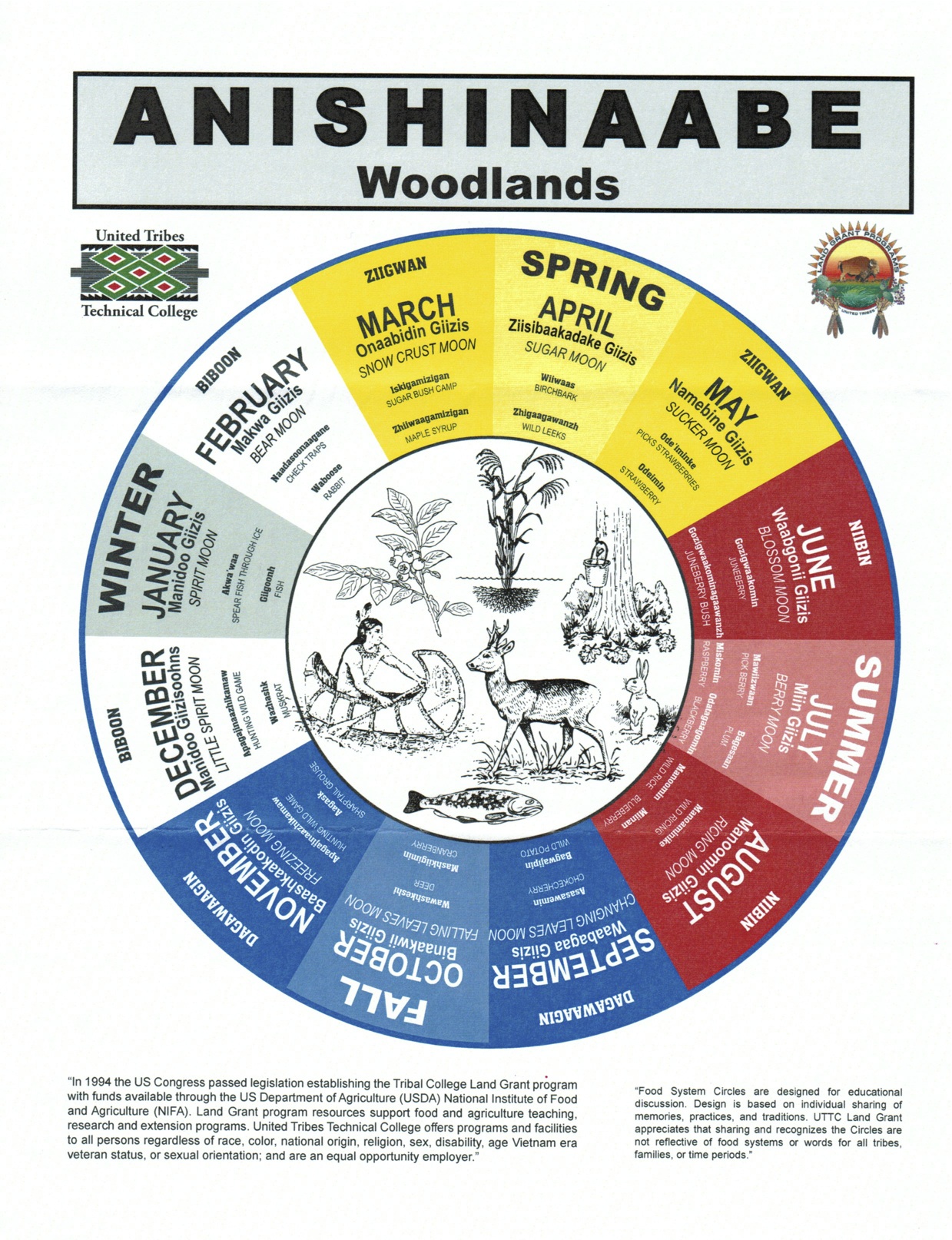
Sahnish AgricultureIt has been a couple years now that I have served on the board of the North Dakota Humanities Council. It is incredible in the sense that a board member is brought within range of all that this NEH-funded council does. While great ideas abound, sometimes we are only logistically able to make it to a sampling of the events around the state. If it was somehow possible for the council to be funded where board members could quit their day-jobs, we indeed would be present at each and every event. But unfortunately my landlord, cell phone provider, and the bill issuers in general refuse to accept my historical articles, papers and daily blogs as payment for their services. Thus, I have to keep at my day job to keep the lights on around here which in turn keeps me from some of the great NDHC programs.

A couple days ago, I received a thank you from Dr. Wanda Agnew of United Tribes Technical College (an institution that has one of the most renowned global pow-wows every year). Dr. Agnew said the “funds provided by the North Dakota Humanities Council gave us the opportunity to make the Key Ingredient American By Food Exhibit and Special event OUTSTANDING!” The goal of this event was to connect the UTTC campus populace, Tribal Sovereign Nations, and folks in the Bismarck-Mandan area with ideas about traditional Native food systems, deepening the understanding of how pre-Industrial agriculture, farming and gardening worked. It has only been in the last 125 years or so (out of at least 6,000) that homo sapiens have increasingly industrialized what we shovel into our mouths. I have thought about and acted on this in recent years.

Lakota AgricultureIn any case, within this blog are the three hand-bill diagrams Dr. Agnew sent along with the thank-you that point to how food, culture and humanity intersect with three different tribal systems (oyate) on the northern Great Plains. They are the Anishinaabe, Lakota, and Sahnish. We are leaving September and heading into October, so note how the traditional calendars describe the seasons: for the Lakota, September-October is the time when trading with other tribes occurs, when buffalo berries are gathered, and when the earth experienced its hard frost and went into hibernation. For the Anishinaabe, chokecherries and wild potatoes and cranberries would be gathered, and deer would be hunted (which also coincides with our modern deer hunting season). For the Sahnish, this time of year marked the corn and harvest ceremonies. Okay, off to start the charcoal grill. Happy weekend to you.

Anishinaabe Agriculture


Notes from Whitestone Hill: August 24, 2013

Last week I returned from the National Archives in DC, and over the weekend I attended and was one of the speakers for the 150th Whitestone Hill observances not too far south of Kulm, in Dickey County, southeastern North Dakota. There has been much said about Whitestone Hill (it is a piece of genocide in American history), and much more to be said too. I have a forthcoming article in The Public Historian (“Imagining a Battle at a Civil War Mistake: The Public History of Whitestone Hill, 1863-2013” Vol. 35, No. 3, August 2013) that concerns the remembrance of this site, and this induced me to note, at least to myself, how history is never final.

During the August 24, 2013 day of observances, I took some notes, photos, and video. Here is a link to the line-up. I thought I’d share some more notes from the day here, but they are not exhaustive (I tried to scribble when I could). Kevin Locke opened the observances around 9:00AM with a Native prayer, and he spoke to the temporality of life. He described this in Dakota and Lakota language, and also noted a word that defined something that was fleeting, a philosophical universal of life. Also, the essence of the word “Dakota” means peace, ally, friend.

Under the tent, the morning at Whitestone Hill. Ladonna is speaking at left.

Under the tent, the morning at Whitestone Hill. Ladonna is speaking at left.

Also: Frogs were everywhere at the site that morning. With every couple steps, a couple little jumps would happen in the grass below. Upon closer inspection, you could see the little frogs. This, of course, provided untold of amusement for youngsters and biologists, and basically any of us city types who don’t regularly get to see frogs in this kind of battalion strength.

I caught up with a good friend, Dakota Goodhouse, and he said he arrived a little late because his son asked him to have breakfast. Note: having breakfast with your son is a good idea, especially if your son wants to.

One of the coolest things ever, especially at these sites and on our northern Great Plains, is coming upon a tipi. Even better, coming upon more than one tipi. And even better-better, coming upon one tipi, and the raising of another. Here is a short video of that. There is a charcoal marker on the top of the last tipi pole, the one where the canvas is fixed to and hoisted up (in pre-canvas days, before Euro-American industrialization nearly wiped out every last bison, these bison hides would be used). Notice the kind of community that simply “happens” with the raising of a tipi.

It’s akin to the pre-Industrial raising of a barn, or relocating a Mongolian ger from one pasture to the next: everyone gets involved, either directly or in supportive spirit. There are smiles everywhere as well. Architecturally the tipi is so fascinating because its verticality rises right out of the horizontal landscape that is the Great Plains. It gets your attention for sure. The new east-facing elevation of the State Historical Society of North Dakota has a brilliant entryway with, impressionistically, a tipi-looking piece of modern art. I think it is excellent.

Tipis at Whitestone Hill, August 24, 2013.

Tipis at Whitestone Hill, August 24, 2013. Note the verticality in contrast to the horizontal landscape of the Great Plains. Everyone should raise more tipis.


Understandable resistance to the name of Whitestone Hill as a "battlefield."

Understandable resistance to the name of Whitestone Hill as a “battlefield.” Photo from August 24, 2013.


Notes from the Basecamp (04/23/2013)

Basecamp water wagon and supplies.

Basecamp water wagon and supplies.

On April 4, 2013, Richard Rothaus and I chatted via e-mail about some base camp logistics for Adventure Science’s 100 miles of North Dakota wild, a pedestrian overland trek through ephemeral drainages and butte plateaus in the nation’s #2-producing oil field that is western North Dakota. We came to the conclusion that I could 1) be useful and helpful in coordinating points of drop off and extraction, and evening details for Rothaus and Andrew Reinhard; and 2) in the interim, between dropping off the team and setting up camp, I could read for comprehensive exams (also known as “comps”). On the April 21, 2013 drive out to western North Dakota, I also thought it would be a good idea to capture some traffic samples that are part and parcel to the borderline anarchy of any blossoming petroleum industry throughout the planet.

After dropping off Rothaus and Reinhard yesterday (04/22/2013) morning, I drove the field vehicle around to where they would arrive that evening, and set to reading for comps (“comps” is one part of the intellectual bootcamp, or disciplinary training, when working on a doctor of philosophy, in my case with North Dakota State University and the University of North Dakota). Winter in North Dakota is holding on a bit more than usual, and it is getting the attention of folks in both the city and in the countryside. The late winter means a late spring, and so the snow has been gradually melting.

While reading for comps, and while temporally in late spring and spatially in western North Dakota, I revisited a short passage from the first chapter of Elwyn B. Robinson’s 1966 History of North Dakota (University of Nebraska Press), entitled, “The Grassland Setting.” In this, Robinson says,

For hundreds of millions of years the Williston Basin [of western ND] and the area surrounding it were intermittently covered by a salt sea stretching from the Gulf of Mexico to the Arctic. Sediment carried into the sea by flowing water was deposited on the bottom and slowly compacted into strata, or layers, of sedimentary rock made up of clay, shale, sandstone, and limestone. (Robinson, 1966: 2)

Basecamp 2 TrafficIf wandering around in the badlands today, the tops of all the buttes represent the bottom of that ancient and dried up sea floor. Erosion from glacial advances and retreats helped shape what we see and make up our landscape on the northern Great Plains, and also what Rothaus and Reinhard slogged through all day. I noticed the slipperiness of this clay and mud about mid-morning (04/22/2013): while sitting in the cab and reading, and while the mid-morning sun warmed the badlands, the snow and mud went from frozen to melt, and this caused the field vehicle to start sliding from a standstill. This feeling is at first a bit unsettling, at least before realizing what is happening. I fired up the vehicle and drove it to a less-remote location, namely a raised and ditched off-road of Highway 85, not too far north of Grassy Butte, North Dakota. That solved the vehicle sliding problem.

From here I collected some traffic samples, capturing the number of vehicles that passed by in two separate 15-minute windows. Below is a short clip of the traffic (arguably a way to humanize the social science).


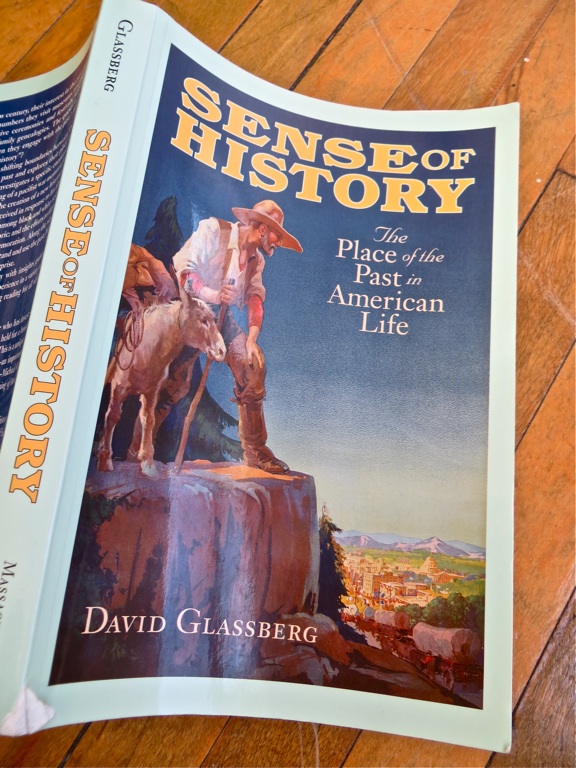
David Glassberg, “Sense of History: The Place of the Past in American Life” (2001)

In David Glassberg’s 2001 work, Sense of History, he says that to have a sense of history is to have a sense of the deep culture of a particular place. This historical sensibility is akin to having spatial and temporal sensibilities, or knowing what happened in particular locations at particular points in time. According to Glassberg, it is “not quit territoriality, as among other animals, but a sense of locatedness and belonging.” It is knowing and being conscious of kinship and ancestral bonds, and how these bonds are fixed to particular landscapes. For many, it is “at the core of who they are and the people and places they care about.” To have a sense of history is to know about previous generations that have traveled and inhabited the landscape. To have a sense of history is also to have a sense of Public History, a forum where ideas from the public and academics intersect, and how these groups bring infinite meanings to particular places in space and time. (Glassberg, 2001: 6-8)

The range of this sensibility is communicated through several case studies, from First World War memorials in Orange, Massachusetts to the thirteen-hour Civil War photomontage marathon organized by Ken Burns and financed by a variety of public and corporate sponsors. In his introduction, Glassberg references Wallace Stegner and Eric Hobsbawm. A Stegner quote fortifies Glassberg’s argument, as “No place is a place until the things that have happened in it are remembered in history, ballads, yarns, legends, or monuments.” (Glassberg, 2001: 19) In the case of the recently deceased Hobsbawm, Glassberg references his 1983 co-authored work, The Invention of Tradition. In short, this work explores how one generation after another envisioned themselves as having a kind of timeless connection with the customs of the past. Glassberg also aptly references William Faulkner, Toni Morison, and Louise Erdrich, individuals who through fiction and prose develop an identity by remembering land- and city-scapes from earlier years.

This developed identity means that when we think of, say, Erdrich, we immediately associate her with her descriptions of the Red River, or of Wahpeton, North Dakota, or with her sisters, or with her bookstore in Minneapolis, Minnesota. It is similar with Stegner, as he is inextricably bound to East End, Saskatchewan, and the same goes for Walter Webb, N. Scott Momaday, Ernest Staples Osgood, Paul Sharp, Gilbert Fite, Willa Cather, and Glenda Riley, all of whom worked toward creating a sense of Great Plains history and culture.

David Glassberg, "Sense of History: The Place of the Past in American Life" (University of Massachusetts Press, 2001).

David Glassberg, “Sense of History: The Place of the Past in American Life” (University of Massachusetts Press, 2001).

Individuals throughout time can associate with, reject, or fix their own particular stories to perceptions that authors and historians have had about certain landscapes. When a culture becomes familiar with a common set of stories, that culture is able to fixate on and relate to one another. And when an economic developer sans a sense of history takes the reigns and proposes a new project, Historic Preservationists are, at best, there to kindly remind the developer that to alter the land- and city-scape is to rub out a livable past. In Glassberg’s words:

We live in landscapes dense with both histories and memories, idealized images of the past that compete to become the standards we use to evaluate and shape our present environment. Personal recollections of past places stand against a flood of place images created for us, from guidebooks and maps published by local civic organizations that recognize some “historical” places in our community but not others, to the generic images of past American landscapes and smalltown life… History in all its varieties guides our sense of where we live, contributing to our perception of the traditions that make our place distinctive. (Glassberg, 2001: 126)

To think of Glassberg’s work in a world historical context requires that we think of each location in space and time as having its own sense of history. This indeed complicates our understanding of the past, but this complexity is nothing new. Historians, for example, that boasted the virtues and lessons of Western Civilization had one understanding of, say, Herodotus and his world, and this was much different than the understanding that Herodotus had of himself and his surroundings. This is also similar of a historian from China writing about the Mongolian hordes, or the Mongolians themselves writing about a conquest of the EurAsian steppe, from Beijing to Baghdad and to the edges of Poland and eastern Europe. In large part historians, or Public Historians, absorb methodologies set down by R.G. Collingwood in the 1930s and 1940s, at least before he collapsed and died from a brain aneurism (arguably due to his synapse firing on protracted overdrive for the duration of his life). Collingwood called on historians to first develop a philosophy toward history. That philosophy was defined as a professional ability to understand the way in which people understand or understood their world.


Memories and Material Culture for the State Historical Society of North Dakota

This is a historic pony truss railroad bridge that spans the Missouri River between Bismarck and Mandan. It is a cultural icon, and has an infinite amount of individual stories attached to it. If someone were to destroy or replace this bridge in the name of "progress," it would seriously hurt and damage the living local history and culture of Bismarck and Mandan.

This is a historic pony truss railroad bridge that spans the Missouri River between Bismarck and Mandan. It is a cultural icon, and has an infinite amount of individual stories attached to it.

Think of this for a second: one of the primary interests and concerns of historians is that memories are fixed to the stuff we use and live with. Memories are also fixed to the stuff that our parents, grandparents, and great grandparents used (landscapes, homesteads, historic buildings and structures included).

I recently received an e-mail forward from archaeological comrade and colleague Amy Bleier, Research Archaeologist with the State Historical Society of North Dakota (SHSND). As the lot of us within range of Bismarck already know, the SHSND is experiencing a much-needed expansion. This also means that Len Thorson, the Registrar with the SHSND, is looking for material culture, or 3-dimensional objects, or what we call “stuff.”

Stuff is much more meaningful if it has those stories and memories fixed and secured to it. And it allows historians to do what historians are trained to do: track change through time.

Thorson sent out the following e-mail the other day. It is cut and pasted below. In Thorson’s words:

The Museum Collections Committee is looking for contemporary items from North Dakota businesses and organizations that you have purchased and/or used… or someone you know who would be willing to donate objects to the SHSND. The items should be relatively small (for space considerations). A history of the object(s), along with appropriate documents and photographs, would add much historical significance to the objects.

Examples include product packages from Cass Clay, Hugo’s Family Marketplace, Dakota Pasta, Noodles by Leonardo, Red River Commodities/SunGold Foods (SunButter), HIT Inc. products, or many other products listed on the Pride of Dakota webpage: http://www.prideofdakota.com/

Other items (used in ND) we are seeking include: beekeeping equipment and supplies; Highway 10 memorabilia; items showing ND school consolidation; solar power devices; objects from the Bank of North Dakota; contemporary powwow related items; contemporary immigration related items; and modern agricultural items such as GPS equipment, and air seeder/drill parts, etc.

If this is something you wish to participate in, please let us know, but PLEASE don’t bring objects in for us to view. Simply reply to this e-mail, or even better, provide the information requested below. The information requested by us may also be sent online via the form at http://www.history.nd.gov/data/padq_emailform.html

Consider this. It is important. If you have some sweet modern artifacts — in the business, we often call this contemporary or modern archaeology and history — with a memory attached to it, you might contact Registrar Thorson, or anyone from the SHSND Museum Collections Committee. It is by and for North Dakotans.


Gerald Friesen, “The Canadian Prairies: A History” (1984)

Published in 1984, the synthetic work that is Gerald Friesen’s The Canadian Prairies incorporated hundreds of books, articles, and government reports to give readers a glimpse of the long historical processes — Fernand Braudel’s longue durée — that unfolded within the western interior of Canada from 1600 up through the middle of the twentieth century. The book begins with a general introduction of the geology that shaped the region’s physiography, an area that is organized into three parts. In the east is the prairie, and west of that is a step (or steppe) up to the parkland, and then higher yet the forest. The prairie is the area of the Red River Valley and Lake Agassiz basin, and as Friesen says it rolls “seemingly without end north and west.” The parkland region is composed of gentle rolling hills and valleys, with prairie potholes and fertile soil. Further west of the parkland is the northern extension of the Rocky Mountains and the Boreal Forest. This area has outcroppings of rocks, frigid lakes, and a portion of forest that is part of a broader network of spruce and pine that extends from Newfoundland to Alaska. (Friesen, 1984: 3-9)

"Fur trade posts of the west." (Friesen, 1984: 96)

“Fur trade posts of the west.” (Friesen, 1984: 96)

Throughout the narrative, culture constantly interacts with the natural world. The year of 1840, however, provides an industrial point of demarcation within this synthesis, and within the history of the Canadian interior. Prior to this, human inhabitants relied much on the broad and gradual swings of nature. Rivers served as transportation routes, and river courses often influenced the direction of trade flows and Native American diplomacy. Rivers, lakes and potholes also provided vegetation with a permanent water source, and where there was vegetation, bison would certainly gather. The global industrial revolution, though, eventually made available such things as steamboats, firearms, agricultural implements, and railroads, and by the latter half of the nineteenth century, the interior of the Canadian west had been altered as never before. The Canadian government favored settlers, and Native American nomads became “wards of the state — put bluntly, they would be treated as children.” (Friesen, 1984: 129)

Two of the passages in Friesen’s work that explain this cultural change come in the form of primary and secondary sources. As a primary source, Friesen quotes Isaac Cowie and his wagon-train experience when maneuvering through a herd of bison. Cowie said in,

…the midst of the herd, which opened in front and closed behind the train of carts like water round a ship… the earth trembled day and night… as they moved… over the inclinations of the plains. Every drop of water on our way was foul and yellow with their wallowing and excretions. (Friesen, 1984: 8)
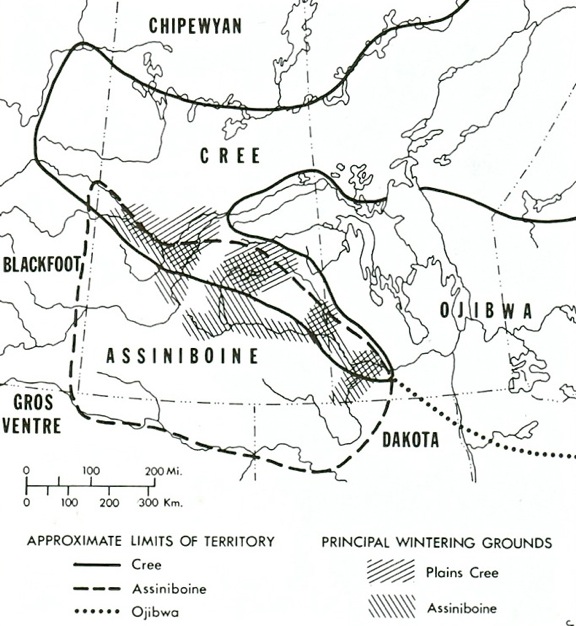
First Nations and Native American boundaries circa 1820. (Friesen, 1984: 94)

First Nations and Native American boundaries circa 1820. (Friesen, 1984: 94)

Further in Friesen’s work is his own anthropological understanding of the furious alteration of old ways that were increasingly giving way to global industrialization. Commenting on the Cree, and placing the reader in that perspective, Friesen said,

A typical Cree youth might have been hunting buffalo and raiding for horses in the 1860s just as his grandfather had done sixty years before; in the 1870s, he might have succumbed to the whiskey trade or been struck by an epidemic; almost certainly he would have been removed to a reserve and perhaps even taught the rudiments of agriculture. In the 1880s, some of his children might have been attending school, and he, having faced starvation for three or four years in succession, might have participated in the violence associated with the 1885 uprising… the buffalo had disappeared, trains and fences and towns now dominated the plains, and the old ways had disappeared beyond recovery. (Friesen, 1984: 130)

Further thoughts on this induce a reader to consider how global population movements before and after the 19th century industrial revolution shifted and altered indigenous customs and habits with a rapidity never before seen or experienced. Localized accounts of this come in the form of Fort Whoop Up, and the expansive network of railroads that eventually eclipsed the smaller fur trade forts. Friesen is good at explaining this in a way that leads readers to envision themselves as individual Native Americans looking at endless waves of non-Natives and invaders colonizing their traditional lands. This, indeed, is the epitome of good history: it is not elevating one side at the expense of another. Rather, the good and excellent historian allows the reader to understand all sides, and how conflict and disorder came about and what resulted from it.

By the first half of the twentieth century, immigrants had flooded into the Canadian interior, and the result was cosmopolitan chaos. Again, Friesen’s prose shines as he places the reader into Winnipeg circa 1900.

To descend from the train at the CPR [railroad] station in Winnipeg was to enter an international bazaar: the noise of thousands of voices and a dozen tongues circled the high marble pillars and drifted out into the street, there to mingle with the sounds of construction, delivery wagons, perambulatory vendors, and labour recruiters. The crowds were equally dense on Main Street, just a block away, where shops displayed their wares in a fashion more European than British North American: fruits and vegetables, books and newspapers, coats and jackets stood on sidewalk tables and racks, even on the outer walls of buildings when weather permitted. (Friesen, 1984: 243)

This continues, as Friesen remarks on the smells of fresh earth and milled lumber from the Boreal Forest resulting from localized construction projects in downtown Winnipeg. He tempers the progress of nostalgic development with smells of “beer and whisky and sweat and horse manure” so that a reader does not get lonesome for a manicured past that never was.

Friesen’s synthetic narrative is a likely starting point for that long duration of the history of the Canadian west. In his introductory and concluding remarks, he chose to celebrate rather than chide the “superficial friendliness that makes daily contact between people of very different backgrounds not only possible but likely.” (Friesen, 1984: xiii) In 1984, Friesen looked kindly on the culture of the Canadian plains and prairie, and this is a marked difference from how Wallace Stegner portrayed it in 1955. For Friesen, curling represented “a most democratic sport,” while all Stegner could see in curling was the absence of tennis. In a large way, Friesen checked any kind of disappointment or snobbery at the door. This is not to throw Stegner under a bus or bison stampede. Rather, it demonstrates that throughout time, perceptions change, both for individuals who are direct participants in the past, and individuals who study and interpret their behavior. This, in a large way, is just as much a reflection of the culture the historian is studying as it is as the culture that the historian comes from.

Glenda Riley, “The Female Frontier” (1988)

Glenda Riley opened her 1988 work, The Female Frontier: A Comparative View of Women on the Prairie and the Plains, by lobbing a volley towards past Great Plains historians. Riley justified this volley by drawing from questionnaires she circulated to academics, students and lay people in the 1980s. (Riley, 1988: 14) She said that while academics were largely skeptical of the traditional myth and image of women on the Great Plains, it was students and laypeople that continued to accept these traditional images and myths. Within the first three paragraphs of chapter 1, she said Frederick Jackson Turner, George F. Parker, Everett Dick, Walter P. Webb, et al., were largely responsible for portraying frontierswomen as “one-dimensional stereotypes.” Women were often victimized as passive agents who were “gaunt and sad-faced… sitting on the front seat of the wagon, following” their “lord where he might lead” her. Or women were portrayed as “leathery, stooped, and lifeless figures who either begged to return home or persevered until they were broken entirely.” Riley uncovered a body of knowledge that undermined the “puerile stereotypes” ascribed to women on the Great Plains and in the American West, and she challenged a traditional way of looking at the past. (Riley, 1988: 1-2)

The historiographic crux of Riley’s argument elevated culture as the primary determinant of understanding how frontierswomen carried on their lives, and through this she discounted the environmental determinism Walter Webb advanced in his 1931 work, The Great Plains. (Riley, 1988: 12) Riley organized her work into two categories, and this included 1) women on the Prairie; and 2) women on the Plains. Women did much more than follow their lords. They managed households, preserved familial, religious and ethnic traditions by acting as local historians, Bible recorders, and genealogists, they shaped their domestic and local economy, and they participated in community and civics.

In this, Riley aptly accounted for the cultural roles of women, and also men. She said the socio-economic system of the nineteenth century required men to be “the primary breadwinners,” and this meant that women were expected to marry. (Riley, 1988: 15) If women wanted something else, they often would not marry, or they “forswore marriage entirely.” Instead, they could enroll in religious institutions that had missions dedicated to improving healthcare and education for the needy, unfortunate, or downtrodden. For example, in 1853 the Sisters of St. Joseph’s built the first hospital in St. Paul, Minnesota, and in 1872, the Sisters of Charity (or the Grey Nuns) came to Dakota Territory. Eight years later the Sisters of the Presentation of the Blessed Virgin Mary arrived. Once in the territory and on the Great Plains, they set out with the progressive mission of improving educational and healthcare facilities for otherwise marginalized groups. (Riley, 1988: 19)

Several thoughts came to mind while reading Riley’s work. The first was how breaking into established cultural orders and institutions can take on at least two forms. One way to change tradition and reframe the conversation is to go through back channels within the established institution, and try to reform it from within. Another way is to publicly denounce the institution. In the sense that Riley published her work in an academic press, it appears that she utilized both courses. She networked and made contacts within academic publishing houses, and they eventually printed her scholarship. This in turn brought about change in the historiography of the Great Plains and the American West, and this is at least one broad roadmap for any historian to incorporate and follow.

Another thought was that in 2013, Riley’s 1988 volley toward the traditional historians of the Great Plains and American West might at first read a bit bombastic. It does not read bombastic in the sense that Riley was out of line. Not in the least. Rather, it is a reflection of pathfinders and scholar-activists who, in some ways, appropriated and used the type of academic rhetoric that was used to marginalize them in the first place. In other cases, Riley’s rhetorical flourishes ensured that women — her included — would not be ignored. For Riley to call foundational historians of the American West “puerile,” and in an academic press, almost guaranteed that historians would have to bring their attention to bear on her and her scholarship. In this sense, Riley could also have a different sub-title to her book that read something along the lines of, The Female Frontier: A Comparative View of our Grandmothers and Great Grandmothers on the Prairie and Plains. This alternative and fictional sub-title might speak a bit more to 21st-century heritage and Public Historians rather than to 1980s feminist history.

A final remark about the continued shift in women’s scholarship looks to how Euro- and Anglo-American women view themselves, and how Margaret D. Jacobs treats this group in her 2011 work, White Mother to a Dark Race: Settler Colonialism, Maternalism, and the Removal of Indigenous Children in the American West and Australia, 1880-1940. But that is easily a topic and point of consideration for another review.