Tag Archives: Great Plains History

N. Scott Momaday, “The Way to Rainy Mountain” (1969)

N. Scott Momaday, The Way to Rainy Mountain (1969) set the Kiowa oral history to print, and in the 1994 preface, Momaday explains how the work is split into three voices. The first voice is that of Kiowa oral and ancestral history, the second is a type of historical commentary, and the third is the personal memoirs of Momaday himself. For this reason the entire work is a kind of historiography, or the way in which historians remark, opine and reflect on the works of their predecessors. The importance of The Way to Rainy Mountain is not only that it sets an oral history to print, but also that it allows non-Kiowa individuals access to the depth and scope of Kiowa culture. Momaday demonstrates how the Kiowa interacted with the Great Plains over generations and have a genealogical investment in the landscape.

Like many cultures throughout the world, the Kiowa were nomadic, and their oral history and legend reflects this. Genesis for the Kiowa took place when the Kiowa as a people emerged from a hollow log in the “bleak northern mountains” of today’s Montana. (Momaday, 1969: 3) They eventually ended up in central Oklahoma, but along the way they impressed stories of themselves into the land. The Kiowa, for example, “made a legend” at the base of Devil’s Tower in northeastern Wyoming, and connected this legend with the astronomy configuration known as the Big Dipper. Momaday’s grandmother said:

Devil's Tower illustration by Al Momaday in N. Scott Momaday, "The Way to Rainy Mountain" (1969), 9.

Devil’s Tower illustration by Al Momaday in N. Scott Momaday, “The Way to Rainy Mountain” (1969), 9.

Eight children were there at play, seven sisters and their brother. Suddenly the boy was struck dumb; he trembled and began to run upon his hands and feet. His fingers became claws, and his body was covered with fur. Directly there was a bear where the boy had been. The sisters were terrified; they ran, and the bear after them. They came to the stump of a great tree, and the tree spoke to them. It bade them climb upon it, and as they did so it began to rise into the air. (Momaday, 1969: 8)
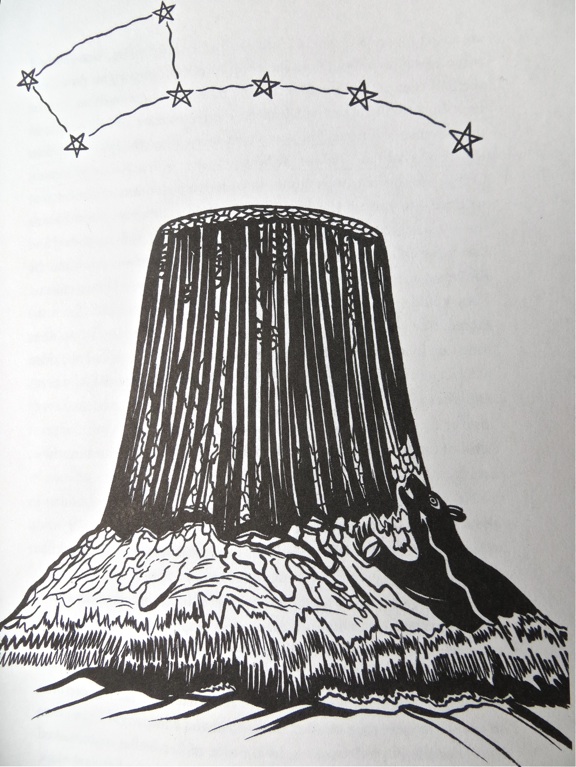
The bear scraped its claws along the base of the tree stump, and eventually the seven sisters rose from the top of this stump into the sky to become the Big Dipper. This story allowed the Kiowa to immediately identify with the Big Dipper, and with today’s Devil’s Tower. So long as the Kiowa were under a clear sky at night, the sight of seven ancestors shining starlight down on them could always provide them with comfort.

The second segment of the book, “The Going On,” opens with anecdote, a story about an old man, a wife and child. The child, innocent to the workings of the world, repeatedly asks his mother for food, leaves the house with it, and returns empty handed only to ask for more food. The third time the child returns, but with an enemy. This enemy tells the family of three, “There are many of us and we are all around. We came to kill you, but your son has given me food. If you will feed us all, we will not harm you.” (Momaday, 1969: 44) The old man is highly suspicious of this offer. His wife obliged the enemy’s request and began cooking while the old man secretly led his horses upstream. After bringing his possessions out of danger, the old man “called out in the voice of a bird” to his wife. She then set fire to the animal fat and tallow, threw it on the enemies, picked up her child and ran to the old man. The story might be used to explain the innocence of children, as enemies or malicious people can easily manipulate them. It could also be used to explain how it is wise to be skeptical of outsiders. In the kinship sense, this story also explains how the family of three looks out for one another.

The utility of anecdotes and stories such as these in any culture is multifaceted, and even biblical. To understand the Kiowa requires a degree of analogy (In The Landscape of History, [2002] Lewis Gaddis remarked on the importance of analogy for this and other reasons). The Kiowa and other cultures throughout the world infused stories and oral history into the physiography, and by this the culture became interconnected with the landscape and surroundings. Momaday’s 1969 The Way to Rainy Mountain was published almost 25 years after the revolt of the provinces, and almost 4 decades after the publisher of the University of Oklahoma Press called on academics and scholars to study Native America with the same intellectual rigor that they had brought to bear on Mediterranean culture.

Momaday’s work also communicates a kind of finality to this culture and others, and this also smacks of Stegner’s Wolf Willow (1955) and Kraenzel’s Great Plains in Transition (1955). Yet at the same time, it also brings about the notion found in Dorman’s Revolt of the Provinces (1993), specifically with John Joseph Mathews, Wah’Kon-Tah: The Osage and the White Man’s Road (1932). When the artists, scholars and literary figures revolted in America’s provinces and periphery during the interwar years (between WWI and WWII), Mathews finally found that the way to preserve and become a proponent of a culture was not necessarily to just recount and study it. (Dorman, 1993: 70-71) This was a part of it, but to truly locate authentic culture required the individual to become a practitioner and contributor to that historic cultural process. In this way, Mathews solved his 1930s dilemma through art, and specifically through Native American Art. Considering that Momaday published The Way to Rainy Mountain in 1969 raises the question as to whether a second volume is necessary to expand on and continue what Dorman ended in 1945. I certainly think so.
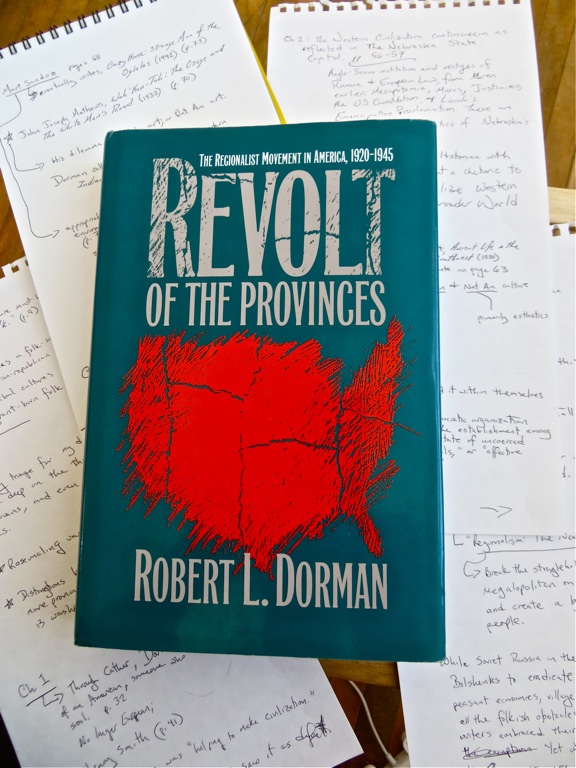
Robert L. Dorman, “Revolt of the Provinces: The Regionalist Movement in America, 1920-1945″” (1993)

In the 1993 work, Revolt of the Provinces, Robert L. Dorman defines “regionalism” in his introduction with trans-historical discourse between 18th century J. Hector St. John de Crèvecoeur and 20th century Lewis Mumford. In the pre-Industrial and Industrial cases, Dorman says Crèvecoeur and Mumford spoke of “the transformation of the immigrant into the indigenous,” or the way in which the recently arrived abandoned or restructured previous ways of doing things. In Crèvecoeur’s time, this meant the European, once they stepped on to the eastern American seaboard, was no longer shackled by the “medieval synthesis” of the Old Country. Approximately 200 years later, Mumford, in 20th century Industrial America, worried how the increasingly hyper-Industrialized world fragmented Crèvecoeur’s 18th century America. Writing from an “enclave in the midst of an industrial desert,” Mumford said “Something of value disappeared with the colonization of America,” where industrialization and modernity had ruptured a common “social heritage.” Mumford then proceeded to ask why it, the common social heritage, disappeared? (Dorman, 1993: 1-7)

DormanThis draws attention to the impetus for the regionalists’ approaches between 1920-1945. It was both a searching out for and cultivating of that lost common, social heritage. Both Crèvecoeur and Mumford could agree that heritage was “a genuine American culture,” and this culture was “grounded on the concept of the folk.” (Dorman, 1993: 9) In the first half of the twentieth century, a regionalist began to think of folk and folk traditions as

organic, but not merely in the sense that they enfold and help to constitute the personal identity of the individual. They are organic as well to a place, symbiotic and indigenous to a specific regional environment… The folk are settled, stable, a veritable human “climax-community,” to borrow a term from ecology. (Dorman, 1993: 9)

To a regionalist, the folk embodied a kind of cultural stability. Following the Great War, regionalists throughout America gained a greater collective intelligence as to exactly what they wanted to do, and they ultimately turned regionalism into a civic religion. The regionalist movement sought to emancipate individuals from the industrial, scientific and standardized shackles of mass culture. Dorman explains how academics, novelists and scholars captured and cultivated the civic religion of regionalism throughout America between the first and second world wars. His first chapter opens with a Willa Cather quote from O Pioneers!, and that is how “The history of every country begins in the heart of a man or a woman.” In this singular sentence, Cather is remarking how individuals in their own particular localities have a particular spirit, a genuine love or heart for a place, and through this a sense of history and community is cultivated.

We see this in Cather’s My Ántonia (1918), and also in Walter Prescott Webb’s The Great Plains (1931). In this latter case, Webb’s work is no doubt tinged with Anglo-Ameri-centrism (what we might call Social Darwinian Racism-Light). But what Webb also attempted to do with The Great Plains was to cultivate historical memory in a particular region of America, and through this forge a common identity. By doing this, perhaps, the folk from the physical Great Plains could indeed have their differences — amongst the southern, central and northern Plains — but also be capable of a kind of unity. Through this unity, the folks on the Great Plains could identify with one another, and thereby oppose, navigate or manage non-Great Plains folks all the more (in many ways, this was a mission of Bernard DeVoto’s, a contemporary of Webb’s. At every opportunity, DeVoto played the America West, a plundered province, off of the east coast Fat Cat Tycoons and the Federal Government). Dorman’s monograph also can be contextualized with the 1950s works of Wallace Stegner and Carl Kraenzel. When Stegner wrote Wolf Willow (1955) and Kraenzel wrote The Great Plains in Transition (1955), they both considered the Great Plains and the American West in what they thought of as a kind of failed afterglow of the regionalist movement from 1920-1945.

In a closing (but by no means a final) remark, it is also interesting to consider Dorman’s subjects in a broad theoretical, history-of-ideas scheme of things. This regionalism was a part of a global movement, something that could be likened to R.G. Collingwood’s idealist and aesthetic reaction to the late-19th century “scientific positivism.” In a way, Dorman hints at this global movement when he compares American Regionalists to what was happening at the time in the Soviet Union. But he would have been better to compare Cather, Webb, Henry Nash Smith and Mari Sandoz to, for example, Vasily Grossman and his humanism, this instead of comparing American regionalists to official Soviet policy. While Soviet Russia in the 1930s encouraged Bolsheviks to eradicate regionalisms — peasant economies, village ties, languages, churches, all the folkish obstacles — so did Washington, D.C. encourage a much softer version of such policy, one that is laid out, for example, in Margaret D. Jacobs, White Mother to a Dark Race: Settler Colonialism, Maternalism, and the Removal of Indegenous Children in the American West and Australia, 1880-1940 (2011). In the first half of the twentieth century, Industrial Capitalism and Industrial Communism — or, to capture them both, Industrial Modernity — imposed itself on the world and its regions. In our post-Cold War, 21st century world, scholars are perpetually in a position to push global, regional and public historical knowledge in infinitely new directions, and Dorman’s 1993 work has set down an excellent foundation.


Woody Guthrie Defines Folkways and Folklore

I’m currently revisiting Robert L. Dorman’s 1993 monograph, Revolt of the Provinces: The Regionalist Movement in America, 1920-1945 (Chapel Hill & London: University of North Carolina Press). Remarks on Dorman are on the way, but I wanted to pass the Guthrie excerpt along first. At the outset of chapter 5, Dorman opens with a piece of correspondence Woody Guthrie sent to Alan Lomax on September 19, 1940. Within, Guthrie expanded on the philosophy, or the why, of a folk song. Verbatim, as the tail end of the Great Depression slipped further and further in to the Second World War, Guthrie said,

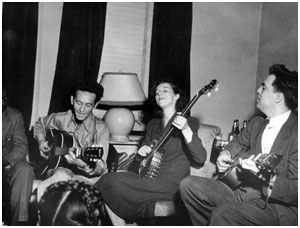
Left to right, Sonny Terry (obscured), Woody Guthrie, Lilly Mae Ledford and Alan Lomax in New York, 1944. Photo online with The Library of Congress, Alan Lomax Collection.

Left to right, Sonny Terry (obscured), Woody Guthrie, Lilly Mae Ledford and Alan Lomax in New York, 1944. Photo online with The Library of Congress, Alan Lomax Collection.

A folk song is what’s wrong and how to fix it, or it could be whose hungry and where their mouth is, or whose out of work and where the job is or whose broke and where the money is or whose carrying a gun and where the peace is — that’s folk lore and folks made it up because they seen that politicians couldn’t find nothing to fix or nobody to feed or give a job of work. We don’t aim to hurt you or scare you when we get to feeling sorta folksy and make up some folk lore, we’re a doing all we can to make it easy on you. (Dorman, 1993: 145)

That is the power of a good folk singer: someone who can speak and sing in a focused enough way to reflect the localized realities of the times, and with enough abstraction to speak to the ages. In this regard, Guthrie was a genius creator and producer of folklore, certainly a reflection of the folk of his times. Note: Woody’s acoustic guitar and folk songs killed fascists, too.


Wallace Stegner, “Wolf Willow: A History, A Story, and A Memory of the Last Plains Frontier” (1955)

There is a duality that comes to mind when reading Wallace Stegner, Wolf Willow (1955), and it centers on the push and the pull between the country and the city. To Stegner, the villages of Eastend and Whitemud in southwest Saskatchewan represent both an idyllic countryside as well as rural idiocy. This stands in contrast to how a city is perceived, as it embodies a sense of the cosmopolitan on the one hand, and political and business corruption on the other. When the country and the city are played off of one another, one has a choice between the rural idiocy of the countryside, or the cosmopolitan corruption of a city.

In the case of Wolf Willow, Stegner focuses on remembering Whitemud as a former attempt of Western Civilization colonizing the Great Plains with a cosmopolitan ethos. A generation later, though, Stegner says these settlements devolved into rural idiocy. He is pointed and upfront about it in the first paragraphs of his final chapter, saying how Whitemud,

…is an object lesson in the naïveté of the American hope of a new society. It emphasizes the predictability and the repetitiousness of the frontier curve from hope to habit, from optimism to country rut, from American Dream to Revolt against the Village… That curve is possible anywhere in America, but nearly inevitable on the Plains, because on the Plains the iron inflexibilities of low rainfall, short growing season, monotonous landscape, and wide extreme of temperatures limit the number of people who can settle and the prosperity and contentment of the ones who manage to stick. (Stegner, 1955: 287)

This statement stands in contrast to his remarks in the opening of the book, where he remembers his boyhood as a “childhood of freedom,” this adolescence unadulterated with impressions of Western Civilization, history, and professional training. (Stegner, 1955: 25 & 27)

From beginning to end, Wolf Willow is an evolutionary remembrance of Stegner’s intellectual development, and how he chose to remember this upbringing. As an adult who returned to visit Whitemud and Eastend, he was at once in a place of countryside idiocy, a landscape he described as a “backwater peasantry incapable of the feeblest cultural aspiration.” (Stegner, 1955: 288) This smacks of his adult inability to understand his childhood, a rejection of his past for a possible alternative that never was nor could have been. For Stegner to learn about and ridicule Western Civilization on the Great Plains smacks more of his own familial past: this should easily be considered as a way in which Stegner mocked himself. This is why Wolf Willow should be understood as Stegner’s essay on his own personal identity, a tension between his professional city life and the frontier childhood he remembered in southwest Saskatchewan. Memoirs and narratives are set down so individuals can establish a linear way of looking at the path they have already made. In this way Stegner’s Wolf Willow is, as he describes it in the sub-title, a memoir and even a confession. As right and as wrong as Stegner is within this work, it remains an individual and personal contribution to that long Great Plains historical record.


Carl F. Kraenzel, “The Great Plains in Transition” (1955)

Writing from Tehran, Iran, circa 1955, Carl Frederick Kraenzel produced a work that recovered a component of regionalist memory for the inhabitants of the Great Plains. It is a, and not thee, component, because the work is consciously or subconsciously written from the Euro-Ameri-centric position. Regionalism, however, was and is a universal concept. Kraenzel defined it as a unique and “democratic ordering and programming of the economic, social, and living activities of the residents of a common area, through political and all other avenues.” Regionalism enabled the greatest possible advantages to the local residents and, with a bit of idealism, Kraenzel also said it best benefitted nation-states and, ultimately, the globe. (Kraenzel, 1955: 8) In other words, it was a system by and for local inhabitants. The Great Plains had experienced bursts of regionalism in the first half of the nineteenth century. In the beginning of the second half of the twentieth century, Kraenzel said that unless industry was developed by and for regions throughout the Great Plains, it would simply result in “antidemocracy.” (Kraenzel, 1955: 384)

Within The Great Plains in Transition, Kraenzel’s initial chapters outline the physiography of the Great Plains, and some early explorers from the Spanish, British and French empires. This includes Villazur’s (1720) and Coronado’s (1540-42) incursions onto the central and southern Great Plains, as well as the Mallet Brothers (1739-40). The first European to record their journeys at length on the northern Great Plains took place in 1742-43 with La Vérendrye and company, and five decades later with the Mackay and Evans expedition. After the founding of the American nation, though, and in the first half of the nineteenth century, mountain plainsmen had established themselves, and they started cultivating a set way of doing things — or a regionalism — throughout the Great Plains and Rocky Mountains. Individuals such as Jim Bridger, John Colter, Jebediah Smith and Kit Carson brought about a common Euro-American culture between 1803 and 1846. Mountain plainsmen would hunt, kill and harvest furs and pelts throughout the Rockies and Rocky Mountain basin, and then bring the items into the fur trading forts established along the river networks (such as this one linked to here).

Nineteenth century routes across the Great Plains.

Nineteenth century routes across the Great Plains.

In the second half of the nineteenth century, pioneers and settlers also charted disparate routes across the plains in an effort to reach Texas, California, and Oregon. The routes included the overland Santa Fe and Oregon trails through the southern and central plains, and the Missouri River on the northern Great Plains. Eventually Anglo-American cattlemen appropriated some aspects of Gaúcho culture and brought it on to the Great Plains, but this culture was short-lived and within a couple decades devastated by industry and outside interests. In all, these individuals were perpetually in transition, and the Great Plains was a place to cross rather than a destination.

In all of this, it is worth remembering that Kraenzel wrote more from a perspective of a social scientist than from a historian of the humanities and liberal arts, and certainly from the vantage of a labor historian. Throughout this work, Kraenzel deepened the readers understanding of the otherwise scattered and complex European and Euro-American past of Great Plains culture. In 1955, this could easily have grounded inhabitants of the Great Plains who experienced some waves of post-WWII out-migration — would, they thought, the depopulation of the North American steppe ultimately end up as a return to a kind of buffalo commons? It did not, of course. And this largely had to do with co-operatives that Great Plains-men and –women organized in an effort to compete with outside Corporate interests and Federal programs. In some closing words, Kraenzel says

The co-operative movement… is that middle road between state or corporate capitalism on the one hand, which in its extreme instances can manifest itself as a kind of Fascism or Nazism, and socialism on the other hand, which in its extreme forms becomes a kind of militant communism. (Kraenzel, 1955: 385)

A summer 2012 photo of the elevator co-operative in Fessenden, Wells County, North Dakota.

A summer 2012 photo of an elevator co-operative in North Dakota.

This statement exemplifies why Kraenzel called for a heightened regionalism throughout the Great Plains in 1955, and it is universal gravity for ideologues aloof with a superficial understanding of the history of co-operatives. If one is from the central and northern Great Plains, one will have directly and indirectly benefitted from these co-operatives. Thus, co-operatives and regionalisms are an essence of Great Plains memory and identity, both in 1955 and in 2013.


Gilbert C. Fite, “The Farmers’ Frontier, 1865-1900” (1966)

In the final pages of Gilbert C. Fite, The Farmers’ Frontier, 1865-1900 (Holt, Rinehart and Winston, 1966), Fite used Walter Prescott Webb’s environmental determinism from The Great Plains (1931) as a point of departure. While Webb said a cultural breakdown came from the flat, treeless and semiarid Great Plains, Fite countered this and said it “was a symptom of the basic problem and not the problem itself.” (Fite, 1966: 222-223) With the absence of wood, settlers to the Great Plains used sod, traded the hand pump for a windmill, and used barbwire instead of wood picket and stone fences. According to Fite, any study of the Great Plains ought to oblige environment but amplify culture and the individuals as the key determinants who acted and reacted to one situation after another. Individual farmers managed labor and resources on farmsteads and “fit conditions on the Great Plains.” (Fite, 1966: 223)

From 1865 to 1900, the Great Plains underwent several Euro-American changes. The frontiersman eventually gave way to the miner, and mining communities created demands for beef that cattlemen and cowboys could supply. Before the arrival of the farmers, though, the Euro-American miner brought this singular industry to the American West. For example, in 1860, the United States Census reported that Colorado had a miner population of 22,086, a saloonkeeper demographic of 175, and a total of 195 farmers. (Fite, 1966: 11) This did not result from a culture of ideology, though. Rather, it resulted from the chaotic settlement and mechanization of the Great Plains, and a change of the Great Plains as the “Great American Desert” to a great American farming oasis. Following the American Civil War, farmers increasingly established themselves in the mining areas of Fort Benton and Bozeman, and in the Bitterroot, Beaverhead, Prickley Pear and Gallatan valleys of Montana, in Walla Walla, Washington, the Snake River, Idaho, the Rio Grande, New Mexico, and the Salt Lake Basin in Utah. (Fite, 1966: 11-12)

Amenia, North Dakota in the 1880s. (Fite, 1966: 77)

Amenia, North Dakota in the 1880s. (Fite, 1966: 77)

Individual farmers and corporate managers also took up small and large-scale farming operations on the northern Great Plains. In Dakota Territory in 1860, 123 farms were recorded. Ten years later, Dakota Territory had a total of 1,720 farms. (Fite, 1966: 11 & 36) By the 1870s, railroads had allowed for the advanced Euro-American colonization and settlement of the Great Plains, and this caught the attention of bonanza financiers and corporate managers. Agrarian mechanization took off in the Red River Valley in this period, and in 1875, Oliver Dalrymple purchased several thousand acres just west of Fargo. He eventually formed the Cass-Cheney-Dalrymple bonanza farms, “a compact body about 6 miles long and 4 miles wide, extending on both sides of the railroad,” or a total of 24 square miles. (Fite, 1966: 80)

By 1879, the Dalrymple family had swallowed up more than 10,000 acres in northern Dakota Territory, and Fite explains how this was managed. The land was divided into 1,280, 1,600, 2,000 and 5,000 -acre subdivisions. A foreman’s house was built on each subdivision, as were lodging quarters for the seasonal migrant laborers. Fite said bonanza farming was large-scale, corporate, had absentee ownership, a professional management staff, was highly mechanized, and they dealt in specialized production. To a degree this crowded out smaller-scale farmers, but they also learned about the effectiveness of mechanization, and how to apply it to their own farmsteads.

Threshing on the Dalrymple mechanized bonanza farm, Cass County, Dakota Territory, 1877. Photo with the ND Institute for Regional Studies, 2029.11.1.

Threshing on the Dalrymple mechanized bonanza farm, Cass County, Dakota Territory, 1877. Photo with the ND Institute for Regional Studies, 2029.11.1.

News of the Dalrymple bonanza farm would reach the media, and eventually generate a moneymaking perception for one and all. This perception increased settlement to these areas, and northern Dakota Territory experienced a “boom” up through 1883. To a large degree, it did matter that reporters got the news correct. What mattered even more, though, was that “reports of quick and large profits, even if exaggerated… excited the imagination of thousands of restless settlers and stimulated the rapid westward movement of the 1880s.” (Fite, 1966: 93) Corporate bonanza farms created the perception that any small-scale farmer could make a living and even get rich in northern Dakota Territory. In some cases that perception was realized, and in other cases it was not.

In 1917, a year before Willa Cather published My Ántonia, Fite’s mother filed a homestead claim in northwestern South Dakota, in what Fite referred to as “the very end of the farmers’ frontier in the United States.” (Fite, 1966: ix) By 1966, Fite had five decades from when his mother filed a homestead claim to consider what this localized story meant in the broader, national context. In his piece of scholarship, Fite is not so much concerned with socio-political problems, but rather with what contributed to the rapid farm settlement, processes of labor, and how dirt farmers responded to the particulars of the Great Plains environment. (Fite, 1966: x) The processes were complex, and through this Fite explained how perceptions of the American West shifted, and individuals and corporate managers brought about the beginning and the end of the farmers’ frontier from 1865 to 1900.


Walter Prescott Webb, “The Great Plains” (1931)

WebbIn 1931, Walter Prescott Webb published The Great Plains, attributing the ideas in the book to two earlier works: Emerson Hough’s, The Way of the West, (1922) and Webb’s own piece, “The American Revolver and the West,” published in Scribner’s Magazine (1927). Webb tweaked or discounted some of Hough’s ideas about the west, or the Great Plains, and instead focused on three attributes. The definition of the Great Plains, according to Webb, necessitates 1) level land; 2) an area barren of timber, and; 3) a semi-arid place — somewhere in that proverbial rain-shadow just east of the Rocky Mountains. So long as two of these three elements remained, Webb said the region would have its “cultural character.” (Webb, 1931: 4)

Here in this early statement Webb makes a case to the reader that environment shapes culture. It is a little heavy-handed, though. Of course environment influences culture, but Webb is fairly aggressive in that he said environment determines culture. This determinism, or determinism light, is an outlook that denies historical actors any type of choice, or that individual cause-and-effect. This also denies historical actors a humanist reality: while environment nudges individuals one way and another, individuals are faced with an infinite number of choices, and they still make one localized decision after another based off an infinite number of variables.

Continuing along this deterministic trajectory, Webb focused on a particular ethnicity, and said that “the Great Plains have bent and molded Anglo-American life, have destroyed traditions, and have influenced institutions in a most singular manner.” Again, Webb would do better to have said that the Great Plains induced historical actors to cobble together a variety of solutions if something did not work the first time around. Willa Cather indirectly points this out in infinite ways in My Ántonia (1918), and Ernest Staples Osgood showed how cattlemen formed stockmen’s associations to bring order to ranching in Wyoming, Montana and the Dakotas. Cultures are not destroyed, nor to they “rise” or “fall.” Humans tweak culture, and that culture slowly evolves over time, and turns into hybridized versions and variations.

In any case, Webb alluded to Cather twice in his 525 page study, referring to her novels as “farm literature” full of “ugliness,” “drudgery,” and “tragedy.” (Webb, 1931: 478) In this, Webb reveals his nostalgic and romantic outlook toward the Anglo-American gun-slinging cowboy (who was not a famer), and this is what he is really concerned with: the rise and fall of cowboy culture. He said cattle kingdom literature is filled with “nothing of protest,” nothing of “destructive criticism,” and nothing of “dissatisfaction” — Webb provided basic amplification to the later delusions intrinsic to Spaghetti Westerns in American cinema.

All of this is not said in a way that suggests Webb was conspiring to hide his fondness for the cowboy within his work. This simply means that when reading Webb, remember that he was a typical Texan of his times. His nostalgia for the past ought not to be taken any more or less seriously than anyone else’s nostalgia for the past.[i] One can understand his ideas without having to agree with them. Understanding how scholarship was framed throughout universities and publishing houses in the 1920s and 1930s might bring 21st century scholars to pause and contemplate what cultural baggage we bring to the evidence in otherwise “objective” studies of the past.


[i] For an exegesis on the typical Texan, see Joseph Leach, The Typical Texan: Biography of an American Myth (Dallas, Texas: Southern Methodist University Press, 1952).


Great Plains Blizzards Now and Then

Snow measurements from February 10, 2013, at 7:00PM (CST) in downtown Fargo, North Dakota.

Snow measurements from February 10, 2013, at 7:00PM (CST) in downtown Fargo, North Dakota.

Last week I revisited Walter P. Webb’s 1931 work, The Great Plains. In the coming days, I’ll blog a bit more on Webb’s work. For now, though, Blizzard Orko (as of 7:03PM [CST], February 10, 2013) induced several departments of transportation to close sections of Interstate 29 and Interstate 94 on the northern Great Plains: north-south from Grand Forks, North Dakota to Sioux Falls, South Dakota, and east-west from Jamestown, North Dakota in to Minnesota (the MNDOT’s road condition map I found is more general than decisive about exactly what sections are closed). These closures, or specifically this blizzard, reminded me a bit about Webb’s remarks on Great Plains blizzards, or what he pulled from Clement A. Lounsberry, the Civil War veteran who started The Bismarck Tribune in the 1870s. Of blizzards, Lounsberry  (via Webb) referenced that historically they were known as a

…mad, rushing combination of wind and snow which neither man nor beast could face. The snow found its way through every crack and crevice. Barns and stacks were literally covered by drifting snow, and, when the storm was over, cattle fed from the tops of stacks. Persons lost upon the prairie were almost certain to meet with death, unless familiar with the nature of these storms… I learned of many instances where persons were lost in trying to go from the house to the barn, and of other instances where cords were fastened to the house so that, if the barn should be missed, by holding onto the cord the house could be found again (Webb, 1931: 25)

With this in mind, this evening I took some measurements of snowfall in downtown Fargo. At least 7 1/4″ of snow has fallen (it is now 7PM, CST). Tomorrow winds are expected to intensify, as is snow removal and book reading.


Willa Cather, “My Antonia” (1918)

In 1918, Willa Cather published My Ántonia. It is a novel loaded with Euro-American homesteading experiences from the Great Plains, and it demonstrates how a seemingly isolated place can in fact have international scope. Without saying it so directly, Cather gives the reader a sense of how the Atlantic World brought itself to the Great Plains, and how these individual immigrants faced an endless amount of new frontiers. After developing the characters in the countryside, Cather moves the cosmopolitans in the country from the landscape of the Burden Homestead to a neighborhood in the town of Black Hawk, Nebraska. In this way it is also a novel that considers the contrasts between the country and the town.

Because Cather was a sharp author, it is fairly easy for a reader to reconstruct the landscape of the Burden Homestead. The landscape was inundated with international settlements, with the Russian neighbors of Peter and Pavel to the north, the Bohemian Shimerda family to the west, and the German neighbors to the south. Six miles east of the Burden homestead was the post office, a vestige of an Anglo-American institution that continuously crept further and further out onto the Great Plains and Euro-American frontier. The Burden Homestead itself was a white frame house on a hilltop, and the terrain gradually sloped westward to where the barn, corncribs, and pond were located. (Cather, 1918: 12-13, 15, 20-21) While reading this work, I reconstructed the Burden Homestead landscape from the text, and sketched it out on paper with pen.

Burden Homestead My Antonia 01.30.2013 Reduced SizeOn page 42, Cather also makes brief reference to the material cultural remnants left by Plains Indians, or what may have been a potential Sun Dance. The Euro-Americans are all in disagreement over what it could represent, and this is how Cather explained it. “Beyond the pond,” west of the Burden home, Cather said Jim Burden noticed that,

…there was, faintly marked in the grass, a great circle where the Indians used to ride. Jake and Otto [two hired hands, the latter from Austria] were sure that when they galloped round that ring the Indians tortured prisoners, bound to a stake in the centre; but grandfather [Burden] thought they merely ran races or trained horses there. Whenever one looked at this slope against the setting sun, the circle showed like a pattern in the grass; and this morning, when the first light spray of snow lay over it, it came out with wonderful distinctness, like strokes of Chinese white on canvas. The old figure stirred me as it had never done before and seemed a good omen for the winter.

In this singular paragraph passage, Cather’s piece of fictional prose exposes the reader to several different Euro-American perceptions and theses. There is the stereotypical perception of the “brutal” or “savage” Indian, the wise grandfatherly ballast that considered the plains Indians and their horses, and the mystic and romantic foreshadowing that Jim Burden felt when he viewed the circle in the landscape. In this way Cather’s statement inadvertently touched on several questions raised by humanities scholars and social scientists (historians, anthropologists and archaeologists).

Novels are fantastic in that they help a reader explore the infinite range of human emotion in a way that scholarship often cannot, and this is why My Ántonia is a central piece of fiction in Great Plains and world literature. There is much more to say about this work, and it certainly compliments Ernest Staples Osgood’s 1929 scholarship, The Day of the Cattleman, and Gilbert C. Fite, The Farmers’ Fronter, 1865-1900 (1966).


The Weekend the Music Died

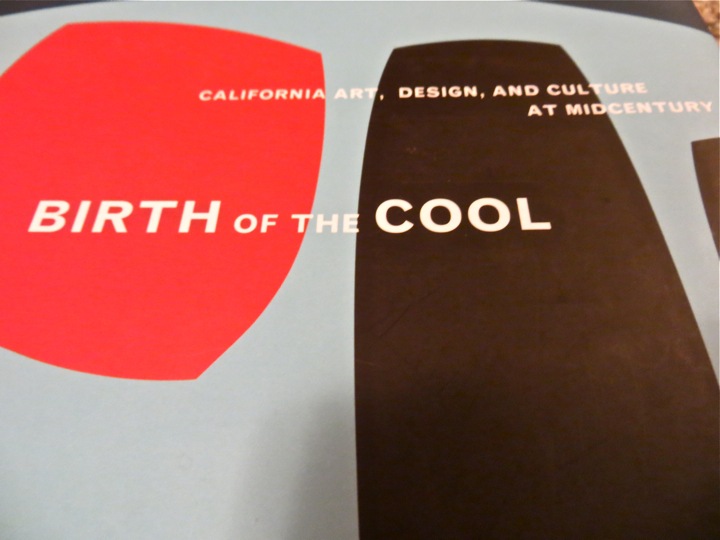
"Birth of the Cool: California Art, Design, and Culture at Midcentury" (Orange County Museum of Art: Prestel Publishing, 2008).

“Birth of the Cool: California Art, Design, and Culture at Midcentury” (Orange County Museum of Art: Prestel Publishing, 2008).

This weekend marks the day the music died. I’ve been reading Birth of the Cool: California Art, Design, And Culture at Midcentury, edited by Elizabeth Armstrong and issued by the Orange County Museum of Art (Prestel Publishing) in 2008. It is a kind of work that explores the genesis (or amplification) of “cool” from southern California, and this raises a chicken or the egg question: in the post-WWII world, did southern California create “cool,” or did southern California appropriate cool, embrace it, and then turn it up to — in the words of Spinal Tap — eleven?

Armstrong says that southern California in 2008 is renowned for nice weather, a laid-back attitude, a “propensity for fantasy indulgences,” an attachment to cars, hillsides covered with suburban tract houses, sunny beaches and blondes — those seemingly perfect suburban conditions that provide a launching off point for punk rock.

It’s not cool to talk about cool, and that is a primary working definition of cool from the post-WWII world (captured in many ways by Anatole Broyard’s 1948 essay, “Portrait of the Hipster”). In Armstrong’s words, cool is “an attitude that eludes those who try too hard to achieve it.” (Armstrong, 2008: 1) In the essay “Cold War Cool” by Thomas Hine (also in this work), he says “Those who speak and write most about it — including most of those quoted in this essay — don’t have it. Truly cool people know enough to keep their mouths shut. (Nevertheless, I shall proceed.)” (Hine, 2008: 194) So shall I.

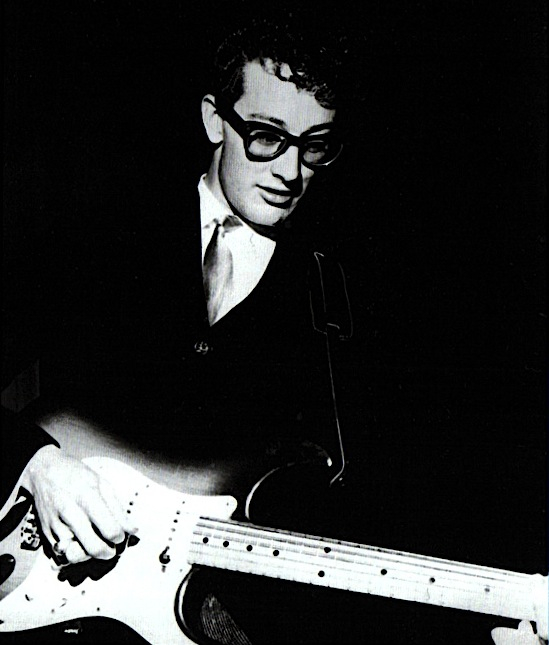
Buddy Holly in the 1950s.

Buddy Holly in the 1950s.

Anyhow, and to not get too far off the topic of Buddy Holly, here is a photo of Buddy used in Birth of the Cool. The caption beside Buddy Holly notes his influence on The Beatles and Rolling Stones, among others (including Jonathan Richman). So in thinking about all this, it’s appropriate to say that my S-10 Chevy is snowed in an alley parking spot just 2.5 blocks from the levy, and this Friday evening I’m going downtown Fargo for a bit of whiskey rye. And to think a bit about the weekend day that the music died. The world sure missed out on a lot of great tunes because of that plane crash in Iowa on February 3, 1959. They were trying to get to a show in Fargo-Moorhead. At least Buddy continues to echo throughout the rock and roll ages, whether we know it or not, aesthetics and rhythm and all. Thanks Buddy.