Tag Archives: Folklore

Glenn Ohrlin Landscape Memory

I’ve gone down the spelunking rabbit hole of western Americana, drover (aka, cowboy) folk music and culture, and have in front of me Glenn Ohrlin The Hell-Bound Train: A Cowboy Songbook (University of Illinois Press, 1973). The foreword is by Archie Green, and he gives a couple touch points of Glenn’s seasons of life. Born in Minneapolis on October 26, 1926, Glenn’s dad was a Swedish immigrant who worked farm labor in the rural, and transitioned to house painting in the growing metropole of Minneapolis-Saint Paul. Glenn’s mother was second generation Norwegian Minnesotan. So Glenn’s birthday comes two years after Clell Gannon’s Songs of the Bunch Grass Acres is published in 1924, and he (Glenn) represents the transition of 2nd to 3rd wave cowpoke western Americana.

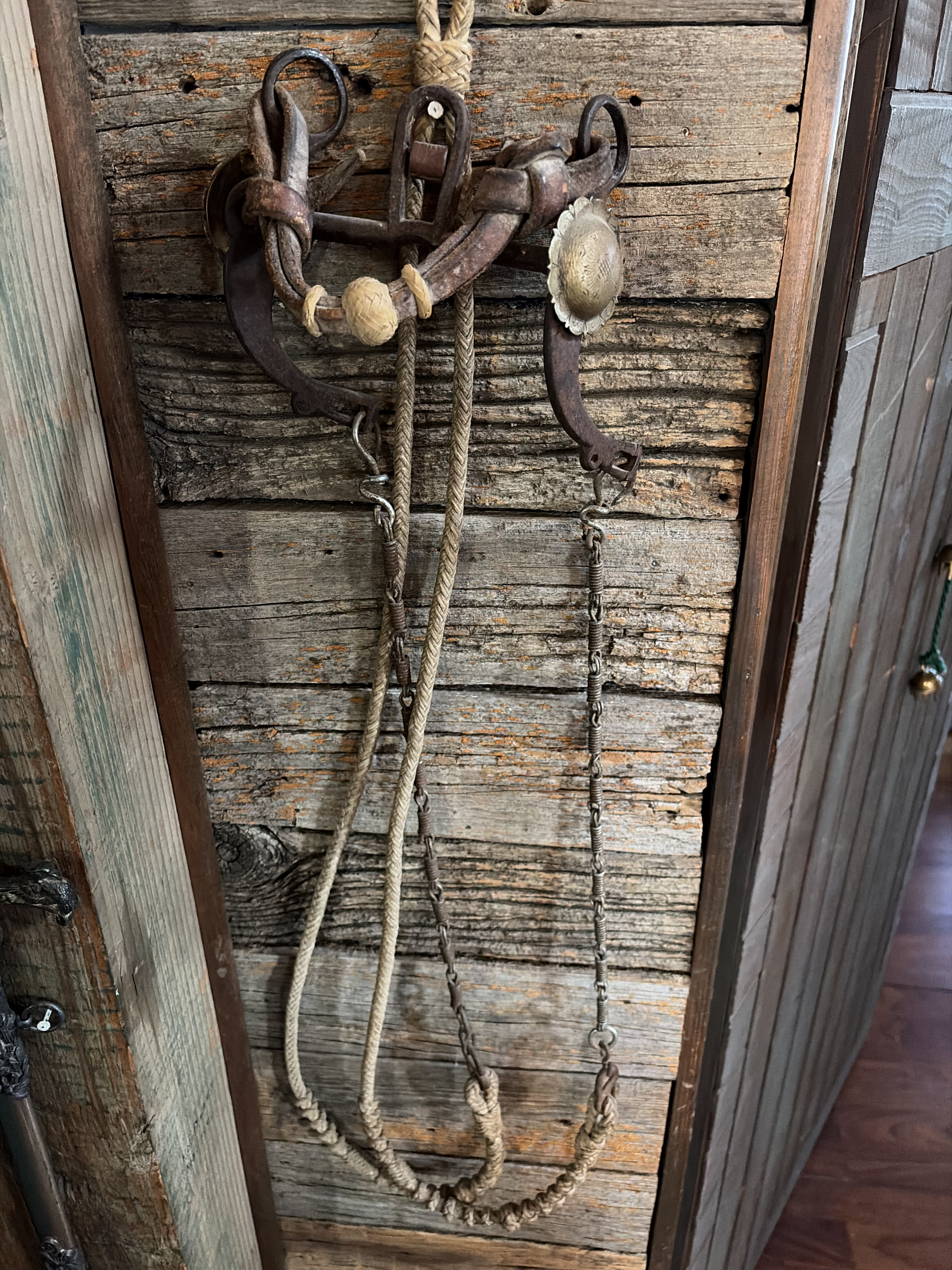
Without going too far into the rest, here are some surviving material culture (aka, “STUFF”) nodes of this all.

First. Within this 1973 U of Illinois Press monograph is a super thin record (33 1/3 RPMs) with just a couple of Glenn Ohrlin’s songs on it. We have a record player. So may try to play this. But this is the second record I’ve seen now in these U of Illinois Press publications on western Americana drover life from the 1970s. Good stuff.

Second. Shadd Piehl, a couple weeks ago, mentioned that he knew Glenn Ohrlin, and Glenn on occasion would visit his family place (Walter and Becky Piehl’s) around Minot and Velva, North Dakota. Because Glenn’s sister had some kind of connection with the Minot and Velva area. So that transitioned into Shadd telling me he, at his house, has some of Glenn’s horse tack hanging on a wall. My eyebrows raised at that and I asked Shadd if he would mind sending me a picture of the horse tack. Relics and history is only alive if we talk about it in the present, no? So below is a photo of said horse tack of Glenn Ohrlin’s. Perhaps we’ll look to curate it indefinitely in a Northern Plains west-Missouri River cowboy bar.
Woody Guthrie Defines Folkways and Folklore

I’m currently revisiting Robert L. Dorman’s 1993 monograph, Revolt of the Provinces: The Regionalist Movement in America, 1920-1945 (Chapel Hill & London: University of North Carolina Press). Remarks on Dorman are on the way, but I wanted to pass the Guthrie excerpt along first. At the outset of chapter 5, Dorman opens with a piece of correspondence Woody Guthrie sent to Alan Lomax on September 19, 1940. Within, Guthrie expanded on the philosophy, or the why, of a folk song. Verbatim, as the tail end of the Great Depression slipped further and further in to the Second World War, Guthrie said,

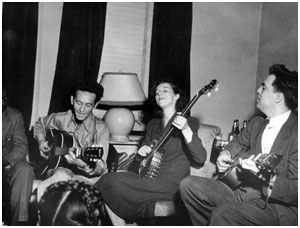
Left to right, Sonny Terry (obscured), Woody Guthrie, Lilly Mae Ledford and Alan Lomax in New York, 1944. Photo online with The Library of Congress, Alan Lomax Collection.

Left to right, Sonny Terry (obscured), Woody Guthrie, Lilly Mae Ledford and Alan Lomax in New York, 1944. Photo online with The Library of Congress, Alan Lomax Collection.

A folk song is what’s wrong and how to fix it, or it could be whose hungry and where their mouth is, or whose out of work and where the job is or whose broke and where the money is or whose carrying a gun and where the peace is — that’s folk lore and folks made it up because they seen that politicians couldn’t find nothing to fix or nobody to feed or give a job of work. We don’t aim to hurt you or scare you when we get to feeling sorta folksy and make up some folk lore, we’re a doing all we can to make it easy on you. (Dorman, 1993: 145)

That is the power of a good folk singer: someone who can speak and sing in a focused enough way to reflect the localized realities of the times, and with enough abstraction to speak to the ages. In this regard, Guthrie was a genius creator and producer of folklore, certainly a reflection of the folk of his times. Note: Woody’s acoustic guitar and folk songs killed fascists, too.