Northern Plains Ethics Journal

Last night I downloaded Volume 1, No. 1, of the Northern Plains Ethics Journal. It is a work born out of the Northern Plains Ethics Institute, a scholarly endeavor that will regularly bring public and academic conversations about ethics together in one edited journal. You can download the journal for free at this link here. It is a collaborative project funded in part by the North Dakota Humanities Council (if one wanted to donate any modest or obnoxious monetary sum to the NDHC, they can easily do so at this link here).

Thus far I have read the introductory remarks by friend and colleague, John Helgeland, and also an article by another friend and scholar, Tayo Basquiat. Of the former, Helgeland says,

…ethics aims its focus at the future. So, ethics is the kind of thinking that imagines the future, to conceive how things could be better and different. Friends doing the Theology of Hope tell us the meaning of hope, namely, that tomorrow can be different from today. People need not feel imprisoned in a web of human frustration. Working through problems in concert creates a community of concern, a value of which is to understand that we are not alone in response to problems and challenges. (Helgeland, 2013: 5)

Of the latter, Basquiat speaks to ethics in the face of roaring economic energy development in western North Dakota. Numerous quotes popped out at me, and I’ll give you a short slice of one of those here. Speaking to how one faces the realities of violence on women as a repercussion of male-dominated petroleum booms, Basquiat focused on that, and broadened it to other groups. He says,

This difficult work is entailed in widening the values which are given power, because, as the old saw goes, when money talks, people listen. I propose listening to people instead of money. Vulnerable groups such as women, children, the elderly, and those unable to work are always in danger of having their values ignored and of having to bear the costs of models of development that focus too narrowly on growth. The question is how do we account for values such as personal safety or clean water if such values are always seen as derivative, secondary, or can’t be monetized for quantification in the calculus? (Basquiat, 2013: 42)

If we take what Helgeland and Basquiat said together, we do have the ability to shape the future, to modify existing institutions so that they can keep up with social and cultural changes. The onus is on all of us, though. I haven’t much to add to that, other than to again recommend visiting this journal in all of its thoughtful glory.


Let the Scholars at Your Family and Local History: Swedish Family Photos and Academic Scholarship

Albertina (Mattson) Larson. She eventually took up a farmstead with Hans T. Larson in northeastern Wells County, North Dakota.

Albertina (Mattson) Larson. Originally from Willmar, MN, she took up a farmstead with Hans T. Larson in northeastern Wells County, North Dakota.

Approximately 20 years or more ago, I recall going to a Larson-Mattson family reunion somewhere in Minnesota. It was important to the Mattson side of the family because my dad’s, mother’s, mother (in Swedish, “min far-mor-mor“), Albertina (Mattson) Larson, was indeed a Mattson. I remember at that family reunion being asked who in the room had relations with the Swedish-Minnesota Civil War Col. Hans Mattson, and I was nudged by my late Grandma (Larson-Mattson) Barth to raise my hand.

Now fast-forward to a year or two ago, when I read H. Arnold Barton, A Folk Divided: Homeland Swedes and Swedish Americans, 1840-1940 (Southern Illinois University Press, 1994). Barton notes in his preface that ethnic groups engage in a kind of ethnogenesis. This means the groups develop a collective identity by gathering together and agreeing upon what they do not stand for, and what they do stand for (often times, we define ourselves by what we are not). While reading Barton’s book, though, I didn’t expect to come across Hans Mattson in the beginning of chapter 5. This was the individual I was told about over two decades at the family reunion in Minnesota. Perhaps Barton was in the crowd too. Who knows.

In his piece of academic scholarship, though, Barton said Hans Mattson hailed from the southern province of Skåne in Sverige, and he came to the U.S. in 1851 as one of the first northern European Swedish settlers to Minnesota. He served with distinction in the Civil War, and eventually became Minnesota’s Secretary of State. He returned to Sweden in 1868-69 to recruit more settlers and develop a chain-migration from Sweden to Minnesota. It worked. He acted as the Northern Pacific Railroad’s chief emigrant agent from 1871-1876, and the list goes on as to his accomplishments by and for his ethnicity.

Albertina (Mattson) Larson, a Swedish-Minnesotan originally from Willmar, MN.

Albertina (Mattson) Larson, a Swedish-Minnesotan originally from Willmar, MN.

With all that said, here are a couple photos of Albertina (Mattson) Larson, my great grandmother. I never had a chance to meet her in person, as she passed away before I was born. As a girl, she grew up in Willmar, Minnesota. Eventually my great grandfather, Hans T. Larson, got up the nerve to ask her to marry him, and they took up a homestead in northeastern Wells County, North Dakota (just north of the borderline historic archaeological town of Bremen, ND).

I’m sharing photos of Albertina for a couple reasons. The first is to make them accessible to other family members (it’s the worst when people hoard documents and artifacts while simultaneously doing nothing with them). There are unknown benefits, too, as perhaps this blog post will reach other Mattson family members who are interested in the various branches of the family. I do plan on ultimately curating the originals with the State Historical Society of North Dakota (but I’ll wait until the grand expansion is complete). By curating them with the SHSND (or any top-tier public archive), the artifacts will be stored in a safe spot with all sorts of fire-prevention and non-acidic devices (stuff along those lines). They will also be accessible to other family members, at least during SHSND archival hours. And if Swedish-American scholars want to have a look, to analyze and scrutinize them, they will be there. Perhaps they will even incorporate them into some piece of future scholarship. Who knows. Access is key, though.


Green Spaces at North Dakota State University

I’ve been in conversation with some friends and colleagues on the campus of North Dakota State University (NDSU) as to where the latest proposed STEM APE (Area of Potential Effect) should be located and, eventually, built. Thus far, NDSU administration is leaning toward putting the important STEM center just to the east of the Memorial Union, requiring the bulldozers to first knock out some historic trees (yes, such ecology exists) and the beautiful and quaint historic Nelson building on campus. So NDSU is now circulating a kind of after-the-proposed-planning-fact survey to gauge student interest.

This is how I answered a couple questions on page 2 of the survey, and I also provided them with all of my contact information.

1) In our broader culture where horizontal asphalt parking lots and strip malls are the norm, it seems not only important but paramount to ensure that North Dakota State University protects historically green, recreational spaces at the heart of our campus. Theodore Roosevelt carved out national green spaces throughout the American West so that the American population could re-create themselves by being in and connecting with the grasses, trees and shrubs. This is where we get the word recreation: our ability to return to natural or artificial landscapes to, as they say, get away from it all, if but momentarily. This is another reason why Island Park in downtown Fargo was created, as well as large green spaces on the eastern seaboard of the United States (take New York’s Central Park as a prime example).

2) The Elm trees within the proposed STEM APE are historical hybrids, a variety resistant to the Dutch Elm disease that nearly wiped out the entire American Elm species in North Dakota. The American Elm, by the way, is the state tree of North Dakota. There is a bit of irony at play every time North Dakota State University obliterates, or proposes to obliterate, a piece of its local ecological history. We as a state have so few trees to begin with. Why not just build the STEM building in a parking lot, or a place on campus where there aren’t any trees? By doing this, it would increase the verticality of the campus while simultaneously preserving green space.

I encouraged them to get a hold of me if they want a proper study of their proposed APE(s). This, in turn, would help guide decision making so that the best possible construction solution could be arrived at. Who knows what will come of this. It is their call. We hope they make the right decision.


Sitting Bull and the Government Shut Down

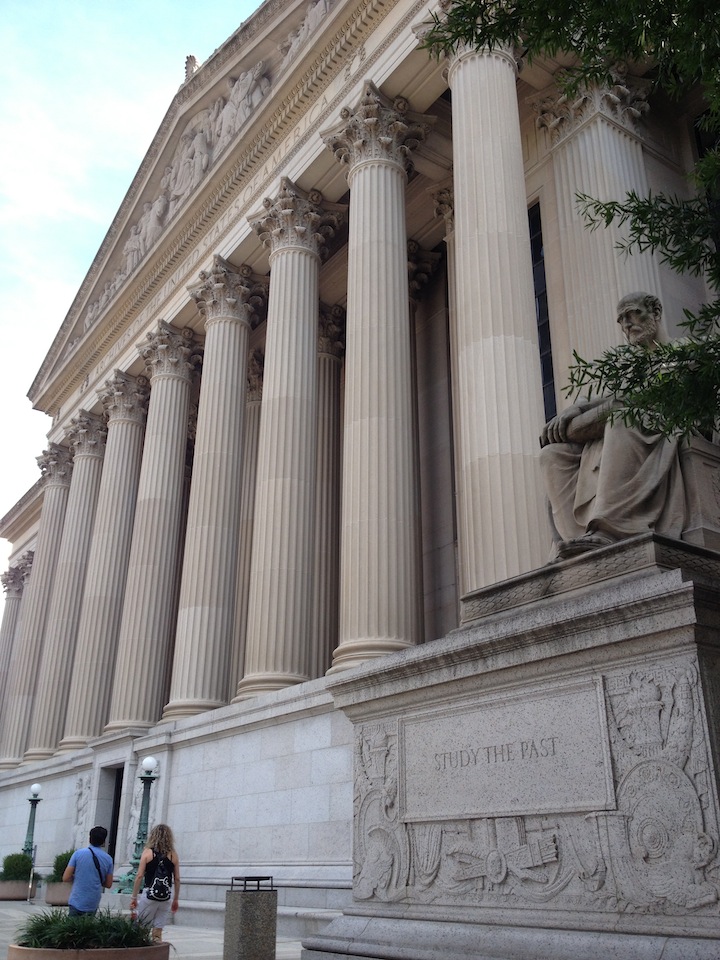
A photo I snapped while in D.C. in August 2013. It is of the National Archives. The inscription at bottom-right of the photo reads, "Study the Past."

A photo I snapped while in D.C. in August 2013. It is of the National Archives. The inscription at bottom-right of the photo reads, “Study the Past.”

Today, October 1st, 2013, the United States Government momentarily halted its business. Perhaps the best story I’ve read on this comes by way of Joshua Keating of Slate.com, and it takes the shut down as an opportune moment to describe how American media would report on this if the shut-down happened in a non-American, or non-Western, nation-state. It is enlightening. This is the first installment of the article. An excerpt from it, and a direct link if you click right here:

The capital’s rival clans find themselves at an impasse, unable to agree on a measure that will allow the American state to carry out its most basic functions. While the factions have come close to such a shutdown before, opponents of President Barack Obama’s embattled regime now appear prepared to allow the government to be shuttered over opposition to a controversial plan intended to bring the nation’s health care system in line with international standards…

…The current rebellion has been led by Sen. Ted Cruz, a young fundamentalist lawmaker from the restive Texas region, known in the past as a hotbed of separatist activity. Activity in the legislature ground to a halt last week for a full day as Cruz insisted on performing a time-honored American demonstration of stamina and self-denial, which involved speaking for 21 hours, quoting liberally from science fiction films and children’s books. The gesture drew wide media attention, though its political purpose was unclear to outsiders.

This story is fascinating for a number of reasons. To historians, it reminds me of how we are disciplined to develop histories of past societies by using the individual words of the people we are talking about. So, for example, yesterday around the graduate seminar table we got to talking about how the British mounty Walsh characterized Sitting Bull during the Hunkpapa chiefs short tenure north of the 49th parallel in Canada. Sitting Bull was thinking things over, and the Anglo-North American Walsh decided to refer to the chief as “Mohommet.”

I’m not sure how Walsh meant it, but it caused me to speak up and note that when Walsh called Sitting Bull “Mohommet,” it said more about Walsh than it ever could say about Sitting Bull: of course Sitting Bull was not Mohommet. Walsh hailed from Prescott, Onterio, though, and that was part of the St. Lawrence Seaway and The Atlantic World, and that world indeed was privy to imaginings of European Christiandom, and so on. This is why Walsh’s analogy is the most non-analogous attempted analogy in the history of analogies (okay, I’m exaggerating, but sometimes a person gets sucked into the amplified media craziness which, in turn, speaks to the point of this blog). Sitting Bull is Sitting Bull. He was by and for the Hunkpapa, the Seven Council Fires, the Lakota, Dakota and Nakota, and the northern Great Plains. Period.

A gratuitous government shutdown photo, this snapped before the shutdown was known or talked about during a DC site visit in August 2013.

A gratuitous government shutdown photo, this snapped before the shutdown was known or talked about during a DC site visit in August 2013.

This is easily the same for today’s media, though, where reporters are given a couple minutes or hours to cobble together something on a non-American or non-Western topic, and make it vaguely intelligible for a news-absorbing public. Then we can all sit in our living rooms and either nod in approval or shake our heads in disagreement about what country we need to consider invading next. In the second half of the 19th century, this is what a reading public did on the east and west coasts of North America as they read about the actions taking place on the North American steppe. “What could possibly go wrong here!?” Right.

An aside on how Keating of Slate.com describes Ted Cruz, with addition: certainly Ted would be described this way if he were the reverse operating in Mesopotamia and Persia and the Levant (in a kind of opposite world, though). But the media would also say something like, “Ted Cruz is from the adjoining Christian country of Canada.” Then listeners of that media would sit in their living rooms and be mind-boggled at how one Christian could have different ideas in North America from another Christian. “Honey, get this: they don’t all think the same way! At least that’s what the news is saying… Should we order pizza tonight? Or go for Chinese?”

Anyhow, happy government shut down. I’ve rolled up my sleeves to get through it all.


Historic Industry in Western North Dakota

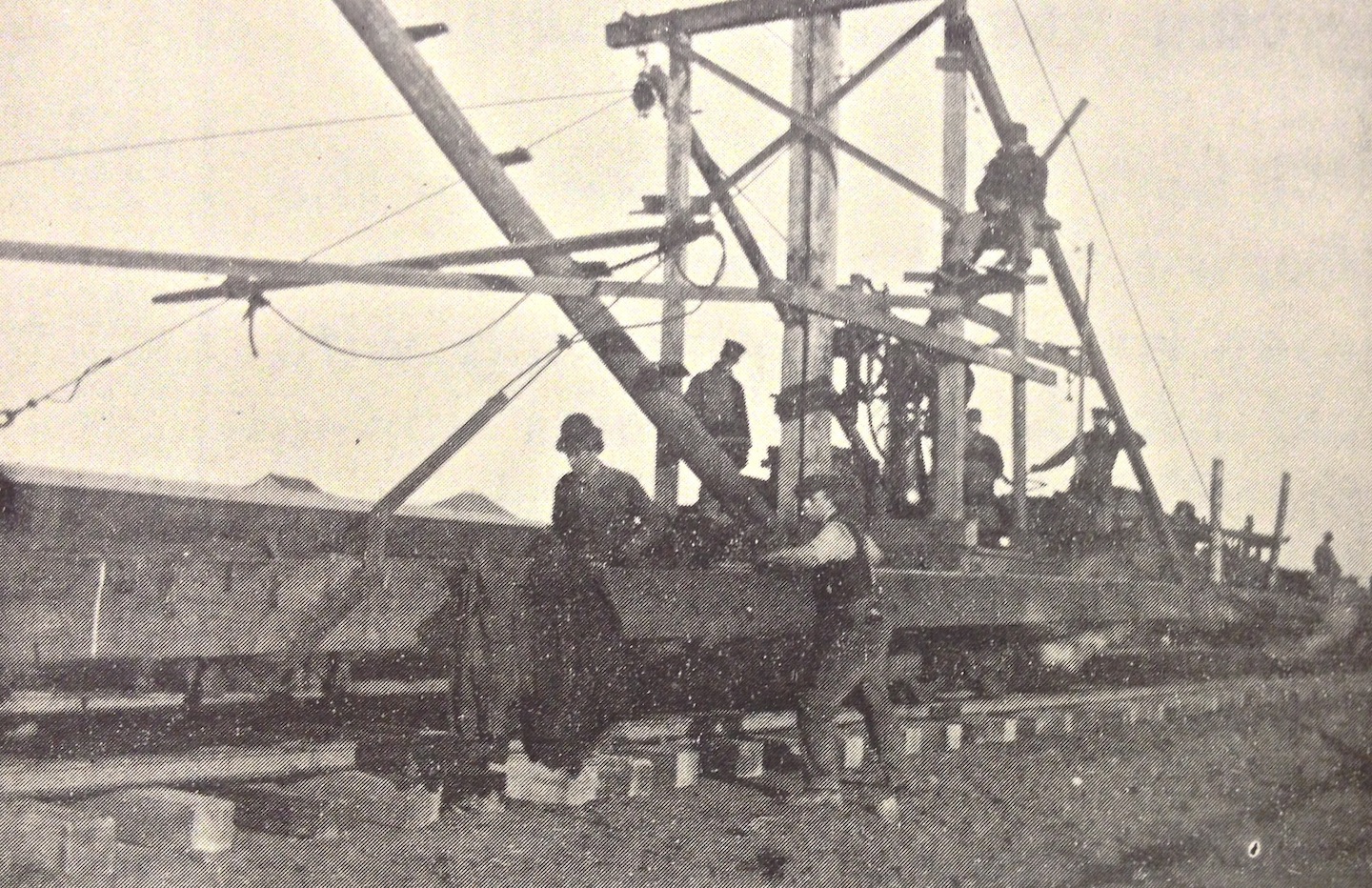
Railroad workers in 1910, this one mile west of Regent, North Dakota.

Railroad workers in 1910 one mile west of Regent, North Dakota.

I just finished a lunch of homemade chicken soup (with lots of fresh lemon juice and cilantro), and before I grab a coffee and get back to the busywork, I thought I would upload a photo of historic railroad industry in western North Dakota circa 1910. The photo was taken about a mile west of Regent, as track was being laid to connect the rural agrarian areas of the American interior with the city centers and rail hubs of Dickinson, Bismarck-Mandan, Fargo, Minneapolis-St. Paul, and so on.

Looked at from an agrarian context, railroad construction was big throughout the world at this time, as nation-states increasingly relied on agricultural production to feed an ever growing populace, and this led to increased competitions over global resources. I suppose a modern public historical treatment of pumping Euro-Americans into colonizing the continent’s interior might come by way of AMC’s “Hell On Wheels” or HBO’s “Deadwood,” a kind of post-Civil War historical days of our lives with amplified skull-duggery, dodgy behavior, and shenanigans. But don’t simply rely on Hollywood to shape the way the past is understood. It’s best to get into those archives and see the documents for yourself.


Traditional Native Food Systems

Sahnish AgricultureIt has been a couple years now that I have served on the board of the North Dakota Humanities Council. It is incredible in the sense that a board member is brought within range of all that this NEH-funded council does. While great ideas abound, sometimes we are only logistically able to make it to a sampling of the events around the state. If it was somehow possible for the council to be funded where board members could quit their day-jobs, we indeed would be present at each and every event. But unfortunately my landlord, cell phone provider, and the bill issuers in general refuse to accept my historical articles, papers and daily blogs as payment for their services. Thus, I have to keep at my day job to keep the lights on around here which in turn keeps me from some of the great NDHC programs.

A couple days ago, I received a thank you from Dr. Wanda Agnew of United Tribes Technical College (an institution that has one of the most renowned global pow-wows every year). Dr. Agnew said the “funds provided by the North Dakota Humanities Council gave us the opportunity to make the Key Ingredient American By Food Exhibit and Special event OUTSTANDING!” The goal of this event was to connect the UTTC campus populace, Tribal Sovereign Nations, and folks in the Bismarck-Mandan area with ideas about traditional Native food systems, deepening the understanding of how pre-Industrial agriculture, farming and gardening worked. It has only been in the last 125 years or so (out of at least 6,000) that homo sapiens have increasingly industrialized what we shovel into our mouths. I have thought about and acted on this in recent years.

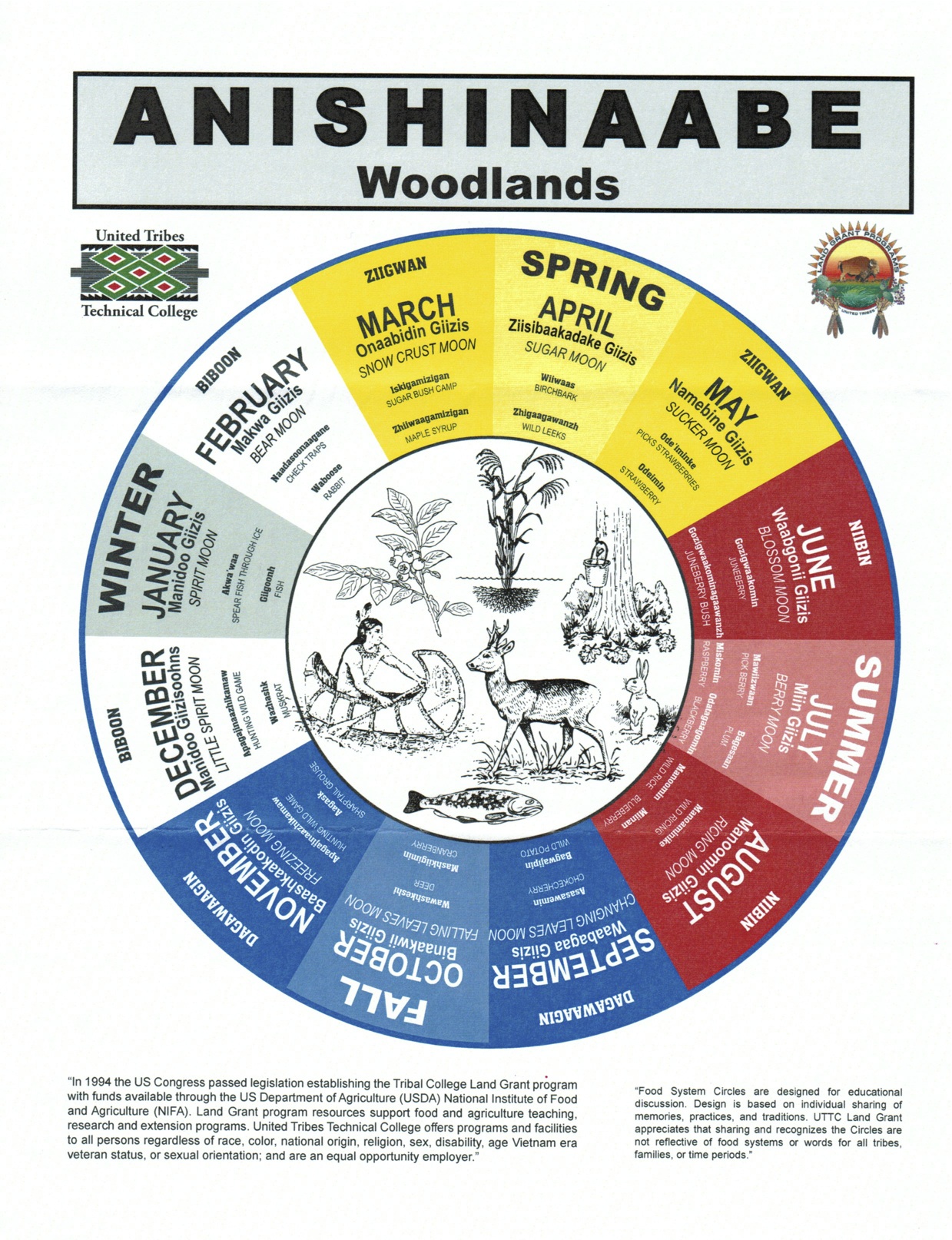
Lakota AgricultureIn any case, within this blog are the three hand-bill diagrams Dr. Agnew sent along with the thank-you that point to how food, culture and humanity intersect with three different tribal systems (oyate) on the northern Great Plains. They are the Anishinaabe, Lakota, and Sahnish. We are leaving September and heading into October, so note how the traditional calendars describe the seasons: for the Lakota, September-October is the time when trading with other tribes occurs, when buffalo berries are gathered, and when the earth experienced its hard frost and went into hibernation. For the Anishinaabe, chokecherries and wild potatoes and cranberries would be gathered, and deer would be hunted (which also coincides with our modern deer hunting season). For the Sahnish, this time of year marked the corn and harvest ceremonies. Okay, off to start the charcoal grill. Happy weekend to you.

Anishinaabe Agriculture


A Great Plains Airport

On the morning of August 31, 2013, Molly and I took an early morning flight from Fargo to Buffalo, New York, with a connecting flight in Chicago. That morning in Fargo’s Hector airport, while we waited to board our flight, I typed out a description of my surroundings. The trinity takeaway from Buffalo: it is the birthplace of Richard Hofstadter and the Buffalo chicken wing, and it is also the city where Teddy Roosevelt was inaugurated after McKinley died from an assassin’s bullet.

Okay, enough of that. Here is the late-August 2013 Fargo airport description in unadulterated form:

It’s 5:12AM at the Fargo Airport, Gate 5, and Molly and I are waiting for the United Chicago flight to board around 5:30. I thought I’d give some descriptions of my surroundings, as this airport has a different social atmosphere than the Chicago hub we’re flying into.

The view: there are about 15 of us so far, waiting to board. A slow trickle of passengers continues advancing toward their respective gates in the terminal. A lot of us are wearing sandals or easily removable shoes. This is for utility, as they are easier to slide off and on when entering and exiting the security checkpoints.

The terminal itself has strip-mall aesthetics (in fact, it is unusual today to be in new construction that is non-strip mall-like). The color scheme is grey, blue, peach, and terracotta. Molly thinks elementary schools used to have this color scheme in the late-80s, at least around these parts, and at least if they were new back then. “New” is an elusive word, like “modern.” The floor and ceiling are carpet, and the walls smooth either with paint or wallpaper. Lighting here is recessed halogen fluorescent, or whatever they are called.

It is dark in the early morning outside too. It is pitch black out there, the “United Express” logo on the plane illuminated by exterior lighting. Within the windows, we can only see the reflection of our Gate. There are three plants at Gate 5 too. They look real. The U.S. Fish & Wildlife Service has static signage near this gate, too, an information booth on local species.

The sounds: a steady gentle hum persists from the black rectangular vending machine. It rattles occasionally, as the refrigeration compressor keeps the beverages cool. A couple of the families have young children, and they are a bit chatty. Other conversation, at least amongst the adults, is muffled. There is a silent kind of still, folks a bit groggy from getting up at 3:30 or 4:00AM, and others wanting to respect the quiet associated with this morning hour. A hum outside, toward the plane, is also audible. The conversations increase as we draw nearer to the boarding time, and as more and more folks arrive.

The sensation: some folks feel like they want to sleep, but can’t. But they so would like to. Everyone knows that in 10 or 17 or 23 minutes or so, we will be asked to board the plane. For myself, there is slight warmth in my forehead, a kind that a person sometimes feels when without enough sleep.

The smells: it smells similar to a hospital waiting room with occasional whiffs of coffee.


Humanities Un-Conference: November 2-3, 2013, Fargo, North Dakota

Ideas are just that: ideas. They often start out with the thought of the results first, and this often bypasses the entire processes that went together to get an idea to that result, to give it actual traction. So the idea of getting ideas together in an informal setting is, well, a good idea. And bringing a confluence of idea-driven individuals across the state together and talking is also a good idea. Who knows where a conversation may lead?

Within North Dakota, the Plains Ethics Institute, North Dakota State University, and the North Dakota Humanities Council have come together to give rise to an idea un-conference. Below is the full poster, with just a couple modifications here: the date for registration has been extended to October 1st, and a proposal is not required. Reimbursement is also available for those individuals thinking about coming from non-Fargo, North Dakota, but wondering how they are going to fund the mileage and lodging (Williston to Fargo, for example, is a 422 mile, 6-cups-of-coffee, 1-way drive). The official handbill is below.

Hum Un-Conf


The History of Ancient History at NDSU

I just got off the phone with my Uncle Jim (known to others as Jim Barth), as I was curious about an old North Dakota State University (NDSU) syllabus of his.  I’m interested in the history of syllabi, primarily because it’s always fascinating to track the history of education: information that was pumped into yesteryear’s generation in contrast to what we’re pumping into tomorrow’s leaders, today.

Jim chatted briefly about this course he took back in the late-1950s at North Dakota Agricultural College (today’s NDSU). He said the course location was at the Neuman Center (he was pretty sure), in a 1-story building across the street from University Street. I figured that so others can access a syllabi from the late-1950s, and perhaps compare it with today’s courses in Ancient Mediterranean History, I’d upload photos of it. They are below. The textbook used for the course was Vincent M. Seramuzza & Paul L. MacKendrick, The Ancient World (Holt, Rinehart & Winston, Inc., 1958). A sticker on the inside cover says it cost $8.95 at Varsity Mart (inflation is also a reality of the world).

Note how informal the syllabus looks from the late-1950s, this in contrast to the corporate-university legalese we see in syllabi today. Much has changed, yes. But that’s the way with the world, and life.

Ancient History I

Ancient History 2

Ancient History 3


Philip Deloria and Dakota Goodhouse

Yesterday Philip Deloria visited one of my alma maters, the campus of University of North Dakota (Grand Forks). I had a chance to ride up from Fargo with good friend Dakota Goodhouse (he was on his way up from Bismarck), and we met with Phil for a short while that morning.

Dakota Goodhouse and Philip Deloria catch up a bit in Grand Forks, North Dakota.

Dakota Goodhouse and Philip Deloria catch up a bit in Grand Forks, North Dakota.

One of Phil’s ongoing projects has to do with the artwork of Mary Sully (1896-1963). Mary was from the Standing Rock Nation in the Dakotas, and Phil is analyzing a large body of artwork she produced throughout the course of her life. Mary did not leave behind any narratives of her art, so Phil is piecing together what he can, and contextualizing a lot of her work with the periods in which it was produced. This reminded me a bit of that general rule of history, that all historical figures influence and are influenced by the times and places they occupy (context, context, context!).

Prior to his talk at noon, Dakota and I chatted with Phil over coffee. In every sense of the classic phrase, he is both a gentleman and a scholar. It was quite interesting to hear about how the grandfathers of Dakota and Phil kept up a correspondence throughout the course of their lifetimes, too. Today, Dakota and Philip continue that correspondence.

And another note: Phil is a great, great, great, great grandson of General Alfred Sully (I may have one too many or few “greats” in their). One year, Sully took a Native Dakota wife while on the northern Great Plains. Children resulted from that, and so did grandchildren. History has an infinite number of connections with the present, as it should: the reason we are here is because of yesteryear. Cool stuff. Also, check out Philip’s scholarship here and here and here. And definitely check out his late father’s scholarship, too, Vine Deloria, Jr., here, here, and here (this is just a cursory sampling of Vine’s body of work).

Phil Deloria and myself, after asking Dakota to snap this photo. Taken on September 18, 2013.

Phil Deloria and myself, after asking Dakota to snap this photo. Taken on September 18, 2013.