Some Rough Notes on Armistice Day

A section of Joe Sacco's 24-foot-long illustrated panorama of the Battle of the Somme, First World War.

A section of Joe Sacco’s 24-foot-long illustrated panorama of the Battle of the Somme, First World War.

It is Armistice Day today, or what in the U.S. we often refer to as Veterans Day. In the last couple days, I’ve noticed a couple news outlets (here and here, and friends, including Richard Rothaus) commenting or  reporting on Joe Sacco’s latest illustrative work on the Great War entitled, The Great War: July 1, 1916, The First Day of the Battle of the Somme, An Illustrated Panorama (W.W. Norton, 2013).  In America, there is a tendency to remember the Second World War more than the First World War. The former was a kind of mopping up of the latter.

Within that former, or WWI, The Battle of the Somme (or Bataille de la Somme; or Schlacht an der Somme) took place between July 1 and November 18, 1916, and it proved to be one of the most horrific military engagements in industrial human history, where something like 60,000 soldiers died, and a total of 1,000,000 men were wounded or killed. Sacco portrays this in his 24-foot-long panorama, complete with howitzers, machine guns, entrenched soldiers in tin hats… The details are superb, and so is the idea of illustrating war with the medium of cartoon. Another recent portrayal of the serious topic of war by way of cartoon comes from Waltz with Bashir, some remarks on that here.

The Battle of the Somme map from Wikipedia commons.

The Battle of the Somme map from Wikipedia commons.

I think the medium of cartoon is attention-getting, especially for these serious topics, for a couple reasons. When it comes to the First World War, it sometimes seems that we’re reading about a topic that certainly happened, but it is in such a far away temporal place. By capturing or re-imagining it with cartoon, a viewer is impressionistically given the choice to mentally go back and forth between the idea of a cartoon and that of reality. One is supposed to be nonrealistic while the topic is very, very real. This in turn is of interest because wars have induced re-education, at least where nations try to get their soldiers to think of the enemy as just that: non- or sub-human, something we might call the “other,” often captured by the phrase, “They aren’t like us.” This psychology, at least as laid out by Ari Folman’s Waltz with Bashir, allows a soldier to not think too hard about pulling the trigger or getting up out of one’s trench and marching head-long into mortar and machine gun fire: one doesn’t think about marching into mortar and machine gun fire before or while marching into mortar and machine gun fire.

This is a point of discussion — conceptualizations of “the other” — that comes up from time to time in the history of conflict on the northern Great Plains. Just last week, while talking about Paul Beck’s, Columns of Vengeance (U of Oklahoma Press, 2013), I was thinking about how much these otherwise ordinary farmers were mustered into being Union soldiers, and how they  conditioned themselves (or were conditioned) to think of Native America as something other than human. When someone thinks of another human as sub-human, the human with those thoughts is becoming less than human. We might also say that humans are capable of great compassion, but they are also capable of atrocious avarice and hate. By being conscious of this, perhaps we can lean more toward the compassion and empathy instead of the avarice, malice and hate.

Barth Memorial Tree

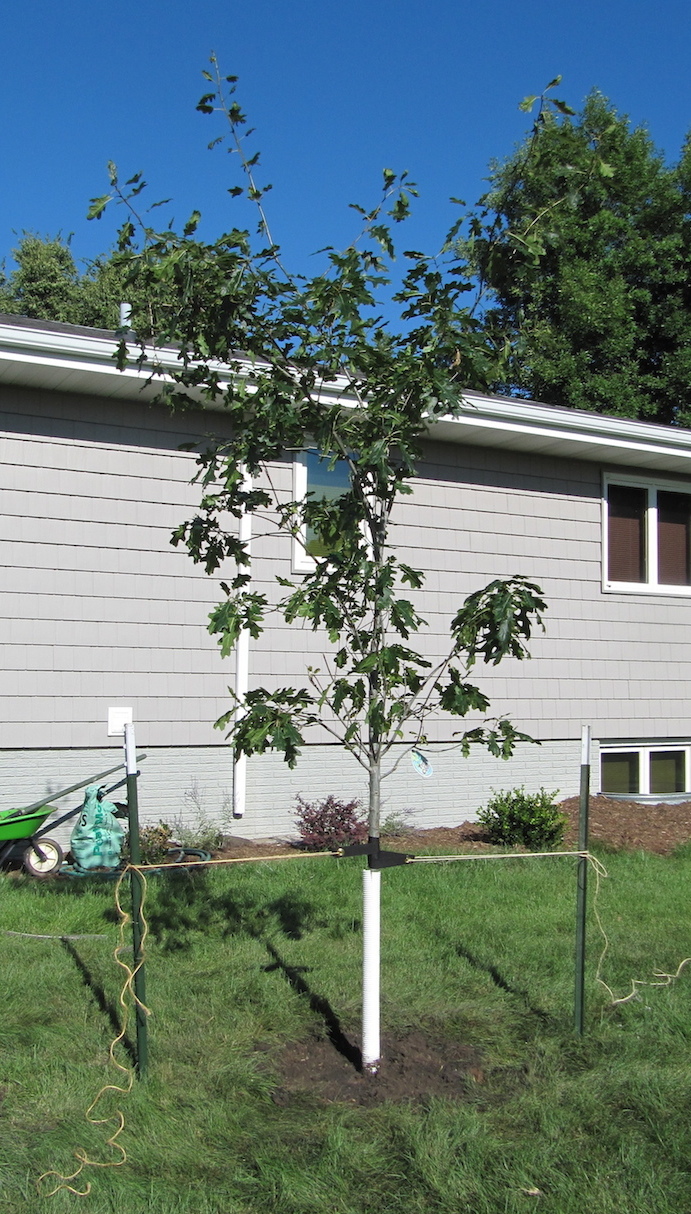
An August 5, 2012 photo of the Charles Barth memorial oak tree.

War is terrible, and terrible things will always happen in war. It’s important to reflect on this. I was privileged to be able to chat at length about the Second World War with my late great uncle Charles “Bud” Barth. He was a front-line medic in the European Theatre of the Second World War. I have blogged about these chats here and here and here. Anyhow, that’s what I’ve thought about a bit this morning.

At left, here is a August 5, 2012 photo of the silver oak tree I planted in my family’s yard in Bismarck, North Dakota, right around the time that Charles passed away. I call it the Charles Barth memorial oak tree. The tree itself was purchased from Cashman’s Nursery, a great local greenhouse in southeast Bismarck. I’m reminded of Charles when I look at that tree.


Dakota Goodhouse’s Winter Counts

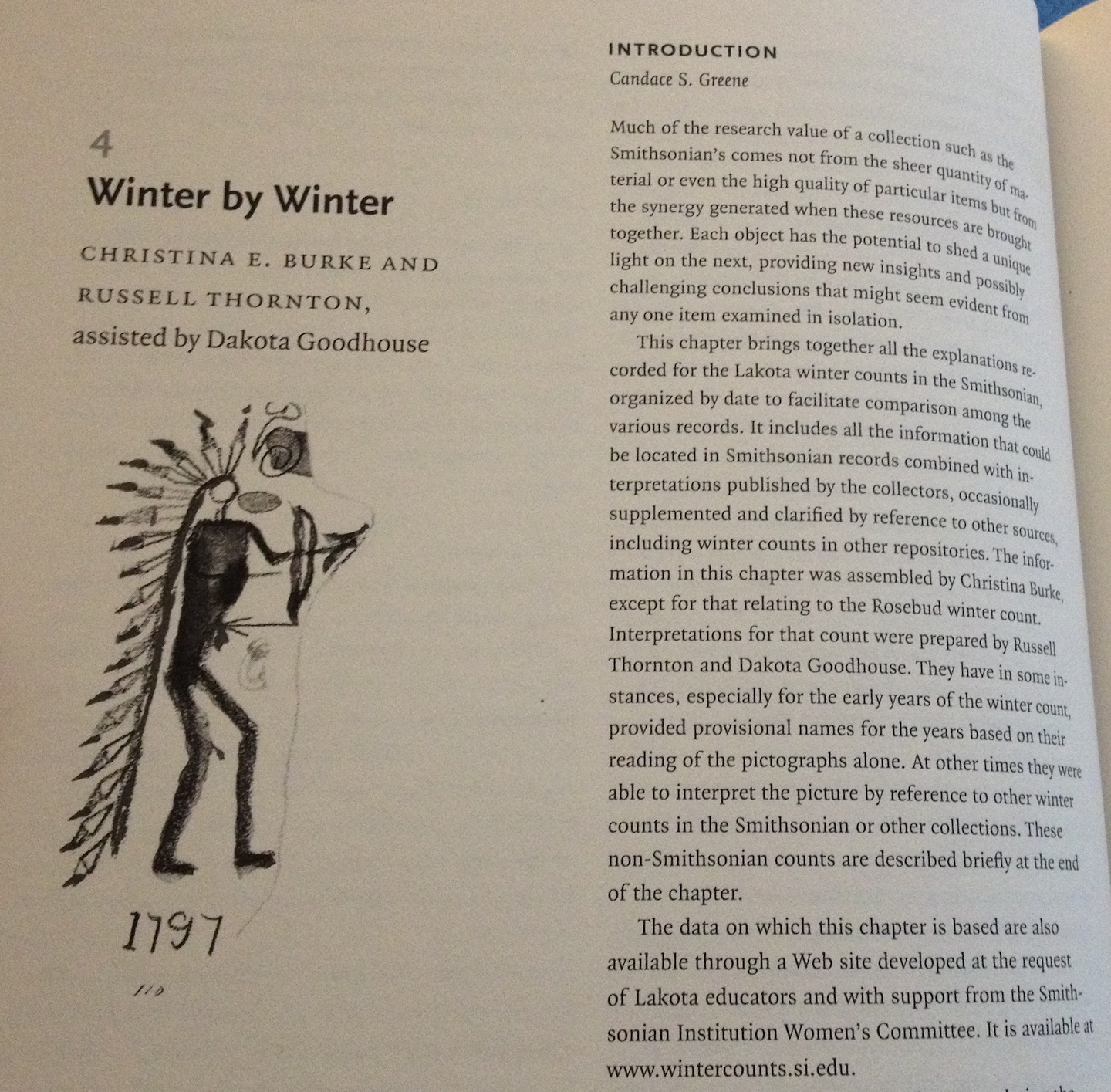
Chapter 4 of "The Year the Stars Fell: Lakota Winter Counts at the Smithsonian" (2007).

Chapter 4 of “The Year the Stars Fell: Lakota Winter Counts at the Smithsonian” (2007).

In the last couple days, Dakota Goodhouse (his blog, which you’ll want to visit, linked here) and I have been hanging out in downtown Fargo, as he’s in town to expand on the Native tradition of winter counts. He crashed at my place for a couple nights, and last night we had dinner over here after his short talk at the Spirit Room (this was organized and funded through a collaboration between the Fargo-West Fargo Public Schools Indian Education program and the North Dakota Humanities Council). Dakota and I chatted more about winter counts, and about future prospects of scholarly interest and inquiry.

I’m thinking that winter counts, and the history of them, have become popular enough that I don’t really need to explain them. But just in case, a winter count is an annual pictograph painted onto the larger medium of buffalo or elk hides. In the latter part of the 19th century, they were painted onto canvas. These counts provided the owner or memory group with a traceable past, the pictograph often representative of a successful high-point of that year.

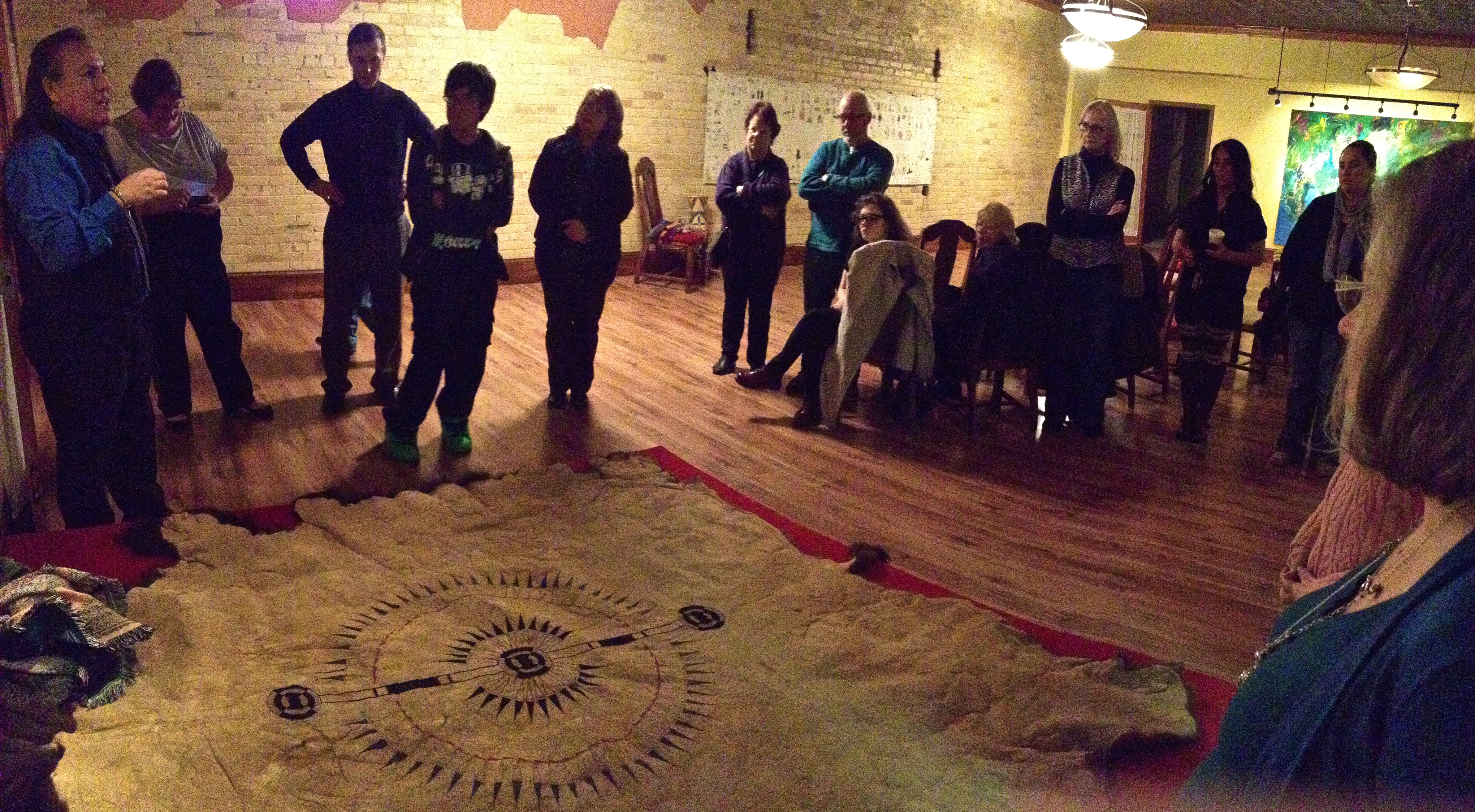
Dakota Goodhouse explains the stories reflected by and attached to the pictographs on the bison hide.

Dakota explains the stories reflected by and attached to the pictographs on the bison hide.

While Dakota explained the winter counts to the group at the Spirit Room last night, he pointed to one of his buffalo hides while expanding on how he saw something different in that particular account. This particular account is a symmetrical series of triangles running around the circumference of a circle. Some years ago, Dakota said he used to think of this as a war bonnet laid out on the floor. Today, though, he said it also looks like the plains indigene narrative attached to what we call “sun dogs.” One of the stories that he knows is that the sun dogs are thought more of as camp fires next to the sun.

These various stories got me thinking at least two related things that are slightly polemical. The first is something we deal with every now and then, and that’s one-dimensional thinkers who sometimes say, “Well, cultures with oral traditions don’t have a history, or if they do it’s impossible to trace.” This is always a fun question to respond to, but last night I was thinking more-so of how a person who reads a novel, or a good piece of history, are likely to walk away with a different perception about the same piece of scholarship within the span of two or more readings.

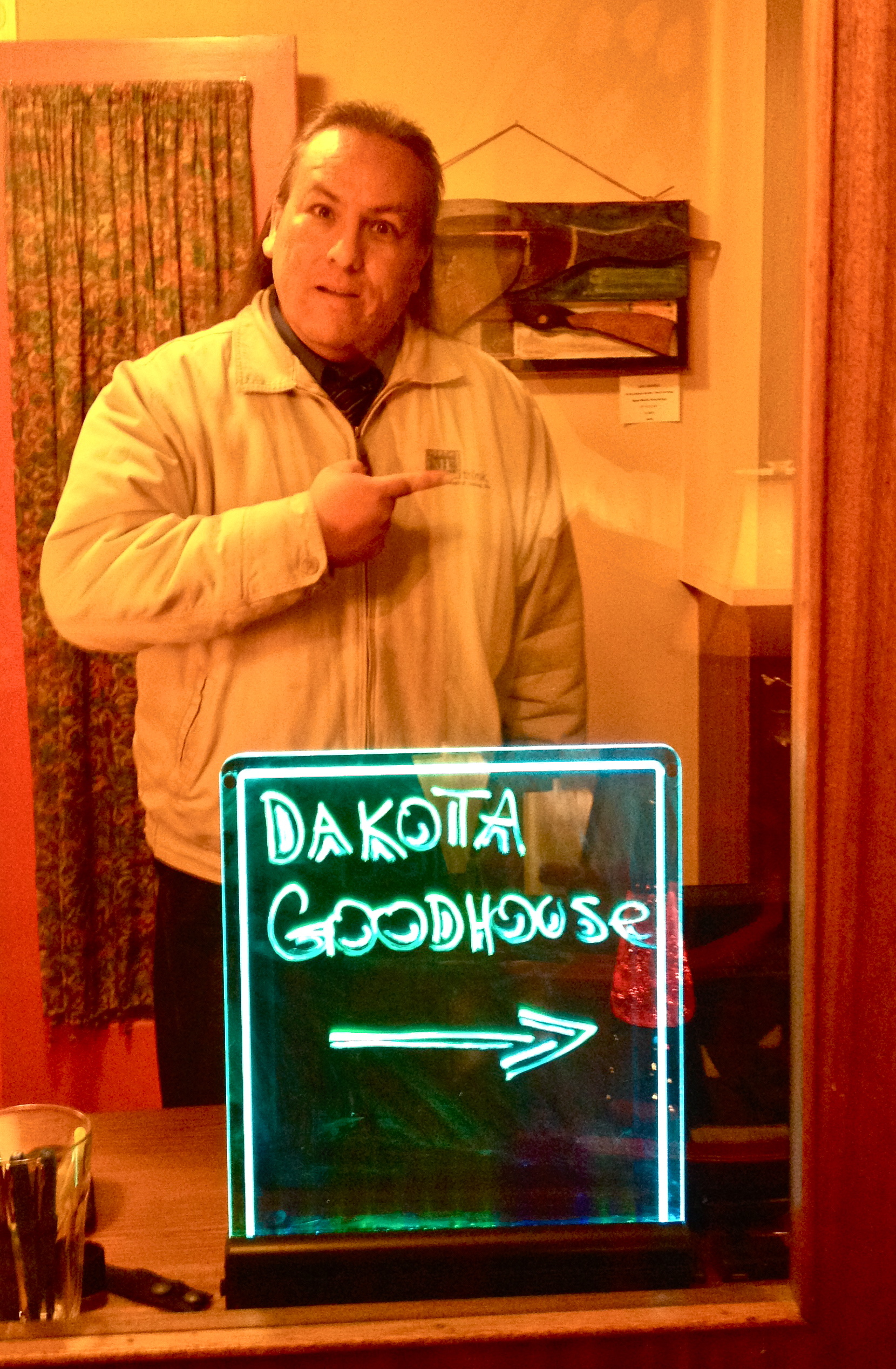
A picture of Dakota being hilarious.

A picture of Dakota being hilarious.

This is similar to the winter count. Dakota explained the difference in how one individual, when looking at the bison robe laid out, might see a native headdress while another might see sun dogs, parhelia, or what the Dakota call wi’aceti, this roughly translated and defined as “when the sun makes fires.” Dakota added that the winters on the northern Great Plains are so cold that the sun requires camp fires to keep it warm.

From here on out I decided to abandon the sun dog phrase and replace it with wi’aceti (pronounced, roughly, “we-ah-che-tee”). If anyone wants to join me on the northern Great Plains in this effort, by all means. If we hear someone say “sun dog,” please feel free to add wi’aceti to that, and with explanation.

Also, Dakota contributed heavily to a piece of winter count scholarship that yo might be interested, chapter 4 of Candace Greene and Russell Thornton, The Year the Stars Fell: Lakota Winter Counts at the Smithsonian (Lincoln: U of Nebraska Press, 2007).


Punk Archaeology Updates

Before getting after some technical writing this morning (only to be later usurped by some Dakota language studies), I thought I’d link to some forthcoming scholarly analyses on the cultural movement of Punk in all of its unadulterated filth and fury. You can read about the soon-to-be-realeased Punk Archaeology anthology here, and about a work of Punk Sociology here. It was great this morning to come across a local story of a proto-punk Jonathan Richman, who is getting ready to play the Aquarium in downtown Fargo, North Dakota this next week too.

On this single-chord punk note, it’s appropriate to mention the passing of one of the first proto-punks, as memorials and obituaries on Lou Reed have been popping up all over the place (here, here, here and here). This shouldn’t eclipse the passing of folk punk hero Phil Chevron (aka, Philip Ryan of The Pogues or The Popes, depending on the year) in early October 2013. A sad reality for sure, and a time for reflection and contemplation.

An October 19, 2013 photo of Modern Times Cafe.

An October 19, 2013 photo of Modern Times Cafe.

And although we are losing our original punk heroes, punk culture continues pushing in a variety of directions today. Here is a photo from some boots-on-the-ground punk (lower case “p”), this coming from the delicious Modern Times cafe in Minneapolis, Minnesota. A couple weeks ago Molly and I had a chance to make a quick jaunt down the I-94 block from Fargo to MSP to visit a couple friends, and the next morning we hit up this cafe. It’s at the intersection of Chicago Avenue and E. 32nd St. in Minneapolis, and everyone should go here. It’s a place where punks either are parents or a place where punks bring their parents to engage in politely brash conversation and society. A couple more photos below, one of the delicious breakfast meal, and below that a photo of a post card from the fine by-and-for establishment. The only thought left was this: “When will Modern Times open up in downtown Fargo and Grand Forks?”

Delicious, sensibly priced breakfast from Modern Times Cafe.

Delicious, sensibly priced breakfast from Modern Times Cafe.

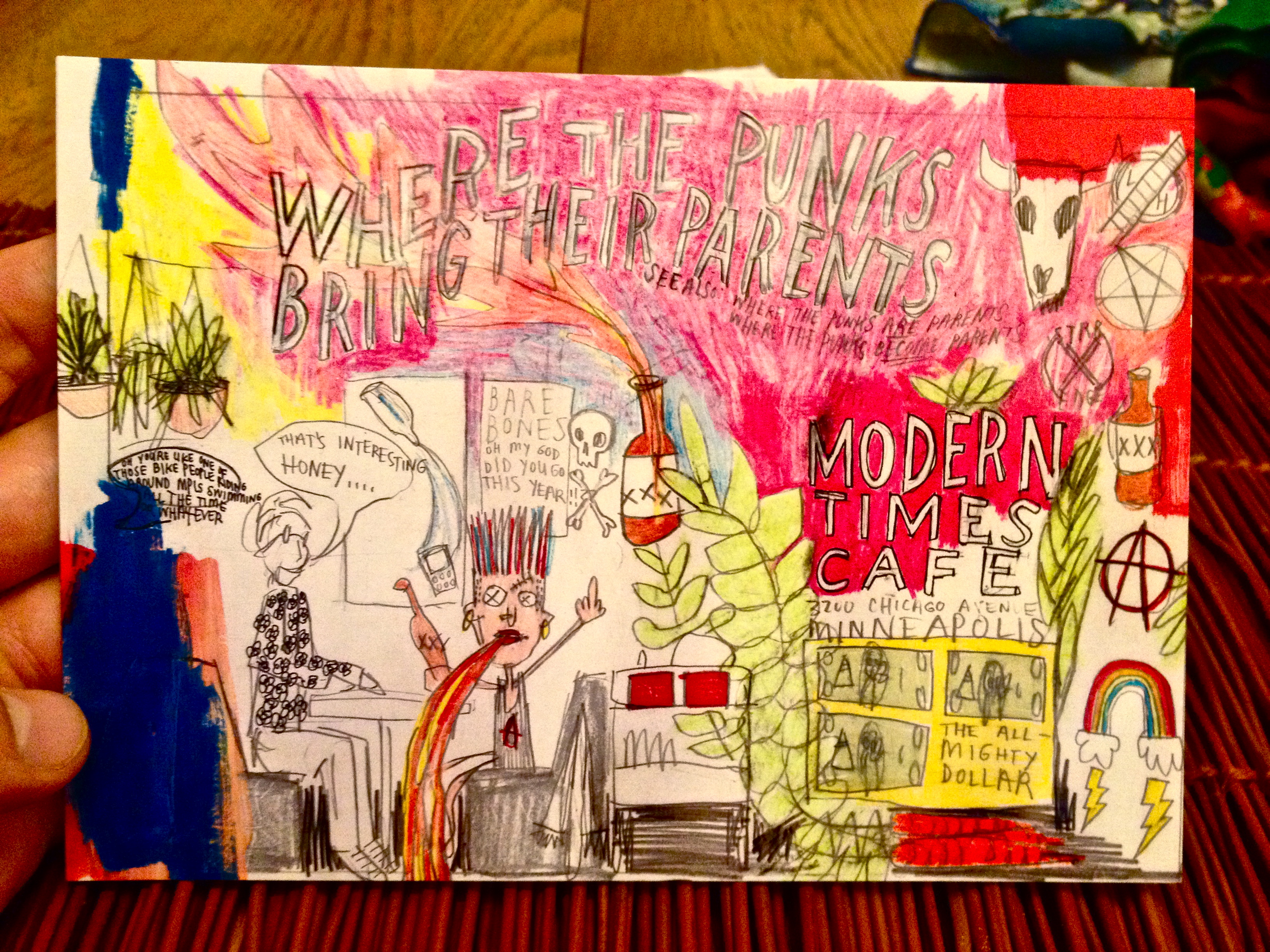
A Modern Times Cafe postcard indicating that this is a place where punks bring their parents.

A Modern Times Cafe postcard indicating that this is a place where punks bring their parents.

At the right, the viewer is informed with the icons that Modern Times is anti-establishment. This includes an anarchist logo, a rainbow with lightning bolts, a pentagram (suggestive of neo-pagan revivalism or acceptance), a phrase that mocks “The All-Mighty Dollar” (strongly suggestive of a counter-capitalist culture), and so on. At the top is a descriptive banner that says, “Where the punks bring their parents; see also: where the punks are parents, where the punks become parents.” Seated in the lower left are two individuals, presumably a mother and her son. Impressionistically, the son is advertising to one and all that he doesn’t care (this indicative of his hoisted left-handed single digit and a “xxx” booze bottle in his right). His mother, like all loving mothers, is just happy to see that her son is engaged in activities of all sorts. She is responding to her son, saying, “That’s interesting honey…”


Post Un-Conference in North Dakota

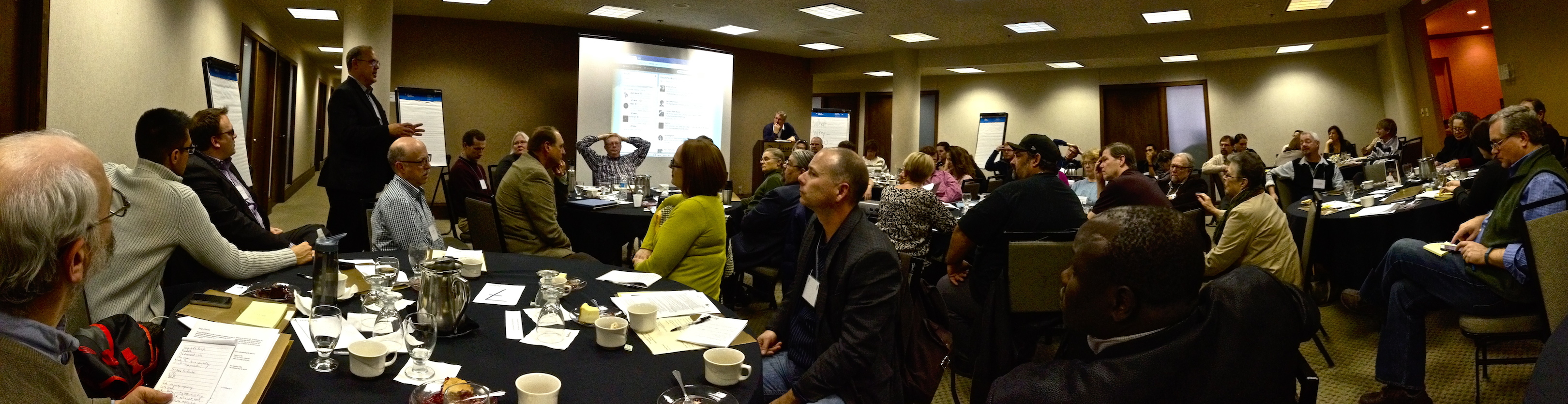
We — the royal North Dakota humanities scholars We — just concluded an informal state-wide humanities get-together in downtown Fargo, North Dakota. It provided a venue to bring a large cross-section of North Dakotans together, pack them into one room, and get them talking about various projects they work on, this to generate unforeseen collaborations for future projects and programming.

Individual attendees came from a variety of institutions, and I’m not going to group them because the conversations cut across all sorts of arts, humanities, and social scientific lines. Scholars came from Williston State College, Minot State University, Sitting Bull College, Holden Village, Turtle Mountain Band of Chippewa, The Arts Partnership, Cardno ENTRIX, the North Dakota Council on the Arts, UND’s Scrap Iron Press, the Plains Art Museum, the First Sudanese Lutheran Church, Concordia College, the Bush Foundation, Bismarck State College, Candeska Cikana Community College, the German-Russian Country Tri-County Tourism Alliance, Prairie Talks, the North Dakota House of Representatives, Trefoil Cultural and Environmental, the ND American Civil Liberties Union, the Red Door Art Gallery & Museum, Cinema 100, the North Dakota Women’s Network, New Rivers Press, Preservation North Dakota, the Dakota Resource Council, the University of North Dakota, the Greater Grand Forks Community Theatre, Meadowlark Arts Council, North Dakota State University, the Northern Plains Ethics Institute, crack scholar Ken Smith from Ellendale, North Dakota, Prairie Public Radio, the State Historical Society of North Dakota, and the North Dakota Humanities Council. Here is a panoramic of it at one point.

Unconference

So that happened. And at the outset I didn’t really know what to expect. But it turns out that there are a lot of arts, humanities, and social scientific scholars on the northern Great Plains primed for this kind of discussion, and it was excellent to hear and see state-wide relationships being formed with individuals who had no idea that such potential collaborative relationships could even exist. Who knows what will come from a conversation? I say this to myself from time to time. The previously unforeseen has been realized, though, and a true genesis happened in numerous ways over the last couple days. More on all this down the line for sure.


Humanities Updates from the Northern Great Plains

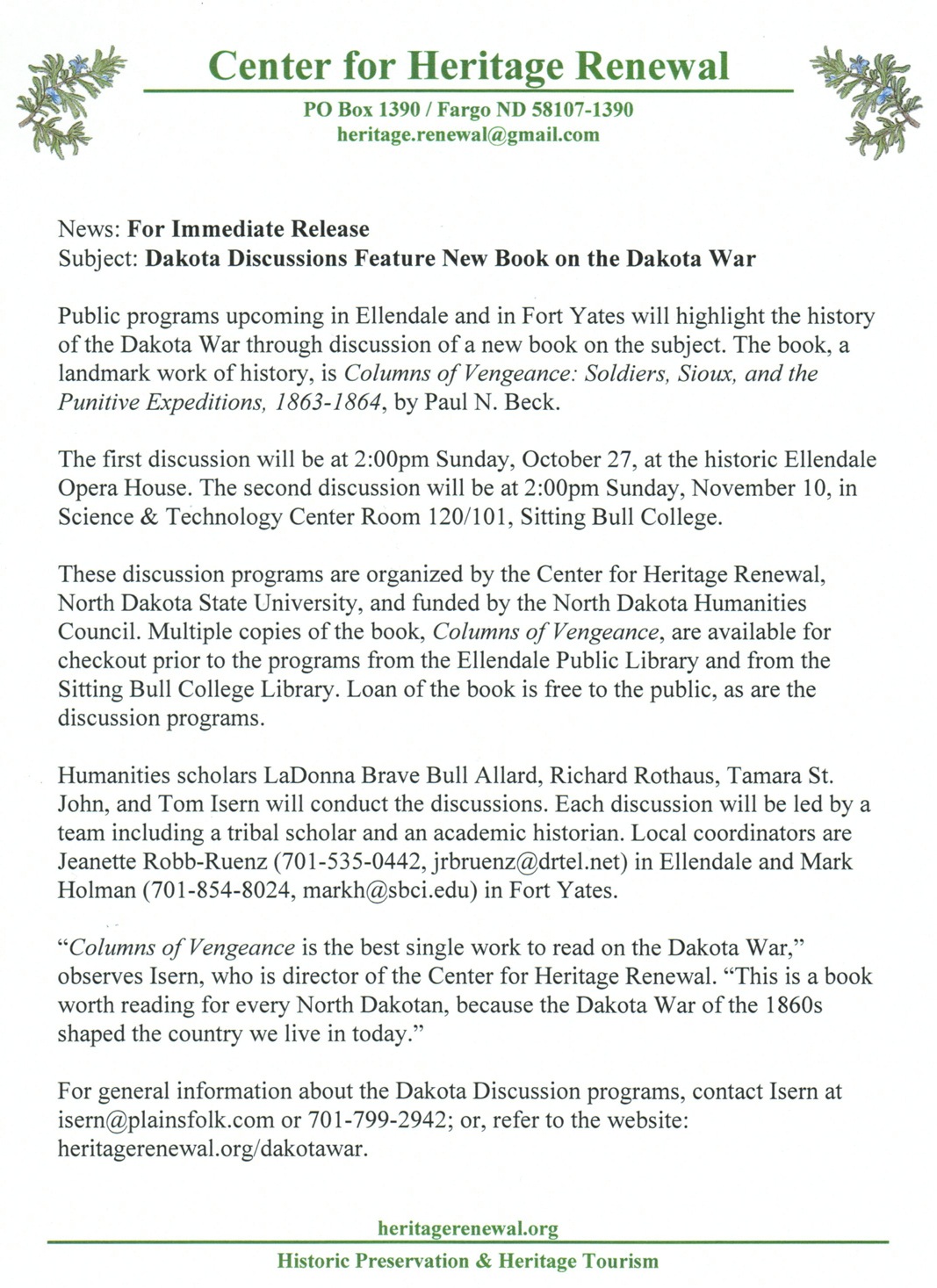
CHRBefore this morning gets away from me, I thought I’d provide two humanities updates taking place in the great state of North Dakota, central North America. The first is a link-reference to the progress of our Punk Archaeology manuscript; and the second concerns the official press release from NDSU’s Center for Heritage Renewal on our continued Dakota book discussions. Of this latter, the discussions bring together the public and scholars to consider the Dakota Conflict and the subsequent punitive campaigns from 1862-1864, and where we, Native and non-Native relations, are today.

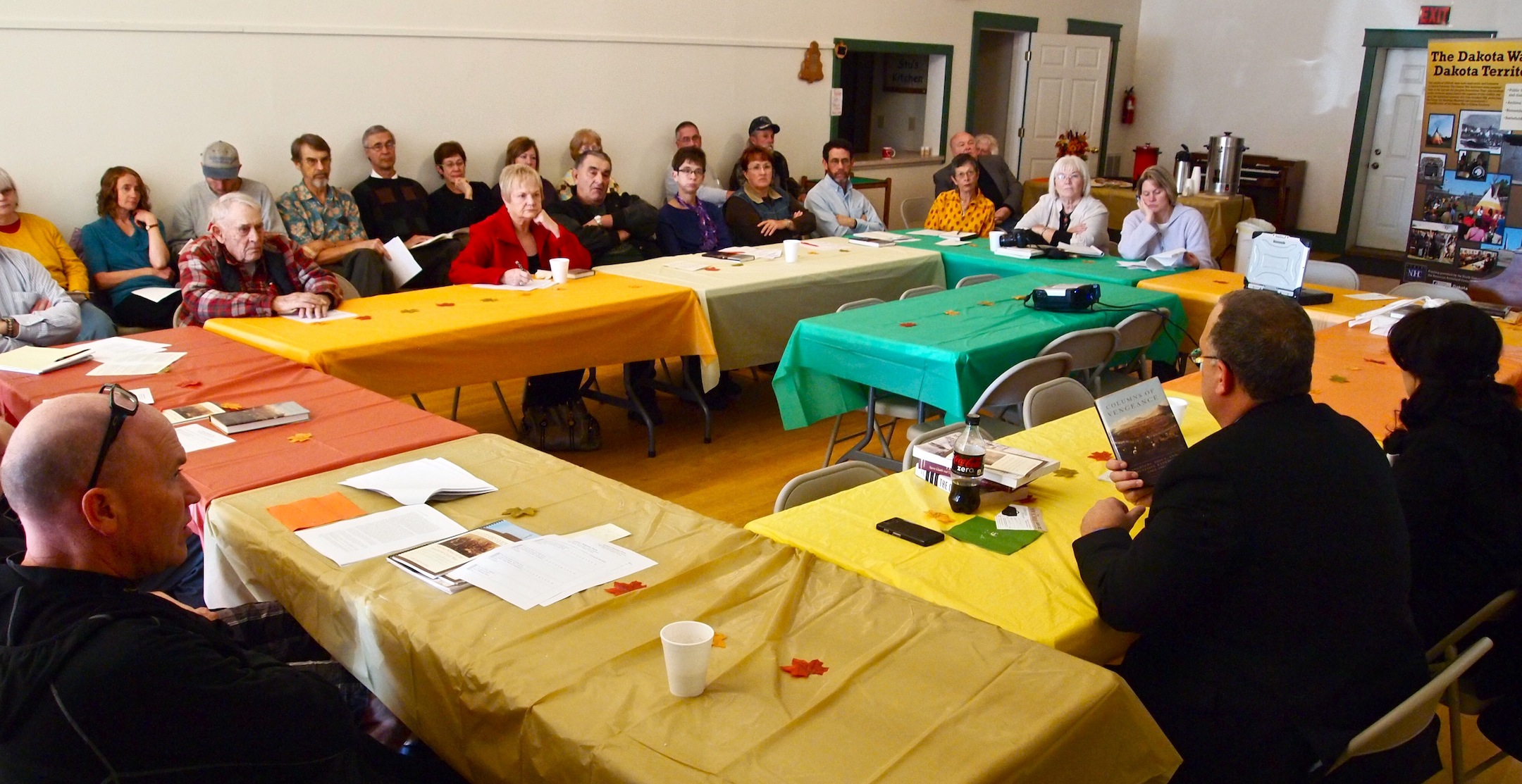
For more details, check out the uploaded hand-bill image to the left. Of this, the most recent discussion took place this Sunday past at the Opera House in Ellendale, Dickey County, North Dakota. This brought out a variety of topics, and the most attentive-grabbing and engaging at all of these events is that of Native historians and knowledge-keepers and scholars. After Tamara St. John, a Native historian and genealogist, spoke at this event, an attendee remarked on how (and I’m paraphrasing) they are starved for this kind of information.

For those of us up to our elbows in the history and historiography of the US-Dakota Conflict and Wars, we understand and often wrestle with accurate and precise and appropriate terminology, definitions, and so on. When we chat about this stuff with non-specialists, one of the most common remarks I have heard is this: “How come we weren’t taught any of this — attempted genocide, attempts at cultural destruction, attempts at forced assimilation — in our public education here in North Dakota, Minnesota and South Dakota?” I’m uncertain. But I do always insist on using attempts and attempted when talking about genocide, cultural destruction and assimilation. I do this because the Dakota, Lakota and Nakota, the Seven Council Fires, are alive and well today. We are pushing ahead as well with these discussions, and every time we have another conversation and chance to talk about this, legitimate history is happening. And if that is happening, so is that large, amorphous thing we call culture and the humanities.

When it comes to the public school systems, I’m sure there are plenty of politics behind all of the curriculum decisions from yesteryear and now. Perhaps that is something we in the future can consider, and perhaps in the future bring before various departments of public instruction in Minnesota, North Dakota and South Dakota. That would be at least one long-range goal to consider.

Nonetheless, the next discussion will be held at 2:00PM (CST) on November 10, 2013, at Sitting Bull College,  in the Science and Technology Center Room 120/101, Fort Yates, Standing Rock Reservation, North Dakota. And here is a photo from the discussion from last Sunday.

OLYMPUS DIGITAL CAMERA


Rough Notes from Minot, North Dakota

Some quick photos from the overnight trip Molly and I took to Minot, North Dakota in the last 36 hours. Upon arrival to Minot, we tracked down Molly’s good friend (and my cousin) Jessica. Housing and lodging is tough to come by in the Bakken, but Jess managed to track down a 250-square foot abode for $600/month. No griping, though. Jess is thoroughly happy to have a place to lay her head and make a meal. But crunch the numbers. This is Minot, North Dakota, folks, and not Harlem, home-sweet-home NYC.

Anyhow, here are a couple photos from Minot, October 25 and 26, 2013. Historians have been known to talk about Nature’s Metropolis. A historic specific of this is the rise and establishment of Chicago, say, in the latter half of the 19th century. One of the reasons Chicago happened was because of the agrarian and natural resource commodities pulled in by rail from the American West. Chicago, of course, used to be a cow town, originally a cattle off-loading and exchange point. It is different today.

With Minot, and other established village and population centers throughout the Bakken, historians are often watching these and wondering which cultural directions they will take. Pulling oil out of the ground is a messy and toxic business, and the flip-side of that is how it monetarily energizes cities and urban centers. The world, at least since the turn of the 19th century, has increasingly relied on petroleum as a dominant source of energy. It kind of just crept up on us over the course of 100 years, and has been the source of handy plastics and war.

I do wonder if the lot of us in the professional world of North Dakota could speak frankly about these dynamics: “Oil is getting spilled. Can we develop a statewide database that everyone can see to keep an eye on that?” Or, “How do we make oil money today and figure out how to use those profits to develop non-petroleum energy sources for when the black gold runs out?” Or, “How did over 850,000 gallons of oil over the course of 11 days get put into one end of a pipeline tube, and not get discovered until it covered some 7 football fields in some farmer’s field in northwestern North Dakota? Don’t we have some red buzzer that goes off if even 10,000 gallons goes missing from the outlet of the oil pipeline tube? If it goes in one end, and doesn’t come out the other end, how does that get missed?” Check out the stories here and here. Stuff like that.

But to return to the original point of this blog entry, here are some grand photos of the energized culture in Minot, Ward County, north-central North Dakota. The first is an established place, one of the last old wood-frame structures in the downtown known as the Blue Rider, owned by Walt Piehl.

Blue Rider

The next photo concerns the Souris River Brewery. Molly and I had bison meat balls there, as well as a great black bean sandwich. And excellent perogies. The glass of beer I had was, as expected, delicious.

Souris

And the next morning (or this morning), we took Jess’s recommendation to breakfast at Sweet & Flour Patisserie. We had French pressed coffee and an chevre-apricot croissant. Here is a shot of that from this morning.

Sweet and Flour


Weekend Line Up

Before logging off and hitting the northern Great Plains segment of Eisenhower’s Interstate system this morning (a grand piece of Federal infrastructure reform from the late 50s and 60s), I thought I’d give a line up as to what is in store for this weekend. Molly and I will first be heading from Fargo up to Minot, North Dakota. We’ll stay with Jessica Christy (Molly’s good friend and my cousin), and I may even have a chance to get over to Walt Piehl’s cowboy poet bar, The Blue Rider. At least for a beer or two and some conversation with, perhaps, fellow Frenchman Todd Reisenauer. Both Christy and Piehl are professors of art at Minot State University, and both are artists from and for the northern Great Plains.

Molly and I will return to Fargo on Saturday, and then on Sunday it is back out on the road to Ellendale, North Dakota (west from Fargo to Jamestown, then south on Highway 281 for about an hour). We are heading to Ellendale to begin and continue another public conversation that considers what happened 150 years ago with the US-Dakota Wars, and where we want or ought to go with the conversations today. These events are sponsored by North Dakota State University’s Center for Heritage Renewal, and the North Dakota Humanities Council, and they bring together a variety of professionals, Native historians, and the public. Gotta run now, but a follow up at some point next week on all this.


Post-Talk Update from North Dakota State University

I had an excellent time in Kjersten Nelson’s Political Science class today speaking about the philosophical whys and technical hows of historical and archival research. After I finished, I asked students where they were in their archival research.

It was excellent to hear from one student who is taking on the hard topic of how returned soldiers deal with Post Traumatic Stress Disorder, and I was glad to recommend that they 1) chat with NDSU Philosopher Dennis R. Cooley about this, since it concerned how soldiers deal with suicide, and since Dennis has thought long and hard about this topic; and 2) that they look into David Silkenat’s Moments of Despair: Suicide, Divorce, and Debt in Civil War Era North Carolina for the historical backdrop of how American soldiers have dealt with these exceedingly difficult memories. The human costs that result from war are infinite, and it was great to hear how an NDSU undergrad (and soldier) is considering ways to push knowledge in new directions. She seriously wants to help. I’m looking forward to checking back in on that research.


Imagining Research and Teaching Tuesday

In a couple hours I’ll follow my established pedestrian transect to North Dakota State University (this is the fancy way of saying I’ll walk up to class) to provide a guest talk on archival research for Dr. Kjersten Nelson’s Political Science classes. Over the last couple days, I’ve thought off and on exactly what I could and should impart upon the class (she said there are approximately 17 students). Three thoughts came to mind, and here they are (note: a friend of mine, Don Paul, attended one of those Ford schools back in the day in Michigan. These were philanthropic schools Henry Ford set up for kids to attend — for free. Don said at those hands-on liberal arts vocational schools, the artisans and industrial manufacturing teachers would tell him to follow this rule when giving talks: start out by telling your audience the three things you’re going to tell them; then tell them the three things with explanation; and then conclude by telling them the three things you told them. This makes sense. Work in threes or fours if possible.):

1) Perhaps the best way to go about it is to initially do a bit of podium driving, explaining why research matters, and why professors at universities invest themselves in pushing knowledge in new directions. Just last Friday I chatted a bit with Bill Caraher in Bismarck, this after a invigorating ND Humanities Council board meeting, and in conversation he mentioned how he explains to his students exactly what he does with his time at the University of North Dakota. Students understandably want their professors to be attentive, and professors should definitely do this, both with class room lecture, discussion, and in office hours and over coffee. But the reverse of that is to make sure the students activate the auto-didactic — the self-taught learner — within themselves. The entire idea, I’ll tell the students today, is to do good on your archival research and paper skills because A) this may turn into a larger research project when you are off working on your own PhD in grad school; and/or B) this will give Dr. Nelson the ability to write you a glowing letter of recommendation that speaks to your abilities as a critical thinker, writer, and self-directed learner and problem solver; and C) your friends, colleagues, and current or future life-long partner will indeed dig these skills.

The granite bugler at Whitestone Hill in southeastern North Dakota.

The granite bugler at Whitestone Hill in southeastern North Dakota.

2) From there I’ll delve into the personal, at least how I managed to bring a topic I’ve cared about since 2008 to a manuscript form that was considered and eventually published by a top-flight academic journal. There are enjoyable struggles and processes of preparing such a manuscript, and one pours themselves into these things not knowing if a journal will consider them at all. That, of course, is why it takes the spirit within each person to be driven to figure out a problem in the social sciences or humanities that may, at the outset, induce confusion or frustration. Such was the case when I first heard about and then visited the Civil War monument at Whitestone Hill in southeastern North Dakota some years ago. I was initially confused by it — “Why did North Dakota install a granite Civil War bugler on top of the largest hill in the area?…” There’s a tendency to be confused or frustrated by what is not yet understood. And one doesn’t have to agree with something to understand it, but agreeing with something and understanding it are two disparate things.

3) And finally, this might be a direction that students and researchers think about as they continue to consider their topics: is there anything in the world of politics or political history that induces confusion or frustration? Research always begins with questions, and sometimes if you one feels frustrated about something, they should indeed start asking questions. “Why is that the way it is?” I’m interested in hearing how far along the students themselves are in their research processes. A large part of archival research deals with imagining where the sources might be. Once a paper trail starts to emerge, it can help with imagining where other sources might be. I’ll again default a bit to the Whitestone Hill case study, but broaden it out to envelop which directions the students are pushing.


North Dakota’s Autumn Pheasant Opener

Yesterday was the day hunters in North Dakota could begin blasting away at pheasants. A couple years ago, after thinking things through a bit, I decided to purchase a sensibly priced double barrel shot-gun to take up seasonal bird hunting. And in the last week, I ended up meeting and briefly chatting with Hank Shaw, the chef and author of the cookbook, Duck, Duck, Goose. Shaw is one of the latest recipients of the James Beard award, and he’s got a spectacular blog here.

Hunting isn’t like going to the grocery store. If you happen to shoot something, you have to gut and field dress whatever it was that you killed. In the case of a bird, this requires you to hold the still-warm bird in your hand while making the right incisions to access and discard the guts. At least for me, it helps recenter my psyche, and I feel a bit more re-attached to the realities of my diet. This is much different from purchasing a saran-wrapped cold chicken in the meat and poultry section of your grocery store. And when one is hunting, there is never a guarantee that a hunter is actually going to return with something dead to eat. That ended up being the case yesterday. But as you’ll often hear hunters say, it’s often not just about the hunt. It is also about walking tree rows, getting out into the landscape, and just looking around at what’s out there.

An abandoned prairie church near Enderlin, North Dakota.

An abandoned prairie church near Enderlin, North Dakota. Photo taken on October 12, 2013.

Rick Gion and Christian Gion and myself made up our entire hunting party. Rick and I brought our shotguns while Christian opted to hunt for edible mushrooms. Christian got a small bundle of oyster mushrooms and some seriously ripe buffalo berries. When Christian returned with the berries, it reminded me that this was also the seasonal plant northern Great Plains Dakota and Lakota indigenes would pick at this time of year. Christian ended up returning with more than Rick or myself (which means Rick and I returned with zero birds). We did find some good spots for next time.

We also came across an abandoned church, and I posted it to Facebook last night. I included this caption:

Abandoned prairie churches on the northern Great Plains really catch the eye when one is out hunting upland birds. Bottom part of the photo is mono-industrial agriculture; the abandoned gothic church architecture is a stratigraphic slice of a time gone by; and the top 3/4s of the photo is the skyline typical of our North American steppe.

So the hunt wasn’t a total loss. At least I got to shoot something, if only a landscape photograph.