Tag Archives: World History

Chinese Pacific World History

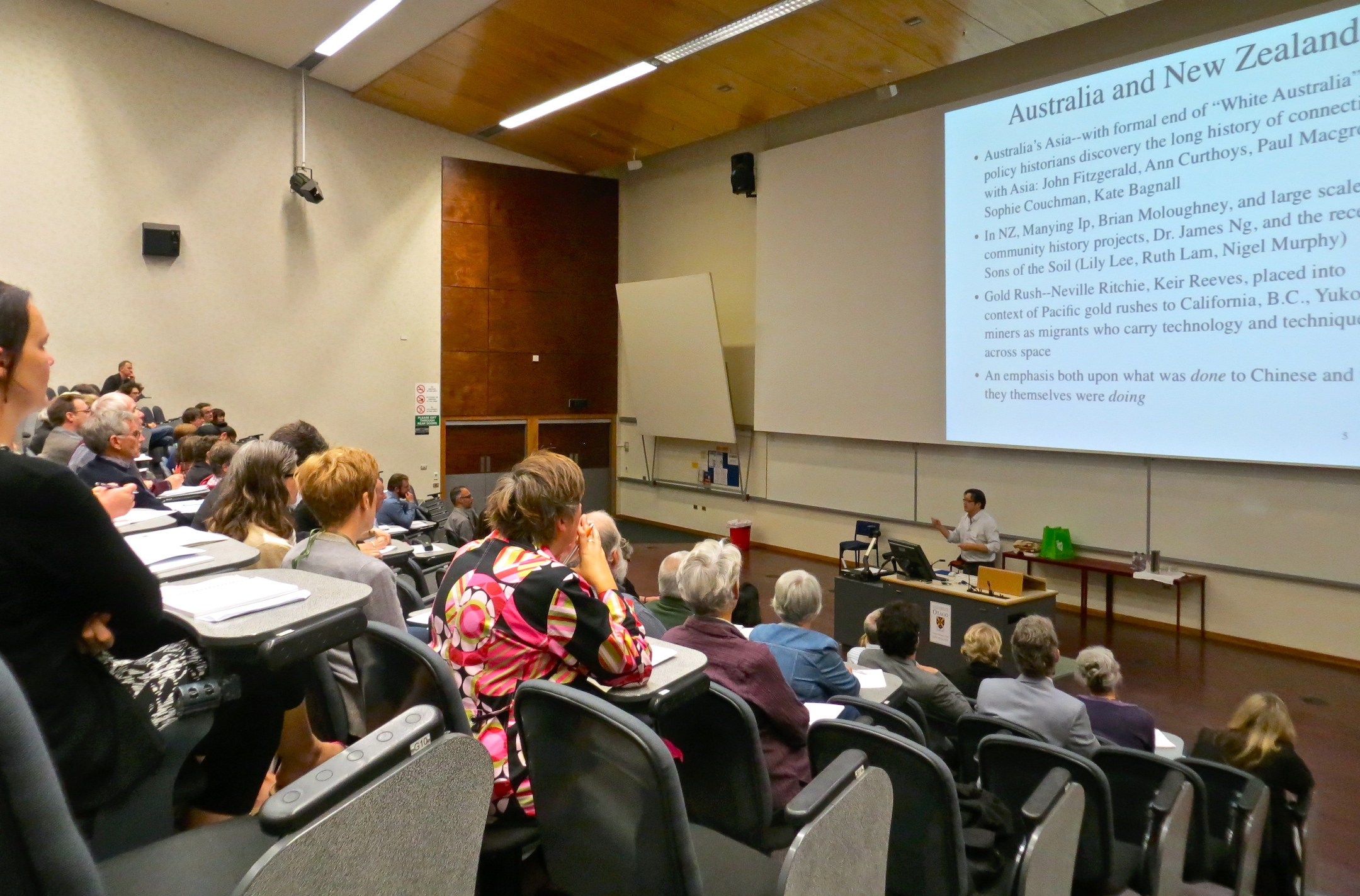
Henry Yu provides the final keynote lecture.

Henry Yu provides the final keynote lecture at the New Zealand Historical Association Conference.

On Friday morning, Henry Yu provided the final keynote lecture at the New Zealand Historical Association conference. Yu’s lecture title was, “The Cantonese Pacific: Anti-Asian Politics, and the Making and Unmaking of White Settler Nations.” Yu talked about the 19th century Chinese migrants specific to the social history of ideas. He explained the notion of Gum San, the namesake that Cantonese migrant gold workers gave to the places they imagined themselves eventually arriving at. Gum San signified an idea rather than a place, and they would travel to these goldfields with the psyche of making it: before we can act, we must first have an idea of action. In some cases the workers returned to their homelands, or their villages, ideally with money that allotted them control over their own destinies. In other cases they always envisioned returning, but remained in their non-homeland locales throughout New Zealand, Australia, and North America. It was great to hear Yu talk about all of this.

My notes from the Henry Yu talk.

My notes from the Henry Yu talk.

Yu’s work fills in large gaps in Pacific and world history, and I thought about at least four things during his talk. The first had to do with the Chinese graves that I remembered visiting a couple years ago while in Deadwood, South Dakota, this of the early Chinese gold miners and service industry workers in the Black Hills. The second has to do with the Chinese labor force that built large segments of the railroad throughout the American West. The third had to do with analogies to contemporary migrant workers entering the business of mineral extraction in western North Dakota. And the fourth had to do with how much easier it was for a migrant laborer to travel across national and imperial boundaries before the nation-state created elaborate bureaucracies to inhibit this (largely in the name of race and nation, at least by the turn of the 20th century).

But I don’t have much time to digress on all of this because I need to get over to the Settlers Museum in Dunedin.


Dunedin and Edinburgh Urban Landscapes

We — the global we — are in the historical shadow of global colonial settlement and struggles, and I thought it interesting how Scottish settlers imposed their image of Edinburgh on the urban landscape of Dunedin, South Island, New Zealand. I’ve heard a few shop owners in the last couple days remark on this, so I pulled a couple maps off Google Earth and loaded them up here, right below. Note the similarity of the octagon, and also the common Moray Place street names. The Dunedin New Zealand colonial layer is on top of what was Maori layers of meaning. And, indeed, that is another blog post all together. The first map is of a segment of Edinburgh, Scotland. The second of Dunedin, New Zealand.

Moray Place in Edinburgh, Scotland.

Moray Place in Edinburgh, Scotland.

Dunedin City Center

Moray Place in Dunedin, New Zealand.


Historic Industry in Western North Dakota

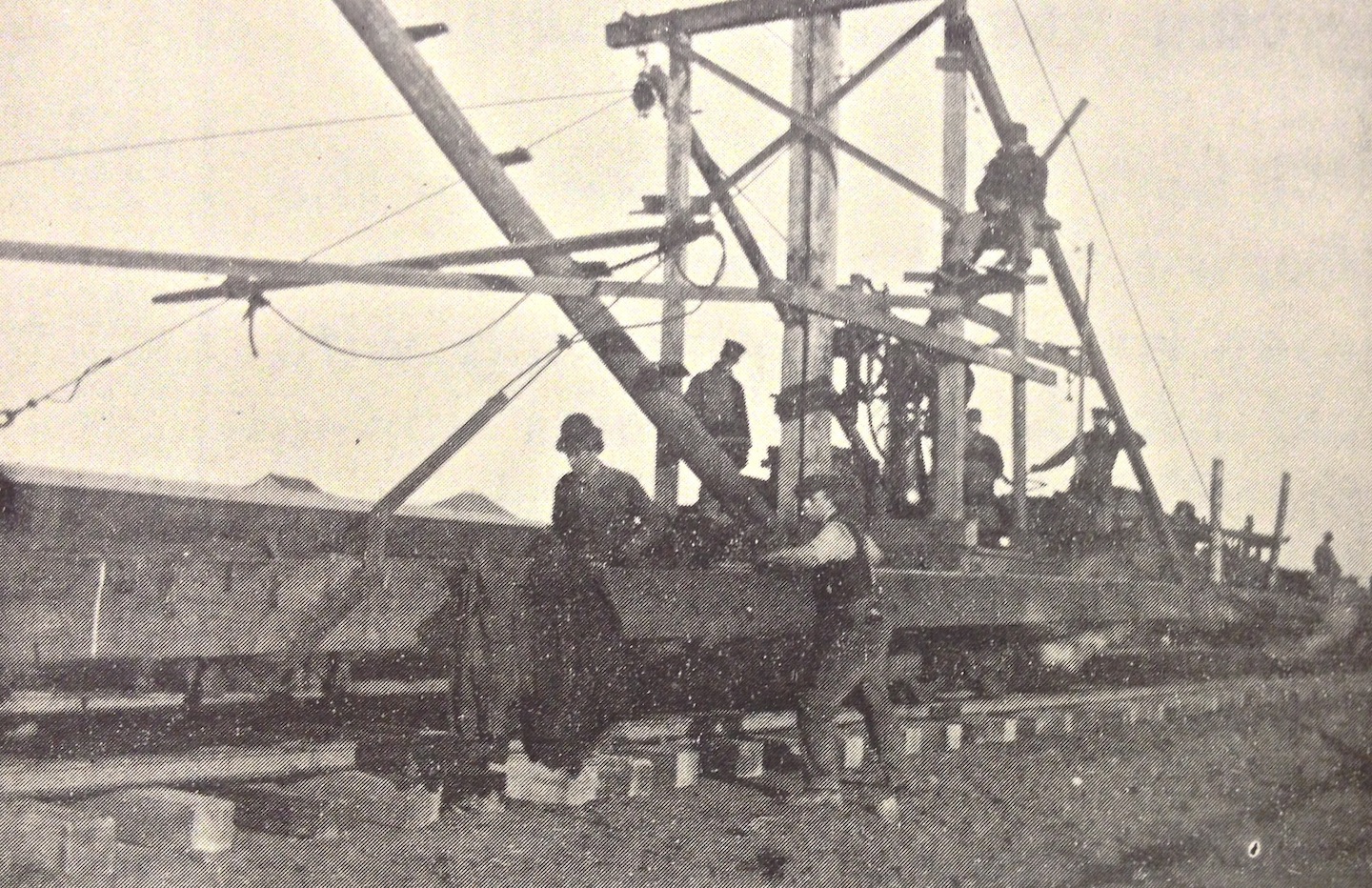
Railroad workers in 1910, this one mile west of Regent, North Dakota.

Railroad workers in 1910 one mile west of Regent, North Dakota.

I just finished a lunch of homemade chicken soup (with lots of fresh lemon juice and cilantro), and before I grab a coffee and get back to the busywork, I thought I would upload a photo of historic railroad industry in western North Dakota circa 1910. The photo was taken about a mile west of Regent, as track was being laid to connect the rural agrarian areas of the American interior with the city centers and rail hubs of Dickinson, Bismarck-Mandan, Fargo, Minneapolis-St. Paul, and so on.

Looked at from an agrarian context, railroad construction was big throughout the world at this time, as nation-states increasingly relied on agricultural production to feed an ever growing populace, and this led to increased competitions over global resources. I suppose a modern public historical treatment of pumping Euro-Americans into colonizing the continent’s interior might come by way of AMC’s “Hell On Wheels” or HBO’s “Deadwood,” a kind of post-Civil War historical days of our lives with amplified skull-duggery, dodgy behavior, and shenanigans. But don’t simply rely on Hollywood to shape the way the past is understood. It’s best to get into those archives and see the documents for yourself.


World War II: Charles E. (“Bud”) Barth Photos

Just over a year ago, a great uncle of mine, Charles E. (“Bud”) Barth passed away. Charles was a front line medic in the European theatre of the Second World War (also in the Battle of the Bulge). Years prior I had the chance to get to know him better, even interviewing him for the United States Veteran’s History Project.

Because I blogged on Charles both here and here, another relation of someone attached to the same medical unit was able to find what I blogged, track me down, and e-mail me additional photos of Charles with his WWII unit. Here are those two photos of Charles with his detachment, these sent to me by the daughter of S/Sgt Kutik (who served alongside Charles).

Note: Charles originally hailed from Braddock, Emmons County, North Dakota.

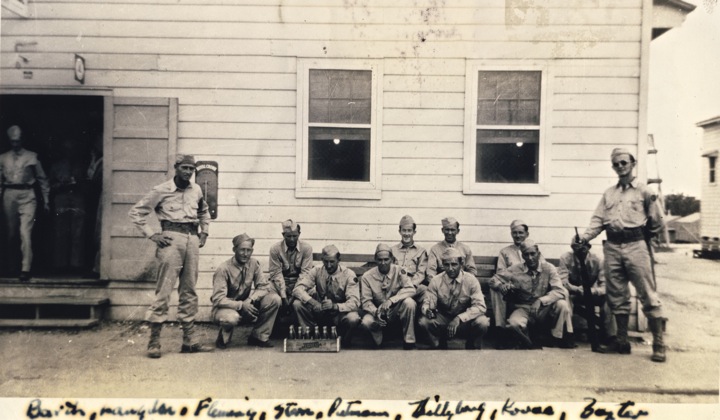
An informal photo of Barth's medical detachment. Charles (kneeling) is second from the left.

An informal photo of Barth’s medical detachment. Charles (kneeling) is second from the left, just next to the standing soldier. The case of beverages in front of them is labeled, “Pepsi.”

409th Medical Detachment, Barth is front row, second from the left.

409th Medical Detachment, Barth is front row, second from the left.


Ideas of Fermentation and Distilled History

On this 4th of July morning (which, in America, is a secular holiday, or holy day), I finally got around to one of my short reading lists that concerns the scholarly study, specifically, of beer, and broadly of fermentation, booze and alcohol (or what academics sometimes refer to as ethyl). The four books in front of me include The Oxford Companion to Beer (Oxford University Press, 2012), two monographs by Patrick McGovern including Ancient Wine: The Search for the Origins of Viniculture (Princeton University Press, 2003) and Uncorking the Past: The Quest for Wine, Beer, and Other Alcoholic Beverages (University of California Press, 2009). The fourth work is The Archaeology of Alcohol and Drinking (University Press of Florida, 2008) by Frederick H. Smith, and this is perhaps the one that speaks most pointedly to the July 4, 2013 day since it is a part of The American Experience in Archaeological Perspective series.

Some booze studies scholarship.

Some booze studies scholarship.

Of all these books, the Oxford companion is put together like an encyclopedia rather than a narrative or anthology, and Oxford sensationalized it a bit by asking Tom Colicchio to write the short forward. Because I am in the dark on many facets of contemporary culture (it all moves and changes so fast, though; and Tom would have to Google our names as well), I had to Google Colicchio’s name, but when an image of his face appeared I recognized him immediately as one of those celebrity chefs. Tom noted how as he matured from his teens up to 2012, so did his appreciation toward beer. Of this work, though, I thought Oxford would have benefitted more to get a brew master to write the forward, or even a monk at a monastery that is renowned for beer. Tom works in the trade of acquiring James Beard Awards, culinary rage and sensationalism (which is how you make it in that business) whereas a monk devotes time to brewing, reflection, and self-reflection (in large part for humanity and the sustainability of the abbey or monastery). Brooklyn Brewery brewmaster Garrett Oliver drafted the preface to this work, and he speaks a bit more to the beer trade.

The Oxford companion is huge like an encyclopedia, numbering 919 pages, or around 2″ thick. I think the only way you’d go about using this book is to check up on a pointed question with the index, look at the topical features just after the preface, or to open it up to a random page. On page 674, the entry “public houses (pubs)” appears, noting that the institution of the pub did not have much renown outside of the U.K. until business owners decided to bring Irish Disneyland to the world with Irish-themed pubs (I suppose the idea was that not everyone can make it to Ireland to visit a pub, so might as well bring the Irish-themed pub to the non-Ireland world). It is moderately surprising to not see Kingsley Amis referenced in the index of this work, but I suppose if a person is building a scholarly library on beer and booze, they already know about it (Amis knew his booze, and he could be accused of being just as interested in its effect as he was the flavor and body of the stuff).

On the first page is the entry “abbey beers,” and this expands on the brewing expertise of the Belgian Trappist monks, and the established “appelation (controlee)” which lets everyone know where the monastic beer originated (time, space and chronology is important to the monastic tradition for many reasons). In reading and writing about this passage, for at least a couple years I have hoped that the monks of Assumption Abbey in Richardton, North Dakota, might at some point down the line consider brewing beer with North Dakota grains, barley and hops. And even better, sharing it (but that’s totally up to them).

As for the works by McGovern, I first came across his name in a popular history of booze put out by the Smithsonian in July-August 2011 (the great article linked to here). McGovern focused on fermentation in Western Civilization (the region of Mesopotamia is the cradle of fermentation), and he also made the case that we today are part of a long fermentation process (the long durée of beer drinking). In McGovern’s scholarship, he is a bit heavy-handed in his testimonies to the irrefutability of the archaeological record or the interpretation thereof (“There is no hidden bias lurking in a pottery sherd or a stone wall, as there might be in a written document.” [McGovern, 2003: 5]). But that sophomoric understanding of philosophy and theory is outweighed by a broad knowledge of the history of beer and wine.

German-produced Bartmann wine bottle from the British settlement site of Jamestown, Virginia. (Smith, 2008: 12)

German-produced Bartmann wine bottle from the British settlement site of Jamestown, Virginia. (Smith, 2008: 12)

Of the four books, the best on the subject is by Frederick H. Smith. And I define best in the sense that it is an academic treatment of the subject that tracks both the subject itself and what other scholars from the academy have said about it (like brewing, the origins of this tradition is monastic in and of itself). The first chapter to this work alludes to numerous scholars in alcohol studies (a kind of subfield in history and anthropology), and the subsequent chapters go on to discuss the Iberian storage vessels first used to transport the sauce throughout the Atlantic World, from the Old to the Jamestown colony in the New, and here to the production of alcohol to its trade and consumption and so on. By the 16th and 17th centuries, hand-blown glass bottles surpassed the ceramic vessels, and Smith notes that when these bottles are recovered, so is the booze. For example, an early 17th century glass bottle of wine was once recovered by marine archaeologists, and it turned out that the Dutch warship had wine at 10.6% alcohol content, this within the same range as the content of wine today.

The final chapter in Smith’s monograph stems from a 2005 study he did on the role alcohol played in the 1816 slave revolt in Barbados (four decades after elite Anglo-America got its start). These case studies are a more effective way to explore the social history of booze in all of its variety and nuance. Specific to this are the caves on Barbados, a place where self-liberated slaves could escape to on an island and carve out an underground existence. Without going too much further into these works, it seems that on July 4th it is important to acknowledge the philosophical substance of America’s Declaration of Independence, but more importantly to know that it was a document prepared by an elite minority on the backs of an enslaved majority.


Remembering Greasy Grass in World History

I remember the first time I started piling over the historiography of Greasy Grass/Little Bighorn at some point in 1999 or 2000, this with a short historical article included in one of those military history readers. This article happened to be by the late Stephen Ambrose (I think he published it sometime in the 1970s), and as a reflection of the scholarly times, it focused exclusively on what we call white military history. Looking back on it, and considering how even by the 1870s the American military was such a small cross section of elite Anglo-Americans that guided policy (as opposed to the lot of our non-English-speaking immigrant great and great-great and great-great-great grandparents who were entering the country at the time), it is much more accurate to refer to the traditional historiographic body of white 19th century American history as Anglo-American or Victorian Military History. This is not meant in a conspiratorial way. Rather, it is meant to point out how institutions are composed of individuals, and if the individuals within those institutions have certain outlooks on the world, then the institutions are going to operate accordingly.

For at least a couple decades, now, enough individual scholars within the academies have created a social structure so that they can shift the direction of the scholarship (archaeologists are sometimes calling this “counter-modern” while other historians refer to it as multivocal). For example, instead of once again combing over what happened on June 25, 1876 at Greasy Grass, scholars have taken to looking at the conflict as a broader segment that needs to be contextualized in World History. James Gump has a work out there entitled, The Dust Rose Like Smoke: The Subjugation of the Zulu and Sioux (University of Nebraska Press, 1994), and it considers how the Anglosphere mythologized themselves after a confederation of Lakota, Cheyenne and Native America decimated the 7th at the Little Bighorn in 1876, and after the Zulu wiped out a British force of 1,500 at Isandhlwana on January 22, 1879. Check out the Zulu monument to the fallen Zulu at Isandhlwana with this link here.

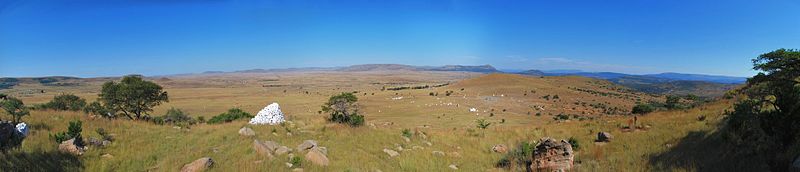
Isandlwana landscape from the Wikipedia public domain page.

Isandlwana landscape from the Wikipedia public domain page.

These broadened world historical treatments help pave the way for other scholarship (for example: so we’re not incessantly sitting around wondering what Custer did wrong; but rather what the Lakota and Cheyenne forces did themselves to bring about George’s demise). The latest and greatest public historical treatment of Greasy Grass comes by way of Debra Buchholtz’s The Battle of the Greasy Grass/Little Bighorn: Custer’s Last Stand in Memory, History, and Popular Culture (Routledge, 2012). This work gets the reader to think secondarily about the actual events of June 25, 1876, and primarily about how the public has remembered the events since 1876. It was, after all, a centennial year (from 1776 to 1876), and the general Anglo-American reading public was nonplussed and aghast to think that Custer (or anyone Anglo-American for that matter) would be capable of losing a battle within the interior of the American nation, and this so close to the centennial anniversary of the nation’s declaration of independence.

Greasy Grass/Little Big Horn from the Google Earth imaging.

Greasy Grass/Little Big Horn from the Google Earth imaging.

So this is where a lot of the contemporary scholarship is at these days: not just looking at the historical event itself, but also looking at what the popular press and academically trained thought about the historical event in and of itself (for example, William Blair and David Blight, among others, have taken a hard look at Civil War memory and memorialization in this way too). And that’s what I’ve kind of been thinking about on this 137th anniversary of the day the Lakota and Cheyenne (and others) stuck it to George at Greasy Grass in eastern Montana.

In closing, I leave you with a paragraph quote from the 1986 work of James Belich, The Victorian Interpretation of Racial Conflict (McGill-Queen’s University Press, 1986 and 1989). This is so you don’t have to lug around numerous books while you’re taking in the various Lakota and Cheyenne holiday celebrations that commemorate the defeat of Custer at the Battle of Greasy Grass — Aaron Barth Consulting does this work for you.

Okay, to quote Belich, and to consider it in the context of Custer as a trained Victorian operative for Anglo-America:

“Racial ideas are not just images of others, but of one’s self and one’s own society. Superiority and inferiority, inevitable victory and inevitable defeat, higher faculties or the lack of them; each are two sides of the same coin. To question one is to question the other, and thereby cast doubt on an individual and collective self image. Victorians, like other people, were not eager to ask such questions.” (Belich, 1989: 327)


Some Philosophies of Histories

In a couple hours I will be taking what is called the oral component of the comprehensive exams. This is the business of academia, what I sometimes think of as the codification of intellect (everyone is sharp, or has potential to be sharp, and universities are designed with a goal of proofing and validating that sharpness). In that case, I am engaged in my morning ritual of visiting, revisiting and reading through some broad conceptual thinkers in final preparation for this upcoming, mid-morning fun.

A potential railroad metaphor for the various and competing tracks of time cultures and societies are hurtling along. This, we historians argue, is why world history is increasingly important in our increasingly global age.

The railroad as metaphor for the various and competing tracks of time cultures and societies are hurtling along. This, we historians argue, is why the study of history and the philosophies of histories is increasingly important to study in our increasingly global age.

In the largest scheme of things, these big-picture thinkers — from R.G. Collingwood to E.H. Carr to John Lewis Gaddis to Michael Shanks — force a reader to contemplate not just the technical hows of a discipline, but also the philosophical whys: for example, why would anyone be engaged in the efforts of history or archaeology or, more broadly, any discipline or trade for that matter? To contemplate this provides a variety of conceptual frameworks in which to filter data through, and these are the substructures of any discipline and trade. While keeping this in mind, it is also important to keep in mind that the disciplines and trades are by and for an infinite variety of culture and subculture and subaltern culture (and so on). Whether conscious of it or not, the collective memory within these groups influences to varying degrees the ways the substructures are built (if looking at the archaeology of language, for example, it quickly becomes apparent that languages are built out of previously established bodies of presumptions and assumptions).

With that said, in revisiting R.G. Collingwood, The Idea of History, (1946) R.G. says in his introduction that “Philosophy is never concerned with thought by itself; it is always concerned with its relation to its object, and is therefore concerned with the object just as much as with the thought.” This entire idea pertains to developing philosophies that disciplinarian doctors (which, to be pedantic, is Greek for “teacher”) train cadets and recruits with, so the latter understands that two thinkers can take the same body of evidence and can arrive at completely disparate conclusions. In the case of history, this is what 18th century Voltaire called a “philosophy of history,” and what 20th century E.H. Carr referred to as a dialog with the past. This philosophy and dialog is important — at least I’ll make the argument here — since the world has and always will be in a perpetual state of crisis. If met with crisis, we have to get used to the idea of re-calibrating and re-adjusting. This is not necessarily to accept the crisis, but to figure out ways through and around it. In some of Carr’s concluding remarks in chapter 5 of What Is History? (1961), he identifies three types of history (using the Royal “You” to bring his case home):

[1] You can, if you please, turn history into theology by making the meaning of the past depend on some extra-historical and super-rational power. [2] You can, if you please, turn it into literature — a collection of stories and legends about the past without meaning or significance. [and 3, which is where Carr is at his best, a proper definition of the historian.] History properly so-called can be written only by those who find and accept a sense of direction in history itself. [and in the copy on my shelf, the following is what I underlined] The belief that we have come from somewhere is closely linked with the belief that we are going somewhere. A society which has lost belief in its capacity to progress in the future will quickly cease to concern itself with its progress in the past.

Thus, for Carr (and myself), to engage in history proper is to engage in the faith of the future of society, and the discipline of history itself. This as well is why history is never “complete.” If history was complete, society would be complete, and both that society and history would be finished and at an end with itself. This, of course, is only theoretically possible, since nothing is ever truly at end. Rather, we humans impose the boundaries and limitations, demarcating a beginning and end for what is otherwise quite gradual and transitionary. This is why in the first two decades of the 21st-century we are having conversations about how we humans engage 2- and 3-dimensional objects. In the words of Michael Shanks, “the past has to be worked at,” (Hunter Thompson sometimes referred to journalism as analogous to chopping wood) and it is just as important to look at the past as it is to look at the way historians have sought to make sense of the past.

I keep thinking that, to use metaphor, as we stand on the 21st century dock and watch the 20th century Cold War — that barge of history — drift further and farther away from us, a host of new crises will continuously arise. Our ability to react to them will be predicated on not just how we know the past, but also of how and why those before us knew the past. And how and why they understood the past is also filtered through the ways in which we remember and know the past, and so on, ad infinitum. 


Notes from the Basecamp (04/23/2013)

Basecamp water wagon and supplies.

Basecamp water wagon and supplies.

On April 4, 2013, Richard Rothaus and I chatted via e-mail about some base camp logistics for Adventure Science’s 100 miles of North Dakota wild, a pedestrian overland trek through ephemeral drainages and butte plateaus in the nation’s #2-producing oil field that is western North Dakota. We came to the conclusion that I could 1) be useful and helpful in coordinating points of drop off and extraction, and evening details for Rothaus and Andrew Reinhard; and 2) in the interim, between dropping off the team and setting up camp, I could read for comprehensive exams (also known as “comps”). On the April 21, 2013 drive out to western North Dakota, I also thought it would be a good idea to capture some traffic samples that are part and parcel to the borderline anarchy of any blossoming petroleum industry throughout the planet.

After dropping off Rothaus and Reinhard yesterday (04/22/2013) morning, I drove the field vehicle around to where they would arrive that evening, and set to reading for comps (“comps” is one part of the intellectual bootcamp, or disciplinary training, when working on a doctor of philosophy, in my case with North Dakota State University and the University of North Dakota). Winter in North Dakota is holding on a bit more than usual, and it is getting the attention of folks in both the city and in the countryside. The late winter means a late spring, and so the snow has been gradually melting.

While reading for comps, and while temporally in late spring and spatially in western North Dakota, I revisited a short passage from the first chapter of Elwyn B. Robinson’s 1966 History of North Dakota (University of Nebraska Press), entitled, “The Grassland Setting.” In this, Robinson says,

For hundreds of millions of years the Williston Basin [of western ND] and the area surrounding it were intermittently covered by a salt sea stretching from the Gulf of Mexico to the Arctic. Sediment carried into the sea by flowing water was deposited on the bottom and slowly compacted into strata, or layers, of sedimentary rock made up of clay, shale, sandstone, and limestone. (Robinson, 1966: 2)

Basecamp 2 TrafficIf wandering around in the badlands today, the tops of all the buttes represent the bottom of that ancient and dried up sea floor. Erosion from glacial advances and retreats helped shape what we see and make up our landscape on the northern Great Plains, and also what Rothaus and Reinhard slogged through all day. I noticed the slipperiness of this clay and mud about mid-morning (04/22/2013): while sitting in the cab and reading, and while the mid-morning sun warmed the badlands, the snow and mud went from frozen to melt, and this caused the field vehicle to start sliding from a standstill. This feeling is at first a bit unsettling, at least before realizing what is happening. I fired up the vehicle and drove it to a less-remote location, namely a raised and ditched off-road of Highway 85, not too far north of Grassy Butte, North Dakota. That solved the vehicle sliding problem.

From here I collected some traffic samples, capturing the number of vehicles that passed by in two separate 15-minute windows. Below is a short clip of the traffic (arguably a way to humanize the social science).


The Longue Durée of Native American Sovereignty: Review of Frank and Goldberg, “Defying the Odds: The Tule River Tribe’s Struggle for Sovereignty in Three Centuries” (Yale University Press, 2010)

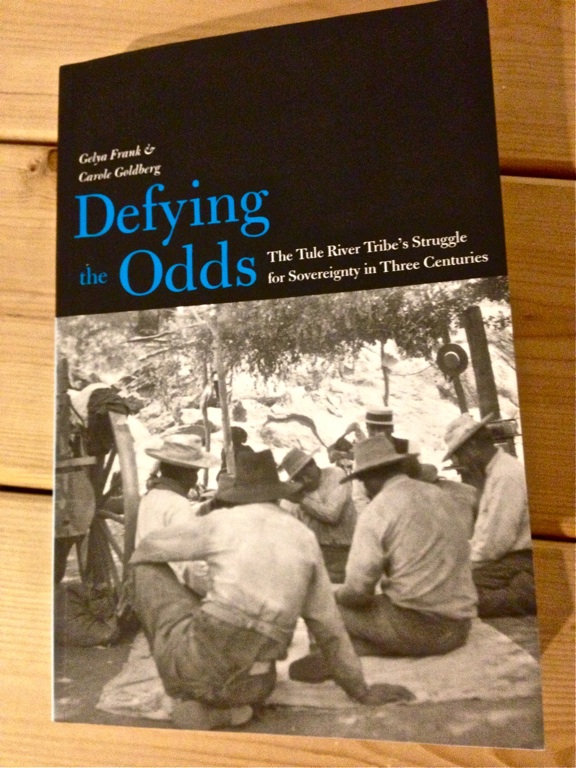
Tule River CoverWhen considering Native and non-Native relations in the United States, it is first necessary to remember that the history rests on the foundational principal of sovereignty, or the ability of Native America to exercise autonomy within a defined geopolitical border. To varying degrees and throughout time, Federal and State governments have contested the sovereignty of Native America, and this is a topic anthropologist Gelya Frank and legal scholar Carole Goldberg cover in Defying the Odds: The Tule River Tribe’s Struggle for Sovereignty in Three Centuries (Yale University Press, 2010). Near the beginning of chapter 3, Frank and Goldberg give a concise paragraph description of the Tule River Tribe in the mid-nineteenth century:

After a brief but devastating war started by settlers in 1856, the Tribe was settled on the first Tule River Reservation located on the site of the traditional Koyeti tribe village. The federal government failed to secure this land and twenty years later forcibly removed the Tule River Tribe to its present reservation in the mountains. In 1886, a tribal council ordered the execution of an Indian on the reservation to reassert order and authority after the death of the Tribe’s recognized leader. The United States government, which indicted the executioners for murder, could have chosen to respect this act of community protection and social control. Judge Erskine M. Ross had an available legal theory that could have allowed him to dismiss the charges and let the four Tule River defendants go free. Under a theory of the Tribe’s “concurrent jurisdiction,” Judge Ross could have found that the execution was not a criminal act, even though Congress had passed the Major Crimes Act. (Frank & Goldberg, 2010: 67)

Judge Ross could have, but he did not. Before embarking on the specifics of this three hundred year struggle that the Tule River Tribe — a First Nation of America and the Western Hemisphere — has had with European and Euro-American nation-states, it is worthwhile to lay out two elements of political philosophy. The first is what is traditionally meant by sovereignty, and the second is the specifics to the 2007 United Nations General Assembly’s Declaration on the Rights of Indigenous Peoples.

The Tule River Tribe's ancestors and map illustration. (Frank & Goldberg, 2010: 23)

The Tule River Tribe’s ancestors and map illustration. (Frank & Goldberg, 2010: 23)

In political philosophy, a broader definition of sovereignty ensures that the sovereign nation is not only defined, but that it is recognized by other sovereign nations. Within each individual nation, sovereign people are able to define and govern themselves, speak a desired language, rejuvenate the culture with its own forms of religion or spirituality, develop its own economic resources, and defend themselves from harmful outsiders and nonmembers. In the case of the Tule River Tribe, they have always had this internal sovereignty, but the Euro-American nation and state has not always recognized it. This is why the focus of Defying the Odds resides on uncovering the internal sovereignty of the Tule River Tribe, or agency, and focusing on how the tribe has, in the words of the authors, “relied on its inherent cultural sovereignty when its externally recognized political sovereignty has been weakened or compromised by the dominant federal and state governments.” (Frank & Goldberg, 2010: 5-6)

For those who are not a-historical, it is easy to understand that unrecognized or challenged sovereignty throughout history has resulted in war, genocide, ethnocide, and the dislocation of indigenous — and non-indigenous — groups throughout the world. This is why the United Nations in 2007 issued a Declaration on the Rights of Indigenous Peoples that made it illegal for indigenes to be subject to forced “action aimed at or affecting their integrity as distinct peoples, their cultural values and identities, including the dispossession of land, forced relocation, assimilation or integration, [and] the imposition of foreign lifestyles and propaganda.” This declaration does more to recognize the collective rather than individual human rights, but it does this so that the defined and defended collective can internally navigate the individual rights of the domestic populace. (Frank & Goldberg, 2010: 6-7)

Frank and Goldberg define sovereignty in a national and international context. In the history of the United States, the Federal and state governments have persistently asked Native America to not only articulate its sovereignty through a legal framework (through treaties and legalese), but also with a romanticized ideal of expected aesthetics. This simply means that non-Natives often want Natives to “look” Native, and if they do not achieve the expected aesthetic, they are somehow no longer authentically Native. Speaking to this, the Lakota scholar Philip S. Deloria noted how the United States holds Native America’s inherent sovereignty to a much different standard than non-Native America. Deloria says the United States does not audit “the demographic status of all the little countries in Europe that are frequently compared in size and population with Indian tribes,” and that “No one asks whether Monaco and Liechtenstein are sufficiently culturally distinct from neighboring countries to justify their continued existence.” The ethical and philosophical point of this remark is impossible to ignore. If representatives of the Monaco or Liechtenstein governments did not show up “looking” like they were from Monaco or Liechtenstein, the United States government would not use this to undermine the sovereignty of Monaco or Liechtenstein. This has not been the historical case throughout Native America and, particular to this study, the Tule River Tribe. (Frank & Goldberg, 2010: 13)

The history of the Tule River Tribe is divided into two segments, particularly what happened before and after the 1888 court case, United States v. Whaley. In the case, United States Judge E.M. Ross favored the U.S. Major Crimes Act of 1885 rather than established tribal sovereignty. In the events that lead up to the 1888 case, Tule River tribal members Salt Lake Pete, Bill Whaley, Pancho Francisco, and Juan Chino ordered the internal execution or capitol punishment of their shaman who was accused of killing the tribe’s Yaudanchi tiya, or chief, and 12 to 20 other tribal members. During the court hearing, though, U.S. Judge Ross favored the Major Crimes Act, a Federal law that prohibited one Native from killing another on a reservation — again, a Federal Act that attacked tribal sovereignty by undermining the sovereign tribe’s ability to take care of its own domestic issues. In essence, the Major Crimes Act criminalized tribal authority and sovereignty. Frank and Goldberg chart how the Tule River Tribe has remained culturally distinct from 1885 to the present, no easy task considering later policies aimed at forced assimilation and relocation.

The Tule River Tribe location in California.

The Tule River Tribe location in California.

This work of scholarship is important to Historians, Public Historians, World Historians and Legal Scholars for several reasons. The first is why it is necessary for scholars to understand the historical origins of political philosophy, specifically the notion or notions of sovereignty, and how the definition changed in a variety of ways within distinct cultures. In the Western world, absolutist monarchs developed some of the first notions of sovereignty. In subsequent centuries secular and Enlightenment colonists altered the definition but retained the word. By the late-nineteenth century, though, Euro-Americans, and particularly Anglo-Americans, developed increasingly strong notions of Social Darwinian or racist thoughts, and they obsessed over domestic and foreign nation-making. This nation-making favored a strong, sovereign arm of the Federal government that rallied around an imagined and common “race.”

This brings up a secondary interest in Frank and Goldberg that speaks to nineteenth century international law, specifically extraterritoriality, which exempted individuals from the jurisdiction of local law. Much in the same way that the Great Powers of the West — Great Britain, France, Germany, the United States — planted their own overlapping versions of jurisprudence in areas they colonized — throughout the Ottoman Empire in North Africa and the Levant, and in places such as Hong Kong, China — so too was the United States engaged in planting the strong arm of Federal jurisprudence in Native America. World Historians, Historians and Legal Scholars (I am capitalizing these professions for some reason) would benefit in understanding these 19th-century processes. In the case of the Tule River Tribe, Public Historians can increasingly consider how a cultural landscape, the Tule River, is linked to an ethnicity much in the same way that a Euro-American with, say, the surname Bergstrom, was at one point in time connected with a mountain stream (“Bergstrom” in many northern European languages is directly translated as Mountain Stream).

Where these considerations will lead is unknown, but the world’s population in the 21st century still carries cultural baggage that originated in and before the 19th century. As well, when a-historical politicians in the 21st century bemoan the “problems” on reservations, the onus is on the historians, anthropologists and legal scholars to point out how the Euro-American colonization of America waged genocide and ethnocide on Native America and disrupted indigenous sovereignty, the political and humanist philosophy that allows a people and culture the spirit and self-determination to breath and live.

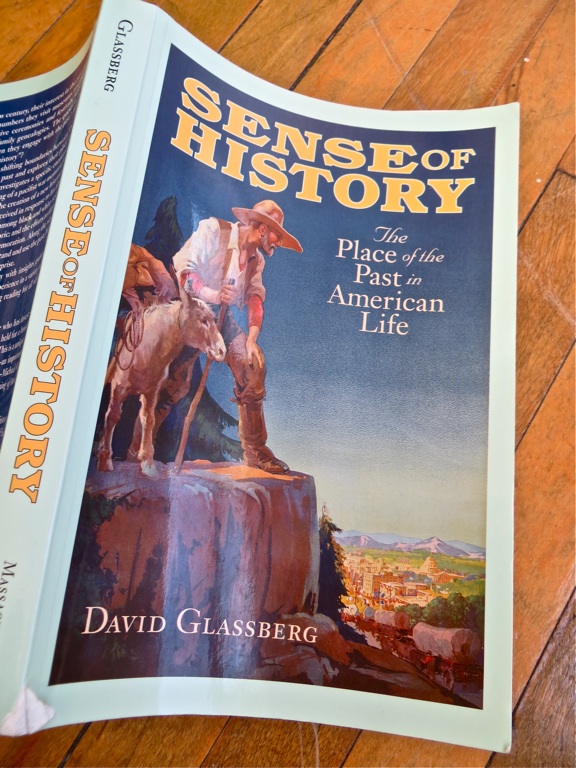
David Glassberg, “Sense of History: The Place of the Past in American Life” (2001)

In David Glassberg’s 2001 work, Sense of History, he says that to have a sense of history is to have a sense of the deep culture of a particular place. This historical sensibility is akin to having spatial and temporal sensibilities, or knowing what happened in particular locations at particular points in time. According to Glassberg, it is “not quit territoriality, as among other animals, but a sense of locatedness and belonging.” It is knowing and being conscious of kinship and ancestral bonds, and how these bonds are fixed to particular landscapes. For many, it is “at the core of who they are and the people and places they care about.” To have a sense of history is to know about previous generations that have traveled and inhabited the landscape. To have a sense of history is also to have a sense of Public History, a forum where ideas from the public and academics intersect, and how these groups bring infinite meanings to particular places in space and time. (Glassberg, 2001: 6-8)

The range of this sensibility is communicated through several case studies, from First World War memorials in Orange, Massachusetts to the thirteen-hour Civil War photomontage marathon organized by Ken Burns and financed by a variety of public and corporate sponsors. In his introduction, Glassberg references Wallace Stegner and Eric Hobsbawm. A Stegner quote fortifies Glassberg’s argument, as “No place is a place until the things that have happened in it are remembered in history, ballads, yarns, legends, or monuments.” (Glassberg, 2001: 19) In the case of the recently deceased Hobsbawm, Glassberg references his 1983 co-authored work, The Invention of Tradition. In short, this work explores how one generation after another envisioned themselves as having a kind of timeless connection with the customs of the past. Glassberg also aptly references William Faulkner, Toni Morison, and Louise Erdrich, individuals who through fiction and prose develop an identity by remembering land- and city-scapes from earlier years.

This developed identity means that when we think of, say, Erdrich, we immediately associate her with her descriptions of the Red River, or of Wahpeton, North Dakota, or with her sisters, or with her bookstore in Minneapolis, Minnesota. It is similar with Stegner, as he is inextricably bound to East End, Saskatchewan, and the same goes for Walter Webb, N. Scott Momaday, Ernest Staples Osgood, Paul Sharp, Gilbert Fite, Willa Cather, and Glenda Riley, all of whom worked toward creating a sense of Great Plains history and culture.

David Glassberg, "Sense of History: The Place of the Past in American Life" (University of Massachusetts Press, 2001).

David Glassberg, “Sense of History: The Place of the Past in American Life” (University of Massachusetts Press, 2001).

Individuals throughout time can associate with, reject, or fix their own particular stories to perceptions that authors and historians have had about certain landscapes. When a culture becomes familiar with a common set of stories, that culture is able to fixate on and relate to one another. And when an economic developer sans a sense of history takes the reigns and proposes a new project, Historic Preservationists are, at best, there to kindly remind the developer that to alter the land- and city-scape is to rub out a livable past. In Glassberg’s words:

We live in landscapes dense with both histories and memories, idealized images of the past that compete to become the standards we use to evaluate and shape our present environment. Personal recollections of past places stand against a flood of place images created for us, from guidebooks and maps published by local civic organizations that recognize some “historical” places in our community but not others, to the generic images of past American landscapes and smalltown life… History in all its varieties guides our sense of where we live, contributing to our perception of the traditions that make our place distinctive. (Glassberg, 2001: 126)

To think of Glassberg’s work in a world historical context requires that we think of each location in space and time as having its own sense of history. This indeed complicates our understanding of the past, but this complexity is nothing new. Historians, for example, that boasted the virtues and lessons of Western Civilization had one understanding of, say, Herodotus and his world, and this was much different than the understanding that Herodotus had of himself and his surroundings. This is also similar of a historian from China writing about the Mongolian hordes, or the Mongolians themselves writing about a conquest of the EurAsian steppe, from Beijing to Baghdad and to the edges of Poland and eastern Europe. In large part historians, or Public Historians, absorb methodologies set down by R.G. Collingwood in the 1930s and 1940s, at least before he collapsed and died from a brain aneurism (arguably due to his synapse firing on protracted overdrive for the duration of his life). Collingwood called on historians to first develop a philosophy toward history. That philosophy was defined as a professional ability to understand the way in which people understand or understood their world.