Tag Archives: World History

More Notes on Clell Gannon: 1920s Census and Cultural History

Just pecking out some more notes to add to the texture of the Clell Gannon project, working on revisions with The Digital Press at the University of North Dakota (Grand Forks).

After revisiting Willa Cather’s 1923 (September 5) essay, “NEBRASKA: The End of the First Cycle” in The Nation (117: 236-238), and particularly after reading Cather’s demographic cross section slice of a day in the life of 1923 Nebraska: “On Sunday we could drive to a Norwegian church and listen to a sermon in that language, or a Danish or a Swedish church. We could go to the French Catholic settlement in the next county and hear a sermon in French, or into the Bohemian townschip and hear one in Czech, or we could go to church with the German Lutherans. There were, of course, American [meaning American English] congregations also… I have walked about the streets of Wilber, the county seat of Saline County, for a whole day without hearing a word of English spoken.” And, a couple sentences later, Cather notes that “Our lawmakers have a rooted conviction that a boy can be a better American if he speaks only one language than if he speaks two.”

North Dakota, in the year 1900, also had a diverse immigrant population with a greater percentage of foreign-born than any other state at that time in the Union. I don’t have the percentage number right in front of me. But from memory it is something like 78% foreign born. Prairie Mosaic is the reference I’ll double check to confirm that number, as this provides ethnohistoric ground-truthing, research that took place from the 1960s through the decades following said 1960s.

U.S. Census 1920 bulletin on North Dakota. Page 1.

This returns to Clell, and thinking about the context in which he wrote his Songs of the Bunch Grass Acres, and the reading audience who had want or access to his 1924 Western Americana poems. In 1920, Orin G. Libby’s article, “The Arikara Narrative of the Campaign Against the Hostile Dakotas — June, 1876” ran in North Dakota Historical Collections (Bismarck, North Dakota, Volume 6). Aaron McGaffey Beede collaborated with Libby on this. Beede was the interpretive and translation conduit between the Arikara scouts and Libby. Libby’s approach was one that would speak to Custer-philes, with an angle that may appeal to Custer-philes who may have had a broad brush stroke (see racist) outlook on all of Native America. With Libby popularizing how Arikara fought alongside the U.S. Military in 1876, he was making a pitch (fortified with numerous data points) that demonstrated their patriotism. In 1918, two years before Libby published his Arikara narratives, the Great War ceasefire (armistice) happened. Up to 12,000 Native American soldiers participated in World War I, this at a time when Native Americans still didn’t have the right to vote. The Indian Citizenship Act of 1924 would change all of this, allowing tribal citizens the Federal status of voting. However, the U.S. Constitution still left it up to individual states to decide who had the right to vote. So Libby’s narrative that set down the Arikara memories of the 1876 Battle of Little Bighorn/Greasy Grass would also have spoken to that political activist line of thinking.

So what does all this mean of and for Clell Gannon’s 1924 Songs of the Bunch Grass Acres? I don’t have much more to say beyond the above, other than this is some of the context in which Clell wrote. A multitude of ethnic languages from the immigrant populations could be encountered in the urban and rural of the Great Plains and American West. Tribal citizens were granted another incremental federal right to vote. Libby lobbied on the Arikara behalf through historical memory and narrative. And Clell continued his relationship with the major shapers of the early State Historical Society of North Dakota, making his poetic contribution to the love of northern plains place through said poems.

Armistice Day 2024

Over the course of the last 100 years, Armistice Day evolved (things evolve, it’s okay) into the November 11 day that is called Veterans Day. I really do enjoy re-centering Veterans Day by returning to the sort of pieces of the past that pulls from its origins as Armistice Day. Earlier today, I texted this to a friend:

…the 11th hour of the 11th day of the 11th month, the machine guns fell silent and the cease fire was put into place. The geopolitical axes would continue to grind against the sharpening wheel, as the ‘surrender’ terms were too intense and could never have been accepted by the German-speaking people. The Austro-Hungarian Empire had imploded. In its wake, all sorts of nations emerged, and with that ethnicities that started asserting themselves as having the “birthright” origins of those nations. “No, my people were here first. Here’s a history that proves it.” All kinds of insanity like that. This also gave rise to internal political infighting, creating a power vacuum that allowed for the rise of insane political groups.

The above is where my mind drifts on the 11th hour of the 11th day of the 11th month. It was the Great War (there wasn’t supposed to be a second Great War, just the First).

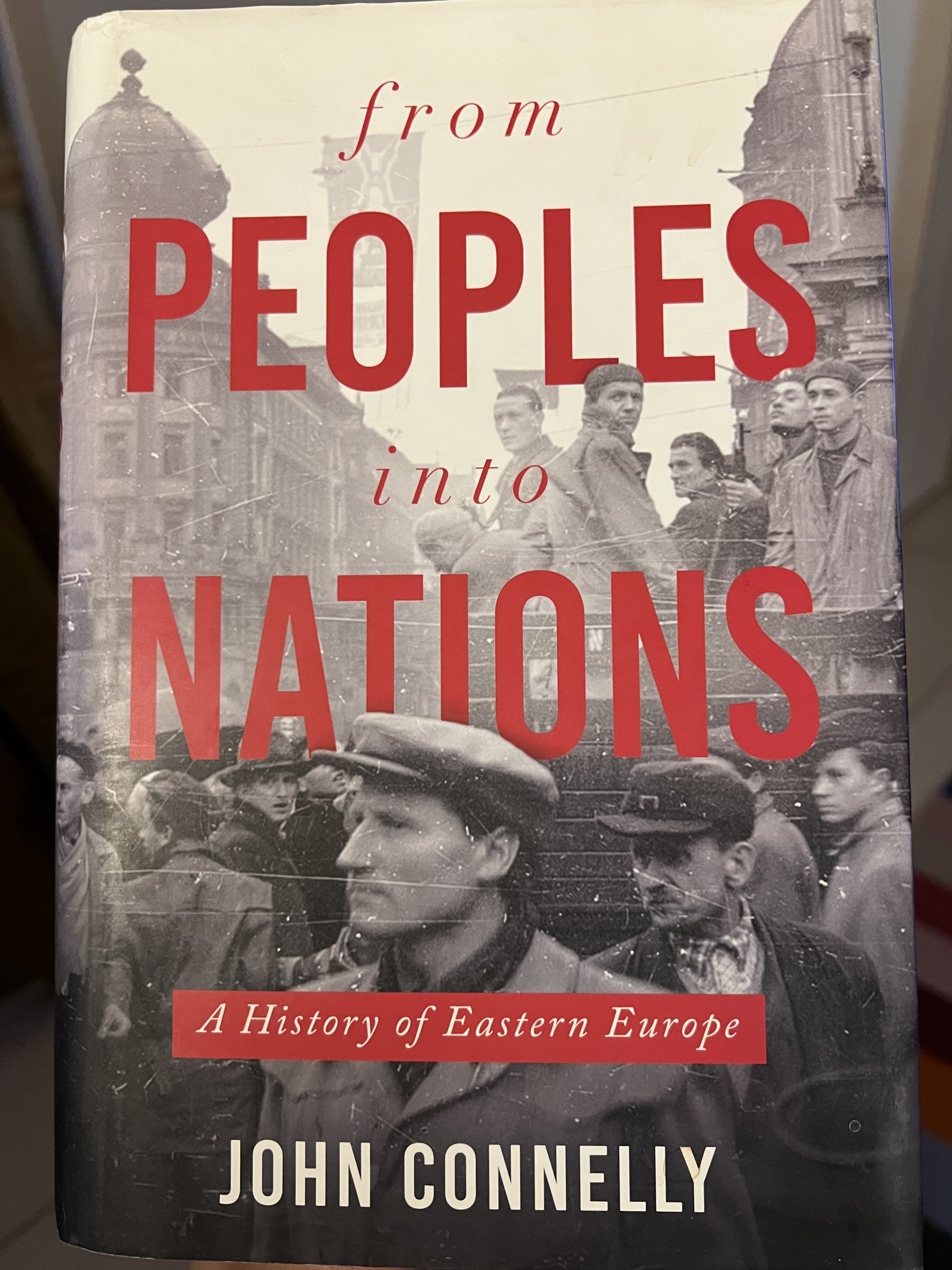
Of the First World War, one rather particularly good monograph (and recent) that I’ve gotten into the first couple introductory pages is John Connelly, From Peoples Into Nations: A History of Eastern Europe (Princeton University Press, 2020).

An excerpt below:

“War broke out in Europe in 1914 because of a deed carried out in the name of a people no one had previously heard of. That June, after years of internecine turmoil and armed conflict in southeastern Europe, a Bosnian Serb named Gavrilo Princip shot and killed Franz Ferdinand, heir to the Habsburg throne, in Sarajevo. The assassin said he was acting to defend the interests of the Yugoslavs, or South Slavs, who were seeking independence from the Austro-Hungarian monarchy.”

Connelly pulls the reader paragraph after paragraph through the decades following 1914:

“When the war ended in 1918, statesmen and revolutionary activists made a new Europe, drawing on the impulse that had taken hold of Gavrilo Princip and his friends: that peoples should govern themselves. Clothed in the words of national self-determination, this impulse was raised as a high political standard by both Bolshevik leader Vladimir I. Lenin and US President Woodrow Wilson, denoting socialism for the first, liberal democracy for the second.”

Ideological lines, whether they existed in reality or not, were drawn in the geopolitical sand. Here’s another zinger from Connelly:

“…nationalists are no more resistant to understanding than any other actors in history. They are guided by motives that are open to reconstruction and analysis. What seemed rational to one side of the nationality dispute usually seemed irrational to the other, and in fact their deeds confound any attempt to divide reason from unreason. Take Gavrilo Princip. On one hand, his act is easy to understand. When Austrian authorities apprehended him, he said he knew ‘what was happening in the villages.’ Thanks to education provided by the Austrian regime, which had ruled Bosnia since 1878, he knew that Austria had done little to alter traditional patterns in the countryside according to which poor Christian sharecroppers — like his parents — worked on properties owned by Muslims and were condemned to second-class lives. He was one of nine children, but five of his siblings had died in infancy. His father worked several jobs, one of which was lugging heavy bundles of mail up and down mountains, even at an advanced age.”

It just goes on and on like this, unpacking the late 1910s until he pulls us up into the 1970s. Get Connelly’s book on your shelf. Or in your local library shelf. Each reader gets to kind of tease out how to bring it from the 1970s into the 2020s.

During Armistice Day, my brain also (invariably) wanders toward The Pogues rendition of “Waltzing Matilda.” It poetically unpacks the global scope of the Great War. Lyrics of it all below:

“When I was a young man I carried my pack
And I lived the free life of a rover
From the murrays green basin to the dusty outback
I waltzed my matilda all over
Then in nineteen fifteen my country said son
It’s time to stop rambling ’cause there’s work to be
Done
So they gave me a tin hat and they gave me a gun
And they sent me away to the war
And the band played Waltzing Matilda
As we sailed away from the quay
And amidst all the tears and the shouts and the
Cheers
We sailed off to Gallipoli…”


Clellification for Halloween, 2024

I’m currently working on a project with Bill Caraher who is the pilot of The Digital Press at University of North Dakota. For a year, or beyond a year now, Caraher and I have been thinking about Clell Gannon, and Gannon’s 1924 publication, Songs of the Bunch Grass Acres (SoBGA). I’m working on revisions from a first draft submitted to The Digital Press, and after letting editorial comments sit with me for a while, I have decided to recalibrate a bit of the original narrative. Like it is the case with many texts, the more you read, revisit, and think about SoBGA, the more the text starts speaking to the reader in different ways. The recalibration of the first draft will look something like this:

  1. Clell Gannon intellectually situates (indirectly and directly) his 1924 SoBGA into the current of Romanticism. And not the romanticism that you’re thinking about. Like he’s not poeming (poem is now a verb) the reader to go pick flowers and let your feelings rather than your brain dictate your moment to moment actions. Rather, in the original intellectual vein of Romanticism (which was a counter balance to the, ahem, Enlightenment), he’s saying (I’m paraphrasing here), Hey, this northern plains and Great Plains and Western Americana place we all live in: this place is completely worth living in. And not only is it worth living it, it deserves our contemplation, and this place is deserving of a sustained relationship with us.
  2. Who else did Clell Gannon roll with at this time? He was a mover and shaker. Also one who was a joy to be around. Thoughtful. And nothing that is in his writings, or others who have written about him, suggests he was a chest thumper. He was friends with Russell Reid and George Will (son of Oscar Will and his vegetable seed empire). The same Russell Reid who acted as secretary of the State Historical Society of North Dakota for decades: when it evolved from the basement of one of the buildings on the State Capitol Grounds eventually to the building that today houses the State Library. Clell would likely lose his mind (in a good way) if he saw the geothermal-heated footprint of today’s State Historical Society of North Dakota, and in-motion expansion of the Military Wing.
    • Clell was unable to physically make the requirements to be mustered into World War I. I do wonder what contributions he might suggest for interpretive exhibits in the 21st military wing following the Great War of the 20th century? Might they have read something along the lines of what Willa Cather spoke of in 1922? “…the world broke in two in 1922 or thereabouts…” In 1922, Cather had seen veterans return from the Great War, and as returned veterans, they were told (not even really told) to navigate the ascent of the industrial capitalistic roaring 20s.
  3. In conversations with Shadd Piehl (ahem, recognized poet of the American West, cowboy poet, teacher, listener, encourager of the written and spoken word, and former bronc rider, etc), Piehl noted that Clell reminded him of the poem American Names that Stephen Vincent Benét set down in 1927, or 3 years after publication of SoBGA. So the revisions of this draft will take into greater account a couple other datum points, including Willa Cather and Stephen Vincent Benét.
  4. Clell Gannon’s introduction (very short) of SoBGA is good.
    • In the first paragraph he sets out his flag of love of regional place. Not nationalistic love. But of the regions within this nation: northern plains. Great Plains. American West.
    • The second paragraph is on about poetic structure, meter to be exact, and with a sampling of how a west of the Mississippi River person pronounces “coyote”: say ki’ot, Clell instructs, as two syllables. Don’t get all sophisticated and say “ki’ot’eee.” Don’t do that. Nobody would ever do that. Use two syllables to say coyote, and the meter of the poems will flow.
    • The third paragraph calls out Florence Harriet Davis, librarian in 1924 of what would have been the beautiful Carnegie Library in Bismarck (it was completely razed in the 1970s or 1960s for progress. Poetically, a parking ramp is located there today.). Who is Florence? In a word search in the Library of Congress searchable newspaper database, she surfaces here and there in Bismarck Tribune articles.
    • Clell’s final poem in SoBGA is to Hazel Dell Gannon, who at 17 years old passed away in what Clell describes as Grand Valley, South Dakota. Maybe she was preparing to attend teachers college? Or something? I Google’d Grand Valley, and the closest thing that surfaces is place names in Lincoln County, southeastern South Dakota.
    • Clell signs off on his short introduction with “Bismarck-by-the-river, North Dakota.” Today, in 2024, this is another great reminder to readers to recenter their view of North Dakota’s capital city as one that is a river city as well. Clell understood the importance of the Missouri River to the early history of the region and, eventually, to the state.

Okay, that’s all the Clell-ification I have for the moment. Gotta get after the other items for this Thörsdag, October 31, 2024, Halloween Day (the pumpkins were carved last night).


Meditations Between 1st and 2nd Sleeps

Subscribe to continue reading

Subscribe to get access to the rest of this post and other subscriber-only content.


Cyprus Footage from 2012

While Bill (Caraher) blogged a bit on Punk Archaeology and PKAP today, in a separate but related sphere (parallel trajectories I call them), I stumbled across an audio-video short that David Pettegrew recorded during the PKAP 2012 field season in Cyprus. I uploaded this to my YouTube channel, and I will share it here.

In May and June of 2012, the Pyla-Koutsopetria Archaeological Project (Dr. William Caraher, Dr. David Pettegrew, and Dr. R. Scott Moore) charged me with trench supervisor duties for an excavation unit located outside of Larnaca, Cyprus. Here in Pettegrew’s video is a wall emerging out of the excavation unit from a 3rd-century BCE Hellenistic coastal fortification. This site is contemporaneous with Alexander the Great and Zeno, the Stoic from Citium. Within the excavation unit, I am to the right, and sorting out the stratigraphic layers with a student and colleague. The student and colleague to my left continues uncovering bedrock at an industrial pace.


D-Day 70th

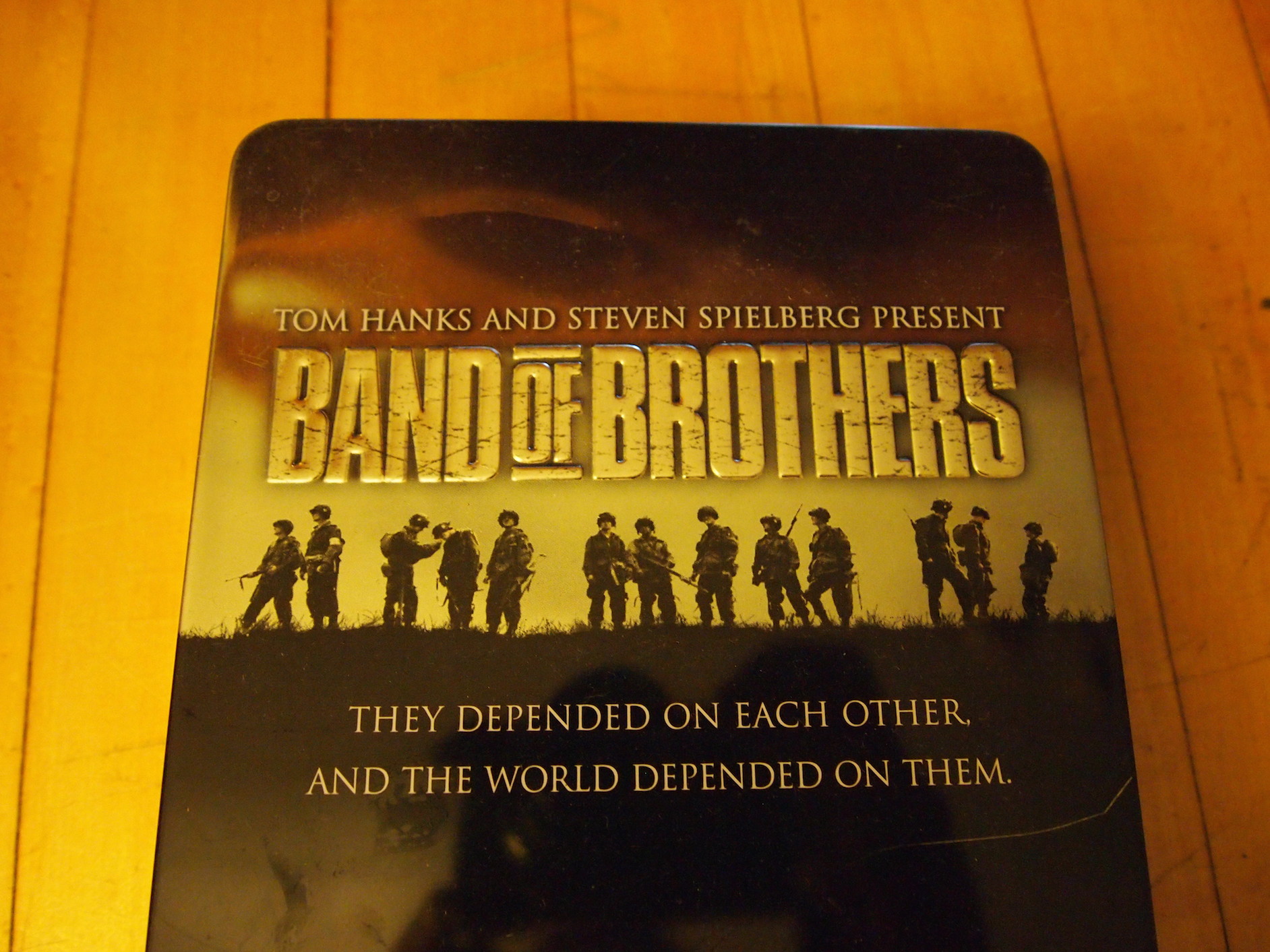
OLYMPUS DIGITAL CAMERAIt is June 5, 2014, which means it is one day away from the 70th anniversary of Operation Overlord, or D-Day. This also means that either this evening or tomorrow evening I’m going to fire up Tom Hanks and Steven Spielberg’s rendition of Stephen Ambrose’s 1992, Band of Brothers (2001).

I’m also drawn to thinking about what my late Grandpa Barth and his brother (my great uncle Charles “Bud” Barth) did during WWII. They both came from a farm near rural Braddock, North Dakota. During the war, Grandpa Barth was shipped to the central Great Plains to build bombers (I remember him talking about how he was charged with buffing the glass bubbles for the bombers). And Uncle Bud was sent to Army training, eventually becoming a front line medic in the Battle of the Bulge. Bless those for blessing us. I think that’s about all I got for now.


Visiting Dickinson State University

Left to right, Historian Frank Varney, Aaron Barth, and Political Scientist Steven Doherty.

Left to right, Historian Frank Varney, Aaron Barth, and Political Scientist Steven Doherty on the campus of Dickinson State University, western North Dakota.

Yesterday Dickinson State University (via Frank Varney) invited me to speak about a component of research concerning how and why the US-Dakota Wars (1862-1864) were remembered at the turn of the 19th century throughout the Minnesota River Valley and on the northern Great Plains. It was great to get west of the upper Missouri River and spend some time with Varney and other fellow history and humanities nerds. I like this topic — thinking about how the US-Dakota Wars were remembered — because it mitigates what I call historical anxiety. I’ve thought about this phrase for a while, and loosely define it as that anxious feeling of not knowing how and why something happened in a particular place in time. A way to mitigate historical anxiety is to head into the archives and cobble together a narrative from the disparate bits and pieces. Through this I’ve been able to understand why the US-Dakota Wars were memorialized the way they were at the turn of the 19th century.

I’m using this, in turn, to push the way in which we think about the US-Dakota Wars today: largely as genocide, the word invented and deployed by Raphael Lemkin first in 1944. At the root, genocide comes from the Greek genos, which roughly means people or tribe; and the Latin cide, which means killing. Don’t take my word for it, though: visit Sully and Sibley in their own words. One humanistic universal I pitched out there to the group was that if the United States concerns (as it should) itself with genocide taking place today in Syria, and in other parts of the world, the U.S. should also concern itself with and consider the genocide that took place in our own past. Otherwise it just gets awkward, as the question will invariably come up time and again. So we can either chat and consider this, or just pretend like it doesn’t exist. If we pursue the latter, it just ends up leading to long bouts of awkward, uncomfortable silence. More on all this scholarship later, at least as it applies to the US-Dakota Wars, and the broader 19th-century Anglosphere.

Just a real quick warranted amplification of Varney’s work (he is in the midst of preparing a second volume that builds off his first monograph), General Grant and the Rewriting of History: How the Destruction of General William S. Rosecrans Influenced Our Understanding of the Civil War (Savas Beatie, 2013). Click on that link. If you enjoy history, or have thought deeply or superficially (there are only so many hours in a day) about memoirs, or Grant’s memoirs, definitely give it a go.


New Americans from Sudan

First Sudanese Lutheran 1Last Sunday, as we on the northern Great Plains were enjoying our 357th blizzard of the winter, Molly and I drove down to southern Fargo to oblige an invite from the First Sudanese Lutheran Church of Fargo, North Dakota. We went to chat with this recently-arrived growing group of New Americans. They put out a huge spread of Sudanese food, too, prepared by no less than 3 Sudanese mothers the night prior.

After the benefit supper, on the drive home, I couldn’t help but think about the processes of global population movements in world history. This invariably led me to think about our grandparents and great grandparents and great-great grandparents who poured into the United States in the 19th century: think today about navigating immigration (the New American Sudanese are here because they are getting away from a lot of this, and a cease-fire update on that here too), finding transportation, learning about car and health insurance, learning a new language, and getting up to speed with the societal customs inherent to America’s increasingly industrial society, all while trying to keep a foot in the old ways too (this is why today we see things like the Sons of Norway, German-Russian, and Three Crowns organizations).

Some of the New Americans expressed an interest in future home ownership, and the gears in my brain started moving: “Who might be able to chat with these folks about the processes and options of home loans and real estate?…” These folks have jobs and they want to continue raising families. Homes are important for going about this. I was so wrapped up in conversation and getting filled up with Sudanese food (the delicious Sambusas were flowing like wine) that I didn’t get a chance to take a photo. But I do have this handy 2013 year-end reflection that I picked up.


Dissertation Update

Dakota LanguageToday is Friday the 6th of December, it is approximately -11°F, I am looking out beyond the laptop screen through a south-facing window to the light blue snowscape, the time when the approach of the sun-rise appears eminent. I plan on finishing my opening dissertation chapter (which might turn into an introduction) that deals with the public remembrance of the US-Dakota Wars. One of the main thrusts in this disquisition is to look at not only how various generations have remembered and memorialized the US-Dakota Wars, but to piece together why.

I chatted with an engineer about this a couple days ago, albeit briefly, and I found in myself another reason that I hadn’t articulated so well: whenever we, the royal we, are frustrated with the way things are, sometimes it helps to track the history so as to see how we got where we are today. This doesn’t necessarily mean we will agree with it, but one doesn’t have to agree with something in order to understand it. To my right on the floor is a stack of published monographs on world and public history — historiography (or the history of history) having spoken to and shaped what we know today.

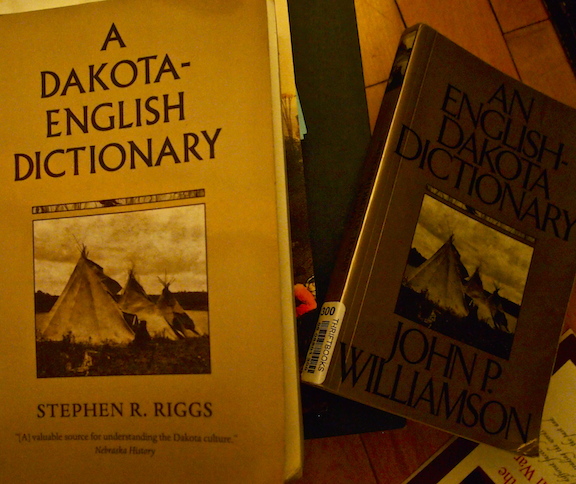
I also picked up and have so far read the introduction of Denise Meringolo, Museums, Monuments, and National Parks: Toward a New Genealogy of Public History (U of Massachusetts Press, 2012) from the dutiful Inter Library Loan-ists at NDSU. A couple months ago Bill Caraher and I were chatting at Laughing Sun in Bismarck, and he suggested I check it out. It is good. More on that later, either in blog or dissertation form. To my left is Stephen R. Riggs, A Dakota-English Diectionary and John P. Williamson, An English-Dakota Dictionary. I continuously re-re-rediscover that language, or the study of it, provides insights into the past, as do oral traditions and oral histories. But okay, enough of all this blogging for now. I’m just going to get after finishing this draft. Happy Friday to you.


Scholarly Publishing Houses in New Zealand

Since having returned from the South Pacific, and now back on the northern Steppe of North America, I have been rummaging through all the pieces of paper one accumulates while on short or long journeys. I came across the flyers, handbills and handouts that speak to the various scholarly publishing houses in New Zealand. Before my New Zealand trip, these were off my radar. And I figured since I didn’t know about them but do now, I’d share the findings and provide links. There is Bridget Williams Books, Auckland University Press, and Otago University Press. There, of course, are more (this is not exhaustive). But this is a start.

During the New Zealand Historical Association conference, a panel of editors from these scholarly and academic presses spoke to where scholarly publishing has been, where it is today, and where it might go tomorrow. This, I know, is an excellent idea for any scholarly conference, since the only way scholars can disseminate their research is by getting it published. And to get something published requires one to get to know the editors in charge of the publishing houses. And so on.