Tag Archives: Steamboats

DIY Pro Historic Exhibits — Everything is a Beta Version Until We Die, So Just Start Experimenting

Before I lean too far into this mid-morning, I wanted to get some process notes down on the A to Z of a beta version fabrication of an historic image displayed in the common area entry of the Heritage River Landing, aka and hereafter the landing (physical address at 1700 River Road, Bismarck, North Dakota 58503).

The below image is what I ended up with. And some notes below that provide the road map that got me there.
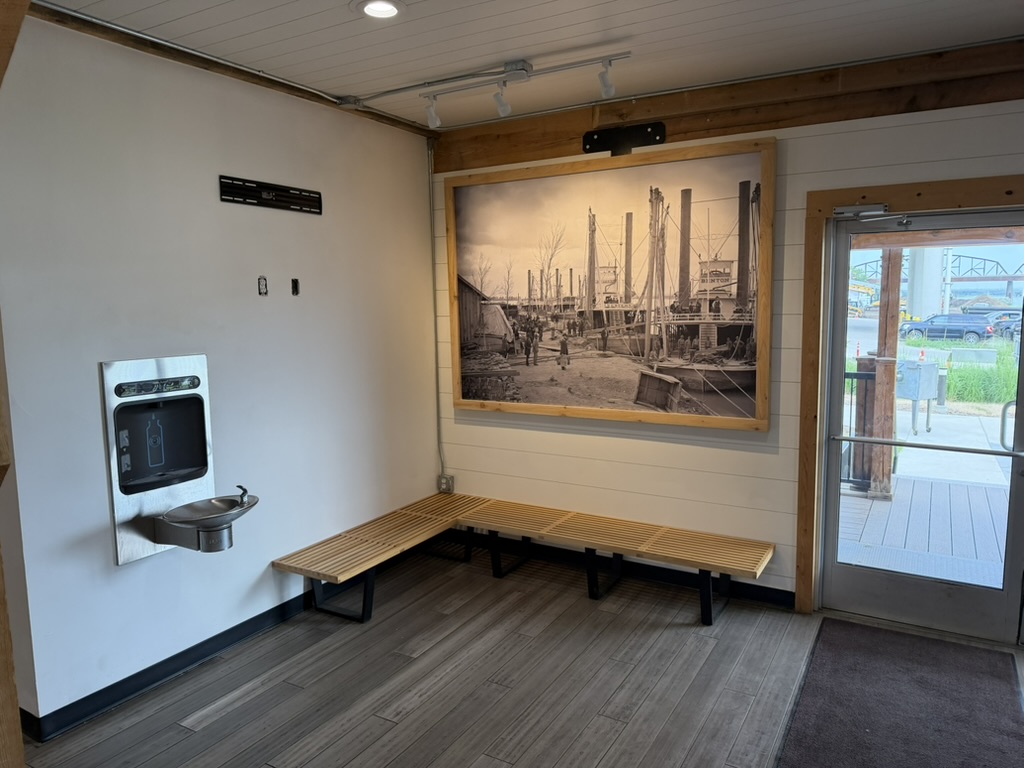
Historic image credit: Montana Historical Society, from the Frank Jay Haynes (b. 10/28/1853 – 03/10/1921 d.) photo collection. Image is 1877-1878, Bismarck, Dakota Territory, Missouri River, steamboats left to right as Far West, Nellie Peck, Western, Benton.

We started with this big chunk of blank wall that faces south, and if you stand where this image was taken, you can look at the wall, then out the glass doors south toward the BNSF-soon-to-be-razed Northern Pacific Railway bridge (substructure/piers date to 1880-1883, and superstructure to 1905). With all the blank white walls in the common area of the landing, I got some off the shelf LED track lights from Menards. And had them installed by a local electrician. We indeed all laugh when Clark Griswold told his father or father in law that he learned everything from him about exterior illumination. But interior illumination is just as important. For making things pop.

Back to the previous blank wall. I wanted local historical imagery to impress upon visitors. It strikes at those senses of history and senses of place — full sensory history. So the evening and weekend research proceeded.

There are a handful of popularized photographers whose works are still in tact today, largely due to one generation after the next deciding that what they photographed was of value. Frank Bennett Fiske. Frank Jay Haynes. David Francis Barry. Type these names into your search engines and you’ll find quite a bit. The Montana Historical Society has an excellent body of images from Haynes. David Barry’s stuff is kind of scattered, in private and public repositories (the Newberry Library in Chicago has some Barry stuff). Digital Horizons has solid online Frank Fiske stuff.

It’s easy to start clicking on these links and just get lost in the images, one after the other. While in the Haynes collection through Montana Historical Society’s online collection, I landed on the image before you. It was perfect: Haynes faced his camera south, just as the present visitor does today at the landing. The historic image shows the Missouri River bank and shoreline, just as visitors can see today (with added twentieth century Interstate 94 “Grant Marsh” bridge and U. S. Army Corps of Engineers riprap). This was the image. Even within the image were humans. With faces and eyes looking into the camera that the visitor could gaze into. And the eyes in this image gazed back to our own retinas here in the present. As we look at them, they look at us. Different time. Same space.

Next was to look into what type of resolution the image could be obtained. The Haynes images are high resolution. So I filled out the necessary image requests, submitted them through the non-profits Fort Abraham Lincoln Foundation (est. 1982) and Northern Plains Heritage Foundation (est. 2004), and FALF resources took care of the non-profit processing fees. A couple weeks later Montana Historical Society e-mailed me a link with the high resolution images for download. So images were now secured.

Then it was exploring the various online and local large scale high resolution print options. For whatever reason I found Banner Buzz, an online shop that does large scale (to me meaning larger than 36″) printing on polyester fabric at a sensible price point (looking at the receipt, it was $193.06). Nothing, mind you, was assured that my process journey was going to work. But I wanted to at least submit the high resolution photo, order this from Banner Buzz, and see what it looked like up close once it arrived in late May 2026.

It was fantastic.

View of the image printed on the polyester fabric when it first arrived in late May 2026. For scale, you can see a chair. Or my Redwing boots bottom center of image.

After this I asked one of our dutiful staff, Grant Sundquist, to build a 1×3″ cedar frame for it to mount the fabric. He got the first draft of the frame all framed up. Then we placed it in the spot. And gazed at it. We did not frame it yet. We needed to look it over. Let it kind of work on us. We decided the skyline, though big, could be edited down. We really wanted the steamboats and the human subjects to be the central “oomph” to the eyes of visitors. So in the last couple days I edited up the frame with a chop saw, using a Bosch air nailer and air compressor. I used 1×2″ cedar strips (rough milled, or whatever it’s called) as the initial border.

The 1×2″ rough cedar was air nailed directly around the stretched polyester image. The top of the rough cedar was made flush with the flat top of the polyester image, as I anticipated I would run my 1×3″ rough cedar moulding on top of that. To frame it all in.

After securing the 1×2″ border, and remembering to snag some digital images of this process, I then used the 1×3″ moulding to finish the front. And I added to the back two French cleats, the longest ones I could find at Bismarck Lowe’s.

All said, this was about $350 in materials. Online, I could not find anywhere to get this high resolution image printed up large enough and in a professional looking display for less than $2,000. I checked with a couple local shops, and found that local print shops often max out at 36″. The local banner and sign shops can go larger. And they have pro ways to mount it and all. But it’s often all of our human labor in this process that is understandably the most valuable and understandably the most cost. Usually.

Gonna rinse and repeat this process for a couple other walls at the landing. The image already has captured the attention of all commercial heritage vessel staff. There are calls for wanting more local steamboat images. And I’ll keep thinking about ways to impress the 30,000′ view upon viewers, that sort of micro and macro that Maya Jasanoff accomplished so well in her steamboat history work on Joseph Conrad.

How to Get Excited About Steamboat History on the Northern Plains?

It’s a real question. At the outset, those who are not excited about steamboat history raise an eyebrow when they first encounter a researcher who is excited about steamboat history. It’s understandable. Because the topic sounds like yet another flash-pan moment in the long historical record. “Steamboats? Importance?” Yes. Both of those. Steamboats accelerated the ability of crew and cargo to advance from port to port across the globe. And steamboats plied up the inland waterways. Throughout the planet. The continental interior of North America as well.

Globally, the Anglo-sphere happened to have greatest influence with steamboats. And this segues into the latest reading by way of Maya Jasanoff’s 2017 work, The Dawn Watch: Joseph Conrad in a Global World (New York: Penguin Press, 2017). On page 96, Jasanoff notes that in 1878, British ships had 5x the registered tonnage capacity of the next-largest merchant fleet.

Locally, on the Northern Plains, steamboats moved goods and materials from all the way up to Fort Benton (est. 1846) in Montana Territory, and all the way down to St. Louis, just south of the confluence of the Missouri and Mississippi rivers. Bismarck, and the landing at Bismarck, was one of those 1870s steamboat intersections.

People reading this should make time to read Jasanoff’s 2017 work on Joseph Conrad. Maya does a great job. Her and I had a chance to visit, real time, in autumn 2013, when we both happened to attend the New Zealand Historical Association’s biannual conference. Jasanoff mentioned she was working on research that concerned Joseph Conrad’s Heart of Darkness. She also was a key note speaker — which is what one is invited to do if one is, ahem, cough cough, a Harvard trained and practicing historian.

At that conference, I was in the trenches, presenting in a session or two. It was great. NDSU’s Tom Isern had accepted my ask to attend the conference with him. It was an amazing experience. My girlfriend (now wife) Molly McLain also joined the travels to New Zealand, and her brother, Matthew McLain, joined too.

It’s relevant to discuss these personal interactions, or the memories of them. It humanizes these otherwise human-less historical titles that we see on the book shelves (those high school or junior high memories of listening to the football coach who was deputized to read from the mechanical narrative of that year’s history text book for 50 minutes at least 3 times a week will diminish the character of any listener).

Interacting with human historians is similar to physically and in-person visiting historic sites: read about it in a library. That’s a great first step. A much needed foundation to it all. Then schedule time with the urban or land scape. Dust has settled since the historical event took place at the historical landscape. But it’s often only millimeters or inches of dust. Maybe a foot or two. Okay maybe it’s a Hellenic meter. But still. Visit them.

Okay, so here are a couple steamboat reads. One is by Tracy Potter, Steamboats in Dakota Territory: Transforming the Northern Plains (Arcadia Publishing, 2017). And the other, mentioned above, by Maya Jasanoff, The Dawn Watch: Joseph Conrad in a Global World (New York: Penguin Press, 2017).

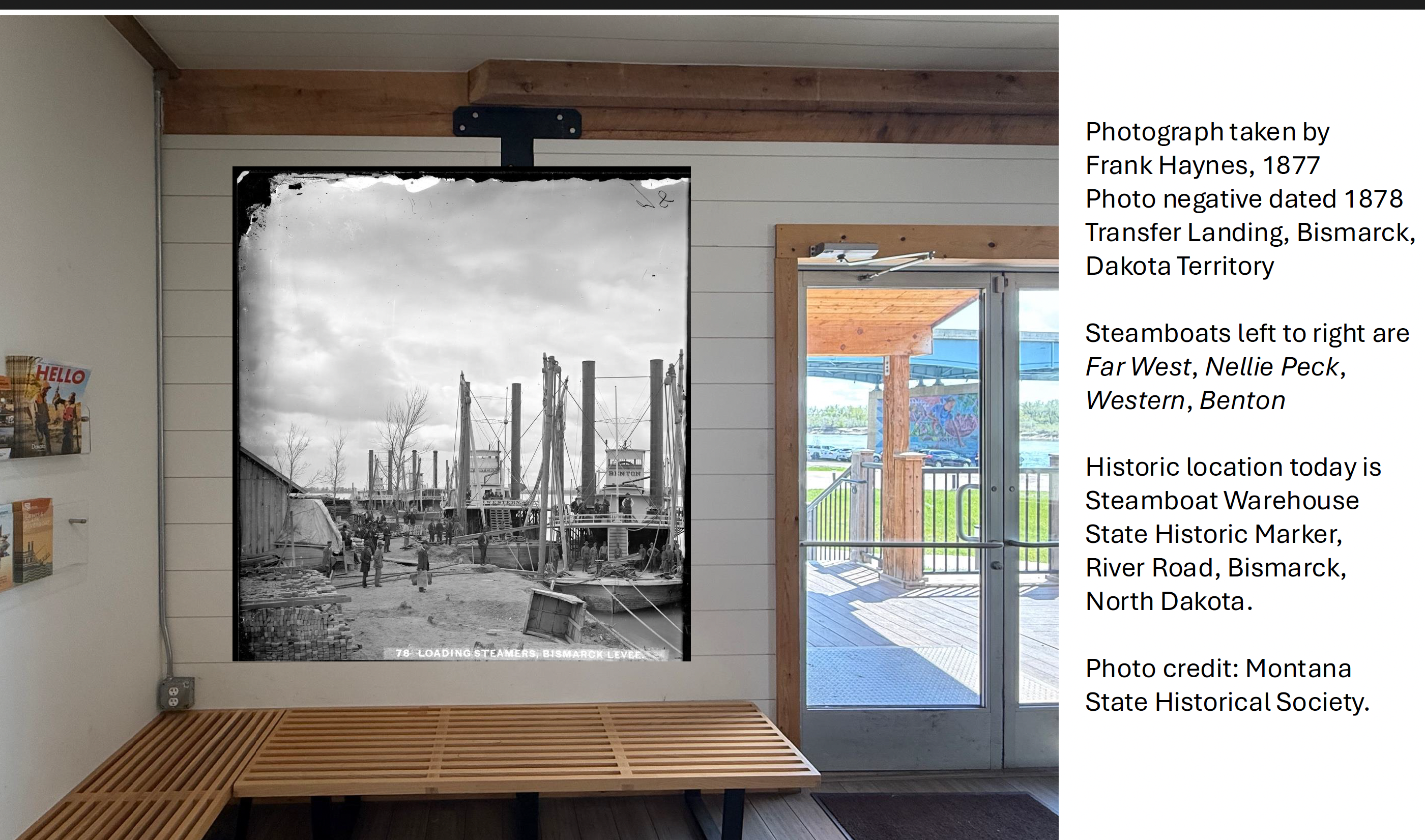
And below-below is a digital mock up, at least one image of what will be a larger assemblage of images, in the common area of the Heritage River Landing, 1700 River Road, Bismarck, North Dakota. I took a photo of the space where we wanted a big historical image to go. Then I slapped the photo into Power Point. Then, I did some research in regional archives, including Montana Historical Society. I remember seeing this image before, and the orientation of how we intend to display it also points directly south of where the original image was taken.

The image is with the Montana Historical Society, Helena, and our non-profits sourced and paid for all the high resolution images and the rights to display them (with appropriate recognition). Those images are a part of the Frank Haynes collection. Frank ran around all over the place taking photos with the wet plate collodion process (the device is similar or the same to yesteryear’s Matthew Brady and today’s Shane Balkowitsch).

Okay, and just before I hit “Publish” on this Word Press blog entry, below-below is some verbatim text transcription from the June 28, 1876 front page of the Bismarck Weekly Tribune, almost 150 years ago today (it is June 14 today):

RIVER NEWS (Bismarck Weekly Tribune, front page, June 28, 1876)

The river is still falling, but the stage of water is good, and promises to remain so for some time.

The Carroll left for Benton on Wednesday [July 21, 1876] last with a full load of Diamond R. goods and a good list of passengers.

The Benton left on Thursday for Benton with a full load of freight and passengers. When near Buford she met with a serious accident to one of her engines which will delay her some days. The Captain left on Monday [July 26, 1876] for repairs.

The Key West will leave for Benton on the 3d of July, and will be the next boat up.

The Durfee left Yan[k]ton on Sunday [July 25, 1876] with a full load of goods for the military posts.

The Denver left for St. Joseph, Missouri, a few days ago but at Fort Pierre was sold to John Dillon, and she will hereafter be engaged in the Black Hills trade, either as a ferry or between Fort Pierre and Yankton, unless the government carries out its intention to close the route over the reserva[t]ion, except for the transportation of supplies.”

The Far West has not yet returned from her first trip up the Yellowstone. The Josephine arrived last evening, departing for the supply depot at 5 o’clock this morning, drawing three and a half [feet] of water…