
It’s a real question. At the outset, those who are not excited about steamboat history raise an eyebrow when they first encounter a researcher who is excited about steamboat history. It’s understandable. Because the topic sounds like yet another flash-pan moment in the long historical record. “Steamboats? Importance?” Yes. Both of those. Steamboats accelerated the ability of crew and cargo to advance from port to port across the globe. And steamboats plied up the inland waterways. Throughout the planet. The continental interior of North America as well.
Globally, the Anglo-sphere happened to have greatest influence with steamboats. And this segues into the latest reading by way of Maya Jasanoff’s 2017 work, The Dawn Watch: Joseph Conrad in a Global World (New York: Penguin Press, 2017). On page 96, Jasanoff notes that in 1878, British ships had 5x the registered tonnage capacity of the next-largest merchant fleet.
Locally, on the Northern Plains, steamboats moved goods and materials from all the way up to Fort Benton (est. 1846) in Montana Territory, and all the way down to St. Louis, just south of the confluence of the Missouri and Mississippi rivers. Bismarck, and the landing at Bismarck, was one of those 1870s steamboat intersections.
People reading this should make time to read Jasanoff’s 2017 work on Joseph Conrad. Maya does a great job. Her and I had a chance to visit, real time, in autumn 2013, when we both happened to attend the New Zealand Historical Association’s biannual conference. Jasanoff mentioned she was working on research that concerned Joseph Conrad’s Heart of Darkness. She also was a key note speaker — which is what one is invited to do if one is, ahem, cough cough, a Harvard trained and practicing historian.
At that conference, I was in the trenches, presenting in a session or two. It was great. NDSU’s Tom Isern had accepted my ask to attend the conference with him. It was an amazing experience. My girlfriend (now wife) Molly McLain also joined the travels to New Zealand, and her brother, Matthew McLain, joined too.
It’s relevant to discuss these personal interactions, or the memories of them. It humanizes these otherwise human-less historical titles that we see on the book shelves (those high school or junior high memories of listening to the football coach who was deputized to read from the mechanical narrative of that year’s history text book for 50 minutes at least 3 times a week will diminish the character of any listener).
Interacting with human historians is similar to physically and in-person visiting historic sites: read about it in a library. That’s a great first step. A much needed foundation to it all. Then schedule time with the urban or land scape. Dust has settled since the historical event took place at the historical landscape. But it’s often only millimeters or inches of dust. Maybe a foot or two. Okay maybe it’s a Hellenic meter. But still. Visit them.
Okay, so here are a couple steamboat reads. One is by Tracy Potter, Steamboats in Dakota Territory: Transforming the Northern Plains (Arcadia Publishing, 2017). And the other, mentioned above, by Maya Jasanoff, The Dawn Watch: Joseph Conrad in a Global World (New York: Penguin Press, 2017).
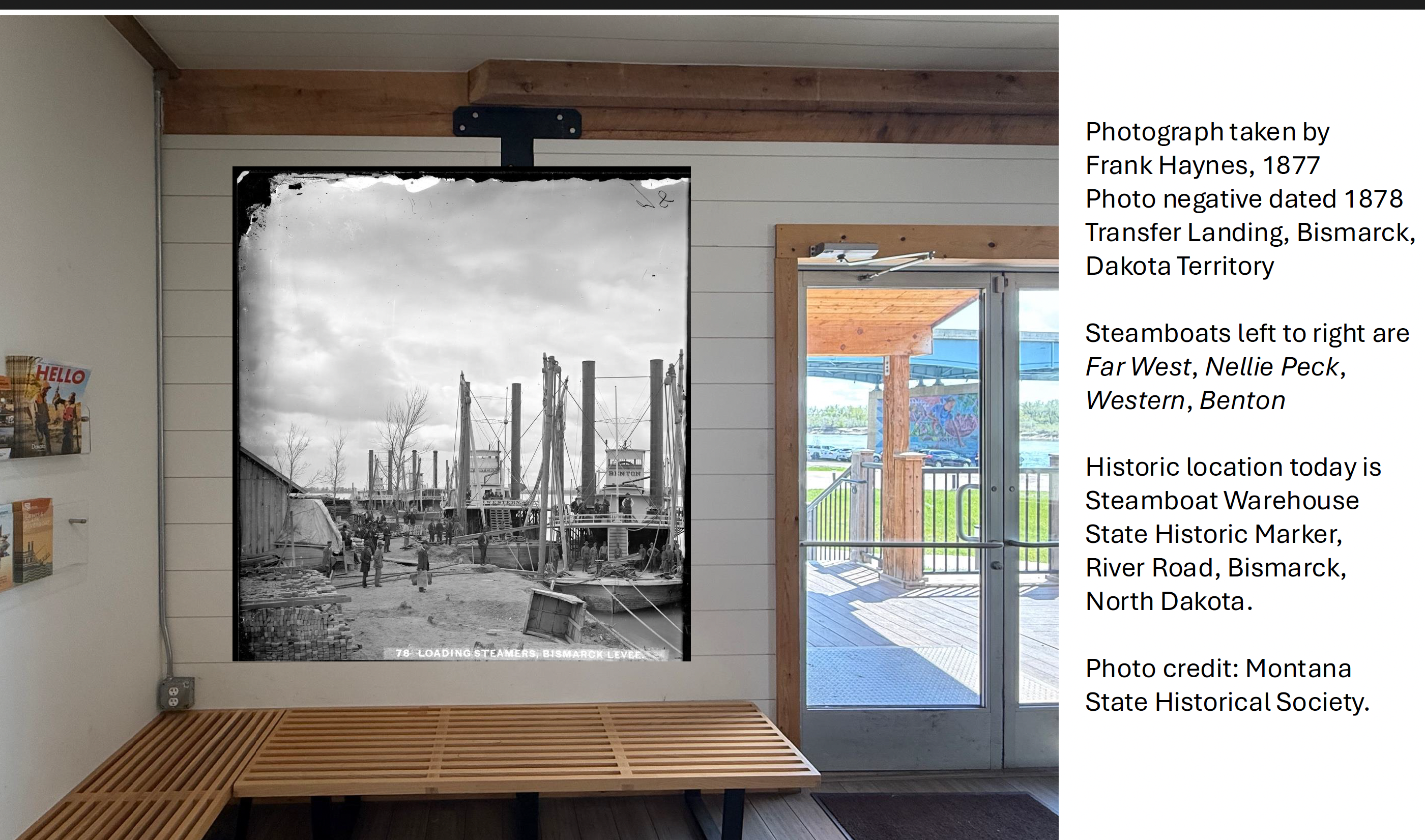
And below-below is a digital mock up, at least one image of what will be a larger assemblage of images, in the common area of the Heritage River Landing, 1700 River Road, Bismarck, North Dakota. I took a photo of the space where we wanted a big historical image to go. Then I slapped the photo into Power Point. Then, I did some research in regional archives, including Montana Historical Society. I remember seeing this image before, and the orientation of how we intend to display it also points directly south of where the original image was taken.
The image is with the Montana Historical Society, Helena, and our non-profits sourced and paid for all the high resolution images and the rights to display them (with appropriate recognition). Those images are a part of the Frank Haynes collection. Frank ran around all over the place taking photos with the wet plate collodion process (the device is similar or the same to yesteryear’s Matthew Brady and today’s Shane Balkowitsch).
Okay, and just before I hit “Publish” on this Word Press blog entry, below-below is some verbatim text transcription from the June 28, 1876 front page of the Bismarck Weekly Tribune, almost 150 years ago today (it is June 14 today):
RIVER NEWS (Bismarck Weekly Tribune, front page, June 28, 1876)
The river is still falling, but the stage of water is good, and promises to remain so for some time.
The Carroll left for Benton on Wednesday [July 21, 1876] last with a full load of Diamond R. goods and a good list of passengers.
The Benton left on Thursday for Benton with a full load of freight and passengers. When near Buford she met with a serious accident to one of her engines which will delay her some days. The Captain left on Monday [July 26, 1876] for repairs.
The Key West will leave for Benton on the 3d of July, and will be the next boat up.
The Durfee left Yan[k]ton on Sunday [July 25, 1876] with a full load of goods for the military posts.
The Denver left for St. Joseph, Missouri, a few days ago but at Fort Pierre was sold to John Dillon, and she will hereafter be engaged in the Black Hills trade, either as a ferry or between Fort Pierre and Yankton, unless the government carries out its intention to close the route over the reserva[t]ion, except for the transportation of supplies.”
The Far West has not yet returned from her first trip up the Yellowstone. The Josephine arrived last evening, departing for the supply depot at 5 o’clock this morning, drawing three and a half [feet] of water…

 The Edge of the Village