Tag Archives: Public History

Happy Mother’s Day

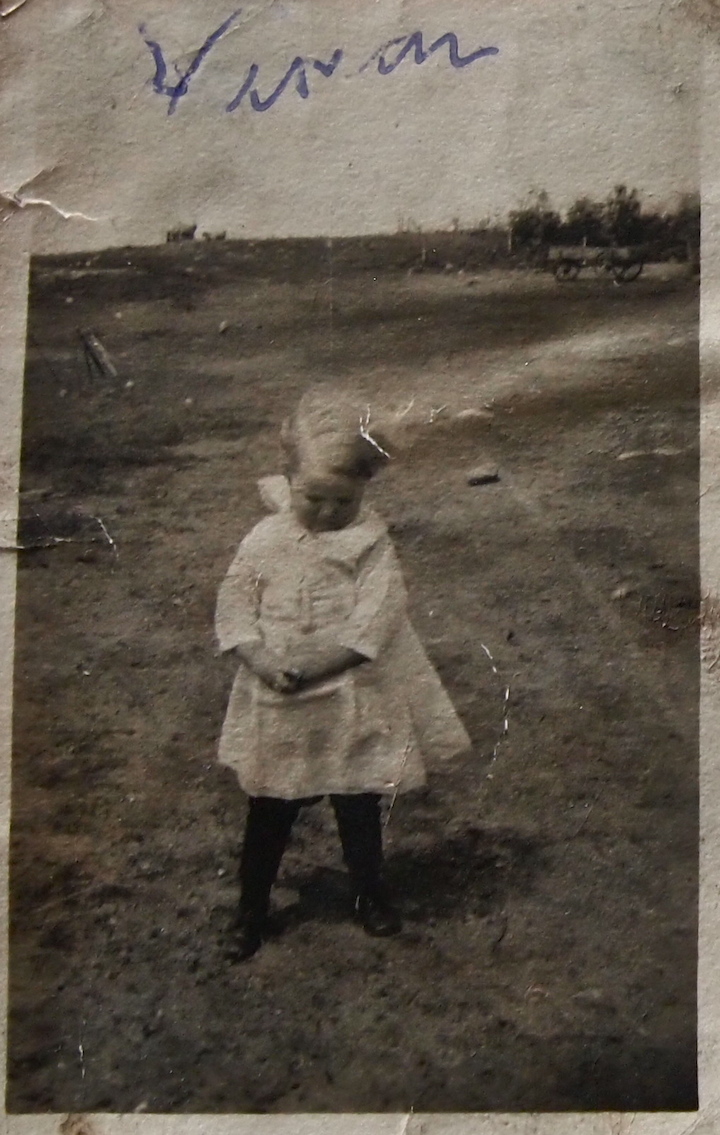
Vivian in the late-1910s on the Swedish-American farmstead just northeast of Bremen, Wells County, North Dakota.

Vivian in the late-1910s on the Swedish-American farmstead just northeast of Bremen, Wells County, North Dakota. That is Vivian’s handwriting at the top of the photo too.

It’s Mother’s Day (of course, every day is mother’s day). It is a holiday with origins in the post-Civil War (American) generation, championed by Anna Jarvis just after the turn of the 19th century. The idea was to get together all the moms who had sons die in the Civil War. Today we use it to recognized the heroine feats of motherhood.

Molly and I drove over to Bismarck, North Dakota, to spend Mother’s Day weekend with Julie and Paul (my parents). I also got flowers for Molly’s late mother a couple days ago, because mothers are all around us. Always. Last night, before bed, Molly and I (or Molly and Me, which has a nice ring to it) stumbled into a family archive in Julie and Paul’s basement. Numerous photos from my late grandmother, Vivian Marie (Larson) Barth, who passed away a year ago this month.

There are a lot of photos within the archive, and a personal project goal will be to digitize them, get family members digital copies, and then consider conversations with archivists at the State Historical Society of North Dakota or NDSU’s North Dakota Institute for Regional Studies or UND’s Special Collections for eventual curation. This is why we have state historical societies and regional archives: it captures what us global locals have been on about from one generation to the next. And it is better to digitize and then curate them with a sound archives than to keep them in a box in your basement (which can flood, or something like that).

But back to Grandma Barth, and a couple photos I digitized for uploading purpose here. To celebrate Mother’s Day. The photo at top is of Vivian, taken likely in 1918 or 1919, just northeast of Bremen, northeastern Wells County, North Dakota. The second photo is of Vivian in the mid- to late-1930s, likely when she moved off the farm to Bismarck, North Dakota. And the third photo was taken likely during or around the time Vivian was attending one of those late-1930s college programs to train as a secretary. She later held positions at the Bank and state capitol of North Dakota. She did this while tending to her three boys and husband (a total of four boys). She was loving (and still is), hard-working (I remember she gardened up until she was 91), and she babysat us grandkids countless times.

OLYMPUS DIGITAL CAMERA

Vivian in the late 1930s.


When I was real little, I remember being bummed out when my parents left for a couple weeks of vacation (I am blessed with great parents, so I tended to get bummed out in their absence). To set me at ease, before bed that night my grandma recounted a story of how her dad at the age of 13 boarded a boat in Sweden with his uncle, and set out for Ellis Island and America. She reminded me, “He was only 13.” Grandma had a way with bringing gravity and reason to any situation that was or seemed stressed. She also made extra ordinary chocolate chip cookies, Swedish meatballs, and, well, you name it. Here’s to you, Vivian. And Grandma Christy (for another blog, perhaps next Mother’s Day). And here’s to the memory of all mothers, and to making memories with our mothers today.

Vivian Marie (Larson) Barth, I'm thinking taken after she relocated from Bremen to Bismarck, North Dakota.

Vivian Marie (Larson) Barth, I’m thinking taken after she relocated from Bremen to Bismarck, North Dakota.

Digital Ed Ayers at the University of North Dakota

Bill Caraher (r) introduces a digital Ed Ayers, streamed live from the University of Richmond to give a talk at the University of North Dakota.

Bill Caraher (r) introduces a digital Ed Ayers (l), streamed live from the University of Richmond to give a talk to the University of North Dakota.

Yesterday in the late afternoon I found myself finished up with fieldwork in Grand Forks, so I thought I’d drop in and catch the digital Ed Ayers being beamed in from the University of Richmond to the University of North Dakota. To history nerds, Ayers is a big deal. Bill Caraher mostly if not entirely lined up the talk. Bill received his undergraduate training in Latin and Classics at the University of Richmond, and today Ayers is the president of said U of Richmond. They met on that common ground.

It was great to hear Ayers chat about his foundational website in digital history. At some point in 1993, The Valley of the Shadow went on-line. You can link to it here. And there is even a Wikipedia page to it here. Ayers noted that with digital projects, it is not only important that they be started, but also that they come to completion. So this, as he pointed out, is why we see 1993 and 2007 at the bottom of the web site. Ayers also noted that in the 1980s, historians thought they could revolutionize the discipline through qualitative analysis. Ayers said that qualitative idea “lasted three weeks.” History certainly requires data. But it is in large part about stories and narratives, and about figuring out ways to make the raw data accessible.

Through this, says Ayers, we are now witnessing what he calls generative scholarship. By this, it is meant that scholarship does not come to some sort of final conclusion. Instead, generative scholarship encourages anyone and everyone to engage with the historical data, or texts, and speak up and out about what they see. This, in turn, adds to the dialog, thus keeping it alive.

Life is a series of short and long term stories. This is how we make sense of it all, and also how we make sense of lives lived. This is what I thought about on my drive back from Grand Forks to Fargo.


History Mash-Up: O’ Brother the Tennessee Valley Authority

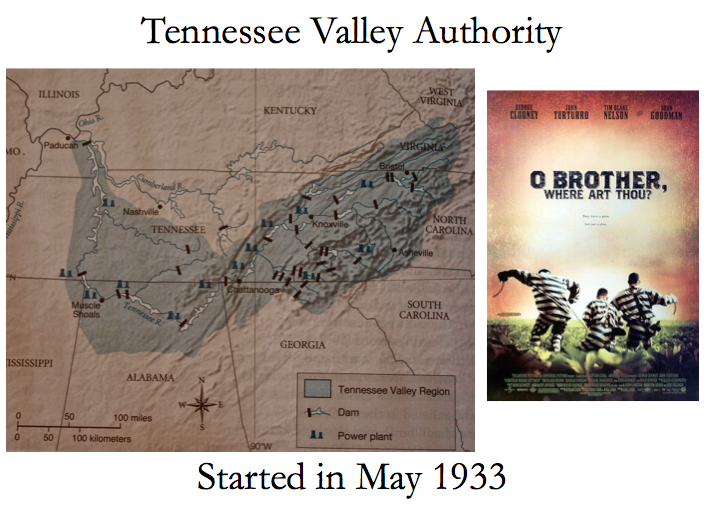
I call this slide, "TVA O' Brother," a combination of the map from Roark, et al., "The American Promise" (2012, p. 726) and the handbill for "O' Brother, Where Art Thou?" (2000)

I call this slide, “TVA O’ Brother,” a combination of the map from Roark, et al., “The American Promise” (2012, p. 726) and the handbill for “O’ Brother, Where Art Thou?” (2000)

For the second lecture on the Great Depression tomorrow at North Dakota State University in Fargo, I’m showing a map of the Tennessee Valley Authority with the handbill for “O’ Brother Where Art Thou,” (2000) the backdrop of the movie set in the TVA of the 30s. My reasoning is that 1) this is a fun visual; 2) the Coen Brothers are great; and 3) students in the future are much more likely to see “O’ Brother” than a TVA map. The idea is that both of these visuals will leave a singular imprint, and from here on out when they hear George Clooney lip sync, there’s a greater possibility that they’ll think about the history of the TVA, the Great Depression, FDR’s responses, hydroelectric power dams, etc.


Visiting Dickinson State University

Left to right, Historian Frank Varney, Aaron Barth, and Political Scientist Steven Doherty.

Left to right, Historian Frank Varney, Aaron Barth, and Political Scientist Steven Doherty on the campus of Dickinson State University, western North Dakota.

Yesterday Dickinson State University (via Frank Varney) invited me to speak about a component of research concerning how and why the US-Dakota Wars (1862-1864) were remembered at the turn of the 19th century throughout the Minnesota River Valley and on the northern Great Plains. It was great to get west of the upper Missouri River and spend some time with Varney and other fellow history and humanities nerds. I like this topic — thinking about how the US-Dakota Wars were remembered — because it mitigates what I call historical anxiety. I’ve thought about this phrase for a while, and loosely define it as that anxious feeling of not knowing how and why something happened in a particular place in time. A way to mitigate historical anxiety is to head into the archives and cobble together a narrative from the disparate bits and pieces. Through this I’ve been able to understand why the US-Dakota Wars were memorialized the way they were at the turn of the 19th century.

I’m using this, in turn, to push the way in which we think about the US-Dakota Wars today: largely as genocide, the word invented and deployed by Raphael Lemkin first in 1944. At the root, genocide comes from the Greek genos, which roughly means people or tribe; and the Latin cide, which means killing. Don’t take my word for it, though: visit Sully and Sibley in their own words. One humanistic universal I pitched out there to the group was that if the United States concerns (as it should) itself with genocide taking place today in Syria, and in other parts of the world, the U.S. should also concern itself with and consider the genocide that took place in our own past. Otherwise it just gets awkward, as the question will invariably come up time and again. So we can either chat and consider this, or just pretend like it doesn’t exist. If we pursue the latter, it just ends up leading to long bouts of awkward, uncomfortable silence. More on all this scholarship later, at least as it applies to the US-Dakota Wars, and the broader 19th-century Anglosphere.

Just a real quick warranted amplification of Varney’s work (he is in the midst of preparing a second volume that builds off his first monograph), General Grant and the Rewriting of History: How the Destruction of General William S. Rosecrans Influenced Our Understanding of the Civil War (Savas Beatie, 2013). Click on that link. If you enjoy history, or have thought deeply or superficially (there are only so many hours in a day) about memoirs, or Grant’s memoirs, definitely give it a go.


Memory Groups

It’s closing in on 7:28AM as I type, and I thought I’d do a quick recap of this last week. Just yesterday evening on my walk home from NDSU campus, I was thinking how much more exciting blog posts on exploding trains are in contrast to posts about napping. Yet when it comes down to it, and if I’d have a choice, I’d rather read up on nap studies than exploding trains, since the former — naps — are much more likely to affect and influence a larger cross-section of society than, say, oil trains that explode near Casselton, North Dakota. Both are important. But I tend to enjoy figuring out how to find and make the otherwise mundane and boring (naps, or even a German-Russian homestead) interesting than focusing on the also important mushroom clouds rising up out of the northern Great Plains winter prairiescape.

Anyhow, I just confirmed a couple lecture-talks this semester at universities within the region, and these talks will build off published research on, broadly speaking, how and why the US-Dakota Wars have been remembered for the last 150 years in the Dakotas and Minnesota. I’m perpetually fascinated by this topic of memory. I suppose one reason is that by looking at how and why groups remember an event is just as informative as the actual event itself. And maybe even more. By studying these groups, we’re able to unpack the cultural, social and political set of ethos that various memory groups brought to bear on the interpretation of historical events.

These groups, in turn, are responsible for advancing the general topics in history that we know today. There is, for another example, the world historical event of the Second World War. But there are also the memory groups — in this case led by Tom Brokaw (also from South Dakota), Tom Hanks, and the late Stephen Ambrose — who study, popularize, and consider America’s involvement in the Second World War. These memory groups have reasons for studying what they study, and I want know the philosophy and technics behind it — the why and the how.


Thoughts On David Blight’s Race and Reunion

A view this morning of I-29 between Fargo and Grand Forks.

A view this morning of I-29 between Fargo and Grand Forks.

This morning Molly and I drove north from Fargo to Grand Forks, and now we’re waiting at the GF Byron L. Dorgan International Airport to board our flight to lovely Las Vegas, Nevada. I got family in Vegas, so that’s where we’re setting up for the holidays.

While we wait for our flight, I’ve been revisiting David W. Blight, Race and Reunion: The Civil War in American Memory (Harvard University Press, 2001). As the title suggests, Blight looks at how aspects of the Civil War were and were not remembered in the post-Civil War era from 1865 to 1915. At the turn of the 19th century, as the self-fulfilled WASP theory of Social Darwinian thinking — also known as racism — gripped many political leaders, old Union and Confederate veterans tried to find a “happy ending” to the divisive Civil War. To do this, they decided to talk about a lot of the Civil War, but they decided not to talk about emancipation and race. They certainly turned away from memorializing it in icon and statue. In chapter 10 of this work, Blight turns out attention toward the 1897 monument dedicated to the Massachusetts Fifty-fourth. This all-black regiment was commanded by Robert Gould Shaw, a Boston Brahmin. In the context of Civil War memorials, at least in the eastern 1/3 or 1/2 of the United States, Blight says,

The Shaw Memorial was (and still is) different… the Shaw Memorial moved people emotionally. The events it commemorated compelled viewers to acknowledge that wars have meanings that go beyond manly valor. Saint-Gaudens’s relief forced the thoughtful citizen to ask how a struggle in the 1860s between white Northerners and Southerners over conflicting conceptions of the future became a struggle for blacks over whether they had any future in America at all. The monument also asserts with majestic anguish that in the nation founded by the Declaration of Independence, black men had to die by the thousands in battle or of disease in order to be recognized as men, much less as citizens. 

I think about this quite a bit. At least since 2009, I’ve been absorbed by how that same Union army carried out punitive campaigns against the Dakota, Lakota and Nakota, and how these campaigns have been remembered in regional and national history. So those are my thoughts for now. Back to the book. And back to waiting to board our flight. Happy Christmas all.


Autumn to Winter in Fargo

This is a quick post, something that has been on my mind during my walks to and from campus at North Dakota State University. I have been walking past a historic apartment building about the corner of College Street and 11th Avenue North for years now. The sturdy brick construction caught my eye a couple years ago. I also appreciate its aesthetics. As autumn began to give way to winter this year, I thought I’d snap a couple photos at seasonal intervals to post later — which is now — on this here blog. The first was taken at some point in August-September, 2013. The second was taken after the first big snowfall. Here are the two photos of my own, followed by the GoogleEarth photo.

Autumn

Winter

GoogleEarth


Dissertation Update

Dakota LanguageToday is Friday the 6th of December, it is approximately -11°F, I am looking out beyond the laptop screen through a south-facing window to the light blue snowscape, the time when the approach of the sun-rise appears eminent. I plan on finishing my opening dissertation chapter (which might turn into an introduction) that deals with the public remembrance of the US-Dakota Wars. One of the main thrusts in this disquisition is to look at not only how various generations have remembered and memorialized the US-Dakota Wars, but to piece together why.

I chatted with an engineer about this a couple days ago, albeit briefly, and I found in myself another reason that I hadn’t articulated so well: whenever we, the royal we, are frustrated with the way things are, sometimes it helps to track the history so as to see how we got where we are today. This doesn’t necessarily mean we will agree with it, but one doesn’t have to agree with something in order to understand it. To my right on the floor is a stack of published monographs on world and public history — historiography (or the history of history) having spoken to and shaped what we know today.

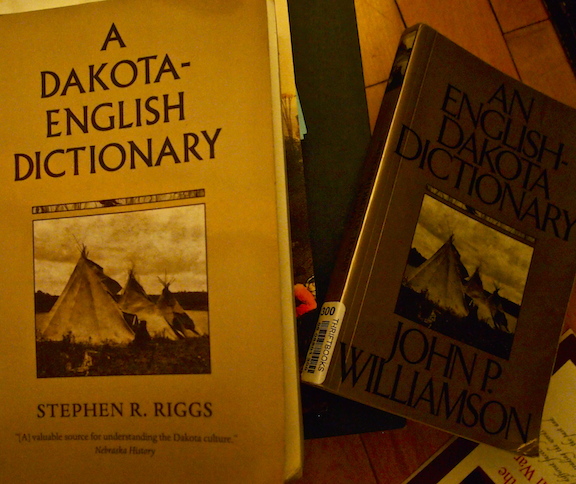
I also picked up and have so far read the introduction of Denise Meringolo, Museums, Monuments, and National Parks: Toward a New Genealogy of Public History (U of Massachusetts Press, 2012) from the dutiful Inter Library Loan-ists at NDSU. A couple months ago Bill Caraher and I were chatting at Laughing Sun in Bismarck, and he suggested I check it out. It is good. More on that later, either in blog or dissertation form. To my left is Stephen R. Riggs, A Dakota-English Diectionary and John P. Williamson, An English-Dakota Dictionary. I continuously re-re-rediscover that language, or the study of it, provides insights into the past, as do oral traditions and oral histories. But okay, enough of all this blogging for now. I’m just going to get after finishing this draft. Happy Friday to you.


Scholarly Publishing Houses in New Zealand

Since having returned from the South Pacific, and now back on the northern Steppe of North America, I have been rummaging through all the pieces of paper one accumulates while on short or long journeys. I came across the flyers, handbills and handouts that speak to the various scholarly publishing houses in New Zealand. Before my New Zealand trip, these were off my radar. And I figured since I didn’t know about them but do now, I’d share the findings and provide links. There is Bridget Williams Books, Auckland University Press, and Otago University Press. There, of course, are more (this is not exhaustive). But this is a start.

During the New Zealand Historical Association conference, a panel of editors from these scholarly and academic presses spoke to where scholarly publishing has been, where it is today, and where it might go tomorrow. This, I know, is an excellent idea for any scholarly conference, since the only way scholars can disseminate their research is by getting it published. And to get something published requires one to get to know the editors in charge of the publishing houses. And so on.


Art After the Earthquake: Public Art and Public History in Christchurch, New Zealand

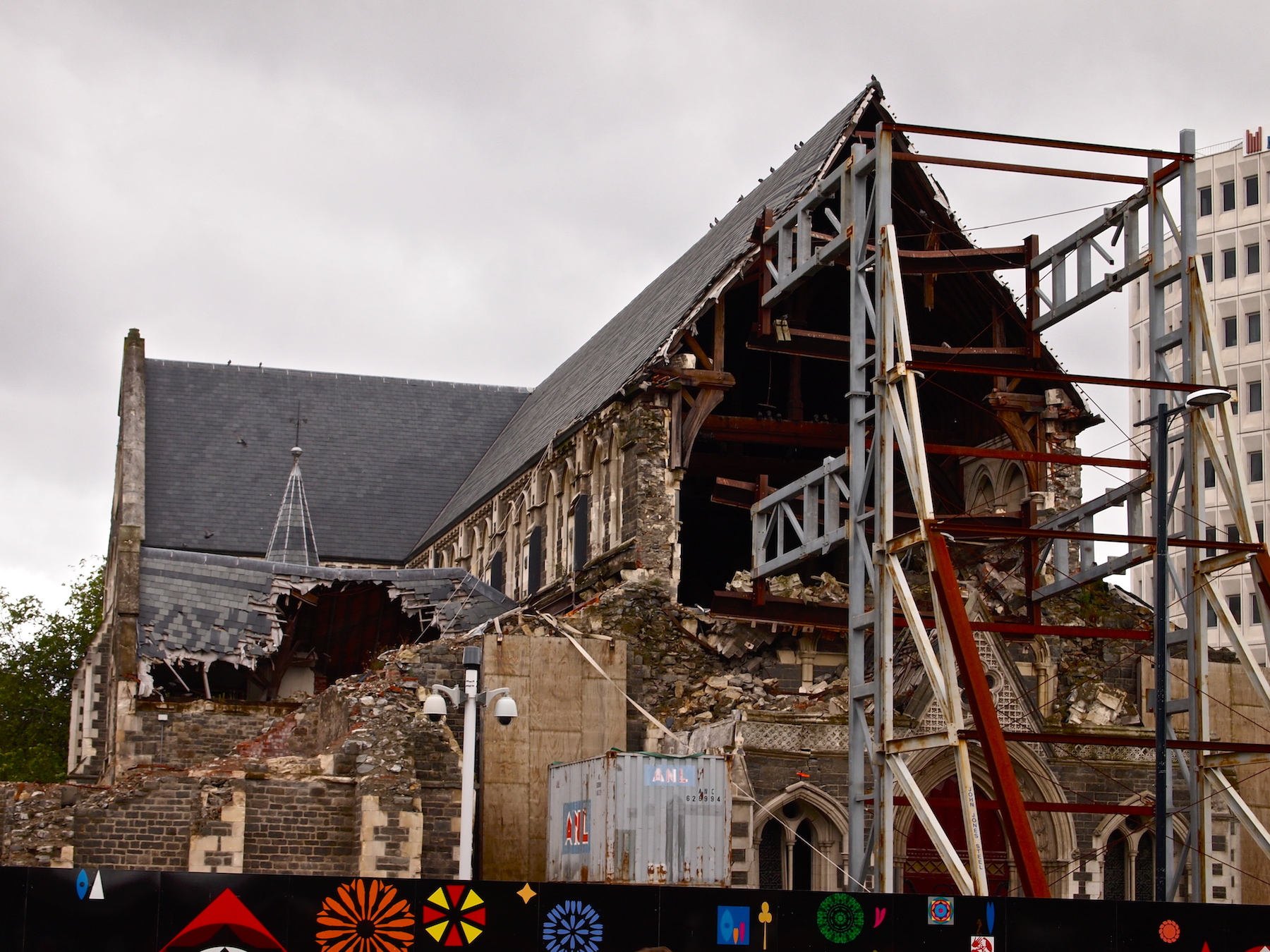
The Anglican Cathedral in Christchurch Square. Photo from November 26, 2013.

The Anglican Cathedral in Christchurch Square. Photo from November 26, 2013.

Since September 4, 2010, an earthquake and subsequent aftershocks have caused death and damage to the South Island of New Zealand. Yesterday, on November 26, 2013, Matthew McLain, Molly McLain and I had a chance to visit Cathedral Square in downtown Christchurch. Since the earthquakes first started in September 2010, I had followed the destruction here and there from North Dakota. Like many (or all) destructive events, one gets a different impression from reading about it in contrast to physically visiting it.

In the aftermath, Christchurch has charged artists and historians to inspire and encourage. We saw a few pieces of local public history and public art, this amidst the endless sounds of jackhammering, and sights of construction barriers, rubble, razed and condemned buildings, chain link fence and orange road cones. I enjoyed on piece of public art history entitled “A vast, changing canvas.” The short narrative said,

A public history display in Cathedral Square, downtown Christchurch, New Zealand. Photo from November 26, 2013.

A public history display in Cathedral Square, downtown Christchurch, New Zealand. Photo from November 26, 2013.

In the city’s altered centre, art, storytelling and the realm of the imagination claim a vital role. Artists Chris Heaphy and Sara Hughes have unleashed color, pattern and energy to communicate an active sense of possibility.

It completely makes sense when wandering around the otherwise grey concrete and rubble-strewn urban scape of the Cathedral District. One piece of public art was a glorified living room covered in astroturf. This impressed upon me the idea of returning the Cathedral District to an outdoor living room. The large sofa, when sitting on it, points you toward the severely damaged Anglican Church.

Another public piece of organic art is the botanical entry that frames the way visitors and sight-seers can view the church (and potential rehab, much of which is documented in this blog here). The three of us had a hard time finding sensibly priced lodging in downtown Christchurch, so we took to the non-city centre and eventually found a cozy little motel. I think it’s important to note here, though, that Christchurch is functioning. In the wake of the September 11, 2001 destruction, I remember Mayor Rudy Giuliani encouraging non-New Yorkers to continue visiting New York City. A couple friends of mine and I ended up taking him up on that, and we visited downtown New York City and Ground Zero in late September 2001.

Public Art that impressionistically simulates an outdoor living room in Cathedral Square, Christchurch. Molly McLain is obliging the artists, and taking it all in.

Public Art that impressionistically simulates an outdoor living room in Cathedral Square, Christchurch. Molly McLain is obliging the artists, and taking it all in.

If someone was to ask me whether or not to visit Christchurch, this in the context of all the rebuilding, I’d encourage it. You might want to book additional sight-seeing to the variety of wineries and vineyards surrounding Christchurch, or the hot spring pools in Hamnar Springs, or the natural history that is the Fox Glacier or Franz Josef Glacier, or (you get the idea). We’ll continue thinking of Christchurch, and we are thankful for the artists that have been charged with and want to reinvigorate the local human spirit. This works just as well in the formal and informal sense. For example, while waiting for our out-going flight at the Christchurch airport, a young kiwi just ran up to Molly and handed her a home-made Merry Christmas card; Molly is creating her own as a response. Inspiration, or inspiring the spirit within others, is contagious that way.