Tag Archives: Public History

Clellification for Halloween, 2024

I’m currently working on a project with Bill Caraher who is the pilot of The Digital Press at University of North Dakota. For a year, or beyond a year now, Caraher and I have been thinking about Clell Gannon, and Gannon’s 1924 publication, Songs of the Bunch Grass Acres (SoBGA). I’m working on revisions from a first draft submitted to The Digital Press, and after letting editorial comments sit with me for a while, I have decided to recalibrate a bit of the original narrative. Like it is the case with many texts, the more you read, revisit, and think about SoBGA, the more the text starts speaking to the reader in different ways. The recalibration of the first draft will look something like this:

  1. Clell Gannon intellectually situates (indirectly and directly) his 1924 SoBGA into the current of Romanticism. And not the romanticism that you’re thinking about. Like he’s not poeming (poem is now a verb) the reader to go pick flowers and let your feelings rather than your brain dictate your moment to moment actions. Rather, in the original intellectual vein of Romanticism (which was a counter balance to the, ahem, Enlightenment), he’s saying (I’m paraphrasing here), Hey, this northern plains and Great Plains and Western Americana place we all live in: this place is completely worth living in. And not only is it worth living it, it deserves our contemplation, and this place is deserving of a sustained relationship with us.
  2. Who else did Clell Gannon roll with at this time? He was a mover and shaker. Also one who was a joy to be around. Thoughtful. And nothing that is in his writings, or others who have written about him, suggests he was a chest thumper. He was friends with Russell Reid and George Will (son of Oscar Will and his vegetable seed empire). The same Russell Reid who acted as secretary of the State Historical Society of North Dakota for decades: when it evolved from the basement of one of the buildings on the State Capitol Grounds eventually to the building that today houses the State Library. Clell would likely lose his mind (in a good way) if he saw the geothermal-heated footprint of today’s State Historical Society of North Dakota, and in-motion expansion of the Military Wing.
    • Clell was unable to physically make the requirements to be mustered into World War I. I do wonder what contributions he might suggest for interpretive exhibits in the 21st military wing following the Great War of the 20th century? Might they have read something along the lines of what Willa Cather spoke of in 1922? “…the world broke in two in 1922 or thereabouts…” In 1922, Cather had seen veterans return from the Great War, and as returned veterans, they were told (not even really told) to navigate the ascent of the industrial capitalistic roaring 20s.
  3. In conversations with Shadd Piehl (ahem, recognized poet of the American West, cowboy poet, teacher, listener, encourager of the written and spoken word, and former bronc rider, etc), Piehl noted that Clell reminded him of the poem American Names that Stephen Vincent Benét set down in 1927, or 3 years after publication of SoBGA. So the revisions of this draft will take into greater account a couple other datum points, including Willa Cather and Stephen Vincent Benét.
  4. Clell Gannon’s introduction (very short) of SoBGA is good.
    • In the first paragraph he sets out his flag of love of regional place. Not nationalistic love. But of the regions within this nation: northern plains. Great Plains. American West.
    • The second paragraph is on about poetic structure, meter to be exact, and with a sampling of how a west of the Mississippi River person pronounces “coyote”: say ki’ot, Clell instructs, as two syllables. Don’t get all sophisticated and say “ki’ot’eee.” Don’t do that. Nobody would ever do that. Use two syllables to say coyote, and the meter of the poems will flow.
    • The third paragraph calls out Florence Harriet Davis, librarian in 1924 of what would have been the beautiful Carnegie Library in Bismarck (it was completely razed in the 1970s or 1960s for progress. Poetically, a parking ramp is located there today.). Who is Florence? In a word search in the Library of Congress searchable newspaper database, she surfaces here and there in Bismarck Tribune articles.
    • Clell’s final poem in SoBGA is to Hazel Dell Gannon, who at 17 years old passed away in what Clell describes as Grand Valley, South Dakota. Maybe she was preparing to attend teachers college? Or something? I Google’d Grand Valley, and the closest thing that surfaces is place names in Lincoln County, southeastern South Dakota.
    • Clell signs off on his short introduction with “Bismarck-by-the-river, North Dakota.” Today, in 2024, this is another great reminder to readers to recenter their view of North Dakota’s capital city as one that is a river city as well. Clell understood the importance of the Missouri River to the early history of the region and, eventually, to the state.

Okay, that’s all the Clell-ification I have for the moment. Gotta get after the other items for this Thörsdag, October 31, 2024, Halloween Day (the pumpkins were carved last night).


American Western Memory and History

This Smithsonian link here is a good write up on a hard, sobering chapter in American western history. The Sand Creek Massacre, like the Whitestone Hill massacre (September 1863, northern Dakota Territory), and the Bear River Massacre (January 1863, Idaho), were never forgotten. This article says the Sand Creek Massacre was lost and rediscovered: it’s highly doubtful that Lakota, Cheyenne, Dakota, among others, “forgot” what happened in 1863 and 1864 when they converged on Custer and the 7th in late June of 1876. Not in the least. And if chatting with the descendants of the historical participants of these conflicts, you’ll know that the memories and stories were never forgotten. In some cases the stories went underground. They are re-emerging today, and justly taking the place as the official interpretation. It is powerful stuff. It continues to compel me to listen, study, and reflect.


Victorian Medallions in Downtown Bismarck

OLYMPUS DIGITAL CAMERA

A 2014 photo of the southwest elevation of the Bismarck Auditorium (Belle Mehus).

Yesterday I took a jaunt around downtown Bismarck to capture some images of historic buildings. Autumn has turned to winter, and this means the glorious deciduous leaves are no longer. At least until spring. This also means that it is a great time to take photos of historic buildings (or buildings in general): just like the presence of leaves gives some good angles for photography, so does the absence of leaves. I ended up sauntering around the beautiful Bismarck Auditorium, renamed the Belle Mehus some years ago during a much-needed and -deserved rehabilitation and restoration. An excellent history of the Belle is linked to here on the Bismarck-Mandan Symphony’s Orchestra’s website.

Erected in 1913 and opened in 1914, this auditorium was typical for its time, at least in the sense that opera houses provided the entertainment before the rise of television, radio, movies and iPhones. Traveling opera companies would make the rounds on railroad, stopping in one town after another (much like touring bands today). When visiting historic opera houses, take note of how close they are to the historic railroad: one can imagine an opera company arriving by rail with all the graceful bustle of offloading at the train depot, making their way to a hotel and preparing for one or three days wortOLYMPUS DIGITAL CAMERAh of performances.

It is fantastic to see opera houses restored, or repurposed. It is literally hard to come by this type of stone and brick monumental architecture, at least today. So that’s what I did yesterday: enjoyed the rehabbed and preserved aesthetics of the Belle Mehus, the Bismarck Auditorium in historic downtown Bismarck, North Dakota. I snapped a photo of the copper Victorian medallion centered at the top of the Belle, too. Michael Gilbertson even drove by, managing to roll down his window in time to give me a drive by “Hi Aaron!”

OLYMPUS DIGITAL CAMERA

The large copper, shield medallion with Victorian ornamentation centered on the west elevation at the top of the Bismarck Auditorium. In winter, it is possible to get this photo due to the absence of the leaves.


Teddy Roosevelt on Halloween in Dakota Territory

I’m looking at some of the original Teddy Roosevelt documents this evening from Bismarck, this provided by the glorious Theodore Roosevelt Center at Dickinson State University in western North Dakota. I came across a historical Halloween gem. It is a November 3, 1885 letter of Teddy describing Halloween in the Badlands of western North Dakota. It is accurately titled, “Hallowe’en in the Bad Lands.” I’ll analyze it after this blog post. I want to just transcribe it here because we’re getting close to Halloween in general. So here is for your historical Halloween sense of time and place. Writing from the Badlands of western North Dakota, Roosevelt said (run-on sentences were his style of the times),

While the young people of Bismarck paid me extraordinary attention to the fair Hallowe’en, the cow boys of the Bad Lands favored the stars and gaudy buttes of that land of earthen goblins with a celebration, which for brilliancy and spontaneity surpasses any thing of the kind on record. True there were no maidens to add the feminine charm to the occasion, but the pistol decorated gentlemen of the ranges were equal to every emergency, and that the conventionalism’s of the occasion might be properly observed, a number of the bovine guardians agreed to don the female garb, and while away the early evening hours in waiting for the coming of the sign changing hoodoos. There were no signs to tear down in the Bad Lands, but they could skim the jagged pasture land on their half breed plugs and rip the ambient air up the back with shouts and whoops and leaden balls. The proper hour having arrived, the cowboys on the outside, as representatives of the masculine gender rode up to the ranch and entered, to find that their female impersonators had been faithful and fifteen of their fellow cowboys were seated about the room in skirts and waists and what scraps of ribbons they could gather from their tanks and neighboring ranches. A dance was immediately opened and everything was as pleasant as a Fifth Avenue social, until the whiskey reached its zenith and the hour for shooting had arrived. The cowboy girls seemed to forget the modesty which their positions demanded, and in language of the prairie, “they turned themselves loose.” A general fusillade was indulged in, the meeting adjourning when the lamps were shot to pieces and the narrowed and improvised dresses were obliterated. It is said that had the celebration lasted an hour longer the climax might have a row, but as it is, a few loud words, a parting drink and a desperate attempt to shoot the blinking stars closed the memorable event.


Dakota Language Update

This morning I have returned to selecting one Dakota word to learn, ideally every morning, the idea being to create for myself a type of vocabulary for unpacking more of the US-Dakota Wars. Language is the way in which we perceive and see our world. So by understanding another language, such as Dakota, one can start arriving at new perceptions in the infinite quest of knowledge (we have these brains, so we might as well put them to use).

I am using two dictionaries to accomplish this, and uploading the Dakota word and English definitions to Cobo cards. The dictionaries are Stephen R. Riggs, A Dakota-English Dictionary (first published in 1890; Minnesota Historical Society Press, 1992), and John P. Williamson, An English-Dakota Dictionary (first published in 1902; Minnesota Historical Society Press, 1992).

Like any deliberate language study, I use the English-Dakota dictionary to first locate the word. So if I look up “anxiety,” it takes me to Caŋ-te´-ši-ča. I use the Dakota-English dictionary to unpack the larger Dakota word of Caŋ-te´-ši-ča: large words are, after all, combinations of shorter words. By unpacking the large words, and defining them in the smaller portions, one can start learning the basics and foundations of the language. This, my friends, is a transferrable skill.

Yesterday morning I decided on the word “Anxiety,” and today I picked the word “Hero.” Here is what definitions the dictionaries turned up:

Caŋ-te´-ši-ča = to be sad, sorrowful, or anxious. I need to unpack this word a bit more. I will log some more time on that this evening, or tomorrow morning.

Itaŋ-caŋ-ka = Hero. The breakdown of Itaŋcaŋka, according to Riggs’ dictionary, is along the defined lines of someone who is “fire-steel,” and who is on a, or your, side. Okay. That makes sense. Fire-steel by your side. Here is the breakdown below.

Itaŋ, adv. of taŋ; on the side. From this we get the word mitaŋtaŋhaŋ, which means at my side.

Caŋka, n., a fire-steel.


Cyprus Footage from 2012

While Bill (Caraher) blogged a bit on Punk Archaeology and PKAP today, in a separate but related sphere (parallel trajectories I call them), I stumbled across an audio-video short that David Pettegrew recorded during the PKAP 2012 field season in Cyprus. I uploaded this to my YouTube channel, and I will share it here.

In May and June of 2012, the Pyla-Koutsopetria Archaeological Project (Dr. William Caraher, Dr. David Pettegrew, and Dr. R. Scott Moore) charged me with trench supervisor duties for an excavation unit located outside of Larnaca, Cyprus. Here in Pettegrew’s video is a wall emerging out of the excavation unit from a 3rd-century BCE Hellenistic coastal fortification. This site is contemporaneous with Alexander the Great and Zeno, the Stoic from Citium. Within the excavation unit, I am to the right, and sorting out the stratigraphic layers with a student and colleague. The student and colleague to my left continues uncovering bedrock at an industrial pace.


The Welk Homestead

Miller Welk Painting 1930A couple weeks ago Molly and I, along with my parents, took a Sunday trip to the homestead of Lawrence Welk. To be more specific, this was the homestead of Welk’s parents in rural Emmons County, south-central North Dakota. The homestead is just south of Braddock, North Dakota, the place where my great grandpa Barth established his homestead and family. The Barth’s were Ohio-Germans imbedded within this larger German-Russian migration group.

Earlier this afternoon I stopped by North Dakota State University’s German-Russian Heritage Collection to pick up a Gary P. Miller reproduction print from 1930. It is what today we might call a mash-up: Miller painted Welk and his Hollywood roadster into the Emmons County homestead setting. In an effort to unfurl this print, I placed four of books at the edges. It seemed fitting to deliberately use Plains Folk: North Dakota’s Ethnic History;  Prairie Mosaic: An Ethnic Atlas of Rural North DakotaPrairie Peddlers: The Syrian-Lebanese in North Dakota; and The Quartzite Border: Surveying and Marking the North Dakota-South Dakota Boundary, 1891-1892.

The Welk homestead today is undergoing continued rehabilitation. One can get a guided tour of the original sod homestead, and a couple outbuildings and the summer kitchen. This latter building, the summer kitchen, still speaks to the utilitarian sensibilities often inherent in North Dakotans: the summer kitchen kept the heat out of the otherwise cool sod home in the June, July and August months. It was straight-forward practicality that German-Russians brought with them when they migrated to North America from Odessa, Russia. Within Miller’s 1930 print, the summer kitchen is center-right in the reproduction, and the sod house is just to the left.


D-Day 70th

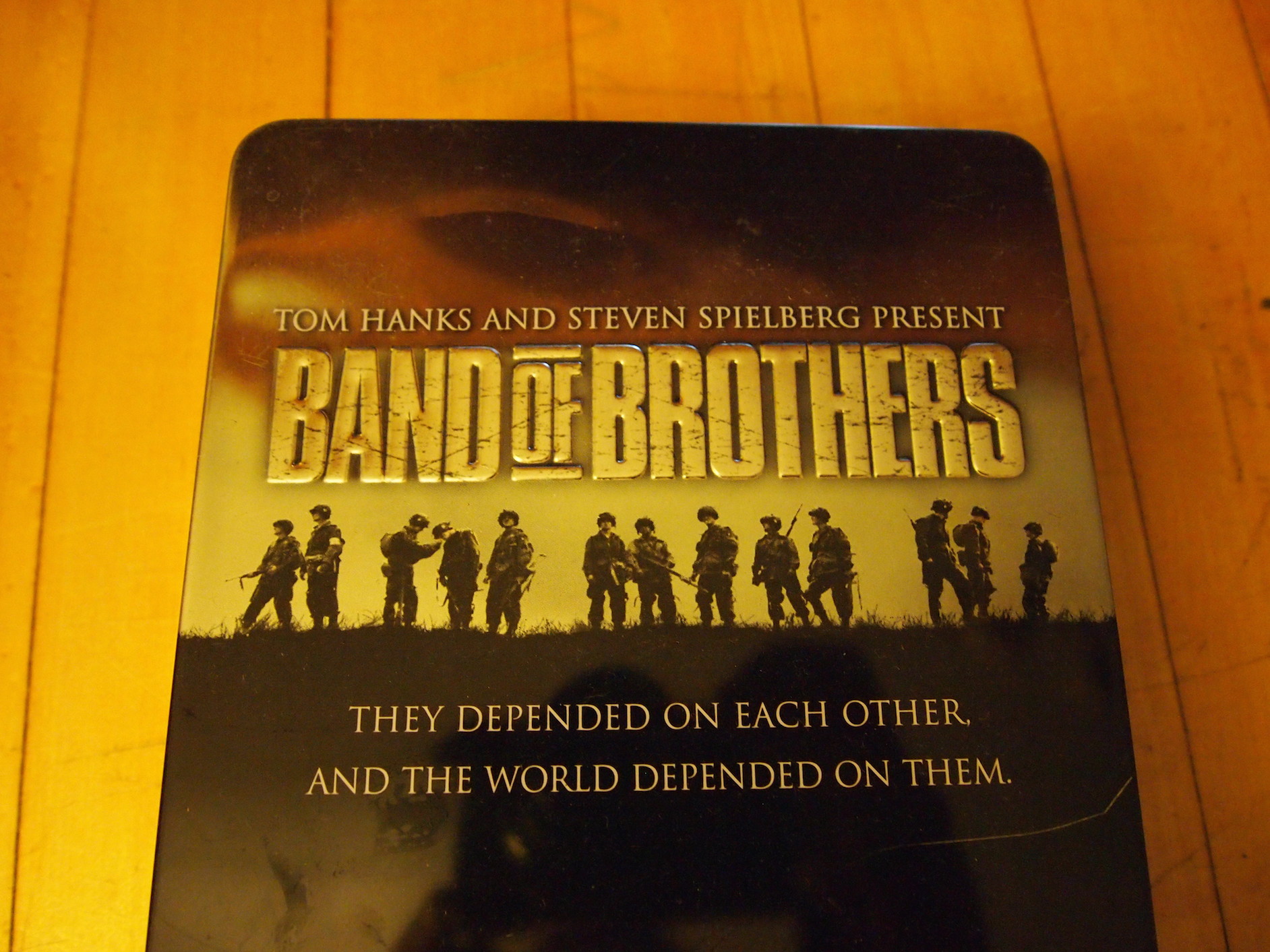
OLYMPUS DIGITAL CAMERAIt is June 5, 2014, which means it is one day away from the 70th anniversary of Operation Overlord, or D-Day. This also means that either this evening or tomorrow evening I’m going to fire up Tom Hanks and Steven Spielberg’s rendition of Stephen Ambrose’s 1992, Band of Brothers (2001).

I’m also drawn to thinking about what my late Grandpa Barth and his brother (my great uncle Charles “Bud” Barth) did during WWII. They both came from a farm near rural Braddock, North Dakota. During the war, Grandpa Barth was shipped to the central Great Plains to build bombers (I remember him talking about how he was charged with buffing the glass bubbles for the bombers). And Uncle Bud was sent to Army training, eventually becoming a front line medic in the Battle of the Bulge. Bless those for blessing us. I think that’s about all I got for now.


Memorial Weekend

Memorial Day weekend burger grill.

Memorial Day weekend burger grill.

It’s Friday evening and Molly and I are sitting on the living room futon which now faces west. It points us in the direction of a screen porch, and beyond this we can see the youthful spring green of deciduous trees and leaves set against a background of grayish-blue sky. A storm is brewing out west for sure. You can smell it. Something to do with the ozone.

We live in pre-WWI construction, so we are also treated to a kind of pre-WWII sense of place. I haven’t been able to put words to the smell, but the smell I’m smelling reminds me of my late Grandma Christy’s house on the 700 block of North 4th Street in Bismarck, North Dakota. That house, too, was built prior to the First World War. Anything built before the Second World War has this sense of smell and place to it. The homes and apartments all have hard wood floors, radiator heating, and super tall ceilings. They were built before the invention and ascent of conditioned air.

My latest archaeological find of Minnesota Twins propaganda.

My latest archaeological find of Minnesota Twins propaganda.

So now that it is Memorial Day Weekend, I thought I would post the epitome of Americana. I love this stuff. Baseball and cowboy charcoal grilled burgers. Memorial Day weekend is a grand extension of Decoration Day, a Civil War day of remembrance.

This evening also got me thinking a bit about all the German-Americans that poured into the United States when, in the words of Lt. Aldo Raine, people were getting out of Europe while the getting was good. Massive religious and political upheavals in the 19th century (this is the most focused brush stroke I’m going to use right now) induced hundreds of thousands of Europeans to simply leave Europe. They crossed the Atlantic and poured in the United States. A large swath of these immigrants came from Germany, or German-speaking countries (I have often hypothesized that the reason Germany started two big ones in the same century had to do with this intellectual emigrant drain from the previous century). And the Germans, when they arrived in the United States, took up numerous causes. In some cases they played baseball. And in other cases they agitated for emancipation. I like to imagine that they also grilled burgers, too. Baseball and burgers. Happy Memorial Day.


Happy Mother’s Day

Vivian in the late-1910s on the Swedish-American farmstead just northeast of Bremen, Wells County, North Dakota.

Vivian in the late-1910s on the Swedish-American farmstead just northeast of Bremen, Wells County, North Dakota. That is Vivian’s handwriting at the top of the photo too.

It’s Mother’s Day (of course, every day is mother’s day). It is a holiday with origins in the post-Civil War (American) generation, championed by Anna Jarvis just after the turn of the 19th century. The idea was to get together all the moms who had sons die in the Civil War. Today we use it to recognized the heroine feats of motherhood.

Molly and I drove over to Bismarck, North Dakota, to spend Mother’s Day weekend with Julie and Paul (my parents). I also got flowers for Molly’s late mother a couple days ago, because mothers are all around us. Always. Last night, before bed, Molly and I (or Molly and Me, which has a nice ring to it) stumbled into a family archive in Julie and Paul’s basement. Numerous photos from my late grandmother, Vivian Marie (Larson) Barth, who passed away a year ago this month.

There are a lot of photos within the archive, and a personal project goal will be to digitize them, get family members digital copies, and then consider conversations with archivists at the State Historical Society of North Dakota or NDSU’s North Dakota Institute for Regional Studies or UND’s Special Collections for eventual curation. This is why we have state historical societies and regional archives: it captures what us global locals have been on about from one generation to the next. And it is better to digitize and then curate them with a sound archives than to keep them in a box in your basement (which can flood, or something like that).

But back to Grandma Barth, and a couple photos I digitized for uploading purpose here. To celebrate Mother’s Day. The photo at top is of Vivian, taken likely in 1918 or 1919, just northeast of Bremen, northeastern Wells County, North Dakota. The second photo is of Vivian in the mid- to late-1930s, likely when she moved off the farm to Bismarck, North Dakota. And the third photo was taken likely during or around the time Vivian was attending one of those late-1930s college programs to train as a secretary. She later held positions at the Bank and state capitol of North Dakota. She did this while tending to her three boys and husband (a total of four boys). She was loving (and still is), hard-working (I remember she gardened up until she was 91), and she babysat us grandkids countless times.

OLYMPUS DIGITAL CAMERA

Vivian in the late 1930s.


When I was real little, I remember being bummed out when my parents left for a couple weeks of vacation (I am blessed with great parents, so I tended to get bummed out in their absence). To set me at ease, before bed that night my grandma recounted a story of how her dad at the age of 13 boarded a boat in Sweden with his uncle, and set out for Ellis Island and America. She reminded me, “He was only 13.” Grandma had a way with bringing gravity and reason to any situation that was or seemed stressed. She also made extra ordinary chocolate chip cookies, Swedish meatballs, and, well, you name it. Here’s to you, Vivian. And Grandma Christy (for another blog, perhaps next Mother’s Day). And here’s to the memory of all mothers, and to making memories with our mothers today.

Vivian Marie (Larson) Barth, I'm thinking taken after she relocated from Bremen to Bismarck, North Dakota.

Vivian Marie (Larson) Barth, I’m thinking taken after she relocated from Bremen to Bismarck, North Dakota.