Tag Archives: Public History

Chinese Pacific World History

Henry Yu provides the final keynote lecture.

Henry Yu provides the final keynote lecture at the New Zealand Historical Association Conference.

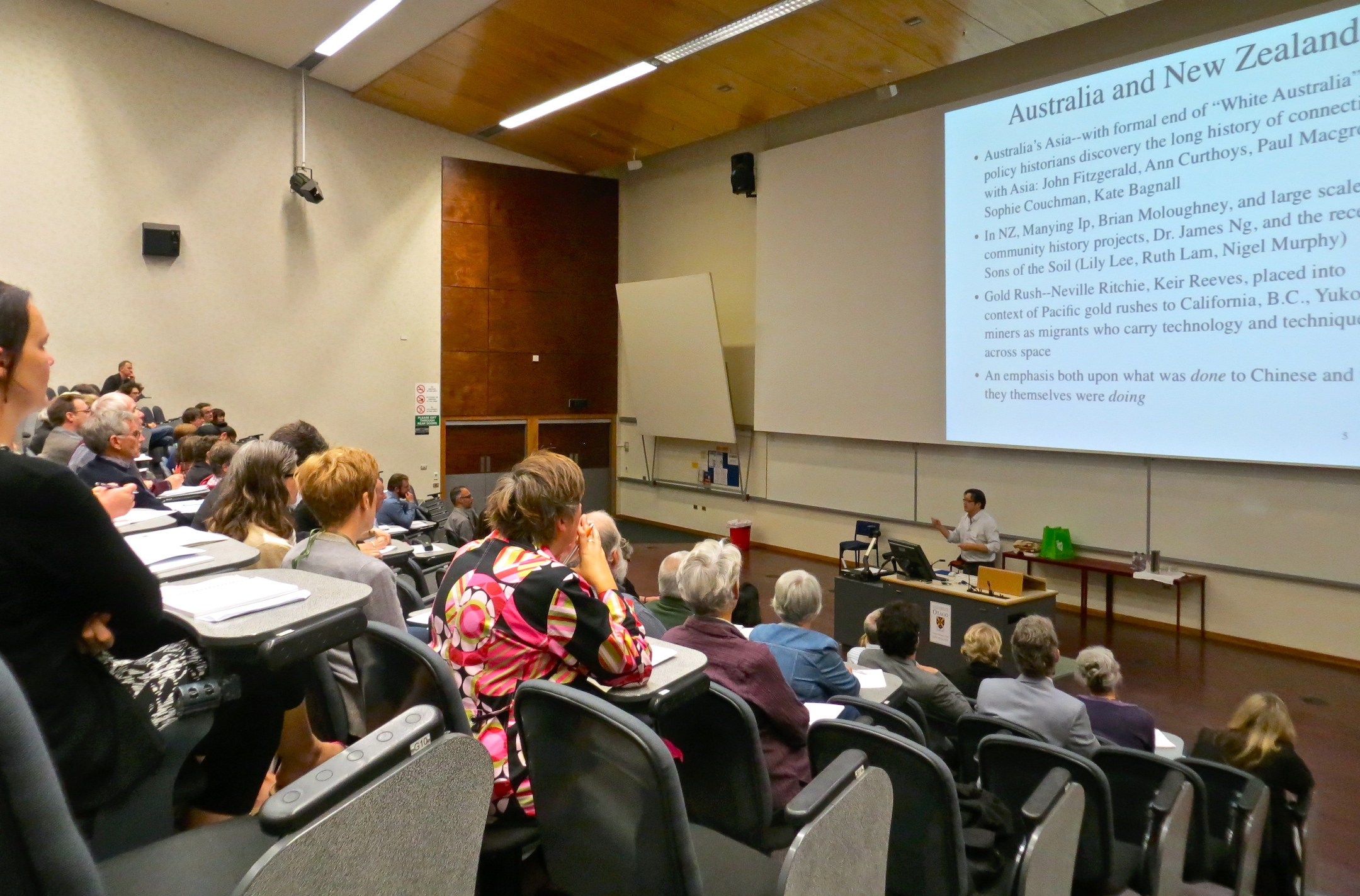
On Friday morning, Henry Yu provided the final keynote lecture at the New Zealand Historical Association conference. Yu’s lecture title was, “The Cantonese Pacific: Anti-Asian Politics, and the Making and Unmaking of White Settler Nations.” Yu talked about the 19th century Chinese migrants specific to the social history of ideas. He explained the notion of Gum San, the namesake that Cantonese migrant gold workers gave to the places they imagined themselves eventually arriving at. Gum San signified an idea rather than a place, and they would travel to these goldfields with the psyche of making it: before we can act, we must first have an idea of action. In some cases the workers returned to their homelands, or their villages, ideally with money that allotted them control over their own destinies. In other cases they always envisioned returning, but remained in their non-homeland locales throughout New Zealand, Australia, and North America. It was great to hear Yu talk about all of this.

My notes from the Henry Yu talk.

My notes from the Henry Yu talk.

Yu’s work fills in large gaps in Pacific and world history, and I thought about at least four things during his talk. The first had to do with the Chinese graves that I remembered visiting a couple years ago while in Deadwood, South Dakota, this of the early Chinese gold miners and service industry workers in the Black Hills. The second has to do with the Chinese labor force that built large segments of the railroad throughout the American West. The third had to do with analogies to contemporary migrant workers entering the business of mineral extraction in western North Dakota. And the fourth had to do with how much easier it was for a migrant laborer to travel across national and imperial boundaries before the nation-state created elaborate bureaucracies to inhibit this (largely in the name of race and nation, at least by the turn of the 20th century).

But I don’t have much time to digress on all of this because I need to get over to the Settlers Museum in Dunedin.


Rough World Historical Thoughts on Castle Larnach

Castle Larnach, Dunedin, NZ.

Castle Larnach, Dunedin, NZ.

There are two items to blog about today. The first is the short record as to what we did yesterday, and the second is what is on the itinerary for today. They blend together, as life does, and I’ll try to make sense out of that below. Of the former:

Yesterday morning Matthew, Molly and I walked a couple blocks to the center of downtown Dunedin, to what I’ve been calling the undisputed octagon (because the city center was laid out like an octagon; not because it has any association with Ultimate Fighting). I learned quickly to watch for the little green man, an indicator that lets pedestrians know when it is a guarded time to cross the street. We also found a grand little breakfast shop. One contrast between NZ and ‘merica is that restaurants and cafes are, generally, a bit more spendy than the States. But this is offset by the reality that NZ servers are paid a greater wage than State-side servers, and this also means that when in NZ one is not expected to tip.

Also, the breakfast was delicious. Matt had French toast and Molly and I split a breakfast of egg, toast, bacon and sausage. It was a very traditional breakfast, at least if one grows up on the northern Great Plains of North America. In many ways NZ is like a parallel universe to the English-speaking Atlantic World, which in turn gives a person pause as to the influence the 18th– and 19th– century Great British world had on the globe. This is going to be a point of conversation for the second item today, which is the Writing Histories of Empire and Colonialism, this put on at St. Margaret’s College at the University of Otago, Dunedin.

Castle Larnach stairwell, from the top floor looking down.

Castle Larnach stairwell, from the top floor looking down.

One of the aims of this history workshop is to bat around and consider ideas about how to write solid global history. One of the potential problems with writing world history is that one is dealing with a large topic, and there is always a danger of saying nothing in an attempt to say everything. So this is why we don’t do that. Instead, a different way to go about it, at least as I’m sitting here and typing, is to 1) work in topics of 3s and 4s; 2) give the reader a personal element to fixate on; and 3) carry a theme/thesis that runs through the entire historical essay or monograph — this, arguably, can be a model for any writer’s workshop.

So to return to the first blogging topic for today: I’m thinking a bit about yesterday afternoon, when we all visited, had high tea, and took an afternoon stroll at and of Castle Larnach, a late-19th century industrial Victorian “home.” While wandering through this castle, I thought about simultaneously how great a view one had from the top of the castle tower and about the excessive absurdity of this kind of built la-la land. I say la-la land because castles, in their original utilitarian form, were built as defensive positions, often in an attempt to protect the feudal lord and local populace when mean outsiders wanted to be mean to the said lord, baron and locals.

In the case of Castle Larnach, this banker and politician made a ton of money off the New Zealand and Australian gold fields, and then decided to conceive of himself as some kind of varietal noble. It reminds me of super late-19th century castles in America, such as the James J. Hill home in St. Paul, Minnesota. It is these sorts of industrial wealth concentrations that, after the turn of the 19th century, Progressive Republicans such as Theodore Roosevelt thundered against, or sought to break up. (Out of this period in world history, we get self-validating, hyper-dodgy theses that the über-rich came up with, such as Social Darwinism and the Social Gospel — we’re rich because either nature or God made us rich). The notion here, though, is to consider how or if a world historical theme is reflected on the local level. Then, in theory, readers might think of their own regional histories as being both local and global.

Fern, the exhausted and super friendly castle dog at Castle Larnach. Nothing gets by Fern. Not that she cares, though.

Fern, the exhausted and super friendly castle dog at Castle Larnach. Nothing gets by Fern. Not that she cares, though.

Another point to consider is that the James J. Hill home, and this Scottish castle in Dunedin, could not be sustained for any length of time, at least not by a singular family. Today they have turned into public historical enclaves, administered by private or public entities, and the public has access to them in ways that they wouldn’t have in their original historic context.

Anyhow, and moving along, I’m excited to get after this first day’s seminar/workshop. All of the world history workshop attendees are required to read three different essays which, of course, I did on the flight over. The readings include Linda Colley, The Ordeal of Elizabeth Marsh (2007), Maya Jasanoff, Liberty’s Exiles: The Loss of America and the Remaking of the British Empire (2011), and Tony Ballantyne, “On Place, Space and Mobility in Nineteenth-Century New Zealand” in the New Zealand Journal of History, 45, 1 (2011). But enough about all this. It’s almost 8:00AM Dunedin time, and we need to track down this thing in Australia and NZ called breakkie.


Imagining Research and Teaching Tuesday

In a couple hours I’ll follow my established pedestrian transect to North Dakota State University (this is the fancy way of saying I’ll walk up to class) to provide a guest talk on archival research for Dr. Kjersten Nelson’s Political Science classes. Over the last couple days, I’ve thought off and on exactly what I could and should impart upon the class (she said there are approximately 17 students). Three thoughts came to mind, and here they are (note: a friend of mine, Don Paul, attended one of those Ford schools back in the day in Michigan. These were philanthropic schools Henry Ford set up for kids to attend — for free. Don said at those hands-on liberal arts vocational schools, the artisans and industrial manufacturing teachers would tell him to follow this rule when giving talks: start out by telling your audience the three things you’re going to tell them; then tell them the three things with explanation; and then conclude by telling them the three things you told them. This makes sense. Work in threes or fours if possible.):

1) Perhaps the best way to go about it is to initially do a bit of podium driving, explaining why research matters, and why professors at universities invest themselves in pushing knowledge in new directions. Just last Friday I chatted a bit with Bill Caraher in Bismarck, this after a invigorating ND Humanities Council board meeting, and in conversation he mentioned how he explains to his students exactly what he does with his time at the University of North Dakota. Students understandably want their professors to be attentive, and professors should definitely do this, both with class room lecture, discussion, and in office hours and over coffee. But the reverse of that is to make sure the students activate the auto-didactic — the self-taught learner — within themselves. The entire idea, I’ll tell the students today, is to do good on your archival research and paper skills because A) this may turn into a larger research project when you are off working on your own PhD in grad school; and/or B) this will give Dr. Nelson the ability to write you a glowing letter of recommendation that speaks to your abilities as a critical thinker, writer, and self-directed learner and problem solver; and C) your friends, colleagues, and current or future life-long partner will indeed dig these skills.

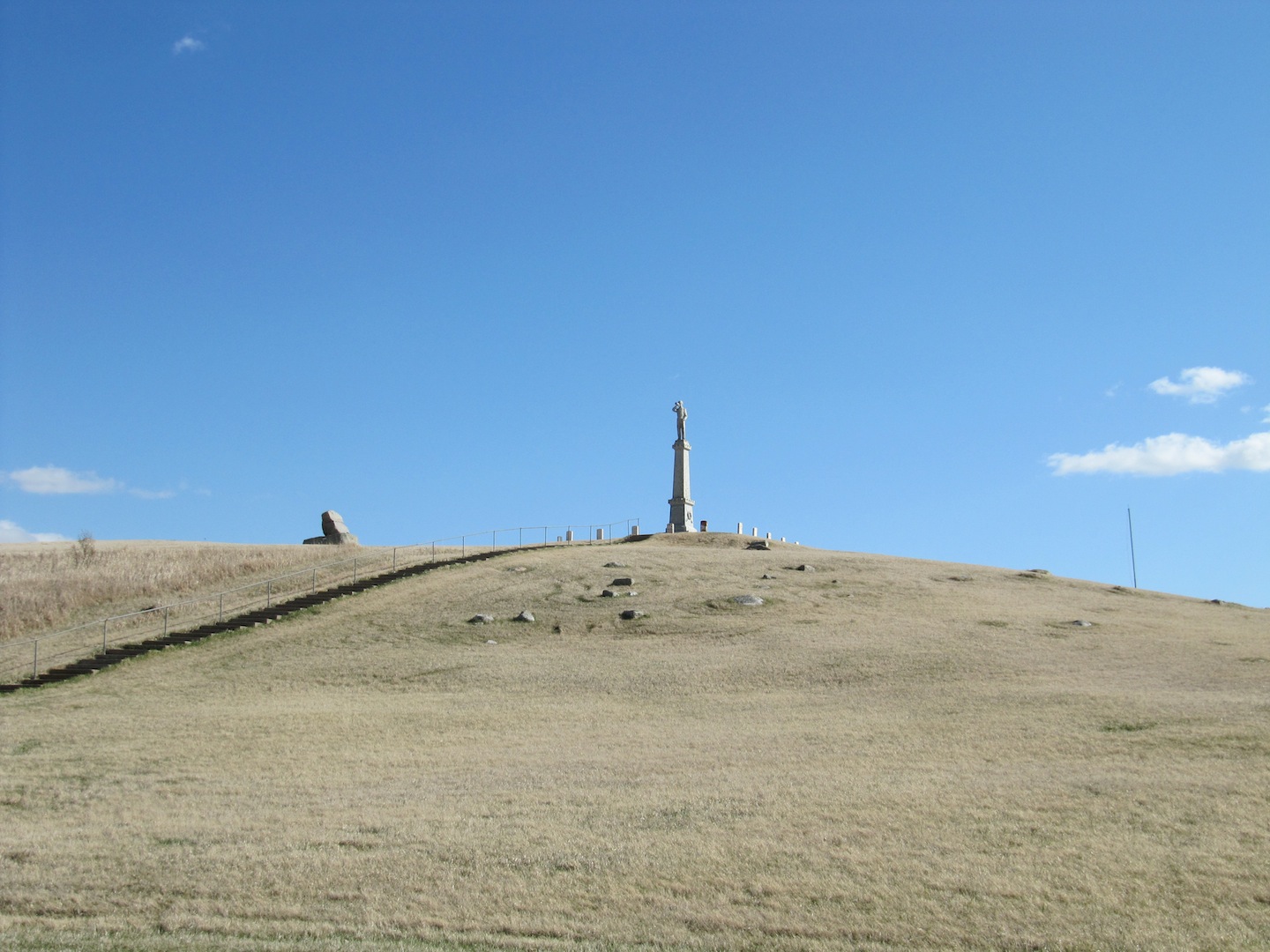
The granite bugler at Whitestone Hill in southeastern North Dakota.

The granite bugler at Whitestone Hill in southeastern North Dakota.

2) From there I’ll delve into the personal, at least how I managed to bring a topic I’ve cared about since 2008 to a manuscript form that was considered and eventually published by a top-flight academic journal. There are enjoyable struggles and processes of preparing such a manuscript, and one pours themselves into these things not knowing if a journal will consider them at all. That, of course, is why it takes the spirit within each person to be driven to figure out a problem in the social sciences or humanities that may, at the outset, induce confusion or frustration. Such was the case when I first heard about and then visited the Civil War monument at Whitestone Hill in southeastern North Dakota some years ago. I was initially confused by it — “Why did North Dakota install a granite Civil War bugler on top of the largest hill in the area?…” There’s a tendency to be confused or frustrated by what is not yet understood. And one doesn’t have to agree with something to understand it, but agreeing with something and understanding it are two disparate things.

3) And finally, this might be a direction that students and researchers think about as they continue to consider their topics: is there anything in the world of politics or political history that induces confusion or frustration? Research always begins with questions, and sometimes if you one feels frustrated about something, they should indeed start asking questions. “Why is that the way it is?” I’m interested in hearing how far along the students themselves are in their research processes. A large part of archival research deals with imagining where the sources might be. Once a paper trail starts to emerge, it can help with imagining where other sources might be. I’ll again default a bit to the Whitestone Hill case study, but broaden it out to envelop which directions the students are pushing.


World War I Memorials: Missoula, Montana and Wahpeton, North Dakota

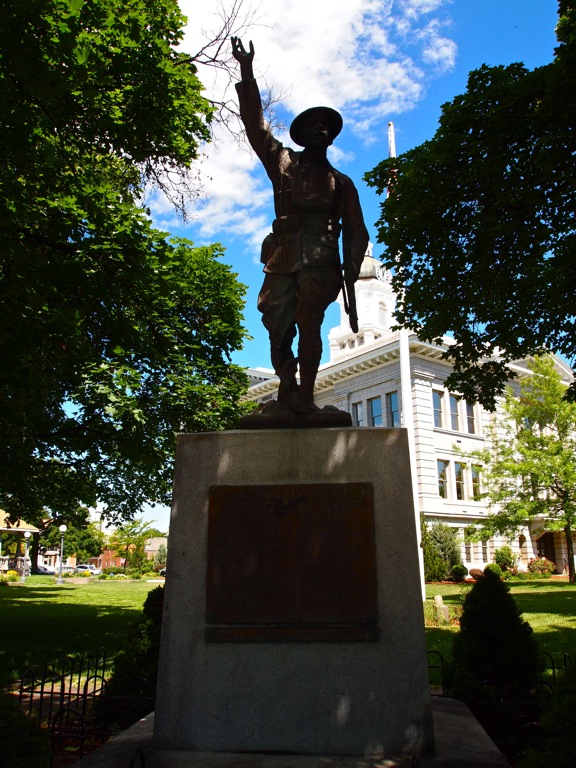
The other day I took some photos of the World War I memorial situated outside of the Missoula County Courthouse in Missoula, Montana. Once I saw the statue, I started snapping photos like crazy because I thought one or two of them would figure into a comparative presentation some day on the public remembrance of World War I in American History. I have also snapped photos of the WWI statue outside the Richland County Courthouse in Wahpeton, North Dakota. This got me re-visiting one of the infinite ideas of history.

If one wanted to, one could organize the historical record in two ways: the events that actually happened, and the long historical and never-ending process of how and why those events are remembered. I haven’t much to say beyond that point, so I’ll just upload some photos of the two related WWI statues from Missoula, Montana and Wahpeton, North Dakota.

The WWI statue outside of the Missoula County Courthouse. Photo from 07/13/2013.

The WWI statue outside of the Missoula County Courthouse. Photo from 07/13/2013.

The WWI monument outside of the Richland County Courthouse in Wahpeton, North Dakota. Photo from November 2012.

The WWI monument outside of the Richland County Courthouse in Wahpeton, North Dakota. Photo from November 2012.


Remembering Greasy Grass in World History

I remember the first time I started piling over the historiography of Greasy Grass/Little Bighorn at some point in 1999 or 2000, this with a short historical article included in one of those military history readers. This article happened to be by the late Stephen Ambrose (I think he published it sometime in the 1970s), and as a reflection of the scholarly times, it focused exclusively on what we call white military history. Looking back on it, and considering how even by the 1870s the American military was such a small cross section of elite Anglo-Americans that guided policy (as opposed to the lot of our non-English-speaking immigrant great and great-great and great-great-great grandparents who were entering the country at the time), it is much more accurate to refer to the traditional historiographic body of white 19th century American history as Anglo-American or Victorian Military History. This is not meant in a conspiratorial way. Rather, it is meant to point out how institutions are composed of individuals, and if the individuals within those institutions have certain outlooks on the world, then the institutions are going to operate accordingly.

For at least a couple decades, now, enough individual scholars within the academies have created a social structure so that they can shift the direction of the scholarship (archaeologists are sometimes calling this “counter-modern” while other historians refer to it as multivocal). For example, instead of once again combing over what happened on June 25, 1876 at Greasy Grass, scholars have taken to looking at the conflict as a broader segment that needs to be contextualized in World History. James Gump has a work out there entitled, The Dust Rose Like Smoke: The Subjugation of the Zulu and Sioux (University of Nebraska Press, 1994), and it considers how the Anglosphere mythologized themselves after a confederation of Lakota, Cheyenne and Native America decimated the 7th at the Little Bighorn in 1876, and after the Zulu wiped out a British force of 1,500 at Isandhlwana on January 22, 1879. Check out the Zulu monument to the fallen Zulu at Isandhlwana with this link here.

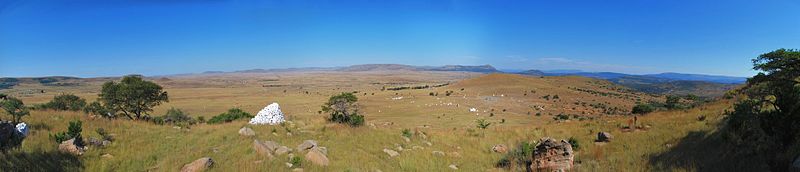
Isandlwana landscape from the Wikipedia public domain page.

Isandlwana landscape from the Wikipedia public domain page.

These broadened world historical treatments help pave the way for other scholarship (for example: so we’re not incessantly sitting around wondering what Custer did wrong; but rather what the Lakota and Cheyenne forces did themselves to bring about George’s demise). The latest and greatest public historical treatment of Greasy Grass comes by way of Debra Buchholtz’s The Battle of the Greasy Grass/Little Bighorn: Custer’s Last Stand in Memory, History, and Popular Culture (Routledge, 2012). This work gets the reader to think secondarily about the actual events of June 25, 1876, and primarily about how the public has remembered the events since 1876. It was, after all, a centennial year (from 1776 to 1876), and the general Anglo-American reading public was nonplussed and aghast to think that Custer (or anyone Anglo-American for that matter) would be capable of losing a battle within the interior of the American nation, and this so close to the centennial anniversary of the nation’s declaration of independence.

Greasy Grass/Little Big Horn from the Google Earth imaging.

Greasy Grass/Little Big Horn from the Google Earth imaging.

So this is where a lot of the contemporary scholarship is at these days: not just looking at the historical event itself, but also looking at what the popular press and academically trained thought about the historical event in and of itself (for example, William Blair and David Blight, among others, have taken a hard look at Civil War memory and memorialization in this way too). And that’s what I’ve kind of been thinking about on this 137th anniversary of the day the Lakota and Cheyenne (and others) stuck it to George at Greasy Grass in eastern Montana.

In closing, I leave you with a paragraph quote from the 1986 work of James Belich, The Victorian Interpretation of Racial Conflict (McGill-Queen’s University Press, 1986 and 1989). This is so you don’t have to lug around numerous books while you’re taking in the various Lakota and Cheyenne holiday celebrations that commemorate the defeat of Custer at the Battle of Greasy Grass — Aaron Barth Consulting does this work for you.

Okay, to quote Belich, and to consider it in the context of Custer as a trained Victorian operative for Anglo-America:

“Racial ideas are not just images of others, but of one’s self and one’s own society. Superiority and inferiority, inevitable victory and inevitable defeat, higher faculties or the lack of them; each are two sides of the same coin. To question one is to question the other, and thereby cast doubt on an individual and collective self image. Victorians, like other people, were not eager to ask such questions.” (Belich, 1989: 327)


The Longue Durée of Native American Sovereignty: Review of Frank and Goldberg, “Defying the Odds: The Tule River Tribe’s Struggle for Sovereignty in Three Centuries” (Yale University Press, 2010)

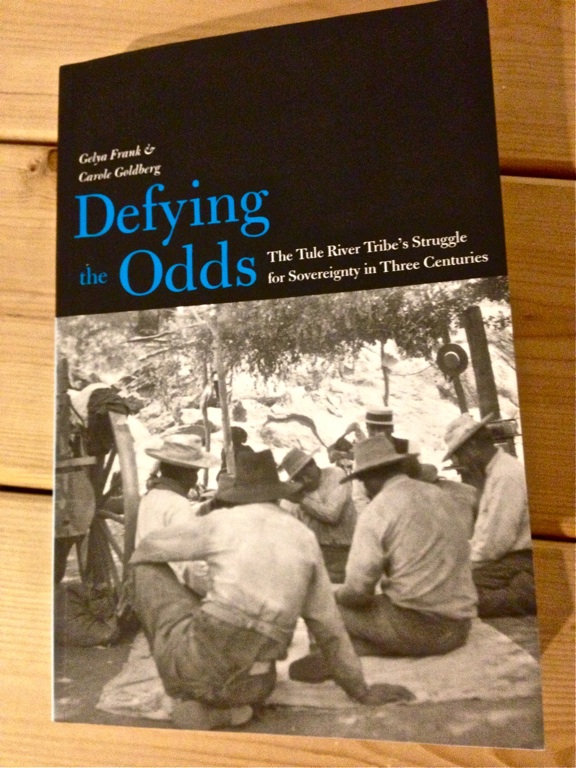
Tule River CoverWhen considering Native and non-Native relations in the United States, it is first necessary to remember that the history rests on the foundational principal of sovereignty, or the ability of Native America to exercise autonomy within a defined geopolitical border. To varying degrees and throughout time, Federal and State governments have contested the sovereignty of Native America, and this is a topic anthropologist Gelya Frank and legal scholar Carole Goldberg cover in Defying the Odds: The Tule River Tribe’s Struggle for Sovereignty in Three Centuries (Yale University Press, 2010). Near the beginning of chapter 3, Frank and Goldberg give a concise paragraph description of the Tule River Tribe in the mid-nineteenth century:

After a brief but devastating war started by settlers in 1856, the Tribe was settled on the first Tule River Reservation located on the site of the traditional Koyeti tribe village. The federal government failed to secure this land and twenty years later forcibly removed the Tule River Tribe to its present reservation in the mountains. In 1886, a tribal council ordered the execution of an Indian on the reservation to reassert order and authority after the death of the Tribe’s recognized leader. The United States government, which indicted the executioners for murder, could have chosen to respect this act of community protection and social control. Judge Erskine M. Ross had an available legal theory that could have allowed him to dismiss the charges and let the four Tule River defendants go free. Under a theory of the Tribe’s “concurrent jurisdiction,” Judge Ross could have found that the execution was not a criminal act, even though Congress had passed the Major Crimes Act. (Frank & Goldberg, 2010: 67)

Judge Ross could have, but he did not. Before embarking on the specifics of this three hundred year struggle that the Tule River Tribe — a First Nation of America and the Western Hemisphere — has had with European and Euro-American nation-states, it is worthwhile to lay out two elements of political philosophy. The first is what is traditionally meant by sovereignty, and the second is the specifics to the 2007 United Nations General Assembly’s Declaration on the Rights of Indigenous Peoples.

The Tule River Tribe's ancestors and map illustration. (Frank & Goldberg, 2010: 23)

The Tule River Tribe’s ancestors and map illustration. (Frank & Goldberg, 2010: 23)

In political philosophy, a broader definition of sovereignty ensures that the sovereign nation is not only defined, but that it is recognized by other sovereign nations. Within each individual nation, sovereign people are able to define and govern themselves, speak a desired language, rejuvenate the culture with its own forms of religion or spirituality, develop its own economic resources, and defend themselves from harmful outsiders and nonmembers. In the case of the Tule River Tribe, they have always had this internal sovereignty, but the Euro-American nation and state has not always recognized it. This is why the focus of Defying the Odds resides on uncovering the internal sovereignty of the Tule River Tribe, or agency, and focusing on how the tribe has, in the words of the authors, “relied on its inherent cultural sovereignty when its externally recognized political sovereignty has been weakened or compromised by the dominant federal and state governments.” (Frank & Goldberg, 2010: 5-6)

For those who are not a-historical, it is easy to understand that unrecognized or challenged sovereignty throughout history has resulted in war, genocide, ethnocide, and the dislocation of indigenous — and non-indigenous — groups throughout the world. This is why the United Nations in 2007 issued a Declaration on the Rights of Indigenous Peoples that made it illegal for indigenes to be subject to forced “action aimed at or affecting their integrity as distinct peoples, their cultural values and identities, including the dispossession of land, forced relocation, assimilation or integration, [and] the imposition of foreign lifestyles and propaganda.” This declaration does more to recognize the collective rather than individual human rights, but it does this so that the defined and defended collective can internally navigate the individual rights of the domestic populace. (Frank & Goldberg, 2010: 6-7)

Frank and Goldberg define sovereignty in a national and international context. In the history of the United States, the Federal and state governments have persistently asked Native America to not only articulate its sovereignty through a legal framework (through treaties and legalese), but also with a romanticized ideal of expected aesthetics. This simply means that non-Natives often want Natives to “look” Native, and if they do not achieve the expected aesthetic, they are somehow no longer authentically Native. Speaking to this, the Lakota scholar Philip S. Deloria noted how the United States holds Native America’s inherent sovereignty to a much different standard than non-Native America. Deloria says the United States does not audit “the demographic status of all the little countries in Europe that are frequently compared in size and population with Indian tribes,” and that “No one asks whether Monaco and Liechtenstein are sufficiently culturally distinct from neighboring countries to justify their continued existence.” The ethical and philosophical point of this remark is impossible to ignore. If representatives of the Monaco or Liechtenstein governments did not show up “looking” like they were from Monaco or Liechtenstein, the United States government would not use this to undermine the sovereignty of Monaco or Liechtenstein. This has not been the historical case throughout Native America and, particular to this study, the Tule River Tribe. (Frank & Goldberg, 2010: 13)

The history of the Tule River Tribe is divided into two segments, particularly what happened before and after the 1888 court case, United States v. Whaley. In the case, United States Judge E.M. Ross favored the U.S. Major Crimes Act of 1885 rather than established tribal sovereignty. In the events that lead up to the 1888 case, Tule River tribal members Salt Lake Pete, Bill Whaley, Pancho Francisco, and Juan Chino ordered the internal execution or capitol punishment of their shaman who was accused of killing the tribe’s Yaudanchi tiya, or chief, and 12 to 20 other tribal members. During the court hearing, though, U.S. Judge Ross favored the Major Crimes Act, a Federal law that prohibited one Native from killing another on a reservation — again, a Federal Act that attacked tribal sovereignty by undermining the sovereign tribe’s ability to take care of its own domestic issues. In essence, the Major Crimes Act criminalized tribal authority and sovereignty. Frank and Goldberg chart how the Tule River Tribe has remained culturally distinct from 1885 to the present, no easy task considering later policies aimed at forced assimilation and relocation.

The Tule River Tribe location in California.

The Tule River Tribe location in California.

This work of scholarship is important to Historians, Public Historians, World Historians and Legal Scholars for several reasons. The first is why it is necessary for scholars to understand the historical origins of political philosophy, specifically the notion or notions of sovereignty, and how the definition changed in a variety of ways within distinct cultures. In the Western world, absolutist monarchs developed some of the first notions of sovereignty. In subsequent centuries secular and Enlightenment colonists altered the definition but retained the word. By the late-nineteenth century, though, Euro-Americans, and particularly Anglo-Americans, developed increasingly strong notions of Social Darwinian or racist thoughts, and they obsessed over domestic and foreign nation-making. This nation-making favored a strong, sovereign arm of the Federal government that rallied around an imagined and common “race.”

This brings up a secondary interest in Frank and Goldberg that speaks to nineteenth century international law, specifically extraterritoriality, which exempted individuals from the jurisdiction of local law. Much in the same way that the Great Powers of the West — Great Britain, France, Germany, the United States — planted their own overlapping versions of jurisprudence in areas they colonized — throughout the Ottoman Empire in North Africa and the Levant, and in places such as Hong Kong, China — so too was the United States engaged in planting the strong arm of Federal jurisprudence in Native America. World Historians, Historians and Legal Scholars (I am capitalizing these professions for some reason) would benefit in understanding these 19th-century processes. In the case of the Tule River Tribe, Public Historians can increasingly consider how a cultural landscape, the Tule River, is linked to an ethnicity much in the same way that a Euro-American with, say, the surname Bergstrom, was at one point in time connected with a mountain stream (“Bergstrom” in many northern European languages is directly translated as Mountain Stream).

Where these considerations will lead is unknown, but the world’s population in the 21st century still carries cultural baggage that originated in and before the 19th century. As well, when a-historical politicians in the 21st century bemoan the “problems” on reservations, the onus is on the historians, anthropologists and legal scholars to point out how the Euro-American colonization of America waged genocide and ethnocide on Native America and disrupted indigenous sovereignty, the political and humanist philosophy that allows a people and culture the spirit and self-determination to breath and live.

US-Dakota War Memory and History

This last Friday (03/22/2013), I attended one of the four US-Dakota War Panel Discussions, this one at Sitting Bull College, Fort Yates, Standing Rock Nation, North Dakota. The events are co-sponsored by the North Dakota Humanities Council and the Center for Heritage Renewal. The discussions are a give-and-take, where three Native and non-Native historians and discussants give introductory remarks and impressions of where we are “at” today, 150 years after engagements, battles and massacres — what today we call Total War — started in the Minnesota River Valley in 1862, and concluded albeit temporarily at Killdeer Mountains in 1864. (I say “albeit temporarily” because the Battle of Greasy Grass [aka, Little Big Horn] and Wounded Knee had yet to come).

Two of the many impressions I had at this particular event are as follows:

The US-Dakota Wars panel discussion at Sitting Bull College on March 22, 2013.

Photo from the US-Dakota Wars panel discussion at Sitting Bull College on March 22, 2013.

1) This public format remains one of the best ways to open a discussion that broadens the exchange not just with the “official” panel discussants, but with the audience members as well. The quasi-lecture and conversational format brings new voices into the fold, and this is important in that it allows researchers an opportunity to hear about historical particulars that simply do not exist in the archives or in “official” histories.

2) In this Sitting Bull College context, one audience participant noted how they, as a Native, felt a bit more comfortable opening up and chatting about the history and memory of the US-Dakota wars: depending on social contexts, individuals may or may not decide to talk about particular points of memory and history. This is an interesting intersection between our Sense of Place and Sense of History: the history we will talk about is largely dependent on where we are and who we are with. This also made me think about how it would be interesting to track how each one of these discussions played out. For example, in chatting with Richard Rothaus after the discussion happened on March 23, 2013 in Watford City, North Dakota, Rothaus noted how the audience contributed a completely different set of voices, and asked a completely different set of questions. This no doubt is due to the different range of cultural back-drops everyone comes from, and also how our vision and memories of the past are shaped by the different cultures we are born in to (for example, the first panel discussion was approximately 240 miles from the second panel discussion, both of which were in North Dakota: the first was at Sitting Bull College, Fort Yates, the second in Watford City, North Dakota).

This is the first of 4 discussions, and each discussion is happening (or happened) at a different location.  The third discussion will take place on Friday, April 5, 2013, at the Ellendale Opera House in Ellendale, North Dakota, and the fourth discussion will be at the Lake Region Heritage Center in Devils Lake, North Dakota on Saturday, April 6, 2013. More details at the following links here and here.


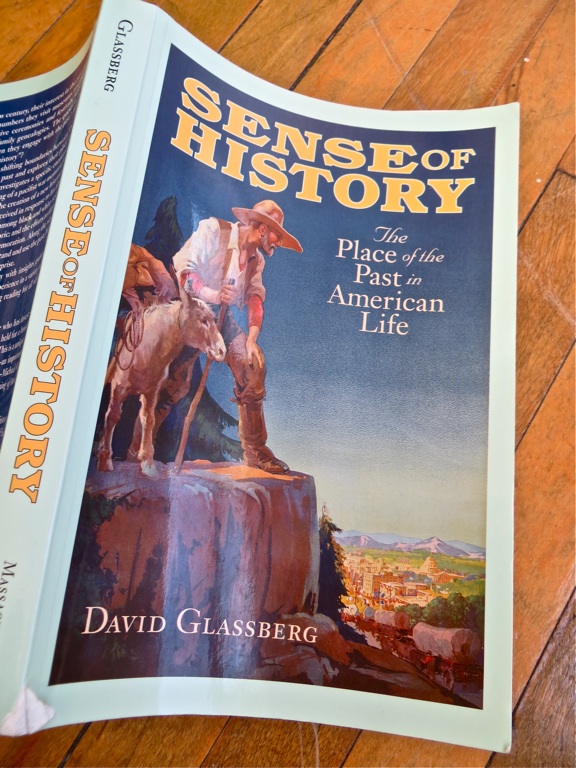
David Glassberg, “Sense of History: The Place of the Past in American Life” (2001)

In David Glassberg’s 2001 work, Sense of History, he says that to have a sense of history is to have a sense of the deep culture of a particular place. This historical sensibility is akin to having spatial and temporal sensibilities, or knowing what happened in particular locations at particular points in time. According to Glassberg, it is “not quit territoriality, as among other animals, but a sense of locatedness and belonging.” It is knowing and being conscious of kinship and ancestral bonds, and how these bonds are fixed to particular landscapes. For many, it is “at the core of who they are and the people and places they care about.” To have a sense of history is to know about previous generations that have traveled and inhabited the landscape. To have a sense of history is also to have a sense of Public History, a forum where ideas from the public and academics intersect, and how these groups bring infinite meanings to particular places in space and time. (Glassberg, 2001: 6-8)

The range of this sensibility is communicated through several case studies, from First World War memorials in Orange, Massachusetts to the thirteen-hour Civil War photomontage marathon organized by Ken Burns and financed by a variety of public and corporate sponsors. In his introduction, Glassberg references Wallace Stegner and Eric Hobsbawm. A Stegner quote fortifies Glassberg’s argument, as “No place is a place until the things that have happened in it are remembered in history, ballads, yarns, legends, or monuments.” (Glassberg, 2001: 19) In the case of the recently deceased Hobsbawm, Glassberg references his 1983 co-authored work, The Invention of Tradition. In short, this work explores how one generation after another envisioned themselves as having a kind of timeless connection with the customs of the past. Glassberg also aptly references William Faulkner, Toni Morison, and Louise Erdrich, individuals who through fiction and prose develop an identity by remembering land- and city-scapes from earlier years.

This developed identity means that when we think of, say, Erdrich, we immediately associate her with her descriptions of the Red River, or of Wahpeton, North Dakota, or with her sisters, or with her bookstore in Minneapolis, Minnesota. It is similar with Stegner, as he is inextricably bound to East End, Saskatchewan, and the same goes for Walter Webb, N. Scott Momaday, Ernest Staples Osgood, Paul Sharp, Gilbert Fite, Willa Cather, and Glenda Riley, all of whom worked toward creating a sense of Great Plains history and culture.

David Glassberg, "Sense of History: The Place of the Past in American Life" (University of Massachusetts Press, 2001).

David Glassberg, “Sense of History: The Place of the Past in American Life” (University of Massachusetts Press, 2001).

Individuals throughout time can associate with, reject, or fix their own particular stories to perceptions that authors and historians have had about certain landscapes. When a culture becomes familiar with a common set of stories, that culture is able to fixate on and relate to one another. And when an economic developer sans a sense of history takes the reigns and proposes a new project, Historic Preservationists are, at best, there to kindly remind the developer that to alter the land- and city-scape is to rub out a livable past. In Glassberg’s words:

We live in landscapes dense with both histories and memories, idealized images of the past that compete to become the standards we use to evaluate and shape our present environment. Personal recollections of past places stand against a flood of place images created for us, from guidebooks and maps published by local civic organizations that recognize some “historical” places in our community but not others, to the generic images of past American landscapes and smalltown life… History in all its varieties guides our sense of where we live, contributing to our perception of the traditions that make our place distinctive. (Glassberg, 2001: 126)

To think of Glassberg’s work in a world historical context requires that we think of each location in space and time as having its own sense of history. This indeed complicates our understanding of the past, but this complexity is nothing new. Historians, for example, that boasted the virtues and lessons of Western Civilization had one understanding of, say, Herodotus and his world, and this was much different than the understanding that Herodotus had of himself and his surroundings. This is also similar of a historian from China writing about the Mongolian hordes, or the Mongolians themselves writing about a conquest of the EurAsian steppe, from Beijing to Baghdad and to the edges of Poland and eastern Europe. In large part historians, or Public Historians, absorb methodologies set down by R.G. Collingwood in the 1930s and 1940s, at least before he collapsed and died from a brain aneurism (arguably due to his synapse firing on protracted overdrive for the duration of his life). Collingwood called on historians to first develop a philosophy toward history. That philosophy was defined as a professional ability to understand the way in which people understand or understood their world.


Memories and Material Culture for the State Historical Society of North Dakota

This is a historic pony truss railroad bridge that spans the Missouri River between Bismarck and Mandan. It is a cultural icon, and has an infinite amount of individual stories attached to it. If someone were to destroy or replace this bridge in the name of "progress," it would seriously hurt and damage the living local history and culture of Bismarck and Mandan.

This is a historic pony truss railroad bridge that spans the Missouri River between Bismarck and Mandan. It is a cultural icon, and has an infinite amount of individual stories attached to it.

Think of this for a second: one of the primary interests and concerns of historians is that memories are fixed to the stuff we use and live with. Memories are also fixed to the stuff that our parents, grandparents, and great grandparents used (landscapes, homesteads, historic buildings and structures included).

I recently received an e-mail forward from archaeological comrade and colleague Amy Bleier, Research Archaeologist with the State Historical Society of North Dakota (SHSND). As the lot of us within range of Bismarck already know, the SHSND is experiencing a much-needed expansion. This also means that Len Thorson, the Registrar with the SHSND, is looking for material culture, or 3-dimensional objects, or what we call “stuff.”

Stuff is much more meaningful if it has those stories and memories fixed and secured to it. And it allows historians to do what historians are trained to do: track change through time.

Thorson sent out the following e-mail the other day. It is cut and pasted below. In Thorson’s words:

The Museum Collections Committee is looking for contemporary items from North Dakota businesses and organizations that you have purchased and/or used… or someone you know who would be willing to donate objects to the SHSND. The items should be relatively small (for space considerations). A history of the object(s), along with appropriate documents and photographs, would add much historical significance to the objects.

Examples include product packages from Cass Clay, Hugo’s Family Marketplace, Dakota Pasta, Noodles by Leonardo, Red River Commodities/SunGold Foods (SunButter), HIT Inc. products, or many other products listed on the Pride of Dakota webpage: http://www.prideofdakota.com/

Other items (used in ND) we are seeking include: beekeeping equipment and supplies; Highway 10 memorabilia; items showing ND school consolidation; solar power devices; objects from the Bank of North Dakota; contemporary powwow related items; contemporary immigration related items; and modern agricultural items such as GPS equipment, and air seeder/drill parts, etc.

If this is something you wish to participate in, please let us know, but PLEASE don’t bring objects in for us to view. Simply reply to this e-mail, or even better, provide the information requested below. The information requested by us may also be sent online via the form at http://www.history.nd.gov/data/padq_emailform.html

Consider this. It is important. If you have some sweet modern artifacts — in the business, we often call this contemporary or modern archaeology and history — with a memory attached to it, you might contact Registrar Thorson, or anyone from the SHSND Museum Collections Committee. It is by and for North Dakotans.


N. Scott Momaday, “The Way to Rainy Mountain” (1969)

N. Scott Momaday, The Way to Rainy Mountain (1969) set the Kiowa oral history to print, and in the 1994 preface, Momaday explains how the work is split into three voices. The first voice is that of Kiowa oral and ancestral history, the second is a type of historical commentary, and the third is the personal memoirs of Momaday himself. For this reason the entire work is a kind of historiography, or the way in which historians remark, opine and reflect on the works of their predecessors. The importance of The Way to Rainy Mountain is not only that it sets an oral history to print, but also that it allows non-Kiowa individuals access to the depth and scope of Kiowa culture. Momaday demonstrates how the Kiowa interacted with the Great Plains over generations and have a genealogical investment in the landscape.

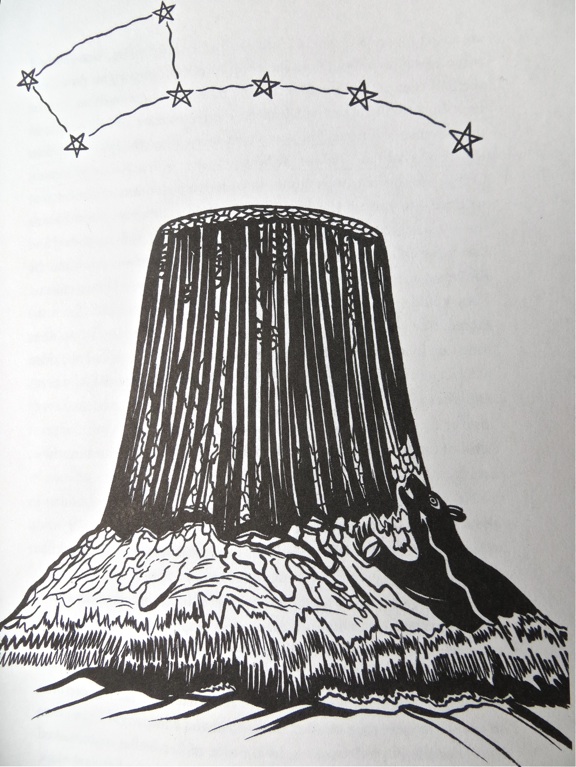
Like many cultures throughout the world, the Kiowa were nomadic, and their oral history and legend reflects this. Genesis for the Kiowa took place when the Kiowa as a people emerged from a hollow log in the “bleak northern mountains” of today’s Montana. (Momaday, 1969: 3) They eventually ended up in central Oklahoma, but along the way they impressed stories of themselves into the land. The Kiowa, for example, “made a legend” at the base of Devil’s Tower in northeastern Wyoming, and connected this legend with the astronomy configuration known as the Big Dipper. Momaday’s grandmother said:

Devil's Tower illustration by Al Momaday in N. Scott Momaday, "The Way to Rainy Mountain" (1969), 9.

Devil’s Tower illustration by Al Momaday in N. Scott Momaday, “The Way to Rainy Mountain” (1969), 9.

Eight children were there at play, seven sisters and their brother. Suddenly the boy was struck dumb; he trembled and began to run upon his hands and feet. His fingers became claws, and his body was covered with fur. Directly there was a bear where the boy had been. The sisters were terrified; they ran, and the bear after them. They came to the stump of a great tree, and the tree spoke to them. It bade them climb upon it, and as they did so it began to rise into the air. (Momaday, 1969: 8)

The bear scraped its claws along the base of the tree stump, and eventually the seven sisters rose from the top of this stump into the sky to become the Big Dipper. This story allowed the Kiowa to immediately identify with the Big Dipper, and with today’s Devil’s Tower. So long as the Kiowa were under a clear sky at night, the sight of seven ancestors shining starlight down on them could always provide them with comfort.

The second segment of the book, “The Going On,” opens with anecdote, a story about an old man, a wife and child. The child, innocent to the workings of the world, repeatedly asks his mother for food, leaves the house with it, and returns empty handed only to ask for more food. The third time the child returns, but with an enemy. This enemy tells the family of three, “There are many of us and we are all around. We came to kill you, but your son has given me food. If you will feed us all, we will not harm you.” (Momaday, 1969: 44) The old man is highly suspicious of this offer. His wife obliged the enemy’s request and began cooking while the old man secretly led his horses upstream. After bringing his possessions out of danger, the old man “called out in the voice of a bird” to his wife. She then set fire to the animal fat and tallow, threw it on the enemies, picked up her child and ran to the old man. The story might be used to explain the innocence of children, as enemies or malicious people can easily manipulate them. It could also be used to explain how it is wise to be skeptical of outsiders. In the kinship sense, this story also explains how the family of three looks out for one another.

The utility of anecdotes and stories such as these in any culture is multifaceted, and even biblical. To understand the Kiowa requires a degree of analogy (In The Landscape of History, [2002] Lewis Gaddis remarked on the importance of analogy for this and other reasons). The Kiowa and other cultures throughout the world infused stories and oral history into the physiography, and by this the culture became interconnected with the landscape and surroundings. Momaday’s 1969 The Way to Rainy Mountain was published almost 25 years after the revolt of the provinces, and almost 4 decades after the publisher of the University of Oklahoma Press called on academics and scholars to study Native America with the same intellectual rigor that they had brought to bear on Mediterranean culture.

Momaday’s work also communicates a kind of finality to this culture and others, and this also smacks of Stegner’s Wolf Willow (1955) and Kraenzel’s Great Plains in Transition (1955). Yet at the same time, it also brings about the notion found in Dorman’s Revolt of the Provinces (1993), specifically with John Joseph Mathews, Wah’Kon-Tah: The Osage and the White Man’s Road (1932). When the artists, scholars and literary figures revolted in America’s provinces and periphery during the interwar years (between WWI and WWII), Mathews finally found that the way to preserve and become a proponent of a culture was not necessarily to just recount and study it. (Dorman, 1993: 70-71) This was a part of it, but to truly locate authentic culture required the individual to become a practitioner and contributor to that historic cultural process. In this way, Mathews solved his 1930s dilemma through art, and specifically through Native American Art. Considering that Momaday published The Way to Rainy Mountain in 1969 raises the question as to whether a second volume is necessary to expand on and continue what Dorman ended in 1945. I certainly think so.