I’m currently waiting for my family to rise for the morning, and reading Sergio Luzzatto, The First Fascist: The Sensational Life and Dark Legacy of the Marquis de Mores (Cambridge, Massachusetts: Harvard University Press, 2026), and came across a contextual description of the historic landscape architecture in Cannes, southern France, where the Marquis (aka, Tony, or Antoine de Vallombrosa — names get really altered and complex when one is born into the invented tradition of the aristocracy) romped around as a child. Luzzatto does good in providing this 1870s-ish description of the social climate of this garden. I’ll just quote Luzzatto below here in this paragraph from page 30:
Already in the late 1860s, tourist guides were calling the garden of Villa Vallombrosa one of the major attractions of Cannes, praising the generosity of the owners for allowing tourists to visit “the magnificent garden.” It was an “authentic Eden,” insisted the accounts of the early 1870s. With the efforts of the skilled horticulturists the duchess hired to manage the garden, it was soon celebrated far beyond the limits of Provence. The crowds of visitors became so large that the duke decided to establish at the entrance a system for collecting donations to benefit the local hospice. As for the duchess, despite her health problems, her reputation as the driving force behind the elegant, salon-like, charitable society gathered on the Riviera ended up earning her — in the very guide that coined the name “Côte d’ Azur” — the posthumous title “Queen of Cannes.”
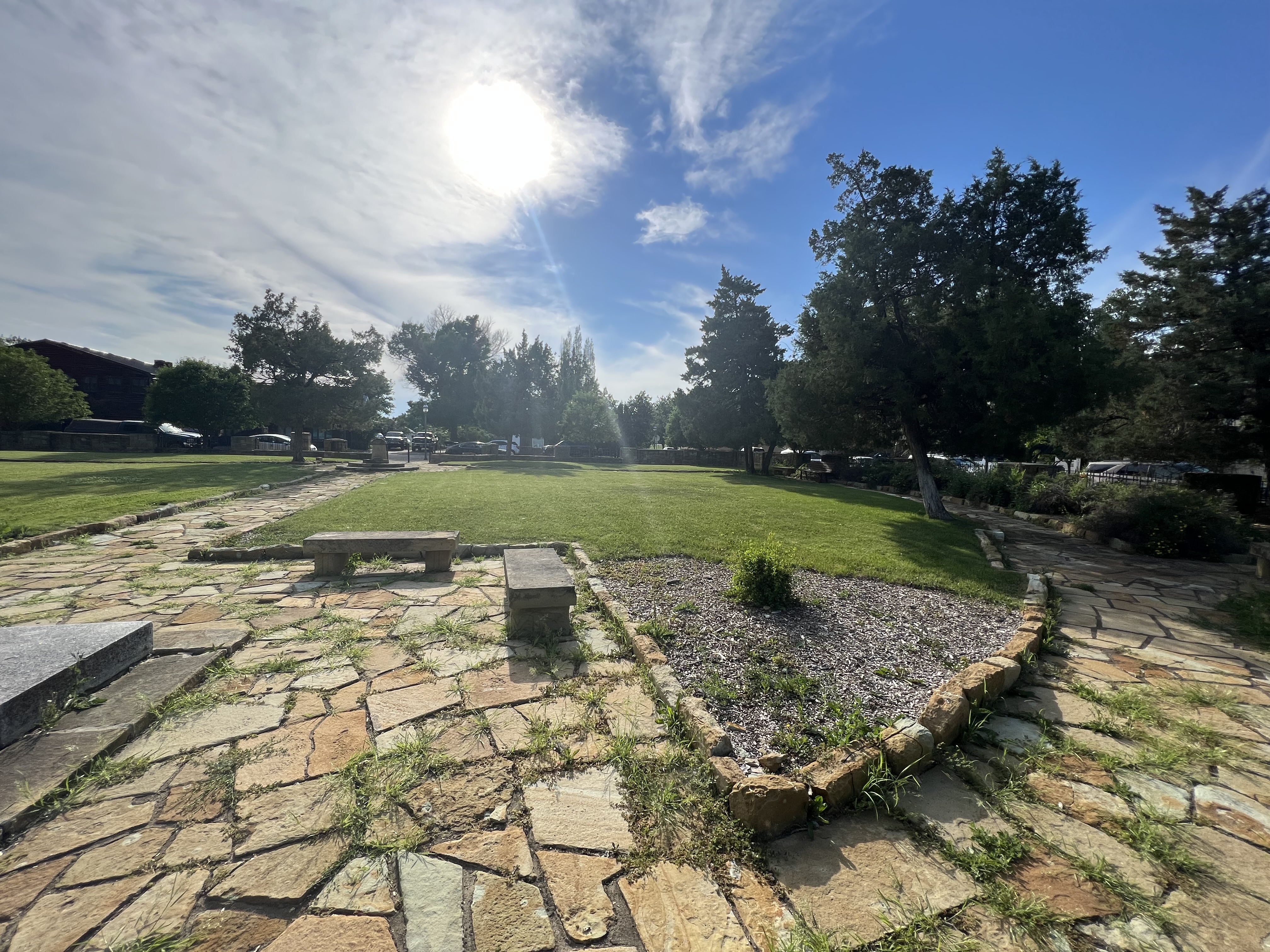
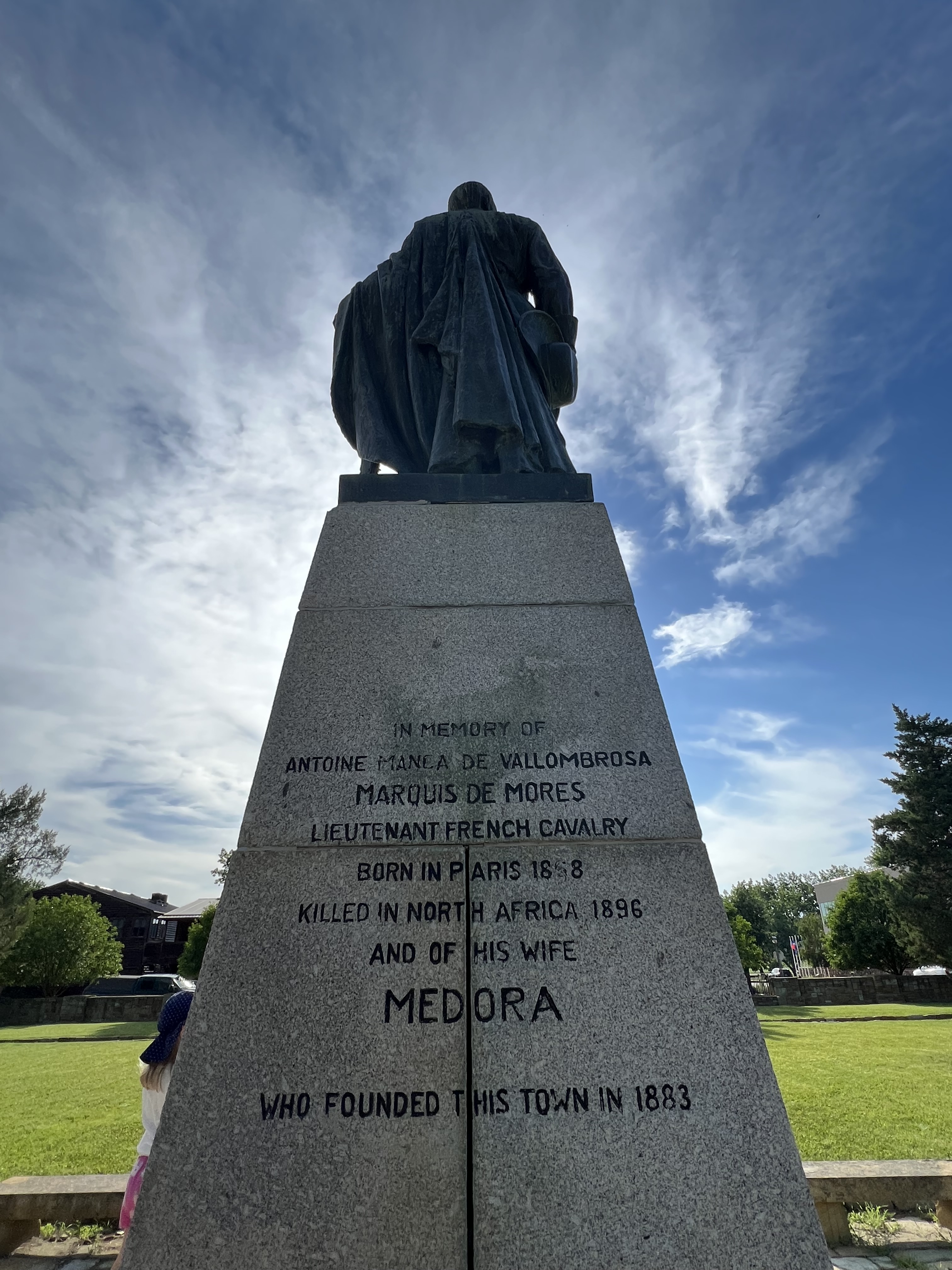
So this got me remembering an on the ground visit in the western North Dakota city of Medora the 1930s Civilian Conservation Corps heritage landscape architecture that is a garden dedicated to Tony, aka, Antoine de Vallombrosa, aka, the Marquis de Mores (one can extend their pinky finger while going through this name sequence if one wants). Have a look at the photos of mine below from a couple summers ago. Was the 1930s landscape architect who guided this CCC construction in Medora imagining a sort of symbolic nod to the 1860-70s fancy garden in Cannes, France that Tony spent his childhood running in? I don’t know. But all research begins with questions.
Some weeks or months ago, while in conversation, Dakota Goodhouse mentioned the name of the late Joseph M. Marshall III. I scribbled it down and got to searching on the webs. Turns out he went to the other side in April 2025, but before that he set down a magnificent body of history, cultural history, and novels in the original sense of the word: new ideas.
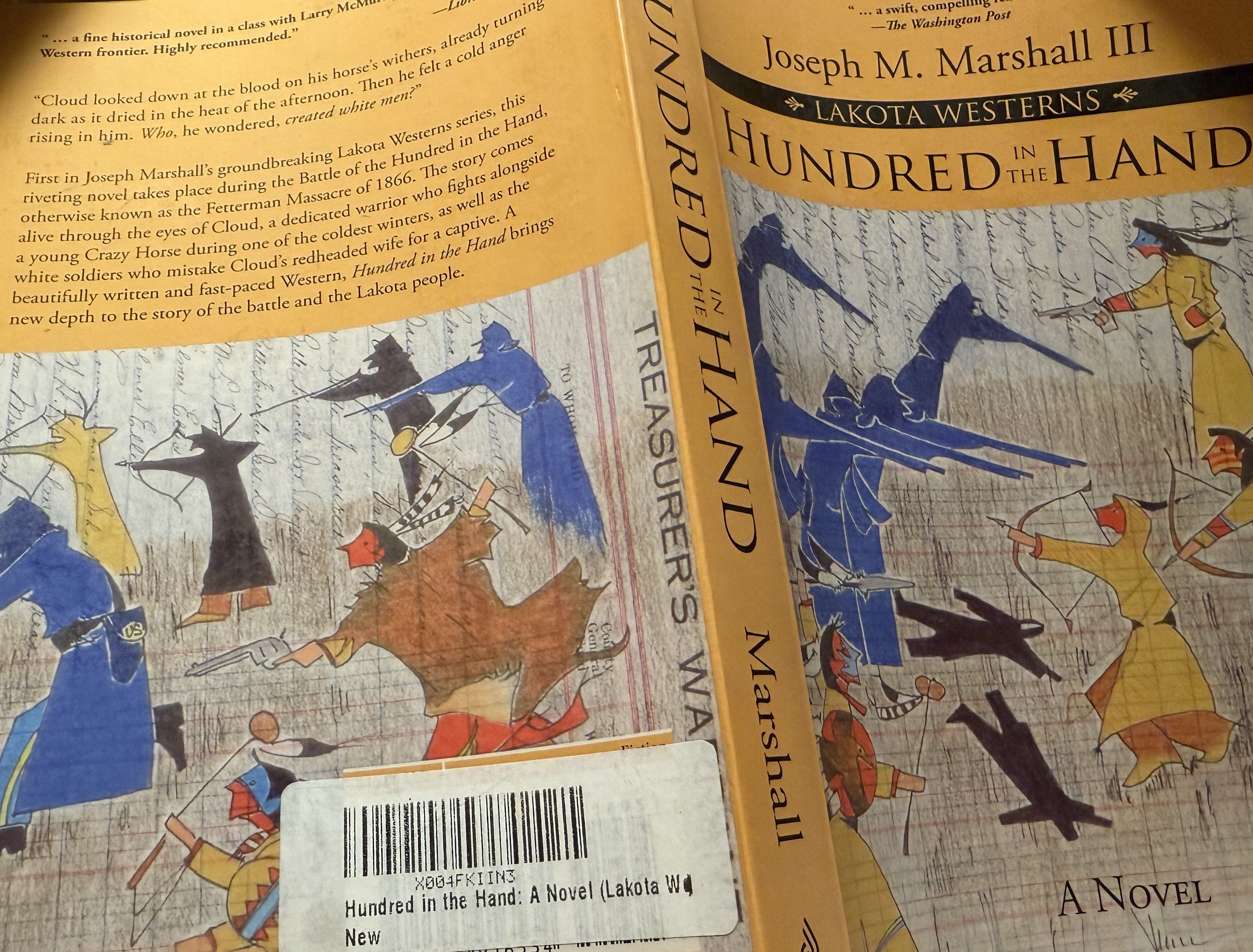
Last night, and in between first and second sleeps, I continued cruising through Marshall’s Hundred in the Hand (Golden, Colorado: Fulcrum Publishing, 2007), described on the coverpage, appropriately, as Lakota Westerns (it’s good to read the plural, as it suggests there is, or will be, more than one).
Reading Marshall III got me thinking about analogies: finding out about Marshall III was similar to finding out about the late Peter La Farge’s work of folk songs, and how Johnny Cash took up numerous songs of La Farge and popularized them. The analogy my brain was running is like this: it seems I’m only now finding out about this amazing historian, artist, folk singer, novelist. It is good stuff.
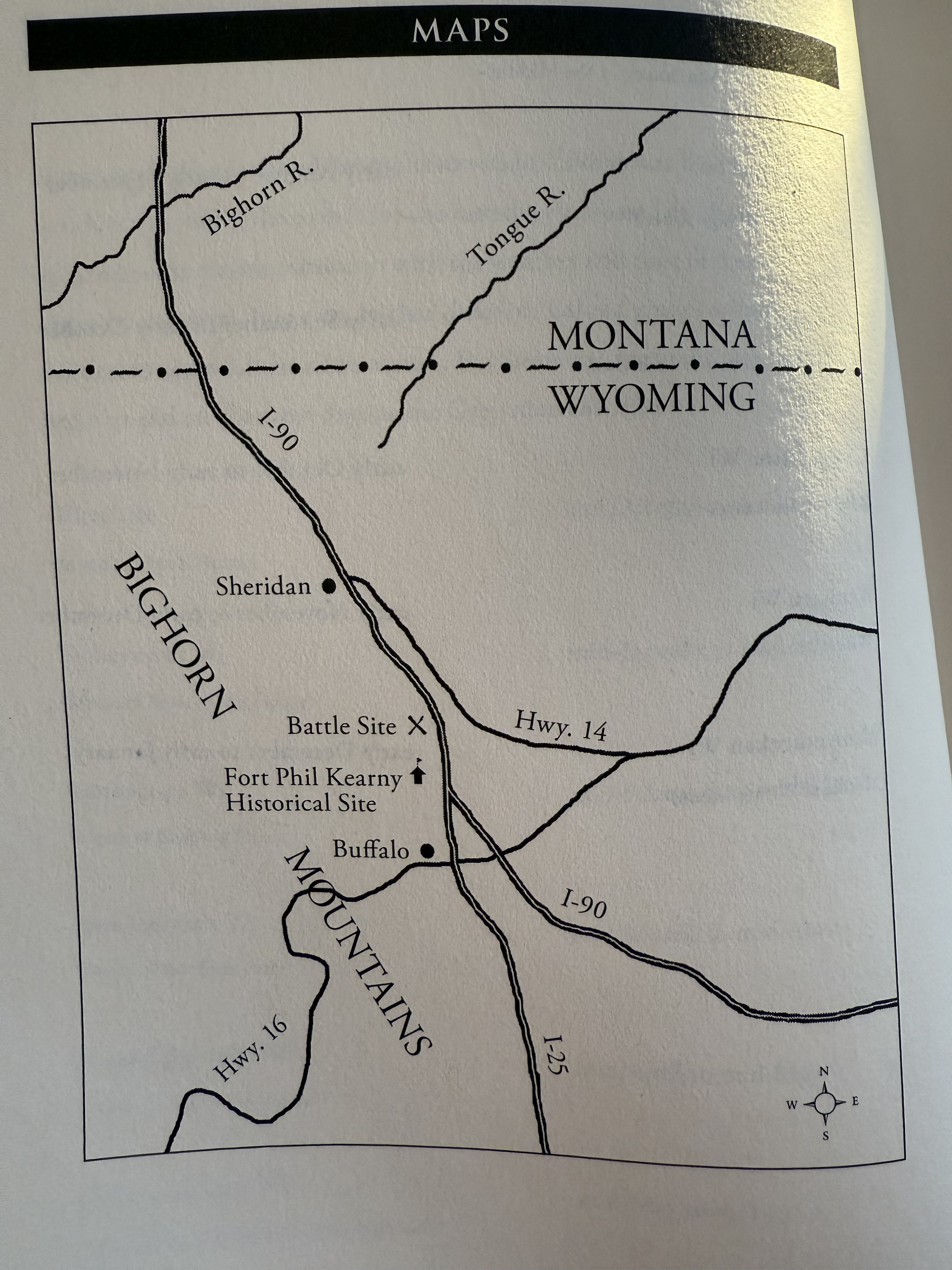
As to Marshall III’s Hundred in the Hand: this morning I texted Goodhouse, “It paints Lakota culture across the 1860s northern plains landscape. Daily lives. It’s good.” The novel takes a reader into a post-American Civil War landscape where the Great Plains mingles with the eastern elevation of Rocky Mountains in today’s Dakotas, Wyoming, Montana, and Nebraska with the characters involved with the specifics of the Bozeman Trail, or what Marshall III notes was called the Powder River Road or, as described in the introductory Lakota to Euro-American glossary, Makablu Wakpa Canku. Marshall III also dictionaries (now a verb) several other landscape names: He Wiyakpa or He Ska (Shining Mountains or White Mountains) = Bighorn Mountains; Canku Wakan Ske Kin (The Road Said to be Holy or Holy Road) = Oregon Trail; Hehaka Wakpa (Elk River) = Yellowstone River; and several others.
The geological river and creek valleys and buttes filled in with the small islands of cottonwoods, amidst a sea of scrub grasses, sage, and cacti. Layered into and upon this is the day to day lives of Lakota, circa 1866, who are understandably frustrated with watching increasing waves of Euro-American gold-seekers migrate through and post up in their country. Without going too much further into it all (save that for reading it yourself), I’d recommend reading Marshall III’s Hundred in the Hand. It adds a greater layer of texture to the region it describes. Needed layers. Historical works often narrate the historical events informed by historical documents (those primary sources) that are created by and for historic bureaucracies: the structures of nation states. Marshall III’s novel allows a reader into the cultural window of a regional northern plains landscape. The smells. The feel of summer heat. The cool of summer night. The tastes of elk stew in the surround of a hide tipi.
The takeaways from this novel thus far? I’ll work in groups of three. The first is that 1866, and Red Cloud’s defense of his people’s country that culminated in the Fetterman Fight, was one of several prologues to the Battle of Greasy Grass/Little Bighorn a decade later. Lakota who fought in 1866 would remember this as one of many as the spring of 1876 approached. Why is this important? As we approach America 250, it will forever coincide with the centennial observance of the June 25, 1876 Battle of Greasy Grass/Little Bighorn, and the various conversations had in the Anglo-American Sphere when news hit the newspapers just after the Bismarck Tribune wired narratives to the New York Herald on July 5, 1876, and the subsequent days after. A second reason take away is the perceptive shift the novel takes the reader on: it reminded me a bit of what Patrick Byrne would like, or would have liked to read, the author of Soldiers of the Plains, a 1926 publication that brought a native perspective to an Anglo-American readership fifty years after the Battle of Little Bighorn. Byrne, who emigrated from Ireland as an orphan, and eventually arrived to Bismarck, Dakota Territory, would understand what Anglosphere Colonization looked like, having seen and heard the recent memories of the potato famines in Ireland, and the Anglosphere’s complete inability to respond in a humanitarian way.
Where are we at with the 3rd takeaway? Regionalism. Unique things have happened, and continue to happen, in the various regions of the world. It’s not that one region is better than another. It’s that things happen in regions. People live out lives in these regions. They are worth considering and thinking about. This, as it goes, leads to an appreciation of regions, and it gives those regions infinite cultural depth in the face of standardized horizontal and vertical strip mall culture (which has its own value of standardized consistency, don’t get me wrong).
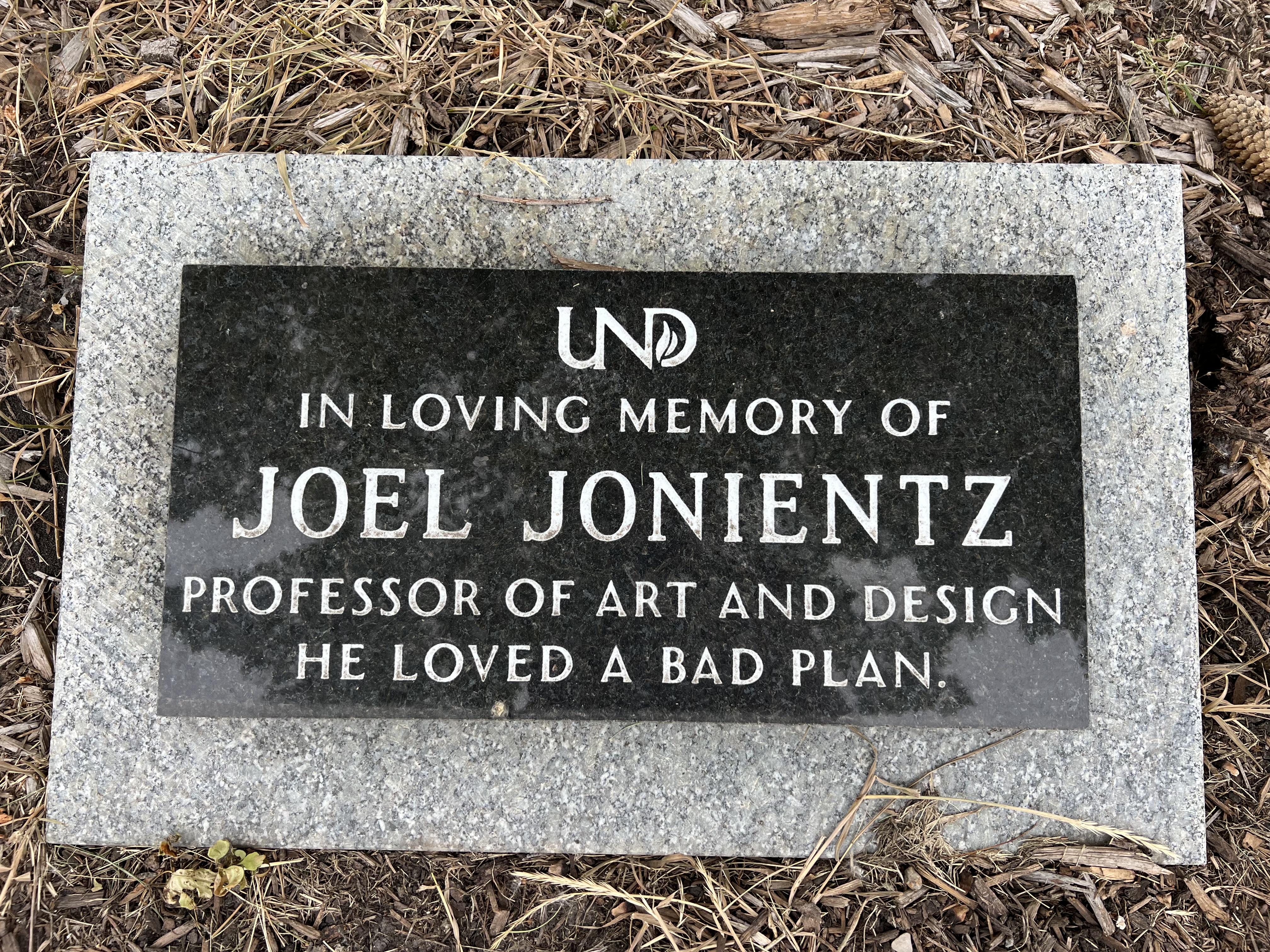
I’m on site at the University of North Dakota this week for professional work and research. While on site, walking across the campus mall, it was a pleasure to see the memorial tree of the late Joel Jonientz, professor of art and design who, in the inscription of his eternal self descriptor, always “loved a bad plan.” Other phrases that come to mind when recalling Joel (he and I interacted directly like 2-5 times in the course of us walking the earth at the same time): “You wanna know how you accomplish something?” This was a rhetorical line of questioning from Joel. He said this to me in like February of 2013 while we were at a high top table at the used-to-be HoDo, now the remodeled BlarneyStone in downtown Fargo. This as we were ramping up with collaborators to carry forward the first global Punk Archaeology Un-Conference at the historic and since bulldozed Sidestreet Tavern (one finds as the decades proceed, one is saying “the old one, not the new one” a lot more and more). He’d follow this by saying something to the effect of, “Ninety-eight percent of it is will power. That’s it.” Not all in one big shot will power. Like sustained will power. Willing power, making incremental gains, sometimes of the magnitude that could be similarly gauged by clipping a hang nail.
Anyhow, some description of the landscape architecture and my own mental point of entry where Joel’s memorial tree resides. The tree itself is a silver maple. I rant the tree image through the PictureThis app on the iPhone. Joel (and the ripple effect of his collaborators) liked detail. So here is some detail. The silver maple is also known as soft maple, water maple, river maple, white maple, creek maple. The latter name, the creek maple, is fitting, as his memorial and this tree is planted near English Coulee (aka creek; and aka “English” as in a departmental discipline) on UND’s campus. The Latin (“It’s a dead language!”) name is Acer saccharinum. It is one of the most common deciduous tress in the United States and southeast Canada. So hardiness zones of 5-9, sustaining Fahrenheit temps from -4 to 100 degrees. It can get vertical from 5-9 stories high. I looked up and snapped this photo of the canopy that arches out over the sweet granite memorial to Joel. It’s okay to lay in the grass and look up at tree canopies.
Also, there are several families of geese with their teenage geese offspring hanging out around the English creek. This just east of the Hughes Fine Arts Center (same Hughes namesake fellow of the Hughes Junior High I attended in the early 1990s in Bismarck — he invented or popularized some kind of electric stove for the world).
Molly and I have been straightening up the flat this weekend, taking short breaks here and there as well. It is really fantastic to be engaged to a professional artist and art teacher for numerous reasons. Molly has a range of medium she works in, including custom mosaics, piano playing and teaching piano, guitar and ukulele playing, mastering the Swedish folk art of Dalmål, and on and on. Of all these mediums, included in a short YouTube video below is Molly’s rendition of Feist’s 1-2-3-4 (the Sesame Street version is linked to here as well). One of the many spectacular reasons that live performance is, well, spectacular has to do with the direct interaction that stage performers have with their environment and the audience. It’s an exchange. Of course, I have recorded and uploaded Molly’s impromptu performance on the YouTubes (thereby digitizing and preserving it in some kind of digital cloud space and time). But it is a slice of the reality that took place. Part of this reality is the unforeseen, as when a BNSF train horn rolling through downtown Fargo let loose about 0:43 and 0:57 in the video. Then a breeze decided to shut the door at about 1:01 in the video. But again, this is live, DIY, living room flat performance. And the band, and life, plays on.
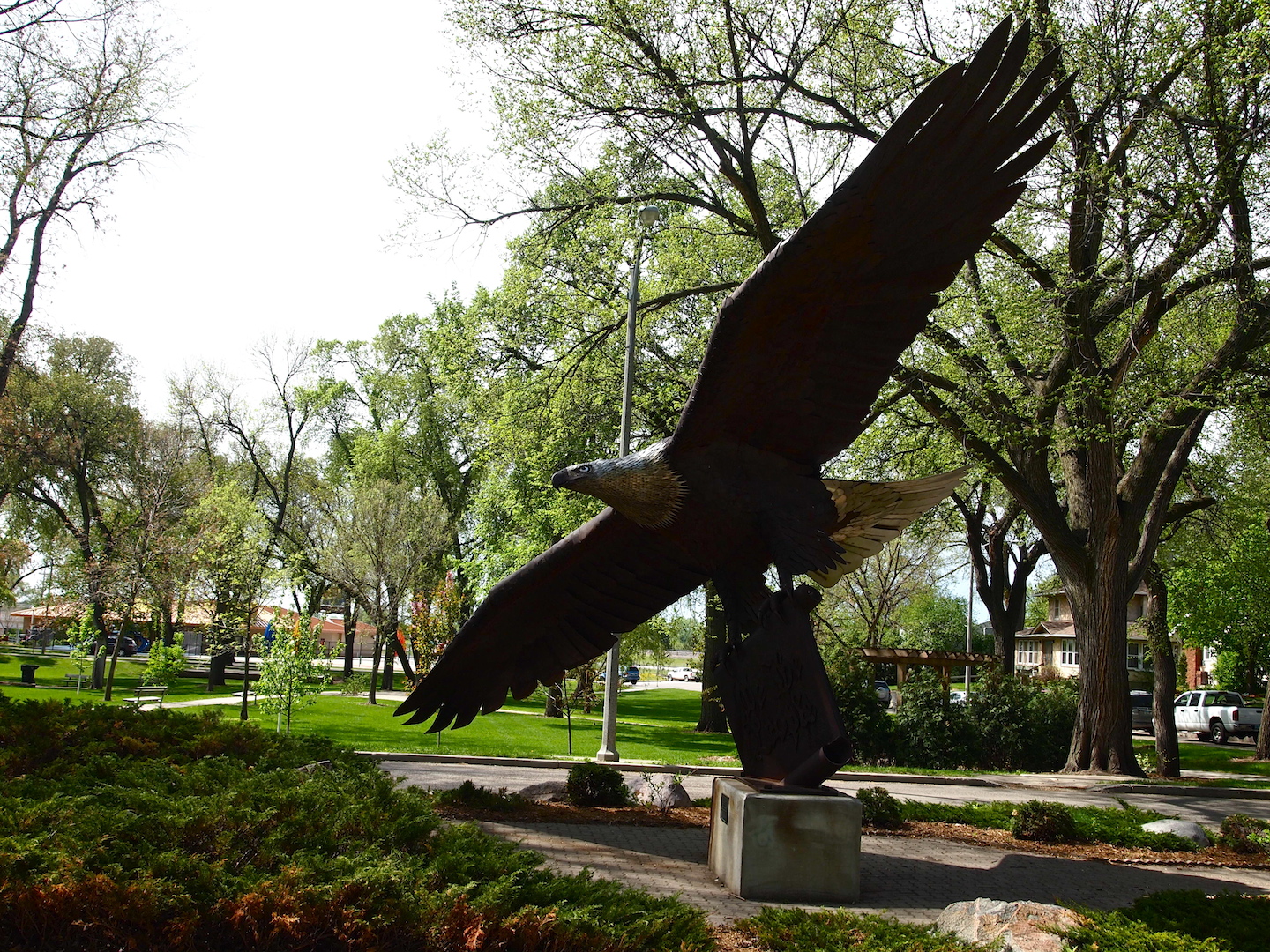
The eagle statue in Custer Park, Bismarck, North Dakota. View to the south.
I dropped into Bismarck yesterday, and after having breakfast with my folks this morning I decided to visit downtown Custer Park. It is beautiful outside.
The park itself is a kind of border between the historic western edge of downtown Bismarck and one of the historic residential areas. To the south is Elks Aquatic Center, and just to the east is a Dairy Queen. You can see how this is triangulated and primed to be a serious summer hangout for those on summer vacation.
While at Custer Park, I also visited the huge metal eagle sculpture. This eagle was dedicated in 1988 (or thereabouts), and I have a vague recollection of my cub scout troop being at the dedication. At that time, when the sculpture was new and sans rust, we were told how the eagle would take on a more eagle-like color because the metal would oxidize and rust over time. This is about all I recall, but every time I drive by the eagle, I think of that dedication.
On this Memorial Day weekend, it seemed fitting to take and post a couple pics of this winged statue, as it is swooping into the park with a handbill that reads “We the People…”
Neary’s “weld” signature from 1988 at the base of the eagle statue.
The dedication plaque below reads as follows:
This sculpture was dedicated to commemorate the bicentennial anniversary of the constitution of the united states of America on October 1, 1988.
Commissioned by: Bismarck Park District
Funding Provided by: Fraternal Order of the Eagles, Bismarck, Aerie No. 2237
Some of the 20th century Cold War missile public art in Langdon, North Dakota. The Langdon Elementary School is immediately behind this missile.
Molly and I are now back in Fargo, having returned from a couple days in Langdon, northeastern North Dakota. To my right is a small pincer sized Cypriot coffee (I trucked back a couple bags of the stuff upon finishing my eastern Mediterranean archaeological trench supervisory work in June 2012, some details of that here and here and here), and on the stove is a long link of smoked garlic Langdon Locker sausage (sides include grated horseradish, stone ground mustard, ketchup). Oranges are also going to make an appearance for breakfast.
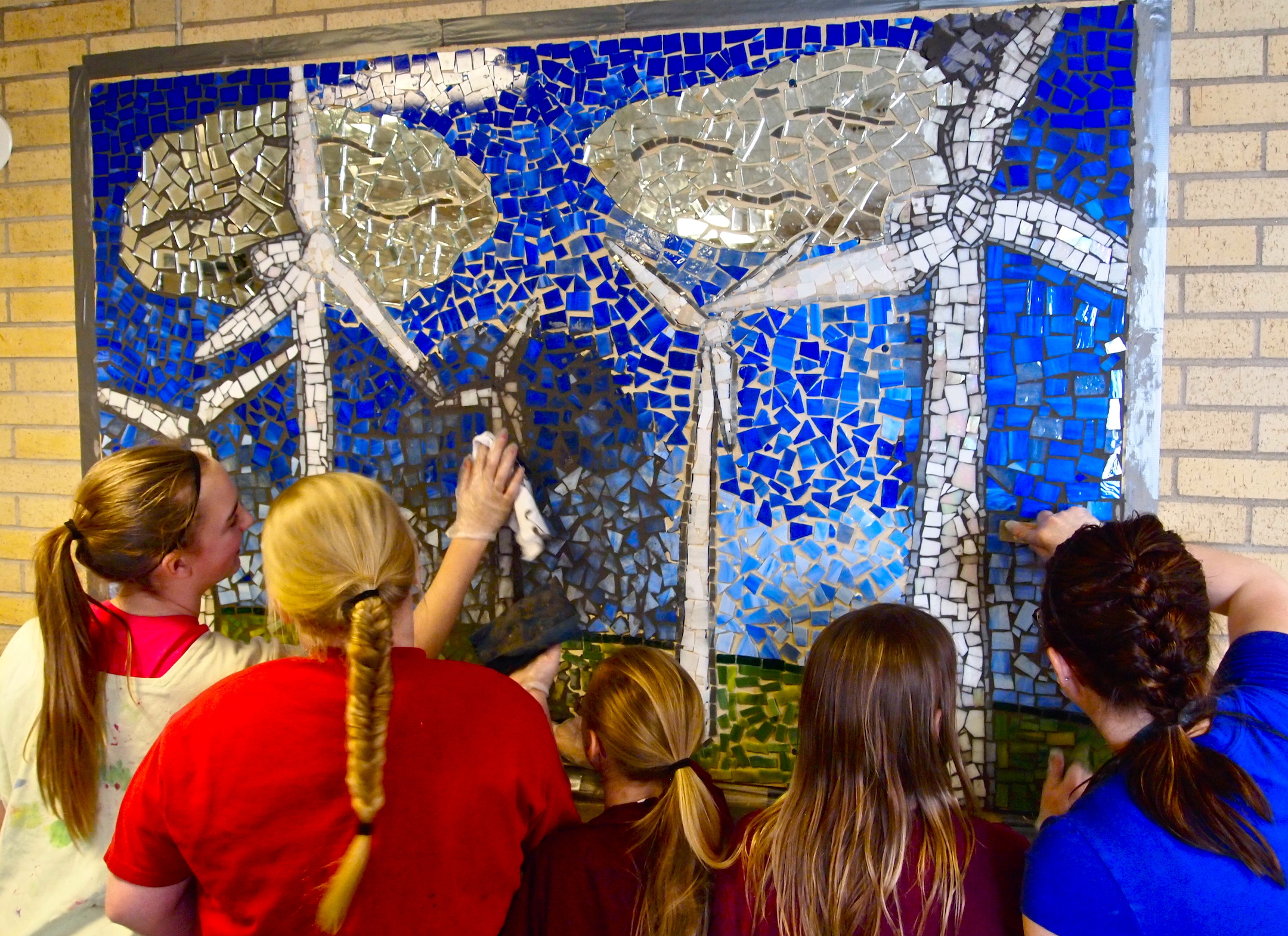
While in Langdon, though, Molly was on a special assignment with the Langdon public school system and the Northern Lights Arts Council. Her colleague and friend, Mindi Paulson, had an idea a couple months ago to co-lead an art project that would produce a mural for the entrance of the Langdon Elementary School. They decided to reflect the built landscape, or the wind turbine field immediately southeast of Langdon. The interesting thing about this 21st century wind turbine field is that it surrounds abandoned 20th century Cold War ICBM architecture, namely the Stanley R. Mickelson Safeguard Complex. In running errands here and there while in Langdon, and in viewing 20th century missile architecture in Langdon, I got to thinking about the perceptual shift in the Langdon landscape.
Teacher Mindi Paulson (far right) leads students in grouting the public wind turbine mosaic at the Langdon Elementary School.
Last century, at least up until the fall of the Berlin Wall and the dissolution of the USSR, the public art projects in Langdon understandably amounted to potential nuclear holocaust, a byproduct of many things: competing D.C. and Moscow ideologies, Eisenhower’s military industrial complex, Cold War anxiety, eventual acceptance, and so on. David Mills has a lengthy monograph on this subject.
And this century, instead of massive Federal military infrastructure projects that reflect potential nuclear Armageddon, we get architecture that reflects and generates green, renewable energy. And you can see how it bears on the public art projects. So today students learn about wind turbines and the hands-on of making wind turbine murals. Last century the public art was a different story. In the discipline of history, we call that a perceptual shift or an intellectual turn. Or something like that.
Teacher Mindi Paulson explains the process of grouting to the students as Molly McLain grouts.
This Saturday, Jessica Christy (an artist who also happens to be one of my cousins) will be showing her work at DK Gallery in downtown Fargo, North Dakota.
This is a copy of the official handbill she is circulating. I figured since she is doing these spectacular Warhol-Factory-esque prints of the USDA’s finest canned beef w/ juices, then it would be okay for me to copy the handbill and post it on my blog.
According to the USDA description, canned beef with juices (USDA item #110),
…consists of coarse ground beef cooked in its own juices for use in a variety of applications, including barbecue beef, pizza, soups, stews, spaghetti sauce, vegetable stir-fry, casseroles, and similar items.
That does sound juicy.
One might make the argument that we, as an increasingly hybridized digital corporate-nation, are becoming a bit disconnected from where our stuff comes from, food included. This in turn is problematic because a government is, as laid down by our founders, a nation by the people, for the people, whereas a corporation is beholden to do one thing and one thing only: make money for the shareholders. I of course would not make this argument, and I would advise against bringing up the idea in polite company. But if someone else wanted to, they certainly could.
Never mind all of that, though. We need to move product here, folks, so let’s get to it. See you Saturday! Don’t forget to bring your Andrew Jacksons!






 The Edge of the Village