German-Russian Migration to the Northern Great Plains

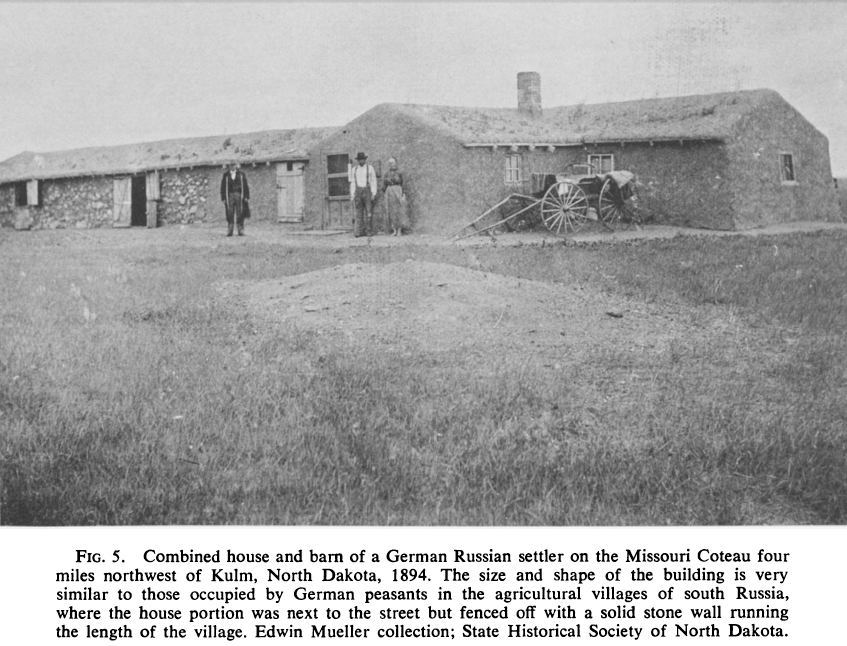
This last week while revisiting John C. Hudson’s 1976 article, “Migration to an American Frontier” in Annals of the Association of American Geographers, Vol. 66, No. 2, pp. 242-265, I came across this photo of German-Russian vernacular architecture. As the caption says, this is from 1894, taken right around Kulm, LaMoure County, North Dakota — the county just east of Emmons County, where the Welk German-Russian homestead is located (recent articles on that here, here, and here).

1894 Sod House Kulm, ND

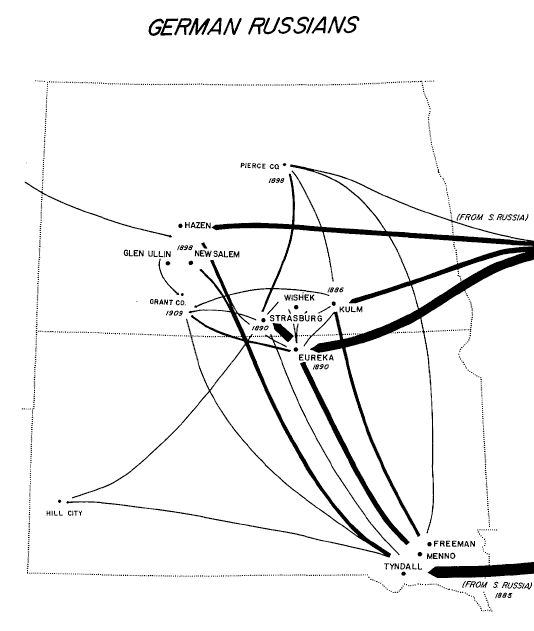
The Welk homestead, in turn, is just down the road from Braddock, Emmons County, North Dakota, where my great grandfather Barth homesteaded and farmed. Barth was an Ohio-German imbedded amongst the German-Russians, something not as difficult to pull off as it might sound. Anyhow, below is also a map of the German-Russian migration to the Dakotas, at least as it played out just before and after the turn of the 19th century.

German Russian Migration


Daughters of Norway, Fargo Chapter

Yesterday, late afternoon, I texted Sean Burt to see if he wanted to meet up for some long-overdue conversation at Würst Bier Hall in downtown Fargo, North Dakota. After he confirmed, I bundled up and started my southward trek down the east side of North Broadway. Along the way I noticed a woman taking a picture of the historic First Lutheran church. I asked if she was getting a good picture, and we chatted just a bit, and she said she was up from California for a meeting. I noted that she was a committed meeting-goer, coming from California to a Fargo winter for a meeting. Here is how the conversation roughly played out:

Aaron: “California is a long way to come for a meeting.”

Californian: “Yeah, but it’s worth it: a bunch of us just met here at First Lutheran about re-igniting the Daughters of Norway chapter here in Fargo.”

Aaron: “Ah, good deal. My great grandparents were Swede, and there’s a lot of continuity worth sharing throughout Scandinavia. Are you ethnic Norwegian?”

Californian: “No, I’m Polish.”

Aaron: “Oh, I see. Is your husband Norwegian?”

Californian: “No, he’s Algerian.”

Aaron: “Oh, I see. That makes sense. Well here’s my card. Let me know if and how I can help you in the future.”

So I was satisfied with having met an ethnic Pole from California who just finished a meeting in Fargo about firing up the Daughters of Norway once again. Heritage groups are fun that way. It’s only a matter of getting involved.


Blizzard Day History Punk

As I type, I’ve got about 30 minutes before Troy Reisenauer picks me up and we head down to Les Dirty Frenchmen‘s global headquarters on Main in downtown Fargo, North Dakota for another Thursday night practice session. I have my earplugs in my front pocket, and I’m not OLYMPUS DIGITAL CAMERAafraid to use them: as we all get longer in the tooth, these sorts of measures are necessary. I don’t think many of us are eager to burn the punk rock candle at both ends the way that, say, the Ramones so dutifully did — punk rock road dogs for life.

Anyhow, earlier today — because universities were cancelled due to a death blizzard — I had a chance to review and prep for lectures I’m co-delivering with Angela Smith at North Dakota State University. Smith and I are rotating here and there, so that I’ll pick up a block of week-long lectures — American History, 1877 to the Present — intermittently throughout the semester. Today I revisited the required course book readings for the start of my lecture on Monday. The topic is the contested American West, and chapter 17 of the book opens with Frederick J. Turner. So this in turn induced me to yank several works by and on Turner off my shelf this evening, and currently I’m revisiting Allan Bogue, Frederick Jackson Turner: Strange Roads Going Down (U of Oklahoma Press, 1998).


Memory Groups

It’s closing in on 7:28AM as I type, and I thought I’d do a quick recap of this last week. Just yesterday evening on my walk home from NDSU campus, I was thinking how much more exciting blog posts on exploding trains are in contrast to posts about napping. Yet when it comes down to it, and if I’d have a choice, I’d rather read up on nap studies than exploding trains, since the former — naps — are much more likely to affect and influence a larger cross-section of society than, say, oil trains that explode near Casselton, North Dakota. Both are important. But I tend to enjoy figuring out how to find and make the otherwise mundane and boring (naps, or even a German-Russian homestead) interesting than focusing on the also important mushroom clouds rising up out of the northern Great Plains winter prairiescape.

Anyhow, I just confirmed a couple lecture-talks this semester at universities within the region, and these talks will build off published research on, broadly speaking, how and why the US-Dakota Wars have been remembered for the last 150 years in the Dakotas and Minnesota. I’m perpetually fascinated by this topic of memory. I suppose one reason is that by looking at how and why groups remember an event is just as informative as the actual event itself. And maybe even more. By studying these groups, we’re able to unpack the cultural, social and political set of ethos that various memory groups brought to bear on the interpretation of historical events.

These groups, in turn, are responsible for advancing the general topics in history that we know today. There is, for another example, the world historical event of the Second World War. But there are also the memory groups — in this case led by Tom Brokaw (also from South Dakota), Tom Hanks, and the late Stephen Ambrose — who study, popularize, and consider America’s involvement in the Second World War. These memory groups have reasons for studying what they study, and I want know the philosophy and technics behind it — the why and the how.


Early Afternoon Recharge Naps

I just read a short blog entry by Tom Isern, a friend, colleague and adviser here at North Dakota State University. Speaking about rising early in the morning, he noted on his productive writing output before sunrise, and then he said that early afternoon napping will undermine his zeal for a heroically productive day. Napping, Tom added, “is not a bad thing, either.” This is correct.

A couple summers ago, before my late Grandma Barth passed away, we sat in the living room chatting one weekend afternoon. I told her I was going to go take a quick nap, and she fired back right away and said, “Good: everyone should take a nap in the afternoon.” My grandma lived to 96 years of age. And this is true about naps. If we treat ourselves decently, we’re likely going to treat those around us decently. Naps are decent things to expect of yourself and others.


Brief Thoughts On Sherman Alexie’s 2007 Novel

Earlier this morning I just finished Sherman Alexie’s novel, The Absolutely True Diary of a Part-Time Indian (Little, Brown & Company, 2007). It is excellent, and it pushed my mind in a variety of directions. This is what a novel is supposed to do, of course: an exploration of ideas through fictional narrative. The phrase “That’s a novel idea” smacks of this definition. Novels are real handy, too, since they operate under a kind of “fictional” rubric, giving the author lee-way to subjectively discuss real life issues and ideas. Because it’s fiction, though, it isn’t true — but it is. This is why the fiction section is arguably more truthful than the non-fiction section (which too is truthful, but with more distance).

So I thought about that while reading the work. I also thought about how this novel was originally passed along from Karis Thompson to Molly, my girlfriend, and then to me. The novel, on the local scene, is slowly crawling northward through downtown Fargo, North Dakota. It is leaving a trail of ideas in its wake. A bunch of us will have to get together to chat about what this novel means to all of us.

Alexie WhiteWhile reading this novel, I also-also thought about sustained broken treaties, the creation of the reservation system, about how the main character in this novel deals with historical trauma, and how the Dawes Act was and is seriously problematic. Then while reading this I thought about a segment of Richard White’s The Middle Ground: Indians, Empires, and Republics in the Great Lakes Region, 1650-1815 (Cambridge University Press, 1991). In the introduction, one of the parts I have underlined, with the words “This is good” scribbled in the margins, is this:

…the middle ground. The middle ground is the place in between: in between cultures, peoples, and in between empires and the nonstate world of villages. It is a place where many of the North American subjects and allies of empires lived… On the middle ground diverse peoples adjust their differences through what amounts to a process of creative, and often expedient, misunderstandings. People try to persuade others who are different from themselves by appealing to what they perceive to be the values and practices of those others… (White, 1991: xxvi)

This brings up the point that there is no such thing as purity in culture. The question or thought is a fallacy from the beginning. And this also means that since there is no such thing as cultural purity, then there is no such thing as cultural death, or a culture that is dead. Alexie demonstrates this through his novel, about a Spokane reservation kid perceiving of himself as living in two worlds: the Native reservation world, and the non-Native reservation world.

It also gives rise to the idea about how much emphasis we humans put on geopolitical boundaries. When we cross the boundary, say, between northeast Italy and southern Austria, we’ll note that people don’t suddenly stop speaking Italian after we cross south-to-north into Austria. What we do note is that while the line is distinct on a map, it isn’t so clear on the ground and in reality.

So those are my short thoughts on Alexie’s novel today. And I wanted to share that and get it down on this here blog. Back to technical writing and revising.


When CNN Airs Your YouTube Train Explosion Video

One week ago I drove from Fargo to Casselton, North Dakota, to take in first hand what happened with the train explosion. Details of that outing are linked to here. The next morning I checked my e-mail in-box, and CNN’s Justin Lear had a message waiting for me. He wondered if it was okay for CNN to use my YouTube video. My thought was, “Yeah. Sure.” So I e-mailed him back, we corresponded briefly, and eventually CNN put my video on their page. Click here to see what it looked like.

When you blog exploding or burning trains, this is what happens to your blog's site visitation.

When you blog exploding or burning trains, this is what happens to your blog’s site visitation.

The footage also got me thinking a bit about how Lear might have come across the video in the first place, this through the computational algorithms built by the internet folks (at Microsoft, Google, and so on). If you happen to be within photographic range of exploding trains, or the burning aftermath of exploding trains, and you upload this footage to YouTube, there’s a good chance Justin Lear will get a hold of you.

I think, perhaps, the most enjoyable footage had to do with the on-the-spot local narration from North Dakotans who caught footage of the actual explosion. If you click on this link and go to 0:24 seconds, you’ll hear through-and-through NoDaker commentary: “There it goes,” and this followed by “There it goes.” Phonetically, it sounds like this: “Der it goeas.” And while this makes us smile, this is the reflection of a North Dakota dialect (played up pretty heavily in the movie Fargo — thank you Coen brothers). The sound of it is completely disarming, and you can hear our Scandinavian and German-Russian great grand-parents within it.


Winter Oil Explosion in Casselton, North Dakota

At mile marker 340 on I-94 looking west.

At mile marker 340 on I-94 looking west. Oil plume just to the left of the signage on the horizon stretching south.

This afternoon while following up on a US-Dakota War historiographic line of research in the library at North Dakota State University, I received a few texts from a friend that read, “KFGO News says 7 oil tanker cars on fire, many have exploded near Casselton.” More went up after this text. This raised my eyebrow. It’s not often that oil tanker cars blow up in North Dakota, and my first thought was, “I sure hope this wasn’t in downtown Casselton.” I was thinking I would just stay in the library, but I also thought about how seeing something first hand is different from seeing it on the flatscreen. Historians are fanatics about primary sources. “Might as well make a contribution,” I thought.

A horizontal smoke from the oil explosion in Casselton, North Dakota.

A horizontal smoke from the oil explosion in Casselton, North Dakota. The setting sun just dipped behind it.

Molly and I drove out west of Fargo on I-94 to Casselton, about a 20 minute ride one way. Here are some of the raw observations: when we started in Fargo, the temperature was -3°F, and when we finished up in Casselton it read -5°F. Sun dogs were also out to the right and left of the sun. Wind was steady out of the north. As we left Fargo, the sun was setting and snow wisped north-south over the interstate. By mile marker 340, we discerned that the horizontal haze in the distance was indeed produced by the burning oil. Since the wind was blowing hard from the north, this horizontal streak stretched south over the horizon. In the flat Red River Valley of the north, this means that the streak stretched south and was visible for a very, very long way. The setting sun dropped behind this streak, some photos of which are included.

I took the exit off of I-94 into Casselton, and we drove north on Highway 18 that runs south-north through town. I eventually parked the car in a parking lot just to the northeast of where the east-west railroad tracks intersect the north-south Highway 18. This is raw video from that:

Here are some subjective thoughts from the outing: I’m uncertain if anyone was hurt, or worse. I hope not. We all hope not. I also thought about the variety of apartments, residences and businesses along these railroads. Molly and I live two blocks north of one of these rail lines. I have friends that live right along them. And what about our neighbors to the north who went through something much worse than this in October 2013 in Quebec. Then I thought of how this will certainly be politicized in

Photo looking west toward the oil fire in Casselton, North Dakota.

Photo looking west toward the oil fire in Casselton, North Dakota.

numerous ways. Then I thought about how the world — all of us — have been born into a culture that relies on petroleum. It’s kind of a cultural inertia, something America, the West and the world has been increasingly addicted to at least since the turn of the 19th century. It seems that until oil becomes expensive enough, there will not be a massive enough cultural effort to harness other energy sources. We see signs of it, of course, with wind turbines and the hydroelectric. But it’ll be a while before all of these other alternatives eclipse petroleum. That’s kind of the way with the petroleum industrial complex. There is plastic all around us, too.

Anyhow, stay safe in Casselton, all. Looks like they may have already started evacuating the entire village…


Local Music Memoirs

This morning I dropped into The Bismarck Tribune‘s website and noticed a front web-page article on Jim McMahon. Anyone who is remotely connected with the Bismarck-Mandan or University of Mary music scene knows Jim, and they also know about his optimistic and upbeat commitment to professional and informal music. This article got me thinking a bit about how I started formal music percussion training in the 5th grade under the direction of Randy Salzer at Grimsrud Elementary in Bismarck. I knew I was interested in percussion (or what I called “drumming”) for a variety of reasons beyond the mimicry of AnimalTommy Lee, or Keith Moon (among others). So in my earlier years I asked my mom and dad about drumming, and they responded immediately. My mom came from a musical family, so it was not only an easy sell, it was encouraged. Her dad, my Grandpa Christy, was an administrator in a musicians union in post-WWII Rapid City, South Dakota. My mom has childhood stories about any variety of musicians being put up at her home in Rapid City (music being played in the house till the wee hours as well). This is kind of the way with musicians, whether professionally trained or auto-didactics (or both, which often is the case).

From behind the drums in the Les Dirty Frenchmen practice room. Photo from December 2013.

From behind the drums in the Les Dirty Frenchmen practice room. Photo from December 2013.

Nonetheless, the story on Jim McMahon reminded me of the 5th grade, and lugging what at the time was a gigantic snare drum to school before the start of classes. I think we had something like 20 minutes or so of time with our professionally trained teacher, and he taught us the basics of quarter, eighth, sixteenth and thirty-second notes, paradiddles, flams, and rim shots. As my 5th-12th grade matriculation continued, I found the percussion avenues of other instruments, including the timpani. Today, just down the road in Fargo, I like to know that if Todd or Troy (Reisenauer) asked me to drop a timpani solo into a Les Dirty Frenchmen song, I’d be able to do that, no problem.

And here’s another thing that Randy Salzer and Jim McMahon (and Robert Pesky, Brad Stockert, Scott Prebys, and professionally trained musical educators in general) plant within their students, whether they know it or not: training one to act on stage in front of small and large groups. Think about it: it is a rarity to play any song to perfection (which is one of the original socio-cultural gripes that punk had toward the music industry). But anyone can receive training to know that when you sense a screw-up, just push on. Instead of obsessing over the mess-up, embrace and own it. This is what in the arts and humanities we call a “transferable skill.” We can use it in other disciplines, and even as a life ethos. There is a psychology to it, and the more one performs, the better they get at their work, and the better they get at interpreting this to larger audiences on stage, both formally and informally. That’s what Shakespeare said, anyhow, about how life is a stage. It’s much more than sound and fury signified by nothing, though. It is, in fact, about how our actions today — the musical training of students — have unforeseen effects. Or unforeseen repercussions (hey, it’s a blog post about percussion). In every conversation I can think of, Jim has been perpetually open to different ideas that encourage and cultivate the local music culture of Bismarck-Mandan. So I just wanted to end this by saying nice work, Jim. Nice work indeed.


Blizzard Grilling On the Northern Great Plains

Rick Gion recently returned from southwestern North Dakota, having hunted pheasant around Mott and Regent. He brought back pheasant, and we — Rick, Molly and I — ended up grilling them last night. Rick pounded out the pheasant breasts and made a roulade, tying them up with peppers, jack cheese, and prosciutto. It, the weather, also decided to turn to a blizzard — icamnatanka — leading up to the grilling. So we just forged ahead. Molly prepared a delicious wildrice-mushroom hot dish, inspired by Linda Whitney (my aunt) and her knowledge of how they prep wild rice hot dishes up around Devils Lake, North Dakota in general. It was a northern Great Plains winter meal through and through. Here are some photos from the late afternoon and evening.

A bag of sensibly priced charcoal purchased as the blizzard set in.

A bag of sensibly priced charcoal purchased as the blizzard set in.

Rick prepares the pheasant-breast roulade.

Rick prepares the pheasant-breast roulade.

Molly's wild rice-mushroom hot dish. This is perfect eating for a blizzard.

Molly’s wild rice-mushroom hot dish. This is deliciously perfect eating for a blizzard.

Grilling the roulade. The temps were sub-zero at this point. In the distance from the grill is a mildly creepy-looking snowman I built the night prior, in anticipation for the sub-zero weather.

Grilling the roulade. The temps were sub-zero at this point. In the distance from the grill is a mildly creepy-looking snowman I built the night prior, in anticipation for the sub-zero weather.

The plated meal. We ended up finishing the roulade in the oven after putting a char on it with the grill. Wild rice-mushroom hot dish to the left, and steamed broccoli above, this just below a bit of table red.

The plated meal. We ended up finishing the roulade in the oven after putting a char on it with the grill. Wild rice-mushroom hot dish to the left, and steamed broccoli above, this just below a bit of table red.