Tag Archives: North Dakota

Directions to Whitestone Hill, North Dakota

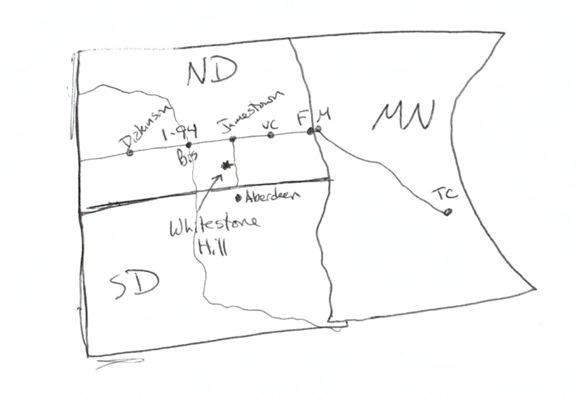
The approximate location of Whitestone Hill.

The approximate location of Whitestone Hill.

I’ve decided that very few people know the location of Whitestone Hill in southeastern North Dakota. This decision came to me after hearing the “Where is that?” response to my remark, “Whitestone Hill…” It is now 2013. This location, Whitestone Hill, is important since it is a site where the U.S. Army brought total war to a domestic encampment of northern Great Plains indigenes in early September of 1863. We are almost upon the 150th year of remembrance. So we need to make ourselves more aware of these sites, primarily because our history — whether we know or like it or not — informs us about how things are today. It is also the stuff that disparate groups identify with. This is why we sometimes hear things like, “History is about identity.” This is true. If we don’t know about Whitestone Hill, then we don’t know why things are the way they are today.

So people can more readily find Whitestone Hill, over the lunch hour I decided to scribble out a map, and also scan a DeLorme topo map of the location specifics. I’m blogging about it now, and I figure that if folks ask me, “Where is that?” instead of me gesturing in the air about the relative location of Whitestone Hill to Jamestown, Aberdeen, Edgeley or Ellendale, I can just send them this link. Above is a rough sketch of the approximate location of Whitestone Hill that I prepared while eating squash and cauliflower curry soup over the lunch hour.

A DeLorme map of the Whitestone Hill location.

A DeLorme map of the Whitestone Hill location.

If you’re on Eisenhower’s Interstate 94, just head south from Jamestown, North Dakota on Highway 281. If you’re in Aberdeen, South Dakota, head north on Highway 281.

If coming from Jamestown, drive about 40 or 50 minutes south until you hit Edgeley, North Dakota. From Edgeley, head west on ND Highway 13, and this eventually turns into south-bound Highway 56. Travel south of Kulm about 10 or 11 miles to 88th Street SE. Travel east on 88th Street SE for four miles, and then turn north (by this point you’ll see “Whitestone Hill” signage to direct you to the site).

If coming from Aberdeen, South Dakota, drive north to Ellendale, North Dakota, and head west on ND Highway 11. Travel west on Hwy 11 for about 20 miles, and turn north onto ND Highway 56. Drive 10 miles north on Highway 56, and turn east on to 88th Street SE. Drive the four miles east, and turn north at the Whitestone Hill signage.

Note: even though the signage on the DeLorme map reads “Battlefield,” and even though during your approach you will start seeing “Whitestone Hill Battlefield” signage, do not be tempted to call it that unless you are ready to define what is meant by that. Even then, it is not a good idea.


Stop and Smell the Russian Sage

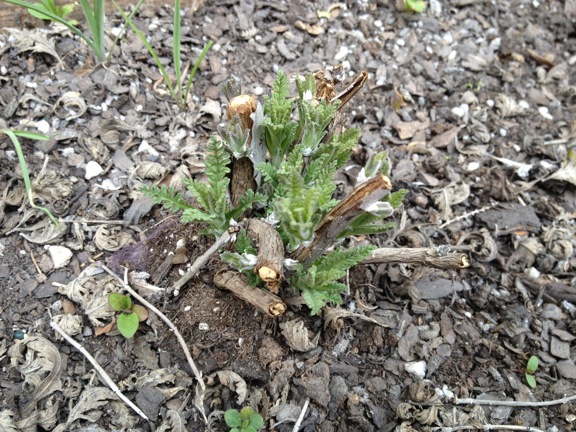
When it was mid-Spring, just before the weather stopped dropping below 32 F at night, the sturdy Russian sage pushed up out of the soil. This is what it looked like at some point in April-May.

Russian sage in the spring on the North American steppe.

Russian sage in the spring on the North American steppe.

Earlier this morning I scrolled past this image while looking for some photos of the ongoing public humanities discussions we’ve been having concerning the Dakota Wars circa 1862-64.

Then I looked at what the Russian sage looked like yesterday evening (August 2013). The honey bees stay busy with all the blooms. Sometimes we gotta stop and smell the Russian sage — it appears the Europeans are better at it than the Americans. That is also what I thought.

Russian sage in August 2013.

Russian sage in August 2013.


Gadgets In Edgeley, North Dakota: Visiting Dawn and Theresa Paul

This morning, while reading about Caraher’s physical concerns as a field archaeologist, I took the third slug of coffee from the first home roasted coffee batch. To home roast the coffee, I used a corn/maize air popper, and learned how to do this just over a week ago when Molly and I visited Dawn and Theresa Paul who reside in Edgeley, south-central North Dakota. It works great, and there appears to be a huge body of DIY internet information on this (which, like numerous things, I only now am discovering). Here is what the roasting looked like this morning.

Roasted coffee from this morning. Green coffee beans just above that.

Roasted coffee from this morning. Green coffee beans just above that.

Anyhow, I thought I’d give you some quick backdrop on Dawn and Theresa and then share another project they finished in Edgeley. Dawn and Theresa used to live on St. Croix. When they first said this, I responded with, “You’re talking about the Virgin Islands and not Minnesota, correct?” (When someone says they are from Oslo, I always do the same thing and ask, “Norway and not Minnesota, right?”) Yes, they were talking about the Caribbean. They both lived on the island for quite a time, developing a house and setting themselves into a variety of projects. Eventually, though, they wanted to relocate to the northern Great Plains (I think this in part had to do with Theresa’s family connections to the area). They claim to be “retired,” but after visiting with Dawn for over an hour I balked at this assertion, or at least modified it. I said, “You’re retired, but busy as ever.” He agreed.

Below are photos of a rehabilitated and restored circus conversion van. Dawn and Theresa can give you the details way better than I can, but the short and skinny of it is this: they discovered this vehicle years back, the vehicle having been abandoned or nearly abandoned. It is a motor home that early 20th-century circus people would use while traveling the circus circuit. This particular van was owned by “The Great Arturo” of the Ringling Brothers and Barnum & Bailey circus shows. The Great Arturo, I learned, was center ring.

Circus people would often winter down in Florida, and then return to the circus life when things warmed back up. Dawn and Theresa decided to do a complete restore on the vehicle, and you’ll occasionally see them traveling the minor and major roads on the northern Great Plains. Here are some photos:

The cockpit of the sweet circus ride.

The cockpit of the sweet circus ride.

Don entering the sweet ride.

Dawn entering the sweet ride.

The front 1/3 of the sweet circus ride.

The front 1/3 of the sweet circus ride.

An interior shot of the sweet circus ride. Note the stove range to the right; sink to the lower left; toilet further back; and bed at the way back.

An interior shot of the sweet circus ride. Note the stove range to the right; dresser just behind that; sink to the lower left; toilet further back; and bed at the way back.


Jessica Christy’s Art This Saturday in Fargo, North Dakota

Jessica ChristyThis Saturday, Jessica Christy (an artist who also happens to be one of my cousins) will be showing her work at DK Gallery in downtown Fargo, North Dakota.

This is a copy of the official handbill she is circulating. I figured since she is doing these spectacular Warhol-Factory-esque prints of the USDA’s finest canned beef w/ juices, then it would be okay for me to copy the handbill and post it on my blog.

According to the USDA description, canned beef with juices (USDA item #110),

…consists of coarse ground beef cooked in its own juices for use in a variety of applications, including barbecue beef, pizza, soups, stews, spaghetti sauce, vegetable stir-fry, casseroles, and similar items.

That does sound juicy.

One might make the argument that we, as an increasingly hybridized digital corporate-nation, are becoming a bit disconnected from where our stuff comes from, food included. This in turn is problematic because a government is, as laid down by our founders, a nation by the people, for the people, whereas a corporation is beholden to do one thing and one thing only: make money for the shareholders. I of course would not make this argument, and I would advise against bringing up the idea in polite company. But if someone else wanted to, they certainly could.

Never mind all of that, though. We need to move product here, folks, so let’s get to it. See you Saturday! Don’t forget to bring your Andrew Jacksons!


Prairie Turnips

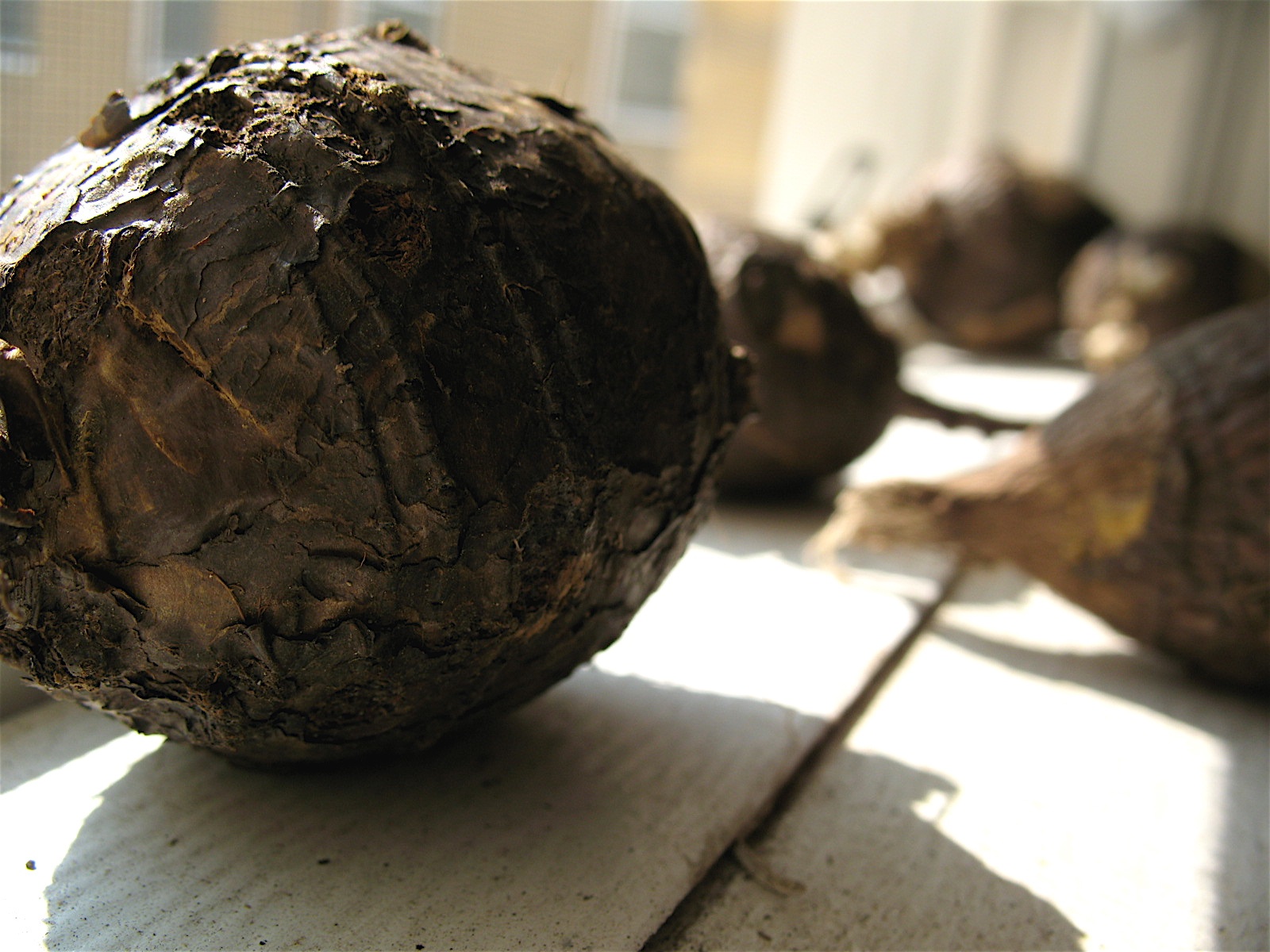
A prairie turnip.

A cluster of prairie turnips.

Where some see a prairie-scape of oblivion, others see a culinary buffet. Just last night I was cruising around in some old digital photos on the desktop, and I came across a couple shots of prairie turnips. I photographed them a couple years ago in the kitchen of a downtown Bismarck apartment I used to live in (the historic Mason Building), I think around 2008 or 2009.

During those summers, Tim Mentz, Jr., of Standing Rock, showed me on the northern Great Plains how to identify the prairie turnip. You can read the landscape for prairie turnips in July. This is when the vegetation sprouts above ground, making them visible. They also grow in certain areas on a hill (it may or may not have something to do with the ph levels of the soil — I’m in the humanities, folks). This, of course, leads to the idea that if you have two different people look at the same landscape, they will see it in a variety of different ways. I like listening to what others have to say about the landscape. Tim Mentz, Jr. always had my ear. We would often joke, too — when a bull was once staring at us and uprooting the topsoil with his front hoof, I asked Tim, “What does that mean?” Tim responded with, “That means we give him distance.”

It is customary to braid the turnips by the root ends, and then hang them to dry. Just like mushrooms (and other dried goods), they will reconstitute in liquid or water. I made turnip soup out of this batch.

With the husk pulled back, this is what the edible flesh of a prairie turnip looks like.

With the husk pulled back, this is what the edible flesh of a prairie turnip looks like.


A Panoramic of the James River Coteau

Panoramic

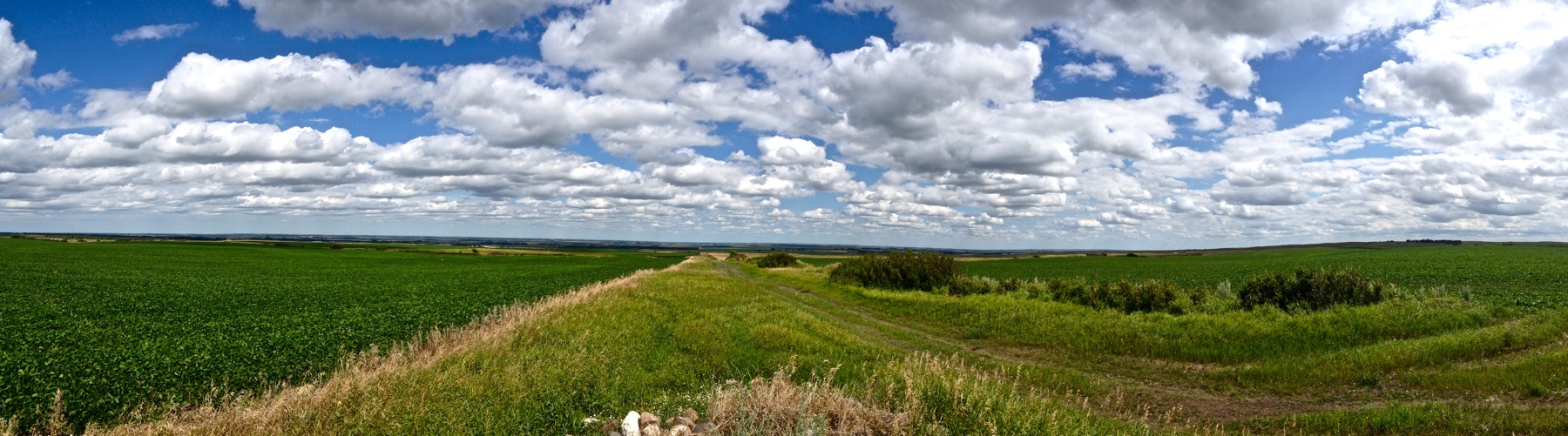
I’ve been fiddling with the “Panoramic” feature on the iPhone 4s. I realize that everyone but me knew about this. But I thought I’d upload at least one photo snapped yesterday approximately 5 miles east and 2 miles south of Kulm, North Dakota. The photo is looking to the northeast and east, just on the ridge of the coteau that drops into the James River Valley proper. To my immediate east, the water goes into the James River. To my immediate west, the water ultimately finds its way to the Missouri River. Both water streams merge around Yankton, South Dakota, and ultimately empty into the Mississippi, then the Gulf of Mexico. Hydrology kind of connects us to the land that way.

To get to your “Panoramic” setting, at least on an iPhone 4s, turn on the camera, tap the “Options” button top-center of the screen, and then tap “Panorama.” Then start experimenting.


The Stump Lake Pavilion of North Dakota

This last week, from Sunday evening to Friday evening, I camped with a small cadre of highly trained artists at Stump Lake (the Dakota called it Wambduska Bde, which means “Snake Water” or “Creeping Thing Water,” this translation courtesy of good friend Dakota Goodhouse), Nelson County, North Dakota. When we (meaning Molly McLain and I) first approached Stump Lake, and since it had been our first time each, everything was new. So it came as a kind of pleasant shock to find a massive historic pavilion situated at the end of the road at the campsite. My eyes widened large when I first saw it. The pavilion has been used as a roller-skating rink since, I was told, it was constructed. And while I was there, I heard banter about the pavilion either being on, or wanting to be on, the National Register of Historic Places.

A panoramic photo of the pavilion at Stump Lake, North Dakota. Photo from August 2, 2013.

A panoramic photo of the pavilion at Stump Lake, North Dakota. Photo from August 2, 2013.


I also heard from Dwight, one of the overseers of Stump Lake campsites, that a raging international polka festival goes on at Stump Lake every summer. Dwight also chatted with me about the stories old timers have told him about their experiences at the Stump Lake pavilion. Dwight said one individual told him how throughout the 1930s they used to polka at the pavilion throughout the night, running down to cool off with a swim in Stump Lake, and then returning to the hard wood polka floors to continue dancing. Does this seem like something out of Prairie Home companion? Of course, anyone from North Dakota knows that the Prairie Home Companion is actually based off reality that has and continues to take place in said North Dakota. It is where Garrison gets all of his best stuff.

An exterior shot of the pavilion from the last week of July 2013, Stump Lake, North Dakota.

An exterior shot of the pavilion from the last week of July 2013, Stump Lake, North Dakota.


There are numerous Bohemian enclaves throughout northern Dakota (check this one out here). One just has to devote the time to stop and listen for the accordion. Note: a future research project will have me investigating whether or not the pavilion is on the National Register of Historic Places. If it is, then yes, the universe is in accord with itself. If it is not, well, then there is more work for all of us to do. Might this be an excellent place to consider a future ND Humanities Council Chautauqua, too?… Perhaps, folks. Perhaps…

Pavilion interior, from hardwood floor to exposed rafter ceiling.

Pavilion interior, from hardwood floor to exposed rafter ceiling.


More On the Civil War and Plains Indigenes Then and Now

Yesterday evening, while sitting around a campfire in northeastern North Dakota, I looked into A People’s History of the Civil War: Struggles for the Meaning of Freedom (The New Press, 2005) by David Williams, and this morning I am finally getting to Thomas Yellowtail, Native Spirit: The Sun Dance Way (World Wisdom, 2007). I’m primarily interested in different interpretations of Dakota, Lakota, and Nakota culture, specifically how this might bear on the historical record (which is why I’ve been blogging on it here, here, here, and broadly on the topic of war here).

In Chapter 7 of A People’s History of the Civil War, Williams says that due to the advanced positioning of the North and South, “Federal forces used the war as an excuse to quicken the pace of killing Native Americans and driving the survivors from their homelands.” (Williams, 2005: 390) This is true, and Williams is upfront about it. An internal American war gripped the eastern 1/3 of the nation (a nation that was both trying to stay together, and expand by overtaking indigenous lands), and certainly the South and North looked at the various territories and newly fabricated states to the west as part and parcel to the overall wartime efforts. Meanwhile, and at the same time, Britain watched America from Canada, and France and Mexico were having it out south of the Rio — think Cinco de Mayo, or the Battle of Puebla, where the Mexican army routed French imperial forces. If Native America could be removed or restricted to reservations, the newly acquired lands could be put into intense farming production. Williams’s work follows the intellectual stream of Howard Zinn, who championed the monograph and who also sparked the intellectual drive. If contrasting the standard Civil War historiography with Native scholarship, though, one starts to understand in much greater detail what else was at stake.

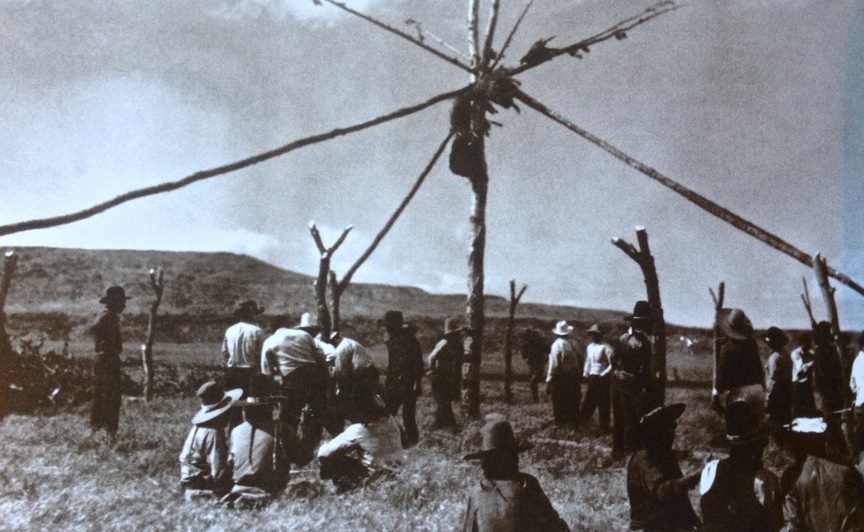
The building of a Crow Sun Dance Lodge from the 1940s. (Yellowtail, 2007: xviii)

The building of a Crow Sun Dance Lodge from the 1940s. (Yellowtail, 2007: xviii)

The introduction of Thomas Yellowtail’s work was written by Joe Medicine Crow, then (in 2007, when the book was published) a 92-year-old Crow tribal historian. Medicine Crow says his grandparents “were pre-reservation Indians who lived before the reservation was set up. They would go camping, hunting, and the men went on the war path.” (Yellowtail, 2007: xi) In reading this, it is important to understand that these activities — camping, hunting, and the war path — mean something much different than they do to us today. They were the very substructure of Plains indigene culture, and to camp and hunt and go on the war path meant one was able to support what we would today call a household (Jonathan Lear goes on in great detail and at length in his excellent work that everyone should read, Radical Hope). Being told by an outsider (or a colonizer) that you need to change the way you do things and that everything you did up to this point is now meaningless are also things that continuously need to be understood. It’d be likened to spending the time and energy to train as a professional welder, and then being told by an outsider that your efforts were for nought. And now here is a new way we’re going to do things. So put away that senseless welding torch and abandon the culture your fore-fathers and -mothers spent generations cultivating. In 1884, this is what the United States ordered, as Medicine Crow says: “The ‘Secretary’s Order’ of 1884… prohibited the Indians from practicing all activities related to their culture, including singing, dancing, and all traditional ceremonials.”

I’m afraid I’m getting a little preachy here, but the idea behind this has universal implications. If one ethnic group is able to do this to another ethnic group, then this means it can happen at any time to any one of us. In looking at that, is that a problem that could continue echoing through time? Yes. Certainly this — 19th-century Manifest Destiny — is something we can understand as happening at a particular time and place, and we can try to distance ourselves from it and say, “Well, we need to understand the historical actors on their own terms.” Yes, this is true (I’m as big of a fan as R.G. Collingwood as the next) But we still need to understand that the terms from yesteryear reverberate throughout the reservation and non-reservation world today (on July 11, 2013, Byron Dorgan had a excellent piece on these implications in the New York Times).


Grandpa’s Handwriting

This is what my late grandfather's handwriting looks like.

This is what my late grandfather’s handwriting looks like.

Yesterday I rummaged through a small toolbox that belonged to my late grandfather, David L. Barth (a link to his brother here). David enjoyed wood-working, both as a carpenter and then a hobby once he was hired on full time by Hedahl’s automotive in Bismarck. Throughout my youth, Grandpa Barth and I did a bit of woodworking together at his shop on the corner of 16th Street and Braman, Bismarck, North Dakota. I can still hear his voice bellowing “C’mon IN!” just after knocking on the exterior door. He and his wife, Vivian (my late grandmother), were always excited to have company.

David was originally born in Braddock, Emmons County, North Dakota (the Barth surname is Ohio-German). But yes, back to yesterday. Here is a photo of what my grandfather’s hand-writing looked like. He scribbled the socket sizes onto white tape and then fixed these to the tools. It is easier to see the numbers then. In our world of computerized text and formating, it’s nice to see the writing of individual humans. I wanted to share it.


The Ethics of Plains Indigenes

Radical HopeHere on the northern Great Plains, we are increasingly considering what the Dakota Wars from 150 years ago meant then and what it means today. A piece of scholarship I stumbled across while visiting the bookstore of Pompey’s Pillar in eastern Montana (where, famously, an Anglo-American incised his graffiti on some tall rock) is Jonathan Lear, Radical Hope: Ethics in the Face of Cultural Devastation (Harvard University Press, 2006). Lear uses the historical documents from Plenty Coups, a Crow leader who helped his people navigate the turn of the 19th century. What makes Lear’s monograph interesting is how he uses his training in philosophy and ethics to approach a previously unexplored topic of the Crow.

Throughout this book, the Dakota/Lakota/Nakota are mentioned, and how they and the Crow were ferocious enemies in the 19th century. Lear looks at this philosophically, though, and says,

One of the ironies that comes to light is that groups of people can be bitterest of enemies in real life, yet ontologically they are on the same side; and a real-life ally can turn out to be one’s ontological nemesis. The Crow and Sioux were bitterest of enemies… Still, their standoff sustained a world in which battles, planting coup-sticks, and counting coups all made sense. One has only to read Chief Sitting Bull’s pictorial autobiography to see that he was every bit as much concerned with counting coups as Plenty Coups was. And yet, with the United States as an ally — a questionable and unfaithful one to be sure, but still an ally in many ways — the Crow moved into a position in which their world fell apart. (Lear, 2006: 50-51)

The rearrangement of this way of life came to an end due to the advanced encroachment of Euro-Americans who, among other things, obliterated the bison food source of the Plains indigenes. Lear doesn’t just stop with the known history of how the bison were wiped out, though. Instead, he expands and explains how the bison food source was a serious component of the Crow’s cultural and ethical telos. Bison had been incorporated into nearly every element of the Crow way of life, and Lear gives excellent examples by unpacking phrases that Crow used for dinner. For example, Lear notes that there was no such thing as simply cooking a meal. Instead, the cooking of a meal had a greater social-psychology behind it. The phrase cooking and eating dinner was inextricably bound to “the cooking-of-a-meal-so-that-those-who-ate-it-would-be-healthy-to-hunt-and-fight.” (Lear, 2006: 40) See how the telos — the psychological extension of an immediate act providing a base for the future — is connected to the food, and that the food comes largely from the bison? Yes, of course. And so when Euro-Americans — whether Sully at Whitestone Hill, or Euro-American riflemen — obliterated the bison, it struck not only at that food source, but at the very culture of Plains indigenes. In short, read this book.