Tag Archives: North Dakota

Visiting the Bear River Massacre Site

A photo from a July 15, 2013 visit to the Bear River Massacre site.

A photo from a July 15, 2013 visit to the Bear River Massacre site in southeastern Idaho.

A couple days ago Molly and I made a site visit to the Bear River Massacre in southeastern Idaho. The massacre happened in late-January 1863 when a U.S. Army group of California Volunteers led by Col. P.E. Connor attacked a domestic, non-combatant encampment of Shoshone. It is interesting to contextualize this site with others throughout the United States.

Nine months later, General Alfred Sully described his actions at Whitestone Hill against families of Lakota, Dakota and Nakota as a “murderous slaughter” of a “promiscuous nature.” This action happened on the northern Great Plains (in presentday North Dakota) only 9 months after the Bear River Massacre. Massacre was, sadly and to put it mildly, a part of the Total War battle rubric (check out John Fabian Witt’s latest work on Lincoln’s rules for war). It is called genocide and ethnocide today.

Today, 150 years later, the Bear River Massacre site remains active with memorials of all kinds. If you are driving from Salmon, Idaho to Salt Lake City, Utah, take exit 36 off of I-15 onto Highway 91. You’ll need to follow the exits, because there isn’t any signage that will guide you to this painful chapter in American history. At the site is a stone obelisk, and for the last 150 years different groups have brought different interpretations to the site.

Some items of remembrance at the Bear River Massacre site. Photo from July 15, 2013.

Some items of remembrance at the Bear River Massacre site. Photo from July 15, 2013.

The Bear River Massacre site was designated a National Historic Landmark in 1990. Today a beautiful memorial tree has taken on the task of an anchor for remembrance and mourning. A variety of individuals have placed items in the tree. A cursory sample of items observed on the July 15, 2013 day of my visit to the site included numerous dream catchers; tobacco pouches; a pair of glasses; a penny; beads on leather necklaces (one read “HOPE”); a wood flute; synthetic flowers; a tin pale filled with beads and chewing tobacco; pieces of rawhide with art on them; and suspenders. The tree is active and alive, as are the memories.

In addition to this, if you want to read up on contemporary scholarship specific to the Bear River Massacre, check out Kass Fleisher, The Bear River Massacre and the Making of History (Albany: State University of New York Press, 2004) and John Barnes, “The Struggle to Control the Past: Commemoration, Memory, and the Bear River Massacre of 1863” in The Public Historian, Vol. 30, No. 1 (February 2008).

Photo from July 15, 2013.

Photo from July 15, 2013.


World War I Memorials: Missoula, Montana and Wahpeton, North Dakota

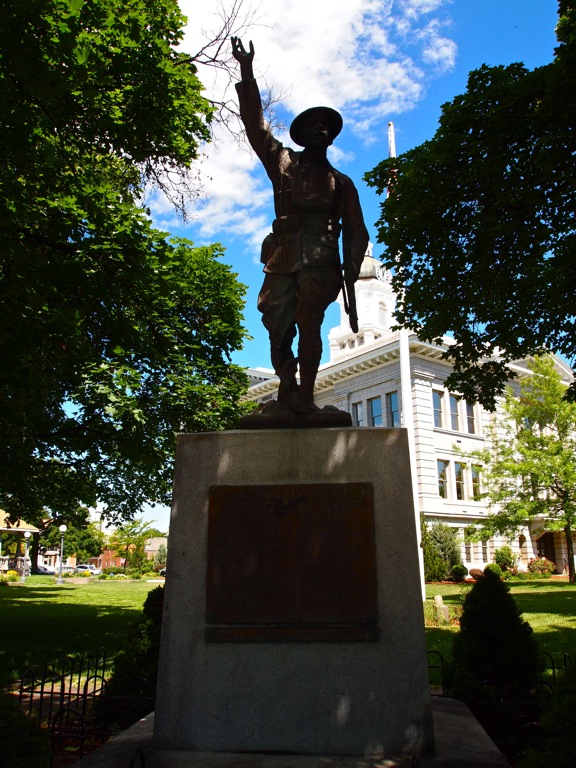
The other day I took some photos of the World War I memorial situated outside of the Missoula County Courthouse in Missoula, Montana. Once I saw the statue, I started snapping photos like crazy because I thought one or two of them would figure into a comparative presentation some day on the public remembrance of World War I in American History. I have also snapped photos of the WWI statue outside the Richland County Courthouse in Wahpeton, North Dakota. This got me re-visiting one of the infinite ideas of history.

If one wanted to, one could organize the historical record in two ways: the events that actually happened, and the long historical and never-ending process of how and why those events are remembered. I haven’t much to say beyond that point, so I’ll just upload some photos of the two related WWI statues from Missoula, Montana and Wahpeton, North Dakota.

The WWI statue outside of the Missoula County Courthouse. Photo from 07/13/2013.

The WWI statue outside of the Missoula County Courthouse. Photo from 07/13/2013.

The WWI monument outside of the Richland County Courthouse in Wahpeton, North Dakota. Photo from November 2012.

The WWI monument outside of the Richland County Courthouse in Wahpeton, North Dakota. Photo from November 2012.


Modern Archaeology of Grilling

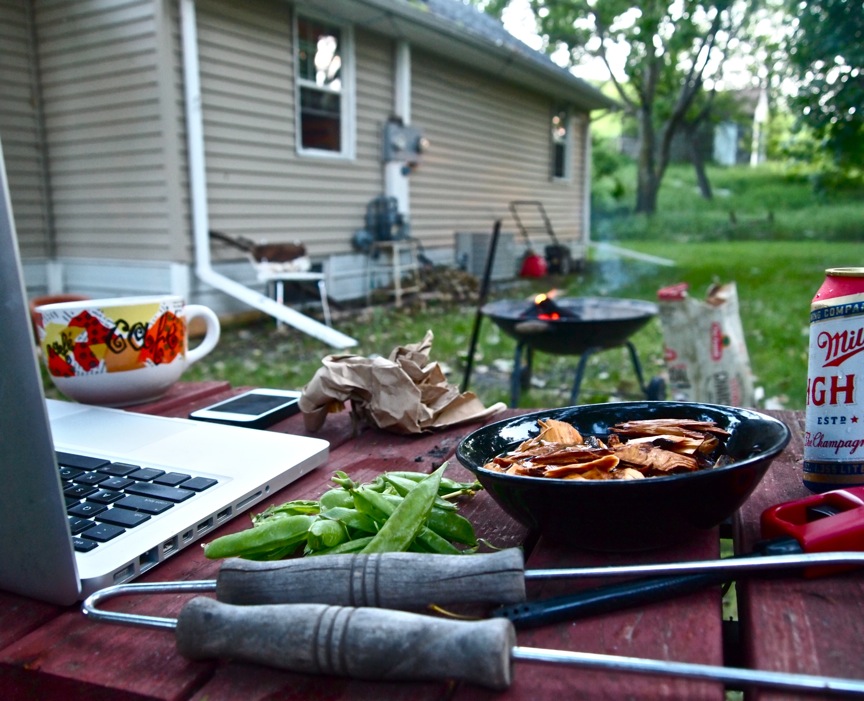
The sun is just starting to set and I’m sitting in the back yard of a residence in Valley City, North Dakota, and thinking that it is worthwhile to both upload a pic of and put some thoughts down on the material culture in front of me. I was thinking this because archaeologists often come across assemblages that have either no voice, or they consciously or unconsciously ascribe a voice to the assemblage through the construction of typologies and interpretations. Archaeologists will find themselves thinking, “I seriously would like to have a conversation with the individual who created this Mandan-Hidatsa pot sherd,” or “If I could only chat with the person who made this Scythian arrowhead…” To counter that, at least in the here and now, I’m going to quickly expand on the domestic assemblage that goes hand in hand with a Saturday evening grill on the northern steppe of North America in the first week of July, 2013.

A contemporary archaeological domestic assemblage from the evening of July 6, 2013, Valley City, North Dakota.

A contemporary archaeological domestic assemblage from the evening of July 6, 2013, Valley City, North Dakota.

Big Picture: This residence is, today, on that proverbial edge of town, a kind of gateway between the rustic countryside and the city or village. To borrow from Raymond Williams, the countryside has been characterized as representing purity and a re-engagement with the wilderness and also backwardness and idiocy (from Virgil, Thoreau and Muir to the Industrial and Post-Industrial H.L. Mencken and beyond). The city as well has been represented as cosmopolitan, where citizens of the world unite to exchange ideas and culture and conversation. Cities also are known to be bastions of corruption and vice. This is the kind of intellectual borderlands where I sit at tonight.

Immediate: with what archaeologists call a “domestic assemblage,” to my right is an aim-and-flame; a can of Miller High Life (the new hipster beer that my friend Troy Reisenauer said may be poised to usurp the hipster Pabst Blue Ribbon beer, if not already); a small bowl of apple wood chips soaking in water; a large coffee cup with a small amount of shucked peas from the Valley City farmer’s market; an iPhone and MacBook Pro, presumably made somewhere in a factory in East Asia by a team of workers who have un-imaginable hours to work; a crumpled up paper bag; and tongs to work the coals on the fire. Music playing is Bruce Springstean, “Mansion on a Hill” from the Nebraska album (appropriate for the Great Plains for sure).

Background: center-right is a make-shift grill (one of those portable backyard firepits, this also made in some East Asian factory by workers with un-imaginable hours); a slender grate; and a bag of Our Family hardwood lump charcoal. I don’t have a proper charcoal grill here (at my girlfriend’s sister’s place), so I just started using the firepit. It has worked quite well.

Far background: behind that (even more blurred) is a pre-WWII home shrouded in modern siding and asphalt shingle with aluminum downspouts, a lawnmower, a plastic gas can (a petroleum product that contains petroleum), a quasi-rusted stool and chair, an A/C unit (which is humming), and toward the back of the house is the beginning of the sparse tree line that separates the country from the city (as mentioned at the outset of this blog).

I better get after putting the steaks on the grill, as these coals are primed and ready. In any case, note how much stuff in this assemblage is industry, factory-made, and whether or not it originates from East Asia or North America (or beyond). The only thing that is produced locally (that I can think of) are the peas I’m shucking, the steaks from Valley Meats I’m readying to put on the grill, and this blog entry. The center of the globe’s gravity continues moving from the Atlantic to the Pacific World, this whether we know it or not. Happy evening to you all. Here is that Springsteen song:


Historic Fireworks in Mandan, North Dakota

A Bismarck Daily Tribune story from July 6, 1913.

A Bismarck Daily Tribune story from July 6, 1913.

As we recover from the pyro-mania hangover associated with America’s Independence (no doubt, celebrated with hundreds of millions of dollars of Chinese fireworks), I came across this 100-year-old local story from The Bismarck Daily Tribune, front page, July 6, 1913. If you have ever witnessed the residential and professional fireworks displays on July 4th in Mandan, North Dakota, this little snippet may resonate with you. It feels somewhat like a war zone. Somewhat. Here is a bit of deep cultural backdrop on things that blow up, and have blown up, in Mandan, North Dakota around the first week of July. Enjoy.


Getting Pickled On the Northern Great Plains

Getting pickled with jars of local farmer's market pickled vegetables.

Getting pickled with jars of local farmer’s market pickled vegetables.

A culinary note: the season of the pickle is here, well established, this on the eve of July 1, 2013. It’s not just a cucumber, folks. This jar was picked up from Becky at the Valley City Farmer’s Market in downtown Valley City, North Dakota. In the past the family has locally raised and sold Christmas/jultid trees, and today they pickle vegetables.

This jar includes chili peppers, cauliflower, broccoli, garlic, carrots, and sturdy dill sprigs. The recommendation is that it be paired and digested with a good dose of Summit Ale. I have to go put the wild rice brats and salmon on the grill now. The onion and garlic saute is already happening (with butter and a shot of course ground mustard). Happy Sunday evening. July, here we come, glorious farmer’s markets and all.


Human Puzzles: Peruvian-pan-North Dakota Art

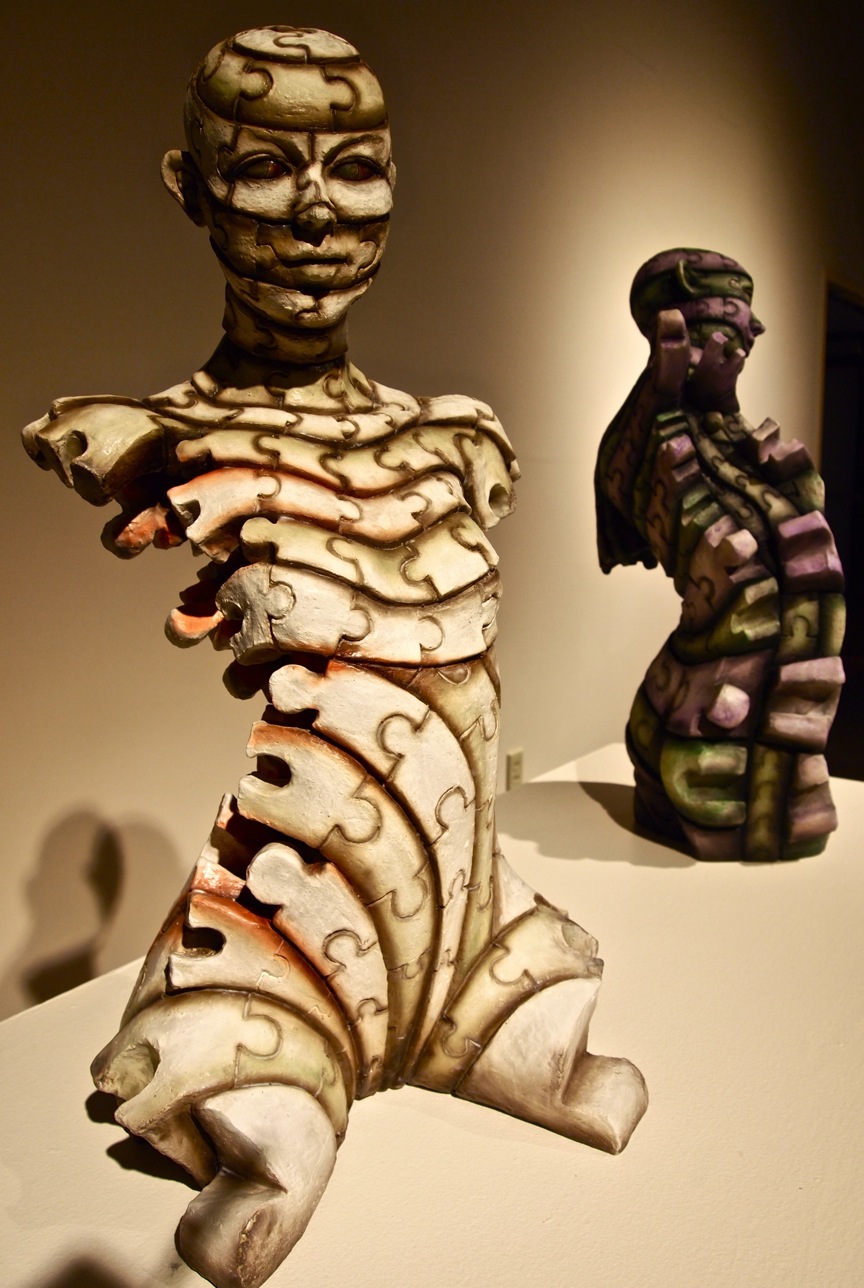
Sculptures by Guillermo Guardia.

Human puzzle sculpture by Guillermo Guardia. Note the sculpture in the backdrop as well.

I just snapped a bunch of photos of Guillermo Guardia’s (the Peruvian-North Dakotan artist, not the Costa Rican football striker) exhibit on display at The Arts Center in downtown Jamestown, North Dakota (the exhibit is sponsored by the North Dakota Art Gallery Association with support from the North Dakota Council on the Arts). Guardia hails from Perú, and did his MFA at the University of North Dakota. In 2009, he started working for the North Dakota Museum of Art as an Artist-in-residence. Guardia’s exhibit will be on display in Jamestown until July 6, 2013.

The pieces, specifically the puzzle-human pieces, got my mental gears cranking. Below is the narrative Guardia put together to accompany these pieces. As you enter the gallery, the narrative is just to your left.


Guillermo Guardia, “3 Truths / 3 Verdades: Puzzle Pieces”

When I began my Masters of Fine Art degree at the University of North Dakota, I knew I wanted to continue depicting the human figure and using it as my main subject and form of art. After building numerous figures in clay, I concluded I was failing at creating the figure I had envisioned. This was very frustrating. I was not pleased with any of my new works. It left me unsure of what direction to take my artwork. My frustration was compounded by the fact that it was my first time in the United States, and my first time out of Perú. At that time, everything was new for me. I had problems communicating with my peers, as it is different to learn English in a Spanish speaking country than practicing it in the United States. Some days I went home with painful headaches.

Two more human puzzles by Guillermo Guardia.

Two more human puzzles by Guillermo Guardia.

In 2003, I turned my attention to building clay figures that looked as if they were thinking (The Thinker by Rodin was a big influence). I quickly finished my first new figure. The new work looked good, but again, it didn’t match the image I had in mind. I sat in front of it, contemplated for a while, took a carving tool, and began to draw some lines over the surface. Eventually those lines crossed each other and became patterns. It made the figure look as if it was built of individual pieces, becoming the inspiration for my current puzzle piece series. The first figure in this series was filled with these puzzle pieces. This puzzle figure was holding a single piece in his hand as if pondering where it fit or where it came from. Perhaps the image of the puzzle piece came from a childhood memory as I remembered my sister always playing with puzzles, something that was beyond my abilities and patience.

Most of us have felt the sensation of something missing and not knowing what it is. We have felt that uncomfortable feeling of emptiness and are unable to describe it. I don’t believe life is a walk in the park anymore. It is difficult and complex. The puzzle pieces represent those little parts of everyone’s life and shape us as human beings. I never thought of myself as a real artist until 3 years ago. So many things have happened since I arrived in North Dakota making me what I am today.


Remembering Greasy Grass in World History

I remember the first time I started piling over the historiography of Greasy Grass/Little Bighorn at some point in 1999 or 2000, this with a short historical article included in one of those military history readers. This article happened to be by the late Stephen Ambrose (I think he published it sometime in the 1970s), and as a reflection of the scholarly times, it focused exclusively on what we call white military history. Looking back on it, and considering how even by the 1870s the American military was such a small cross section of elite Anglo-Americans that guided policy (as opposed to the lot of our non-English-speaking immigrant great and great-great and great-great-great grandparents who were entering the country at the time), it is much more accurate to refer to the traditional historiographic body of white 19th century American history as Anglo-American or Victorian Military History. This is not meant in a conspiratorial way. Rather, it is meant to point out how institutions are composed of individuals, and if the individuals within those institutions have certain outlooks on the world, then the institutions are going to operate accordingly.

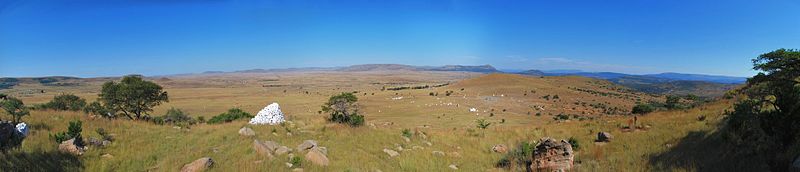
For at least a couple decades, now, enough individual scholars within the academies have created a social structure so that they can shift the direction of the scholarship (archaeologists are sometimes calling this “counter-modern” while other historians refer to it as multivocal). For example, instead of once again combing over what happened on June 25, 1876 at Greasy Grass, scholars have taken to looking at the conflict as a broader segment that needs to be contextualized in World History. James Gump has a work out there entitled, The Dust Rose Like Smoke: The Subjugation of the Zulu and Sioux (University of Nebraska Press, 1994), and it considers how the Anglosphere mythologized themselves after a confederation of Lakota, Cheyenne and Native America decimated the 7th at the Little Bighorn in 1876, and after the Zulu wiped out a British force of 1,500 at Isandhlwana on January 22, 1879. Check out the Zulu monument to the fallen Zulu at Isandhlwana with this link here.

Isandlwana landscape from the Wikipedia public domain page.

Isandlwana landscape from the Wikipedia public domain page.

These broadened world historical treatments help pave the way for other scholarship (for example: so we’re not incessantly sitting around wondering what Custer did wrong; but rather what the Lakota and Cheyenne forces did themselves to bring about George’s demise). The latest and greatest public historical treatment of Greasy Grass comes by way of Debra Buchholtz’s The Battle of the Greasy Grass/Little Bighorn: Custer’s Last Stand in Memory, History, and Popular Culture (Routledge, 2012). This work gets the reader to think secondarily about the actual events of June 25, 1876, and primarily about how the public has remembered the events since 1876. It was, after all, a centennial year (from 1776 to 1876), and the general Anglo-American reading public was nonplussed and aghast to think that Custer (or anyone Anglo-American for that matter) would be capable of losing a battle within the interior of the American nation, and this so close to the centennial anniversary of the nation’s declaration of independence.

Greasy Grass/Little Big Horn from the Google Earth imaging.

Greasy Grass/Little Big Horn from the Google Earth imaging.

So this is where a lot of the contemporary scholarship is at these days: not just looking at the historical event itself, but also looking at what the popular press and academically trained thought about the historical event in and of itself (for example, William Blair and David Blight, among others, have taken a hard look at Civil War memory and memorialization in this way too). And that’s what I’ve kind of been thinking about on this 137th anniversary of the day the Lakota and Cheyenne (and others) stuck it to George at Greasy Grass in eastern Montana.

In closing, I leave you with a paragraph quote from the 1986 work of James Belich, The Victorian Interpretation of Racial Conflict (McGill-Queen’s University Press, 1986 and 1989). This is so you don’t have to lug around numerous books while you’re taking in the various Lakota and Cheyenne holiday celebrations that commemorate the defeat of Custer at the Battle of Greasy Grass — Aaron Barth Consulting does this work for you.

Okay, to quote Belich, and to consider it in the context of Custer as a trained Victorian operative for Anglo-America:

“Racial ideas are not just images of others, but of one’s self and one’s own society. Superiority and inferiority, inevitable victory and inevitable defeat, higher faculties or the lack of them; each are two sides of the same coin. To question one is to question the other, and thereby cast doubt on an individual and collective self image. Victorians, like other people, were not eager to ask such questions.” (Belich, 1989: 327)


Punk, the Humanities and Academia: Some Analogies

Bret Weber and Bill Caraher prepare to present man camp findings to NDSU in the Spring of 2013. Tom Isern pictured at right saunters back to take a seat.

Bret Weber and Bill Caraher prepare to present man camp findings to NDSU in the Spring of 2013. Tom Isern pictured at right saunters back to take a seat.

This coming Friday the board of the North Dakota Humanities Council (or humanities council, however one prefers) will convene for one of its regular meetings. The council meets every three or four months in various locations throughout the state to conduct the business of a board. A primary function of these meetings is to consider a variety of outstanding proposal submissions. In addition to this, and at this Friday’s meeting, we will officially or unofficially welcome aboard — the board — some new members. One of these new members is Bill Caraher, a crack Ohio State University-trained jet-setting ancient and modern historian and archaeologist with University of North Dakota’s prestigious department of history. Bill is also a Punk Archaeologist without borders, much like our friend and colleague Andrew Reinhard.

Because Bill’s summer field season regularly takes him to Cyprus and the greater Levantine world, he physically cannot be with us in eastern North Dakota for this specific meeting. But because it’s the second decade of the 21st century — and even though we don’t have flying cars or flux capacitors, yet — we will digitally beam Bill from Cyprus in the eastern Mediterranean to conduct a short presentation in Fargo, North Dakota. The topic is a presentation on our modern archaeological and sociological research of man camps in the petroleum booming Bakken of western North Dakota. I just returned

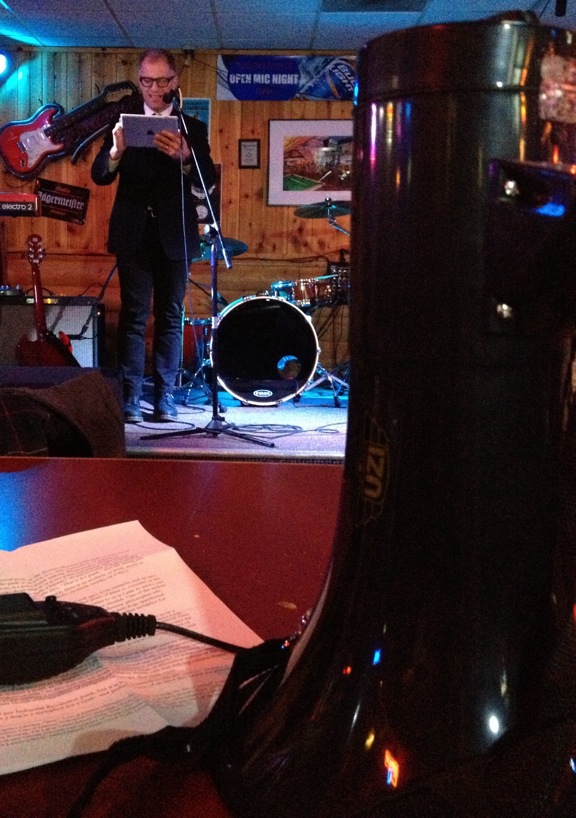
Dr. Kostis Kourelis, punk archaeologist and art historian with Franklin and Marshall College (Pennsylvania), gives his thoughts on punk archaeology through a PA after being introduced with a bullhorn.

Dr. Kostis Kourelis, punk archaeologist and art historian with Franklin and Marshall College (Pennsylvania), gives his thoughts on punk archaeology through a PA after being introduced with a bullhorn.

an e-mail to Bill this morning, letting him know the technology I’ll bring to the NDHC board meeting so that we can pull a kind of joint half-hour presentation off in good order.

Doing something like this is akin to playing in a band. Professors and teachers: encourage your students to start or join bands. Here are some analogies between the two: there is the processes of research and preparation (or what a band calls making songs and then rehearsing those songs), locating the technology to transmit that research (the band refers to this as instruments, including voice, guitars, harmonicas, drums, banjos, cymbals, sound boards, timpani, PAs, speakers, cow-bell[s], monitors, lights), finding the specific meeting room and location and coordinating with the executive director (this is what a band calls finding a venue, and “chatting with a bar owner”), and then executing the entire thing within the span of 30 minutes (this is what a band calls a “set”). Doing this over and over and over again, too, ensures that researchers and lecturers (or individual band members) will simply refine the process and get better and better.

Another note: while we can digitally bridge the spatial gap between the northern Steppe of North America and the eastern Mediterranean, there is little we can do about the temporal gap: it’s not that big of deal, though, since when it is noon Central Standard Time in eastern North Dakota, it is roughly 20:00 hours in Greeco-Levantine time (or about 8:00pm). This will be fun. Long live modern archaeology, the digital humanities, and punk.

Some modern archaeology of a punk archaeology set.

Some modern archaeology of a punk archaeology set.


Neighborhood Historical Research: Some Initial Thoughts on a Grand Forks Micro-History

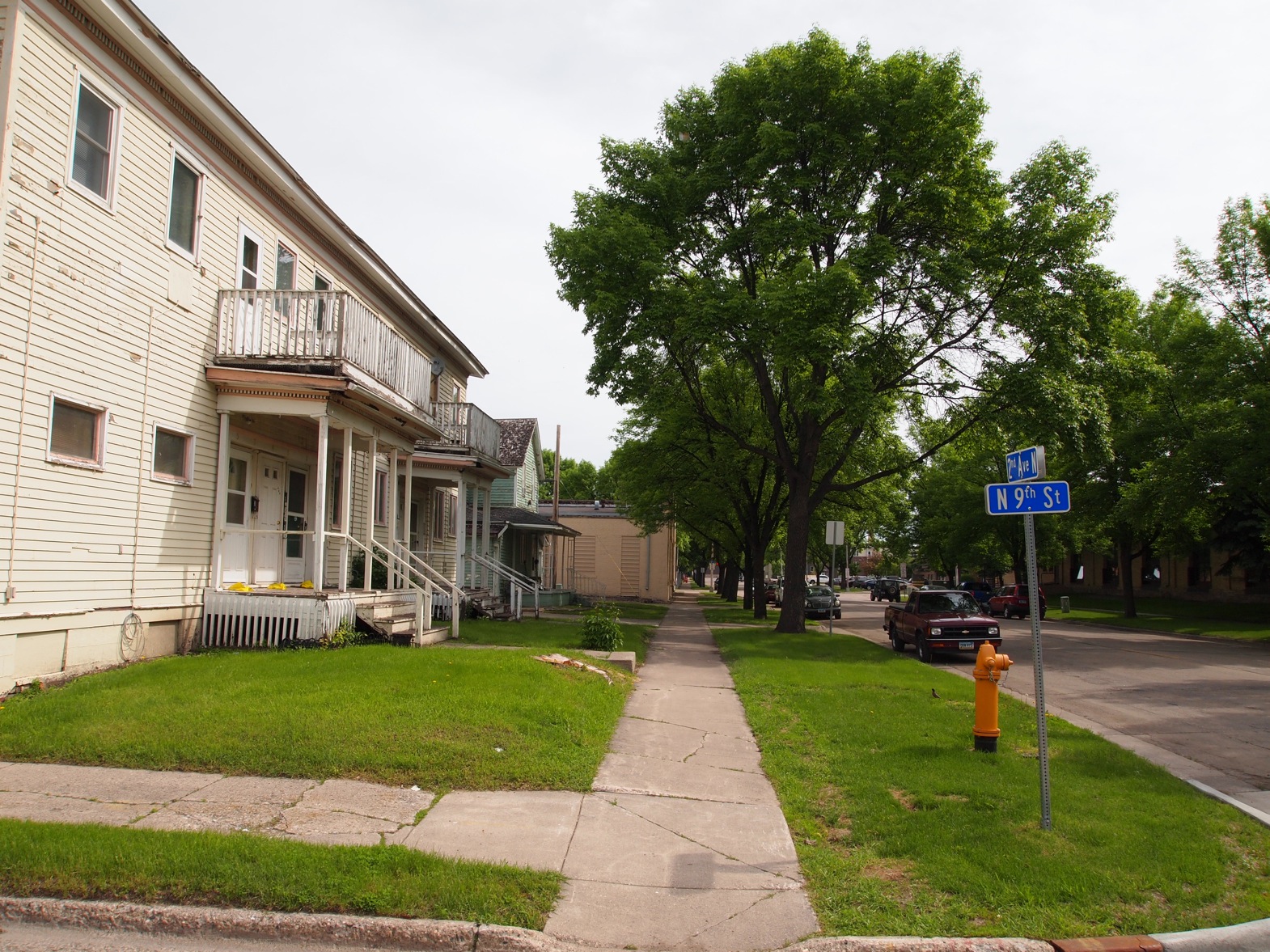
The intersection of 2nd Avenue North and North 9th Street in Grand Forks, North Dakota. Photo from June 12, 2013.

The intersection of 2nd Avenue North and North 9th Street in Grand Forks, North Dakota. Photo from June 12, 2013.

Last week I had some historic preservation detail that took me up to Grand Forks, North Dakota, this along the Red River of the North which in turn is within the Hudson Bay watershed. While I tended to one project, I also found a bit of down time to engage another project.

Some months ago friends Bill Caraher and Bret Weber (professors at one of my — ahem — alma maters, this the University of North Dakota) asked if I would be interested in making a contribution to their Neighborhood History series in Grand Forks. Even before Caraher finished the sentence, I remember saying, “Yes, yes. I’ll do it. I would love to.” So after paying my research location a second visit, I started thinking about how I would outline my research area. The primary area concerns 824 2nd Avenue North, and this falls just a few blocks beyond the boundaries of the Grand Forks downtown historic district.

During the actual field work visit, I not only took photos of this primary area of focus, but I also decided it would be good to saunter around the entire area. So I walked up and down the street a few times and then around the block, photographing each structure and taking in a lot of the overgrown foliage. The northwest side of this block has gone really green (perhaps more-so out of owner neglect than owner ethos — of course, not mistaking

The foundation of 824 2nd Avenue North is brick.

The foundation of 824 2nd Avenue North is brick.

that neglect could be an ethos). The primary area of focus, the southwestern side of the block, tends more toward the concrete jungle. The southeastern portion of the block remains commercial and industrial (Cole Papers), and the northeastern portion of the block has a few residences amidst vacant lots with manicured lawns.

After this fieldwork, and once home, I pulled up Google Earth, and organized three areas I would study with different intensities. Then I decided I’d just approach these areas with the first three criteria laid out by the National Register of Historic Places (no sense in trying to re-invent the NRHP). But instead of cobbling a micro-history together in the otherwise clunky National Register Nomination or Site Form format, I decided to use a hybrid combination of a blogging voice and academic narrative complete with the rigors of U of Chicago footnoting and see how that goes (everything has shortcomings).

I’ll be able to draft architectural descriptions of exteriors and façades, and secondary local, regional and national sources will contribute to showing how this neighborhood reflected broader, national themes. But the true grunt work, as I see it, will be tracking the various chains-of-ownership within each structure. I’ve done this numerous times, and the only way to go about it is within a County Courthouse. I’ll be sure to track the primary residence (824), and from there I’ll see how much more data would be needed for a simultaneously thorough but concise micro-history.

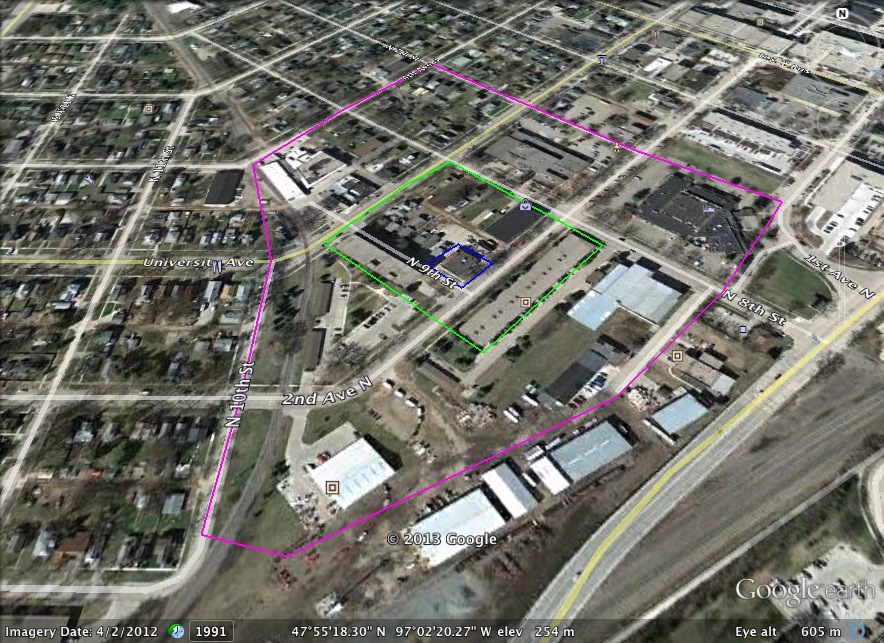
The research boundaries for a micro-history of a neighborhood in Grand Forks, North Dakota.

The research boundaries for a micro-history of a neighborhood in Grand Forks, North Dakota.

So with that said, here is the research triage model I imposed on this neighborhood. Don’t worry: historians impose on the historical record all the time — we wouldn’t be humans if we did not consciously or subconsciously impose on any data set. Just remember to be very suspicious of anyone who says they have found some kind of research design or reporting scheme that ensures absolute objectivity. This is why I tend to use the phrase “subjective objectivity” or “objective subjectivity,” but only in conversation.

Within Google Earth I outlined three areas. The first is of the residence in question, which is outlined in blue. The second is more peripheral, an area outlined in neon green, and the third is (yeah) outlined in neon purple. No doubt, depending on what I can track down during the research process, the study areas may shift a bit here and there. But the idea this last weekend was to delineate some kind of research boundaries so I’m non trying to herd historical cats. More updates as they come in.


Historic Scandinavian Log Cabins: Then and Now

Yesterday I visited a project area in the Sheyenne River Valley in southeastern North Dakota, and on the way back from fieldwork I stopped by some static public historical signage and historical Scandinavian-American log cabins on one of America’s Scenic Byway routes. I snapped some photos, downloaded them in the computer last night, and then started to do a bit of research on the archaeological project area: history often informs the archaeology, since much happens with the history of an archaeological site before archaeologists have a chance to descend on it.

While looking through a series of digitized photos, I came across a historic photo in the Digital Horizons/ND Institute for Regional Studies archive. The photo is titled, “Building at Fort Ransom, N.D.,” and it is a log cabin today located some miles north of Fort Ransom, N.D. I compared the historic with the modern this morning. Below are the photos I’ve looked at: one is a 1950s photo of the cabin, and below that is a June 16, 2013 photo. Note the gable-end elevation, and compare the shapes of the logs, and the seams of the logs. You’ll notice that they match one another.

A photo of the Slattum cabin in the 1950s.

A photo of the Slattum cabin in the 1950s.

A June 16, 2013 photo of the Slattum Cabin. Note the gable end elevation, and compare the seams of the log cabin with the seams of the gable elevation in the 1950s photo. They are the same.

A June 16, 2013 photo of the Slattum Cabin. Note the gable end elevation, and compare the seams of the log cabin with the seams of the gable elevation in the 1950s photo. They are the same.

As the public historical signage said, this cabin was built in 1879 by Norwegian immigrant Theodore Slattum, and he originally hailed from Christiana, Norway. He immigrated to Fillmore County, Minnesota in 1870, and he and his wife, Jorgine, relocated to the Sheyenne River Valley in 1879, where they built this cabin. They also raised nine children in the cabin (they modified the original cabin from what it looks like here in the photos). In 1945, this cabin was moved to the Fort Ransom Historic Site, and then moved back to this original location at some point around the turn of the 20th century (this is likely why the description of the cabin’s provenience is what it is within Digital Horizons/NDIRS; and this is also an example of how history informs archaeology, and not the other way around).

The Slattum family, this photo from the public historical signage at the cabin site. Photo taken on June 16, 2013.

The Slattum family, this photo from the public historical signage at the cabin site. Photo taken on June 16, 2013.