Sharp’s “Whoop-Up Country” (1955) in Great Plains Historiography

Whoop-Up Country: The Canadian-American West, 1865-1885. By Paul F. Sharp. (Norman: University of Minnesota Press, 1955. 347 pages.)

Review by Aaron L. Barth

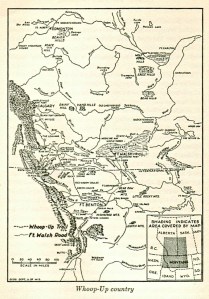
In 1955, Paul F. Sharp pushed the Turnerian model north across the 49th parallel with his Whoop-Up Country: The Canadian-American West, 1865-1885. In doing this Sharp turned Turner’s national model into an international one, describing the two-decade history of the trail that linked Fort Benton in west-central Montana with Fort McLeod in western Canada. In Sharp’s words, “Here on the northern plains, the two great streams of Anglo-Saxon pioneering that had pushed across the continent finally reached their last west in the same environment.” (Sharp, 1955: 8) A shortcoming of Sharp’s use of “whoop-up” is that he never defines its origins (for example, why would Euro-Americans use this phrase?). Grasslands united the United States and Canada, the matching physiographic and semi-arid plain transcending the geopolitical borders, yet culture carried on in its own respective way. Merchants arrived to these grasslands, acting on behalf of “their London masters — Peter Pond, Alexander Mackenzie, Henry Kelsey, David Thompson, Peter Skene Ogden, and scores of others.” (Sharp, 1955: 33) Castor Canadensis, or beaver (and the Euro-American fetish for top hats), compelled these trappers to move into this area, and with them arrived vestiges of Anglo-American culture.

"Whoop-Up" country map (Sharp, 1955: 6).

“Whoop-Up” country map (Sharp, 1955: 6).

The way in which Sharp breaks with earlier Anglo-Americentric histories is in his portrayal of the May 1873 massacre (rather than a battle) at Cypress Hills. In the nineteenth century American mind, when Custer and his Seventh Cavalry died at Bighorn, it remained a “massacre.” Yet when the Union army fell upon Native American villages with rifle, cannon and sabre, it remained a “battle.” According to Sharp, neither interpretation did the historical record any justice, or benefit, as they did no “credit to the objectivity or scholarship of those who, by reason of inadequate research or national bias, have perpetuated legend as history or myth as truth.” (Sharp, 1955: 55) Bringing up the topics of legend and history, or myth and truth, is where Sharp slips into a Positivistic, 1950s frame of mind. Three decades later, in 1986, William McNeill would cover this topic with more rigor and tenacity in Mythistory.

In other ways Sharp’s scholarship is dated, at least in his victimization of the Indian as a “drunk,” this inebriation described as the malefactor of the Cyprus Hills massacre. In Sharp’s words, “Whisky was the real culprit and this fight was another of its fearful effects upon the western Indians,” since this was a “frontier society which tolerated the sale of whiskey to the Indians and encouraged violence against them when disagreements arose.” (Sharp, 1955: 77) While Sharp’s scholarship broke from earlier Anglo-American histories, he continued to use paternalistic condescension toward Native America in his interpretation. When it came to interpreting the behavior of whites, however, he aptly allowed for individual agency and explained the differences in how it played on each side of the 49th parallel.

Four years before the massacre of Cyprus Hills, the Hudson’s Bay Company “transferred to the government of Canada its title to the vast preserve granted in its charter of 1670 and known as Rupert’s Land.” Sharp says it was approximately 2,300,000 square miles (italics mine) of land, this unit of measurement a subtle and slight reminder that Sharp’s readership still obliged American rather than Canadian interests. The establishment of a police force (“Law in Scarlet Tunics”) in the Northwest Territories on April 28, 1873 arguably denied the Canadian west a type of “lawlessness” and chaos so typical of the American West. Sharp addressed this, saying that if “every westerner lived by the myth and defended his honor with Colt’s ‘Great Equalizer’ at the slightest provocation, only one honorable man would have survived in each community” (Sharp, 1955: 107) Yet violence still held true, since the decentralized authority in the American West invariably could not stand up against large, roving gangs (unofficial social institutions in their own right). “Decentralization of authority in local governments was the heart of the matter, for through them law enforcement and judicial administration functioned.” (Sharp, 1955: 108) Local and regional laws guided the development of the American West, until they gave way to organized State and Federal systems that replaced the territories. Under the British-Canadian system, though, the myth or reality of disorder compelled London and Ottawa to bring the Empire immediately to bear on their western wilderness. Thus, in the western United States, chaos theory, regionalism, might-is-likely-right, and individual wits reigned. In the British-Canadian west, imperial order for god and country carried the day.

It is important to keep in mind that this history, when launched onto the scene in 1955, was nudging the interpretation of the Indian as “barrier” (as Walter Webb did in his Great Plains, 1933) to the Indian as understandable victim of United States and Canadian policy. A decade later, Vine Victor Deloria, Jr. and M. Scott Momaday (among others) would further this, an intellectual contribution that coincided with advances made by the American Indian Movement. Today, at least in the first two decades of the twenty-first century, scholarship has again shifted. Note, for example, Pekka Hämäläinen’s The Comanche Empire (Yale University Press, 2008), or Elizabeth Fenn’s forthcoming work on the Mandan, Encounters at the Heart of the World: A History of the Mandan People. This scholarship demonstrates how Native American cultures acted rather than reacted to Euro-American encroachment. It is up to Native and non-Natives scholars today to push these interpretive boundaries, and help reshape the understanding of the past, and even the present.


Thoughts on the Fargo History Project: An NDSU Public History Initiative

As Dr. Angela Smith and a cohort of digital public historians prepares this week for Friday’s grand unveiling of the Fargo History Project at the Plains Art Museum in downtown Fargo, North Dakota, I thought I’d pull a couple titles off the shelf and revisit them to work up some thoughts for opening and/or closing remarks later this week at that event. The class has benefitted from the scholarship of Carroll Engelhardt, Gateway to the Northern Plains: Railroads and the Birth of Fargo and Moorhead (University of Minnesota Press, 2007), from visiting the primary sources within the North Dakota Institute for Regional Studies, and from first-hand visits to the physical places throughout Fargo. Each individual scholar honed in on specific segments of Fargo history between the years of 1871-1893, and they developed short blog-style entries on these topics. In almost every case, digitized historic pictures either compliment the stories or contribute to the analysis, context, and content.

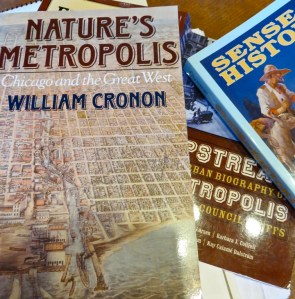
Urban HistoryBringing all of these seemingly disparate and compartmentalized mini-histories under an umbrella of sense requires us to think about cities in the American West as distillations of the resources pulled in from the countryside’s natural, renewable, and non-renewable resources. So what this means is that when we drive by a grain elevator in a rural setting, we should look at the landscape for the linear, abandoned railroad bed. Then we should think about how this was built by a variety of immigrant laborers, and how that provided a route for grain to make its way to larger elevators in urban areas with population concentrations, such as Fargo-Moorhead, Minneapolis-St.Paul, or Chicago. We can then think about how northern Great Plains agriculture is the reason there is a James J. Hill mansion in St. Paul, Minnesota, and how a state Bank of North Dakota, a state elevator in North Dakota, and regional co-ops were historic responses to fat cat Twin Cities bankers and urban industrial areas. Metropolitan bankers in the Twin Cities were not responsive enough to the needs of rural northern Plains farmers and ranchers. Rural farmers and ranchers decided to, in North Dakota, form a state bank.

It is also possible to think about the historic archaeology of dairy cooperatives as responses to large centers of eastern industry. The industrial, assembly-line manufacturing centers (sometimes called Fordism rather than Capitalism) flooded the market with cheap dairy products. They didn’t do this in some cynical or conspiratorial way. But they did it out of their own self-interest. Historical actors in the upper Mid-West and on the northern Great Plains had to figure out ways to make a living, and they in turn responded. They were not going to wait around for industrial assembly lines to become “more ethical.” This is why large local swaths of Scandinavian immigrants in Wisconsin, Minnesota and North Dakota formed rural dairy co-ops. Through these co-ops, they could once again compete with industrial centers. The architecture of the dairy co-ops still occupy our urban and rural landscapes, and in some cases — at least in Fargo — they provide punk rock bands with basement practice space.

That is the interplay, the push and the pull between urban and rural. Again, making sense out of all of this gets a historian thinking about historiography. Here is what William Cronon said in “Kennecott Journey,” Under an Open Sky: Rethinking America’s Western Past (1992):

Mapping out the geography of gender, class, race, and ethnicity remains one of the most important but least studied aspects of environmental history. (Cronon, 1992: 45)

It has been two decades since Cronon said this, and as it pertains to our history of Fargo project, it is important to keep in mind how the individual cultural actors within the history of Fargo perceived the natural and urban world, and also how they acted and reacted to ecology, or nature’s metropolis.


Bakken Oil Field Paper Abstract for the WSSA

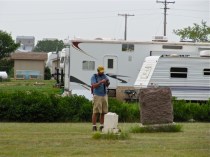
Field crew member Professor Holmgren (of Franklin and Marshall College, PA) documents a historic cemetery surrounded by a Type II camp just south of Tioga, ND in August 2012.

Field crew member Professor Holmgren (of Franklin and Marshall College, PA) documents a historic cemetery surrounded by a Type II camp just south of Tioga, ND in August 2012.

The Western Social Science Association‘s abstract deadline for the April 2013 conference in Denver, Colorado is but a day away. So in the last three days, I put together two disparate abstracts (one for a paper and one for a poster) and submitted them to the conference committee. The paper proposal draws from August 2012 research in the man or labor camps in western North Dakota’s Bakken oil fields, and builds off existing scholarship at this link here. (Note: North Dakota is #2 for oil production in the United States, just behind Texas).

The paper will broadly touch on how and why an area is populated, depopulated, and then repopulated (or re-re-populated, ad infinitum), but focus in on the micro, or what in the business we call individual lives. Contextualizing the micro within the macro, the local within the broader theme. Sometimes historians say those sorts of things in academic papers, or in conversation in general.

Here is the proposed title and abstract of my paper, the one I e-mailed just yesterday to the WSSA people:

Food, Shelter and Water: The Bakken Oil Boom and the Repopulation of Rural Western North Dakota

In August 2012, a collaborative team of historians, archaeologists, architects, sociologists and photographers spent four days studying the labor and “man” camps associated with the Bakken oil boom in rural western North Dakota. While there is monetary success and tragedy inherent in any petroleum boom, the team documented the ways in which skilled and un-skilled laborers carved out their own identities. This captured how an oil boom is much more dynamic than the typical media reporting of it as 100% “good” or absolutely “bad.” Humans are much more complex. This paper considers how a selection of individuals came to work in the Bakken oil field, and how they find lodging, food and hygiene on a day-to-day basis in a rural environment with limited infrastructure.


Sadness in Little Falls, Minnesota

Last evening and this morning I came across a story unfolding out of Little Falls, Minnesota, the headline reading, “Little Falls teen shooting deaths called ‘cold-blooded’,” reported by Curt Brown of the Star Tribune here.

Upon hearing about and reading this, the first thing to rattle itself through my mind was a speech Al Carlson gave on the floor of the North Dakota legislature mid-February 2007, on behalf of a “Castle Bill.” State law enforcement officials opposed this bill that Al was supporting. And Dave Thompson of Prairie Public news reported on that story here.

Carlson, who is the sitting house majority leader of North Dakota, said in 2007 that if a person broke into his house, and I quote,

“I’d tell you what would happen in my house — I would shoot that intruder, and I would shoot him enough times that I knew he wasn’t going to do any danger to me and my family. He’d leak like a watering can when I was done with him.”

To be fair to Carlson, when asked to comment on the 2012 incident in Little Falls, Minnesota, Carlson said, “That was way excessive,” and “That was never the intention of the law.”

Still, Little Falls, Minnesota is left in November 2012 with two dead teenagers who were killed, literally execution style, after they got into mischief and broke into a home (or a couple homes). I read this, and can’t stop thinking of how a leading public official said what he did in 2007, and how he may have composed himself and his speech quite a bit better on the floor of my government (by the people, for the people, folks) back in my hometown of Bismarck in my home state of North Dakota.

We have strong reason and evidence to believe that we do not live in feudal times anymore. Carrying this logic forward, this means we also do not live in castles (or only a few of us do, but they were born into more money than you and I would know what to do with, so they don’t really count). Following this line of thought even further, this means we do not need Castle legislation, or public officials who make Quixotic speeches on the floor of our government. We live in the first decade of the 21st-century, which means we live in homes rather than castles. If you want to be Quixotic and chivalric, open the door for your wife. Do this instead of saying insane things on my government’s floor.

In considering the recent 2012 cold blooded murders in Little Falls, Minnesota, I am now bowing and shaking my head at Al, and his absurd remarks from 2007. Al, use better judgement with your words next time. Stop with the paranoia, please. It ends up spreading, and there’s a good chance it’ll drop into the ear of someone who is just looking for an excuse to do what they did in Little Falls, Minnesota. This is all just so sad.


Raw Field Notes: A Punk Archaeology Meeting with J. Earl Miller and Phil Leitch

Notes scribbled down during a punk archaeology meeting with J. Earl Miller and Phil Leitch on November 26, 2012 at Sidestreet in downtown Fargo, North Dakota.

On November 26, 2012, around 6pm at Sidestreet Grill & Pub in downtown Fargo, North Dakota, I met with J. Earl Miller and Phil Leitch. A couple days ago Miller texted me and said Phil and I should meet and chat (one never knows what one is going to discover with a chat). So we did that.

Phil told me many things. One of these things had to do with dark house spear fishing. I thought it sounded like a punk band, but Phil said it’s something his father does during the winters on the northern Great Plains. Phil’s dad wrote a book about this practice, that of which you can purchase at this link here. I just ordered mine.

At top left are the rest of the raw notes I scribbled down. J. Earl Miller also said he wanted lard instead of cream cheese used in all frosting, both foreign and domestic. That is where the eventual phrase, “Fistfull of Crisco” within the notes came from. And then the word “Lardcore” was dropped, this a slight variation on hard core.

Anyhow, the left side of the page is what I took down while we had our hour long conversation. The right side is the follow up notes I took just after J. Earl Miller and Phil Leitch left to continue their dart league circuit (I think they played at Rooter’s this evening).

It’s a good idea to scribble down notes during and immediately after, and any archaeologist will tell you the same. Especially if this is data or a memory (objective or subjective) you want to, well, remember. Don’t trust your instincts weeks later to somehow magically recall everything that you did, this as you sit in front of a computer monitor trying to recall how it all played out. Just jot it down then and there. Then look at it two weeks from then, this when you are sitting down and trying to remember what happened. The notes will jog your memory. Seriously.

Note: Sid Vicious died on February 2, 1979. Leitch noted this early on during our meeting, and he also noted that the Punk Archaeology round table will take place on that day, February 2. Leitch also said to visit the Fargo Band Family Tree website, which is linked here.


Vicky’s Viking Room in Valley City, North Dakota

The menu cover of Vicky’s Viking Room in downtown Valley City, North Dakota.

If you plan on stopping in to Vicky’s Viking Room for breakfast in downtown Valley City, North Dakota, you’ll need to get just a bit off the Eisenhower Interstate 94 corridor. But that doesn’t take more than 10 minutes. Valley City is nestled in the Sheyenne River Valley in east-central North Dakota, and before I-94 was built, Old Highway 10 used to take you right through central downtown. The Eisenhower Interstate system created new points of gravity for any city it went through (and any city it bypassed). And this initially threatened to suck activity from the historic downtowns. But it’s unnecessary to let high-speed travel corridors dictate the course of culture and Thanksgiving weekend trips. So when you begin seeing Valley City exits while on I-94, take the County Highway 21/8th Avenue SW exit, and head north. Turn east on Main Street and drive over the Sheyenne River to Central Avenue and turn north. You’ll head in that direction on Central Avenue for just a couple blocks. When you hit 3rd Street NW, turn west. Find a parking spot on that block right away. You can identify the façade of Vickey’s Viking Room from the three gable extensions jutting out of the entryway. It has classic cafe restaurant fare. For breakfast try the spinach quiche, or the Messy Jessy, or the biscuits and gravy. The biscuits are huge. Seriously. They may be as large as Ragnarok’s shield. And they provide an excellent base for large volumes of coffee. I was taken to Vicky’s by Valley City native Molly McLain.

While in Vickey’s, some Sunday mid-morning conversation was launched back and forth between two patrons. It went down like this:

Patron at the cash register to patron seated in a booth, in a tone of humorous yet restrained judgment: “I didn’t see you in church this morning…”

Patron seated in booth, responding in exonerating tone, said, “I sat in the way back.”

Patron at cash register, in monotone voice, responded by saying, “I prayed for you.”

Patron seated in booth, in a grateful voice, countered with, “Oh, I need all the help I can get.”

You’ll wonder if you’re in an episode from Prairie Home Companion while at Vicky’s Viking Room. But then you’ll also think that this is where Garrison Keillor gets his most honest material (and what makes up his best shows), from the reality of our northern Great Plains. Go to Vicky’s Viking Room.


Black Friday at the State Historical Society of North Dakota

Earlier today I dropped in to the archives of the State Historical Society of North Dakota, officially “Black Friday,” to comb over some coveted primary sources. It was quiet when I strolled through, the construction for the addition at a momentary standstill on this day after Thanksgiving. The bookstore and gift shop, normally at left of this photo, have been relocated to make way for chop saws and ladders and piles of lumber and extension cords and so on. Some of the ceiling panels have been removed, and bits and sections of the SHSND’s 1980 skeleton exposed. After my time in the SHSND looking at some letters sent to Washington, D.C. from Dakota Territory and some official surgeon reports from Fort Abercrombie circa 1857-1863, I thought I’d snap a photo of the historic addition and remodel. So here is that shot, looking to the north-northeast.

Note: there are some spectacular holiday gift ideas within the gift shop of the SHSND.


Quick Remarks on How to Live Sans Irony

A couple days ago (11/19/2012) Nick Steffens wired a facespace message to me from Salt Lake City to Fargo with the attached New York Times “Opinionator” piece by Christy Wampole entitled, “How to Live Without Irony” (11/17/2012).

The title of the article communicates a hipster trope from any age that seeks to outflank the absurd by acknowledging, amplifying and asserting that absurd. For example, “How to Live Without Irony” is a funny thing to say or read, although the humor is seven-chess moves removed (or what we might call deep humor). To live without irony, or to say there is a way to live without irony, is arguably irony.

Wampole’s introductory paragraph smacks of Anatole Broyard’s 1948 piece, “The Portrait of a Hipster,” and Wampole might do a bit more to tip a hat to Anatole within the 2012 piece. For example, check out this Wampole excerpt from November 17, 2012:

“The hipster haunts every city street and university town. Manifesting a nostalgia for times he never lived himself, this contemporary urban harlequin appropriates outmoded fashions (the mustache, the tiny shorts), mechanisms (fixed-gear bicycles, portable record players) and hobbies (home brewing, playing trombone). He harvests awkwardness and self-consciousness. Before he makes any choice, he has proceeded through several stages of self-scrutiny. The hipster is a scholar of social forms, a student of cool. He studies relentlessly, foraging for what has yet to be found by the mainstream. He is a walking citation; his clothes refer to much more than themselves. He tries to negotiate the age-old problem of individuality, not with concepts, but with material things.”

And then compare it with this excerpt from Anatole circa 1948 (first published in Partisan Review, June 1948):

As he was the illegitimate son of the Lost Generation, the hipster was really nowhere. And, just as amputees often seem to localize their strongest sensations in the missing limb, so the hipster longed, from the very beginning, to be somewhere. He was like a beetle on its back; his life was a struggle to get straight. But the law of human gravity kept him overthrown, because he was always of the minority—opposed in race or feeling to those who owned the machinery of recognition.
The hipster began his inevitable quest for self-definition by sulking in a kind of inchoate delinquency. But this delinquency was merely a negative expression of his needs, and, since it led only into the waiting arms of the ubiquitous law, he was finally forced to formalize his resentment and express it symbolically. This was the birth of a philosophy—a philosophy of somewhereness called jive, from jibe: to agree or harmonize. By discharging his would-be aggressions symbolically, the hipster harmonized or reconciled himself with society.

Maybe Wampole had initially included an Anatole reference in an earlier draft, but some hipster editor didn’t recognize it as important and therefore sliced it out? I don’t know. And this is not to say that the irony-amplifying hipster surfaced only after the Second World War. If thinking deep about the hipster-ography (which is the study of hipsters over time), the name Diogenes enters the brain, an Ancient Hipster, or moreso a Punk, from the Mediterranean if there ever was one. Diogenes lived in a gutter with his dogs and ate bags of onions and questioned everything — if his delivery was off, he would certainly be regarded as a jerk. In the words of Oscar Wilde, it is very impolite and even impossible to be 100% honest with everyone all the time. Was Socrates a hipster? I’m not sure. But I’m willing to pose the question if it leads today’s hipster or student into considering whether philosophers and thinkers from yesteryear were in fact hipsters in their own time and place. Thanks for the article forward, Nick.

Note: Perhaps the most thorough contemporary exegesis on hipsterosophy is the 2010 piece published by n+1 (Brooklyn, NY) titled, What Was the Hipster?: A Sociological Investigation.


Natural Turkeys: Spring Prairie Hutterite Colony in Clay County, Minnesota

Last week I started texting friends about where they might source organic turkeys for a Thursday afternoon gorging on Thanksgiving Day. These friends rightly pummeled me with a miscellany of suggestions local to their, well, locale, this from Burleigh and Morton counties in central North Dakota. I also posted the question on social media about where folks were getting their organic turkeys, and Tom Isern (the arguable Herodotus of the Northern Great Plains) said the Spring Prairie Hutterite commune was the place to go. I should have known, since Isern has been known to distribute Spring Prairie hams around jultid. So this mid-morning I headed off to find the Spring Prairie Hutterite Colony. Below are some photos from the meat-sourcing expedition.

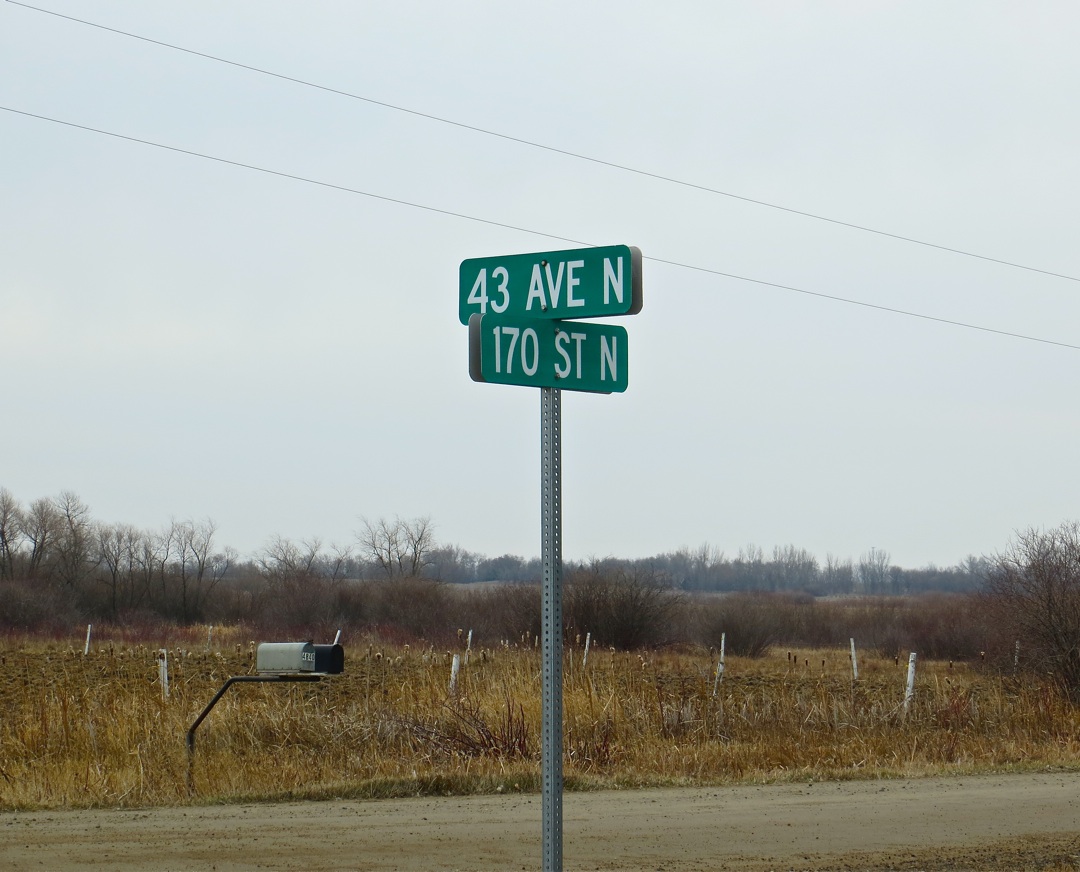
At this intersection, turn north. Drive that way for 1.5 miles to the entrance of the Hutterite Colony.

After you hit the intersection above, point the vehicle north and drive for approximately 1.5 miles to the entrance of the Hutterite Colony. At this entrance, turn west and follow a sort-of-looking main road that arcs briefly to the southwest, and then turn west again. By this time you should have the below in view. To be sure, it is a bit nondescript, the antithesis of Robert Venturi’s lament in Learning from Las Vegas. It seems Hutterites never had to learn from Venturi or Las Vegas in the first place.

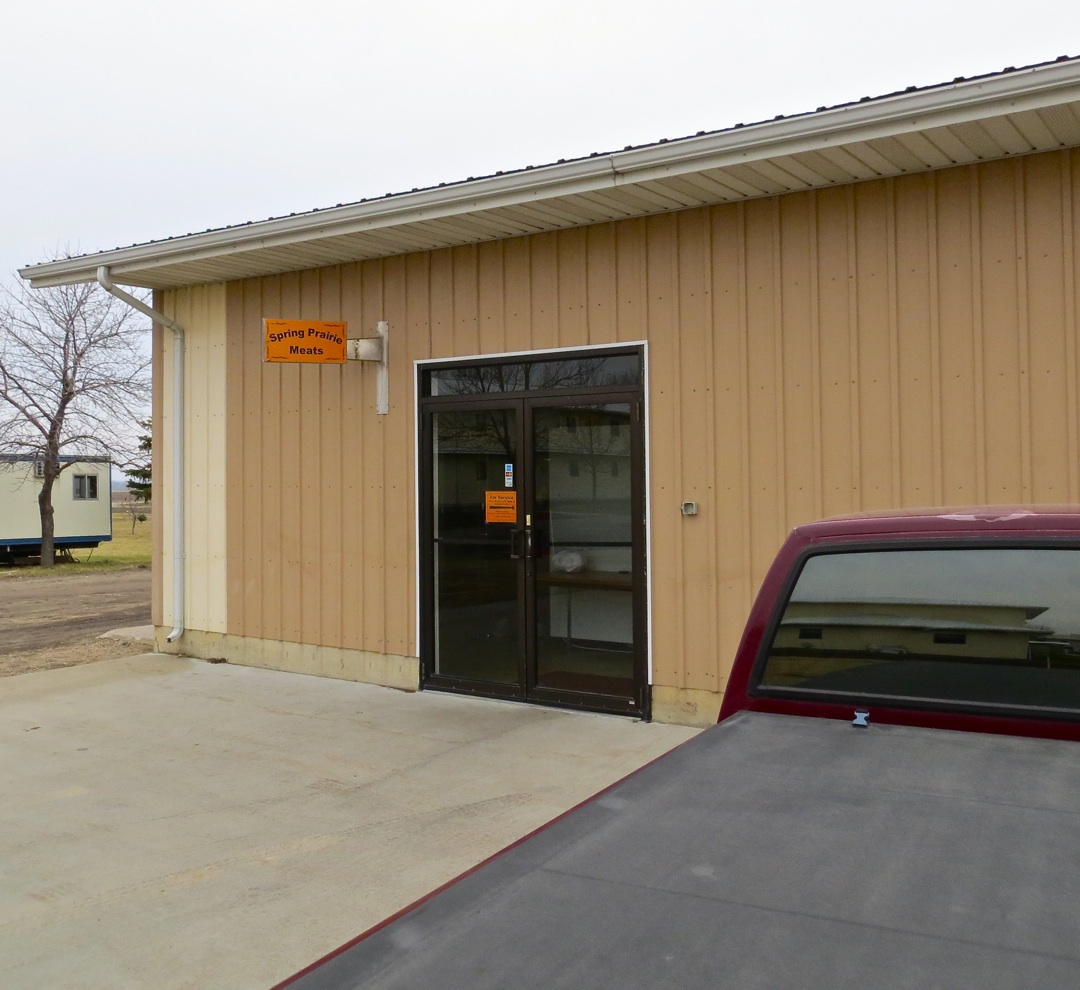
Spring Prairie Meats within the Spring Prairie Hutterite Colony in Clay County, Minnesota.

The photo above is the south entrance to Spring Prairie Meats. Note the dormitory building reflections in the automotive glass and the building’s glass door. You are in Hutterite central. This religious commune has worked hard to bring its religious and social structure into the 21st century, and they are doing great work of it. Silke Van Ness says in “The Current Status of Research on German Dialects in North America,”

The purchase of poultry, beef and pork products at a Hutterite meat bazaar.

from The American Dialect Society: Duke University Press (Vol. 70, No. 4, Winter 1995) that German language maintainence in North America results from socio-religious isolation, “the only factor which retains full force.” When you’re going over the various pork, poultry and beef products within the fridges at Spring Prairie Meats, there’s a strong chance you’ll encounter this insulated dialect, especially if unintentionally overhearing Hutterite conversation.

A Hutterite man eventually asked me in English if I needed help. I responded and told him I needed a lot of help, but for now was only interested in help finding turkeys. He laughed and obliged my turkey request. I purchased a 17lb turkey for just over $1.52/pound, or right around $25. This in addition to some summer sausage and beef sticks came to around $32 and change. Not bad at all. The label of the Prairies’ Pride turkey says it is “all natural, home grown, young turkey,” and “minimally processed – no additives – no artificial ingredients – no growth hormones (Federal Regulations prohibit the use of growth hormones in poultry)” — this latter statement I was unaware of. This labeling that requires labelers to call pre-Industrial agriculture practices “natural” or “organic” is a bit silly: the majority of sedentary human history, at least up to the turn of the 19th century, was what today we’d call “organic” farming. Why not return to just calling organic farming, farming? We could then require produce produced from industrialized and mechanized means to be labeled as such: this produce was made from industrial means, and we shot a ton of antibiotics into the mammals and anhydrous ammonia in the ground to get the stuff this big. Nevermind, though. I got my natural turkey. I will be back to the Spring Prairie Hutterite Colony. I’m glad they are around. Happy Thanksgiving, and happy brining.

Prairie Turkey label. The brining will commence within days.


Punk Archaeology: Joe Strummer on DIY

This evening I revisited the documentary, “Joe Strummer: The Future is Unwritten” on the Web 2.0/DIY platform that is YouTube. I have AppleTV jacked into a shamelessly huge flat-screen, and the AppleTV somehow allows me the ability to stream any YouTube selection through it. So by punching in “Joe Strummer: The Future is Unwritten,” YouTube’s search engine returned a series of 2008 uploads by the YouTuber named “madferrett.” Smack dab on 4:02/8:24 in the fourth of eleven installments (the subtitle is “Squatting 101’ers DAY’S”), the late Joe Strummer defines Punk as straight-away Do-It-Yourself. Of this DIY ethos, Joe in the video says:

We had the nerve to rent a room above a pub, and charge people 10 p [aka, pence] to get in. That’s how we learned to play, by doing it for ourselves, which is like a punk ethos. I mean, you gotta be able to go out there and do it yourself, because no one is going to give it to you.

Here is the Joe Strummer YouTube embed:

In the long-winded scheme of things, this is also referred to as being an autodidactic, or a self-taught learner. As fellow blogger Bill Caraher and I continue conversations with any and all about Punk Archaeology, this invariably has helped develop and shape the all-important fineries of the Punk Archaeology conference scheduled to take place in downtown Fargo, North Dakota on February 2-3, 2013 (it starts Saturday evening and is scheduled to end Sunday morning).

It seemed reasonable to post Joe’s remarks, if nothing else to continue to consider what the phrase Punk Archaeology means. In one sense, there is the localized archaeology of punk within Fargo-Moorhead, where any number of bands formed up in DIY fashion to cut loose on stage. In another sense, there is punk archaeology (or Punk Archaeology, depending on how formal one wants to be), the latter word “archaeology” not only specific to the discipline of said archaeology, but also to other DIY attitudes intrinsic to sustaining the disciplines and vocations and trades, and also as in the archaeology of knowledge. Punk archaeology is all around, and often right in front of us. Back to it on this end.