Category Archives: Uncategorized

Post Maah Daah Hey 2016

Yesterday I helped a friend with the supply and gear during his 107-mile jaunt through the badlands of western North Dakota, on the increasingly famous Maah Daah Hey trail. It’s adventure recreational tourism, or even extreme adventure recreation. Bicyclists convene at the northern portion of the Maah Daah Hey trail head on a Thursday and Friday (taking up lodging at the Roosevelt Inn or campsites at the CCC or the north unit of Theodore Roosevelt National Park), and prepare for an early Saturday morning rise to begin the ride.

I started situating this whole activity in the context of the world, and came to the agreement with the friend I was helping that this indeed is a 1st world activity. By that we meant that adventurers who partake in this extreme recreation have the resources to pay the admission fee and train and then take vacation to expend calories — a lot — to complete a 100+ mile mountain bike jaunt through rugged terrain during one of the hottest times of the northern Plains year. Compare that with, say, a country where inhabitants could live, perhaps, an entire year from the cost of admission. Or, when inhabitants of this other country expend calories, it’s toward agriculture, or raising and growing commodities — stuff that will continue to sustain life.

We then started recognizing this, and affirming the goodness of the race, since it was indeed that, and noting that it provided healthy outlets for hundreds of athletes to explore and push their bodies and minds to different stages of exhaustion. This is one of those common and collective experiences. We agreed that the Maah Daah Hey was a good idea. The views during this entire race were extraordinary. And it was fun in the morning to hear the Theodore Roosevelt re-inactor address the bicyclists. The TR actor recited the famous Man in the Arena, and told the bicyclists to continue to do good deeds and think good thoughts. This is simple yet powerful medicine. I enjoyed it.


Maah Daah Hey 100: Supply and Gear

A couple weeks ago a friend, Tayo, texted and asked if I would be his supply line for the Maah Daah Hey 100+ this coming Saturday, August 6, 2016. His original text read, “Do you have any interest in spending a night in the badlands and being my support vehicle for the Maah Daah Hey 100 bike race the first weekend in August?” I asked about exact dates. And then checked with the calendar. And then quickly talked myself into doing this after chatting a bit about it with my wife (she was enthusiastic too).

The trail name, Maah Daah Hey, is from a local language, the Mandan people. The trail name translates into something along the lines of an area that has been or will be around for a long time. I know this because I Google’d it. But there is likely a ton more nuance to the phrase than is captured by this one, Google’d definition.

So what does one need before doing the entire supply and gear (SAG for short) for a comrade and friend? It first requires time to think about what to bring and how to prepare. The Maah Daah Hey association has built up an impressive road map and guide for both riders and the SAG support vehicles. While the rider zips through an impossible and marked course in the rugged badlands of western North Dakota, the SAG vehicles zip around on the scoria/klinker covered roads to meet their riders at the next check point. I was reading that just a bit ago and decided to blog these thoughts.

Before all this, though, Tayo and I spent the last week hypothesizing how we might locate or bum an appropriate SAG vehicle. Even a modest weekend outing in western North Dakota requires a bit of gear. And something that requires gear requires the proper vehicle to haul that gear. The last time I did something recreational like this was with Adventure Science, the 100 Miles of Wild: North Dakota Badlands Transect. In this 2013 outing, I helped the team with supply and gear. It was during the late winter or early spring. With the snow thawing, it turned the badlands silt into super slick mud during the day and afternoons. Then, at night, it would refreeze. And the process would repeat itself. It’s been doing this for a long time. Which, when thinking about it, makes the Mandan description applied to this place all the more fitting. It’s the first week of August, though, so we don’t need to concern ourselves with the thaw and slick mud. I checked the weather forecast, and it said no rain too.

I touched base with a friend who has a huge pick up truck (but small by Bakken Oilfield standards). He said go ahead and use it over the weekend. So this evening my wife and I picked it up and drove it over to Tayo’s to load most of his gear. It’s now parked. And I’m taking this blogging break from laying out my own gear. I still have to toss a couple changes of cloths into a backpack.

I want to continue narrating this and uploading it eventually to this blog. I won’t be hooked up to internet. So I’ll type out updates on Microsoft Word and later upload them. That’s the ambition. It’ll provide Tayo and I with a bit of future history and memory. Tayo will be way too focused on the ride. So again, this little log will be quite a bit of fun.


Cinema and BBQ Updates from Summer 2016

It’s been a while since I blogged last. Which is fine. Because energy has been devoted to many, many other constructive things (like a very important capital campaign, overseeing a heritage riverboat, working with National Heritage Area folks, and so on). So this evening, while doing dishes after another exceptional lump charcoal grilling session (we used a baharat dry rub from Turkey on some chicken drum sticks from the Bis-Man Food Co-Op), I started piecing together a theme I caught in the latest couple movies I watched. These movies both took place in the periphery — either time or space — of the First World War, or WWI, or the Great War (since that was supposed to be the war to end all wars). So that’s the theme.

The movies themselves are good: they situate the viewer in the complex web of nation-state geo-politic, and also the internal struggles that individual empires experienced as nation-state making really grabbed at the grass roots level — or with radicals — just after the turn of the 19th century. One was a movie called Water Diviner, and the other was a Sundance series, Rebellion.

I liked Water Diviner. Russell Crowe is the lead in it, and he appropriately plays an Aussie. An Aussie who, after receiving word that his sons all perished in the ANZAC amphibious assault on Gallipoli, and after his wife so sadly takes her own life after learning that her sons perished, decides to visit the nation state of Turkey. I won’t spoil the film for you. But I will say that I sent the movie title to a Turkish friend, and he responded with something like, “That was a great flick.”

The series Rebellion also walked a tightrope in explaining the complexities inherent in trying to narrate the attempts of Irish groups who desired to overthrow the British yoke during the First World War. It indeed is a very, very nuanced, and complex story. Something that only extended literature or cinema can — if done right — accomplish.

The take away from these two films is not my flimsy review (if we want to call them even that). It’s that cinema is revisiting the First World War and the immediate aftermath quite seriously. And that’s a good thing. Because understanding it still illuminates today, the 21st century. And why things are the way they are. This, in turn, opens up conversations to ways in which we might consider changing them. For the better.


The Bunny and the Egg

It is Easter Sunday, which means over the last couple days I have been eating chocolate eggs and chatting with friends over the best ways and methods to prepare and eat PEEPs (some friends prefer the dry age PEEP, as it changes the resistance a bit). This afternoon friends and family will gather so we can grill (with cowboy charcoal) the t-bone steaks and chicken. Holidays are good and important that way: gives us all another reason to get together.

I caught this NPR piece on the etymology of Easter, the name. It comes from a northern European goddess, Eostra, who was an annual pathfinder for fertility and spring — life, as it is also called. The article mentions the Venerable Bede, and it has been a while since I read any Bede. About a decade to be precise. Bede was one of the many books in my graduate historiography (the history of history) seminar at the University of North Dakota-Grand Forks. We read Bede’s Ecclesiastical history of England, stories about the troubled world of Northumbria from the 5th to the 8th centuries. Those Vikings continued making inroads and eventual settlements in England. As our common narrative goes, it wasn’t until 1066 that the Norman Viking William the Conqueror finally brought the country together (it didn’t go well for Harold at the Battle of Hastings, an arrow in his eye and all).

Bede, though, also wrote The Reckoning of Time, and it is here (according to the NPR) where the bunnies and eggs start making an appearance. Again, not that I’m really going anywhere with this. But it is kind of fun conversation for the Easter grilling this afternoon.


Alzheimer’s, History, Memory, Heritage, Identity…

Here’s a quick post, something that rattled though my brain while reading Stanford University’s advancements in Alzheimer’s disease studies. I know all of us have watched Alzheimer’s disease take a close relative or friend from us, and it may have been all the more distressful because your relative or friend is taken from you even before mortality sets in: we literally watch someone’s memory die before they die. This is super-depressing. When Alzheimer’s destroys the memory banks, it destroys our ability to remember what we did, and this means we forget who we were. If we don’t know who we were, or we don’t know our history and heritage, then we do not know who we are. Again, this is troubling for infinite reasons.

Certainly there is more to be said on this, but I’m just sending a flag into the air on it here. Thanks Stanford University, and the research and development and knowledge-sharing that goes with it throughout the global, university world. Let’s all get together on this and have more public discussions. I’d like to see a panel of Alzheimer’s researchers and professional historians explore why this research is so important. I’ll add it to my bucket list.


Engineering and Humanities

I’m fifteen minutes away from heading out to meet a group of friends (librarians, archaeologists, historians, humanities people) for lunch. Earlier this morning, just before Molly and I set out to hunter-gather for Saturday mid-morning breakfast, I came across Loretta Jackson-Hayes call for STEM folks to get into those arts and humanities classrooms before graduation (keep with it after graduation, too, no matter where life takes you). The article reminded me just a bit of the opportunity I had last summer (2014) to work in the Bakken oilfields of western North Dakota.

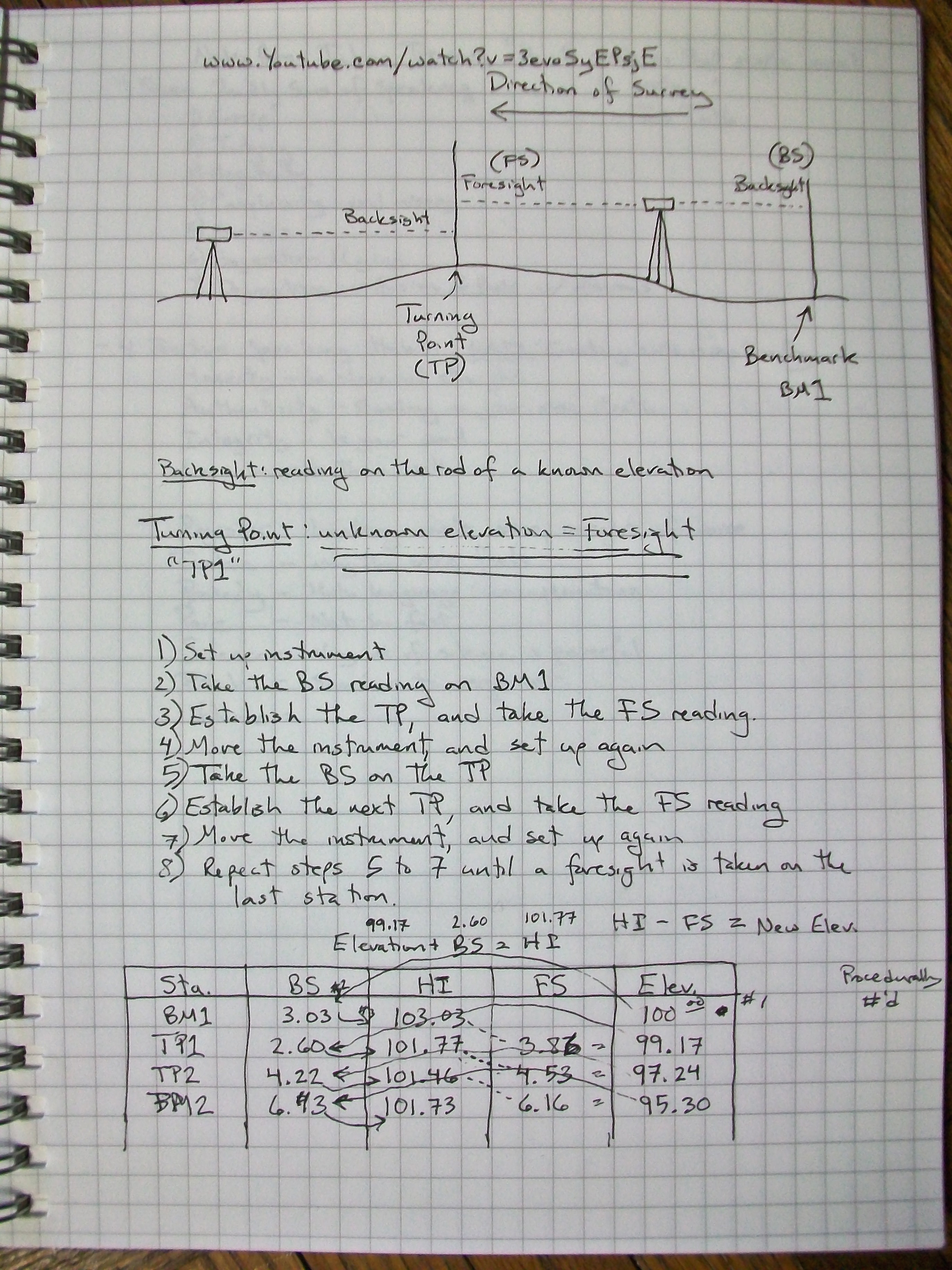
My evening notes from watching YouTube land survey tutorials while working on road construction in the Bakken summer 2014.

My evening notes from watching YouTube land survey tutorials while working on road construction in the Bakken summer 2014.

I spent several months working around Williston and Watford City, North Dakota. Williston is the arguable center of the Bakken universe, and Watford City can easily contest that. While in Williston, I befriended colleagues in the important business and profession of Land Survey. I helped them out, watching intensely what they were doing, and anticipating what they would need from me 2 to 5 chess moves in the immediate future.

We searched for section line corner markers throughout the summer. This is applied historic archaeology at its finest. In addition to me learning what land surveyors do, the land surveyors would ask me about my line of work, the world of cultural resource management and historic preservation. It was fun to show them, for example, stone circles in situ within the Native prairie, and to explain to them what different tribal groups have explained to me about the importance of those stone circles.

I also took up some work with a land survey group on the Watford City bypass. I helped pound hubs, as the phrase went. Pounding hubs means that wood stakes are driven into the ground with a 3lb hammer to specific elevations. The head construction manager then uses these stakes to determine where gravel and soil needs to be unloaded by a seemingly endless convoy of semi-tractor trailers. All of the drops are recorded .

While pounding hubs in the day, I wanted to learn about the gauging and marking of elevations with a level. After work in the late evenings I plugged into YouTube and brought up land survey tutorials. I familiarized myself with back-sighting and fore-sighting, turning points and benchmarks. I also took notes.

I thought about all of that this morning as I read what Loretta Jackson-Hayes said about the importance of science, humanities, engineering, arts, mathematics, and technology, at least if we are going to understand existing systems and create new and better systems for tomorrow. I hear the phrase STEM (Science-Technology-Engineering-Mathematics) and another phrase STEAM, which adds “Art” to the original STEM. That’s important, but I want to advance the phrase SHTEAM, adding the “H” for Humanities. Civilization and culture is in a perpetual state of evolution. It has to be to stay healthy and thrive. We can train those tomorrow how not only to respond to culture, but how to spearhead culture, to be the avant-garde. Okay, my tangent has to end for now, because I need to dash to my luncheon.


Washington, DC and Dakota Territory: Then and Now

US Dakota WarsA Washington, D.C.-Minnesota and Dakota Territory historical note: the US Capitol cast iron dome approached final construction at the same time that the US-Dakota Wars unfolded in Minnesota and Dakota Territory from 1862-1864. On December 2, 1865, the “Statue of Freedom” was placed on top of the US Capitol dome. To bring this into the present, The Smithsonian’s National Museum of the American Indian (SNMAI) has a Dakota-US War of 1862 exhibit up through December 29, 2015. This is a bulletin that speaks to that outside of the SNMAI’s entrance. The US Capitol’s cast iron dome in the distance is undergoing a much needed preservation/rehabilitation update. Here in the Dakotas, we are undergoing a much needed reappraisal of the US-Dakota Wars.


Updates on Aaron Beede and UND’s Digital Press

One of the only known 6:23AM screen shots from the NDDOT road conditions website on January 21, 2015.

One of the only known 6:23AM screen shots from the NDDOT road conditions website on January 21, 2015.

It’s about 6:20AM (at least as I sit down to type), and the snow is letting up. I’m sitting in a hotel room in Minot, Ward County, North Dakota, on the eastern edge of the Bakken. I have a short field-research trip to the west, but I’m temporarily yielding to the ND Department of Transportation’s road conditions map. Which appears like this, at left. I’m updating this blog post with a couple items on my brain.

The first is another public history sighting of Reverend Aaron McGaffey Beede, PhD. Beede figures seriously in the history of North Dakota, and only a handful of scholars have sifted through his papers. Last week, during a lunch meeting in the Peacock Alley, in historic downtown Bismarck, I sat at a table and looked over the picture to my left. In addition to offering delicious food (I ordered the half-prime rib lunch special with chips), the owners of the historic Peacock Alley have reproduced numerous local historical photos to hang on the walls. This was one of them. There is a gentleman addressing the legislature, with cigar in left hand. I accidentally cut out of the photo the ash tray at the foot of the podium. Believe me: it was there. Those were different times.

Beede

Note the ND legislator from the ’20s or ’30s, with cigar in left hand, and the nameplates on the desks behind him. “Beede, Grand Sioux” is behind him.

Behind that, behind the name Saumur of Grand Forks, is “Beede, Grand Sioux” agency or county. It was great to see the photo, and that is about all I have on it right now. I’ll do some more tracking on this. Beede figures into a chapter of my ongoing dissertation which, roughly, figures into how and why the US-Dakota Wars were remembered on the northern Great Plains. Beede was formative in shaping and pushing that memory in one direction, arguing just after the turn of the 19th century that Natives need to be listened to and allowed to tell their version of history. It was serious push-back against the Social Darwinian and Manifest Destiny crowd (some of which is still around today).

And finally, the third item is a hot-off-the-digital presses book, the second title from University of North Dakota’s The Digital Press, Visions of Substance: 3D Imagining in Mediterranean Archaeology (edited by Bill Caraher and Brandon Olson). The work is an anthology of blog posts Caraher charged guest writers with publishing at his blogspot linked to here. Susan Caraher edited the blog posts to comb out any of the craziness that is inherent in on-the-spot blogs. Caraher and Olson told the guest writers to respond to the following questions in each post. The questions include:

  1. How do we understand the current crop of 3D modeling technologies in the context of the history of archaeological imaging? Are the most optimistic readings of this technology a mere echo of earlier enthusiasm for photography in an archaeological context or is this somehow qualitatively different?
  2. Is there an emerging consensus on best practices of 3D imaging of archaeological sites? What are the current limits to this kind of technology and how does this influence the way in which data is collected in the field?
  3. How do we understand archival considerations for 3D models and their dependent data? For example, what happens when we begin to prepare archaeological illustrations from 3D models collected in the field and processed using proprietary software? How do we manage the web of interrelated data so that future archaeologists can understand our decision making?
  4. What is the future of 3D modeling in archaeology? At present, the 3D image is useful for illustrating artifacts and — in some cases — presenting archaeological and architectural relationships, but it has yet to prove itself as an essential basis for analysis or as a viable medium for communicating robust archaeological description. Will 3D visualization become more than just another method for providing illustrations for archaeological arguments?

Without going further into this (it’s about 6:50AM, and I need to move forward with the morning), you can read the entire collection of academically produced and academically edited and academically published essays, for free, at this link here. Thanks Bill and Brandon and Susan for compiling this. I know there will be many more.


The Latest Theodore Roosevelt Scholarship

I’m sitting here with a couple fresh biographies of Theodore Roosevelt, getting a little downtime around the 10:04PM hour. To my right is Edward P. Kohn, Heir to the Empire City: New York and the Making of Theodore Roosevelt (Basic Books, 2014) and Paul Grondahl, I Rose Like a Rocket: The Political Education of Theodore Roosevelt (Free Press, 2004). Being from North Dakota, these are nourishing reads since, naturally, North Dakota has claimed Theodore Roosevelt because Theodore Roosevelt claimed North Dakota.

They are nourishing reads because Kohn’s central idea challenges traditional TR scholarship (a Great White Battleship’s worth) which accepts TR’s ideas about himself as being a cowboy and American westerner. Kohn says no. He says TR was a New Yorker through and through. Kohn opens the introduction by saying, “Theodore Roosevelt’s path to the White House may have gone through the West, but it did not start there.” This is true.

Grondahl’s work situates TR as a young man in his freshman year with the New York State Legislature. In 1882, TR entered the assembly chamber in Albany, New York. In the second paragraph of the prelude, “Practical Politics,” he sets the stage for the reader, at least what TR was facing, using the present tense for added reality and to situate the reader in 1882:

“The atmosphere in Albany during the legislative session is part carnival, part college fraternity. Some of the city’s denizens are just passing through, looking to ride along on the political parade for a while. Others arrive full of idealism and a burning desire to make meaningful change. A few seem perplexed to be elected public officials in the state’s capital, as if they had awoken from a Rip van Winkle-like slumber to find themselves holding a seat in the Assembly or Senate. It’s a dream job for some, a nightmare for others. Many build their reputations here. A few sacrifice their respectability on the alter of politics, learning the rules only to abuse them. The Legislature is a closed system, a kind of political union shop. The principles of prep school secret societies guide its old boys’ network, clubby familiarity, oaths of loyalty, and rituals of initiation.” 

This is what TR faced when he caught wind of the plans of “Big John” McManus, one of Tammany Hall’s “persuaders.” McManus wanted to haze TR by tossing him in a blanket. TR, though, having fought his childhood through asthma and monetary privilege, made a bee-line for McManus and, flat out, said to him, “By God! McManus, I hear you are going to toss me in a blanket. By God! If you try anything like that, I’ll kick you, I’ll bite you, I’ll kick you in the balls. I’ll do anything to you — you’d better leave me alone.” This method, later popularized by Rooster Cogburn, worked.

While I’m only in the introductions to both, I don’t see the biographies by Grondahl and Kohn challenging the traditional TR scholarship so much as they do to humanize TR. Life is about change, and it is about evolving as human beings, and as circumstances warrant and dictate. It’s important to remember that, lest we think of historical actors as monolithic (a fancy way of saying 1 dimensional).


Northern Great Plains Cowboy Poetry: Shadd Piehl

Shadd PiehlWestern Americana persists and thrives on the northern Great Plains. A photo of a poem from cowboy poet Shadd Piehl, this commissioned by the Hotel Donaldson, Fargo. Shadd is a good friend.

The Bohemian pulse runs thick in the Piehl DNA (see here for detail). Some days I know we’re living out a long extension of a Willa Cather My Ántonia novel here in the 21st century. We’re sitting in the saddle of the 49th parallel on the northern Great Plains, North America.