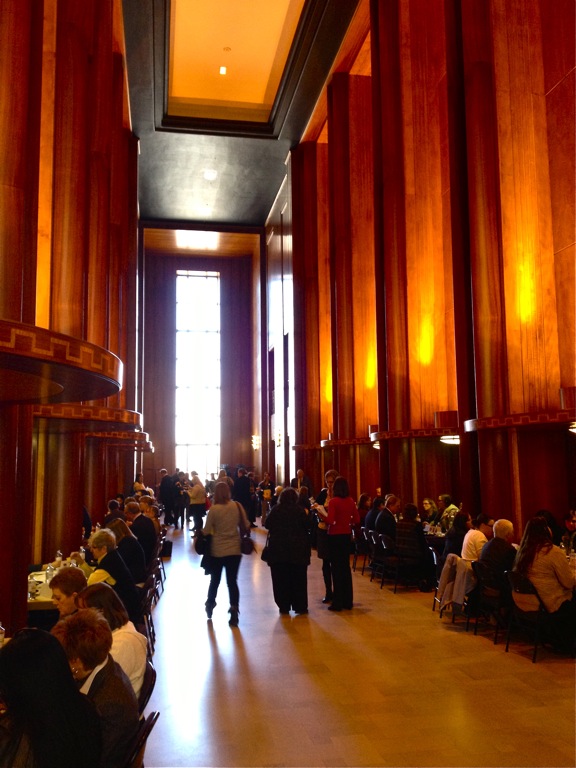
This last weekend I dropped into Bismarck to catch up with my folks, to do a bit of research, and to take in a bit of the WE Rise event with Molly McLain, Karis Thompson and others at the state capitol. The luncheon for the WE Rise gathering was also held in the Great Hall at the capitol. The Great Hall is, unsurprisingly, a really great room, with tremendous verticality. At least this is the perception I had, having grown up on the Great Plains which is more horizontal than vertical. The Art Deco aesthetics (from 1925 and on) also reminded me of the 21st century Steampunk movement. Below are a couple photos of the Great Hall from March 11, 2013.
Author Archives: Aaron Barth
Memories and Material Culture for the State Historical Society of North Dakota

This is a historic pony truss railroad bridge that spans the Missouri River between Bismarck and Mandan. It is a cultural icon, and has an infinite amount of individual stories attached to it.
Think of this for a second: one of the primary interests and concerns of historians is that memories are fixed to the stuff we use and live with. Memories are also fixed to the stuff that our parents, grandparents, and great grandparents used (landscapes, homesteads, historic buildings and structures included).
I recently received an e-mail forward from archaeological comrade and colleague Amy Bleier, Research Archaeologist with the State Historical Society of North Dakota (SHSND). As the lot of us within range of Bismarck already know, the SHSND is experiencing a much-needed expansion. This also means that Len Thorson, the Registrar with the SHSND, is looking for material culture, or 3-dimensional objects, or what we call “stuff.”
Stuff is much more meaningful if it has those stories and memories fixed and secured to it. And it allows historians to do what historians are trained to do: track change through time.
Thorson sent out the following e-mail the other day. It is cut and pasted below. In Thorson’s words:
The Museum Collections Committee is looking for contemporary items from North Dakota businesses and organizations that you have purchased and/or used… or someone you know who would be willing to donate objects to the SHSND. The items should be relatively small (for space considerations). A history of the object(s), along with appropriate documents and photographs, would add much historical significance to the objects.
Examples include product packages from Cass Clay, Hugo’s Family Marketplace, Dakota Pasta, Noodles by Leonardo, Red River Commodities/SunGold Foods (SunButter), HIT Inc. products, or many other products listed on the Pride of Dakota webpage: http://www.prideofdakota.com/
Other items (used in ND) we are seeking include: beekeeping equipment and supplies; Highway 10 memorabilia; items showing ND school consolidation; solar power devices; objects from the Bank of North Dakota; contemporary powwow related items; contemporary immigration related items; and modern agricultural items such as GPS equipment, and air seeder/drill parts, etc.
If this is something you wish to participate in, please let us know, but PLEASE don’t bring objects in for us to view. Simply reply to this e-mail, or even better, provide the information requested below. The information requested by us may also be sent online via the form at http://www.history.nd.gov/data/padq_emailform.html
Consider this. It is important. If you have some sweet modern artifacts — in the business, we often call this contemporary or modern archaeology and history — with a memory attached to it, you might contact Registrar Thorson, or anyone from the SHSND Museum Collections Committee. It is by and for North Dakotans.
Gerald Friesen, “The Canadian Prairies: A History” (1984)
Published in 1984, the synthetic work that is Gerald Friesen’s The Canadian Prairies incorporated hundreds of books, articles, and government reports to give readers a glimpse of the long historical processes — Fernand Braudel’s longue durée — that unfolded within the western interior of Canada from 1600 up through the middle of the twentieth century. The book begins with a general introduction of the geology that shaped the region’s physiography, an area that is organized into three parts. In the east is the prairie, and west of that is a step (or steppe) up to the parkland, and then higher yet the forest. The prairie is the area of the Red River Valley and Lake Agassiz basin, and as Friesen says it rolls “seemingly without end north and west.” The parkland region is composed of gentle rolling hills and valleys, with prairie potholes and fertile soil. Further west of the parkland is the northern extension of the Rocky Mountains and the Boreal Forest. This area has outcroppings of rocks, frigid lakes, and a portion of forest that is part of a broader network of spruce and pine that extends from Newfoundland to Alaska. (Friesen, 1984: 3-9)
Throughout the narrative, culture constantly interacts with the natural world. The year of 1840, however, provides an industrial point of demarcation within this synthesis, and within the history of the Canadian interior. Prior to this, human inhabitants relied much on the broad and gradual swings of nature. Rivers served as transportation routes, and river courses often influenced the direction of trade flows and Native American diplomacy. Rivers, lakes and potholes also provided vegetation with a permanent water source, and where there was vegetation, bison would certainly gather. The global industrial revolution, though, eventually made available such things as steamboats, firearms, agricultural implements, and railroads, and by the latter half of the nineteenth century, the interior of the Canadian west had been altered as never before. The Canadian government favored settlers, and Native American nomads became “wards of the state — put bluntly, they would be treated as children.” (Friesen, 1984: 129)
Two of the passages in Friesen’s work that explain this cultural change come in the form of primary and secondary sources. As a primary source, Friesen quotes Isaac Cowie and his wagon-train experience when maneuvering through a herd of bison. Cowie said in,
…the midst of the herd, which opened in front and closed behind the train of carts like water round a ship… the earth trembled day and night… as they moved… over the inclinations of the plains. Every drop of water on our way was foul and yellow with their wallowing and excretions. (Friesen, 1984: 8)
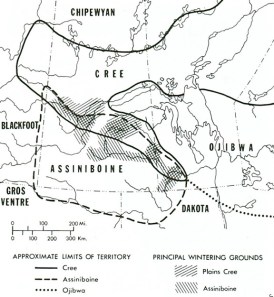
Further in Friesen’s work is his own anthropological understanding of the furious alteration of old ways that were increasingly giving way to global industrialization. Commenting on the Cree, and placing the reader in that perspective, Friesen said,
A typical Cree youth might have been hunting buffalo and raiding for horses in the 1860s just as his grandfather had done sixty years before; in the 1870s, he might have succumbed to the whiskey trade or been struck by an epidemic; almost certainly he would have been removed to a reserve and perhaps even taught the rudiments of agriculture. In the 1880s, some of his children might have been attending school, and he, having faced starvation for three or four years in succession, might have participated in the violence associated with the 1885 uprising… the buffalo had disappeared, trains and fences and towns now dominated the plains, and the old ways had disappeared beyond recovery. (Friesen, 1984: 130)
Further thoughts on this induce a reader to consider how global population movements before and after the 19th century industrial revolution shifted and altered indigenous customs and habits with a rapidity never before seen or experienced. Localized accounts of this come in the form of Fort Whoop Up, and the expansive network of railroads that eventually eclipsed the smaller fur trade forts. Friesen is good at explaining this in a way that leads readers to envision themselves as individual Native Americans looking at endless waves of non-Natives and invaders colonizing their traditional lands. This, indeed, is the epitome of good history: it is not elevating one side at the expense of another. Rather, the good and excellent historian allows the reader to understand all sides, and how conflict and disorder came about and what resulted from it.
By the first half of the twentieth century, immigrants had flooded into the Canadian interior, and the result was cosmopolitan chaos. Again, Friesen’s prose shines as he places the reader into Winnipeg circa 1900.
To descend from the train at the CPR [railroad] station in Winnipeg was to enter an international bazaar: the noise of thousands of voices and a dozen tongues circled the high marble pillars and drifted out into the street, there to mingle with the sounds of construction, delivery wagons, perambulatory vendors, and labour recruiters. The crowds were equally dense on Main Street, just a block away, where shops displayed their wares in a fashion more European than British North American: fruits and vegetables, books and newspapers, coats and jackets stood on sidewalk tables and racks, even on the outer walls of buildings when weather permitted. (Friesen, 1984: 243)
This continues, as Friesen remarks on the smells of fresh earth and milled lumber from the Boreal Forest resulting from localized construction projects in downtown Winnipeg. He tempers the progress of nostalgic development with smells of “beer and whisky and sweat and horse manure” so that a reader does not get lonesome for a manicured past that never was.
Friesen’s synthetic narrative is a likely starting point for that long duration of the history of the Canadian west. In his introductory and concluding remarks, he chose to celebrate rather than chide the “superficial friendliness that makes daily contact between people of very different backgrounds not only possible but likely.” (Friesen, 1984: xiii) In 1984, Friesen looked kindly on the culture of the Canadian plains and prairie, and this is a marked difference from how Wallace Stegner portrayed it in 1955. For Friesen, curling represented “a most democratic sport,” while all Stegner could see in curling was the absence of tennis. In a large way, Friesen checked any kind of disappointment or snobbery at the door. This is not to throw Stegner under a bus or bison stampede. Rather, it demonstrates that throughout time, perceptions change, both for individuals who are direct participants in the past, and individuals who study and interpret their behavior. This, in a large way, is just as much a reflection of the culture the historian is studying as it is as the culture that the historian comes from.
Glenda Riley, “The Female Frontier” (1988)
Glenda Riley opened her 1988 work, The Female Frontier: A Comparative View of Women on the Prairie and the Plains, by lobbing a volley towards past Great Plains historians. Riley justified this volley by drawing from questionnaires she circulated to academics, students and lay people in the 1980s. (Riley, 1988: 14) She said that while academics were largely skeptical of the traditional myth and image of women on the Great Plains, it was students and laypeople that continued to accept these traditional images and myths. Within the first three paragraphs of chapter 1, she said Frederick Jackson Turner, George F. Parker, Everett Dick, Walter P. Webb, et al., were largely responsible for portraying frontierswomen as “one-dimensional stereotypes.” Women were often victimized as passive agents who were “gaunt and sad-faced… sitting on the front seat of the wagon, following” their “lord where he might lead” her. Or women were portrayed as “leathery, stooped, and lifeless figures who either begged to return home or persevered until they were broken entirely.” Riley uncovered a body of knowledge that undermined the “puerile stereotypes” ascribed to women on the Great Plains and in the American West, and she challenged a traditional way of looking at the past. (Riley, 1988: 1-2)
The historiographic crux of Riley’s argument elevated culture as the primary determinant of understanding how frontierswomen carried on their lives, and through this she discounted the environmental determinism Walter Webb advanced in his 1931 work, The Great Plains. (Riley, 1988: 12) Riley organized her work into two categories, and this included 1) women on the Prairie; and 2) women on the Plains. Women did much more than follow their lords. They managed households, preserved familial, religious and ethnic traditions by acting as local historians, Bible recorders, and genealogists, they shaped their domestic and local economy, and they participated in community and civics.
In this, Riley aptly accounted for the cultural roles of women, and also men. She said the socio-economic system of the nineteenth century required men to be “the primary breadwinners,” and this meant that women were expected to marry. (Riley, 1988: 15) If women wanted something else, they often would not marry, or they “forswore marriage entirely.” Instead, they could enroll in religious institutions that had missions dedicated to improving healthcare and education for the needy, unfortunate, or downtrodden. For example, in 1853 the Sisters of St. Joseph’s built the first hospital in St. Paul, Minnesota, and in 1872, the Sisters of Charity (or the Grey Nuns) came to Dakota Territory. Eight years later the Sisters of the Presentation of the Blessed Virgin Mary arrived. Once in the territory and on the Great Plains, they set out with the progressive mission of improving educational and healthcare facilities for otherwise marginalized groups. (Riley, 1988: 19)
Several thoughts came to mind while reading Riley’s work. The first was how breaking into established cultural orders and institutions can take on at least two forms. One way to change tradition and reframe the conversation is to go through back channels within the established institution, and try to reform it from within. Another way is to publicly denounce the institution. In the sense that Riley published her work in an academic press, it appears that she utilized both courses. She networked and made contacts within academic publishing houses, and they eventually printed her scholarship. This in turn brought about change in the historiography of the Great Plains and the American West, and this is at least one broad roadmap for any historian to incorporate and follow.
Another thought was that in 2013, Riley’s 1988 volley toward the traditional historians of the Great Plains and American West might at first read a bit bombastic. It does not read bombastic in the sense that Riley was out of line. Not in the least. Rather, it is a reflection of pathfinders and scholar-activists who, in some ways, appropriated and used the type of academic rhetoric that was used to marginalize them in the first place. In other cases, Riley’s rhetorical flourishes ensured that women — her included — would not be ignored. For Riley to call foundational historians of the American West “puerile,” and in an academic press, almost guaranteed that historians would have to bring their attention to bear on her and her scholarship. In this sense, Riley could also have a different sub-title to her book that read something along the lines of, The Female Frontier: A Comparative View of our Grandmothers and Great Grandmothers on the Prairie and Plains. This alternative and fictional sub-title might speak a bit more to 21st-century heritage and Public Historians rather than to 1980s feminist history.
A final remark about the continued shift in women’s scholarship looks to how Euro- and Anglo-American women view themselves, and how Margaret D. Jacobs treats this group in her 2011 work, White Mother to a Dark Race: Settler Colonialism, Maternalism, and the Removal of Indigenous Children in the American West and Australia, 1880-1940. But that is easily a topic and point of consideration for another review.
Vitruvius on the Liberal Arts
Sometimes when you’re revisiting the Ten Books On Architecture by Vitruvius, and you come across a quote from “Book 6: Private Buildings,” and the quote induces you to think about the philosophy of education in today’s universities, then sometimes you will feel compelled to blog the short thought.
In the introductory remarks to Book 6, Vitruvius paraphrased Theophrastus, who in turn “urged that people be well educated rather than relying on money.” He said this, education, or what he called encyclios disciplina, this today known as the Liberal Arts, was essential to an individual’s character. Theophrastus (through the lens of Vitruvius) said it was essential, because,
…an educated person is the only one who is never a stranger in a foreign land, nor at a loss for friends even when bereft of household and intimates. Rather, he is a citizen in every country, and may look down without fear on the difficult turns of fortune. He, whoever, who thinks that he is fortified by the defenses of good fortune rather than learning will find himself a wanderer on shifting pathways, beleaguered by a life that is never stable, but always wavering.
It seems reasonable to think that the Roman Republic and Empire held together for as long as it did in part because enough of its citizens took the above ethos seriously, at least that which emphasized a lifetime of education in the liberal arts, both for good times and for bad.
Hoarfrost at North Dakota State University
Every now and then, a celebration of winter aesthetics is in order. Here is a photo taken on the afternoon of February 26, 2013, on the campus of North Dakota State University, Fargo.
N. Scott Momaday, “The Way to Rainy Mountain” (1969)
N. Scott Momaday, The Way to Rainy Mountain (1969) set the Kiowa oral history to print, and in the 1994 preface, Momaday explains how the work is split into three voices. The first voice is that of Kiowa oral and ancestral history, the second is a type of historical commentary, and the third is the personal memoirs of Momaday himself. For this reason the entire work is a kind of historiography, or the way in which historians remark, opine and reflect on the works of their predecessors. The importance of The Way to Rainy Mountain is not only that it sets an oral history to print, but also that it allows non-Kiowa individuals access to the depth and scope of Kiowa culture. Momaday demonstrates how the Kiowa interacted with the Great Plains over generations and have a genealogical investment in the landscape.
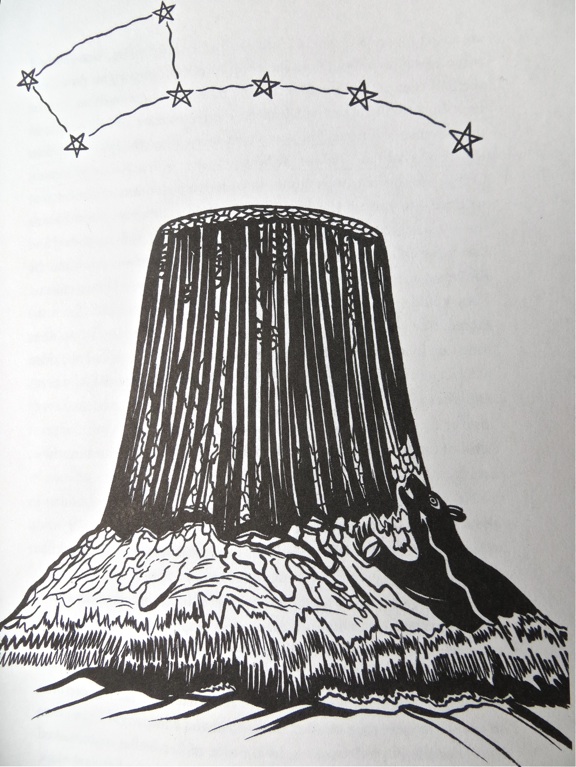
Like many cultures throughout the world, the Kiowa were nomadic, and their oral history and legend reflects this. Genesis for the Kiowa took place when the Kiowa as a people emerged from a hollow log in the “bleak northern mountains” of today’s Montana. (Momaday, 1969: 3) They eventually ended up in central Oklahoma, but along the way they impressed stories of themselves into the land. The Kiowa, for example, “made a legend” at the base of Devil’s Tower in northeastern Wyoming, and connected this legend with the astronomy configuration known as the Big Dipper. Momaday’s grandmother said:
Devil’s Tower illustration by Al Momaday in N. Scott Momaday, “The Way to Rainy Mountain” (1969), 9.
Eight children were there at play, seven sisters and their brother. Suddenly the boy was struck dumb; he trembled and began to run upon his hands and feet. His fingers became claws, and his body was covered with fur. Directly there was a bear where the boy had been. The sisters were terrified; they ran, and the bear after them. They came to the stump of a great tree, and the tree spoke to them. It bade them climb upon it, and as they did so it began to rise into the air. (Momaday, 1969: 8)
The bear scraped its claws along the base of the tree stump, and eventually the seven sisters rose from the top of this stump into the sky to become the Big Dipper. This story allowed the Kiowa to immediately identify with the Big Dipper, and with today’s Devil’s Tower. So long as the Kiowa were under a clear sky at night, the sight of seven ancestors shining starlight down on them could always provide them with comfort.
The second segment of the book, “The Going On,” opens with anecdote, a story about an old man, a wife and child. The child, innocent to the workings of the world, repeatedly asks his mother for food, leaves the house with it, and returns empty handed only to ask for more food. The third time the child returns, but with an enemy. This enemy tells the family of three, “There are many of us and we are all around. We came to kill you, but your son has given me food. If you will feed us all, we will not harm you.” (Momaday, 1969: 44) The old man is highly suspicious of this offer. His wife obliged the enemy’s request and began cooking while the old man secretly led his horses upstream. After bringing his possessions out of danger, the old man “called out in the voice of a bird” to his wife. She then set fire to the animal fat and tallow, threw it on the enemies, picked up her child and ran to the old man. The story might be used to explain the innocence of children, as enemies or malicious people can easily manipulate them. It could also be used to explain how it is wise to be skeptical of outsiders. In the kinship sense, this story also explains how the family of three looks out for one another.
The utility of anecdotes and stories such as these in any culture is multifaceted, and even biblical. To understand the Kiowa requires a degree of analogy (In The Landscape of History, [2002] Lewis Gaddis remarked on the importance of analogy for this and other reasons). The Kiowa and other cultures throughout the world infused stories and oral history into the physiography, and by this the culture became interconnected with the landscape and surroundings. Momaday’s 1969 The Way to Rainy Mountain was published almost 25 years after the revolt of the provinces, and almost 4 decades after the publisher of the University of Oklahoma Press called on academics and scholars to study Native America with the same intellectual rigor that they had brought to bear on Mediterranean culture.
Momaday’s work also communicates a kind of finality to this culture and others, and this also smacks of Stegner’s Wolf Willow (1955) and Kraenzel’s Great Plains in Transition (1955). Yet at the same time, it also brings about the notion found in Dorman’s Revolt of the Provinces (1993), specifically with John Joseph Mathews, Wah’Kon-Tah: The Osage and the White Man’s Road (1932). When the artists, scholars and literary figures revolted in America’s provinces and periphery during the interwar years (between WWI and WWII), Mathews finally found that the way to preserve and become a proponent of a culture was not necessarily to just recount and study it. (Dorman, 1993: 70-71) This was a part of it, but to truly locate authentic culture required the individual to become a practitioner and contributor to that historic cultural process. In this way, Mathews solved his 1930s dilemma through art, and specifically through Native American Art. Considering that Momaday published The Way to Rainy Mountain in 1969 raises the question as to whether a second volume is necessary to expand on and continue what Dorman ended in 1945. I certainly think so.
When Goats Yell Like Humans
In the last two weeks, I came across a YouTube video, Goats Yelling Like Humans – Super Cut Compilation. As of 16:21 (CST), February 23, 2013, the 2:05 minute video is up to almost 7,000,000 views. When I first caught this video, I thought it was remarkable how much the yelling goats sounded like humans. I kept replaying this video, eventually to the point where other folks in the same room asked me to stop.
Here is the video, imbedded:
In the last couple days, I learned and thought about a couple things.
- The first is that when goats yell like humans, they are in pain and distress. I learned this from Linda Whitney (whom I know of as Aunt Linda, because she is my aunt). Linda knows about these sounds because she has raised goats. If we hear goats making these sounds, we need to know that they are either scared, hungry, need milking, or they are looking for their friends, the herd. Or there is something genuinely wrong with them in that they are physically hurt or sick. If we hear goats making this sound, it is okay for us to seek out and alert their caretaker, or a veterinarian.
- While watching the YouTube of these goats yelling like humans, it also reminded me of the Pinocchio story, and how the Italian author, Carlo Collodi, eventually turned the liar, Pinocchio, into a donkey. Certainly there is something genuinely wrong with someone who lies in the same way that there is something wrong with a goat that yells like a human.
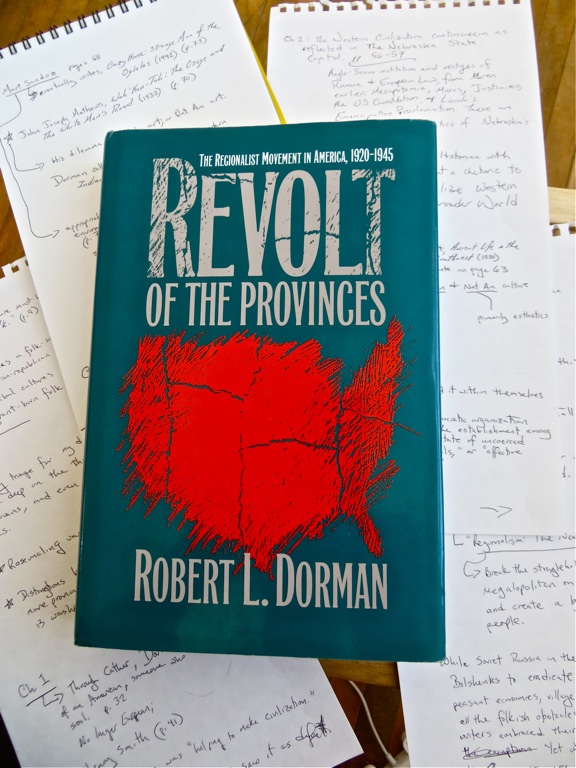
Robert L. Dorman, “Revolt of the Provinces: The Regionalist Movement in America, 1920-1945″” (1993)
In the 1993 work, Revolt of the Provinces, Robert L. Dorman defines “regionalism” in his introduction with trans-historical discourse between 18th century J. Hector St. John de Crèvecoeur and 20th century Lewis Mumford. In the pre-Industrial and Industrial cases, Dorman says Crèvecoeur and Mumford spoke of “the transformation of the immigrant into the indigenous,” or the way in which the recently arrived abandoned or restructured previous ways of doing things. In Crèvecoeur’s time, this meant the European, once they stepped on to the eastern American seaboard, was no longer shackled by the “medieval synthesis” of the Old Country. Approximately 200 years later, Mumford, in 20th century Industrial America, worried how the increasingly hyper-Industrialized world fragmented Crèvecoeur’s 18th century America. Writing from an “enclave in the midst of an industrial desert,” Mumford said “Something of value disappeared with the colonization of America,” where industrialization and modernity had ruptured a common “social heritage.” Mumford then proceeded to ask why it, the common social heritage, disappeared? (Dorman, 1993: 1-7)
This draws attention to the impetus for the regionalists’ approaches between 1920-1945. It was both a searching out for and cultivating of that lost common, social heritage. Both Crèvecoeur and Mumford could agree that heritage was “a genuine American culture,” and this culture was “grounded on the concept of the folk.” (Dorman, 1993: 9) In the first half of the twentieth century, a regionalist began to think of folk and folk traditions as
…organic, but not merely in the sense that they enfold and help to constitute the personal identity of the individual. They are organic as well to a place, symbiotic and indigenous to a specific regional environment… The folk are settled, stable, a veritable human “climax-community,” to borrow a term from ecology. (Dorman, 1993: 9)
To a regionalist, the folk embodied a kind of cultural stability. Following the Great War, regionalists throughout America gained a greater collective intelligence as to exactly what they wanted to do, and they ultimately turned regionalism into a civic religion. The regionalist movement sought to emancipate individuals from the industrial, scientific and standardized shackles of mass culture. Dorman explains how academics, novelists and scholars captured and cultivated the civic religion of regionalism throughout America between the first and second world wars. His first chapter opens with a Willa Cather quote from O Pioneers!, and that is how “The history of every country begins in the heart of a man or a woman.” In this singular sentence, Cather is remarking how individuals in their own particular localities have a particular spirit, a genuine love or heart for a place, and through this a sense of history and community is cultivated.
We see this in Cather’s My Ántonia (1918), and also in Walter Prescott Webb’s The Great Plains (1931). In this latter case, Webb’s work is no doubt tinged with Anglo-Ameri-centrism (what we might call Social Darwinian Racism-Light). But what Webb also attempted to do with The Great Plains was to cultivate historical memory in a particular region of America, and through this forge a common identity. By doing this, perhaps, the folk from the physical Great Plains could indeed have their differences — amongst the southern, central and northern Plains — but also be capable of a kind of unity. Through this unity, the folks on the Great Plains could identify with one another, and thereby oppose, navigate or manage non-Great Plains folks all the more (in many ways, this was a mission of Bernard DeVoto’s, a contemporary of Webb’s. At every opportunity, DeVoto played the America West, a plundered province, off of the east coast Fat Cat Tycoons and the Federal Government). Dorman’s monograph also can be contextualized with the 1950s works of Wallace Stegner and Carl Kraenzel. When Stegner wrote Wolf Willow (1955) and Kraenzel wrote The Great Plains in Transition (1955), they both considered the Great Plains and the American West in what they thought of as a kind of failed afterglow of the regionalist movement from 1920-1945.
In a closing (but by no means a final) remark, it is also interesting to consider Dorman’s subjects in a broad theoretical, history-of-ideas scheme of things. This regionalism was a part of a global movement, something that could be likened to R.G. Collingwood’s idealist and aesthetic reaction to the late-19th century “scientific positivism.” In a way, Dorman hints at this global movement when he compares American Regionalists to what was happening at the time in the Soviet Union. But he would have been better to compare Cather, Webb, Henry Nash Smith and Mari Sandoz to, for example, Vasily Grossman and his humanism, this instead of comparing American regionalists to official Soviet policy. While Soviet Russia in the 1930s encouraged Bolsheviks to eradicate regionalisms — peasant economies, village ties, languages, churches, all the folkish obstacles — so did Washington, D.C. encourage a much softer version of such policy, one that is laid out, for example, in Margaret D. Jacobs, White Mother to a Dark Race: Settler Colonialism, Maternalism, and the Removal of Indegenous Children in the American West and Australia, 1880-1940 (2011). In the first half of the twentieth century, Industrial Capitalism and Industrial Communism — or, to capture them both, Industrial Modernity — imposed itself on the world and its regions. In our post-Cold War, 21st century world, scholars are perpetually in a position to push global, regional and public historical knowledge in infinitely new directions, and Dorman’s 1993 work has set down an excellent foundation.
Punk Archaeology Recap for Dakota Goodhouse

A photo of the evening crowd at the NDHC Punk Archaeology un-conference in downtown Fargo, North Dakota.
Today my good friend Dakota Goodhouse, staff with the North Dakota Humanities Council, sent out a group e-mail and asked individual board members to reflect on and write a short summary about a particular North Dakota Humanities Council event they attended. Dakota said he would accept these write-ups, consider them, and eventually post them on the NDHC blogspot sometime down the line. So this is a draft of what I wrote, photos, hyperlinks and all:
On the evening of February 2nd, 2013, at Sidestreet Grille and Pub in downtown Fargo, North Dakota, the first global Punk Archaeology un-conference unfolded with song, bullhorn, academic rants and discussion, and more bullhorn and song. The event was simple enough: get a group of scholars together in a tavern, get an audio-video system and a pitcher or two of beer, and have these scholars openly talk about and consider why and how “punk” might be part and parcel to the disciplines of archaeology, history, and art history.
Scholars from North Dakota State University, the University of North Dakota, Concordia College, and Franklin and Marshall College (Pennsylvania) contributed to the discussion. Considering that a winter storm pummeled central and eastern North Dakota that night — that evening, the North Dakota Department of Transportation shut down I-94 between Bismarck and Dickinson — an approximate audience of 300-to-400 visitors to the 5-hour Punk Archaeology un-conference was considered more than a success. One noticeable difference of conferences compared to un-conferences, at least noted by University of North Dakota’s Bill Caraher, was that at punk archaeology un-conferences, scholars are introduced with a bullhorn, and then they are required to give their talks through the same PA that the punk bands play through.
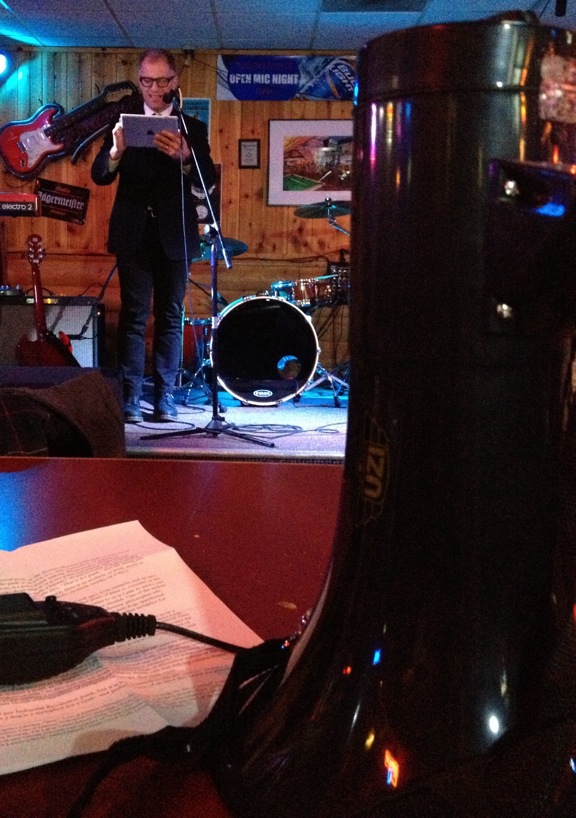
Dr. Kostis Kourelis, punk archaeologist and art historian with Franklin and Marshall College (Pennsylvania), gives his thoughts on punk archaeology through a PA after being introduced with a bullhorn.
In the weeks that led up to this event, a variety of Red River Valley media outlets contacted me, as they were understandably interested in what was meant by the phrase Punk Archaeology, and also what an “un-conference” entailed. Without me rehashing everything that was said, here are the hyperlinks to the media punk archaeology frenzy. Bob Harris of KFGO 790AM in Fargo-Moorhead interviewed me on the evening of January 21, 2013. The first segment of that interview is linked to here, and the second installment is linked to here. On January 23, Kris Kerzman put together a Punk Archaeology write-up for the The Arts Partnership blog here, Kayleigh Johnson ran a Punk Archaeology story in The High Plains Reader on January 31, 2013 linked to here, and The North Dakota Free Press covered it on February 1, 2013 here. The Fargo Forum covered the story in two different instances, once in a January 23, 2013 blurb here, and John Lamb’s January 29, 2013 write-up of it here. Steve Poitras asked me to chat about this event during his February 2nd, Saturday morning Fargo-Moorhead radio show on 101.9 FM from 7:30-to-8:15AM. So I did that too. This was what the official press covered, and it went over well.
Several additional sponsors of Punk Archaeology included Laughing Sun Brewing (Bismarck), Tom Isern’s Center for Heritage Renewal (NDSU), the Cyprus Research Fund (UND), and the Working Group in Digital and New Media at the University of North Dakota. In all, it was an event that brought together North Dakota State University, the University of North Dakota, and the North Dakota Humanities Council, among others.In closing, here his Bill Caraher’s blog-spot recap of Punk Archaeology linked to here. It happened. And it was awesome. And there is light banter about doing it again.