Tag Archives: History

Flag Day and Thoughts on Art and Growing Gardens

On Thursday evening (06/12/2014), Molly and I strolled down to the Plains Art Museum to hear Sandra Menefee Taylor speak about her exhibit, Heart/Land: Sandra Menefee Taylor’s Vital Matters. This exhibit is on the 3rd floor of the Plains, at 704 First Avenue North in downtown Fargo, just in case you’re in the area and want to visit. Two things among many stand out as I think back on taking in the talk and the exhibit.

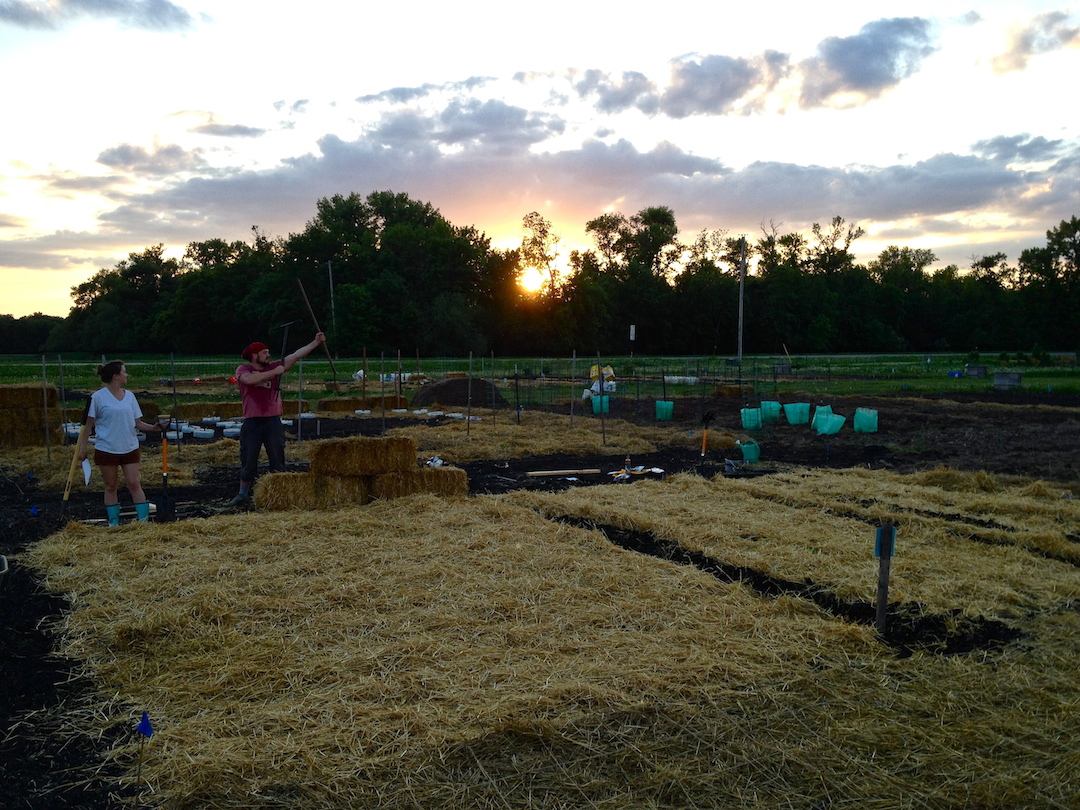
Planting at our Probstfield Farm plot in early June 2014. View to the west, the setting sun dropping behind the trees.

Planting at our Probstfield Farm plot in early June 2014. View to the west, the setting sun dropping behind the trees.

The first was an all too brief conversation with Abby Gold about farming, or gardening, at the historic Probstfield Farm just north of Moorhead, Minnesota. Molly and I, and two of our friends, decided to go in on a small community garden plot, the idea being that the four of us can more easily tend to such a garden than two or one of us.

I told Abby that when one has a garden, or a farm, one is suddenly paying more attention to weather patterns, especially rain. If we don’t have rain for more than a day and a half, then it means someone has to go and irrigate: literally one of us has to coordinate with the others, and say, “Okay, we’ll run up to the farm this evening, walk over to the watering station with buckets, and haul water back to our plot and gently water each row.” This, in turn, means that we are connected to the soil and land, at least if we want a harvest (and at least if we want to harvest beans so we can pickle them).

I said all this (more or less) to Abby, with the broader idea of how gardens are healthy for the psychology and soul. If I did not have a garden like this, irrigation would not cross my mind, and I would not pay as close attention to rain patterns as well. This garden, too, is bringing Molly and I, and our two friends, closer together, since we are privileged with the obligation of caring for our small rows of crops. We are a team.

The second point that stands out in my mind from Thursday evening was brought up during Sandra Taylor’s talk. It dealt with four ways in which one might consider approaching life. The four ways are as follows (and it turns out a lot of us already carry out these ways, but it’s nice to have someone articulate them):

  1. Show up. Be on time. I’ll add even another point: be early.
  2. Pay attention to what is going on in front of you. I’ll also add: research and think about what will go on in front of you, and then actively pay attention when it is happening.
  3. Speak the truth, and do so without judgment. I’ll add: we can tell the truth all the time, and we can do so without judging. It does not have to become entangled in emotion, or polemics, or name calling, and so on.
  4. Be open to the infinite range of un-intended outcomes. Or don’t be attached to a particular outcome. Things will never play out the way we think they will. So we might as well remind ourselves of that, and carry on.

Okay, I’ll end there. I just wanted to set this down and float it out there into the blogosphere. Happy weekend all. It’s Flag Day by the way, too.


Memorial Weekend

Memorial Day weekend burger grill.

Memorial Day weekend burger grill.

It’s Friday evening and Molly and I are sitting on the living room futon which now faces west. It points us in the direction of a screen porch, and beyond this we can see the youthful spring green of deciduous trees and leaves set against a background of grayish-blue sky. A storm is brewing out west for sure. You can smell it. Something to do with the ozone.

We live in pre-WWI construction, so we are also treated to a kind of pre-WWII sense of place. I haven’t been able to put words to the smell, but the smell I’m smelling reminds me of my late Grandma Christy’s house on the 700 block of North 4th Street in Bismarck, North Dakota. That house, too, was built prior to the First World War. Anything built before the Second World War has this sense of smell and place to it. The homes and apartments all have hard wood floors, radiator heating, and super tall ceilings. They were built before the invention and ascent of conditioned air.

My latest archaeological find of Minnesota Twins propaganda.

My latest archaeological find of Minnesota Twins propaganda.

So now that it is Memorial Day Weekend, I thought I would post the epitome of Americana. I love this stuff. Baseball and cowboy charcoal grilled burgers. Memorial Day weekend is a grand extension of Decoration Day, a Civil War day of remembrance.

This evening also got me thinking a bit about all the German-Americans that poured into the United States when, in the words of Lt. Aldo Raine, people were getting out of Europe while the getting was good. Massive religious and political upheavals in the 19th century (this is the most focused brush stroke I’m going to use right now) induced hundreds of thousands of Europeans to simply leave Europe. They crossed the Atlantic and poured in the United States. A large swath of these immigrants came from Germany, or German-speaking countries (I have often hypothesized that the reason Germany started two big ones in the same century had to do with this intellectual emigrant drain from the previous century). And the Germans, when they arrived in the United States, took up numerous causes. In some cases they played baseball. And in other cases they agitated for emancipation. I like to imagine that they also grilled burgers, too. Baseball and burgers. Happy Memorial Day.


Happy Mother’s Day

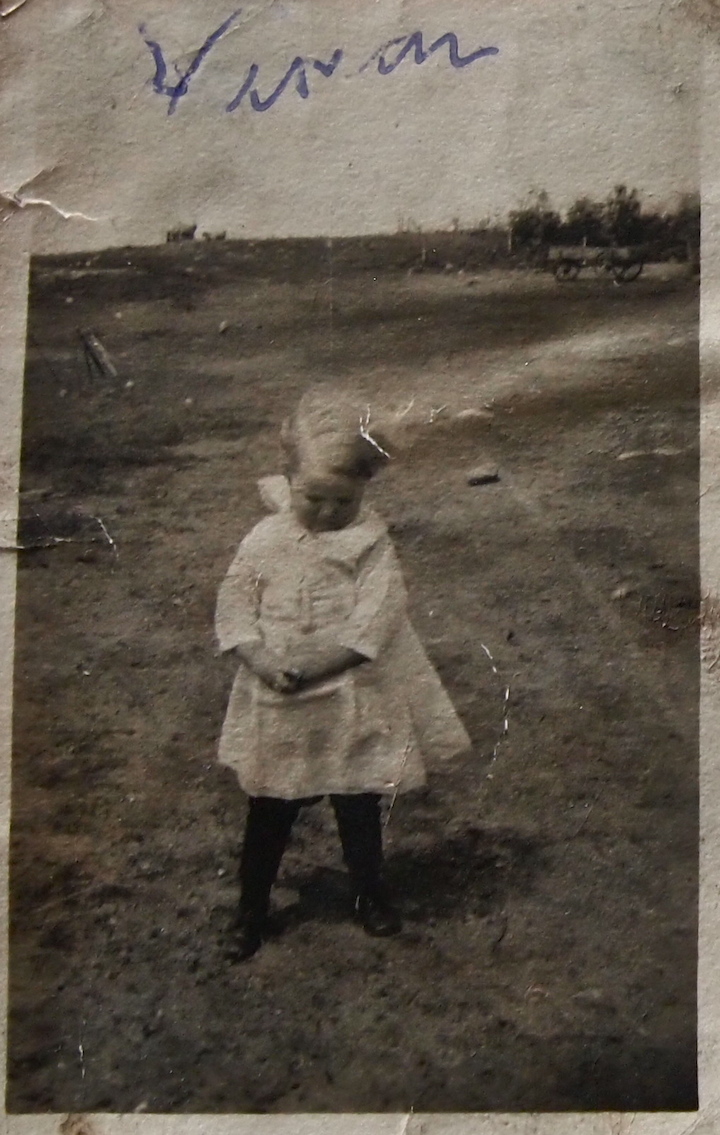
Vivian in the late-1910s on the Swedish-American farmstead just northeast of Bremen, Wells County, North Dakota.

Vivian in the late-1910s on the Swedish-American farmstead just northeast of Bremen, Wells County, North Dakota. That is Vivian’s handwriting at the top of the photo too.

It’s Mother’s Day (of course, every day is mother’s day). It is a holiday with origins in the post-Civil War (American) generation, championed by Anna Jarvis just after the turn of the 19th century. The idea was to get together all the moms who had sons die in the Civil War. Today we use it to recognized the heroine feats of motherhood.

Molly and I drove over to Bismarck, North Dakota, to spend Mother’s Day weekend with Julie and Paul (my parents). I also got flowers for Molly’s late mother a couple days ago, because mothers are all around us. Always. Last night, before bed, Molly and I (or Molly and Me, which has a nice ring to it) stumbled into a family archive in Julie and Paul’s basement. Numerous photos from my late grandmother, Vivian Marie (Larson) Barth, who passed away a year ago this month.

There are a lot of photos within the archive, and a personal project goal will be to digitize them, get family members digital copies, and then consider conversations with archivists at the State Historical Society of North Dakota or NDSU’s North Dakota Institute for Regional Studies or UND’s Special Collections for eventual curation. This is why we have state historical societies and regional archives: it captures what us global locals have been on about from one generation to the next. And it is better to digitize and then curate them with a sound archives than to keep them in a box in your basement (which can flood, or something like that).

But back to Grandma Barth, and a couple photos I digitized for uploading purpose here. To celebrate Mother’s Day. The photo at top is of Vivian, taken likely in 1918 or 1919, just northeast of Bremen, northeastern Wells County, North Dakota. The second photo is of Vivian in the mid- to late-1930s, likely when she moved off the farm to Bismarck, North Dakota. And the third photo was taken likely during or around the time Vivian was attending one of those late-1930s college programs to train as a secretary. She later held positions at the Bank and state capitol of North Dakota. She did this while tending to her three boys and husband (a total of four boys). She was loving (and still is), hard-working (I remember she gardened up until she was 91), and she babysat us grandkids countless times.

OLYMPUS DIGITAL CAMERA

Vivian in the late 1930s.


When I was real little, I remember being bummed out when my parents left for a couple weeks of vacation (I am blessed with great parents, so I tended to get bummed out in their absence). To set me at ease, before bed that night my grandma recounted a story of how her dad at the age of 13 boarded a boat in Sweden with his uncle, and set out for Ellis Island and America. She reminded me, “He was only 13.” Grandma had a way with bringing gravity and reason to any situation that was or seemed stressed. She also made extra ordinary chocolate chip cookies, Swedish meatballs, and, well, you name it. Here’s to you, Vivian. And Grandma Christy (for another blog, perhaps next Mother’s Day). And here’s to the memory of all mothers, and to making memories with our mothers today.

Vivian Marie (Larson) Barth, I'm thinking taken after she relocated from Bremen to Bismarck, North Dakota.

Vivian Marie (Larson) Barth, I’m thinking taken after she relocated from Bremen to Bismarck, North Dakota.


History Mash-Up: O’ Brother the Tennessee Valley Authority

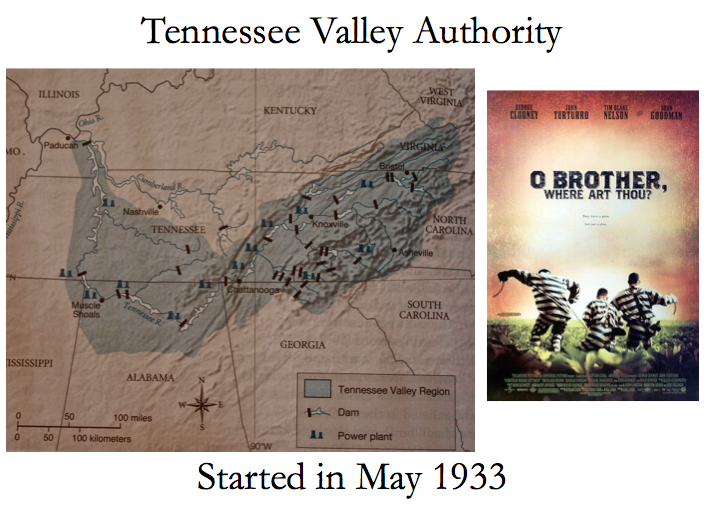
I call this slide, "TVA O' Brother," a combination of the map from Roark, et al., "The American Promise" (2012, p. 726) and the handbill for "O' Brother, Where Art Thou?" (2000)

I call this slide, “TVA O’ Brother,” a combination of the map from Roark, et al., “The American Promise” (2012, p. 726) and the handbill for “O’ Brother, Where Art Thou?” (2000)

For the second lecture on the Great Depression tomorrow at North Dakota State University in Fargo, I’m showing a map of the Tennessee Valley Authority with the handbill for “O’ Brother Where Art Thou,” (2000) the backdrop of the movie set in the TVA of the 30s. My reasoning is that 1) this is a fun visual; 2) the Coen Brothers are great; and 3) students in the future are much more likely to see “O’ Brother” than a TVA map. The idea is that both of these visuals will leave a singular imprint, and from here on out when they hear George Clooney lip sync, there’s a greater possibility that they’ll think about the history of the TVA, the Great Depression, FDR’s responses, hydroelectric power dams, etc.


Friends in Fargo this Weekend

It’s about 3:23PM, so I thought I’d break just a moment for tea and a blog entry to throw out a little PR for some colleagues and friends.

Two events are going down in Fargo this Saturday, March 15. Well, wait a minute: certainly there are more than two events going down in Fargo this Saturday. But here are the two events that I know of right now, this Monday afternoon. The two that I’m going to talk about. You should definitely go see other events, too, above and beyond this.

The first event is a benefit for a friend and scholar, Mike Casler. Mike was diagnosed with thyroid cancer in 2011, and he’s been through a battery of surgeries and radiation treatment. Mike, along with a bunch of us, are gathering at The Bowler in Fargo (2630 South University Dr.) anywhere from 4:00-11:55PM for the official Mike Casler Benefit Fund — again this Saturday, March 15. Also, Mike is the author and historian of several upper Missouri River scholarly works, including Steamboats of the Fort Union Fur Trade: An Illustrated Listing of Steamboats on the Upper Missouri River, 1831-1867 (Ft. Union Association, 1999); and he regularly collaborates and conspires (in a good way) with the Great Plains titan of anthro, archaeology and history, W. Raymond Wood (some of Ray’s works here, here, and here, and his memoirs here).

And also on Saturday, March 15, Keith Bear will be playing Mandan-Hidatsa flute at 8:15PM in The Avalon. This is a part of the larger Great Winter Crow Show organized by Dawn and the Spirit Room Galleries. Also check that out from 5:00-10:00PM. You can read more about Keith at this link here. The event is sponsored by the Avalon Event Center, the Lake Region Art Council, and the North Dakota Humanities Council.

Okay, that was a 5-minute blog post update. Back to it.


Some Thursday Teaching Notes

I rounded out another lecture for tomorrow, this on the particulars, complexities, triumphs and problems of the Progressive Era at the turn of the 19th century. After that I dropped into Bill Caraher’s blog and read a bit on his latest pedagogy, including the ideas of a slow archaeology part I and part II (which is great, and good to think about in our hyper-drive digital 21st century world). This, in turn, induced me to reflect just a bit on teaching this week at North Dakota State University.

The lectures I deliver, at least this semester at NDSU, are American History 1877-present. The class text is The American Promise: A History of the United States, by Roark, et al., (New York: St. Martin’s Press, Fifth Edition, Value Edition, 2012). The text itself is accessible, both in its prose and price (Amazon.com has the value edition listed at $48.38 with free shipping). Considering what I paid for required course materials during my 1999-2002 undergraduate training in history at the University of Minnesota-Twin Cities, this ranks up there with sensibly priced text books, even over a decade later in 2014 (presumably text books would cost more today than in 1999 — presumably).

I co-lecture (or lecture every 2nd or 3rd week) with Dr. Angela Smith, the powerhouse Public and Digital Historian within NDSU’s Department of History, Philosophy and Religious Studies (some of Angela and her student’s work linked to here). On Tuesday evening I led a non-mandatory review session with the students to prep them for their exam yesterday, Wednesday. The key to successful reviews are manifold: presenting the material in a repetitious but non-open-mouth-breathing kind of way.

Perhaps the most damaging thing a history lecturer can do is deliver history the way the stereotypical high school coach was charged with teaching history; that is, reading for 50 minutes directly from the textbook (which, in turn, reflects just how important American public school systems think of the teaching of history — sigh). Impressing the historical record into the minds of freshmen and sophomores requires the lecturer to revisit the knowledge, and rehash it in several ways. I’m also interested in what students are thinking, yet this can be difficult to extract from a reticent demographic. Of course, the more students become familiar with the lecturer, the more (in theory) they’ll feel comfortable in speaking up and out about their thoughts.

In the mean time, it is always interesting to figure out ways of gauging success. To do this I had the students who attended the review session sign in on, well, a sign in sheet, and at the semester’s end this will be compared with students who did not attend the review session. In theory, students who attended the review session will do better than non-attendees (in theory, right?).


Blizzard Day History Punk

As I type, I’ve got about 30 minutes before Troy Reisenauer picks me up and we head down to Les Dirty Frenchmen‘s global headquarters on Main in downtown Fargo, North Dakota for another Thursday night practice session. I have my earplugs in my front pocket, and I’m not OLYMPUS DIGITAL CAMERAafraid to use them: as we all get longer in the tooth, these sorts of measures are necessary. I don’t think many of us are eager to burn the punk rock candle at both ends the way that, say, the Ramones so dutifully did — punk rock road dogs for life.

Anyhow, earlier today — because universities were cancelled due to a death blizzard — I had a chance to review and prep for lectures I’m co-delivering with Angela Smith at North Dakota State University. Smith and I are rotating here and there, so that I’ll pick up a block of week-long lectures — American History, 1877 to the Present — intermittently throughout the semester. Today I revisited the required course book readings for the start of my lecture on Monday. The topic is the contested American West, and chapter 17 of the book opens with Frederick J. Turner. So this in turn induced me to yank several works by and on Turner off my shelf this evening, and currently I’m revisiting Allan Bogue, Frederick Jackson Turner: Strange Roads Going Down (U of Oklahoma Press, 1998).


Winter Oil Explosion in Casselton, North Dakota

At mile marker 340 on I-94 looking west.

At mile marker 340 on I-94 looking west. Oil plume just to the left of the signage on the horizon stretching south.

This afternoon while following up on a US-Dakota War historiographic line of research in the library at North Dakota State University, I received a few texts from a friend that read, “KFGO News says 7 oil tanker cars on fire, many have exploded near Casselton.” More went up after this text. This raised my eyebrow. It’s not often that oil tanker cars blow up in North Dakota, and my first thought was, “I sure hope this wasn’t in downtown Casselton.” I was thinking I would just stay in the library, but I also thought about how seeing something first hand is different from seeing it on the flatscreen. Historians are fanatics about primary sources. “Might as well make a contribution,” I thought.

A horizontal smoke from the oil explosion in Casselton, North Dakota.

A horizontal smoke from the oil explosion in Casselton, North Dakota. The setting sun just dipped behind it.

Molly and I drove out west of Fargo on I-94 to Casselton, about a 20 minute ride one way. Here are some of the raw observations: when we started in Fargo, the temperature was -3°F, and when we finished up in Casselton it read -5°F. Sun dogs were also out to the right and left of the sun. Wind was steady out of the north. As we left Fargo, the sun was setting and snow wisped north-south over the interstate. By mile marker 340, we discerned that the horizontal haze in the distance was indeed produced by the burning oil. Since the wind was blowing hard from the north, this horizontal streak stretched south over the horizon. In the flat Red River Valley of the north, this means that the streak stretched south and was visible for a very, very long way. The setting sun dropped behind this streak, some photos of which are included.

I took the exit off of I-94 into Casselton, and we drove north on Highway 18 that runs south-north through town. I eventually parked the car in a parking lot just to the northeast of where the east-west railroad tracks intersect the north-south Highway 18. This is raw video from that:

Here are some subjective thoughts from the outing: I’m uncertain if anyone was hurt, or worse. I hope not. We all hope not. I also thought about the variety of apartments, residences and businesses along these railroads. Molly and I live two blocks north of one of these rail lines. I have friends that live right along them. And what about our neighbors to the north who went through something much worse than this in October 2013 in Quebec. Then I thought of how this will certainly be politicized in

Photo looking west toward the oil fire in Casselton, North Dakota.

Photo looking west toward the oil fire in Casselton, North Dakota.

numerous ways. Then I thought about how the world — all of us — have been born into a culture that relies on petroleum. It’s kind of a cultural inertia, something America, the West and the world has been increasingly addicted to at least since the turn of the 19th century. It seems that until oil becomes expensive enough, there will not be a massive enough cultural effort to harness other energy sources. We see signs of it, of course, with wind turbines and the hydroelectric. But it’ll be a while before all of these other alternatives eclipse petroleum. That’s kind of the way with the petroleum industrial complex. There is plastic all around us, too.

Anyhow, stay safe in Casselton, all. Looks like they may have already started evacuating the entire village…


Dunedin and Edinburgh Urban Landscapes

We — the global we — are in the historical shadow of global colonial settlement and struggles, and I thought it interesting how Scottish settlers imposed their image of Edinburgh on the urban landscape of Dunedin, South Island, New Zealand. I’ve heard a few shop owners in the last couple days remark on this, so I pulled a couple maps off Google Earth and loaded them up here, right below. Note the similarity of the octagon, and also the common Moray Place street names. The Dunedin New Zealand colonial layer is on top of what was Maori layers of meaning. And, indeed, that is another blog post all together. The first map is of a segment of Edinburgh, Scotland. The second of Dunedin, New Zealand.

Moray Place in Edinburgh, Scotland.

Moray Place in Edinburgh, Scotland.

Dunedin City Center

Moray Place in Dunedin, New Zealand.


Rough World Historical Thoughts on Castle Larnach

Castle Larnach, Dunedin, NZ.

Castle Larnach, Dunedin, NZ.

There are two items to blog about today. The first is the short record as to what we did yesterday, and the second is what is on the itinerary for today. They blend together, as life does, and I’ll try to make sense out of that below. Of the former:

Yesterday morning Matthew, Molly and I walked a couple blocks to the center of downtown Dunedin, to what I’ve been calling the undisputed octagon (because the city center was laid out like an octagon; not because it has any association with Ultimate Fighting). I learned quickly to watch for the little green man, an indicator that lets pedestrians know when it is a guarded time to cross the street. We also found a grand little breakfast shop. One contrast between NZ and ‘merica is that restaurants and cafes are, generally, a bit more spendy than the States. But this is offset by the reality that NZ servers are paid a greater wage than State-side servers, and this also means that when in NZ one is not expected to tip.

Also, the breakfast was delicious. Matt had French toast and Molly and I split a breakfast of egg, toast, bacon and sausage. It was a very traditional breakfast, at least if one grows up on the northern Great Plains of North America. In many ways NZ is like a parallel universe to the English-speaking Atlantic World, which in turn gives a person pause as to the influence the 18th– and 19th– century Great British world had on the globe. This is going to be a point of conversation for the second item today, which is the Writing Histories of Empire and Colonialism, this put on at St. Margaret’s College at the University of Otago, Dunedin.

Castle Larnach stairwell, from the top floor looking down.

Castle Larnach stairwell, from the top floor looking down.

One of the aims of this history workshop is to bat around and consider ideas about how to write solid global history. One of the potential problems with writing world history is that one is dealing with a large topic, and there is always a danger of saying nothing in an attempt to say everything. So this is why we don’t do that. Instead, a different way to go about it, at least as I’m sitting here and typing, is to 1) work in topics of 3s and 4s; 2) give the reader a personal element to fixate on; and 3) carry a theme/thesis that runs through the entire historical essay or monograph — this, arguably, can be a model for any writer’s workshop.

So to return to the first blogging topic for today: I’m thinking a bit about yesterday afternoon, when we all visited, had high tea, and took an afternoon stroll at and of Castle Larnach, a late-19th century industrial Victorian “home.” While wandering through this castle, I thought about simultaneously how great a view one had from the top of the castle tower and about the excessive absurdity of this kind of built la-la land. I say la-la land because castles, in their original utilitarian form, were built as defensive positions, often in an attempt to protect the feudal lord and local populace when mean outsiders wanted to be mean to the said lord, baron and locals.

In the case of Castle Larnach, this banker and politician made a ton of money off the New Zealand and Australian gold fields, and then decided to conceive of himself as some kind of varietal noble. It reminds me of super late-19th century castles in America, such as the James J. Hill home in St. Paul, Minnesota. It is these sorts of industrial wealth concentrations that, after the turn of the 19th century, Progressive Republicans such as Theodore Roosevelt thundered against, or sought to break up. (Out of this period in world history, we get self-validating, hyper-dodgy theses that the über-rich came up with, such as Social Darwinism and the Social Gospel — we’re rich because either nature or God made us rich). The notion here, though, is to consider how or if a world historical theme is reflected on the local level. Then, in theory, readers might think of their own regional histories as being both local and global.

Fern, the exhausted and super friendly castle dog at Castle Larnach. Nothing gets by Fern. Not that she cares, though.

Fern, the exhausted and super friendly castle dog at Castle Larnach. Nothing gets by Fern. Not that she cares, though.

Another point to consider is that the James J. Hill home, and this Scottish castle in Dunedin, could not be sustained for any length of time, at least not by a singular family. Today they have turned into public historical enclaves, administered by private or public entities, and the public has access to them in ways that they wouldn’t have in their original historic context.

Anyhow, and moving along, I’m excited to get after this first day’s seminar/workshop. All of the world history workshop attendees are required to read three different essays which, of course, I did on the flight over. The readings include Linda Colley, The Ordeal of Elizabeth Marsh (2007), Maya Jasanoff, Liberty’s Exiles: The Loss of America and the Remaking of the British Empire (2011), and Tony Ballantyne, “On Place, Space and Mobility in Nineteenth-Century New Zealand” in the New Zealand Journal of History, 45, 1 (2011). But enough about all this. It’s almost 8:00AM Dunedin time, and we need to track down this thing in Australia and NZ called breakkie.