Sabir’s in Valley City, North Dakota

Sabir’s in Valley City, North Dakota, is owned and operated by a Kurdish family. It is an excellent place, just off I-94 (by the AmericInn motel exit). On occasions such as New Years Eve, Valentine’s Day, and Mother’s Day, a Kurdish-Levantine cuisine is rolled out, and the salads look like this:

Sabir's Salads

After finishing the main course (we had seafood-stuff shrimp and calgary-seasoned ribeye), a dessert cart is rolled around so a person can gorge on sweets that look like this:

Sabir's Desserts


Paleo Grilling in the Winter

Michael Pollan has been focusing our attention to what is on our table for some time now (the body of his work is listed here). It is probably a good idea: whether we verbalize it or not, when those huge anhydrous ammonia trucks pass us on the interstate, the thought that rattles through the mind has a kind of duality to it: “There goes the fertilizer truck with the death labels on it… should we be eating food that is juiced up with this stuff?… should we be feeding tomorrow’s generation with this stuff? It’s probably okay, right? I mean, they wouldn’t do it if it wasn’t okay… right?” We live on an industrial planet — or, more accurately, a planet industrialized by humanity (that’s us). But it wasn’t always this way.

A glorious flank steak.

A glorious flank steak.

This last weekend I thought about that as I prepped a flank steak (from a cow grazed on grass, the way cows have done throughout the forests of the Mediterranean region for ages). After letting the chunk of meat sit in a bath of spices, beer and lemon juice for a couple days, I decided to cook the flank steak paleo style, placing the chunk of meat directly on the hot coals. This in turn got me thinking about any number of archaeological digs where just a bit of charcoal surfaces, and is oh-so deliberately collected (usually it is placed in aluminum foil for storage). On a dig, the charcoal is saved. But this technical description often stops there, and that is where the mind really picks up and is left to wonder. That charcoal, buried under one stratigraphic layer after another, possibly provided a source of heat and fire for a small or large family thousands of years ago. Perhaps they grilled a chunk of bison or elk on this fire, placing it directly on the coals? Seems like one possible and reasonable idea. Here is some audio-video from that winter night of grilling:

Archaeologists should feel comfortable whipping up flank steaks directly on hot coals for any number of tasty reasons, and it also answers the call that Ian Hodder issued over 20 years ago in a post-processual statement (I blogged it here once, and below are his remarks in full, pulled from “Interpretive Archaeology and Its Role,” 1999, American Antiquity, Vol. 56, No. 1, page 9).

…new theories and the new ways of writing them often serve to make archaeological texts more obscure and difficult for anyone but the highly trained theorist to decipher. How can alternative groups have access to a past that is locked up both intellectually and institutionally? Subordinate groups who wish to be involved in archaeological interpretation need to be provided with the means and mechanisms for interacting with the archaeological past in different ways. This is not a matter of popularizing the past but of transforming the relations of production of archaeological knowledge into more democratic structures.

Alternative groups, such as flank-steak-charring cooks, should be brought into the broader archaeological discussion. There is the study of the past, but there is also the applied anthropology of trying to recreate some semblance of a paleo meal, but today.


Walter Prescott Webb, “The Great Plains” (1931)

WebbIn 1931, Walter Prescott Webb published The Great Plains, attributing the ideas in the book to two earlier works: Emerson Hough’s, The Way of the West, (1922) and Webb’s own piece, “The American Revolver and the West,” published in Scribner’s Magazine (1927). Webb tweaked or discounted some of Hough’s ideas about the west, or the Great Plains, and instead focused on three attributes. The definition of the Great Plains, according to Webb, necessitates 1) level land; 2) an area barren of timber, and; 3) a semi-arid place — somewhere in that proverbial rain-shadow just east of the Rocky Mountains. So long as two of these three elements remained, Webb said the region would have its “cultural character.” (Webb, 1931: 4)

Here in this early statement Webb makes a case to the reader that environment shapes culture. It is a little heavy-handed, though. Of course environment influences culture, but Webb is fairly aggressive in that he said environment determines culture. This determinism, or determinism light, is an outlook that denies historical actors any type of choice, or that individual cause-and-effect. This also denies historical actors a humanist reality: while environment nudges individuals one way and another, individuals are faced with an infinite number of choices, and they still make one localized decision after another based off an infinite number of variables.

Continuing along this deterministic trajectory, Webb focused on a particular ethnicity, and said that “the Great Plains have bent and molded Anglo-American life, have destroyed traditions, and have influenced institutions in a most singular manner.” Again, Webb would do better to have said that the Great Plains induced historical actors to cobble together a variety of solutions if something did not work the first time around. Willa Cather indirectly points this out in infinite ways in My Ántonia (1918), and Ernest Staples Osgood showed how cattlemen formed stockmen’s associations to bring order to ranching in Wyoming, Montana and the Dakotas. Cultures are not destroyed, nor to they “rise” or “fall.” Humans tweak culture, and that culture slowly evolves over time, and turns into hybridized versions and variations.

In any case, Webb alluded to Cather twice in his 525 page study, referring to her novels as “farm literature” full of “ugliness,” “drudgery,” and “tragedy.” (Webb, 1931: 478) In this, Webb reveals his nostalgic and romantic outlook toward the Anglo-American gun-slinging cowboy (who was not a famer), and this is what he is really concerned with: the rise and fall of cowboy culture. He said cattle kingdom literature is filled with “nothing of protest,” nothing of “destructive criticism,” and nothing of “dissatisfaction” — Webb provided basic amplification to the later delusions intrinsic to Spaghetti Westerns in American cinema.

All of this is not said in a way that suggests Webb was conspiring to hide his fondness for the cowboy within his work. This simply means that when reading Webb, remember that he was a typical Texan of his times. His nostalgia for the past ought not to be taken any more or less seriously than anyone else’s nostalgia for the past.[i] One can understand his ideas without having to agree with them. Understanding how scholarship was framed throughout universities and publishing houses in the 1920s and 1930s might bring 21st century scholars to pause and contemplate what cultural baggage we bring to the evidence in otherwise “objective” studies of the past.


[i] For an exegesis on the typical Texan, see Joseph Leach, The Typical Texan: Biography of an American Myth (Dallas, Texas: Southern Methodist University Press, 1952).


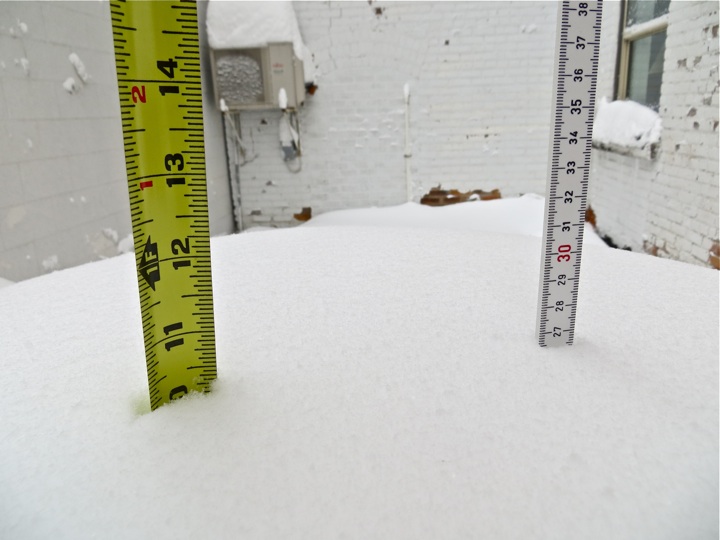
Blizzard Orko: Downtown Fargo Snowfall as of February 11, 2013

Readings of the snowfall at 8:30AM (CST) in downtown Fargo, North Dakota on February 11, 2013.

Readings of the snowfall at 8:30AM (CST) in downtown Fargo, North Dakota on February 11, 2013.

I’m not only talking about the weather just because it’s a safe topic of conversation. It is healthy for the mind and soul to discuss unsafe topics, and it is necessary to revive and invigorate culture. For example, it may be prudent to hold off on opening the conversation at Christmas Eve dinner with, “Hey, what do you all think about politics and religion, and can you pass me the gravy?”

But in any case, here is a very safe topic of morning conversation, a snap shot of the local patio readings from Blizzard Orko (the name ascribed to this blizzard, and not to be confused with Gandolf the White Blizzard, but certainly connected with Willa Cather’s thoughts on blizzards). These were taken at 8:30AM, CST, in downtown Fargo, North Dakota. Looks like just over 10″ in downtown Fargo as of this morning (centimeters are to the right).


Great Plains Blizzards Now and Then

Snow measurements from February 10, 2013, at 7:00PM (CST) in downtown Fargo, North Dakota.

Snow measurements from February 10, 2013, at 7:00PM (CST) in downtown Fargo, North Dakota.

Last week I revisited Walter P. Webb’s 1931 work, The Great Plains. In the coming days, I’ll blog a bit more on Webb’s work. For now, though, Blizzard Orko (as of 7:03PM [CST], February 10, 2013) induced several departments of transportation to close sections of Interstate 29 and Interstate 94 on the northern Great Plains: north-south from Grand Forks, North Dakota to Sioux Falls, South Dakota, and east-west from Jamestown, North Dakota in to Minnesota (the MNDOT’s road condition map I found is more general than decisive about exactly what sections are closed). These closures, or specifically this blizzard, reminded me a bit about Webb’s remarks on Great Plains blizzards, or what he pulled from Clement A. Lounsberry, the Civil War veteran who started The Bismarck Tribune in the 1870s. Of blizzards, Lounsberry  (via Webb) referenced that historically they were known as a

…mad, rushing combination of wind and snow which neither man nor beast could face. The snow found its way through every crack and crevice. Barns and stacks were literally covered by drifting snow, and, when the storm was over, cattle fed from the tops of stacks. Persons lost upon the prairie were almost certain to meet with death, unless familiar with the nature of these storms… I learned of many instances where persons were lost in trying to go from the house to the barn, and of other instances where cords were fastened to the house so that, if the barn should be missed, by holding onto the cord the house could be found again (Webb, 1931: 25)

With this in mind, this evening I took some measurements of snowfall in downtown Fargo. At least 7 1/4″ of snow has fallen (it is now 7PM, CST). Tomorrow winds are expected to intensify, as is snow removal and book reading.


John Stuart Mill “The Subjection of Women” (1869)

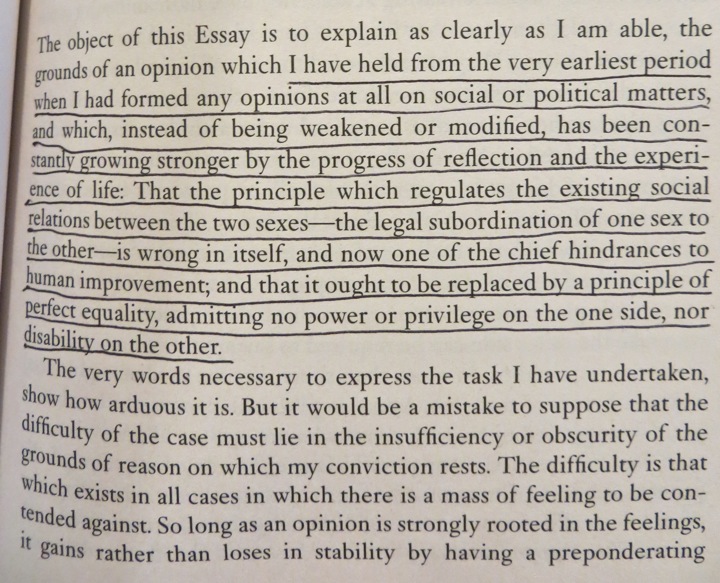
MillIn 1869, four years after the conclusion of the American Civil War and, on the other side of the Atlantic, a year after John Stuart Mill finished his tenure as a member of the British Parliament, Mill published The Subjection of Women, a philosophical volley and contribution to the history of ideas for the ages, specifically those toward individual human rights. To be short, Mill knew his languages and philosophers as well. In his opening remarks of his polemic that speaks toward the rights of women, he said,

…I have held from the very earliest period when I had formed any opinions at all on social or political matters, and which, instead of being weakened or modified, has been constantly growing stronger by the progress of reflection and the experience of life: That the principle which regulates the existing social relations between the two sexes — the legal subordination of one sex to the other — is wrong in itself, and now one of the chief hindrances to human improvement; and that it ought to be replaced by a principle of perfect equality, admitting no power or privilege on the one side, nor disability on the other.


Killdeer Mountain SB 2341 Post-Hearing Report

Rob Sand, a landowner local to Killdeer Mountains, testifies in support of SB 2341.

Rob Sand, a landowner immediate and local to the Killdeer Mountains, testifies in support of SB 2341.

A follow up to today’s hearing today at the capitol in Bismarck on Senate Bill 2341, spear-headed by North Dakota Senator Rich Wardner, and co-sponsored by a host of legislators. Individual archaeologists, Native historians, historians and local Killdeer Mountain land owners that testified in support of this bill included Tamara St. John, Dakota Goodhouse, Ladonna Brave Bull Allard, Waste Win Young, Tom Isern, Richard Rothaus, Kimball Banks, Rob Sand, Fern Swenson, Merl Paaverud, Tim Reed, and Mary Hoff (and I also testified, the synopsis of my testimony here). Private land owner issues mentioned in this article linked here are being addressed. Amy Dalrymple brings a more balanced angle to what happened here today linked here. Our conversation afterwards re-emphasized how private land owner rights are and continue to be protected throughout North Dakota, and our dutiful legislators said it may be a good idea to re-emphasize this in the bill. So there you have it. Props to all who came out today (there were many more in the crowd), and props to all of those that were there in spirit.


Killdeer Mountains 150 Years Later: Rescuing the Fallen and Forgotten Veterans from the Past

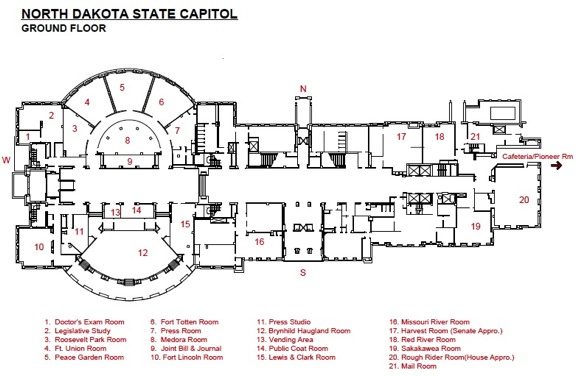
North Dakota State Capitol meeting room locations. Missouri River Room is #16, bottom-center of map.

North Dakota State Capitol meeting room locations. Missouri River Room is #16, bottom-center of map.

Tomorrow, Thursday, February 7, 2013, at 1400 hours (CST), North Dakota Senator Connie Triplett (District 18, Grand Forks) will collaboratively sponsor SB 2341, a bill that seeks to carry out an archaeological and historic-archaeological study on the Killdeer Mountains in Dunn County, western North Dakota. I’ll be attending this hearing (it will take place before the Senate Government & Veteran’s Affairs Committee in the Missouri River Room), and Triplett has circulated an e-mail asking historians, landowners, archaeologists, Natives and others for testimonies to support this bill. The Killdeer Mountains figure into our nation’s history and the US-Dakota Wars that spanned from 1862 in the Minnesota River Valley, and carried on through 1864 at Killdeer Mountains in western North Dakota.

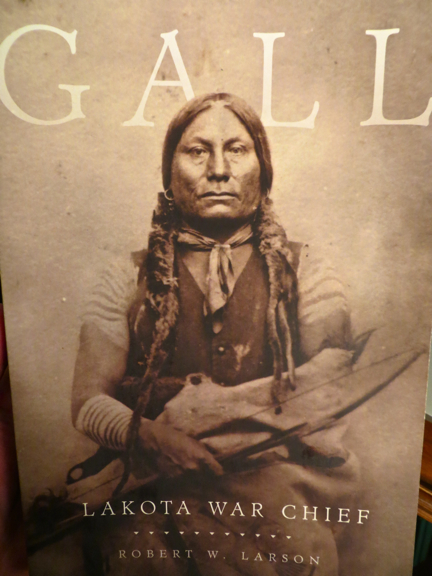
Taken from the cover of Robert W. Larson, "Gall: Lakota War Chief" (Norman: University of Oklahoma Press, 2007).

Taken from the cover of Robert W. Larson, “Gall: Lakota War Chief” (Norman: University of Oklahoma Press, 2007).

What we know right now about Killdeer from 1864 is limited (the State Historical Society of North Dakota has a nice and thoughtful write up of it here), and further archaeological and historical research is needed. It was an action between the Union Army and various Dakota nations, and some key players involved were Sitting Bull, Inkpaduta, Gall (among others), and General Alfred Sully and his Union soldiers. In many ways, just as this nation recognizes and respects fallen Union and Confederate combatants and non-combatants, this nation owes it to honor the Dakota soldiers and non-combatants killed in Dakota Territory during the Civil War. To extend this honor requires and necessitates a deliberate and culturally sensitive systematic archaeological and historical study like the one proposed in SB 2341. We understandably honor Americans that have fought and died in 21st century warfare, and we ought to also be honoring and rescuing those fallen and forgotten from the Killdeer Mountains from July 1864.

Note: according to Sioux County Veterans Service Officer Roster, today in 2013 Standing Rock has a veteran population of 357.


Willa Cather, “My Antonia” (1918)

In 1918, Willa Cather published My Ántonia. It is a novel loaded with Euro-American homesteading experiences from the Great Plains, and it demonstrates how a seemingly isolated place can in fact have international scope. Without saying it so directly, Cather gives the reader a sense of how the Atlantic World brought itself to the Great Plains, and how these individual immigrants faced an endless amount of new frontiers. After developing the characters in the countryside, Cather moves the cosmopolitans in the country from the landscape of the Burden Homestead to a neighborhood in the town of Black Hawk, Nebraska. In this way it is also a novel that considers the contrasts between the country and the town.

Because Cather was a sharp author, it is fairly easy for a reader to reconstruct the landscape of the Burden Homestead. The landscape was inundated with international settlements, with the Russian neighbors of Peter and Pavel to the north, the Bohemian Shimerda family to the west, and the German neighbors to the south. Six miles east of the Burden homestead was the post office, a vestige of an Anglo-American institution that continuously crept further and further out onto the Great Plains and Euro-American frontier. The Burden Homestead itself was a white frame house on a hilltop, and the terrain gradually sloped westward to where the barn, corncribs, and pond were located. (Cather, 1918: 12-13, 15, 20-21) While reading this work, I reconstructed the Burden Homestead landscape from the text, and sketched it out on paper with pen.

Burden Homestead My Antonia 01.30.2013 Reduced SizeOn page 42, Cather also makes brief reference to the material cultural remnants left by Plains Indians, or what may have been a potential Sun Dance. The Euro-Americans are all in disagreement over what it could represent, and this is how Cather explained it. “Beyond the pond,” west of the Burden home, Cather said Jim Burden noticed that,

…there was, faintly marked in the grass, a great circle where the Indians used to ride. Jake and Otto [two hired hands, the latter from Austria] were sure that when they galloped round that ring the Indians tortured prisoners, bound to a stake in the centre; but grandfather [Burden] thought they merely ran races or trained horses there. Whenever one looked at this slope against the setting sun, the circle showed like a pattern in the grass; and this morning, when the first light spray of snow lay over it, it came out with wonderful distinctness, like strokes of Chinese white on canvas. The old figure stirred me as it had never done before and seemed a good omen for the winter.

In this singular paragraph passage, Cather’s piece of fictional prose exposes the reader to several different Euro-American perceptions and theses. There is the stereotypical perception of the “brutal” or “savage” Indian, the wise grandfatherly ballast that considered the plains Indians and their horses, and the mystic and romantic foreshadowing that Jim Burden felt when he viewed the circle in the landscape. In this way Cather’s statement inadvertently touched on several questions raised by humanities scholars and social scientists (historians, anthropologists and archaeologists).

Novels are fantastic in that they help a reader explore the infinite range of human emotion in a way that scholarship often cannot, and this is why My Ántonia is a central piece of fiction in Great Plains and world literature. There is much more to say about this work, and it certainly compliments Ernest Staples Osgood’s 1929 scholarship, The Day of the Cattleman, and Gilbert C. Fite, The Farmers’ Fronter, 1865-1900 (1966).


Drummer’s View of a Sound Check

A quick concluding note on the punk archaeology unconference from this weekend at Sidestreet Grille and Pub in downtown Fargo, North Dakota. Since history, archaeology and life require us to put ourselves in the shoes of others, I wondered if it would be interesting for non-drummers to have access to a drummer’s view during a sound check. So here is a still photo of the stage from the vantage of the Audio-Video team from the University of North Dakota.

View of the stage from the Audio-Video sound station.

View of the stage from the Audio-Video sound station.

And here it is from another angle, a drummer’s view of the sound check (this brings up the fact that there are always more than two sides to a story, or history):