Iconic Railroads on the Great Plains

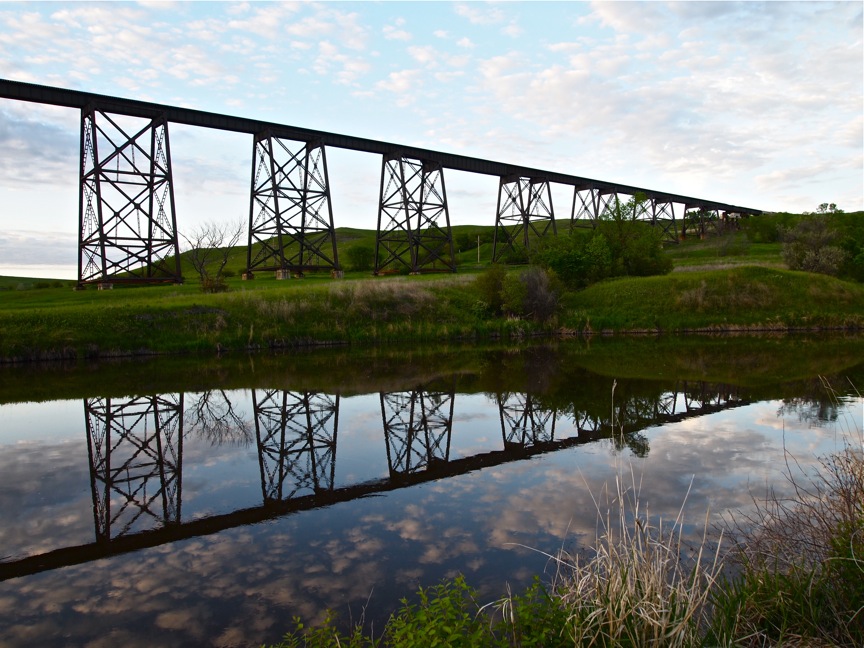
High Line BridgeA couple days ago I snapped some photos and a video short in Chautauqua Park, Valley City, North Dakota. While looking at the High Line railroad bridge (built in the first decade of the 20th century), I was kind of thinking about how elder Euro-American frontiersmen (or frontierspeople? — what the heck is the non-gender form of frontiersmen?) might have been thinking about this and railroads around the turn of the 19th century, especially as younger industrial laborers swarmed into the area.

The idea of history is to understand understanding, or understand how others understood their world. To apply my historical sense of place, a frontiersman, along with Natives in the area, would have looked at this industrial expanse of railroad as something out of place; or as a way to populate the Great Plains and American West with non-Natives; or as a new industrial icon supplanting a time and place that had passed (Fred Turner rambled on about this at great length in Chicago in 1893).

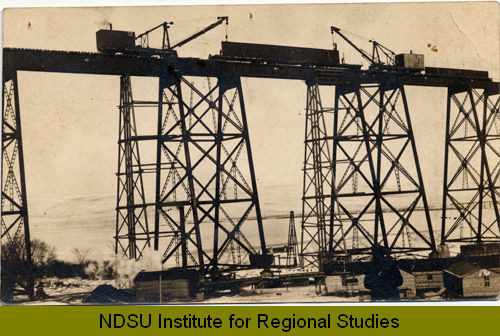
A historic photo of the construction of the High Line. Photo from Digital Horizon's, NDSU Institute for Regional Studies.

A historic photo of the construction of the High Line. Photo from Digital Horizon’s, NDSU Institute for Regional Studies.

Today, though, there are many that say Valley City wouldn’t be Valley City sans the High-Line bridge. History is both complex and universal that way: the sensibilities of younger generations will supplant those of the older generations — both might presume or assume that the way they grew up and the time they lived in was and always had been. (this is often captured in the phrase, “Things just aren’t like they used to be…”)

If you overnight, and it’s a pleasant enough evening to have the windows open (or even closed), you’ll be woken up by the thumping cha-chunk, cha-chunk of today’s diesel locomotives playing the Hi-Line bridge like an instrument. I find the noise soothing.

Here is the link to the historic High Line photo from NDSU’s Institute for Regional Studies. The video short and another photo below.

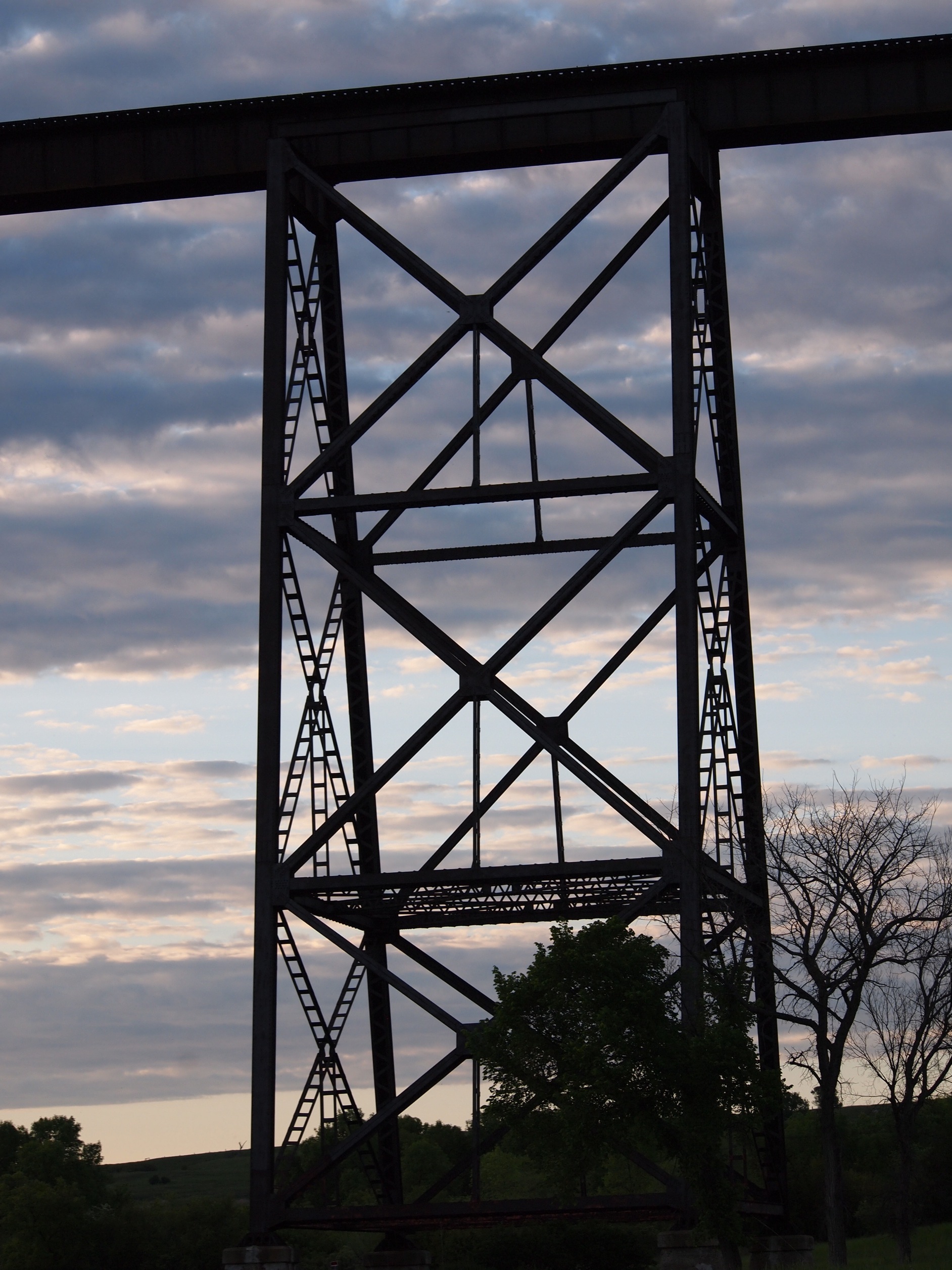
A detail of the High Line substructure.

A detail of the High Line substructure.


One Longue Durée of Mosaic History

Molly is finalizing the mosaic grouting process on a reused terra-cotta potter.

Molly is finalizing the mosaic grouting process on a reused terra-cotta potter salvaged from someone’s trash pile.

It is the weekend and projects are happening: plans have been set in motion to slow-smoke some baby back ribs, and Molly is out front of her sister’s Valley City home, toiling away at a mosaic project. I’ve busied myself with reading James Belich, The Victorian Interpretation of Racial Conflict: The Maori, The British, and the New Zealand Wars (McGill-Queen’s University Press, 1986 & 1989), but have set it down to do a bit of immediate chores.

So while taking the trash out from the kitchen to the dumpster, I passed by Molly’s ongoing mosaic project. Then I started thinking about how Molly’s mosaic project today reminded me of the Late Roman mosaics I saw a year ago in the historic archaeological village of Kourion, Cyprus. Then I started thinking about how historians and archaeologists — depending on what cultural settings they were born into, and depending on what previous experiences they have had — bring individual and disparate meanings to the stuff they come across. (This may be getting a bit too self-absorbed, so if you’ve noticed it, and it offends you, please stop reading here if you already haven’t. I will not take offense. But it is a line of thinking with universal application.)

So without slamming out any more dialog (we are packing up and readying to go, which is timely to end this short entry), I will upload a couple pictures I snapped a year ago in Kourion, and a couple pictures from today in Valley City. Taking massive leaps through space and time, this is what I call a global and local longue durée of mosaic history, from Kourion, the Roman Empire, to Valley City, North Dakota.

Close-up mosaic detail from Kourion, Cyprus.

Close-up mosaic detail from Kourion, Cyprus.

A mosaic from a Roman gladiator's home in Kourion, Cyprus. Mosaics are not for cowards.

A mosaic from a Roman gladiator’s home in Kourion, Cyprus. Mosaics are not for cowards.


Thoughtful and Respectful Disagreements

Before I return to the coding and data entry before me, I wanted to jot down some quick notes on this latest piece from The Atlantic Monthly by Larry Alex Taunton, “Listening to Young Atheists, Lessons for a Stronger Christianity” (June 6, 2013). Whether Christian or atheist, the specific note comes in the form of this quote by Taunton:

I find talking to people who disagree with me much more stimulating than those gatherings that feel a bit too much like a political party convention, and the exchanges with these students are mostly thoughtful and respectful.

This is why we have institutes such as the Prince Alwaleed bin Talal Center for Muslim-Christian Understanding and why we support and fund thinkers such as John Voll, among others. The words “thoughtful” and “respectful” are crucial, though, because these exchanges (the ones I have viewed) can easily turn into reactionary diatribes. To get a bit pedantic: in many ways — whether one is reading or thinking about Darwin or grand theological thinkers — individuals throughout time have been searching for the origins of humanity. We want to deeply know locally and globally where we came from, because this will give us a bearing on why we are here, and also direct us to what we ought to be doing in preparation for tomorrow. Only through thoughtful and respectful dialog with one another will we be able to sharpen that knowledge, and who knows where it will lead.

This, of course, is why certain thinkers in the 20th century Western World held up the ideal of the free and open exchange of ideas (whether this was real or mythical is important but not of concern here). One final thought, ancillary but somewhat related, is this: while one of those free market thinkers in the first half of the 20th century fatalistically charted a future road to serfdom (see F.A. Hayek, The Road to Serfdom [March 1944]), it seems like there is room in the 21st century for someone to consider a fatalistic monograph with the tentative title, The Corporate Road to Serfdom. (side note: I’m not much for fatalism, so I would be interested in reading this for the sake of conversation rather than belief). I haven’t the time to consider something like this now. But I’m sure it would get the attention of large ideological factions.

So here on the memorial of D-Day, we might ponder this one final-final fatalistic piece of fiction: a future world war will not require the tank divisions, navies and airforces to be labeled with flags of nation-states, but rather they will have multinational corporate labels such as “Google,” “GE,” “Dupont,” “ADM” and “Monsanto.” This, of course, is extremely dangerous to humanity, because corporations are beholden to generating industrial profits for shareholders rather than upholding ideals of liberal, democratic-republics. But again, that’s another point of long conversation that will not be settled in a simple blog entry (perhaps it is better for a graduate seminar in political philosophy and business school). Nonetheless, back to my data entry…


Some Archaeology of Food

Pheasant and BarthSome years ago I decided to take up bird hunting for this main reason: if I was going to purchase saran-wrapped chicken legs, thighs and breasts in the refrigerator section of the grocery store, I thought it was more respectful to at least experience what it was like to kill wildlife — in this case pheasant, doves and grouse — for the purpose of feeding family, friends and myself. This decision required me to purchase a bird gun (in my case, I bought a double-barrel, side-by-side 12-gauge shotgun), shotgun shells, and the necessary hunting permits. Since then I have hunted with at least four friends, including Rod Austin (accompanied by Grizzly, his beagle), Tayo Basquiat, Ed Stine, and Bob Shannon.

After identifying suitable areas to hunt (in ND, PLOTs land provides excellent public hunting grounds), walking several miles, spooking pheasant from the brush, identifying the roosters from the hens, and then downing a rooster, one of the first impressions I had (and I’m presuming I’m not the only one here) in picking up a recently-killed pheasant rooster was the warmth. This stands in contrast to the cold feel of a saran-wrapped chicken breast in the grocery store, or the increasingly ubiquitous appetizer called “bone-in” and “boneless” chicken wings (culturally, we shovel these into our mouths, kind of on autopilot, as we watch the 37 flat-screen televisions broadcast UFC fights and sporting events, and as additional juke box and video game machines drown out any kind of conversation that could have been had in our drinking warehouses throughout America).

A local plate of food. Slices of bison (medium-rare) from south-central North Dakota, this topped with a sauté of locally-harvested morel mushrooms. The origin of the salmon is unknown, but comes from Valley Meats in Valley City, North Dakota. The remaining vegetables were organic, or from what I call historic farming practices.

A local plate of food. Slices of bison (medium-rare) from south-central North Dakota, this topped with a sauté of locally-harvested morel mushrooms. The origin of the salmon is unknown, but comes from Valley Meats in Valley City, North Dakota. The remaining vegetables were organic, or from what I call historic farming practices.

No doubt, authors such as Michael Pollan have tapped into a growing social structure that concerns itself with the technics of how and philosophies of why food is produced. As an observer of this growing movement, international and local journals have also turned attention to reporting on these stories. Or at least the stories that involve individuals who want to know where their food comes from. These groups are bringing attention to multi-national corporations, and the stories have been picked up by The New York Times, CNN and, locally, WDAY News in the Red River Valley of North Dakota and Minnesota.

In this latter story, the reporter focused on something North Dakotans are very aware of: heritage. This heritage is in turn used to consider how our grandparents and great grandparents produced food on family farms in contrast to how the Agricultural Industrial Complex produces food today. I remember when I was 10 or 11 years old (or thereabouts) in the kitchen of my late Grandma Barth. She had just sliced up a tomato, and in putting it on the table in front of me she said, “Here is a tomato, although they probably gassed it just a couple days ago.” My grandmother was communicating something to me that has been lost (and what I’m trying to recover by hunting): a connection with the land, and the landscape, and the food we eat that comes from that land. Although she didn’t say it directly, she was also concerned with what a gassed tomato (which is how the Agricultural Industrial Complex turns a green tomato into a red-colored tomato to simulate ripeness) might do to physiological early childhood development of her grandchildren.

The main point of this, though, is that individual consumers continue to consider and ask questions about where the food is coming from. (I’m a bit amazed by this point, too: if Monsanto made this great bio-tech seed that is going to feed the world, why aren’t they proud about labeling it so you and I can easily identify it when in the grocery store?)

Another note: North Dakota legislators recently said it was okay for individuals to purchase unpasteurized or raw milk, so long as they owned a share in the cow. Below is the local WDAY story, and also the CNN story too.

The CNN story:

The WDAY story, which won’t imbed for some reason, so you have to just click on this link here.


Garages Then and Now

Governor's MansionThe Former Governors’ Mansion of North Dakota (1893-1960) in Bismarck. This is the southeast elevation. The carriage house is a separate structure behind the house, built in the days before garages became permanent attachments in the design of homes. Carriage houses and garages were often not attached to the homes, and were hidden (this in contrast to garages being the central foci of the home today — friend, colleague and fellow blogger Richard Rothaus has some more thoughts on that linked to here). One hundred years ago, horses were smelly (or organic) and automobiles were noisy and they produced exhaust and smelled of petroleum and they leaked a lot of oil. If you were elite-elite, you would install a carousel in your carriage house to rotate your automobile 180-degrees since said automobiles didn’t yet have a reverse function (this is a feature of the carriage house/garage at the American-Swedish Institute in Minneapolis). There was always a chance (or thought) that automobiles would or could catch fire. So it was better to keep them separate from the house. As well, you’ll often see kitchens from elite late-19th century homes as separate structures from the rest of the house for this reason too: if the kitchen went up in flames, at least the house would be spared.


Hermetically Sealed Hotels

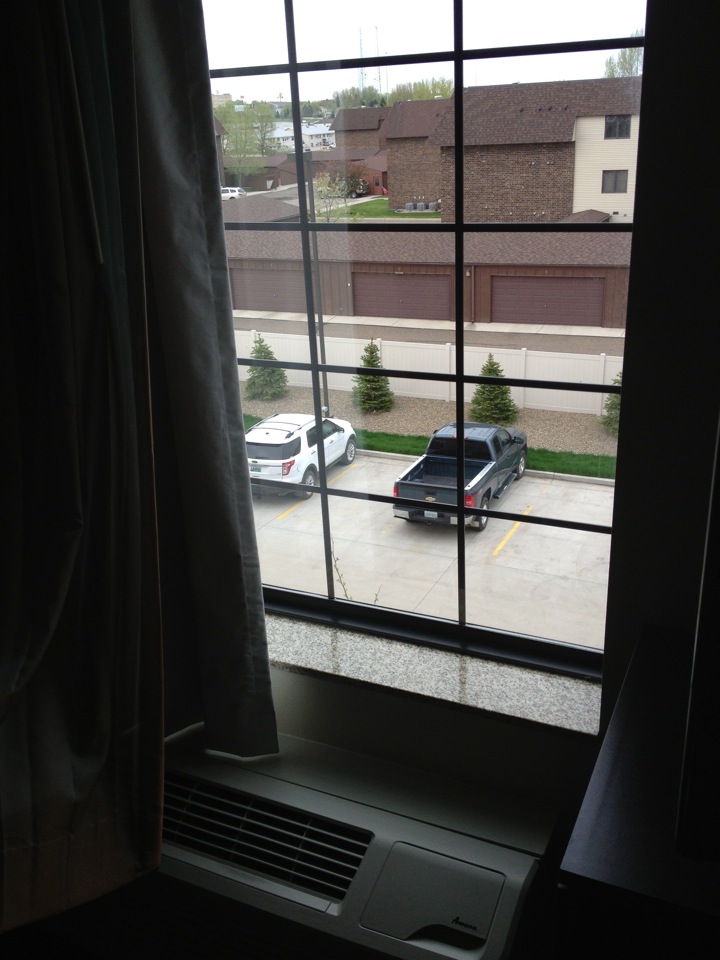
A hermetically sealed hotel room in a spiffy new hotel.

A hermetically sealed hotel room in a spiffy new hotel. Note how there is no device on the window to open said window to the outside world.

In the last month and a half, I have stayed in several hotels, two of which were very spiffy and new, and completely sealed off from the outside world. By this I mean that there was no way to circulate outside air directly into the hotel room. Sure, they have these conditioned air units, but I’m a little weary of these suckers since it doesn’t take long for imperial fungus to start colonizing said A/C units — then, when we turn them on in hermetically sealed hotels because we’re human and animal and we like some kind of air movement, the A/C units are just blasting us with some potential super fungus, this shooting directly down into the capillaries of our lungs.

When it comes to the layouts of these spiffy new hotels, I’m sure there are reasons for the engineering or, at best, architectural design of such structures. I sure would like to see the arguments for the designs (perhaps intended for super smoggy places). But if I’m sitting in a hotel situated in a place on the planet that has comparatively good to great air, and especially if it is during a fresh rain or thunder storm, I would rather have the option of cracking a window open (preferably on a sliding track or pane rather than with a brick). For now, oh well (this is where I insert the obligatory Jeremy Bentham, Panopticon reference).


Some Philosophies of Histories

In a couple hours I will be taking what is called the oral component of the comprehensive exams. This is the business of academia, what I sometimes think of as the codification of intellect (everyone is sharp, or has potential to be sharp, and universities are designed with a goal of proofing and validating that sharpness). In that case, I am engaged in my morning ritual of visiting, revisiting and reading through some broad conceptual thinkers in final preparation for this upcoming, mid-morning fun.

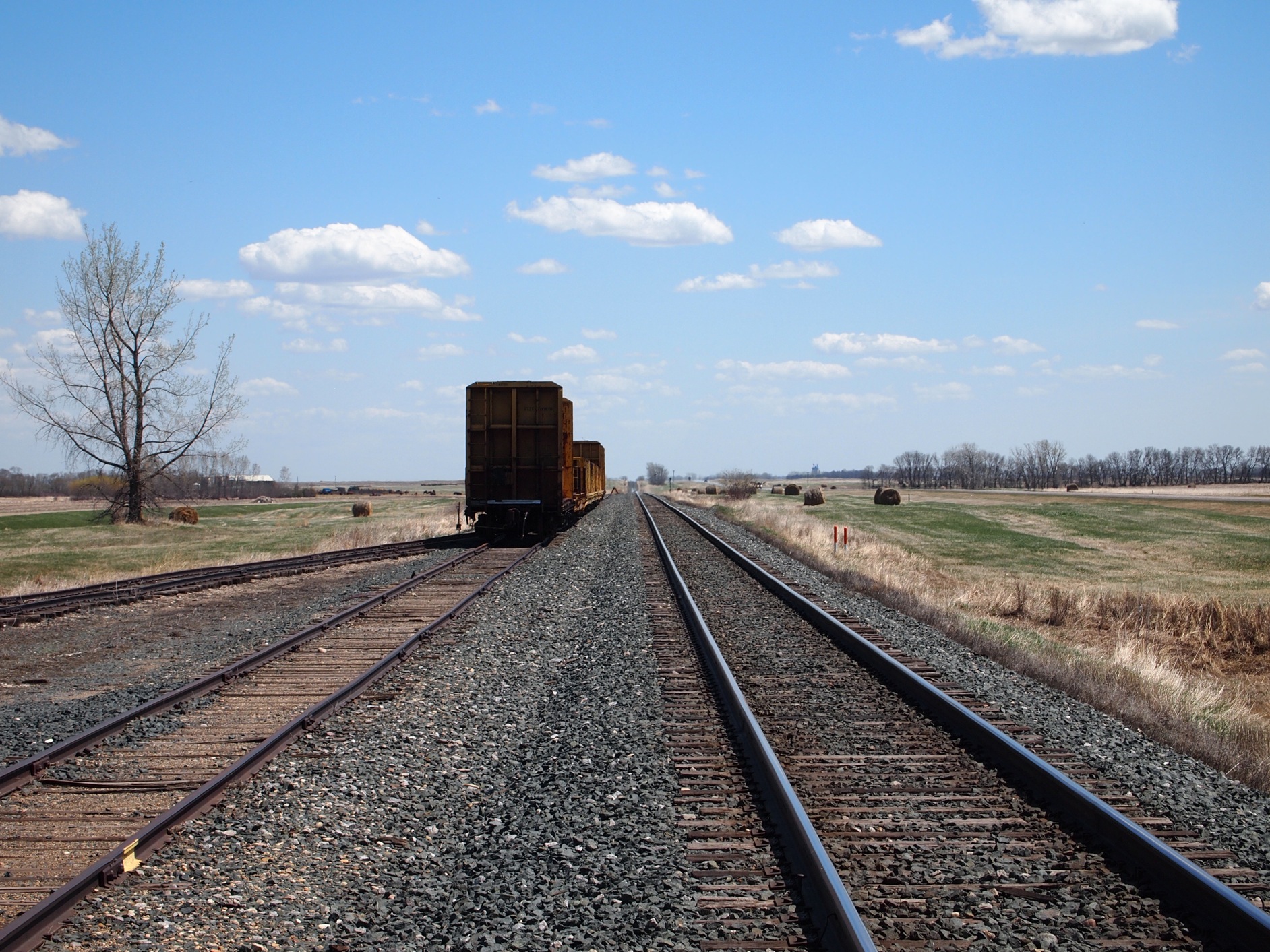
A potential railroad metaphor for the various and competing tracks of time cultures and societies are hurtling along. This, we historians argue, is why world history is increasingly important in our increasingly global age.

The railroad as metaphor for the various and competing tracks of time cultures and societies are hurtling along. This, we historians argue, is why the study of history and the philosophies of histories is increasingly important to study in our increasingly global age.

In the largest scheme of things, these big-picture thinkers — from R.G. Collingwood to E.H. Carr to John Lewis Gaddis to Michael Shanks — force a reader to contemplate not just the technical hows of a discipline, but also the philosophical whys: for example, why would anyone be engaged in the efforts of history or archaeology or, more broadly, any discipline or trade for that matter? To contemplate this provides a variety of conceptual frameworks in which to filter data through, and these are the substructures of any discipline and trade. While keeping this in mind, it is also important to keep in mind that the disciplines and trades are by and for an infinite variety of culture and subculture and subaltern culture (and so on). Whether conscious of it or not, the collective memory within these groups influences to varying degrees the ways the substructures are built (if looking at the archaeology of language, for example, it quickly becomes apparent that languages are built out of previously established bodies of presumptions and assumptions).

With that said, in revisiting R.G. Collingwood, The Idea of History, (1946) R.G. says in his introduction that “Philosophy is never concerned with thought by itself; it is always concerned with its relation to its object, and is therefore concerned with the object just as much as with the thought.” This entire idea pertains to developing philosophies that disciplinarian doctors (which, to be pedantic, is Greek for “teacher”) train cadets and recruits with, so the latter understands that two thinkers can take the same body of evidence and can arrive at completely disparate conclusions. In the case of history, this is what 18th century Voltaire called a “philosophy of history,” and what 20th century E.H. Carr referred to as a dialog with the past. This philosophy and dialog is important — at least I’ll make the argument here — since the world has and always will be in a perpetual state of crisis. If met with crisis, we have to get used to the idea of re-calibrating and re-adjusting. This is not necessarily to accept the crisis, but to figure out ways through and around it. In some of Carr’s concluding remarks in chapter 5 of What Is History? (1961), he identifies three types of history (using the Royal “You” to bring his case home):

[1] You can, if you please, turn history into theology by making the meaning of the past depend on some extra-historical and super-rational power. [2] You can, if you please, turn it into literature — a collection of stories and legends about the past without meaning or significance. [and 3, which is where Carr is at his best, a proper definition of the historian.] History properly so-called can be written only by those who find and accept a sense of direction in history itself. [and in the copy on my shelf, the following is what I underlined] The belief that we have come from somewhere is closely linked with the belief that we are going somewhere. A society which has lost belief in its capacity to progress in the future will quickly cease to concern itself with its progress in the past.

Thus, for Carr (and myself), to engage in history proper is to engage in the faith of the future of society, and the discipline of history itself. This as well is why history is never “complete.” If history was complete, society would be complete, and both that society and history would be finished and at an end with itself. This, of course, is only theoretically possible, since nothing is ever truly at end. Rather, we humans impose the boundaries and limitations, demarcating a beginning and end for what is otherwise quite gradual and transitionary. This is why in the first two decades of the 21st-century we are having conversations about how we humans engage 2- and 3-dimensional objects. In the words of Michael Shanks, “the past has to be worked at,” (Hunter Thompson sometimes referred to journalism as analogous to chopping wood) and it is just as important to look at the past as it is to look at the way historians have sought to make sense of the past.

I keep thinking that, to use metaphor, as we stand on the 21st century dock and watch the 20th century Cold War — that barge of history — drift further and farther away from us, a host of new crises will continuously arise. Our ability to react to them will be predicated on not just how we know the past, but also of how and why those before us knew the past. And how and why they understood the past is also filtered through the ways in which we remember and know the past, and so on, ad infinitum. 


Vivian Marie (Larson) Barth

Pictured here is a photo of Vivian and David Barth, or who I know of as my Grandma and Grandpa Barth. Their three boys are sound asleep. This photo was taken not too long after the end of WWII.

Pictured here is a photo of Vivian and David Barth, or who I know of as my Grandma and Grandpa Barth. The three boys are sound asleep. This photo was taken not too long after the end of WWII.

This last Monday morning I received a call from my mom, and she informed me that my Grandmother, Vivian Marie (Larson) Barth, had passed away peacefully earlier in the morning. My grandma was 97 years old, and we got along real well. Without saying too much, I do know that I am grateful to have had such an extra ordinary grandmother, and also grateful to have lived within range of her and her influence. And although 97 is a long and full life (you really can’t ask for more), on the inside I still feel very sad, and kind of hollow about the region of the heart. But dying is a part of life. And for some reason I am reminded what Grandma Barth often said to us when she sensed we were distressed: “Everything will be okay.” This is true.

She was the reason we think of Swedes as stoic, and by no means was she void of emotion. She loved her family, her friends, her church, and her community. On occasion she would inject a sharp quip that would bring gravity to any lofty conversation. I once said to her, after reading in Engelhardt’s history of Fargo-Moorhead about J.A. Johnson, the first long-time Swedish mayor of Fargo, that he was mayor for 5 terms. Without missing a beat, Grandma Barth responded with, “Sounds like someone was in office for way too long.” This caused me to laugh out loud. While driving around with Grandma Barth, she once gave an indirect opinion of conspicuous consumption by simply saying, “You don’t need all that money to live and be happy.” Yes, we will miss you Grandma Barth, but your intellect and wisdom will continue echoing through the ages. You taught us well. A full obituary is linked here, and some reflections from Grandma Barth are linked to here and here.


Bringing American Public History to New Zealand

Just moments ago, from the northern Great Plains of North America, I submitted a short paper proposal to the other side of the planet, this to the New Zealand Historical Association (NZHA) in Dunedin, New Zealand. It is for the NZHA 2013 Biennial Conference (click the blue link to the left for direct details) on November 20-22, 2013. My paper concerns the contested public memory of Whitestone Hill, and concludes with some World Historical considerations. It builds off landscape memory and history, and research from 2009 to the present. The intent is to join two additional landscape historians, Dr. Thomas D. Isern and Dr. Suzzanne Kelley, to make a complete panel. Tom and Suzzanne are considering the public memory of local New Zealand history specific to the Lindis. I am bringing some public memory from the northern Great Plains to the mix. I thought I would share my paper title and abstract here.

Photo of Whitestone Hill from April 2012.

Photo of Whitestone Hill from April 2012.

Title: Aaron L. Barth, “A Contested Site of Memory from the American Civil War: Whitestone Hill 150 Years Later”

Abstract: In early September of 1863, as the American Civil War raged in the eastern half of the continental United States, General Alfred Sully led a military column on a punitive campaign against the Dakota (aka, Sioux) on the northern Great Plains. The military goal was to punish the Dakota majority, en masse, for the atrocities committed by a small Dakota minority the previous year in the Minnesota River Valley. Sully’s 1863 campaign culminated in an action at Whitestone Hill, this in present-day North Dakota. In his official words, Sully said he engaged Dakota “warriors… squaws, [and] children” in a “melée” and “murderous slaughter” of a “promiscuous nature.” His command killed 150 to 300 Dakota, and if he had another hour or two of light, he said, “I could have annihilated the enemy,” giving “one of the most severe punishments that the Indians have ever received.” For 150 years, the public memory of Whitestone Hill has been contested, called a “battlefield” by a United States Congressman, and called a “mistake” by Sully and Episcopalian Reverend Aaron McGaffey Beede. This paper tracks the public tension in the remembrance of Whitestone Hill, and concludes with samples of how sites of memory from this period are contested in World History.


Adventure Science and the North American Landscape

Reinhard and Rothaus set out on the first day of Adventure Science's fieldwork in western North Dakota.

Reinhard and Rothaus set out on the first day of Adventure Science’s fieldwork in western North Dakota.

This morning I’ve been listening to one of Adventure Science‘s raw audio press conferences and forums, this concerning the latest trek through the badlands of western North Dakota, and I couldn’t stop thinking about the divide between the hard and soft sciences and the humanities, and how it is so necessary for conversations to take place between them (another interview from Prairie Public can be found here). Throughout academia, this is often called “crossing disciplinary lines.” In non-academic jargon, this means that you walk down the hall or out the building and across the courtyard to someone else’s office, kitchen, machine shop or garage, and ask her or him why and how they are working on a problem, whether an abstract theorem or a carburetor.

In the case of this Adventure Science press conference (which everyone should listen to at least once), Simon Donato and Richard Rothaus explain at the outset that they undertook this project in a completely scientific and objective fashion, and by this they were not obligated to produce — ahem — results for one public or private group or another. This is true, to a point. Yet the cultures that we are born into also contributes to the way we see the world, and consciously or unconsciously we will speak to a variety of these groups whether we like it or not.

I was thinking about this in relation to an observation Simon, who hails from the culture of Alberta, Canada (this is important, just stay with me here), made about half way into the press conference or conversation (or press conference-sation). In the history of the British-Canadian West and the American West, Euro-American settlement above and below the 49th parallel played out in much different ways. Simon consciously or unconsciously hints at this. There is historical reason for this (something the late historian Paul Sharp researched at-length, and some comments on that here and here).

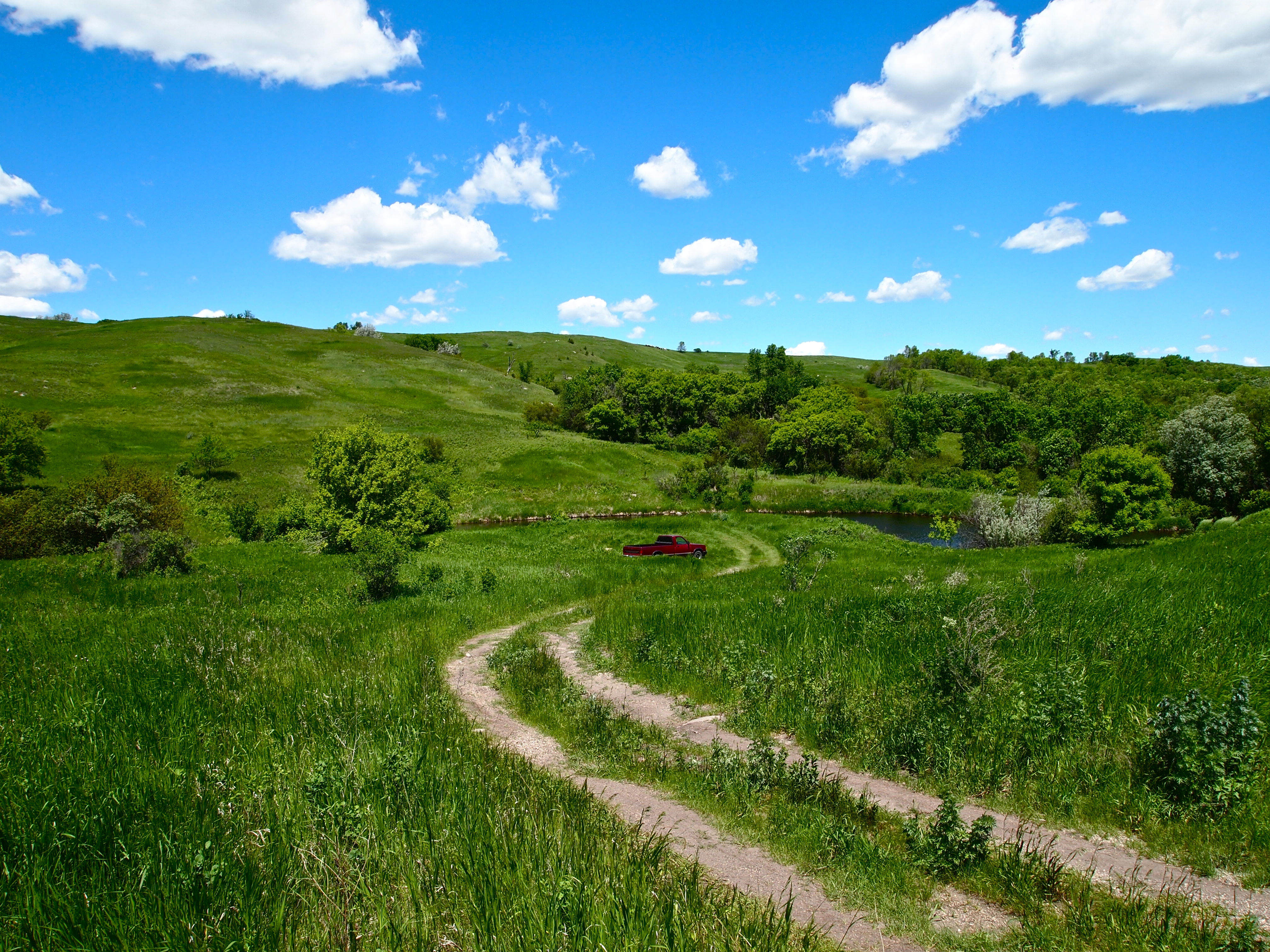
Some badlands beauty, on the abrupt cusp of the winter to spring transition.

Some badlands beauty, on the abrupt cusp of the winter to spring transition.

In the history of the Canadian West, Anglo- and Euro-American settlement was deliberate. This is often symbolized by the Royal Canadian Mounties, who would patrol and police the areas, ensuring that the Crown’s Law and Order would be maintained across all the land, and ideally across the global empire. Through this order, land would be settled in an orderly fashion, and be made “useful” and useful for the commonwealth and crown (see Thomas Hobbes for intellectual exegesis). If coming from that Canadian backdrop, either yesteryear and today, when you enter the American West, including western North Dakota, it still looks like a crazed free-for-all, even in the wilderness. At the Adventure Science forum, beginning at 35:20 in the audio, Simon said,

…As we got into some of the ranching areas where, again it’s vast, you know you feel like you’re kind of on the edge of a wilderness area, but there’s no houses… there’s fences, there’s obviously been cattle through there, but there’s no houses and no structures at all, and that was really surprising to me. Where I’m from in Alberta, if you got fences, there’s gonna be a farmhouse somewhere, there’s gonna be a barn somewhere. You get into these areas, and I was really surprised that I didn’t find these structures out there, I mean, not even hunting cabins.

Bison in the badlands of western North Dakota.

Bison in the badlands of western North Dakota.

So I guess what Simon hints at and what I’m communicating here is that yes, science tries to be as objective as possible. But there is no amount of finality to that objective science, because as cultures evolve, so does science, and so do perceptions. What appears normal to one person will be abnormal to an outsider. This is why cross-cultural and cross-disciplinary studies and conversations absolutely have to take place, and this is why it is worth our while to conserve and preserve some of these places (one of the reasons Theodore Roosevelt set up the national parks).

Note: Native America/First Nations had occupied these badlands and North America for millenia, at least 12,000 to 13,000 years (and even this is contested by Native friends, as they have told me much longer), before non-Natives got to the area. Even the fact that we call a wilderness a “wilderness” today is a cultural bias worthy of consideration and contemplation.