There’s something like a 3rd or 7th polar vortex bearing down on the northern Great Plains and Great Lakes region on this sunny, cold Saturday lunch hour. Yesterday Molly suggested that we make white chicken chili. I set the navy beans to soaking yesterday afternoon, and she put soup together just before lunch today. Lots of coriander, cumin, Tochi’s taco seasoning, green and red chilies, etc. This is what she was telling me after I asked, “Why is this so delicious?” We also added cilantro just before serving. Note: what you can’t see in this photo are the two chihuahuas at my feet. Seriously. They are named Willow and Honey. This soup is heating us up for sure. Polar vortex, your serve.
Category Archives: Uncategorized
Some Thursday Teaching Notes
I rounded out another lecture for tomorrow, this on the particulars, complexities, triumphs and problems of the Progressive Era at the turn of the 19th century. After that I dropped into Bill Caraher’s blog and read a bit on his latest pedagogy, including the ideas of a slow archaeology part I and part II (which is great, and good to think about in our hyper-drive digital 21st century world). This, in turn, induced me to reflect just a bit on teaching this week at North Dakota State University.
The lectures I deliver, at least this semester at NDSU, are American History 1877-present. The class text is The American Promise: A History of the United States, by Roark, et al., (New York: St. Martin’s Press, Fifth Edition, Value Edition, 2012). The text itself is accessible, both in its prose and price (Amazon.com has the value edition listed at $48.38 with free shipping). Considering what I paid for required course materials during my 1999-2002 undergraduate training in history at the University of Minnesota-Twin Cities, this ranks up there with sensibly priced text books, even over a decade later in 2014 (presumably text books would cost more today than in 1999 — presumably).
I co-lecture (or lecture every 2nd or 3rd week) with Dr. Angela Smith, the powerhouse Public and Digital Historian within NDSU’s Department of History, Philosophy and Religious Studies (some of Angela and her student’s work linked to here). On Tuesday evening I led a non-mandatory review session with the students to prep them for their exam yesterday, Wednesday. The key to successful reviews are manifold: presenting the material in a repetitious but non-open-mouth-breathing kind of way.
Perhaps the most damaging thing a history lecturer can do is deliver history the way the stereotypical high school coach was charged with teaching history; that is, reading for 50 minutes directly from the textbook (which, in turn, reflects just how important American public school systems think of the teaching of history — sigh). Impressing the historical record into the minds of freshmen and sophomores requires the lecturer to revisit the knowledge, and rehash it in several ways. I’m also interested in what students are thinking, yet this can be difficult to extract from a reticent demographic. Of course, the more students become familiar with the lecturer, the more (in theory) they’ll feel comfortable in speaking up and out about their thoughts.
In the mean time, it is always interesting to figure out ways of gauging success. To do this I had the students who attended the review session sign in on, well, a sign in sheet, and at the semester’s end this will be compared with students who did not attend the review session. In theory, students who attended the review session will do better than non-attendees (in theory, right?).
Notes for Friday

A photo of Tumbleweed from yesterday. I thought I’d include a photo of this sweet nice dog, since almost everyone likes looking at photos of cats and dogs on the internet. Tumbleweed is Harley’s faithful friend.
Several things have been happening in the last week, so I thought I’d jot them down here.
1) Our dear friend Harley passed away, and funeral services will be held tomorrow (02/15/2014), Saturday at the Congregational United Church of Christ in Valley City, Barnes County, North Dakota. If you’re in the area we hope to see you there. Also, we know Harley cared deeply about farming. He also received an English degree back in the day from Jamestown University. It got me thinking about how we need more farmers with English or Humanities degrees in this country, and on this planet. I can elaborate later.
2) Minot State University invited me to give a talk on February 24, a Monday, on institutional memory and how that has shaped why and how we know what we know today about the US-Dakota Wars in North Dakota, with allusions of course to Minnesota and South Dakota. The talk will be held in the Aleshire Theatre starting at 7:00PM. I’ll speak at length for a while, showing slides of my established and latest research and such. There will also be a give-and-take session, since the idea behind being informed is to always allow oneself to be informed.
3) Dickinson State University also invited me to give a talk, and that will take place on March 7th, Friday afternoon. Specifics on that are still being decided on. So more on that later.
4) The sun is coming up on another cold winter day on the northern Great Plains. And that feels good.
Harley McLain

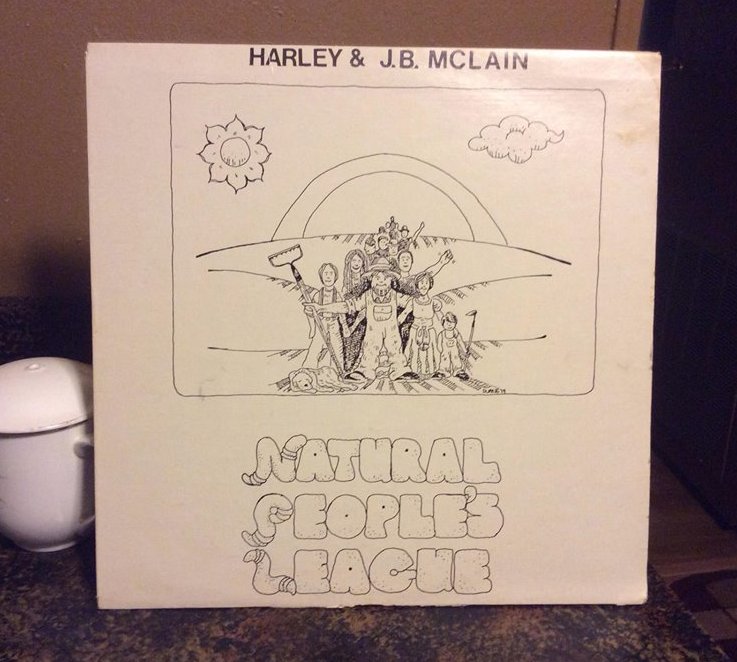
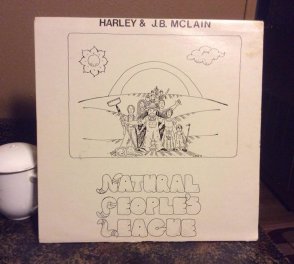
In 1979-1980, JB and Harley McLain (brothers) wrote, played and cut this album in Hollywood. It appropriated the “NPL” acronym, but replaced the Non-Partisan League with the Natural People’s League. Note the earthworms that make up the “NPL.” Photo by Darren King.
If you haven’t yet caught the passing of Harley McLain, here are some links on stories that The Bismarck Tribune, The Fargo Forum, and News Dakota have put together. Please take the time to read them. They are beautifully written. While I have only known Harley since 2012, it appears that the entire northern Great Plains has known him since at least the 1960s. This is testament to his beautiful soul.
I was thinking the other day about a photo of a younger Harley with his wife, Julie. In the photo Harley’s shirt read, “Question Authority.” He did that, of course. It made me think about how in Harley’s questioning of authority, he himself became his own author. In that, he believed in the state of North Dakota, and therefore the country and world (I’m convinced that he still does from the other side). He believed in it so much that he decided to speak up about a variety of issues, and with his particular charm and wit.
Tracy Potter, after hearing about Harley’s passing, remembered his good friend on Facebook. Tracy said,
Sad news today from Molly McLain. Her father, my friend, Harley McLain rejoined his beautiful wife Julie yesterday. Harley was a remarkable man, who had more influence on North Dakota with his guerrilla theatre approach to politics than many much more serious reformers. Out of his campaigns and legal action, North Dakota’s corrupt ballot structure (which Harley argued offended his “poetic sensibilities”) was ruled unconstitutional by Federal courts, giving us the modern, rotating ballot. Always fun, always interesting, and always the kindest, gentle heart. I’ll miss him.
Today and tomorrow and forever, we will continue recounting Harley stories and memories. They bring simultaneous tears and laughs. Harley impressed himself upon anyone who was within his range. Darren King, a slaying upright bassist and family friend of the McLain’s, said:
A couple of days ago North Dakota lost one of its great dreamers, political activists, songwriters, fathers, and forward thinkers. I look forward to jamming again someday Harley. Thanks for helping to raise me.
In conversations around the McLain family table last night, between JB McLain, Chris McLain, Molly McLain, Mira McLain, Matthew McLain, and Ben Simonson, we figured out that Harley, during his life, hung out with Allen Ginsberg, Hunter Thompson, potentially Keith Richards (happening into one another on some boat in the Mediterranean), and for a short time he lived down the street from one if not all of the Ramones. And these were just the individuals we pegged around the table last night. The list by no means is exhaustive.
The most important thing about Harley is that he would treat these individuals the same way he would treat anyone else: without pretension, with respect, and ready for insight and humor and give-and-take conversation. Harley loved people. He loved individuals. If you look at someone who knew Harley, you’re looking a bit at the man himself.
Bless you, Harley McLain. Thank you for the wonderful family you and Julie gave to North Dakota. And to use a bit of Scandinavian subtlety, I’m particularly fond of Molly.
From a sunny Valley City, North Dakota, Aaron L. Barth.
Bakken Oil Train Photo
A photo from a couple weeks ago of a BNSF train facing west with Bakken oil cars in tow. This was taken just east of Moorhead, Minnesota. If the train cars are going east, they are carrying oil. If they are going west, they are returning to pick more oil up.
Historian Frank Vyzralek
So I’m sitting here at my desk this Saturday morning looking up some more details of the crop lien system of farming from the 1860s to 1890, and reading academic articles on the origins of agribusiness. I’m doing this in preparation for this coming week’s lectures that deal with a period of American history from 1890-1900. I’m engaged in my usual over-preparation, which I’m fine with. In fact, I find that as my over-preparation intensifies, the glorious edgy feeling one gets before lectures and presentations begins to ebb.
But even earlier this morning I caught an article in The Bismarck Tribune on the passing of Frank Vyzralek. Sometimes it’s okay to stop reading articles on the crop lien system of farming so as to direct that energy toward thinking about the passing of a friend and colleague. So I thought I’d type out just a couple immediate thoughts that came to me after reading about Frank this morning.
- In doing my own research at the State Historical Society of North Dakota over the years, it was common to see Frank — long white hair and long white beard — at the microfiche reader, with laptop, typing out notes for one area of research or another.
- On occasion, I would bump into Frank at a local watering hole in north Bismarck. I think the last conversation I had with Frank happened years ago, this about Joseph Henry Taylor. I remember Frank sipped a glass of red wine as we traded Joe Taylor points back and forth.
Thanks for all the history, Frank. Thanks for reminding us how unique a place North Dakota was, and is.
Three Dakota Words
Every Tuesday and Thursday afternoon I sit in on and learn a bit more of the Dakota language with Dr. Clifford Canku (pronounced “chan-ku”), Dakota elder and professor of Dakota language at North Dakota State University (NDSU). The classroom setting is both structured and informal, and it has been incredible thus far. By this I mean eye-opening, as in language is the epitome of culture. It is the way we perceive of and describe our world. To understand a culture and its history requires us to understand the language. It’s a basic rule but it bears repeating.
On Tuesday Canku instructed our small student squad to select 10 Dakota words in which non-Dakota/Lakota/Nakota speakers have difficulty enunciating. Here are three from my selection, all of which begin with the letter č. This is a hard c, making a kind of “ch” noise. Also, you can always consult and listen to Canku going through the Dakota alphabet at this link here, too.
čáǧa (v.n.), to freeze, or become ice.
čantiŋ’za (v.n.), to be of good courage. — side note: this might be required to endure the season of čáǧa.
čanza’ni (v.n), to be well in heart; to be tranquil; or of good cheer. — again, see side note above.
Books and Boots
Walking is fun no matter what season. It helps clear the head, and we get to see the world at a slower pace (meaning not from a car). Some thoughts on that here and here.