This is a quick post, something that has been on my mind during my walks to and from campus at North Dakota State University. I have been walking past a historic apartment building about the corner of College Street and 11th Avenue North for years now. The sturdy brick construction caught my eye a couple years ago. I also appreciate its aesthetics. As autumn began to give way to winter this year, I thought I’d snap a couple photos at seasonal intervals to post later — which is now — on this here blog. The first was taken at some point in August-September, 2013. The second was taken after the first big snowfall. Here are the two photos of my own, followed by the GoogleEarth photo.
Author Archives: Aaron Barth
Minneapolis Winter Walk

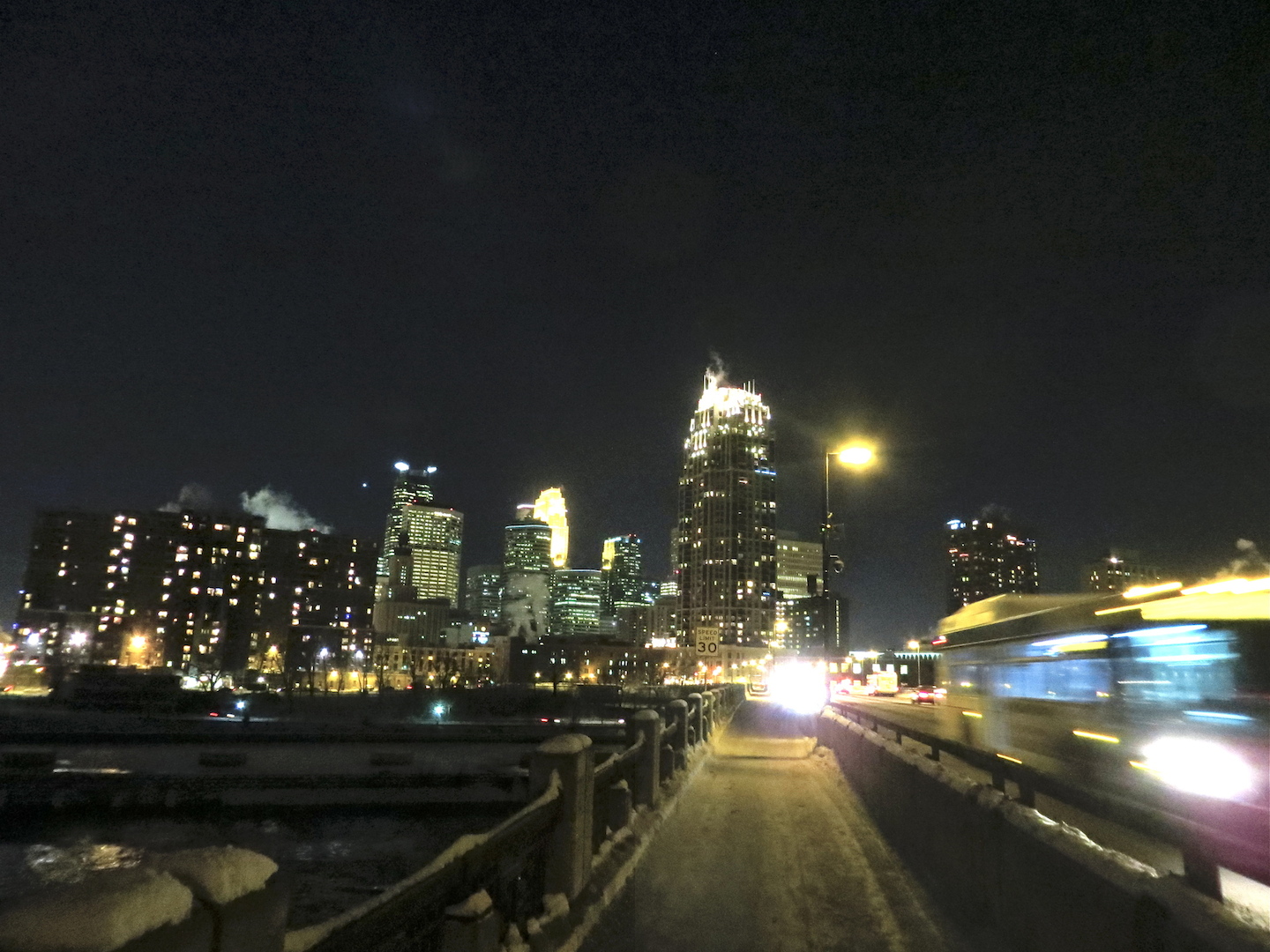
Downtown Minneapolis, looking southwest from the Central Avenue NE bridge. The reflection from the Mississippi River is visible in the lower-left corner of this photo.
Yesterday (12/09/2013), between the late-afternoon and the early evening, I caught up a bit with friend and colleague (Brett Ewald) in Dinkytown, Minneapolis-St. Paul, and after I had to get to downtown Minneapolis proper. I thought about riding some kind of public transportation, but since I normally wear outdoor winter gear, it seemed just as good to walk. The temps were hovering around 0°F.
My typical winter gear run-down is as follows: a wool sweater, this over an undershirt and collared shirt. Exterior layers include a down-filled wool coat, a thermal neck warmer, a merino wool scarf, leather choppers, a thick Carhartt winter cap, merino wool socks, and a pair of classic Sorel winter boots. I think I’ve had these Sorel winter boots for about two decades now, purchasing them long ago at a hardware-tractor supply store in Bismarck, North Dakota.
Back to Minneapolis for the walk, though. It was rush hour, and I worked out that it would take just a little more time walking than by any other means. I’m glad I walked. I went northwest from Dinkytown on 4th Street SE, took a left at 11th Avenue SE, and followed this up to Central Avenue NE where I turned left. Traffic intensified at this intersection, as I was again on a main artery.
From there I crossed the bridge, one of the many that spans the Mississippi. I noticed while walking across this bridge that the temperature warmed up a bit. This warmth came from the Mississippi River — the frigid water not as frigid as the exhilarating air. It was also humbling to hear the mighty roar of that water, and this induced a sensation that was similar to what I felt while looking at the verticality of the glacial fjords of New Zealand. The water reflected the neon Gold Medal Flour sign, among others. Whenever I see agricultural industry in Minneapolis-St. Paul, it reminds me about North Dakota history, and why NoDakers banded together to form a state bank and state mill. I also think about how Minneapolis-St. Paul, one of nature’s metropolises, is a distillation of the agrarian world. The city would not have been possible without all the agricultural and natural resources from the Dakotas.

The Mississippi River reflects the neon Gold Medal Flour signage (among other signs). Photo taken from the Central Avenue NE bridge, view to the south.
Anyhow, after crossing the Central Avenue bridge I was in downtown Minneapolis proper. I turned right on to 1st Street, and I occasionally gazed up toward all the windows in the various high-rises and skyscrapers, noting several Christmas trees framed by their large picture windows. I imagined that a good majority of these folks had jobs as high-powered lawyers, executive officers, banking executives, and Wall Street types. Perhaps they were affiliated with the Timberwolves, Vikings, Wild, or Twins, too? Perhaps. This is why it’s not uncommon to hear the phrase, “big time Minneapolis and good old St. Paul.” A couple bundled up Minneapolisians emerged with their dogs here and there from the ground floor of these skyscrapers for a brief walk around the block to let the dog take care of evening business.
From 1st Street I turned left onto Marquette Avenue, and headed southwest to my destination near the corner of Marquette Avenue and 9th Street South. I think the walk totaled approximately 2 miles, or about 24-25 city blocks. I think the only other piece of cold weather gear I’ll invest in are a pair of light thermal underwear.
If College Football Was History
Over the weekend I wrote some more of my dissertation on why and how the US-Dakota Wars have been remembered on the northern Great Plains. But things beyond my dissertation also happened at North Dakota State University, including the announcement from football head coach Craig Bohl that he just took a job with the University of Wyoming. You can read one of the stories in The Fargo Forum here.
Since I’m a practitioner and fan of the arts and humanities, I thought it would be fun to modify and render the story. If you swap out the word “coach” with “professor,” the word “football” with the word “history department,” and “Craig Bohl” with an NDSU professor of history, it reads like a pretty tense story coming out of the liberal arts in the American West.
Since Bohl is moving to the University of Wyoming, and since NDSU’s Mark Harvey received his PhD history training at the University of Wyoming, it seemed appropriate to use Mark’s name in the rendered, fictional story below. You can find one of Mark’s excellent works of historical scholarship here.
One version of the modified, fictional story would read as follows:
The Mark Harvey history professorial era at North Dakota State ended abruptly, if not shockingly. The 11th-year history professor will be introduced today as the next head professor of history at the University of Wyoming.
NDSU students through social media on Saturday night were stunned and surprised that CBS reported Harvey is taking the head professor of history position with the University of Wyoming. At the heart of the matter: Who will profess history at NDSU?
Harvey and the history department chair did not return text messages Saturday night.
Bruce Feldman, senior college history analyst from CBS, first broke the story that Harvey will be introduced tonight as the next head historian of the University of Wyoming. NDSU called a 9 a.m. departmental history meeting for today, which is unusual.
Wyoming has called a news conference for 6 p.m. (CDT) today to announce a new professor of history.
It left everybody surprised, including the students after Harvey dominated the Western Historical Association‘s conference with a lecture from Gate City Bank Auditorium. Harvey convinced people not even interested in history that it was in fact important.
On their Twitter accounts, PhD Student of History Troy Reisenauer wrote, “Tell me this isn’t true.”
Said PhD student of History Derek Ystebo: “Please say this is a joke.” Later, Ystebo tweeted he was happy for Mark Harvey and “sad it had to get leaked like this.”
Graduate Student Chad Halvorson tweeted, “this is a little weird.”
Harvey, as has been his customary response, did not comment about the speculation after the lecture.
It would be a considerable bump in pay for Harvey to at least $1.2 million per year if not more. The previous professor of history made $1.2 million and reports from Laramie media indicate the next professor of history would be paid higher, perhaps as high as $1.5 million…
Dissertation Update
Today is Friday the 6th of December, it is approximately -11°F, I am looking out beyond the laptop screen through a south-facing window to the light blue snowscape, the time when the approach of the sun-rise appears eminent. I plan on finishing my opening dissertation chapter (which might turn into an introduction) that deals with the public remembrance of the US-Dakota Wars. One of the main thrusts in this disquisition is to look at not only how various generations have remembered and memorialized the US-Dakota Wars, but to piece together why.
I chatted with an engineer about this a couple days ago, albeit briefly, and I found in myself another reason that I hadn’t articulated so well: whenever we, the royal we, are frustrated with the way things are, sometimes it helps to track the history so as to see how we got where we are today. This doesn’t necessarily mean we will agree with it, but one doesn’t have to agree with something in order to understand it. To my right on the floor is a stack of published monographs on world and public history — historiography (or the history of history) having spoken to and shaped what we know today.
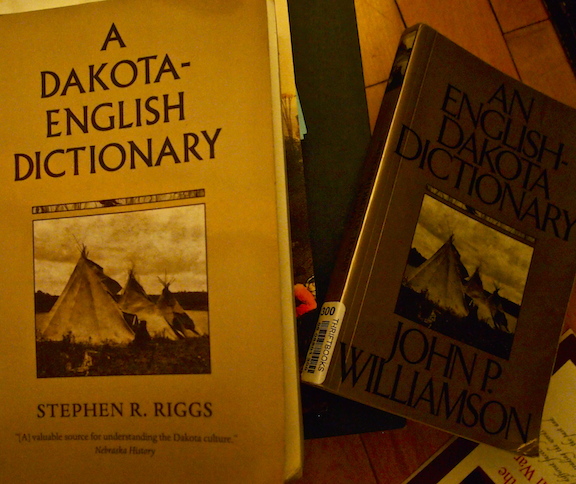
I also picked up and have so far read the introduction of Denise Meringolo, Museums, Monuments, and National Parks: Toward a New Genealogy of Public History (U of Massachusetts Press, 2012) from the dutiful Inter Library Loan-ists at NDSU. A couple months ago Bill Caraher and I were chatting at Laughing Sun in Bismarck, and he suggested I check it out. It is good. More on that later, either in blog or dissertation form. To my left is Stephen R. Riggs, A Dakota-English Diectionary and John P. Williamson, An English-Dakota Dictionary. I continuously re-re-rediscover that language, or the study of it, provides insights into the past, as do oral traditions and oral histories. But okay, enough of all this blogging for now. I’m just going to get after finishing this draft. Happy Friday to you.
Dakota for Blizzard: Icamnatanka
Since it is snowing now and we’re bracing for a blizzard on the northern Steppes of North America, it seems appropriate to look at and unpack the Dakota word for these storm systems. Dakota, after all, was one of the original languages of the Dakotas and Minnesota.
Blizzard in Dakota is icamnatanka, prounced roughly as ih-cha-mnah-tan-ka. In the case of icamnatanka, the word is a combination of two slightly smaller Dakota words. The first is icamna, which means “to blow, bluster, storm, drive, as wind and snow.” Mna in the word icamna is related to yumna. The yu in yumna expresses causation in some way. Thus the entire word yumna denotes a causation that means to rip a seam with scissors, or to rip a seam in anyway by pulling.
The second word in icamnatanka might be a bit more familiar. The word tanka means large or great. It is easy by now to see how icamnatanka comes to denote blizzard. It is a large or great blowing, blustering storm driven by wind. And mna is a word also connected to ripping at the seams. If we use our historical imaginations, we can envision a Dakota, Lakota or Nakota on the northern Great Plains in what we know today as early December. When an icamnatanka would strike, this blizzard would indeed bluster and blow snow through or rip at any kind of seam, whether in a tipi, earth lodge or through the seam of a hide-garment.
I posted a short version of this to social media the other day and a good friend, Dakota Goodhouse, texted me and said, “The Lakota use ichamna for snow storm or blizzard too, but use Iwoblu for severe blizzard.” The variations in language are mind-blowing. In the paraphrased words of John K. Cox at North Dakota State University, to learn a second language means that one learns to grow the other half of their brain. This is true.
Anyhow, as I continue the joyous struggle to learn second languages, it has always seemed to make more sense to me when individual words are unpacked. And by “joyous struggle” I mean just that: learning languages, at least for myself, is difficult. But I’m up for the task. To understand another word and language is to begin to understand another culture. Language is so very connected to culture, and is the way a culture describes itself, immediate surroundings, and the world. When one opens a language they open up a new way of seeing yesteryear, today, and even tomorrow.
The unpacking of icamnatanka came by way of help from one of Clifford Canku‘s Dakota Language I worksheets, and A Dakota-English Dictionary by Stephen R. Riggs (Minnesota Historical Society Press, 1992). Riggs started developing the dictionary in the 1830s with Samuel W. and Gideon H. Pond, and Thomas S. Williamson. They worked directly with Michael Renville, David Grey Cloud, James Garvie, and Walking Elk, a Yankton tribal leader.
This blog entry has been cross-posted at North Dakota State University’s Center for Heritage Renewal here and here.
Scholarly Publishing Houses in New Zealand
Since having returned from the South Pacific, and now back on the northern Steppe of North America, I have been rummaging through all the pieces of paper one accumulates while on short or long journeys. I came across the flyers, handbills and handouts that speak to the various scholarly publishing houses in New Zealand. Before my New Zealand trip, these were off my radar. And I figured since I didn’t know about them but do now, I’d share the findings and provide links. There is Bridget Williams Books, Auckland University Press, and Otago University Press. There, of course, are more (this is not exhaustive). But this is a start.
During the New Zealand Historical Association conference, a panel of editors from these scholarly and academic presses spoke to where scholarly publishing has been, where it is today, and where it might go tomorrow. This, I know, is an excellent idea for any scholarly conference, since the only way scholars can disseminate their research is by getting it published. And to get something published requires one to get to know the editors in charge of the publishing houses. And so on.
Art After the Earthquake: Public Art and Public History in Christchurch, New Zealand
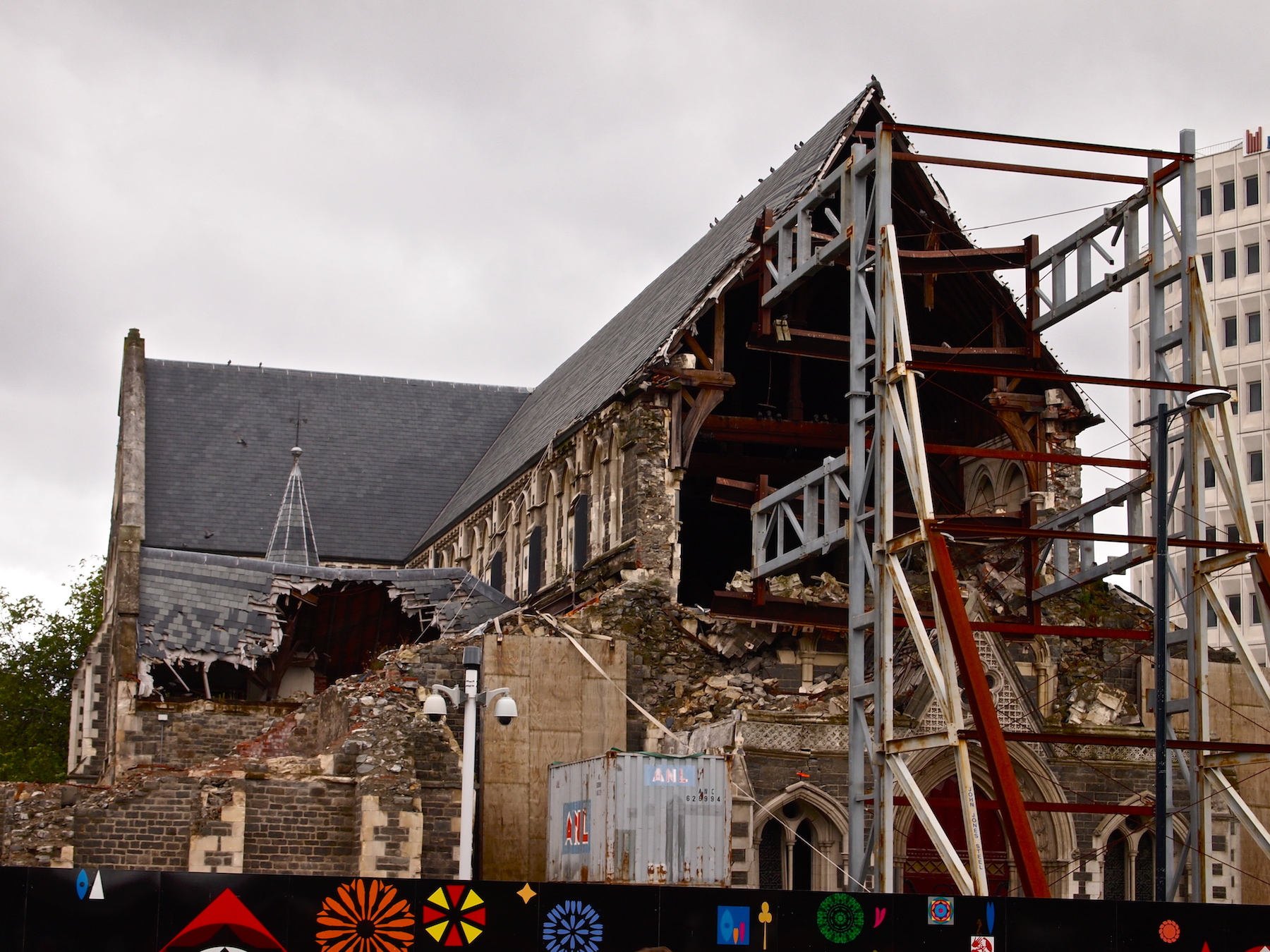
Since September 4, 2010, an earthquake and subsequent aftershocks have caused death and damage to the South Island of New Zealand. Yesterday, on November 26, 2013, Matthew McLain, Molly McLain and I had a chance to visit Cathedral Square in downtown Christchurch. Since the earthquakes first started in September 2010, I had followed the destruction here and there from North Dakota. Like many (or all) destructive events, one gets a different impression from reading about it in contrast to physically visiting it.
In the aftermath, Christchurch has charged artists and historians to inspire and encourage. We saw a few pieces of local public history and public art, this amidst the endless sounds of jackhammering, and sights of construction barriers, rubble, razed and condemned buildings, chain link fence and orange road cones. I enjoyed on piece of public art history entitled “A vast, changing canvas.” The short narrative said,
A public history display in Cathedral Square, downtown Christchurch, New Zealand. Photo from November 26, 2013.
In the city’s altered centre, art, storytelling and the realm of the imagination claim a vital role. Artists Chris Heaphy and Sara Hughes have unleashed color, pattern and energy to communicate an active sense of possibility.
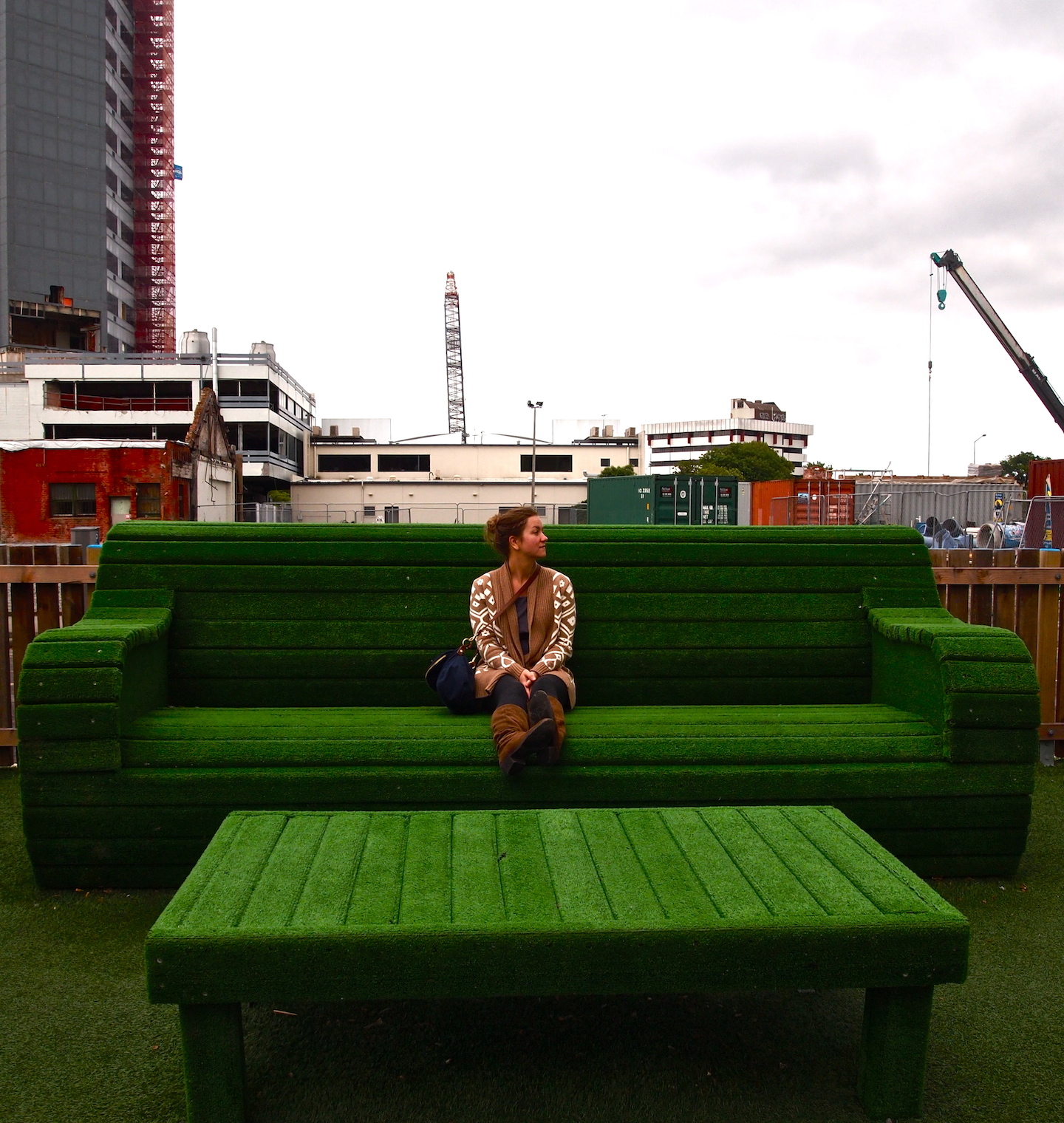
It completely makes sense when wandering around the otherwise grey concrete and rubble-strewn urban scape of the Cathedral District. One piece of public art was a glorified living room covered in astroturf. This impressed upon me the idea of returning the Cathedral District to an outdoor living room. The large sofa, when sitting on it, points you toward the severely damaged Anglican Church.
Another public piece of organic art is the botanical entry that frames the way visitors and sight-seers can view the church (and potential rehab, much of which is documented in this blog here). The three of us had a hard time finding sensibly priced lodging in downtown Christchurch, so we took to the non-city centre and eventually found a cozy little motel. I think it’s important to note here, though, that Christchurch is functioning. In the wake of the September 11, 2001 destruction, I remember Mayor Rudy Giuliani encouraging non-New Yorkers to continue visiting New York City. A couple friends of mine and I ended up taking him up on that, and we visited downtown New York City and Ground Zero in late September 2001.

Public Art that impressionistically simulates an outdoor living room in Cathedral Square, Christchurch. Molly McLain is obliging the artists, and taking it all in.
If someone was to ask me whether or not to visit Christchurch, this in the context of all the rebuilding, I’d encourage it. You might want to book additional sight-seeing to the variety of wineries and vineyards surrounding Christchurch, or the hot spring pools in Hamnar Springs, or the natural history that is the Fox Glacier or Franz Josef Glacier, or (you get the idea). We’ll continue thinking of Christchurch, and we are thankful for the artists that have been charged with and want to reinvigorate the local human spirit. This works just as well in the formal and informal sense. For example, while waiting for our out-going flight at the Christchurch airport, a young kiwi just ran up to Molly and handed her a home-made Merry Christmas card; Molly is creating her own as a response. Inspiration, or inspiring the spirit within others, is contagious that way.
Chinese Pacific World History
On Friday morning, Henry Yu provided the final keynote lecture at the New Zealand Historical Association conference. Yu’s lecture title was, “The Cantonese Pacific: Anti-Asian Politics, and the Making and Unmaking of White Settler Nations.” Yu talked about the 19th century Chinese migrants specific to the social history of ideas. He explained the notion of Gum San, the namesake that Cantonese migrant gold workers gave to the places they imagined themselves eventually arriving at. Gum San signified an idea rather than a place, and they would travel to these goldfields with the psyche of making it: before we can act, we must first have an idea of action. In some cases the workers returned to their homelands, or their villages, ideally with money that allotted them control over their own destinies. In other cases they always envisioned returning, but remained in their non-homeland locales throughout New Zealand, Australia, and North America. It was great to hear Yu talk about all of this.
Yu’s work fills in large gaps in Pacific and world history, and I thought about at least four things during his talk. The first had to do with the Chinese graves that I remembered visiting a couple years ago while in Deadwood, South Dakota, this of the early Chinese gold miners and service industry workers in the Black Hills. The second has to do with the Chinese labor force that built large segments of the railroad throughout the American West. The third had to do with analogies to contemporary migrant workers entering the business of mineral extraction in western North Dakota. And the fourth had to do with how much easier it was for a migrant laborer to travel across national and imperial boundaries before the nation-state created elaborate bureaucracies to inhibit this (largely in the name of race and nation, at least by the turn of the 20th century).
But I don’t have much time to digress on all of this because I need to get over to the Settlers Museum in Dunedin.
Memory and Remembrance in New Zealand

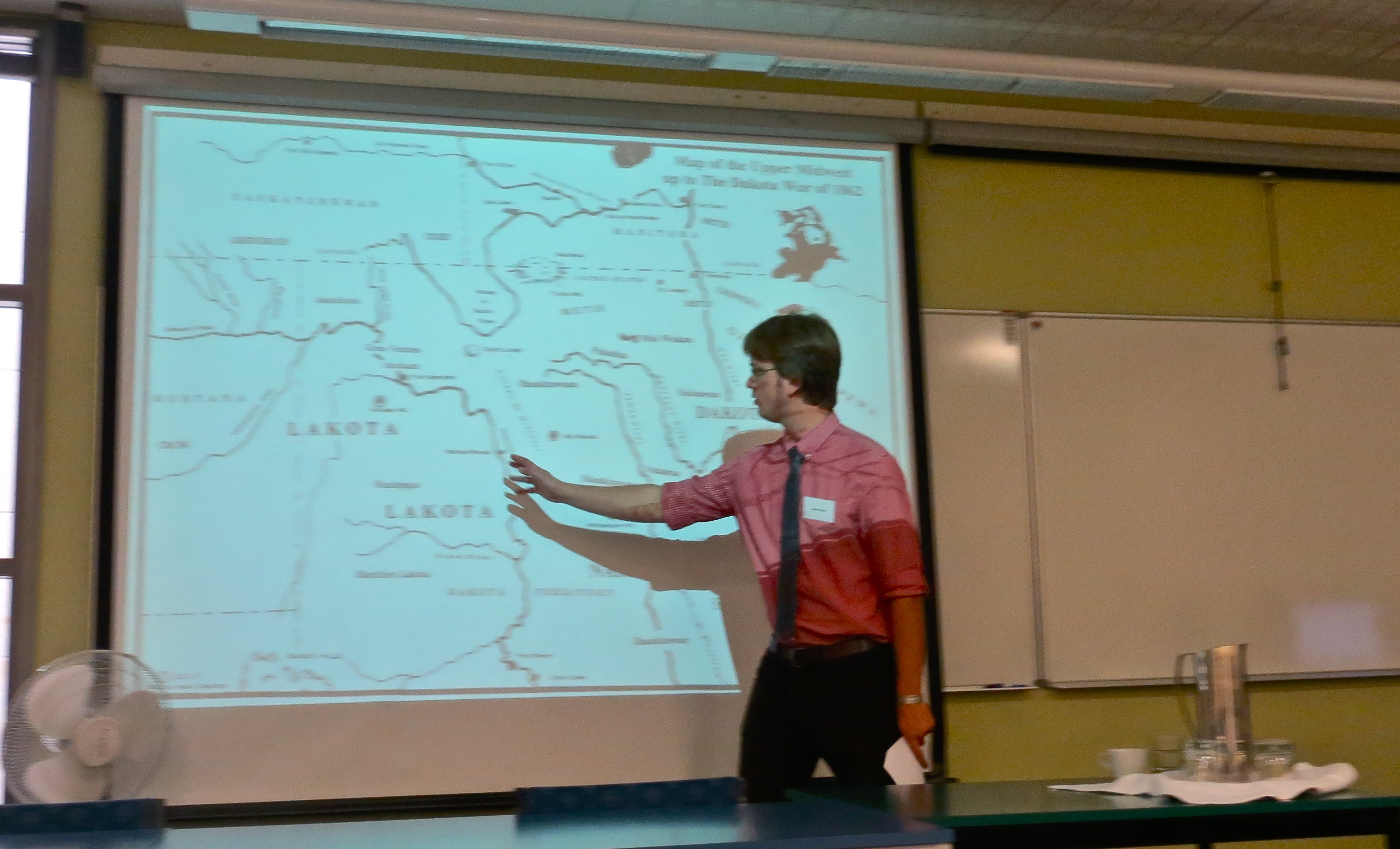
Explaining the various locations of the Dakota, Nakota and Lakota on the northern Great Plains, North America at the New Zealand Historical Association biennial conference on November 21, 2013, at University of Otago, New Zealand.
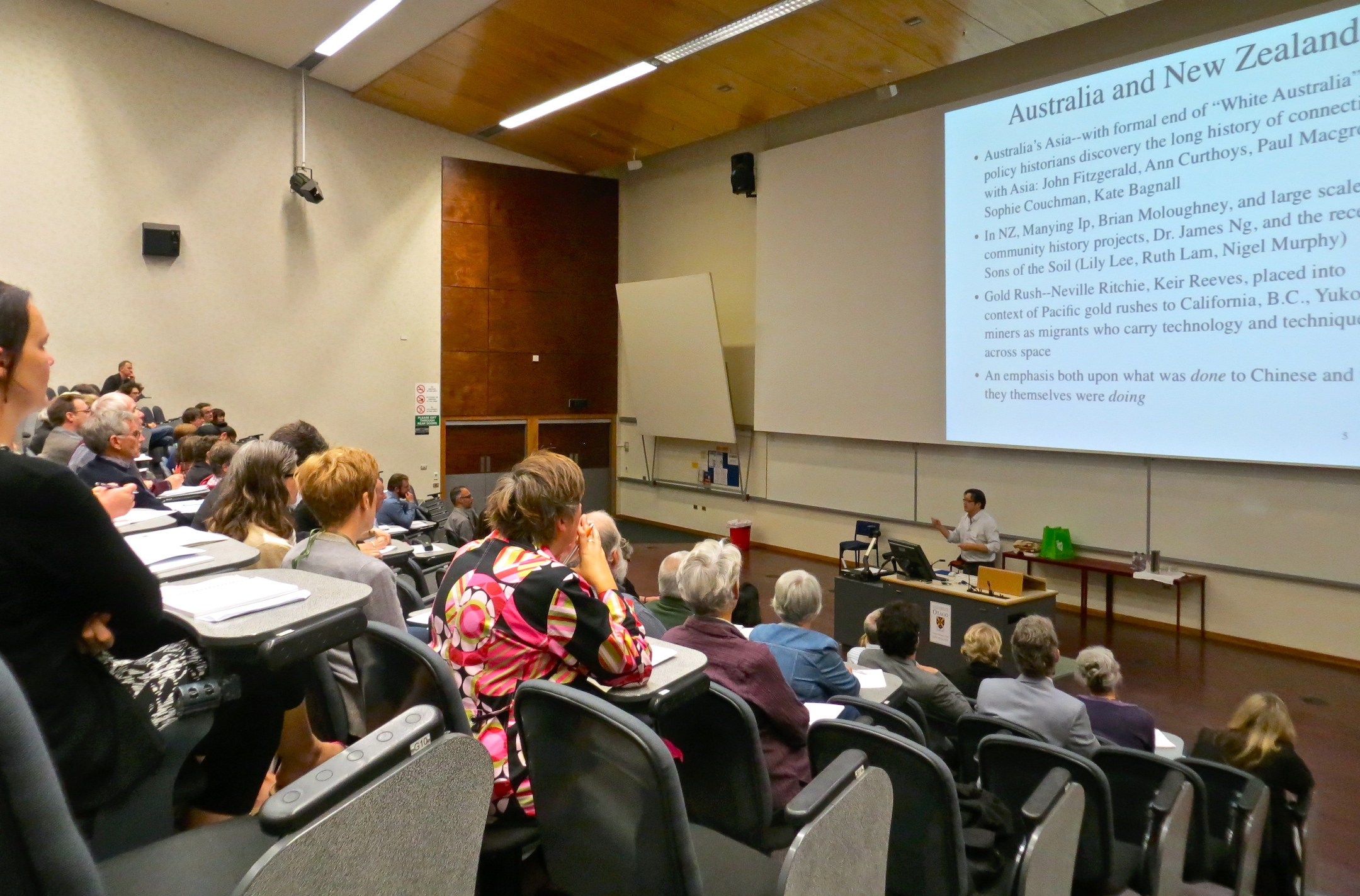
Before I head off to another day of conference papers this morning, I thought I’d do a short recap of the session I attended and presented in yesterday afternoon, representing North Dakota State University and the Center for Heritage Renewal here at the University of Otago, the southern-most university in all the world.
Each presenter has 10-15 minutes to work with, and this is always the challenge of presenting: it’s how to communicate a rather complex idea to an audience — in this case on the other side of the world — using the allotted time parameters. My talk must have resonated with the other attendees and presenters, including George Davis and John Moremon (we chatted a bit after the talk).
I got what I came for, too: my goal was two-fold, the first to present a case-study history on one US-Dakota site of memory and mourning on the northern Great Plains (complete with the history of “official” and counter-official remembrance), and then ask Maori and Kiwi scholars to direct me to various sites of remembrance that resulted from the 19th century British-Maori wars. Of the latter, these conversations are continuing, so I’ll round out this blog post so I can get to those said conversations today.
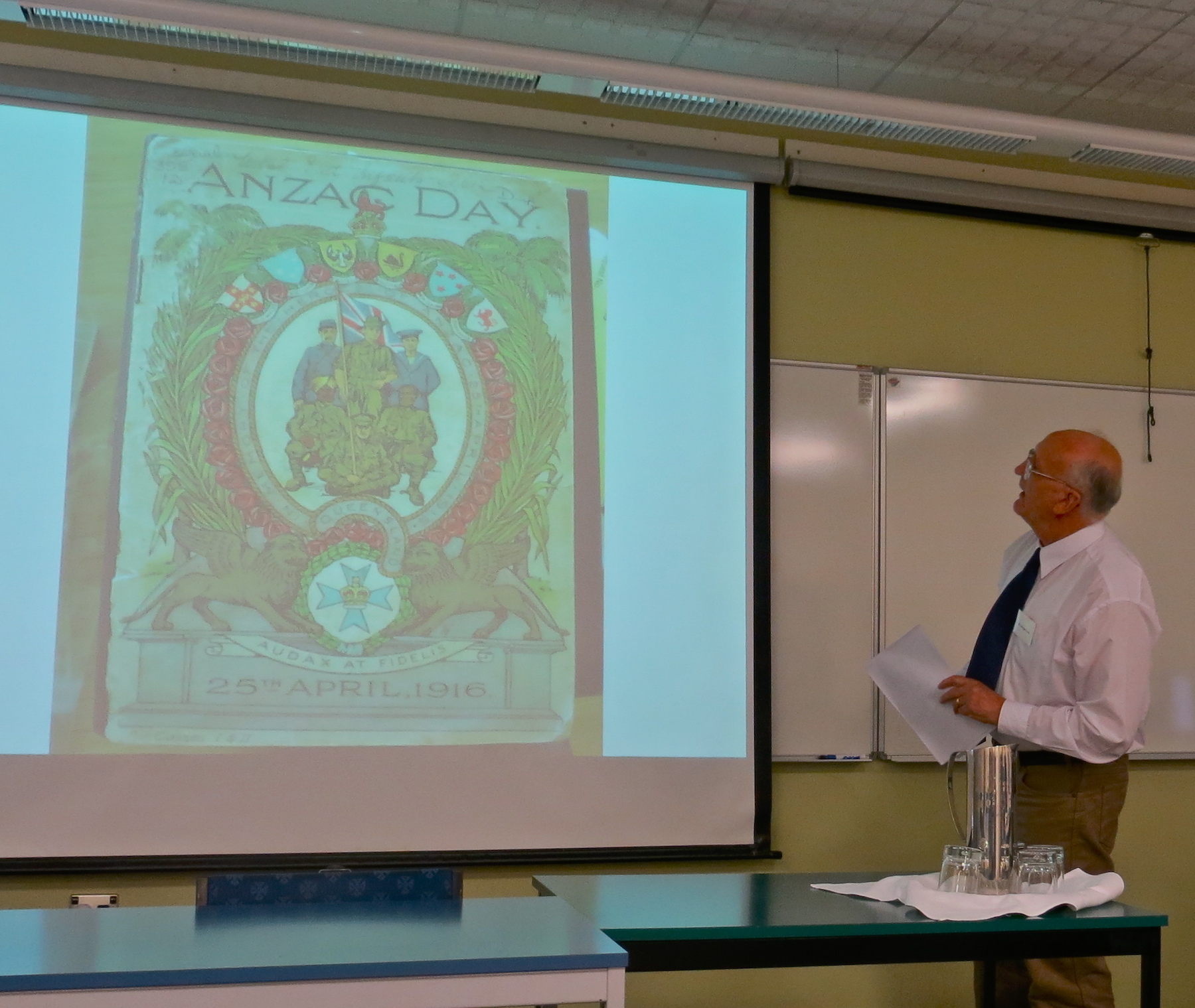
My presentation was followed by George Davis, who considered the remembrance of ANZAC Day memorials, or how memory groups conceive of the physical and mental landscapes, in this case relative to the First World War. And the final presenter came from Aussie John Moremon, who considered how the Aussie and New Zealand government helped (or didn’t help) WWII veteran Calvin Coghill’s relatives through the grieving processes after finding out that Calvin had been killed in action in the European Theatre. Geoff Watson chaired our panel discussion, dutifully keeping all of us within our time limits.
Live Blogging from the NZHA
I’m currently sitting in on Patrick Coleman’s talk entitled “Transnational Orangeism” at the New Zealand Historical Association’s biennial conference in the very antipodes at the University of Otago, Dunedin, south island New Zealand. The Orange Order was a militant organization that rose out of anti-Catholic sentiments in Ireland in the late-18th century. The order reached back into history to grab hold of the memory of William of Orange’s victory over King James. The former was protestant, the latter Catholic. It was a battle that was couched in religious terms, not only about politics and power, but the overlap of religion, politics and power.
The Orange order was global, and they established lodges throughout the world (Canada, the United States, New Zealand, Australia, etc). Patrick used the historical figure of Edith O’Gorman (1842-1919), using historical biography to explain how the ideas of this particular movement moved across the world. Edith was famous amongst her 19th century Orangeists because she escaped nun-hood, converted to protestantism, and went on to give public talks about her self-described struggle.
The use and consideration of using historical biography to discuss world historical events has been a theme of several historical talks at this conference. Maya Jasanoff chatted yesterday about her work which considers Joseph Conrad and his novels as windows into the marginal territories of the global British Empire at the turn of the 19th century. So without going too much further into all of this, I’ll press “Publish” on the blog post and put my computer away to redirect my focus on this next talk.