Tag Archives: North Dakota

Bakken Oil Field Paper Abstract for the WSSA

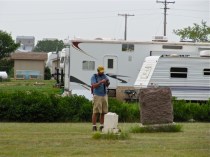
Field crew member Professor Holmgren (of Franklin and Marshall College, PA) documents a historic cemetery surrounded by a Type II camp just south of Tioga, ND in August 2012.

Field crew member Professor Holmgren (of Franklin and Marshall College, PA) documents a historic cemetery surrounded by a Type II camp just south of Tioga, ND in August 2012.

The Western Social Science Association‘s abstract deadline for the April 2013 conference in Denver, Colorado is but a day away. So in the last three days, I put together two disparate abstracts (one for a paper and one for a poster) and submitted them to the conference committee. The paper proposal draws from August 2012 research in the man or labor camps in western North Dakota’s Bakken oil fields, and builds off existing scholarship at this link here. (Note: North Dakota is #2 for oil production in the United States, just behind Texas).

The paper will broadly touch on how and why an area is populated, depopulated, and then repopulated (or re-re-populated, ad infinitum), but focus in on the micro, or what in the business we call individual lives. Contextualizing the micro within the macro, the local within the broader theme. Sometimes historians say those sorts of things in academic papers, or in conversation in general.

Here is the proposed title and abstract of my paper, the one I e-mailed just yesterday to the WSSA people:

Food, Shelter and Water: The Bakken Oil Boom and the Repopulation of Rural Western North Dakota

In August 2012, a collaborative team of historians, archaeologists, architects, sociologists and photographers spent four days studying the labor and “man” camps associated with the Bakken oil boom in rural western North Dakota. While there is monetary success and tragedy inherent in any petroleum boom, the team documented the ways in which skilled and un-skilled laborers carved out their own identities. This captured how an oil boom is much more dynamic than the typical media reporting of it as 100% “good” or absolutely “bad.” Humans are much more complex. This paper considers how a selection of individuals came to work in the Bakken oil field, and how they find lodging, food and hygiene on a day-to-day basis in a rural environment with limited infrastructure.


Sadness in Little Falls, Minnesota

Last evening and this morning I came across a story unfolding out of Little Falls, Minnesota, the headline reading, “Little Falls teen shooting deaths called ‘cold-blooded’,” reported by Curt Brown of the Star Tribune here.

Upon hearing about and reading this, the first thing to rattle itself through my mind was a speech Al Carlson gave on the floor of the North Dakota legislature mid-February 2007, on behalf of a “Castle Bill.” State law enforcement officials opposed this bill that Al was supporting. And Dave Thompson of Prairie Public news reported on that story here.

Carlson, who is the sitting house majority leader of North Dakota, said in 2007 that if a person broke into his house, and I quote,

“I’d tell you what would happen in my house — I would shoot that intruder, and I would shoot him enough times that I knew he wasn’t going to do any danger to me and my family. He’d leak like a watering can when I was done with him.”

To be fair to Carlson, when asked to comment on the 2012 incident in Little Falls, Minnesota, Carlson said, “That was way excessive,” and “That was never the intention of the law.”

Still, Little Falls, Minnesota is left in November 2012 with two dead teenagers who were killed, literally execution style, after they got into mischief and broke into a home (or a couple homes). I read this, and can’t stop thinking of how a leading public official said what he did in 2007, and how he may have composed himself and his speech quite a bit better on the floor of my government (by the people, for the people, folks) back in my hometown of Bismarck in my home state of North Dakota.

We have strong reason and evidence to believe that we do not live in feudal times anymore. Carrying this logic forward, this means we also do not live in castles (or only a few of us do, but they were born into more money than you and I would know what to do with, so they don’t really count). Following this line of thought even further, this means we do not need Castle legislation, or public officials who make Quixotic speeches on the floor of our government. We live in the first decade of the 21st-century, which means we live in homes rather than castles. If you want to be Quixotic and chivalric, open the door for your wife. Do this instead of saying insane things on my government’s floor.

In considering the recent 2012 cold blooded murders in Little Falls, Minnesota, I am now bowing and shaking my head at Al, and his absurd remarks from 2007. Al, use better judgement with your words next time. Stop with the paranoia, please. It ends up spreading, and there’s a good chance it’ll drop into the ear of someone who is just looking for an excuse to do what they did in Little Falls, Minnesota. This is all just so sad.


Raw Field Notes: A Punk Archaeology Meeting with J. Earl Miller and Phil Leitch

Notes scribbled down during a punk archaeology meeting with J. Earl Miller and Phil Leitch on November 26, 2012 at Sidestreet in downtown Fargo, North Dakota.

On November 26, 2012, around 6pm at Sidestreet Grill & Pub in downtown Fargo, North Dakota, I met with J. Earl Miller and Phil Leitch. A couple days ago Miller texted me and said Phil and I should meet and chat (one never knows what one is going to discover with a chat). So we did that.

Phil told me many things. One of these things had to do with dark house spear fishing. I thought it sounded like a punk band, but Phil said it’s something his father does during the winters on the northern Great Plains. Phil’s dad wrote a book about this practice, that of which you can purchase at this link here. I just ordered mine.

At top left are the rest of the raw notes I scribbled down. J. Earl Miller also said he wanted lard instead of cream cheese used in all frosting, both foreign and domestic. That is where the eventual phrase, “Fistfull of Crisco” within the notes came from. And then the word “Lardcore” was dropped, this a slight variation on hard core.

Anyhow, the left side of the page is what I took down while we had our hour long conversation. The right side is the follow up notes I took just after J. Earl Miller and Phil Leitch left to continue their dart league circuit (I think they played at Rooter’s this evening).

It’s a good idea to scribble down notes during and immediately after, and any archaeologist will tell you the same. Especially if this is data or a memory (objective or subjective) you want to, well, remember. Don’t trust your instincts weeks later to somehow magically recall everything that you did, this as you sit in front of a computer monitor trying to recall how it all played out. Just jot it down then and there. Then look at it two weeks from then, this when you are sitting down and trying to remember what happened. The notes will jog your memory. Seriously.

Note: Sid Vicious died on February 2, 1979. Leitch noted this early on during our meeting, and he also noted that the Punk Archaeology round table will take place on that day, February 2. Leitch also said to visit the Fargo Band Family Tree website, which is linked here.


Punk Archaeology: Joe Strummer on DIY

This evening I revisited the documentary, “Joe Strummer: The Future is Unwritten” on the Web 2.0/DIY platform that is YouTube. I have AppleTV jacked into a shamelessly huge flat-screen, and the AppleTV somehow allows me the ability to stream any YouTube selection through it. So by punching in “Joe Strummer: The Future is Unwritten,” YouTube’s search engine returned a series of 2008 uploads by the YouTuber named “madferrett.” Smack dab on 4:02/8:24 in the fourth of eleven installments (the subtitle is “Squatting 101’ers DAY’S”), the late Joe Strummer defines Punk as straight-away Do-It-Yourself. Of this DIY ethos, Joe in the video says:

We had the nerve to rent a room above a pub, and charge people 10 p [aka, pence] to get in. That’s how we learned to play, by doing it for ourselves, which is like a punk ethos. I mean, you gotta be able to go out there and do it yourself, because no one is going to give it to you.

Here is the Joe Strummer YouTube embed:

In the long-winded scheme of things, this is also referred to as being an autodidactic, or a self-taught learner. As fellow blogger Bill Caraher and I continue conversations with any and all about Punk Archaeology, this invariably has helped develop and shape the all-important fineries of the Punk Archaeology conference scheduled to take place in downtown Fargo, North Dakota on February 2-3, 2013 (it starts Saturday evening and is scheduled to end Sunday morning).

It seemed reasonable to post Joe’s remarks, if nothing else to continue to consider what the phrase Punk Archaeology means. In one sense, there is the localized archaeology of punk within Fargo-Moorhead, where any number of bands formed up in DIY fashion to cut loose on stage. In another sense, there is punk archaeology (or Punk Archaeology, depending on how formal one wants to be), the latter word “archaeology” not only specific to the discipline of said archaeology, but also to other DIY attitudes intrinsic to sustaining the disciplines and vocations and trades, and also as in the archaeology of knowledge. Punk archaeology is all around, and often right in front of us. Back to it on this end.


Coffee Science in Fargo

I was trying to think of something epic to blog on for this 100th theedgeofthevillage.com post. Since winter has taken over autumn on the northern Great Plains, hot coffee seems just as good a topic for analysis as any. There are a couple places around the campus of North Dakota State University to purchase cups of coffee. As of late, I have wondered about coffee temperatures. This thought came from being served super-heated coffee in paper cups with those petro-plastic lids within NDSU’s memorial union — a place that fosters memory and unity, no doubt. In the last couple weeks, I have encased the paper cup in one of those cardboard sleeves, and have had to let the super-heated coffee cool enough to sip. Once cooled, I sip the coffee, but then wonder whether the heat melted the insides of the cup: was I just tasting burnt coffee? Or was I tasting coffee infused with melted glue? And was this more damaging to my innards than, say, drinking pints of chilled energy drinks that seem to have begun replacing otherwise traditional coffee drinking? I have no idea, but this in turn led to another idea: data collection on the heat temps of coffee around the Fargo-Moorhead area. So this is the first entry of coffee SCIENCE! in Fargo, North Dakota.

The coffee reviewed in this case is not from the coffee shop alluded to above. Instead, this coffee is from Jitter’s, a coffee house located to the southwest of the intersection of 12th Avenue North and Albrecht Boulevard in Fargo, North Dakota. Here is the raw data from my field notes. Equipment used: one of those thermometers you pick up for around five bucks at the grocery store.

Coffee science.

Objective data: On November 13, 2012, at 9:30AM, the temperature reading from the medium roast coffee just pumped from a thermos into a heated ceramic mug at Jitter’s read 151° F.  The room temperature read 70° F, and the outside winter temp was 19° F (this according to AccuWeather.com). A second reading was taken after a refill at 10:25AM, this at 139° F.

Subjective data: at 151° F, I was able to sip the coffee immediately (no need to let it cool). This immediacy was important since it is necessary to intersperse coffee sips with apple fritterer bites upon the ceremonious opening of the pastry bag. Before getting my coffee, I only had to stand in line for approximately 13 minutes while waiting for the two patrons ahead of me to order some kind of double soy latte decaf with a re-caffeinated infusion loaded with Italian syrup and topped with whipped cream (this will eventually contribute to the downfall of the West to North Korea, a running hypothesis of mine here).

Contribution to Coffee Memory: The rise of the prepared sugar bomb drinks could be felt easily in the year 2000 if a person was engaged in serious coffee drinking at the Dinkydome or throughout the coffee houses in Dinkytown, Minneapolis, Minnesota. It seemed a bit more gendered, though, at least in my mind, as I remember it. Young women tended to order white cafe mochas left and right. Today, full grown men are shamelessly purchasing these types of drinks — not that there’s anything wrong with that. Nonetheless, I’m fairly supportive of nudging our culture in the direction where there are separate but equal ordering lines in coffee houses: one for straight-up coffee drinkers, and the other for sugar-bomb drinkers. More to come on objective and subjective coffee data collection throughout Fargo, ND.


Archaeological Disturbances in Western North Dakota

I came across this October 29, 2012 article, “Land eyed for oil well may be on burial site,” through a colleague and friend, Richard Rothaus.  With the Bakken oil boom going full tilt, this article concerns oil drilling development near and around the Killdeer Mountains in Dunn County, western North Dakota. The part within the article that is incredible is from Lynn Helms, the director of the North Dakota Oil and Gas Division. Mr. Helms said, as paraphrased by the Forum, that “he had no doubts the proposed drilling area has no artifacts.” Once again, this was a paraphrase, but it caused in me the following thoughts: I don’t know whether Mr. Helms physically visited the lithic scatter and possible burial, nor do I know if an archaeologist explained it to him. In the event that he did not physically visit the site, there are quite a few of us that would be happy to explain to him the processes, and why they are necessary. But his lack of doubt is  disturbing. This is why.

The very nature of science and our legal system necessitates constructive and deconstructive doubt. Without this doubt, a case cannot be made one way or another. And without this kind of doubt, and without verifying one’s assertions, a statement is simply a statement sans substance (this is often captured in the saying, “You have no case here.”) Further inquiry into Killdeer is indeed necessary. Numerous archaeologists are concerned with these high profile sites, as they should be, and we are quite interested in showing Mr. Helms why and how. Education is powerful that way. That’s all. Back to it on this end.


Kite Photography in Western North Dakota

On the weekend of October 6-7, 2012, we (meaning archaeologist Richard Rothaus, artist Molly McLain, and myself) piled into the Trefoil field vehicle and cruised out to western North Dakota for a session of low altitude, aerial photography (“low altitude, aerial photography” is the phrase you use in fancy proposals; in lay terms it is kite photography, a do-it-yourself technique historians and archaeologists grapple with from time to time, in Omanwestern North Dakota and the eastern Mediterranean). A fortune cookie has read that you cannot control the wind, but you can adjust the sails. This is true, and when it comes to time-sensitive kite photography on super still days on the northern Great Plains, you can also expend vocal hot air, curse the gods, embrace the absurdity of said still day, and record your comrade at his finest. So while at Theodore Roosevelt’s Elkhorn Ranch site on Saturday evening (with less than 4MPH of wind), sometimes you can catch Rothaus opining on the situation:

To be sure that you caught the audio, Rothaus made an initial objective statement that gave way to the rhetorical question, and then the camera panned over to the impotent aesthetics of a pile of kite on a gravel road. BULLY!

Rothaus from the above video:

I need four miles an hour worth of wind. How can there not be four miles an hour worth of wind in North Dakota?

That is an excellent question, Richard. The gods eventually smiled on us, though, at least for a couple moments, and the wind took the kite in the air allowing the digital camera to capture the evening panoramic of the Elkhorn Ranch:

Elkhorn Ranch photo by Richard Rothaus/Trefoil Cultural, October 2012.

There are green evergreens (which is why they call them ever-green) to the right and leafless deciduous trees to the left, the Little Missouri River looking more like a creek as it should in autumn.

Another one of the problems of kite photography is figuring out what minor or major adjustments the camera needs to capture enough horizon to give the viewer a sense of direction. If you want to make an adjustment, you have to repeatedly send the kite up and down with each camera tweak (bring snacks and a cooler).

Digital cameras attached to low flying kites will not capture everything, and this is why cross-disciplinary teams are a great idea for any type of field research, foreign or domestic. For example, approximately 10 steps to the south of the Elkhorn Ranch visitor signatory signage, an oil derrick can be viewed to the east-southeast across the river. While Rothaus is putting together the kite photography apparatus, you can also capture photos of a book Bill Sewall wrote about his time at the Elkhorn. Bill and his comrade Wilmot Dow did the majority of the hard work out at

Bill Sewall returns to the Elkhorn Ranch, 2012.

the Elkhorn. In thinking about this, I suppose a cynic might say that Theodore brought Bill and Wilmot on board so he could have the time to write about how hard he was working in western North Dakota — if the technology was available, Roosevelt probably would have blogged about kite photography while his comrades were doing the actual hard work of kite photography, too (one has to be a bit philosophical about this).

Anyhow, that evening we refortified with elk burgers and steaks in Medora, and the following day set out to capture some portions of badlands undisturbed yet by precious energy development. We were made aware of these portions of lands through stories in the Dickinson Press, and through one of the missions carried out by the Badlands Conservation Alliance. So on a Sunday we drove down to the area. The wind was really blowing. It was blowing so much that I once again decided not to do any hard work, but do the all important work of capturing the hard work. Notice similarities between Richard Rothaus reeling in this kite and someone reeling in a marlin while deep-water fishing:

It almost smacks of a passage from Fear and Loathing, where kites were swooping down on Richard like huge manta rays coming from all directions out of the sky. Another peril of low altitude, aerial photography is in the photo below. You’ll eventually come across landscape shots like this. If everyone remains silent enough in the field truck, though, you can all pretend like you didn’t just see it. That you just didn’t see this here. Everyone just has to look straight ahead and talk about the weather or something. Don’t draw attention to the following…

Oil Pumps and National Grasslands signage in western North Dakota, October 2012.

BULLY!


Pyramids on the Northern Great Plains

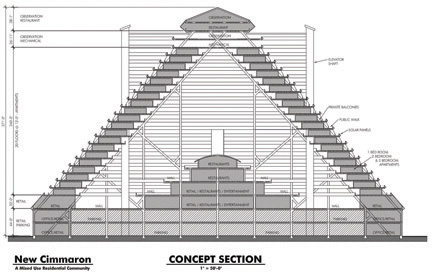
In the last day or so a story about the proposed construction of a pyramid (bigger than the Luxor, Las Vegas) in Williston, North Dakota by a Georgia firm (Camp and Associates) has gained increased attention (The Fargo Forum reports on it here). I hope everything works out a-okay on this project, and it appears local city planners and officials in Williston are generating questions for Camp and Associates. It’s important to be plugged in.

The proposed commercial pyramid for Williston, North Dakota.

The proposed pyramid in Williston got me thinking about another pyramid on the northern Great Plains, this built during some understandably paranoid Cold War times in world history. That pyramid, the Stanley R. Mickelsen Safeguard Complex just north of Nekoma, North Dakota (or not too far south of Langdon, ND), stands as an artifact of the great struggle between the USSR and the US, or as we used to more broadly say, The West.

In Nekoma, I remember a local tavern that with the name, “The Pain Reliever,” or the equivalent, and it reflects a social-psyche from a period in world history when one had to learn how to not only live with but also love the bomb — embracing what one cannot control, or the absurd, is crucial to that.

Below are a couple photos of the safeguard complex from early spring 2012. Today wind turbines surround the SRM Safeguard Complex. When walking around the SRM Safeguard Complex pyramid (at least when I did some years back for an archaeological investigation and inventory), a thought that ran through my brain was the juxtaposition of architecture: the potential for 20th century global nuclear holocaust symbolized by the SRM Safeguard Complex, this in contrast to the green and renewable energy wind turbines of the 21st century. Pyramids aren’t just for Ancient Aztec and Egyptian civilizations…

A 20th century archaeological relic from the Cold War with 21st century Green energy turbines at the right.

MRS signage to the SRM ICBM Cold War relic in North Dakota.


Sweden and North Dakota: Local Genealogy and Google Earth

During the first week of July 2012, I sat down with my grandmother, Vivian Marie (“Larson”) Barth, and we started chatting about genealogy. We, as in the Royal Humanity We, are interested in genealogy for several

Vivian points to a Google Earth map focused in on the near historic archaeological townsite of Bremen, North Dakota. Her father, H.T. Larson, and his brothers and relations settled in and around Bremen and throughout Valhalla Township.

reasons. One of the reasons has to do with identity, or explaining who we can identify with, and how we identify who we are when asked by others. Large genealogical thinkers are often reflected in the form of theologians and naturalists (such as Charles Darwin): they have thought long and hard about where humanity came from, or might have come from.

Another reason we are obsessed with genealogy has to do with trying to explain to ourselves and others with better detail where we came from (when we know our origins, it gives us a feeling — delusional or not — that we know exactly where we are going, a way in which to push into the future).  It’s a fallacy to think that those in the past had such clarity of vision and that they new exactly where they were going. It is only the present, or present mindedness, that imposes this view on the past.

Anyhow, while chatting with this 96 year old Swede, I was able to capture some more focused familial history that invariably reflected a broader historical pattern (migration patterns and that thing we call diaspora). Vivian’s father (or my Swedish great grandfather, Hans Theodore Larson, or “H.T.” as he

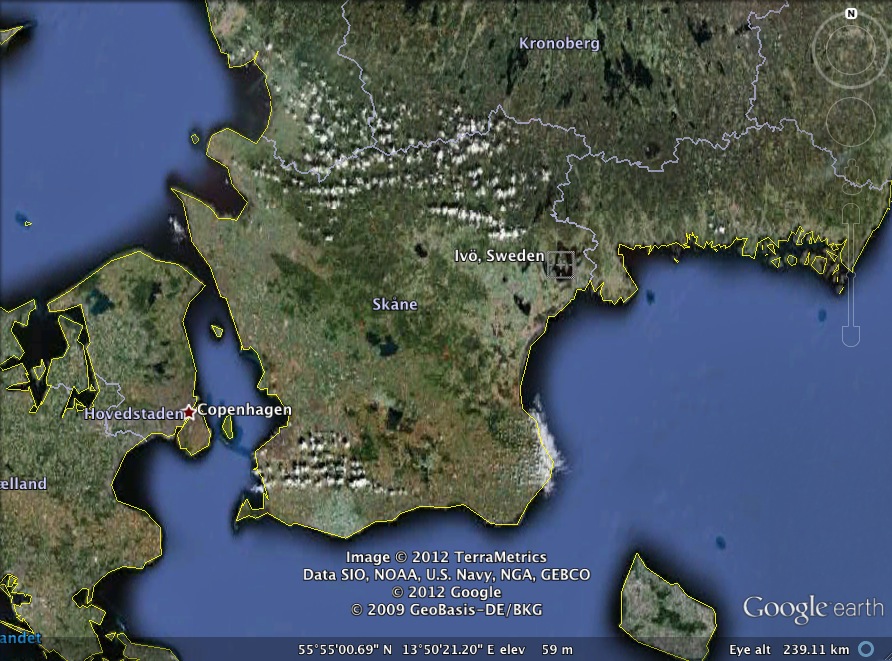
Ivö, Sweden on a Google Earth map.

preferred to be called), came to the United States with his Uncle Pehr in 1889. H.T was 13 years old at the time, and he eventually found himself in Willmar, Minnesota (amongst other folks who talked his talk as well). I knew H.T. came from Skåne, but I did not know he came from the eastern portion of Skåne called Ivö. While sitting with Vivian, I pulled Google Earth up on the laptop and typed in “Ivö, Sweden” and hit “return.” The Google Earth map went from the now nearly historic archaeological townsite of Bremen, North Dakota (in northeastern Wells County), zoomed out, and then back in to the rural Ivö setting in southern Sweden. Below is a short clip of Vivian recalling where her father came from. One more ancillary note: does anyone else see a likeness in facial features between my grandma and the sitting Swedish King? Yeah, you’re right, I’m probably just projecting.


Thoughts on Global Archaeology

On June 5, 2012, my Pyla-Koutsopetria Archaeological Project excavation team hit glorious bedrock (something just over or around 1.8 meters below ground surface). Here is what happens when you sink a hand pick into clay and hit said bedrock. Reverberations shoot up and in through the handle, up to the hand, all while simultaneously returning audible reverberations produced by said metal pick striking bedrock (also known as “that sturdy clink”). The ear drum will pick this up and trigger cognition in a certain direction. It will induce a New World northern Great Plains’ers’ eyes to widen. Note: if you are privy to Native America and its history (and you always should be), you will arguably not regard yourself as from the New World (in academia, we sometimes refer to this as post-colonialism). However, when you are in the Mediterranean, you will need to somehow communicate differences from one side of the Atlantic to another. “Damn that Columbus.” Say this while smiling. If you carry Scandinavian historical identity with you, remind Columbus fanatics about this Smithsonian web-link. We all need balance.

The wall emerges. It’s okay to vacillate between the late Lewis Binford’s processualism and Ian Hodder’s post-processualism while uncovering subsurface Hellenistic architecture at this stage in the game. Say to yourself, “What does this all mean!?”

Anyhow, and upon hearing this bedrock clink, thank the archaeological comrade to your immediate east. “Thank you for also hitting bedrock.” Then pull the pick up out of the earth, swivel the handle 180 degrees, grip it again, and bring back the right arm to its physiological apex. When at its entire apex swing downward, coordinating the arm with gravity to aim the scraper end where the pick left off. Note: you will hear a similar clink and feel the handle vibrate again. With the pick lodged in the dirt and resting on the bedrock below, extend the free left arm toward the upended pick, enclose the left hand around the topside of it, and then drag the handle toward yourself with your right while pushing down on the backside with your left. Essentially, pull the scraper in to the body. Do this repeatedly, moving across the horizontal stratigraphy, only stopping to wipe the sweat from the brow (it otherwise will get into your eyes and produce a slight sting in the corners). This, in turn, will ultimately induce northern Great Plains and Old World historic and archaeological comparative thoughts.

No matter the location on the planet, archaeological excavation units are essentially closed quarter laboratories, where theory and data are in constant exchange with one-another. There is the material culture that continuously emerges from below, inanimate objects from a bygone age (note: do not ever, ever, refer to skeletal remains as “inanimate objects.” You will deservedly be destroyed by the present). These objects carry and reflect the imprint of humanity. Know them. Respect them. They are from civilizations and cultures that pushed in certain directions for an infinite amount of reasons. While in the excavation unit, thoughts will continue, at least when bounced off the word culture (this word and idea re-popularized by Fernand Braudelin the 20th century).  This latter word, culture, is analogous with the word cult (and even agriculture, and monoculture), or the process of doing things together and in a particular direction. These are some thoughts that will rip through your brain.

Hellenistic Imagined Community (name-dropping thanks here to Benedict Anderson). Map taken from U of Texas web-link: http://www.utexas.edu/courses/macedonia/maps_hellenistic_kingdoms_.htm

In addition to this, your archaeological physiology will be in constant exchange with meteorology and the weather. This may be reflected in the saying, “If you can’t stand the heat, then get out of the excavation unit.” You will be uncertain how warm it has been getting at the Vigla site on Cyprus — “What does this Centigrade mean? And why can’t the world just get on board with Fahrenheit? What does it all mean?!” Never mind all of these thoughts. Keep them to yourself. If you know the sun is going to be up and about, definitely wear a brimmed hat (sombreros have been suggested), collars if you can, sunscreen for certain. If your shirt is in its second day of rotation, you may take offense at your own odor about mid-afternoon of that second day. It’s okay to announce this to your crew. Be calm in your tone, though. “I am taking offense at my own body odor. I just wanted to announce that.” In the correct context, all of this will lighten things up a bit.

But back to this exchange in the excavation unit, the one that is set down on top of a 3rd century BC Hellenistic site. As the fortification wall grows up out of the ground (you’re excavating around it), you will begin admiring the mason who some 2,300 years prior chiseled these ashlar blocks and roughed out stones here and there to assemble this wall. “Is it a partition wall? Is it one phase of an exterior wall? What’s with all the military-like artifacts we keep coming down on within these walls? MAKE SENSE OF ALL THIS, DAMMIT!!!” You’re brain will think these things, a kind of psychological inversion into itself. After climbing out of the test unit, scribble a distilled and filtered variation of these thoughts down in the subjective note section of your excavation unit forms. Use big words here and there. They tend to be more timeless than relativistic lay-terms. Also: a slight breeze may push up over the plateau and evaporate the sweat out of your drenched shirt. Be sure to say to the crew, “Don’t come out of the excavation unit: it’s cold up here, something like 90 degrees Fahrenheit, or whatever,  and you’ll catch a chill and perhaps your death. Stay down and warm in the breeze-less 90+ degree excavation unit.”

As mentioned above, excavation units can become cramped. But this doesn’t matter because you’ll have kept the bigger idea and picture in mind. The mind convinces the body that an inevitability is at stake: we will finish this excavation unit, record it properly, and be satisfied with questions we answered, and the new questions generated by the unanticipated finds — happens every time.

While in the western portion of the excavation unit and while facing north, you will have to bring the pick down close to the emerging foundation wall. This will invariably bring your knuckles into direct contact with the said foundation wall. With one repeated swing after another, your knuckles hitting the wall is ultimately a game of chance and odds. At some point they will scrape the wall. When this happens, you’ll immediately think of the epilogue Tom Isern set down in Prairie Churches. Tom was re-roofing a prairie church, and he maneuvered in a way on the ladder that was in discord with gravity, and amazingly he captured himself, but only after dragging his forearm across the said church roof. One imagines that a bit of Tom, at least the DNA from his scrape, was set into this church roof. Similar situation when your knuckles whack and scrape the side of subsurface Hellenistic architecture in the Levant. You’ll see a dash of blood and think, “Well, there it is. Better take a picture and Web 2.0/Digital Humanities this thing on the Internets…”