Tag Archives: North Dakota

Kite Photography in Western North Dakota

On the weekend of October 6-7, 2012, we (meaning archaeologist Richard Rothaus, artist Molly McLain, and myself) piled into the Trefoil field vehicle and cruised out to western North Dakota for a session of low altitude, aerial photography (“low altitude, aerial photography” is the phrase you use in fancy proposals; in lay terms it is kite photography, a do-it-yourself technique historians and archaeologists grapple with from time to time, in Omanwestern North Dakota and the eastern Mediterranean). A fortune cookie has read that you cannot control the wind, but you can adjust the sails. This is true, and when it comes to time-sensitive kite photography on super still days on the northern Great Plains, you can also expend vocal hot air, curse the gods, embrace the absurdity of said still day, and record your comrade at his finest. So while at Theodore Roosevelt’s Elkhorn Ranch site on Saturday evening (with less than 4MPH of wind), sometimes you can catch Rothaus opining on the situation:

To be sure that you caught the audio, Rothaus made an initial objective statement that gave way to the rhetorical question, and then the camera panned over to the impotent aesthetics of a pile of kite on a gravel road. BULLY!

Rothaus from the above video:

I need four miles an hour worth of wind. How can there not be four miles an hour worth of wind in North Dakota?

That is an excellent question, Richard. The gods eventually smiled on us, though, at least for a couple moments, and the wind took the kite in the air allowing the digital camera to capture the evening panoramic of the Elkhorn Ranch:

Elkhorn Ranch photo by Richard Rothaus/Trefoil Cultural, October 2012.

There are green evergreens (which is why they call them ever-green) to the right and leafless deciduous trees to the left, the Little Missouri River looking more like a creek as it should in autumn.

Another one of the problems of kite photography is figuring out what minor or major adjustments the camera needs to capture enough horizon to give the viewer a sense of direction. If you want to make an adjustment, you have to repeatedly send the kite up and down with each camera tweak (bring snacks and a cooler).

Digital cameras attached to low flying kites will not capture everything, and this is why cross-disciplinary teams are a great idea for any type of field research, foreign or domestic. For example, approximately 10 steps to the south of the Elkhorn Ranch visitor signatory signage, an oil derrick can be viewed to the east-southeast across the river. While Rothaus is putting together the kite photography apparatus, you can also capture photos of a book Bill Sewall wrote about his time at the Elkhorn. Bill and his comrade Wilmot Dow did the majority of the hard work out at

Bill Sewall returns to the Elkhorn Ranch, 2012.

the Elkhorn. In thinking about this, I suppose a cynic might say that Theodore brought Bill and Wilmot on board so he could have the time to write about how hard he was working in western North Dakota — if the technology was available, Roosevelt probably would have blogged about kite photography while his comrades were doing the actual hard work of kite photography, too (one has to be a bit philosophical about this).

Anyhow, that evening we refortified with elk burgers and steaks in Medora, and the following day set out to capture some portions of badlands undisturbed yet by precious energy development. We were made aware of these portions of lands through stories in the Dickinson Press, and through one of the missions carried out by the Badlands Conservation Alliance. So on a Sunday we drove down to the area. The wind was really blowing. It was blowing so much that I once again decided not to do any hard work, but do the all important work of capturing the hard work. Notice similarities between Richard Rothaus reeling in this kite and someone reeling in a marlin while deep-water fishing:

It almost smacks of a passage from Fear and Loathing, where kites were swooping down on Richard like huge manta rays coming from all directions out of the sky. Another peril of low altitude, aerial photography is in the photo below. You’ll eventually come across landscape shots like this. If everyone remains silent enough in the field truck, though, you can all pretend like you didn’t just see it. That you just didn’t see this here. Everyone just has to look straight ahead and talk about the weather or something. Don’t draw attention to the following…

Oil Pumps and National Grasslands signage in western North Dakota, October 2012.

BULLY!


Pyramids on the Northern Great Plains

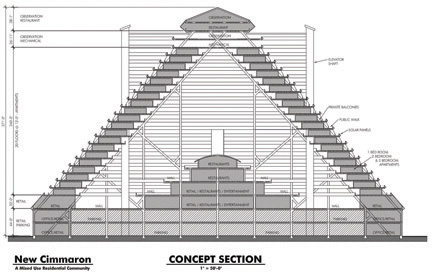
In the last day or so a story about the proposed construction of a pyramid (bigger than the Luxor, Las Vegas) in Williston, North Dakota by a Georgia firm (Camp and Associates) has gained increased attention (The Fargo Forum reports on it here). I hope everything works out a-okay on this project, and it appears local city planners and officials in Williston are generating questions for Camp and Associates. It’s important to be plugged in.

The proposed commercial pyramid for Williston, North Dakota.

The proposed pyramid in Williston got me thinking about another pyramid on the northern Great Plains, this built during some understandably paranoid Cold War times in world history. That pyramid, the Stanley R. Mickelsen Safeguard Complex just north of Nekoma, North Dakota (or not too far south of Langdon, ND), stands as an artifact of the great struggle between the USSR and the US, or as we used to more broadly say, The West.

In Nekoma, I remember a local tavern that with the name, “The Pain Reliever,” or the equivalent, and it reflects a social-psyche from a period in world history when one had to learn how to not only live with but also love the bomb — embracing what one cannot control, or the absurd, is crucial to that.

Below are a couple photos of the safeguard complex from early spring 2012. Today wind turbines surround the SRM Safeguard Complex. When walking around the SRM Safeguard Complex pyramid (at least when I did some years back for an archaeological investigation and inventory), a thought that ran through my brain was the juxtaposition of architecture: the potential for 20th century global nuclear holocaust symbolized by the SRM Safeguard Complex, this in contrast to the green and renewable energy wind turbines of the 21st century. Pyramids aren’t just for Ancient Aztec and Egyptian civilizations…

A 20th century archaeological relic from the Cold War with 21st century Green energy turbines at the right.

MRS signage to the SRM ICBM Cold War relic in North Dakota.


Sweden and North Dakota: Local Genealogy and Google Earth

During the first week of July 2012, I sat down with my grandmother, Vivian Marie (“Larson”) Barth, and we started chatting about genealogy. We, as in the Royal Humanity We, are interested in genealogy for several

Vivian points to a Google Earth map focused in on the near historic archaeological townsite of Bremen, North Dakota. Her father, H.T. Larson, and his brothers and relations settled in and around Bremen and throughout Valhalla Township.

reasons. One of the reasons has to do with identity, or explaining who we can identify with, and how we identify who we are when asked by others. Large genealogical thinkers are often reflected in the form of theologians and naturalists (such as Charles Darwin): they have thought long and hard about where humanity came from, or might have come from.

Another reason we are obsessed with genealogy has to do with trying to explain to ourselves and others with better detail where we came from (when we know our origins, it gives us a feeling — delusional or not — that we know exactly where we are going, a way in which to push into the future).  It’s a fallacy to think that those in the past had such clarity of vision and that they new exactly where they were going. It is only the present, or present mindedness, that imposes this view on the past.

Anyhow, while chatting with this 96 year old Swede, I was able to capture some more focused familial history that invariably reflected a broader historical pattern (migration patterns and that thing we call diaspora). Vivian’s father (or my Swedish great grandfather, Hans Theodore Larson, or “H.T.” as he

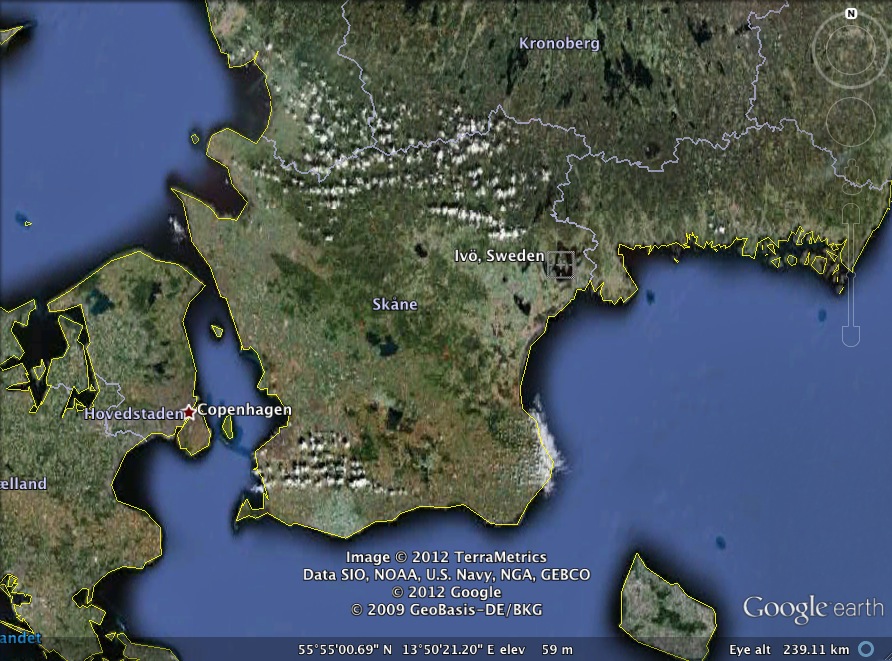
Ivö, Sweden on a Google Earth map.

preferred to be called), came to the United States with his Uncle Pehr in 1889. H.T was 13 years old at the time, and he eventually found himself in Willmar, Minnesota (amongst other folks who talked his talk as well). I knew H.T. came from Skåne, but I did not know he came from the eastern portion of Skåne called Ivö. While sitting with Vivian, I pulled Google Earth up on the laptop and typed in “Ivö, Sweden” and hit “return.” The Google Earth map went from the now nearly historic archaeological townsite of Bremen, North Dakota (in northeastern Wells County), zoomed out, and then back in to the rural Ivö setting in southern Sweden. Below is a short clip of Vivian recalling where her father came from. One more ancillary note: does anyone else see a likeness in facial features between my grandma and the sitting Swedish King? Yeah, you’re right, I’m probably just projecting.


Thoughts on Global Archaeology

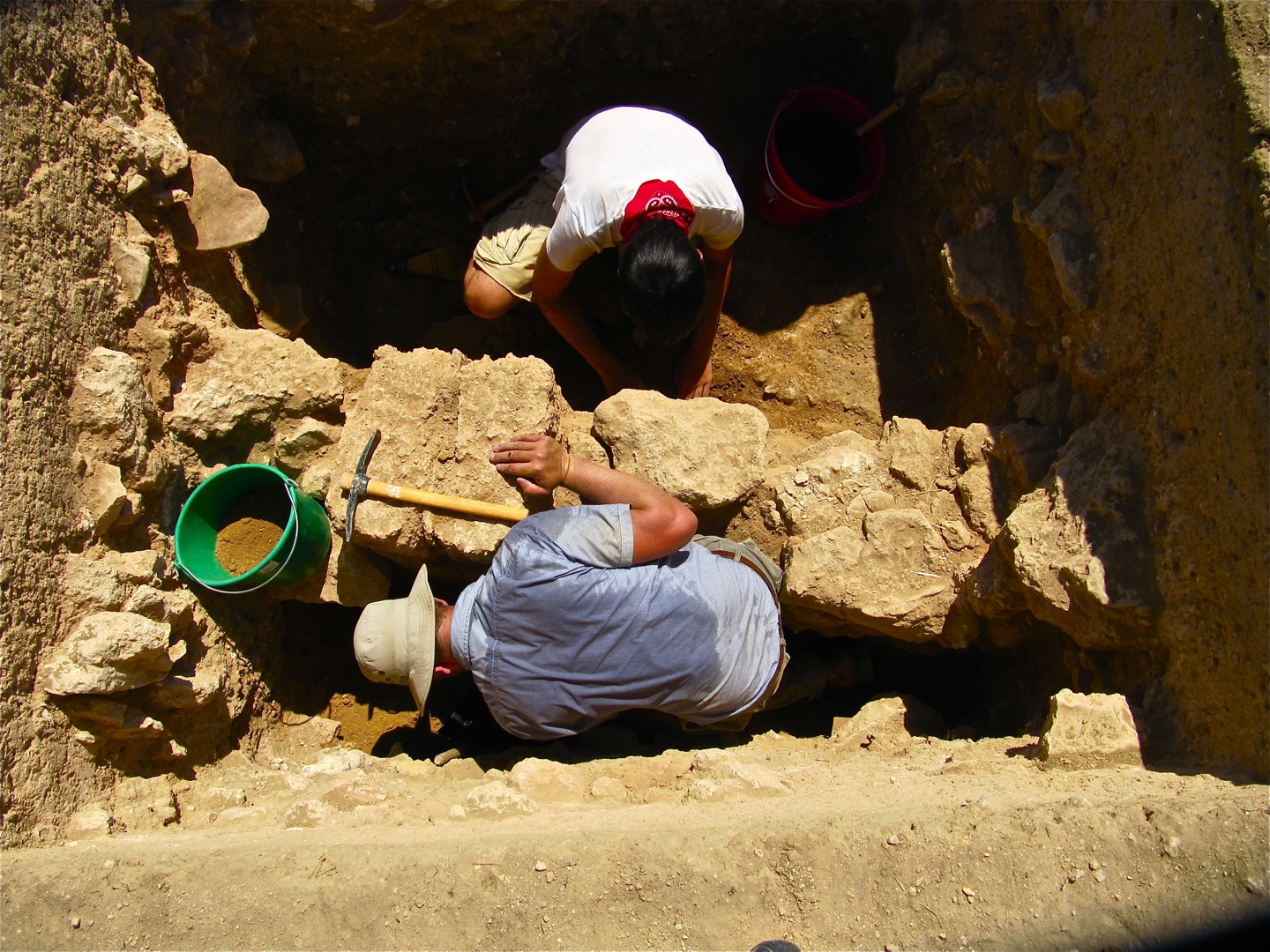
On June 5, 2012, my Pyla-Koutsopetria Archaeological Project excavation team hit glorious bedrock (something just over or around 1.8 meters below ground surface). Here is what happens when you sink a hand pick into clay and hit said bedrock. Reverberations shoot up and in through the handle, up to the hand, all while simultaneously returning audible reverberations produced by said metal pick striking bedrock (also known as “that sturdy clink”). The ear drum will pick this up and trigger cognition in a certain direction. It will induce a New World northern Great Plains’ers’ eyes to widen. Note: if you are privy to Native America and its history (and you always should be), you will arguably not regard yourself as from the New World (in academia, we sometimes refer to this as post-colonialism). However, when you are in the Mediterranean, you will need to somehow communicate differences from one side of the Atlantic to another. “Damn that Columbus.” Say this while smiling. If you carry Scandinavian historical identity with you, remind Columbus fanatics about this Smithsonian web-link. We all need balance.

The wall emerges. It’s okay to vacillate between the late Lewis Binford’s processualism and Ian Hodder’s post-processualism while uncovering subsurface Hellenistic architecture at this stage in the game. Say to yourself, “What does this all mean!?”

Anyhow, and upon hearing this bedrock clink, thank the archaeological comrade to your immediate east. “Thank you for also hitting bedrock.” Then pull the pick up out of the earth, swivel the handle 180 degrees, grip it again, and bring back the right arm to its physiological apex. When at its entire apex swing downward, coordinating the arm with gravity to aim the scraper end where the pick left off. Note: you will hear a similar clink and feel the handle vibrate again. With the pick lodged in the dirt and resting on the bedrock below, extend the free left arm toward the upended pick, enclose the left hand around the topside of it, and then drag the handle toward yourself with your right while pushing down on the backside with your left. Essentially, pull the scraper in to the body. Do this repeatedly, moving across the horizontal stratigraphy, only stopping to wipe the sweat from the brow (it otherwise will get into your eyes and produce a slight sting in the corners). This, in turn, will ultimately induce northern Great Plains and Old World historic and archaeological comparative thoughts.

No matter the location on the planet, archaeological excavation units are essentially closed quarter laboratories, where theory and data are in constant exchange with one-another. There is the material culture that continuously emerges from below, inanimate objects from a bygone age (note: do not ever, ever, refer to skeletal remains as “inanimate objects.” You will deservedly be destroyed by the present). These objects carry and reflect the imprint of humanity. Know them. Respect them. They are from civilizations and cultures that pushed in certain directions for an infinite amount of reasons. While in the excavation unit, thoughts will continue, at least when bounced off the word culture (this word and idea re-popularized by Fernand Braudelin the 20th century).  This latter word, culture, is analogous with the word cult (and even agriculture, and monoculture), or the process of doing things together and in a particular direction. These are some thoughts that will rip through your brain.

Hellenistic Imagined Community (name-dropping thanks here to Benedict Anderson). Map taken from U of Texas web-link: http://www.utexas.edu/courses/macedonia/maps_hellenistic_kingdoms_.htm

In addition to this, your archaeological physiology will be in constant exchange with meteorology and the weather. This may be reflected in the saying, “If you can’t stand the heat, then get out of the excavation unit.” You will be uncertain how warm it has been getting at the Vigla site on Cyprus — “What does this Centigrade mean? And why can’t the world just get on board with Fahrenheit? What does it all mean?!” Never mind all of these thoughts. Keep them to yourself. If you know the sun is going to be up and about, definitely wear a brimmed hat (sombreros have been suggested), collars if you can, sunscreen for certain. If your shirt is in its second day of rotation, you may take offense at your own odor about mid-afternoon of that second day. It’s okay to announce this to your crew. Be calm in your tone, though. “I am taking offense at my own body odor. I just wanted to announce that.” In the correct context, all of this will lighten things up a bit.

But back to this exchange in the excavation unit, the one that is set down on top of a 3rd century BC Hellenistic site. As the fortification wall grows up out of the ground (you’re excavating around it), you will begin admiring the mason who some 2,300 years prior chiseled these ashlar blocks and roughed out stones here and there to assemble this wall. “Is it a partition wall? Is it one phase of an exterior wall? What’s with all the military-like artifacts we keep coming down on within these walls? MAKE SENSE OF ALL THIS, DAMMIT!!!” You’re brain will think these things, a kind of psychological inversion into itself. After climbing out of the test unit, scribble a distilled and filtered variation of these thoughts down in the subjective note section of your excavation unit forms. Use big words here and there. They tend to be more timeless than relativistic lay-terms. Also: a slight breeze may push up over the plateau and evaporate the sweat out of your drenched shirt. Be sure to say to the crew, “Don’t come out of the excavation unit: it’s cold up here, something like 90 degrees Fahrenheit, or whatever,  and you’ll catch a chill and perhaps your death. Stay down and warm in the breeze-less 90+ degree excavation unit.”

As mentioned above, excavation units can become cramped. But this doesn’t matter because you’ll have kept the bigger idea and picture in mind. The mind convinces the body that an inevitability is at stake: we will finish this excavation unit, record it properly, and be satisfied with questions we answered, and the new questions generated by the unanticipated finds — happens every time.

While in the western portion of the excavation unit and while facing north, you will have to bring the pick down close to the emerging foundation wall. This will invariably bring your knuckles into direct contact with the said foundation wall. With one repeated swing after another, your knuckles hitting the wall is ultimately a game of chance and odds. At some point they will scrape the wall. When this happens, you’ll immediately think of the epilogue Tom Isern set down in Prairie Churches. Tom was re-roofing a prairie church, and he maneuvered in a way on the ladder that was in discord with gravity, and amazingly he captured himself, but only after dragging his forearm across the said church roof. One imagines that a bit of Tom, at least the DNA from his scrape, was set into this church roof. Similar situation when your knuckles whack and scrape the side of subsurface Hellenistic architecture in the Levant. You’ll see a dash of blood and think, “Well, there it is. Better take a picture and Web 2.0/Digital Humanities this thing on the Internets…”


From Athens, Greece

As I type, the sturdy MacBook Pro has 29% battery power left. This is not because I forgot to purchase those handy power converters (I have two in my bag), but rather because I don’t think it would be a good idea to cut off that third prong on the MacBook Pro power cord just so I can get it into the two-prong outlet converter (I’ll figure this out once in Cyprus, or so I tell myself).

Some quick updates, a sort of on-line journal file:

Getting there, and the psychology leading up to traveling to a destination are in dispute. For some, the arrival to the destination signals the beginning of the vacation or, in my case, the archaeological

When you’re driving from Fargo to Rothaus’s in Sauk Rapids, Minnesota, your windshield starts looking like this.

fieldwork in Cyprus. Yet it seems more reasonable to consider the point at which the tickets are purchased as a type of prologue, or introductory transition, that signals the eventual beginning of a trip. Life is one gradual push out of one situation and into another, and the only way to distinguish between one event and the next is to psychologically impose order on it. Sometimes students will say (and I understand why they say this), “This isn’t how we did it in high-school.” Often I tell them I know, but I counter by explaining that it is no longer high-school, and this in turn is part of pushing out of one situation in life and transitioning into another. In many ways this is called reconditioning one’s behavior. In lay-terms it is known as getting one’s crap together. Much of life is about getting there, about getting one’s crap together to get there.

Anyhow, on May 14, 2012, I loaded two bags into the ’93 Chevy S-10 and drove from Fargo to Sauk Rapids, MN. Richard Rothaus, a friend and colleague, shuttled me from his home down to the MSP-International. We talked about past and future archaeological, historical, ethnographic, genealogical and anthropological fieldwork. I told him I had been reading up on Zeno of Citium, and Rothaus openly considered Zeno’s paradox — that is, when an arrow is fired at a tree, it invariably
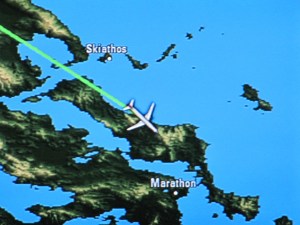
From London, tell the pilot to head east-bound across the channel, and then hang about a 45 degree right at Brussels. Eventually you’ll get to this.

reaches a point where it is half way there. Then it is half-way to half-way there. Then half-way to half-way to half-way there, and so on, and the question remains: how does the arrow ever get to the tree if it is always half-way there? He said, “Zeno did not have calculus technology yet.” I said, “Yeah, eventually I’d have to tell Zeno that the arrow will get there when it gets there.” Rothaus eventually got me at that top-tier roadway at MSP International.

The line at the airport wasn’t much of a line. Instead it was the standard mob of confusion and misdirected energy, as it normally is at airports. Numerous individuals are dropped off, and they are all looking to be in a hurry and get where they need to get. A confluence of human energy shuttled through the check-in lines and security, all preparing to board planes that take them to different regions, different parts of the nation, or on some international travel, perhaps even a relocation or re-settlement. Airlines are hybrids of government (for the people, by the people) and corporations (a few making money by providing a service to the many), and they do what they can to manage this grand confluence of energy.
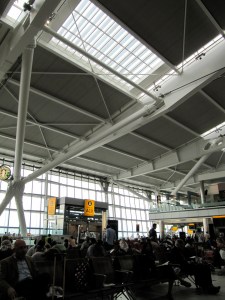
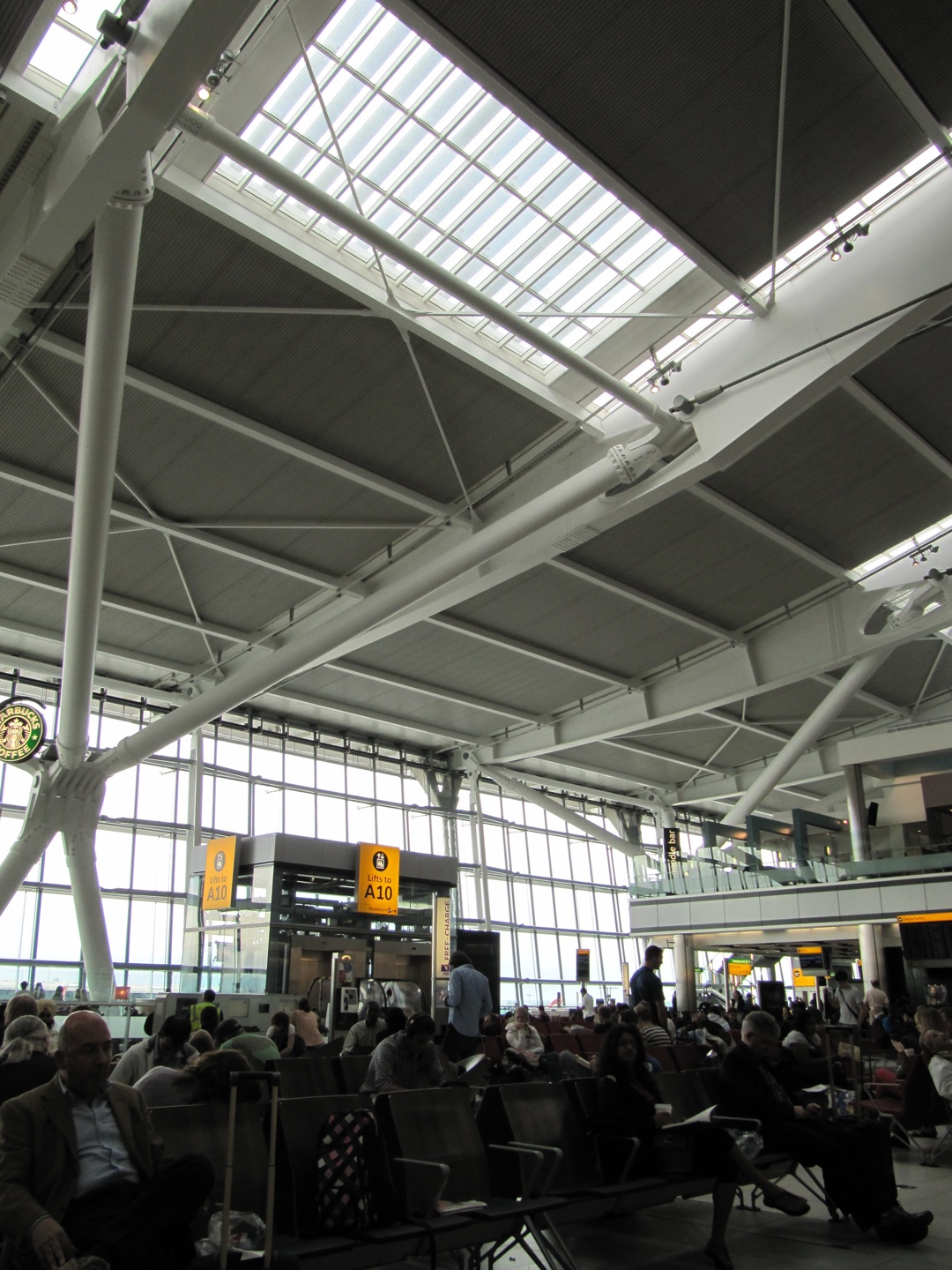
Terminal 5, the correct terminal at Heathrow, and the obligatory Starbucks and some clear-span interior architecture. The airport’s architecture gives the feeling that one is inside of an airplane wing.

At the terminal gate I had about 28 minutes to kill (or, if you’re French, 28 minutes — or time — continued killing me). An airport tavern that sells those over-priced beers was within meters of my terminal, so I decided to imbibe and refortify. The bartender, it turned out, originally hailed from Bulgaria. He immigrated to the United States some 20 years prior as a university exchange student. He said he studied veterinary science and technique at the University of Minnesota, the St. Paul campus. “My family has lots of animals back in Bulgaria!” he said over his shoulder to me, while walking away to pour another draft beer. Two bar-stools to my right was a woman drinking a half-glass of white wine. Eventually she confessed to the bar tender that she was unprepared to return home to Virginia as she had been having such an agreeable time with her family in the Twin Cities. The bar-tender wanted to chat about the famous borderlands rivalries of eastern Europe, vestiges of the Ottoman Empire, the Balkans, Greece (and so on and so forth). I reframed the conversation and asked him if he heard about Zeno of Citium, especially about Zeno’s awesome beard (pointed out to me by a friend from Missoula), something Chuck Klosterman may be aspiring to as well.
I boosted the exposure on this in order to see the early morning lights in Athens a bit better. This photo was taken about 2:30AM on the inbound flight.

Then it was from MSP to Dallas/Ft. Worth, north to south across the Great Plains, to join up with a connecting flight from said Dallas/Ft. Worth across the Atlantic to London. If I had to do this all over again, I think I’d try to avoid another 8 or 9 hour layover in Heathrow. The hours pile up, and eventually when you’ve entered into a type of time vacuum continuum (which is common when spending large amounts of time in airports), and all the hours seem to revert and jump forward and then revert again, and you’re trying to purchase your second power converter, the merchant will invariably check your ticket and inform you that you need to be in Terminal 5 rather than purchasing power converters, eating panini sandwiches, and thinking you’re in the correct terminal while people watching for hours on end in Terminal 3. Thank the merchant after she or he points this out for you.

Out of all the airports, the personnel in each one must have some kind of Aaron Barth Management Training. They are certainly ready for us. They are all extremely pleasant, from MSP to Athens. The power level in the MacBook Pro is at 18%. Time to post and shut down.


An Evening Stroll in Downtown Fargo

Often times a Wednesday evening walk is in order to counter or shake off the protracted sitting incurred throughout the day (Homo sapien is at a peculiar time in history, the most sedentary we’ve been since emerging out of east Africa some 150,000 to 200,000 years ago). To recap my

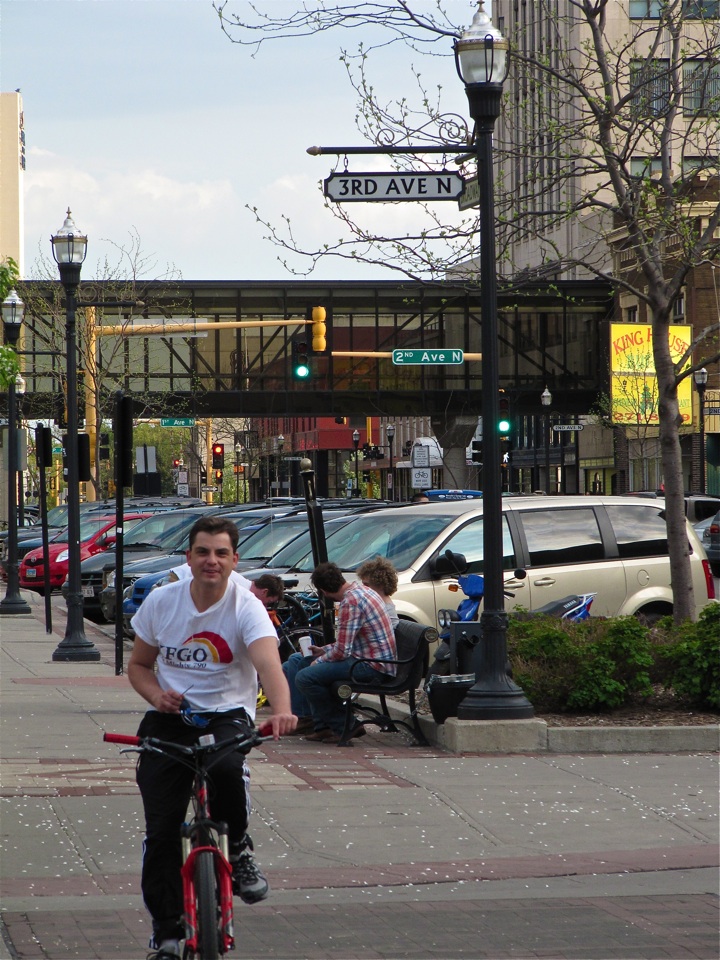
A May 2, 2012 photo of Rick Gion in one of his natural habitats.

walk from May 2, 2012, about the 7:30PM hour, I set out from 4th Avenue and Broadway in downtown Fargo and headed south toward Island Park. Along the way I noticed that groups of two-to-five or more gathered here and there, folks wanting to be outside with the short-sleeve temps and all. They tended to station themselves on the sidewalk benches installed at the ends of each block. About a block south of where I started my walk I ran into Rick Gion (or Rick Gion ran into me) to, as we often say, shoot the breeze. After busting each-other’s chops a bit (which is a North Dakota thing to do), Rick rode off to the north and I continued south. After that I called my father on my cell phone, and also thought of the mobility cell phones allow us. Not that many years ago a chat on the telephone required that we seek out a telephone which in turn was attached to a telephone line: this arguably required more social commitment, since you had to call someone, plan on being at a set location, and then do everything possible to make it to that location at the designated time. Today the convenience of cell phones and text-messaging ensures that you will receive something like 3 to 17 texts from the party you intend to meet, first canceling the meeting, then rescheduling the time and location, and then informing one another that you are within 2 minutes of arriving via text. Cell phone technology influences our behavior, but technology does that often. It shifts how we behave throughout time, and tracking this otherwise gradual change is one of the businesses of historians. Phone booths are nearly if not entirely obsolete, now, and I often wonder if in two or three decades (or even sooner) we will look at the 20th century as the Age of the Telephone Land Line. Anyhow, I phoned my dad because before setting out on my walk a couple

About Main and Broadway in Fargo on May 2, 2012. Photo looks west toward the storm dumping rain on central North Dakota.

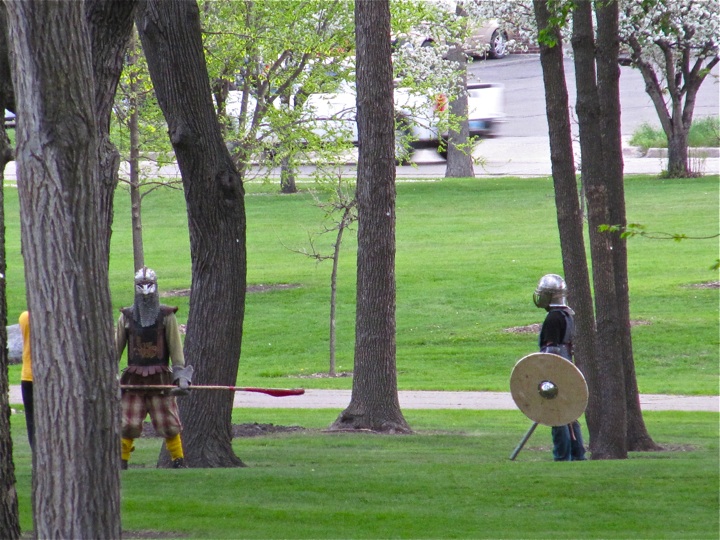
friends from Bismarck updated their social media web site with information about rain and possible hail. I wanted to check up on that, chat with kin, and since the weather is a very neutral topic, it is a great way to have a conversation with basically anyone in or outside of North Dakota. I stopped just north of the intersection of Main Avenue and Broadway, looked west, and snapped a photo of the eastern tops of the cloud system that was saturating Bismarck. I communicated this to my dad, and then moved on to other neutral topics such as the price of gas, how the Twins are doing, and so on. Eventually I got into Island Park, and visited the Henrik Wergeland statue, which has been a monument for quite some time, a video-history of which can be seen here. I circled the monument, and then to the west noticed a chivalrous scene playing out. I snapped a photo of that as well. “So this is what some people do on Wednesday evenings…” I thought. “Interesting…” By the time I rounded the park, the cell

Knights at Island Park in downtown Fargo, North Dakota.

phone conversation had ended and another couple folks spotted me. So more light banter ensued, and I remember asking the two if they had yet seen the Cold War Comedy, “Spies Like Us.” This was the third time in 24 hours that I’ve asked groups of two or more if they had viewed this movie. Each time the groups have responded with no. For some reason I think it’s important for people to watch it. After that, the final stretch of my walk took me back up Broadway, and I inadvertently ran into Den Bolda, perhaps one of the most accomplished Civil War reenactors in the tri-state area. I say this only after learning that Mr. Bolda had just finished attending another knitting class, this so he could reproduce vintage (aka, knit) Civil War wool socks to wear at all the 150th anniversary mock-battles back east. Nice work, Den. Nice work indeed.