Tag Archives: North Dakota

The Killdeer Mountains: Living History and Sacredness

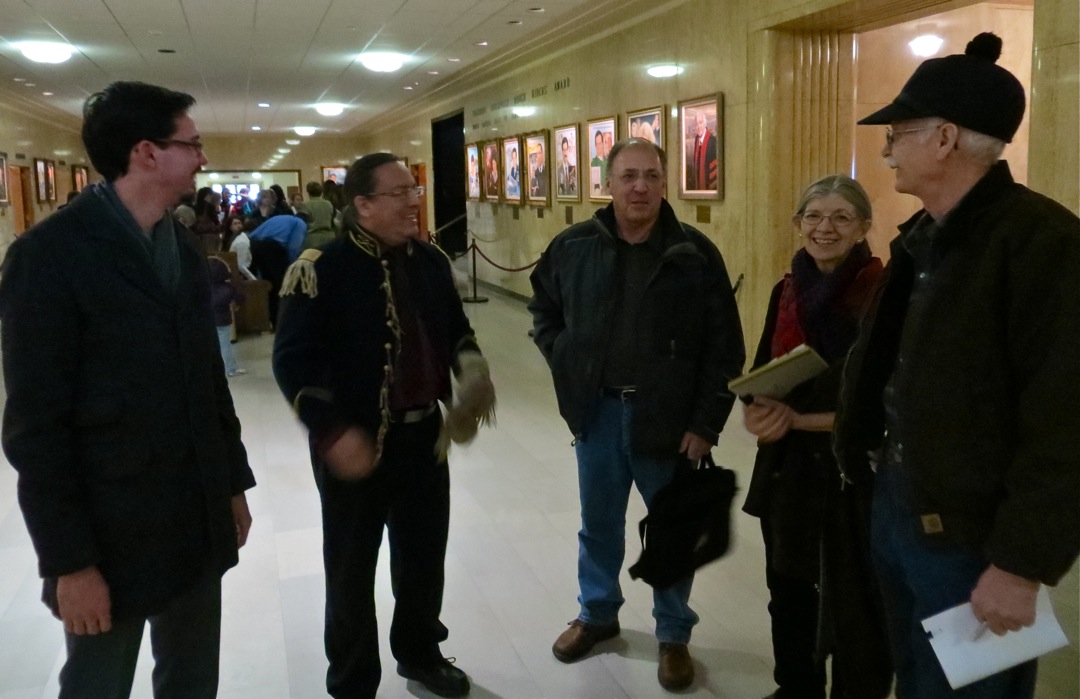
Individuals concerned about what happens to the Killdeer Mountains chat before the public hearing at the Bismarck capitol on January 24, 2013.

Individuals concerned about what happens to the Killdeer Mountains chat before the public hearing at the Bismarck capitol on January 24, 2013.

The Killdeer Mountains in Dunn County, western North Dakota have been getting a lot of attention lately, especially after the North Dakota Industrial Commission decided to, well, industrialize the area, and allow the Hess Corporation to follow through with signed leases and drill and frack for oil there. The Grand Forks Herald reported on it here, and The Bismarck Tribune here. The Industrial Commission is composed of three individuals, including Jack Dalrymple, Wayne Stenehjem, and Doug Goehring. They have scheduled meetings with the Department of Mineral Resources and Lynn Helms, the sitting Director. It is important to remember that this was a public hearing, and at public hearings the public ought not to be shy about attending. This experiment America has going, our Democratic-Republic, necessitates these local meetings that have global implications.

On January 24, 2013, at 1:00pm (CST) the public hearing for the Killdeer Mountains was held in the capitol of Bismarck, North Dakota. It was Industrial Commission Case Number 18618 concerning sections 25 & 36, T. 146 N., R. 97 W, this about 30-35 miles north of Dickinson, North Dakota. Originally the hearing was scheduled in the Governor’s meeting room, a rather closed-off and secluded place. Because of the public turn-out, though, the hearing was relocated to the larger Brynhild Haugland room in the western wing of the capitol. I drove over from Fargo to Bismarck to attend the meeting, and while there scribbled down some notes and took some audio-video as well. The high-points, I thought, were in capturing two Native voices from two disparate cultures.

The first is a video from Theodora Birdbear of Mandaree, North Dakota (Mandaree is Mandan, Hidatsa and Arikara territory). The microphone on my Canon PowerShot SX260 HS captured the audio a bit, and just in case there are those of us hard-of-hearing, I provided transcript of Theodora’s testimony below.

Transcript:

…and he expressed the impact of oil and gas development, the industrialization of an area, which impacts the quality of that spiritual experience. I guess it’s kind of equivalent to having an oil well right beside your Catholic church or something. It’s parallel to that. So I wanted the commission to know that Fort Berthold does have a living connection to that area, and to consider that in your decision making. As people have said prior to this, technology is evolving, and to keep it [oil] in the ground is not wasting it. They are going to be after it in the future. What’s the rush? The rush is quick decisions, unplanned decisions, and unplanned impacts. So I just wanted to make a comment about our relationship with that area. It is still living today.

North Dakota Industrial Commissioners listen to Natives speak about the sacredness and history of the Killdeer Mountains.

North Dakota Industrial Commissioners listen to Natives speak about the sacredness and history of the Killdeer Mountains.

Theodora remarks on how the Killdeer Mountains are a sanctuary, as sacred and sacrosanct as a Catholic Church, and to carry the analogy further, as a Lutheran or protestant church, a Synagogue, a Mosque, a Buddhist monastery, a Hindu temple, a Confucian temple, and so on. These spaces are sacrosanct in the sense that when an individual goes to the area to pray, they are really interested in having it as quiet. A library could also be considered a sacred space by this definition (libraries carry on that monastic-academic tradition of the deliberate contemplation of texts — this is arguably the antithesis of our hyper-industrial, full-throttle, 21st century world).

The other Native voice captured came by way of Dakota Goodhouse, who originally hails from the Standing Rock Sioux Reservation in south-central North Dakota (he shares the namesake of the state, which in English means ally or friend). Dakota gives some backdrop about the history of Killdeer Mountains as it pertains to the US-Dakota Wars, specifically the punitive campaigns carried out by General Alfred Sully west of the Missouri River circa 1864.

For some video context, Dakota is speaking and Lynn Helms is seated at the right. In this video excerpt, Dakota is remarking on how the encampment and battle boundaries are much larger and broader than what is delineated now (as of 01/25/2013), and how they need to be re-considered.


Punk Archaeology Practice Notes

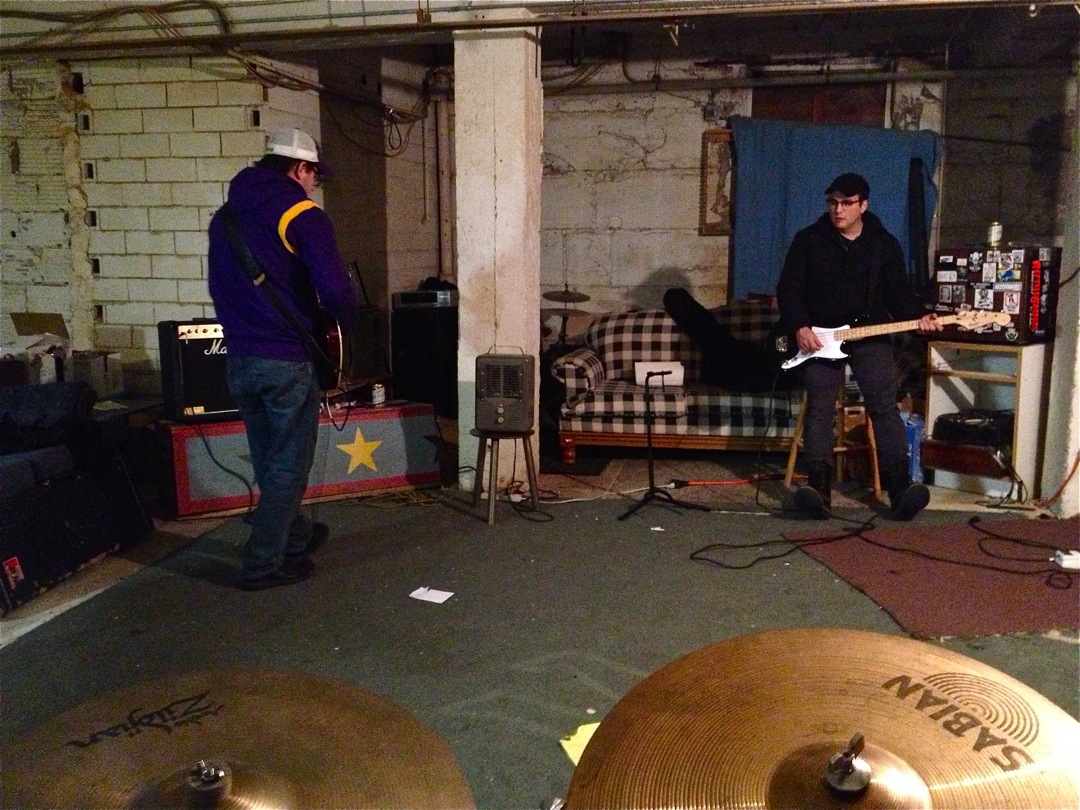
Todd Reisenauer and Troy Reisenauer of Les Dirty Frenchmen.

Todd Reisenauer and Troy Reisenauer of Les Dirty Frenchmen.

The other night, Troy Reisenauer and Todd Reisenauer invited me over to the Les Dirty Frenchmen practice space for the first of our get-together of practices, this for the February 2, 2013 Punk Archaeology un-conference at Sidestreet Grille and Pub in downtown Fargo, North Dakota. Through the randomness inherent to the music world, this assembly happened — come to think of it, every band I’ve ever played in has never been planned. It was a process that came together over a matter of several conversations and days or weeks — the important thing, though, was each individual’s willingness and desire to play for the love of playing. Todd and Troy offered to bring their slaying punk guitars to back the songs and lyrics of Andrew Reinhard, and the keyboard of Michael Wittgraf. Andrew’s original punk archaeology tunes are available here, and free for download.

As Reisenauer, Reisenauer and I bounced around from one song to another, there certainly were tunes we favored. Todd rightly pointed out that we ought to stick with a theme, though, and that Reinhard’s tunes definitely have a garage punk sound. So this helped us narrow and focus our practice, as earlier we considered other classics such as Bobby Fuller’s “I Fought the Law” and Velvet Underground, “Sweet Jane.” We decided to not play those. At least not this time.

Eventually, Team Reisenauer, Reisenauer & I decided on a short list of punk archaeology songs. Some classic go-tos include covering “Nervous Breakdown” by Black Flag, “Loser’s Club” by The Humpers, and “I Wanna Be Your Dog” by Iggy Pop and The Stoogies. We also ran through two Reinhard originals, including “History,” and “Publish and Perish,” a segment of this latter song appropriating a punk-abilly sound that might be familiar to Social Distortion fans.


Punk Archaeology Handbills

Around the Fargo-Moorhead area, here is a glimpse of some of the first Punk Archaeology handbills to go up. This one is secured to the entrance of the Rhombus Guys Pizza joint on Main Avenue in downtown Fargo in Cass County, North Dakota. For more details, click here. On February 2, 2013 (a Saturday) at Sidestreet Grille and Bar in downtown Fargo, ND, music will kick off around 7:17pm, and the panel discussion just a bit later. And like any quality un-conference time, it may start just a little before, or a little after. Swing on down if you’re in town. It is happening. And it will be awesome.

Various handbills in the entrance of Rhombus Guys in downtown Fargo, North Dakota. Punk Archaeology handbill lower right.

Various handbills in the entrance of Rhombus Guys in downtown Fargo, North Dakota. Punk Archaeology handbill lower right.


Gandolf the White Blizzard

It is the evening of January 11, 2013, and I am on the second floor of The Arts Center in downtown Jamestown, North Dakota. In the past couple days the Weather Channel and regional meteorologists have been psychologically preparing the public for the first intense blizzard of the year. The Weather Channel has subsequently named this blizzard Gandolf — yes, I’m serious. Originally I intended on making the Eisenhower Interstate 94 drive from Fargo to Jamestown after an NDSU departmental meeting concluded in the late afternoon, but eureka rattled through my brain earlier in the morning and I thought it would be better to make the drive then and there. My hope was to beat the thermometer from Fargo to Jamestown, knowing that the light rain would turn to ice as the temps dropped below 32 F. And if I didn’t make it to Jamestown, how would I be able to attend the art gallery reception for Walter Piehl on Saturday evening with Molly at The Arts Center? Yes, I needed to act.

Ice forming on the windshield and radio antenna during the early stages of Gandolf the White Blizzard.

Ice forming on the windshield and radio antenna during the early stages of Gandolf the White Blizzard.

The drive turned into a white-knuckled affair, a ’93 Chevrolet S-10 rear-wheel drive pickup providing joyous stress. I found that by keeping the speedometer at no more than 40mph, the rear wheels would stay secure to the pavement. During the drive, I also thought about how author Chuck Klosterman killed off several main characters (spoiler alert!) with a blizzard in Downtown Owl, this piece of fiction set in a small town in rural North Dakota in 1984. Then I thought about the book, Children’s Blizzard. Then I tried to stop thinking such thoughts, and I continued driving.

Note: when driving in winter rainstorms that are turning to ice, there are two opposing thoughts that bash at each other in the brain. It goes something like this: after a driver is 30 miles into a 90 mile drive, and just after the rear wheels slip a little at 50mph (the pick up will jerk a bit), the driver considers two options: turn around and endure another 30 mile drive back, or press on and gain another 30 miles. In the long term, if the driver retreats and makes it back home, they will have logged 60 miles, which, essentially means one could have been 2/3s the way to the destination. So I pushed on. Would I end up sliding off the road and into the ditch? Stop thinking about these thoughts. I did, and I made it to my destination. My advice: don’t do this. Ever. Anyhow, the photo pictured above is what the windshield looked like in the early stages of Gandolf the Grey, this between 8:30AM-to-12PM in Cass, Barnes and Stutsman counties, North Dakota.

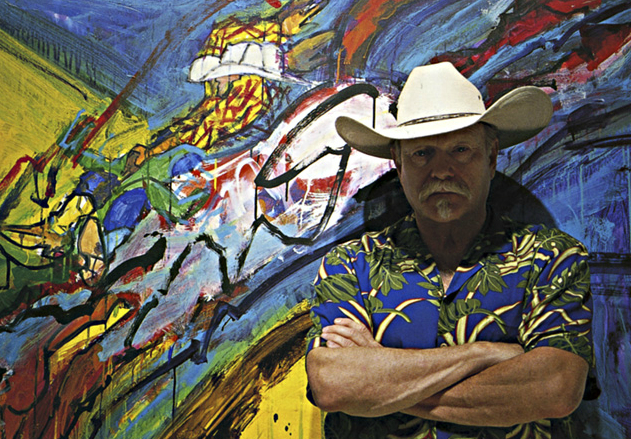
Walter Piehl and his art.

Walter Piehl and his art.

The below short video clip is an intensified Gandolf, when a winter rain storm receives more training to ultimately become Gandolf the White Blizzard. As I re-visit the video over and over from a historic building in downtown Jamestown, North Dakota, I can’t help but thinking how 100 years ago an individual in the building would have heard similar sounds from this very vantage. Note, for example, the subtle chug-chug-chug in the audio, this coming from a train just a block north. The large grain elevator (not visible) is located along the tracks. Yup, 100 years ago it was possible during a winter blizzard to hear the same blasts of shivering whispers blow through the small cracks in commercial brick construction, and also hear the thump-thump-thump of the iron horse on the Northern Pacific Railroad.  Historically, it is important to respect White Blizzards — lest they teach us mortality instead of just humility.


Mankato, Minnesota: 150 Years Later

Today, December 26, 2012, marks the 150th year since the largest mass execution in United States history took place in Mankato, Minnesota. This execution has been remembered and suppressed for a variety of reasons, but it seemed reasonable to post and pass on at least two pieces of public history. The first is a story put together by This American Life, entitled, “Little War on the Prairie.” Here is a link to the transcript, and another link to the recorded radio program here. It aired on November 23, 2012, and I first heard it while driving back to Fargo from having Thanksgiving in Bismarck and Valley City.

Photo by David Joles of the Associated Press.

Photo by David Joles of the Associated Press.

What is often missing from stories such as these is a kind of non-discussion about what followed this hanging. For example, it wasn’t just as though the hanging happened, and Governor Ramsey clapped his hands together and said, “Well, that’s taken care of…” Instead, it marked the beginning of annual punitive campaigns that the United States Government launched against the Sioux — against every combatant and non-combatant, or every man, woman, elder and child — throughout Dakota Territory. When we look back on it, the 19th century kind of looks like a racist primer for the industrial genocide that characterized much of the 20th century, at least the first half. The world eventually had a post-WWII convention to consider all of this. It’s sobering to think about.

In the 1860s, Total War campaigns against the Sioux were organized by General John Pope, and he in turn charged generals Henry Sibley and Alfred Sully with carrying them out. Today there are namesakes of “Sibley” and “Sully” scattered all throughout North Dakota. These names were ascribed to the landscape, and they resulted from that earlier US-Dakota War that roared up and down the Minnesota River Valley in August-September of 1862. Below is another piece of public history called “Dakota 38 [+2].” It is excellent, and the documentary was put together in 2008.

This year’s riders are just getting to Mankato, as they do every year. Here is another piece on this from the Mankato Free Press.


The Archaeology of Kindness

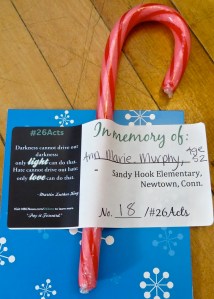
No. 18/#26Acts I found this afternoon on my windshield in Jamestown, North Dakota.

No. 18/#26Acts I found this afternoon on my windshield in Jamestown, North Dakota.

About 20 minutes ago I finished up some grocery shopping (getting the crucial jultid ingredients for Swedish meatballs and gravlax) at the Coborn’s in Jamestown, North Dakota. After loading the pickup box with the staples for the weekend, I got into the cab, looked up and noticed that someone had put something between my windshield wiper and windshield. I got back out, grabbed it and inspected it. Someone, inspired by NBC News and the Twitter hashtag, #26Acts, gave me an act of charity and kindness to honor and remember Anne Marie Murphy, age 52, Sandy Hook Elementary, Newtown, Connecticut. On the front of the small envelope is a quote from Martin Luther King, Jr. It reads:

“Darkness cannot drive out darkness: only light can do that. Hate cannot drive out hate: only love can do that.”

This is true. There was a candy cane strapped to the envelope, and within was a Farmers Union Oil gas card for $5.00. Wow. That’s what I thought. A little backdrop on Anne Marie Murphy: she died while using herself as a human shield to cover 6-year-old Dylan Hockley (Dylan was also killed). Anne is a saint, and her final act on this planet is being recognized as such (as are many from Sandy Hook Elementary). And an anonymous person in Jamestown, North Dakota wanted to randomly share this 18 of 26 Acts with someone.

The note also says, “Pay it Forward,” so that charges me with sharing this information on the blogs to keep it in the pipeline. I’m inspired. I suppose if we’re feeling a little overwhelmed by the holiday season, it’s okay to pause for a moment, look at the person next to you, and imagine what life would be like without them. Go ahead and hug them. It’s okay to do that. Happy Christmas and merry holidays to all from the northern Great Plains.


Cultural Landscapes on the Northern Great Plains: From 1862 to 2012

This evening while toying around with Google Earth’s image overlay feature, I thought it would be interesting to see what a 2012 map would look like in contrast to the map of the 1860s in Mark Diedrich’s, Mni Wakan Oyate (Spirit Lake Nation): A History of Sisituwan, Wahpeton, Pabaksa, and Other Dakota That Settled at Spirit Lake, North Dakota (Fort Totten, North Dakota: Cankdeska Cikana Community College Publishing, 2007). I was keeping in mind how we — the Royal We — are all born into particular sets of cultural values that we consciously or unconsciously bring to bear on everything we process, do, and see. So in 2012, it’s a given that we can hop Eisenhower’s Interstate 94, lean heavy on the gas peddle, and within 1 to a dozen hours find ourselves anywhere between Minneapolis, Minnesota, Billings, Montana, Omaha, Nebraska, or Winnipeg, Manitoba. In 1862, the reality would have required weeks worth of time to cover that amount of space. One hundred fifty years is quite the temporal gap. But Google Earth reconnects us with the spatial, or what we might consider as that sense of place.

Here, for example, is the Diedrich map imported into Google Earth with an approximate transparency of 20-40%. This is laid on top of a 2012 map (some specifics don’t quite line up, but considering that this took 3 minutes to put together, it’s not bad, and the general idea is conveyed).

1862 sans 2012 Geopolitic

Note the non-existence of the 2012 place names. We get the large type of Dakota in the east, Nakota in central Dakota Territory, and the Lakota primarily west of the Missouri River. Imbedded within that are several sub-national sets, including the Ihanktuwana, Sisituwan, Pabaksa, Assiniboin, Mandan (“Gros Ventre”), Arikara, and Blackfeet Lakota. It might be worthwhile to filter our 2012 mindsets through an 1862 landscape in the same way that we would consider today’s landscape in Central Asia, western Europe, or eastern Asia. To an outsider, “it all looks the same.” But try telling someone who hails from Hong Kong that Bangkok and Ulaanbaatar are just the same. Or try telling someone from Tashkent that they’ve experienced something similar because they once saw a picture of Moscow, they talked to a guy who visited Kabul, or they heard about the cultural mecca of St. Petersburg. Or try telling a Parisian that Germany is just like Italy. Or try… yes, the idea is conveyed. And this doesn’t even begin to touch on the dynamics of Africa, Australia and so on.

In 1862, North Dakota was northern Dakota Territory to Abraham Lincoln, Minnesota Governor Alexander Ramsey, and any immigrant Euro-American back east (many of our great- or great-great grandparents included). The names of Bismarck, Williston, Dickinson, Jamestown, Fargo, Casselton, Valley City, Grand Forks, Watford City, New Town, Devils Lake, Minot, Ellendale and so on wouldn’t have been on anyone’s cultural radar. Between the 1860s and today, though, several generations have come and gone. And through this amount of time, our perception of the landscape has altered as well. This Google Earth gadget is amazing in that regard. Here is Diedrich’s map with Eisenhower’s Interstate System and the industrial Geopolitics imposed on the landscape:

1862 and 2012

Above, the 49th parallel is quite pronounced, as is our national (or international) system of highways and byways. Today’s 2012 I-94 blasts east-west through former Native America. You can travel from Minneapolis through the 1860s Dakota (Red River Valley now), Nakota, Mandan, Hidatsa, Arikara (upper Missouri River) and Lakota country (now the Bakken Oil Fields) to Billings in about 20 hours (I cannot recommend any more efficient time). In North Dakota, we can sail past these 1862 landscapes at no less than 75 miles an hour, thermostat pumped full tilt, iPods routed through the speakers. This is the push and the pull between culture and landscape throughout time. I think that’s all I have for now.


Global Cowboy Culture

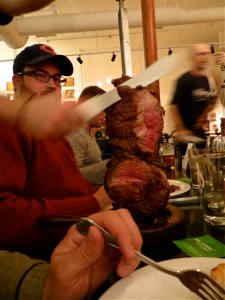
Endless amounts of meat at Harvest Brazilian Grill, Mandan, North Dakota.

Endless amounts of meat at Harvest Brazilian Grill, Mandan, North Dakota.

On the afternoon of December 9, 2012, Edgar, the owner and operator of Harvest Brazilian Grill, sat down with me and chatted a bit about the cultural commonalities of the Great Plains cowboy and the Brazilian gaúcho in downtown Mandan, North Dakota. The cowboy and gaúcho professions revolve around, obviously, cattle, and this in turn brings up dietary similarities: if you’re around cattle, there’s a good chance your diet will consist of beef.

Edgar hails from Porto Alegre, southern Brazil, spent time with an e-company in Santa Barbara, California, then moved to Linton, North Dakota, and finally relocated the Harvest Brazilian Grill to downtown Mandan, North Dakota. Below are two video shorts, as Edgar obliged my request to reflect on his business, Brazilian churrascaria, and global gaúcho and cowboy culture.

The first video draws upon cultural and culinary similarities of Brazil and North Dakota, both cowboy and gaúcho, and German immigrants to the northern Great Plains and Brazil.

In the second video, Edgar explains where he comes from, Porto Alegre, Brazil, and why Brazil has dietary similarities to the northern Great Plains.

Harvest Brazilian Grill, 308 Main Street, Mandan, North Dakota. If you are ready to devour endless supplies of meat, and endure post-dinner meat sweats, here are the hours of operation:

Tuesday – Friday: 11AM – 3PM Lunch, and 5PM – 9PM Dinner

Saturday: 11AM – 3PM Lunch, and 4PM – 9PM Dinner

Contact Harvest Brazilian Grill or make reservations at 701-751-4393.


No Smoking in North Dakota: Local History and the Atlantic World

North Dakota Smoke Free announcement retrieved from the mail box on December 5, 2012.

North Dakota Smoke Free announcement retrieved from the mail box on December 5, 2012.

This evening from my post office box I retrieved several envelopes, one of which was the “SmokeFree!” announcement to inform North Dakotans of the latest smoke free Century Code 23-12-9 to 23-12-12. This got me thinking about tobacco in both a local and global historical context. Tobacco as a cash crop is one of the reasons Great Britain continued colonizing Virginia, and tobacco was cultivated by Native America long before the Columbian Exchange.

As for a local historical context, tobacco appears in a variety of sources. One of them is through Guy Gibbon’s thorough work on the Sioux. Gibbon indexed the word “tobacco” seven times in The Sioux: The Dakota and Lakota Nations (Malden, MA and Oxford, UK: Blackwell Publishing, 2003). Gibbon notes the archaeological sites around Mille Lacs Lake in east-central Minnesota as yielding a variety of botanics, or plant remains, including locally cultivated tobacco.

A cultural and socio-religious story concerning tobacco in the Lakota historical record comes in the form of “The White Buffalo Calf Woman,” a story set down by Black Elk, an Oglala wicasa wakan (“holy man”) and Catholic catechist. In 1931 and in the late 1940s, Black Elk embraced a hybridized version of Euro-American Christianity and Native ways, and he narrated a story where “the sacred messenger of the Great Spirit, brings the People the peace pipe, tobacco, and seven rites.” Students of American literature have considered this story for quite some time, and as Gibbon also notes, “A popular current trend is to devalue Black Elk’s teachings because they seem compromised by Christianity.” (Gibbon, 2003: 149) Whether it is used in customs on behalf of old and new ways, the role of tobacco remains central throughout Native America.

The second history of tobacco text to come to mind upon receiving the update to the new ND tobacco free century code was from James VI and I, a primary source from 1604 entitled, “A Counterblaste to Tobacco.” As the English found ways to bring this cash crop across the Atlantic from the new to the old world, King James felt provoked to respond for the sake of the mainland British common wealth. The paradox remained: England profited financially from tobacco on the one hand, and yet the aristocracy critiqued it on the other. Keeping in mind his use of elitist language, and his complete and raging mischaracterization of the use of tobacco throughout Native America, in 1604 the King of England, verbatim, said,

“…For Tobacco being a common herbe, which (though vnder diuers names) growes almost euery where, was first found out by some of the barbarous Indians, to be a Preseruative, or Antidot against the Pockes, a filthy disease, whereunto these barbaous people are (as all men know) very much subject, through the intemperate heate of their Climat: so that as from them was first brought into Christendome, that most detestable disease, so from them likewise was brought this vse of Tobacco, as a stinking and vnsavourie Antidot, for so corrupted and execrable a Maladie, the stinking Suffumigation whereof they yet vse against that diesease, making son one canker or venime to eate out another.

And this goes on for some length.

Don’t smoke cigarettes, kids, because yes, they do stink, they are unhealthy for you, and they no doubt will cause and/or contribute to cancer. Yet also remember that not every culture uses or has used tobacco the same way, individually and throughout history. Every cultural historical perception toward tobacco is always in flux. And also there is a difference between cigarettes and leaf tobacco: the former are jammed with additives (even with fiber glass, they tell me!) while the latter is not.


Thoughts on the Fargo History Project: An NDSU Public History Initiative

As Dr. Angela Smith and a cohort of digital public historians prepares this week for Friday’s grand unveiling of the Fargo History Project at the Plains Art Museum in downtown Fargo, North Dakota, I thought I’d pull a couple titles off the shelf and revisit them to work up some thoughts for opening and/or closing remarks later this week at that event. The class has benefitted from the scholarship of Carroll Engelhardt, Gateway to the Northern Plains: Railroads and the Birth of Fargo and Moorhead (University of Minnesota Press, 2007), from visiting the primary sources within the North Dakota Institute for Regional Studies, and from first-hand visits to the physical places throughout Fargo. Each individual scholar honed in on specific segments of Fargo history between the years of 1871-1893, and they developed short blog-style entries on these topics. In almost every case, digitized historic pictures either compliment the stories or contribute to the analysis, context, and content.

Urban HistoryBringing all of these seemingly disparate and compartmentalized mini-histories under an umbrella of sense requires us to think about cities in the American West as distillations of the resources pulled in from the countryside’s natural, renewable, and non-renewable resources. So what this means is that when we drive by a grain elevator in a rural setting, we should look at the landscape for the linear, abandoned railroad bed. Then we should think about how this was built by a variety of immigrant laborers, and how that provided a route for grain to make its way to larger elevators in urban areas with population concentrations, such as Fargo-Moorhead, Minneapolis-St.Paul, or Chicago. We can then think about how northern Great Plains agriculture is the reason there is a James J. Hill mansion in St. Paul, Minnesota, and how a state Bank of North Dakota, a state elevator in North Dakota, and regional co-ops were historic responses to fat cat Twin Cities bankers and urban industrial areas. Metropolitan bankers in the Twin Cities were not responsive enough to the needs of rural northern Plains farmers and ranchers. Rural farmers and ranchers decided to, in North Dakota, form a state bank.

It is also possible to think about the historic archaeology of dairy cooperatives as responses to large centers of eastern industry. The industrial, assembly-line manufacturing centers (sometimes called Fordism rather than Capitalism) flooded the market with cheap dairy products. They didn’t do this in some cynical or conspiratorial way. But they did it out of their own self-interest. Historical actors in the upper Mid-West and on the northern Great Plains had to figure out ways to make a living, and they in turn responded. They were not going to wait around for industrial assembly lines to become “more ethical.” This is why large local swaths of Scandinavian immigrants in Wisconsin, Minnesota and North Dakota formed rural dairy co-ops. Through these co-ops, they could once again compete with industrial centers. The architecture of the dairy co-ops still occupy our urban and rural landscapes, and in some cases — at least in Fargo — they provide punk rock bands with basement practice space.

That is the interplay, the push and the pull between urban and rural. Again, making sense out of all of this gets a historian thinking about historiography. Here is what William Cronon said in “Kennecott Journey,” Under an Open Sky: Rethinking America’s Western Past (1992):

Mapping out the geography of gender, class, race, and ethnicity remains one of the most important but least studied aspects of environmental history. (Cronon, 1992: 45)

It has been two decades since Cronon said this, and as it pertains to our history of Fargo project, it is important to keep in mind how the individual cultural actors within the history of Fargo perceived the natural and urban world, and also how they acted and reacted to ecology, or nature’s metropolis.