Tag Archives: North Dakota

Prairie Turnips

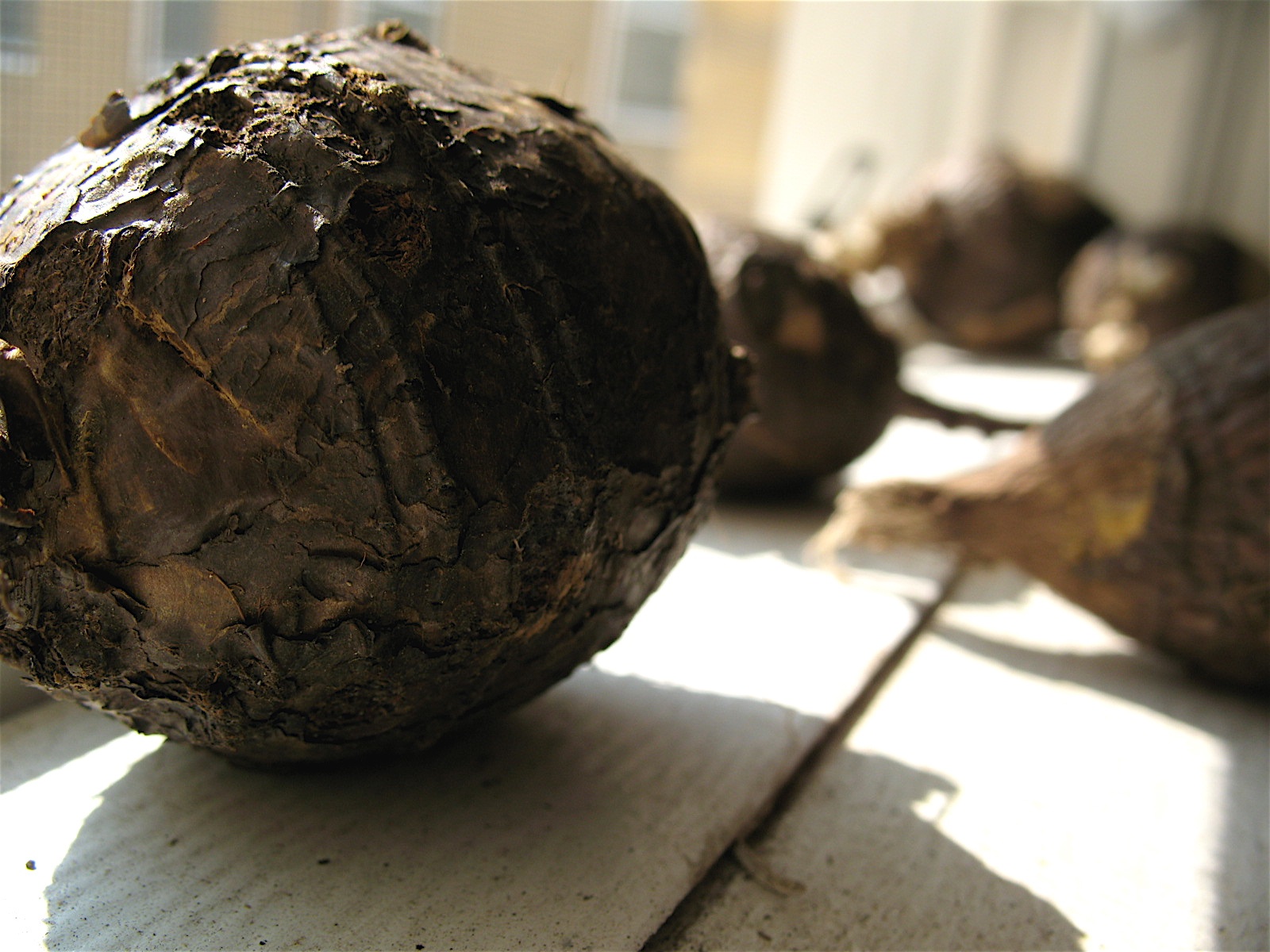
A prairie turnip.

A cluster of prairie turnips.

Where some see a prairie-scape of oblivion, others see a culinary buffet. Just last night I was cruising around in some old digital photos on the desktop, and I came across a couple shots of prairie turnips. I photographed them a couple years ago in the kitchen of a downtown Bismarck apartment I used to live in (the historic Mason Building), I think around 2008 or 2009.

During those summers, Tim Mentz, Jr., of Standing Rock, showed me on the northern Great Plains how to identify the prairie turnip. You can read the landscape for prairie turnips in July. This is when the vegetation sprouts above ground, making them visible. They also grow in certain areas on a hill (it may or may not have something to do with the ph levels of the soil — I’m in the humanities, folks). This, of course, leads to the idea that if you have two different people look at the same landscape, they will see it in a variety of different ways. I like listening to what others have to say about the landscape. Tim Mentz, Jr. always had my ear. We would often joke, too — when a bull was once staring at us and uprooting the topsoil with his front hoof, I asked Tim, “What does that mean?” Tim responded with, “That means we give him distance.”

It is customary to braid the turnips by the root ends, and then hang them to dry. Just like mushrooms (and other dried goods), they will reconstitute in liquid or water. I made turnip soup out of this batch.

With the husk pulled back, this is what the edible flesh of a prairie turnip looks like.

With the husk pulled back, this is what the edible flesh of a prairie turnip looks like.


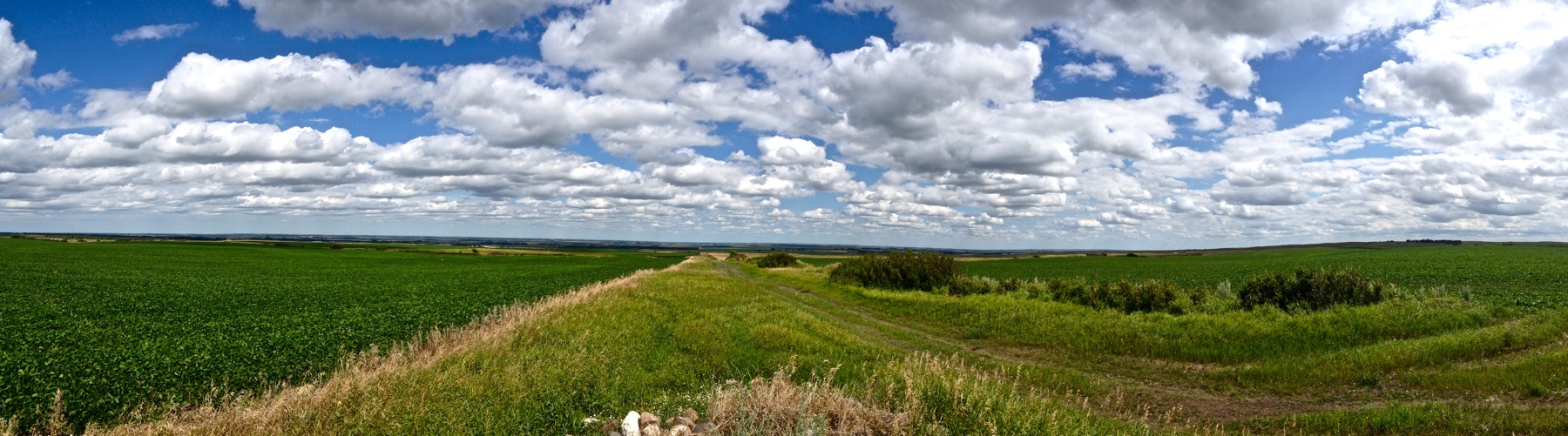
A Panoramic of the James River Coteau

Panoramic

I’ve been fiddling with the “Panoramic” feature on the iPhone 4s. I realize that everyone but me knew about this. But I thought I’d upload at least one photo snapped yesterday approximately 5 miles east and 2 miles south of Kulm, North Dakota. The photo is looking to the northeast and east, just on the ridge of the coteau that drops into the James River Valley proper. To my immediate east, the water goes into the James River. To my immediate west, the water ultimately finds its way to the Missouri River. Both water streams merge around Yankton, South Dakota, and ultimately empty into the Mississippi, then the Gulf of Mexico. Hydrology kind of connects us to the land that way.

To get to your “Panoramic” setting, at least on an iPhone 4s, turn on the camera, tap the “Options” button top-center of the screen, and then tap “Panorama.” Then start experimenting.


The Stump Lake Pavilion of North Dakota

This last week, from Sunday evening to Friday evening, I camped with a small cadre of highly trained artists at Stump Lake (the Dakota called it Wambduska Bde, which means “Snake Water” or “Creeping Thing Water,” this translation courtesy of good friend Dakota Goodhouse), Nelson County, North Dakota. When we (meaning Molly McLain and I) first approached Stump Lake, and since it had been our first time each, everything was new. So it came as a kind of pleasant shock to find a massive historic pavilion situated at the end of the road at the campsite. My eyes widened large when I first saw it. The pavilion has been used as a roller-skating rink since, I was told, it was constructed. And while I was there, I heard banter about the pavilion either being on, or wanting to be on, the National Register of Historic Places.

A panoramic photo of the pavilion at Stump Lake, North Dakota. Photo from August 2, 2013.

A panoramic photo of the pavilion at Stump Lake, North Dakota. Photo from August 2, 2013.


I also heard from Dwight, one of the overseers of Stump Lake campsites, that a raging international polka festival goes on at Stump Lake every summer. Dwight also chatted with me about the stories old timers have told him about their experiences at the Stump Lake pavilion. Dwight said one individual told him how throughout the 1930s they used to polka at the pavilion throughout the night, running down to cool off with a swim in Stump Lake, and then returning to the hard wood polka floors to continue dancing. Does this seem like something out of Prairie Home companion? Of course, anyone from North Dakota knows that the Prairie Home Companion is actually based off reality that has and continues to take place in said North Dakota. It is where Garrison gets all of his best stuff.

An exterior shot of the pavilion from the last week of July 2013, Stump Lake, North Dakota.

An exterior shot of the pavilion from the last week of July 2013, Stump Lake, North Dakota.


There are numerous Bohemian enclaves throughout northern Dakota (check this one out here). One just has to devote the time to stop and listen for the accordion. Note: a future research project will have me investigating whether or not the pavilion is on the National Register of Historic Places. If it is, then yes, the universe is in accord with itself. If it is not, well, then there is more work for all of us to do. Might this be an excellent place to consider a future ND Humanities Council Chautauqua, too?… Perhaps, folks. Perhaps…

Pavilion interior, from hardwood floor to exposed rafter ceiling.

Pavilion interior, from hardwood floor to exposed rafter ceiling.


More On the Civil War and Plains Indigenes Then and Now

Yesterday evening, while sitting around a campfire in northeastern North Dakota, I looked into A People’s History of the Civil War: Struggles for the Meaning of Freedom (The New Press, 2005) by David Williams, and this morning I am finally getting to Thomas Yellowtail, Native Spirit: The Sun Dance Way (World Wisdom, 2007). I’m primarily interested in different interpretations of Dakota, Lakota, and Nakota culture, specifically how this might bear on the historical record (which is why I’ve been blogging on it here, here, here, and broadly on the topic of war here).

In Chapter 7 of A People’s History of the Civil War, Williams says that due to the advanced positioning of the North and South, “Federal forces used the war as an excuse to quicken the pace of killing Native Americans and driving the survivors from their homelands.” (Williams, 2005: 390) This is true, and Williams is upfront about it. An internal American war gripped the eastern 1/3 of the nation (a nation that was both trying to stay together, and expand by overtaking indigenous lands), and certainly the South and North looked at the various territories and newly fabricated states to the west as part and parcel to the overall wartime efforts. Meanwhile, and at the same time, Britain watched America from Canada, and France and Mexico were having it out south of the Rio — think Cinco de Mayo, or the Battle of Puebla, where the Mexican army routed French imperial forces. If Native America could be removed or restricted to reservations, the newly acquired lands could be put into intense farming production. Williams’s work follows the intellectual stream of Howard Zinn, who championed the monograph and who also sparked the intellectual drive. If contrasting the standard Civil War historiography with Native scholarship, though, one starts to understand in much greater detail what else was at stake.
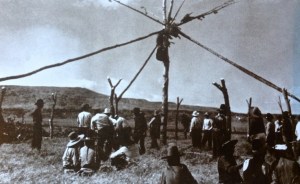
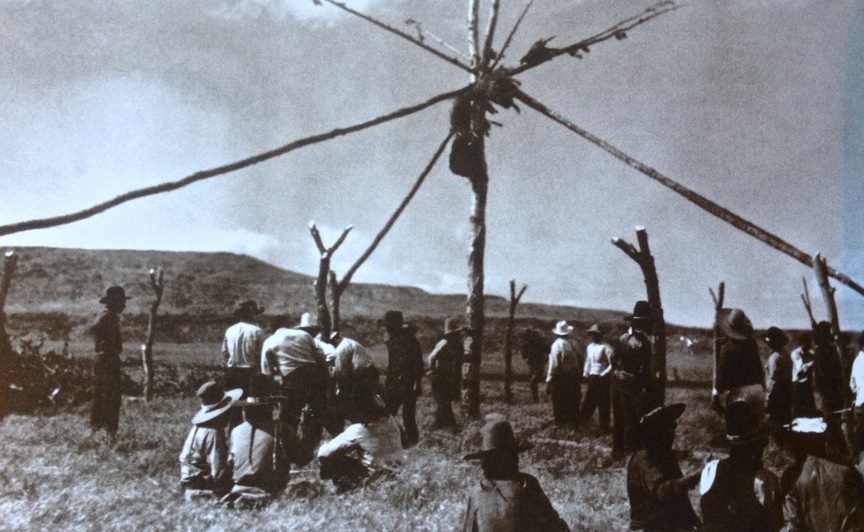
The building of a Crow Sun Dance Lodge from the 1940s. (Yellowtail, 2007: xviii)

The building of a Crow Sun Dance Lodge from the 1940s. (Yellowtail, 2007: xviii)

The introduction of Thomas Yellowtail’s work was written by Joe Medicine Crow, then (in 2007, when the book was published) a 92-year-old Crow tribal historian. Medicine Crow says his grandparents “were pre-reservation Indians who lived before the reservation was set up. They would go camping, hunting, and the men went on the war path.” (Yellowtail, 2007: xi) In reading this, it is important to understand that these activities — camping, hunting, and the war path — mean something much different than they do to us today. They were the very substructure of Plains indigene culture, and to camp and hunt and go on the war path meant one was able to support what we would today call a household (Jonathan Lear goes on in great detail and at length in his excellent work that everyone should read, Radical Hope). Being told by an outsider (or a colonizer) that you need to change the way you do things and that everything you did up to this point is now meaningless are also things that continuously need to be understood. It’d be likened to spending the time and energy to train as a professional welder, and then being told by an outsider that your efforts were for nought. And now here is a new way we’re going to do things. So put away that senseless welding torch and abandon the culture your fore-fathers and -mothers spent generations cultivating. In 1884, this is what the United States ordered, as Medicine Crow says: “The ‘Secretary’s Order’ of 1884… prohibited the Indians from practicing all activities related to their culture, including singing, dancing, and all traditional ceremonials.”

I’m afraid I’m getting a little preachy here, but the idea behind this has universal implications. If one ethnic group is able to do this to another ethnic group, then this means it can happen at any time to any one of us. In looking at that, is that a problem that could continue echoing through time? Yes. Certainly this — 19th-century Manifest Destiny — is something we can understand as happening at a particular time and place, and we can try to distance ourselves from it and say, “Well, we need to understand the historical actors on their own terms.” Yes, this is true (I’m as big of a fan as R.G. Collingwood as the next) But we still need to understand that the terms from yesteryear reverberate throughout the reservation and non-reservation world today (on July 11, 2013, Byron Dorgan had a excellent piece on these implications in the New York Times).

Grandpa’s Handwriting

This is what my late grandfather's handwriting looks like.

This is what my late grandfather’s handwriting looks like.

Yesterday I rummaged through a small toolbox that belonged to my late grandfather, David L. Barth (a link to his brother here). David enjoyed wood-working, both as a carpenter and then a hobby once he was hired on full time by Hedahl’s automotive in Bismarck. Throughout my youth, Grandpa Barth and I did a bit of woodworking together at his shop on the corner of 16th Street and Braman, Bismarck, North Dakota. I can still hear his voice bellowing “C’mon IN!” just after knocking on the exterior door. He and his wife, Vivian (my late grandmother), were always excited to have company.

David was originally born in Braddock, Emmons County, North Dakota (the Barth surname is Ohio-German). But yes, back to yesterday. Here is a photo of what my grandfather’s hand-writing looked like. He scribbled the socket sizes onto white tape and then fixed these to the tools. It is easier to see the numbers then. In our world of computerized text and formating, it’s nice to see the writing of individual humans. I wanted to share it.


The Ethics of Plains Indigenes

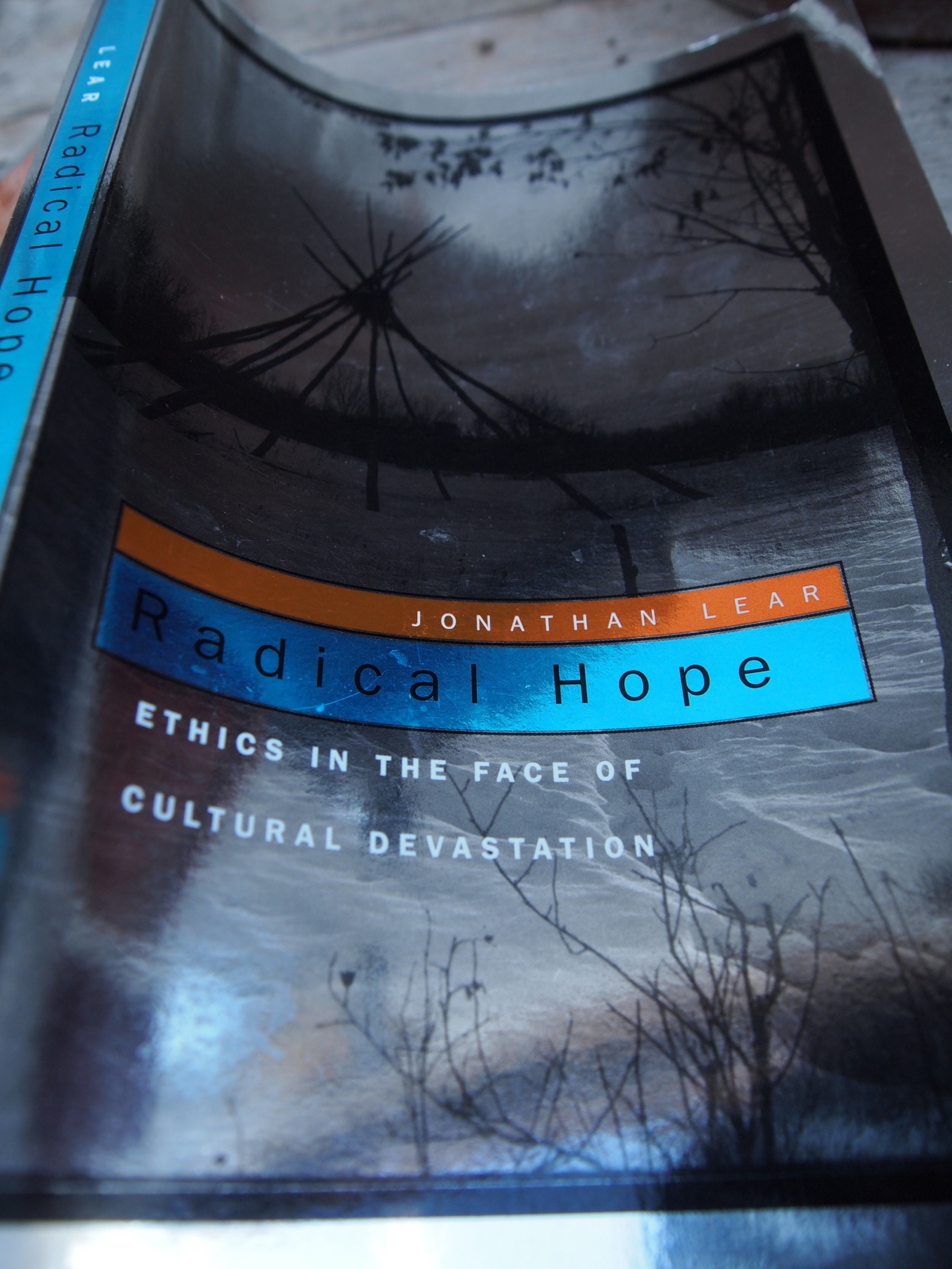
Radical HopeHere on the northern Great Plains, we are increasingly considering what the Dakota Wars from 150 years ago meant then and what it means today. A piece of scholarship I stumbled across while visiting the bookstore of Pompey’s Pillar in eastern Montana (where, famously, an Anglo-American incised his graffiti on some tall rock) is Jonathan Lear, Radical Hope: Ethics in the Face of Cultural Devastation (Harvard University Press, 2006). Lear uses the historical documents from Plenty Coups, a Crow leader who helped his people navigate the turn of the 19th century. What makes Lear’s monograph interesting is how he uses his training in philosophy and ethics to approach a previously unexplored topic of the Crow.

Throughout this book, the Dakota/Lakota/Nakota are mentioned, and how they and the Crow were ferocious enemies in the 19th century. Lear looks at this philosophically, though, and says,

One of the ironies that comes to light is that groups of people can be bitterest of enemies in real life, yet ontologically they are on the same side; and a real-life ally can turn out to be one’s ontological nemesis. The Crow and Sioux were bitterest of enemies… Still, their standoff sustained a world in which battles, planting coup-sticks, and counting coups all made sense. One has only to read Chief Sitting Bull’s pictorial autobiography to see that he was every bit as much concerned with counting coups as Plenty Coups was. And yet, with the United States as an ally — a questionable and unfaithful one to be sure, but still an ally in many ways — the Crow moved into a position in which their world fell apart. (Lear, 2006: 50-51)

The rearrangement of this way of life came to an end due to the advanced encroachment of Euro-Americans who, among other things, obliterated the bison food source of the Plains indigenes. Lear doesn’t just stop with the known history of how the bison were wiped out, though. Instead, he expands and explains how the bison food source was a serious component of the Crow’s cultural and ethical telos. Bison had been incorporated into nearly every element of the Crow way of life, and Lear gives excellent examples by unpacking phrases that Crow used for dinner. For example, Lear notes that there was no such thing as simply cooking a meal. Instead, the cooking of a meal had a greater social-psychology behind it. The phrase cooking and eating dinner was inextricably bound to “the cooking-of-a-meal-so-that-those-who-ate-it-would-be-healthy-to-hunt-and-fight.” (Lear, 2006: 40) See how the telos — the psychological extension of an immediate act providing a base for the future — is connected to the food, and that the food comes largely from the bison? Yes, of course. And so when Euro-Americans — whether Sully at Whitestone Hill, or Euro-American riflemen — obliterated the bison, it struck not only at that food source, but at the very culture of Plains indigenes. In short, read this book.


Visiting the Bear River Massacre Site

A photo from a July 15, 2013 visit to the Bear River Massacre site.

A photo from a July 15, 2013 visit to the Bear River Massacre site in southeastern Idaho.

A couple days ago Molly and I made a site visit to the Bear River Massacre in southeastern Idaho. The massacre happened in late-January 1863 when a U.S. Army group of California Volunteers led by Col. P.E. Connor attacked a domestic, non-combatant encampment of Shoshone. It is interesting to contextualize this site with others throughout the United States.

Nine months later, General Alfred Sully described his actions at Whitestone Hill against families of Lakota, Dakota and Nakota as a “murderous slaughter” of a “promiscuous nature.” This action happened on the northern Great Plains (in presentday North Dakota) only 9 months after the Bear River Massacre. Massacre was, sadly and to put it mildly, a part of the Total War battle rubric (check out John Fabian Witt’s latest work on Lincoln’s rules for war). It is called genocide and ethnocide today.

Today, 150 years later, the Bear River Massacre site remains active with memorials of all kinds. If you are driving from Salmon, Idaho to Salt Lake City, Utah, take exit 36 off of I-15 onto Highway 91. You’ll need to follow the exits, because there isn’t any signage that will guide you to this painful chapter in American history. At the site is a stone obelisk, and for the last 150 years different groups have brought different interpretations to the site.

Some items of remembrance at the Bear River Massacre site. Photo from July 15, 2013.

Some items of remembrance at the Bear River Massacre site. Photo from July 15, 2013.

The Bear River Massacre site was designated a National Historic Landmark in 1990. Today a beautiful memorial tree has taken on the task of an anchor for remembrance and mourning. A variety of individuals have placed items in the tree. A cursory sample of items observed on the July 15, 2013 day of my visit to the site included numerous dream catchers; tobacco pouches; a pair of glasses; a penny; beads on leather necklaces (one read “HOPE”); a wood flute; synthetic flowers; a tin pale filled with beads and chewing tobacco; pieces of rawhide with art on them; and suspenders. The tree is active and alive, as are the memories.

In addition to this, if you want to read up on contemporary scholarship specific to the Bear River Massacre, check out Kass Fleisher, The Bear River Massacre and the Making of History (Albany: State University of New York Press, 2004) and John Barnes, “The Struggle to Control the Past: Commemoration, Memory, and the Bear River Massacre of 1863” in The Public Historian, Vol. 30, No. 1 (February 2008).

Photo from July 15, 2013.

Photo from July 15, 2013.


World War I Memorials: Missoula, Montana and Wahpeton, North Dakota

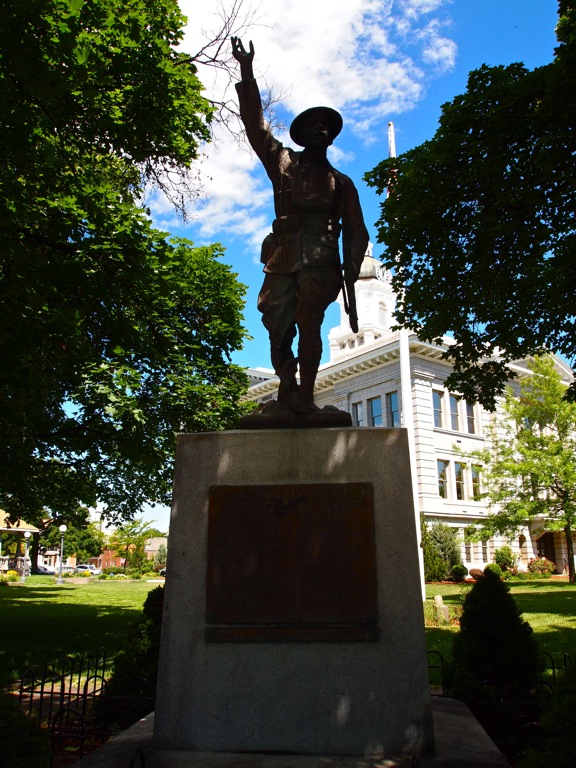
The other day I took some photos of the World War I memorial situated outside of the Missoula County Courthouse in Missoula, Montana. Once I saw the statue, I started snapping photos like crazy because I thought one or two of them would figure into a comparative presentation some day on the public remembrance of World War I in American History. I have also snapped photos of the WWI statue outside the Richland County Courthouse in Wahpeton, North Dakota. This got me re-visiting one of the infinite ideas of history.

If one wanted to, one could organize the historical record in two ways: the events that actually happened, and the long historical and never-ending process of how and why those events are remembered. I haven’t much to say beyond that point, so I’ll just upload some photos of the two related WWI statues from Missoula, Montana and Wahpeton, North Dakota.

The WWI statue outside of the Missoula County Courthouse. Photo from 07/13/2013.

The WWI statue outside of the Missoula County Courthouse. Photo from 07/13/2013.

The WWI monument outside of the Richland County Courthouse in Wahpeton, North Dakota. Photo from November 2012.

The WWI monument outside of the Richland County Courthouse in Wahpeton, North Dakota. Photo from November 2012.


Modern Archaeology of Grilling

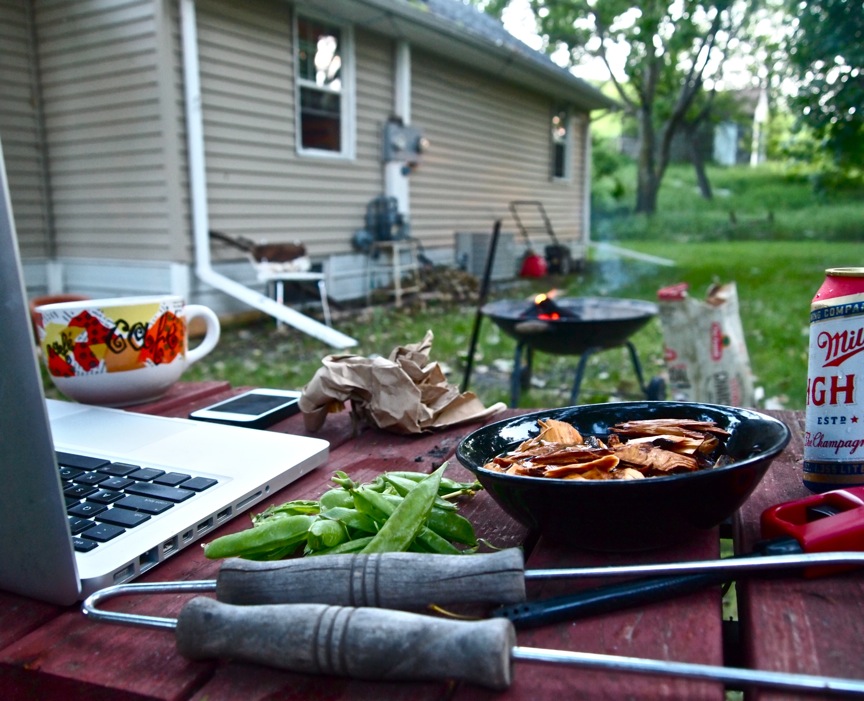
The sun is just starting to set and I’m sitting in the back yard of a residence in Valley City, North Dakota, and thinking that it is worthwhile to both upload a pic of and put some thoughts down on the material culture in front of me. I was thinking this because archaeologists often come across assemblages that have either no voice, or they consciously or unconsciously ascribe a voice to the assemblage through the construction of typologies and interpretations. Archaeologists will find themselves thinking, “I seriously would like to have a conversation with the individual who created this Mandan-Hidatsa pot sherd,” or “If I could only chat with the person who made this Scythian arrowhead…” To counter that, at least in the here and now, I’m going to quickly expand on the domestic assemblage that goes hand in hand with a Saturday evening grill on the northern steppe of North America in the first week of July, 2013.

A contemporary archaeological domestic assemblage from the evening of July 6, 2013, Valley City, North Dakota.

A contemporary archaeological domestic assemblage from the evening of July 6, 2013, Valley City, North Dakota.

Big Picture: This residence is, today, on that proverbial edge of town, a kind of gateway between the rustic countryside and the city or village. To borrow from Raymond Williams, the countryside has been characterized as representing purity and a re-engagement with the wilderness and also backwardness and idiocy (from Virgil, Thoreau and Muir to the Industrial and Post-Industrial H.L. Mencken and beyond). The city as well has been represented as cosmopolitan, where citizens of the world unite to exchange ideas and culture and conversation. Cities also are known to be bastions of corruption and vice. This is the kind of intellectual borderlands where I sit at tonight.

Immediate: with what archaeologists call a “domestic assemblage,” to my right is an aim-and-flame; a can of Miller High Life (the new hipster beer that my friend Troy Reisenauer said may be poised to usurp the hipster Pabst Blue Ribbon beer, if not already); a small bowl of apple wood chips soaking in water; a large coffee cup with a small amount of shucked peas from the Valley City farmer’s market; an iPhone and MacBook Pro, presumably made somewhere in a factory in East Asia by a team of workers who have un-imaginable hours to work; a crumpled up paper bag; and tongs to work the coals on the fire. Music playing is Bruce Springstean, “Mansion on a Hill” from the Nebraska album (appropriate for the Great Plains for sure).

Background: center-right is a make-shift grill (one of those portable backyard firepits, this also made in some East Asian factory by workers with un-imaginable hours); a slender grate; and a bag of Our Family hardwood lump charcoal. I don’t have a proper charcoal grill here (at my girlfriend’s sister’s place), so I just started using the firepit. It has worked quite well.

Far background: behind that (even more blurred) is a pre-WWII home shrouded in modern siding and asphalt shingle with aluminum downspouts, a lawnmower, a plastic gas can (a petroleum product that contains petroleum), a quasi-rusted stool and chair, an A/C unit (which is humming), and toward the back of the house is the beginning of the sparse tree line that separates the country from the city (as mentioned at the outset of this blog).

I better get after putting the steaks on the grill, as these coals are primed and ready. In any case, note how much stuff in this assemblage is industry, factory-made, and whether or not it originates from East Asia or North America (or beyond). The only thing that is produced locally (that I can think of) are the peas I’m shucking, the steaks from Valley Meats I’m readying to put on the grill, and this blog entry. The center of the globe’s gravity continues moving from the Atlantic to the Pacific World, this whether we know it or not. Happy evening to you all. Here is that Springsteen song:


Historic Fireworks in Mandan, North Dakota

A Bismarck Daily Tribune story from July 6, 1913.

A Bismarck Daily Tribune story from July 6, 1913.

As we recover from the pyro-mania hangover associated with America’s Independence (no doubt, celebrated with hundreds of millions of dollars of Chinese fireworks), I came across this 100-year-old local story from The Bismarck Daily Tribune, front page, July 6, 1913. If you have ever witnessed the residential and professional fireworks displays on July 4th in Mandan, North Dakota, this little snippet may resonate with you. It feels somewhat like a war zone. Somewhat. Here is a bit of deep cultural backdrop on things that blow up, and have blown up, in Mandan, North Dakota around the first week of July. Enjoy.