Tag Archives: History

Rough World Historical Thoughts on Castle Larnach

Castle Larnach, Dunedin, NZ.

Castle Larnach, Dunedin, NZ.

There are two items to blog about today. The first is the short record as to what we did yesterday, and the second is what is on the itinerary for today. They blend together, as life does, and I’ll try to make sense out of that below. Of the former:

Yesterday morning Matthew, Molly and I walked a couple blocks to the center of downtown Dunedin, to what I’ve been calling the undisputed octagon (because the city center was laid out like an octagon; not because it has any association with Ultimate Fighting). I learned quickly to watch for the little green man, an indicator that lets pedestrians know when it is a guarded time to cross the street. We also found a grand little breakfast shop. One contrast between NZ and ‘merica is that restaurants and cafes are, generally, a bit more spendy than the States. But this is offset by the reality that NZ servers are paid a greater wage than State-side servers, and this also means that when in NZ one is not expected to tip.

Also, the breakfast was delicious. Matt had French toast and Molly and I split a breakfast of egg, toast, bacon and sausage. It was a very traditional breakfast, at least if one grows up on the northern Great Plains of North America. In many ways NZ is like a parallel universe to the English-speaking Atlantic World, which in turn gives a person pause as to the influence the 18th– and 19th– century Great British world had on the globe. This is going to be a point of conversation for the second item today, which is the Writing Histories of Empire and Colonialism, this put on at St. Margaret’s College at the University of Otago, Dunedin.

Castle Larnach stairwell, from the top floor looking down.

Castle Larnach stairwell, from the top floor looking down.

One of the aims of this history workshop is to bat around and consider ideas about how to write solid global history. One of the potential problems with writing world history is that one is dealing with a large topic, and there is always a danger of saying nothing in an attempt to say everything. So this is why we don’t do that. Instead, a different way to go about it, at least as I’m sitting here and typing, is to 1) work in topics of 3s and 4s; 2) give the reader a personal element to fixate on; and 3) carry a theme/thesis that runs through the entire historical essay or monograph — this, arguably, can be a model for any writer’s workshop.

So to return to the first blogging topic for today: I’m thinking a bit about yesterday afternoon, when we all visited, had high tea, and took an afternoon stroll at and of Castle Larnach, a late-19th century industrial Victorian “home.” While wandering through this castle, I thought about simultaneously how great a view one had from the top of the castle tower and about the excessive absurdity of this kind of built la-la land. I say la-la land because castles, in their original utilitarian form, were built as defensive positions, often in an attempt to protect the feudal lord and local populace when mean outsiders wanted to be mean to the said lord, baron and locals.

In the case of Castle Larnach, this banker and politician made a ton of money off the New Zealand and Australian gold fields, and then decided to conceive of himself as some kind of varietal noble. It reminds me of super late-19th century castles in America, such as the James J. Hill home in St. Paul, Minnesota. It is these sorts of industrial wealth concentrations that, after the turn of the 19th century, Progressive Republicans such as Theodore Roosevelt thundered against, or sought to break up. (Out of this period in world history, we get self-validating, hyper-dodgy theses that the über-rich came up with, such as Social Darwinism and the Social Gospel — we’re rich because either nature or God made us rich). The notion here, though, is to consider how or if a world historical theme is reflected on the local level. Then, in theory, readers might think of their own regional histories as being both local and global.

Fern, the exhausted and super friendly castle dog at Castle Larnach. Nothing gets by Fern. Not that she cares, though.

Fern, the exhausted and super friendly castle dog at Castle Larnach. Nothing gets by Fern. Not that she cares, though.

Another point to consider is that the James J. Hill home, and this Scottish castle in Dunedin, could not be sustained for any length of time, at least not by a singular family. Today they have turned into public historical enclaves, administered by private or public entities, and the public has access to them in ways that they wouldn’t have in their original historic context.

Anyhow, and moving along, I’m excited to get after this first day’s seminar/workshop. All of the world history workshop attendees are required to read three different essays which, of course, I did on the flight over. The readings include Linda Colley, The Ordeal of Elizabeth Marsh (2007), Maya Jasanoff, Liberty’s Exiles: The Loss of America and the Remaking of the British Empire (2011), and Tony Ballantyne, “On Place, Space and Mobility in Nineteenth-Century New Zealand” in the New Zealand Journal of History, 45, 1 (2011). But enough about all this. It’s almost 8:00AM Dunedin time, and we need to track down this thing in Australia and NZ called breakkie.

World War II: Charles E. (“Bud”) Barth Photos

Just over a year ago, a great uncle of mine, Charles E. (“Bud”) Barth passed away. Charles was a front line medic in the European theatre of the Second World War (also in the Battle of the Bulge). Years prior I had the chance to get to know him better, even interviewing him for the United States Veteran’s History Project.

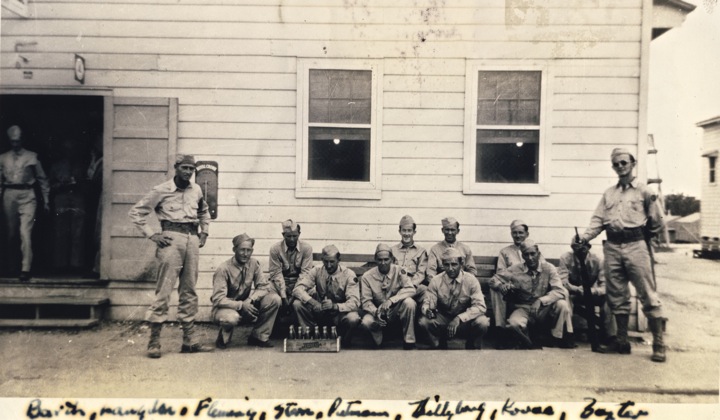
Because I blogged on Charles both here and here, another relation of someone attached to the same medical unit was able to find what I blogged, track me down, and e-mail me additional photos of Charles with his WWII unit. Here are those two photos of Charles with his detachment, these sent to me by the daughter of S/Sgt Kutik (who served alongside Charles).

Note: Charles originally hailed from Braddock, Emmons County, North Dakota.

An informal photo of Barth's medical detachment. Charles (kneeling) is second from the left.

An informal photo of Barth’s medical detachment. Charles (kneeling) is second from the left, just next to the standing soldier. The case of beverages in front of them is labeled, “Pepsi.”

409th Medical Detachment, Barth is front row, second from the left.

409th Medical Detachment, Barth is front row, second from the left.


Ideas of Fermentation and Distilled History

On this 4th of July morning (which, in America, is a secular holiday, or holy day), I finally got around to one of my short reading lists that concerns the scholarly study, specifically, of beer, and broadly of fermentation, booze and alcohol (or what academics sometimes refer to as ethyl). The four books in front of me include The Oxford Companion to Beer (Oxford University Press, 2012), two monographs by Patrick McGovern including Ancient Wine: The Search for the Origins of Viniculture (Princeton University Press, 2003) and Uncorking the Past: The Quest for Wine, Beer, and Other Alcoholic Beverages (University of California Press, 2009). The fourth work is The Archaeology of Alcohol and Drinking (University Press of Florida, 2008) by Frederick H. Smith, and this is perhaps the one that speaks most pointedly to the July 4, 2013 day since it is a part of The American Experience in Archaeological Perspective series.

Some booze studies scholarship.

Some booze studies scholarship.

Of all these books, the Oxford companion is put together like an encyclopedia rather than a narrative or anthology, and Oxford sensationalized it a bit by asking Tom Colicchio to write the short forward. Because I am in the dark on many facets of contemporary culture (it all moves and changes so fast, though; and Tom would have to Google our names as well), I had to Google Colicchio’s name, but when an image of his face appeared I recognized him immediately as one of those celebrity chefs. Tom noted how as he matured from his teens up to 2012, so did his appreciation toward beer. Of this work, though, I thought Oxford would have benefitted more to get a brew master to write the forward, or even a monk at a monastery that is renowned for beer. Tom works in the trade of acquiring James Beard Awards, culinary rage and sensationalism (which is how you make it in that business) whereas a monk devotes time to brewing, reflection, and self-reflection (in large part for humanity and the sustainability of the abbey or monastery). Brooklyn Brewery brewmaster Garrett Oliver drafted the preface to this work, and he speaks a bit more to the beer trade.

The Oxford companion is huge like an encyclopedia, numbering 919 pages, or around 2″ thick. I think the only way you’d go about using this book is to check up on a pointed question with the index, look at the topical features just after the preface, or to open it up to a random page. On page 674, the entry “public houses (pubs)” appears, noting that the institution of the pub did not have much renown outside of the U.K. until business owners decided to bring Irish Disneyland to the world with Irish-themed pubs (I suppose the idea was that not everyone can make it to Ireland to visit a pub, so might as well bring the Irish-themed pub to the non-Ireland world). It is moderately surprising to not see Kingsley Amis referenced in the index of this work, but I suppose if a person is building a scholarly library on beer and booze, they already know about it (Amis knew his booze, and he could be accused of being just as interested in its effect as he was the flavor and body of the stuff).

On the first page is the entry “abbey beers,” and this expands on the brewing expertise of the Belgian Trappist monks, and the established “appelation (controlee)” which lets everyone know where the monastic beer originated (time, space and chronology is important to the monastic tradition for many reasons). In reading and writing about this passage, for at least a couple years I have hoped that the monks of Assumption Abbey in Richardton, North Dakota, might at some point down the line consider brewing beer with North Dakota grains, barley and hops. And even better, sharing it (but that’s totally up to them).

As for the works by McGovern, I first came across his name in a popular history of booze put out by the Smithsonian in July-August 2011 (the great article linked to here). McGovern focused on fermentation in Western Civilization (the region of Mesopotamia is the cradle of fermentation), and he also made the case that we today are part of a long fermentation process (the long durée of beer drinking). In McGovern’s scholarship, he is a bit heavy-handed in his testimonies to the irrefutability of the archaeological record or the interpretation thereof (“There is no hidden bias lurking in a pottery sherd or a stone wall, as there might be in a written document.” [McGovern, 2003: 5]). But that sophomoric understanding of philosophy and theory is outweighed by a broad knowledge of the history of beer and wine.

German-produced Bartmann wine bottle from the British settlement site of Jamestown, Virginia. (Smith, 2008: 12)

German-produced Bartmann wine bottle from the British settlement site of Jamestown, Virginia. (Smith, 2008: 12)

Of the four books, the best on the subject is by Frederick H. Smith. And I define best in the sense that it is an academic treatment of the subject that tracks both the subject itself and what other scholars from the academy have said about it (like brewing, the origins of this tradition is monastic in and of itself). The first chapter to this work alludes to numerous scholars in alcohol studies (a kind of subfield in history and anthropology), and the subsequent chapters go on to discuss the Iberian storage vessels first used to transport the sauce throughout the Atlantic World, from the Old to the Jamestown colony in the New, and here to the production of alcohol to its trade and consumption and so on. By the 16th and 17th centuries, hand-blown glass bottles surpassed the ceramic vessels, and Smith notes that when these bottles are recovered, so is the booze. For example, an early 17th century glass bottle of wine was once recovered by marine archaeologists, and it turned out that the Dutch warship had wine at 10.6% alcohol content, this within the same range as the content of wine today.

The final chapter in Smith’s monograph stems from a 2005 study he did on the role alcohol played in the 1816 slave revolt in Barbados (four decades after elite Anglo-America got its start). These case studies are a more effective way to explore the social history of booze in all of its variety and nuance. Specific to this are the caves on Barbados, a place where self-liberated slaves could escape to on an island and carve out an underground existence. Without going too much further into these works, it seems that on July 4th it is important to acknowledge the philosophical substance of America’s Declaration of Independence, but more importantly to know that it was a document prepared by an elite minority on the backs of an enslaved majority.


Historic Scandinavian Log Cabins: Then and Now

Yesterday I visited a project area in the Sheyenne River Valley in southeastern North Dakota, and on the way back from fieldwork I stopped by some static public historical signage and historical Scandinavian-American log cabins on one of America’s Scenic Byway routes. I snapped some photos, downloaded them in the computer last night, and then started to do a bit of research on the archaeological project area: history often informs the archaeology, since much happens with the history of an archaeological site before archaeologists have a chance to descend on it.

While looking through a series of digitized photos, I came across a historic photo in the Digital Horizons/ND Institute for Regional Studies archive. The photo is titled, “Building at Fort Ransom, N.D.,” and it is a log cabin today located some miles north of Fort Ransom, N.D. I compared the historic with the modern this morning. Below are the photos I’ve looked at: one is a 1950s photo of the cabin, and below that is a June 16, 2013 photo. Note the gable-end elevation, and compare the shapes of the logs, and the seams of the logs. You’ll notice that they match one another.

A photo of the Slattum cabin in the 1950s.

A photo of the Slattum cabin in the 1950s.

A June 16, 2013 photo of the Slattum Cabin. Note the gable end elevation, and compare the seams of the log cabin with the seams of the gable elevation in the 1950s photo. They are the same.

A June 16, 2013 photo of the Slattum Cabin. Note the gable end elevation, and compare the seams of the log cabin with the seams of the gable elevation in the 1950s photo. They are the same.

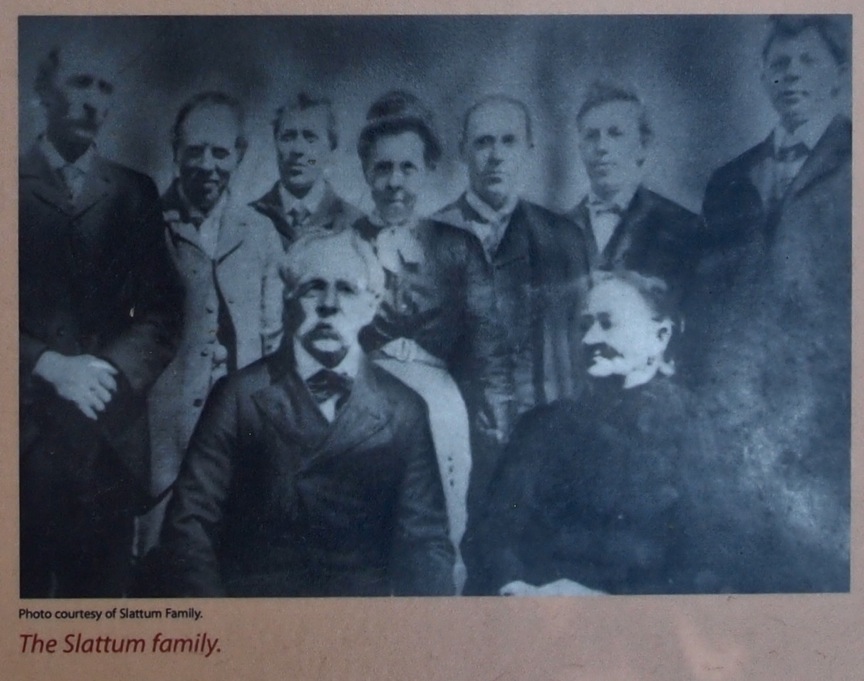
As the public historical signage said, this cabin was built in 1879 by Norwegian immigrant Theodore Slattum, and he originally hailed from Christiana, Norway. He immigrated to Fillmore County, Minnesota in 1870, and he and his wife, Jorgine, relocated to the Sheyenne River Valley in 1879, where they built this cabin. They also raised nine children in the cabin (they modified the original cabin from what it looks like here in the photos). In 1945, this cabin was moved to the Fort Ransom Historic Site, and then moved back to this original location at some point around the turn of the 20th century (this is likely why the description of the cabin’s provenience is what it is within Digital Horizons/NDIRS; and this is also an example of how history informs archaeology, and not the other way around).

The Slattum family, this photo from the public historical signage at the cabin site. Photo taken on June 16, 2013.

The Slattum family, this photo from the public historical signage at the cabin site. Photo taken on June 16, 2013.


Some Philosophies of Histories

In a couple hours I will be taking what is called the oral component of the comprehensive exams. This is the business of academia, what I sometimes think of as the codification of intellect (everyone is sharp, or has potential to be sharp, and universities are designed with a goal of proofing and validating that sharpness). In that case, I am engaged in my morning ritual of visiting, revisiting and reading through some broad conceptual thinkers in final preparation for this upcoming, mid-morning fun.

A potential railroad metaphor for the various and competing tracks of time cultures and societies are hurtling along. This, we historians argue, is why world history is increasingly important in our increasingly global age.

The railroad as metaphor for the various and competing tracks of time cultures and societies are hurtling along. This, we historians argue, is why the study of history and the philosophies of histories is increasingly important to study in our increasingly global age.

In the largest scheme of things, these big-picture thinkers — from R.G. Collingwood to E.H. Carr to John Lewis Gaddis to Michael Shanks — force a reader to contemplate not just the technical hows of a discipline, but also the philosophical whys: for example, why would anyone be engaged in the efforts of history or archaeology or, more broadly, any discipline or trade for that matter? To contemplate this provides a variety of conceptual frameworks in which to filter data through, and these are the substructures of any discipline and trade. While keeping this in mind, it is also important to keep in mind that the disciplines and trades are by and for an infinite variety of culture and subculture and subaltern culture (and so on). Whether conscious of it or not, the collective memory within these groups influences to varying degrees the ways the substructures are built (if looking at the archaeology of language, for example, it quickly becomes apparent that languages are built out of previously established bodies of presumptions and assumptions).

With that said, in revisiting R.G. Collingwood, The Idea of History, (1946) R.G. says in his introduction that “Philosophy is never concerned with thought by itself; it is always concerned with its relation to its object, and is therefore concerned with the object just as much as with the thought.” This entire idea pertains to developing philosophies that disciplinarian doctors (which, to be pedantic, is Greek for “teacher”) train cadets and recruits with, so the latter understands that two thinkers can take the same body of evidence and can arrive at completely disparate conclusions. In the case of history, this is what 18th century Voltaire called a “philosophy of history,” and what 20th century E.H. Carr referred to as a dialog with the past. This philosophy and dialog is important — at least I’ll make the argument here — since the world has and always will be in a perpetual state of crisis. If met with crisis, we have to get used to the idea of re-calibrating and re-adjusting. This is not necessarily to accept the crisis, but to figure out ways through and around it. In some of Carr’s concluding remarks in chapter 5 of What Is History? (1961), he identifies three types of history (using the Royal “You” to bring his case home):

[1] You can, if you please, turn history into theology by making the meaning of the past depend on some extra-historical and super-rational power. [2] You can, if you please, turn it into literature — a collection of stories and legends about the past without meaning or significance. [and 3, which is where Carr is at his best, a proper definition of the historian.] History properly so-called can be written only by those who find and accept a sense of direction in history itself. [and in the copy on my shelf, the following is what I underlined] The belief that we have come from somewhere is closely linked with the belief that we are going somewhere. A society which has lost belief in its capacity to progress in the future will quickly cease to concern itself with its progress in the past.

Thus, for Carr (and myself), to engage in history proper is to engage in the faith of the future of society, and the discipline of history itself. This as well is why history is never “complete.” If history was complete, society would be complete, and both that society and history would be finished and at an end with itself. This, of course, is only theoretically possible, since nothing is ever truly at end. Rather, we humans impose the boundaries and limitations, demarcating a beginning and end for what is otherwise quite gradual and transitionary. This is why in the first two decades of the 21st-century we are having conversations about how we humans engage 2- and 3-dimensional objects. In the words of Michael Shanks, “the past has to be worked at,” (Hunter Thompson sometimes referred to journalism as analogous to chopping wood) and it is just as important to look at the past as it is to look at the way historians have sought to make sense of the past.

I keep thinking that, to use metaphor, as we stand on the 21st century dock and watch the 20th century Cold War — that barge of history — drift further and farther away from us, a host of new crises will continuously arise. Our ability to react to them will be predicated on not just how we know the past, but also of how and why those before us knew the past. And how and why they understood the past is also filtered through the ways in which we remember and know the past, and so on, ad infinitum. 


Getting Students to Like School

In Daniel T. Willingham, Why Don’t Students Like School?: A Cognitive Scientist Answers Questions About How the Mind Works and What It Means for the Classroom (Wiley, 2009), a reader is at once subjected to a subtitle with 19th-century length (for example, click here to check out the length of 19th century titles). More importantly, though, the reader is reminded how reading and studies shape and reconfigure the mind, that “three-pound mass of cells, approximately the consistency of oatmeal, that reside in the skull of each of us” (Willingham’s opening words). In the fourth paragraph of the conclusion, Willingham says, “Reading is a mental act that literally changes the thought process of the reader.” (Willingham, 2009: 207)

Get this book. It is good.

Get this book. It is good.

When I read this I thought, “Of course!” immediately re-remembering the way reading alters our way about the world (my mind was changed to remember how the mind changes when reading). This, in turn, caused my brain to recall conversations years ago from the University of Minnesota-Twin Cities, chatting with fellow undergrads and agreeing with the statement, “Whenever I read something, it often changes my mind.” At its best this is the power of a classical liberal education, or a liberal education, an ability to allow students to wander around in the infinite of ideas and build arguments and perspectives about the world. It is up to the teacher, though, to consider how they might best teach this to students. This requires historians to embrace the methodological ethos of thinking about thinking, or thinking about the way another person might understand the world, including students. And this in turn leads to pedagogical considerations about how to teach, which in turn leads to how to engage students with narratives and stories (aka, histories).

Willingham brings about one approach, a broad 4-part outline used by good and great screen-writers in Hollywood. It is building a narrative around the four Cs: causality, conflict, complications, and character. In Willingham’s book, he uses the example of Star Wars as a narrative to explain to the reader how important narratives are to telling a story worth remembering, and how this model can be used to teach memorable science, math and history (come to think of it, as an adolescent in school, mathematics became amazingly interesting when it was humanized with the founding thinkers of particular theorems and formulas. At once it was not just a Cartesian grid, but instead a grid work developed by this insanely intelligent Renaissance thinker, René Descartes… this information was crucial, at least to break up the 50-minute monotone lectures presented on overhead projectors in junior high and high school).

With the Star Wars example, Willingham answers the title of Chapter 3, a question laid out as, “Why Do Students Remember Everything That’s on Television and Forget Everything I Say?” To answer this with “Because you’re boring” would be true but incredibly unhelpful. The reason students remember Star Wars is because screenwriters have modeled the story or narrative around the 4 Cs (and also because Star Wars has permeated every facet of global culture, and also because of Star Wars dorkdom which propels some kind cult of Star Wars, but that’s another tangent for another time).  In Star Wars, there is a strong character development that is Luke Skywalker and Princess Leia. The overarching cause or causality is hinted at in the opening: find the plans for the Death Star so the rebels can blow it up. Throughout the story, though, Luke, Leia and others face a variety of complications, including a show-down with Darth Vader, this played by the voice of James Earl Jones, and learning from Obi-Wan Kenobi, Yoda, and so on. Still, the overarching theme remains: find a way to destroy that bloody Death Star. What Willingham is telling teachers is to be sure to put time into organizing lesson plans to develop those overarching themes. Conflict and character development will push and pull a listener or student through the narrative, and the end-goal will not change. Students will appreciate these well-organized narratives and lesson plans. And if they appreciate that, the teacher will have their attention.