Tag Archives: Great Plains History

Cultural Landscapes on the Northern Great Plains: From 1862 to 2012

This evening while toying around with Google Earth’s image overlay feature, I thought it would be interesting to see what a 2012 map would look like in contrast to the map of the 1860s in Mark Diedrich’s, Mni Wakan Oyate (Spirit Lake Nation): A History of Sisituwan, Wahpeton, Pabaksa, and Other Dakota That Settled at Spirit Lake, North Dakota (Fort Totten, North Dakota: Cankdeska Cikana Community College Publishing, 2007). I was keeping in mind how we — the Royal We — are all born into particular sets of cultural values that we consciously or unconsciously bring to bear on everything we process, do, and see. So in 2012, it’s a given that we can hop Eisenhower’s Interstate 94, lean heavy on the gas peddle, and within 1 to a dozen hours find ourselves anywhere between Minneapolis, Minnesota, Billings, Montana, Omaha, Nebraska, or Winnipeg, Manitoba. In 1862, the reality would have required weeks worth of time to cover that amount of space. One hundred fifty years is quite the temporal gap. But Google Earth reconnects us with the spatial, or what we might consider as that sense of place.

Here, for example, is the Diedrich map imported into Google Earth with an approximate transparency of 20-40%. This is laid on top of a 2012 map (some specifics don’t quite line up, but considering that this took 3 minutes to put together, it’s not bad, and the general idea is conveyed).

1862 sans 2012 Geopolitic

Note the non-existence of the 2012 place names. We get the large type of Dakota in the east, Nakota in central Dakota Territory, and the Lakota primarily west of the Missouri River. Imbedded within that are several sub-national sets, including the Ihanktuwana, Sisituwan, Pabaksa, Assiniboin, Mandan (“Gros Ventre”), Arikara, and Blackfeet Lakota. It might be worthwhile to filter our 2012 mindsets through an 1862 landscape in the same way that we would consider today’s landscape in Central Asia, western Europe, or eastern Asia. To an outsider, “it all looks the same.” But try telling someone who hails from Hong Kong that Bangkok and Ulaanbaatar are just the same. Or try telling someone from Tashkent that they’ve experienced something similar because they once saw a picture of Moscow, they talked to a guy who visited Kabul, or they heard about the cultural mecca of St. Petersburg. Or try telling a Parisian that Germany is just like Italy. Or try… yes, the idea is conveyed. And this doesn’t even begin to touch on the dynamics of Africa, Australia and so on.

In 1862, North Dakota was northern Dakota Territory to Abraham Lincoln, Minnesota Governor Alexander Ramsey, and any immigrant Euro-American back east (many of our great- or great-great grandparents included). The names of Bismarck, Williston, Dickinson, Jamestown, Fargo, Casselton, Valley City, Grand Forks, Watford City, New Town, Devils Lake, Minot, Ellendale and so on wouldn’t have been on anyone’s cultural radar. Between the 1860s and today, though, several generations have come and gone. And through this amount of time, our perception of the landscape has altered as well. This Google Earth gadget is amazing in that regard. Here is Diedrich’s map with Eisenhower’s Interstate System and the industrial Geopolitics imposed on the landscape:

1862 and 2012

Above, the 49th parallel is quite pronounced, as is our national (or international) system of highways and byways. Today’s 2012 I-94 blasts east-west through former Native America. You can travel from Minneapolis through the 1860s Dakota (Red River Valley now), Nakota, Mandan, Hidatsa, Arikara (upper Missouri River) and Lakota country (now the Bakken Oil Fields) to Billings in about 20 hours (I cannot recommend any more efficient time). In North Dakota, we can sail past these 1862 landscapes at no less than 75 miles an hour, thermostat pumped full tilt, iPods routed through the speakers. This is the push and the pull between culture and landscape throughout time. I think that’s all I have for now.

Sharp’s “Whoop-Up Country” (1955) in Great Plains Historiography

Whoop-Up Country: The Canadian-American West, 1865-1885. By Paul F. Sharp. (Norman: University of Minnesota Press, 1955. 347 pages.)

Review by Aaron L. Barth

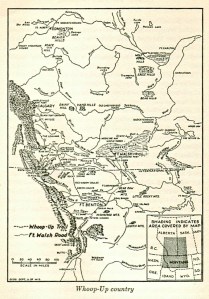
In 1955, Paul F. Sharp pushed the Turnerian model north across the 49th parallel with his Whoop-Up Country: The Canadian-American West, 1865-1885. In doing this Sharp turned Turner’s national model into an international one, describing the two-decade history of the trail that linked Fort Benton in west-central Montana with Fort McLeod in western Canada. In Sharp’s words, “Here on the northern plains, the two great streams of Anglo-Saxon pioneering that had pushed across the continent finally reached their last west in the same environment.” (Sharp, 1955: 8) A shortcoming of Sharp’s use of “whoop-up” is that he never defines its origins (for example, why would Euro-Americans use this phrase?). Grasslands united the United States and Canada, the matching physiographic and semi-arid plain transcending the geopolitical borders, yet culture carried on in its own respective way. Merchants arrived to these grasslands, acting on behalf of “their London masters — Peter Pond, Alexander Mackenzie, Henry Kelsey, David Thompson, Peter Skene Ogden, and scores of others.” (Sharp, 1955: 33) Castor Canadensis, or beaver (and the Euro-American fetish for top hats), compelled these trappers to move into this area, and with them arrived vestiges of Anglo-American culture.

"Whoop-Up" country map (Sharp, 1955: 6).

“Whoop-Up” country map (Sharp, 1955: 6).

The way in which Sharp breaks with earlier Anglo-Americentric histories is in his portrayal of the May 1873 massacre (rather than a battle) at Cypress Hills. In the nineteenth century American mind, when Custer and his Seventh Cavalry died at Bighorn, it remained a “massacre.” Yet when the Union army fell upon Native American villages with rifle, cannon and sabre, it remained a “battle.” According to Sharp, neither interpretation did the historical record any justice, or benefit, as they did no “credit to the objectivity or scholarship of those who, by reason of inadequate research or national bias, have perpetuated legend as history or myth as truth.” (Sharp, 1955: 55) Bringing up the topics of legend and history, or myth and truth, is where Sharp slips into a Positivistic, 1950s frame of mind. Three decades later, in 1986, William McNeill would cover this topic with more rigor and tenacity in Mythistory.

In other ways Sharp’s scholarship is dated, at least in his victimization of the Indian as a “drunk,” this inebriation described as the malefactor of the Cyprus Hills massacre. In Sharp’s words, “Whisky was the real culprit and this fight was another of its fearful effects upon the western Indians,” since this was a “frontier society which tolerated the sale of whiskey to the Indians and encouraged violence against them when disagreements arose.” (Sharp, 1955: 77) While Sharp’s scholarship broke from earlier Anglo-American histories, he continued to use paternalistic condescension toward Native America in his interpretation. When it came to interpreting the behavior of whites, however, he aptly allowed for individual agency and explained the differences in how it played on each side of the 49th parallel.

Four years before the massacre of Cyprus Hills, the Hudson’s Bay Company “transferred to the government of Canada its title to the vast preserve granted in its charter of 1670 and known as Rupert’s Land.” Sharp says it was approximately 2,300,000 square miles (italics mine) of land, this unit of measurement a subtle and slight reminder that Sharp’s readership still obliged American rather than Canadian interests. The establishment of a police force (“Law in Scarlet Tunics”) in the Northwest Territories on April 28, 1873 arguably denied the Canadian west a type of “lawlessness” and chaos so typical of the American West. Sharp addressed this, saying that if “every westerner lived by the myth and defended his honor with Colt’s ‘Great Equalizer’ at the slightest provocation, only one honorable man would have survived in each community” (Sharp, 1955: 107) Yet violence still held true, since the decentralized authority in the American West invariably could not stand up against large, roving gangs (unofficial social institutions in their own right). “Decentralization of authority in local governments was the heart of the matter, for through them law enforcement and judicial administration functioned.” (Sharp, 1955: 108) Local and regional laws guided the development of the American West, until they gave way to organized State and Federal systems that replaced the territories. Under the British-Canadian system, though, the myth or reality of disorder compelled London and Ottawa to bring the Empire immediately to bear on their western wilderness. Thus, in the western United States, chaos theory, regionalism, might-is-likely-right, and individual wits reigned. In the British-Canadian west, imperial order for god and country carried the day.

It is important to keep in mind that this history, when launched onto the scene in 1955, was nudging the interpretation of the Indian as “barrier” (as Walter Webb did in his Great Plains, 1933) to the Indian as understandable victim of United States and Canadian policy. A decade later, Vine Victor Deloria, Jr. and M. Scott Momaday (among others) would further this, an intellectual contribution that coincided with advances made by the American Indian Movement. Today, at least in the first two decades of the twenty-first century, scholarship has again shifted. Note, for example, Pekka Hämäläinen’s The Comanche Empire (Yale University Press, 2008), or Elizabeth Fenn’s forthcoming work on the Mandan, Encounters at the Heart of the World: A History of the Mandan People. This scholarship demonstrates how Native American cultures acted rather than reacted to Euro-American encroachment. It is up to Native and non-Natives scholars today to push these interpretive boundaries, and help reshape the understanding of the past, and even the present.