Tag Archives: Greasy Grass

Thinking About Patrick Byrne and America 250 and Little Bighorn/Greasy Grass 150

For some weeks now I’ve been imagining setting down some thoughts on some (how would one do ALL) historiography of the Irish Potato Famine from the 1840s and on. It has been research in prep for America 250 (1776-2026) this year, at least as it pertains to our region that is the Northern Plains. We (a growing group of us) are thinking about the Battle of Little Bighorn/Greasy Grass (LBH/GG) at 150 (1876-2026), as word arrived to Bismarck, northern Dakota Territory, on July 5, 1876 (about 11:00PM, as some local memorial markers indicate), that Custer and his command fell to the combined tribes of Oceti Sakowin and Northern Cheyenne. Yes: for you non-LBG/GG-o-philes, Custer’s command fell on the first centennial of the nation, at 100 years (1776-1876), so the memory of this is, and will, forever be interconnected with any and all national semiquincentennial, sestercentennial, bicesquicentennial, tercentennial, and it’ll just go on and on.

Stay with me here. So not too long after Custer and his command fell at LBH/GG, this Patrick Byrne chap arrives to the area, as an orphan immigrant from County Roscommon, Ireland, to Bismarck. He’s in his teenage years, yet. Byrne gets through local highschool, and at some point works with John Burke, another Irish-Northern Plainser who ended up being pretty successful navigating the political ladder in North Dakota and with U.S. President Woodrow Wilson. By that point, Byrne was a personal secretary to Burke (if you attain a certain threshold of monetary wealth, the paperwork can get so abundant that it’s a good idea to bring aboard a personal secretary — so I am told.). And Byrne puts his head down and works. But Byrne also works on his own historical memory project, Soldiers of the Plains, and intentionally has it published in 1926, which would have been the 50th observance (1876-1926) of LBH/GG. It may have been the first time, at least in 1926, that an immigrant settler researched, wrote about, and had published a narrative for an Anglo-American-reading audience that was empathetic and sympathetic toward the Oceti and Northern Cheyenne at LBG/GG.

The brick-by-brick historical case that I’m working up here goes something like this: when Byrne learned and read and heard the oral histories of LBH/GG, he understood exactly what was happening as he would have lived through it and exited Ireland because of it: the Anglo-sphere attempting to remove the local population so the Anglo-sphere could bring it into their own agricultural production, whether on the Northern Plains or in Ireland. Byrne would look at what happened on the Northern Plains, evaluated it with his own Irish life history, and said something to the effect of, “Same wine, different bottle.” So that’s what has brought me to Irish potato famine historiography: gotta see what has been researched and written about to be informed by it and also interconnect it with the larger research communities.

I looked through three titles which include Tim Pat Coogan, The Famine Plot: England’s Role in Ireland’s Greatest Tragedy (New York, New York: Palgrave MacMillan, 2012), John Kelly, The Graves are Walking: The Great Famine and the Saga of the Irish People (New York, New York: Henry Holt & Company, 2012), and Padraic X. Scanlan, Rot: An Imperial History of the Irish Famine (New York City, New York: Basic Books, 2025). Because this happened around jultid, I also found myself revisiting Charles Dickens, A Christmas Carol, originally published in 1843, just a couple years before the initial onset of the first wave of the Irish potato famine.

Now how did the potato famine happen? Scanlan and Kelly do a really thorough job of covering this in their works. It is a result of the Columbian Exchange. I’ll be as brief as possible here: in the 1530s, when the potato arrived to Portugal from Peru, it wasn’t the infinite variety of potato seeds that arrived to Portugal. Or lemme restart: potatoes brought from central and meso America to western Europe didn’t include every variety. It was just one or a couple. Then when western Europeans grew potatoes, they essentially used a singular variety and copies upon copies of that singular variety: so as the potatoes proliferated, it was kind of like a bad xerox of a bad xerox copy with each grown potato (you’d just lop off one eye of the potato, and plant it, you wouldn’t seed potatoes from a multitude of different origin seeds). So when the fungus of P. infestans proliferated, it completely decimated the copies of the copies of the same potato copy throughout Ireland, a bit in Scandinavia, and western Europe. The same fungus is pretty common in central and meso-America, but the potato varieties have over time developed immunity or resistance to that fungus. And the fungus needs certain weather and temperature conditions to really proliferate. These temp and weather conditions are literally perfect during growing season in Ireland.

The responses to this famine from London policy makers was abysmal. Scanlan does a good job of setting the sociological zeitgeist of the times that help inform readers why policy decisions were so abysmal: at first, in the 19th century, as in the latter part of the 18th century, political economists started growing tired of Imperial mercantilism, or a lot of “protectionist” and protectionist policies that would, well, protect the Imperial economy. Those who grew tired of it advocated for freedom, or this idea that if “natural” economic forces could just be allowed to play out, everything would be fine. We hear this narrative packaged yet today. Or things would at least be better. But that’s not what happened. And it so far has never happened. Maybe some day, right? There’s also a fallacy of “purity” at play in the minds of policy makers, or these certain types of policy makers: there is no such thing as pure, natural economy. It’s a fallacy to begin with. There are always influences, some strong, some ancillary, so to think a pure economy could exist would mean one believes an economy can somehow operate in a vacuum that is and is not connected with the human condition.

See how difficult it can be to try to get a tidy 15-page paper prepped for a singular America 250 conference? But back to Byrne. Byrne’s mother died in childbirth. And his father passed away when Byrne was really young. I’d have to revisit what from, but I think the cause was listed as influenza or pneumonia. But throughout Roscommon County, Ireland, the potato famine memories would be prolific. As would the narratives. Anyhow, jumping forward to 1926, Byrne had his Soldiers of the Plains published, and it’s an important text to recall, today, because it demonstrates the infinite messiness of the past. And also how the memory of Custer was, and has always been, just as messy when Custer was alive as when he wasn’t. Perhaps messier.


Bighorn and Little Bighorn Confluence

In the latter afternoon hours of this last Tuesday, May 15, 2018, I found myself at the confluence of where the Little Bighorn River empties into the Bighorn River in southeastern Montana. It was the first time I had been to this spot. And I stared at it for a while.

The Situation Circa June 1876

The National Park Service Little Bighorn/Greasy Grass map.

This is the location where Cpt. Grant Prince Marsh parked the steamer Far West and waited under orders of General Terry for the outcome that would go down in history as the Battle of Little Bighorn/Greasy Grass.

Confluence of Little Bighorn and Bighorn Rivers

This is the approximate location where Captain Grant Prince Marsh secured the Far West steamer under orders of General Terry.

At the time of the action, Marsh and crew and the Far West were 15 miles from it all. Marsh’s biographer, Joseph Hanson, noted that Marsh and crew tied up the Far West at this approximate location to wait for the outcome. The waters had become too shallow to go any further. It required more than 3′ of depth.

During the wait several of the Far West crew took to fishing. And they could see little contours here and there of smoke and/or dust rise up out of the horizon.

We know what happened. And it is always a fascination to view history from the infinite perspectives it can afford us. It’s similar to or just like listening to someone else’s experience that we will never be able to experience ourselves. We sit and listen. We wonder what it was like.

When I came across this location, the one thought that cleared up in my mind was how Cpt. Marsh initially could not confirm the correct location of the Little Bighorn River in his ascent up the Bighorn River.

Water moves fairly swift, at least at this time in mid-May. Marsh operated in a pre-dam world, too. In June and late-June.

Boots and LBH River Mud

What the Redwing boots look like after making it to the confluence of the Little Bighorn and Bighorn rivers. There is no rival when it comes to eastern Montana mud. It is the best mud out there. The best.

Once he was informed of what had happened, he ordered the crew to cut grass and lay it on the Far West deck. Then he ordered that to be covered with sheets. All of this was in anticipation of the wounded who would be put on the Far West. 

Once boarded, Marsh set off and set a never-again-to-be-accomplished record of making it to the Missouri River shores of Bismarck, Dakota Territory, in the late-late hours of July 5, 1876.

From there the officers swiftly made their way a mile up to what is today the historic downtown of Bismarck to wake Col. Lounsberry, the owner and publisher of The Bismarck Tribune. 

Lounsberry then communicated what happened by telegraph to the New York Herald, and from there the story fired around the world.

I still have Little Bighorn-Bighorn river mud on my Redwing boots from this last May 15 outing.

Bismarck Tribune and Far West

The Far West was a part of the Coulson Line on the upper Missouri River. This is an ad the Coulson Line ran in the Bismarck Tribune during the Dakota Territorial years.


Remembering Greasy Grass in World History

I remember the first time I started piling over the historiography of Greasy Grass/Little Bighorn at some point in 1999 or 2000, this with a short historical article included in one of those military history readers. This article happened to be by the late Stephen Ambrose (I think he published it sometime in the 1970s), and as a reflection of the scholarly times, it focused exclusively on what we call white military history. Looking back on it, and considering how even by the 1870s the American military was such a small cross section of elite Anglo-Americans that guided policy (as opposed to the lot of our non-English-speaking immigrant great and great-great and great-great-great grandparents who were entering the country at the time), it is much more accurate to refer to the traditional historiographic body of white 19th century American history as Anglo-American or Victorian Military History. This is not meant in a conspiratorial way. Rather, it is meant to point out how institutions are composed of individuals, and if the individuals within those institutions have certain outlooks on the world, then the institutions are going to operate accordingly.

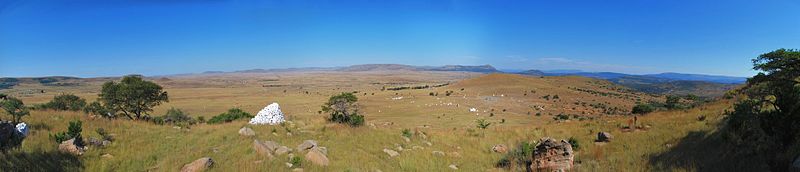
For at least a couple decades, now, enough individual scholars within the academies have created a social structure so that they can shift the direction of the scholarship (archaeologists are sometimes calling this “counter-modern” while other historians refer to it as multivocal). For example, instead of once again combing over what happened on June 25, 1876 at Greasy Grass, scholars have taken to looking at the conflict as a broader segment that needs to be contextualized in World History. James Gump has a work out there entitled, The Dust Rose Like Smoke: The Subjugation of the Zulu and Sioux (University of Nebraska Press, 1994), and it considers how the Anglosphere mythologized themselves after a confederation of Lakota, Cheyenne and Native America decimated the 7th at the Little Bighorn in 1876, and after the Zulu wiped out a British force of 1,500 at Isandhlwana on January 22, 1879. Check out the Zulu monument to the fallen Zulu at Isandhlwana with this link here.

Isandlwana landscape from the Wikipedia public domain page.

Isandlwana landscape from the Wikipedia public domain page.

These broadened world historical treatments help pave the way for other scholarship (for example: so we’re not incessantly sitting around wondering what Custer did wrong; but rather what the Lakota and Cheyenne forces did themselves to bring about George’s demise). The latest and greatest public historical treatment of Greasy Grass comes by way of Debra Buchholtz’s The Battle of the Greasy Grass/Little Bighorn: Custer’s Last Stand in Memory, History, and Popular Culture (Routledge, 2012). This work gets the reader to think secondarily about the actual events of June 25, 1876, and primarily about how the public has remembered the events since 1876. It was, after all, a centennial year (from 1776 to 1876), and the general Anglo-American reading public was nonplussed and aghast to think that Custer (or anyone Anglo-American for that matter) would be capable of losing a battle within the interior of the American nation, and this so close to the centennial anniversary of the nation’s declaration of independence.

Greasy Grass/Little Big Horn from the Google Earth imaging.

Greasy Grass/Little Big Horn from the Google Earth imaging.

So this is where a lot of the contemporary scholarship is at these days: not just looking at the historical event itself, but also looking at what the popular press and academically trained thought about the historical event in and of itself (for example, William Blair and David Blight, among others, have taken a hard look at Civil War memory and memorialization in this way too). And that’s what I’ve kind of been thinking about on this 137th anniversary of the day the Lakota and Cheyenne (and others) stuck it to George at Greasy Grass in eastern Montana.

In closing, I leave you with a paragraph quote from the 1986 work of James Belich, The Victorian Interpretation of Racial Conflict (McGill-Queen’s University Press, 1986 and 1989). This is so you don’t have to lug around numerous books while you’re taking in the various Lakota and Cheyenne holiday celebrations that commemorate the defeat of Custer at the Battle of Greasy Grass — Aaron Barth Consulting does this work for you.

Okay, to quote Belich, and to consider it in the context of Custer as a trained Victorian operative for Anglo-America:

“Racial ideas are not just images of others, but of one’s self and one’s own society. Superiority and inferiority, inevitable victory and inevitable defeat, higher faculties or the lack of them; each are two sides of the same coin. To question one is to question the other, and thereby cast doubt on an individual and collective self image. Victorians, like other people, were not eager to ask such questions.” (Belich, 1989: 327)