Tag Archives: Fargo

Daughters of Norway, Fargo Chapter

Yesterday, late afternoon, I texted Sean Burt to see if he wanted to meet up for some long-overdue conversation at Würst Bier Hall in downtown Fargo, North Dakota. After he confirmed, I bundled up and started my southward trek down the east side of North Broadway. Along the way I noticed a woman taking a picture of the historic First Lutheran church. I asked if she was getting a good picture, and we chatted just a bit, and she said she was up from California for a meeting. I noted that she was a committed meeting-goer, coming from California to a Fargo winter for a meeting. Here is how the conversation roughly played out:

Aaron: “California is a long way to come for a meeting.”

Californian: “Yeah, but it’s worth it: a bunch of us just met here at First Lutheran about re-igniting the Daughters of Norway chapter here in Fargo.”

Aaron: “Ah, good deal. My great grandparents were Swede, and there’s a lot of continuity worth sharing throughout Scandinavia. Are you ethnic Norwegian?”

Californian: “No, I’m Polish.”

Aaron: “Oh, I see. Is your husband Norwegian?”

Californian: “No, he’s Algerian.”

Aaron: “Oh, I see. That makes sense. Well here’s my card. Let me know if and how I can help you in the future.”

So I was satisfied with having met an ethnic Pole from California who just finished a meeting in Fargo about firing up the Daughters of Norway once again. Heritage groups are fun that way. It’s only a matter of getting involved.


Brief Thoughts On Sherman Alexie’s 2007 Novel

Earlier this morning I just finished Sherman Alexie’s novel, The Absolutely True Diary of a Part-Time Indian (Little, Brown & Company, 2007). It is excellent, and it pushed my mind in a variety of directions. This is what a novel is supposed to do, of course: an exploration of ideas through fictional narrative. The phrase “That’s a novel idea” smacks of this definition. Novels are real handy, too, since they operate under a kind of “fictional” rubric, giving the author lee-way to subjectively discuss real life issues and ideas. Because it’s fiction, though, it isn’t true — but it is. This is why the fiction section is arguably more truthful than the non-fiction section (which too is truthful, but with more distance).

So I thought about that while reading the work. I also thought about how this novel was originally passed along from Karis Thompson to Molly, my girlfriend, and then to me. The novel, on the local scene, is slowly crawling northward through downtown Fargo, North Dakota. It is leaving a trail of ideas in its wake. A bunch of us will have to get together to chat about what this novel means to all of us.

Alexie WhiteWhile reading this novel, I also-also thought about sustained broken treaties, the creation of the reservation system, about how the main character in this novel deals with historical trauma, and how the Dawes Act was and is seriously problematic. Then while reading this I thought about a segment of Richard White’s The Middle Ground: Indians, Empires, and Republics in the Great Lakes Region, 1650-1815 (Cambridge University Press, 1991). In the introduction, one of the parts I have underlined, with the words “This is good” scribbled in the margins, is this:

…the middle ground. The middle ground is the place in between: in between cultures, peoples, and in between empires and the nonstate world of villages. It is a place where many of the North American subjects and allies of empires lived… On the middle ground diverse peoples adjust their differences through what amounts to a process of creative, and often expedient, misunderstandings. People try to persuade others who are different from themselves by appealing to what they perceive to be the values and practices of those others… (White, 1991: xxvi)

This brings up the point that there is no such thing as purity in culture. The question or thought is a fallacy from the beginning. And this also means that since there is no such thing as cultural purity, then there is no such thing as cultural death, or a culture that is dead. Alexie demonstrates this through his novel, about a Spokane reservation kid perceiving of himself as living in two worlds: the Native reservation world, and the non-Native reservation world.

It also gives rise to the idea about how much emphasis we humans put on geopolitical boundaries. When we cross the boundary, say, between northeast Italy and southern Austria, we’ll note that people don’t suddenly stop speaking Italian after we cross south-to-north into Austria. What we do note is that while the line is distinct on a map, it isn’t so clear on the ground and in reality.

So those are my short thoughts on Alexie’s novel today. And I wanted to share that and get it down on this here blog. Back to technical writing and revising.


When CNN Airs Your YouTube Train Explosion Video

One week ago I drove from Fargo to Casselton, North Dakota, to take in first hand what happened with the train explosion. Details of that outing are linked to here. The next morning I checked my e-mail in-box, and CNN’s Justin Lear had a message waiting for me. He wondered if it was okay for CNN to use my YouTube video. My thought was, “Yeah. Sure.” So I e-mailed him back, we corresponded briefly, and eventually CNN put my video on their page. Click here to see what it looked like.

When you blog exploding or burning trains, this is what happens to your blog's site visitation.

When you blog exploding or burning trains, this is what happens to your blog’s site visitation.

The footage also got me thinking a bit about how Lear might have come across the video in the first place, this through the computational algorithms built by the internet folks (at Microsoft, Google, and so on). If you happen to be within photographic range of exploding trains, or the burning aftermath of exploding trains, and you upload this footage to YouTube, there’s a good chance Justin Lear will get a hold of you.

I think, perhaps, the most enjoyable footage had to do with the on-the-spot local narration from North Dakotans who caught footage of the actual explosion. If you click on this link and go to 0:24 seconds, you’ll hear through-and-through NoDaker commentary: “There it goes,” and this followed by “There it goes.” Phonetically, it sounds like this: “Der it goeas.” And while this makes us smile, this is the reflection of a North Dakota dialect (played up pretty heavily in the movie Fargo — thank you Coen brothers). The sound of it is completely disarming, and you can hear our Scandinavian and German-Russian great grand-parents within it.


Vegas to Fargo

Molly and I returned to Fargo from spending a Christmas in fabulous Las Vegas, Nevada, and we are settling back into our regular duties on the northern Great Plains. Since temperature comparisons are eternal sources of fun and conversation, it seems worth while to note that right now, as I type, the temps in Fargo are 29°F, while in Vegas it is 39°F. Of course, the Vegas high is expected to top out at 65°F today, while the Fargo high at 37°F. Of the latter, this means snow will melt so it can freeze solid when the temps return to sub-zero starting this Sunday (the Fargo high for Sunday is -7°F, dipping further to -13°F on Wednesday and Thursday — yes, the high, not the low).

So yes, the weather is always fun to talk about. I don’t mind the cold, or the bitter cold, but I know it can be a huge morale crusher for many of my family, friends and comrades on the northern Great Plains. One solution I have used, at least for myself, is psychological, and that is to simply own it (versus complaining about something, which doesn’t make it go away). The other is to keep moving. Another is to use it as time to enjoy hot coffee, grilled cheese, and tomato soup even more (it tastes better when it’s frigid outside). As a kid, when it was this cold I remember my mother trying to keep us inside. All we wanted to do was bundle up and go outside for hours on end to sled, build snow forts, have snow ball fights, and so on. So that’s a mild tangent on this Friday morning.

And since I’m on weather conversation, below is a video short from time recently spent presenting at a scholarly conference in New Zealand. This is of the Milford Sound fjord, west coast of the south island, New Zealand. In late November, of course, Kiwis are transitioning from their spring to summer. So it’s a perfect time to take a short boat ride out from the fjords to the Tasman Sea and back. That’s what we did. The boat captain gave us all a close up of the humbling waterfall, too. Here it is, from my perspective.


Autumn to Winter in Fargo

This is a quick post, something that has been on my mind during my walks to and from campus at North Dakota State University. I have been walking past a historic apartment building about the corner of College Street and 11th Avenue North for years now. The sturdy brick construction caught my eye a couple years ago. I also appreciate its aesthetics. As autumn began to give way to winter this year, I thought I’d snap a couple photos at seasonal intervals to post later — which is now — on this here blog. The first was taken at some point in August-September, 2013. The second was taken after the first big snowfall. Here are the two photos of my own, followed by the GoogleEarth photo.

Autumn

Winter

GoogleEarth


Dakota Goodhouse’s Winter Counts

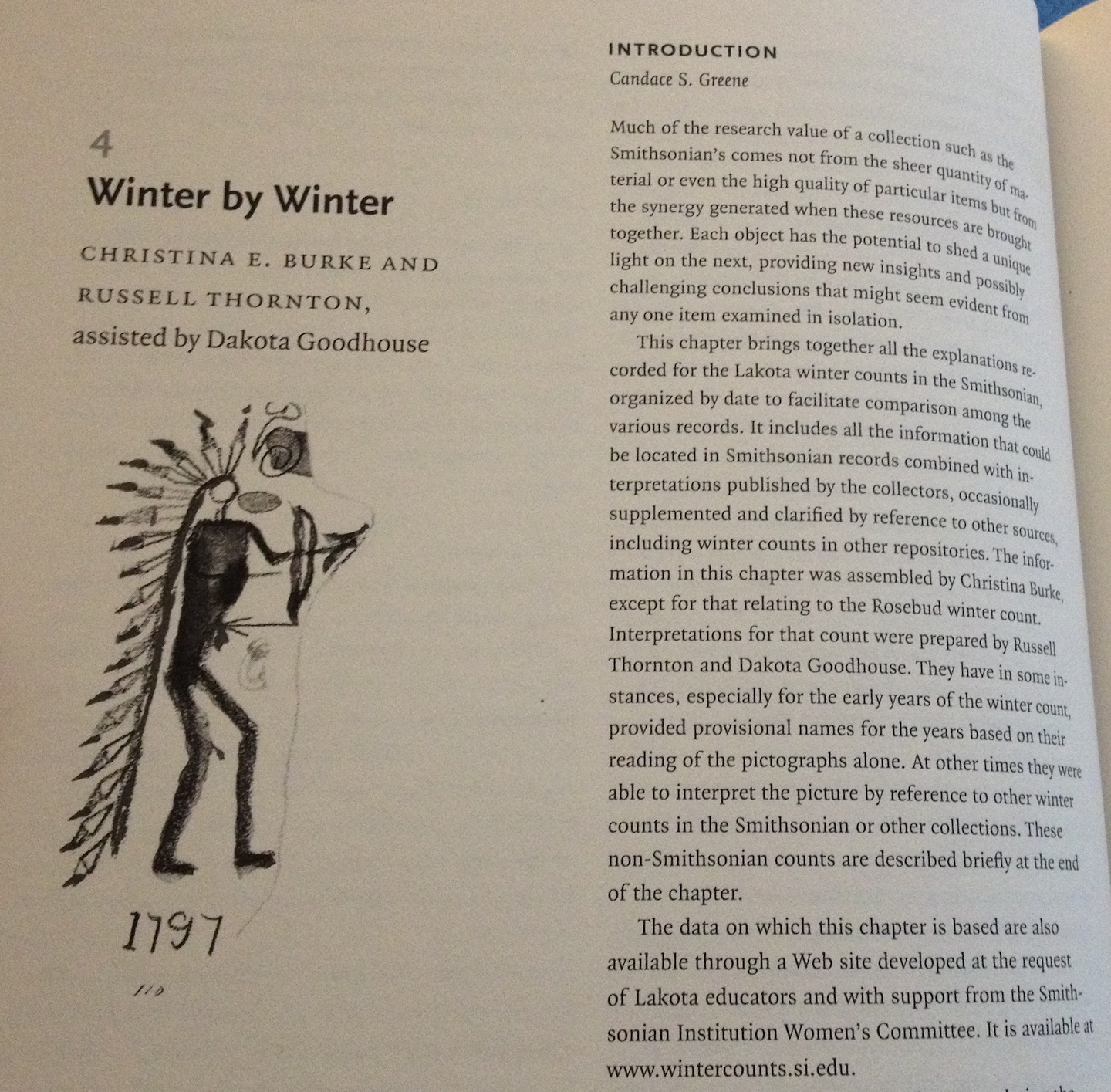
Chapter 4 of "The Year the Stars Fell: Lakota Winter Counts at the Smithsonian" (2007).

Chapter 4 of “The Year the Stars Fell: Lakota Winter Counts at the Smithsonian” (2007).

In the last couple days, Dakota Goodhouse (his blog, which you’ll want to visit, linked here) and I have been hanging out in downtown Fargo, as he’s in town to expand on the Native tradition of winter counts. He crashed at my place for a couple nights, and last night we had dinner over here after his short talk at the Spirit Room (this was organized and funded through a collaboration between the Fargo-West Fargo Public Schools Indian Education program and the North Dakota Humanities Council). Dakota and I chatted more about winter counts, and about future prospects of scholarly interest and inquiry.

I’m thinking that winter counts, and the history of them, have become popular enough that I don’t really need to explain them. But just in case, a winter count is an annual pictograph painted onto the larger medium of buffalo or elk hides. In the latter part of the 19th century, they were painted onto canvas. These counts provided the owner or memory group with a traceable past, the pictograph often representative of a successful high-point of that year.

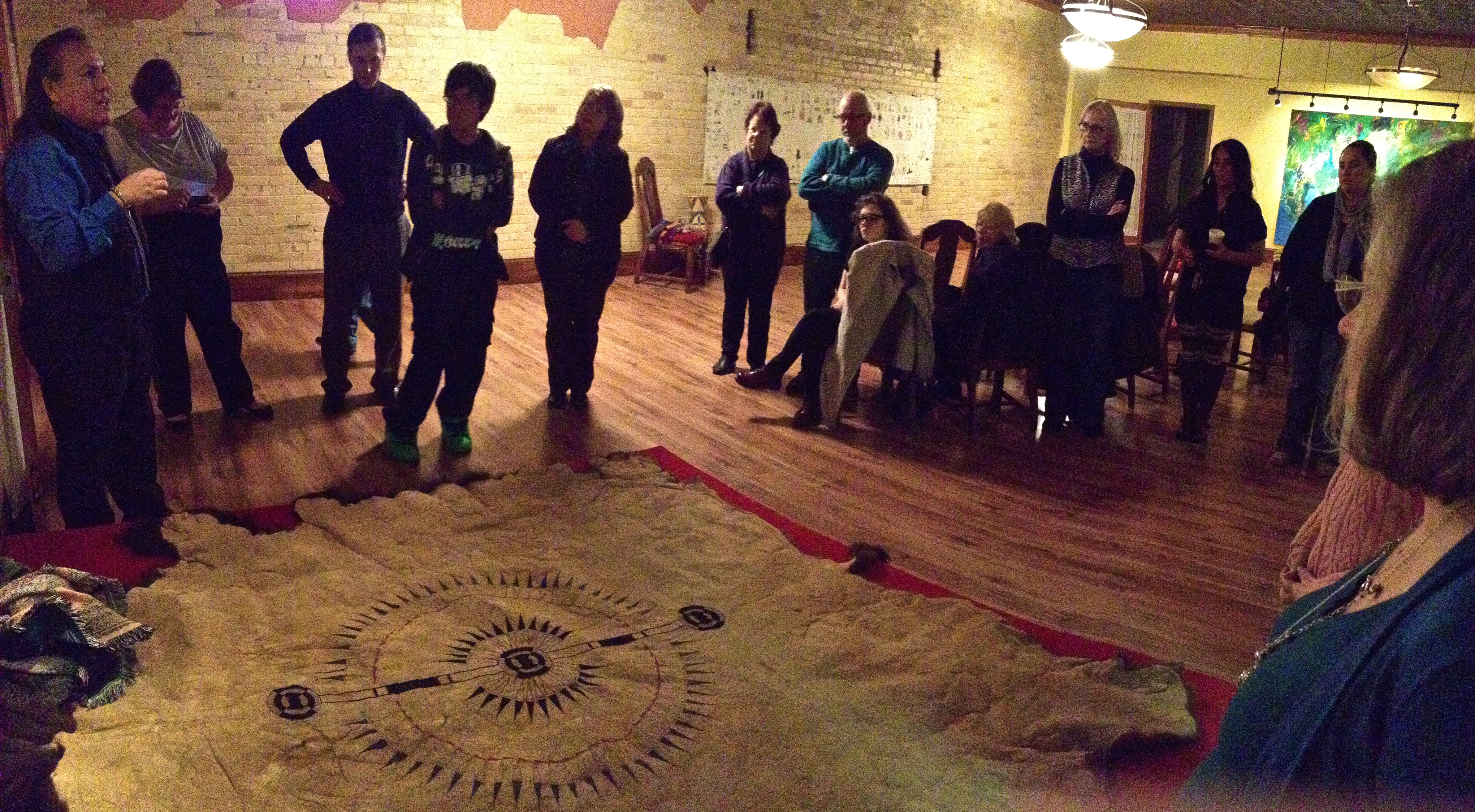
Dakota Goodhouse explains the stories reflected by and attached to the pictographs on the bison hide.

Dakota explains the stories reflected by and attached to the pictographs on the bison hide.

While Dakota explained the winter counts to the group at the Spirit Room last night, he pointed to one of his buffalo hides while expanding on how he saw something different in that particular account. This particular account is a symmetrical series of triangles running around the circumference of a circle. Some years ago, Dakota said he used to think of this as a war bonnet laid out on the floor. Today, though, he said it also looks like the plains indigene narrative attached to what we call “sun dogs.” One of the stories that he knows is that the sun dogs are thought more of as camp fires next to the sun.

These various stories got me thinking at least two related things that are slightly polemical. The first is something we deal with every now and then, and that’s one-dimensional thinkers who sometimes say, “Well, cultures with oral traditions don’t have a history, or if they do it’s impossible to trace.” This is always a fun question to respond to, but last night I was thinking more-so of how a person who reads a novel, or a good piece of history, are likely to walk away with a different perception about the same piece of scholarship within the span of two or more readings.

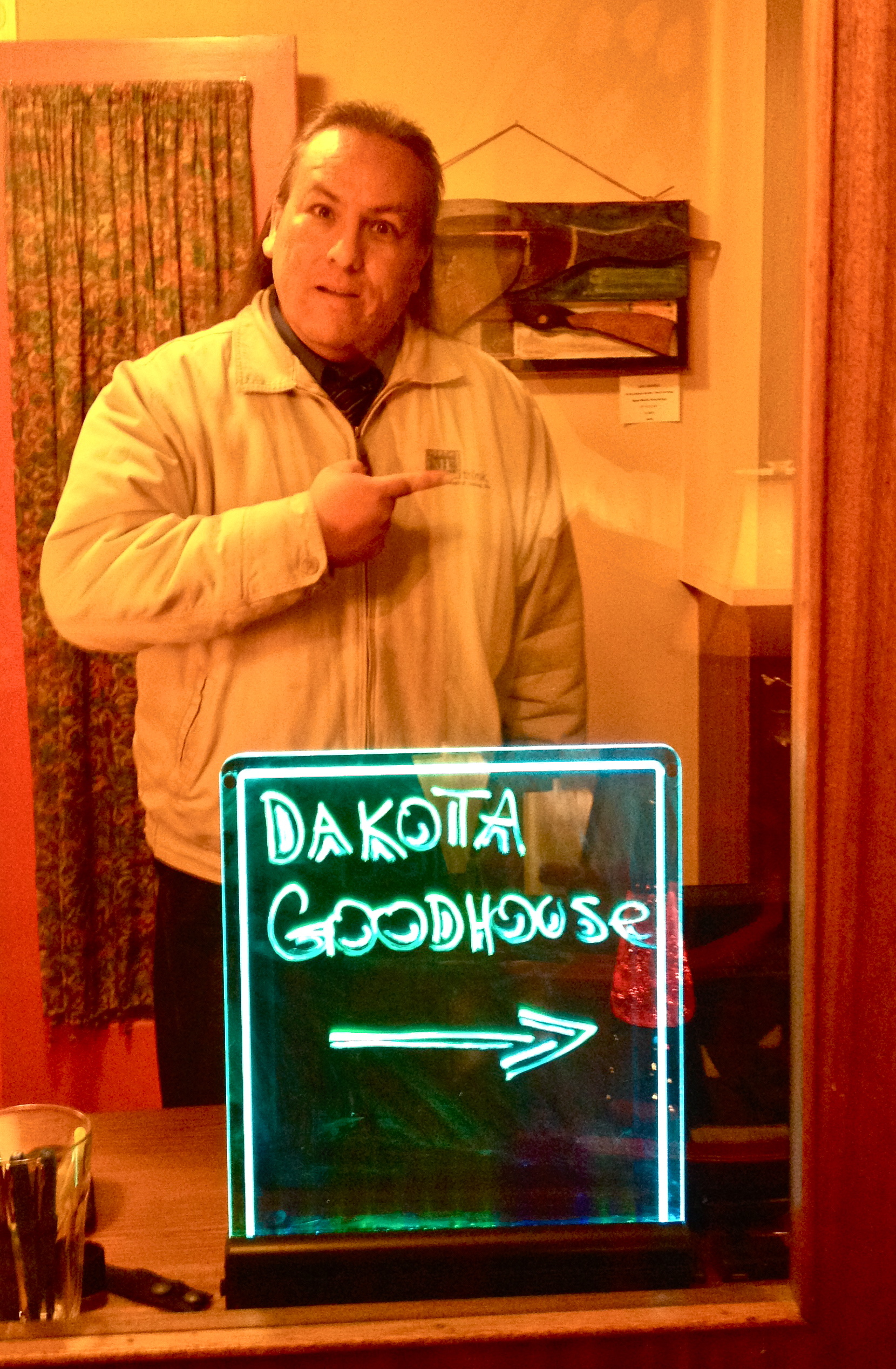
A picture of Dakota being hilarious.

A picture of Dakota being hilarious.

This is similar to the winter count. Dakota explained the difference in how one individual, when looking at the bison robe laid out, might see a native headdress while another might see sun dogs, parhelia, or what the Dakota call wi’aceti, this roughly translated and defined as “when the sun makes fires.” Dakota added that the winters on the northern Great Plains are so cold that the sun requires camp fires to keep it warm.

From here on out I decided to abandon the sun dog phrase and replace it with wi’aceti (pronounced, roughly, “we-ah-che-tee”). If anyone wants to join me on the northern Great Plains in this effort, by all means. If we hear someone say “sun dog,” please feel free to add wi’aceti to that, and with explanation.

Also, Dakota contributed heavily to a piece of winter count scholarship that yo might be interested, chapter 4 of Candace Greene and Russell Thornton, The Year the Stars Fell: Lakota Winter Counts at the Smithsonian (Lincoln: U of Nebraska Press, 2007).


Punk Archaeology Updates

Before getting after some technical writing this morning (only to be later usurped by some Dakota language studies), I thought I’d link to some forthcoming scholarly analyses on the cultural movement of Punk in all of its unadulterated filth and fury. You can read about the soon-to-be-realeased Punk Archaeology anthology here, and about a work of Punk Sociology here. It was great this morning to come across a local story of a proto-punk Jonathan Richman, who is getting ready to play the Aquarium in downtown Fargo, North Dakota this next week too.

On this single-chord punk note, it’s appropriate to mention the passing of one of the first proto-punks, as memorials and obituaries on Lou Reed have been popping up all over the place (here, here, here and here). This shouldn’t eclipse the passing of folk punk hero Phil Chevron (aka, Philip Ryan of The Pogues or The Popes, depending on the year) in early October 2013. A sad reality for sure, and a time for reflection and contemplation.

An October 19, 2013 photo of Modern Times Cafe.

An October 19, 2013 photo of Modern Times Cafe.

And although we are losing our original punk heroes, punk culture continues pushing in a variety of directions today. Here is a photo from some boots-on-the-ground punk (lower case “p”), this coming from the delicious Modern Times cafe in Minneapolis, Minnesota. A couple weeks ago Molly and I had a chance to make a quick jaunt down the I-94 block from Fargo to MSP to visit a couple friends, and the next morning we hit up this cafe. It’s at the intersection of Chicago Avenue and E. 32nd St. in Minneapolis, and everyone should go here. It’s a place where punks either are parents or a place where punks bring their parents to engage in politely brash conversation and society. A couple more photos below, one of the delicious breakfast meal, and below that a photo of a post card from the fine by-and-for establishment. The only thought left was this: “When will Modern Times open up in downtown Fargo and Grand Forks?”

Delicious, sensibly priced breakfast from Modern Times Cafe.

Delicious, sensibly priced breakfast from Modern Times Cafe.

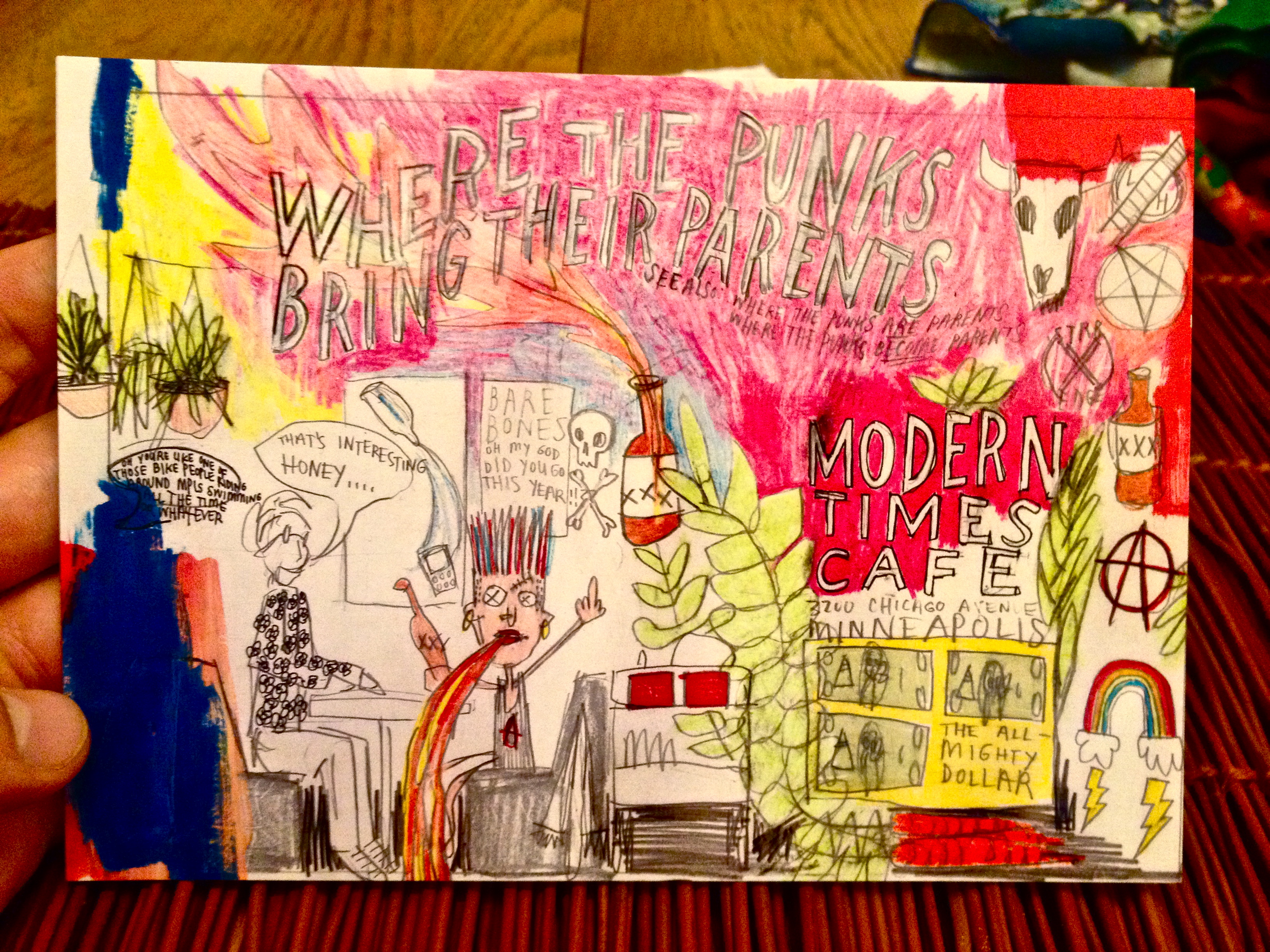
A Modern Times Cafe postcard indicating that this is a place where punks bring their parents.

A Modern Times Cafe postcard indicating that this is a place where punks bring their parents.

At the right, the viewer is informed with the icons that Modern Times is anti-establishment. This includes an anarchist logo, a rainbow with lightning bolts, a pentagram (suggestive of neo-pagan revivalism or acceptance), a phrase that mocks “The All-Mighty Dollar” (strongly suggestive of a counter-capitalist culture), and so on. At the top is a descriptive banner that says, “Where the punks bring their parents; see also: where the punks are parents, where the punks become parents.” Seated in the lower left are two individuals, presumably a mother and her son. Impressionistically, the son is advertising to one and all that he doesn’t care (this indicative of his hoisted left-handed single digit and a “xxx” booze bottle in his right). His mother, like all loving mothers, is just happy to see that her son is engaged in activities of all sorts. She is responding to her son, saying, “That’s interesting honey…”


A Great Plains Airport

On the morning of August 31, 2013, Molly and I took an early morning flight from Fargo to Buffalo, New York, with a connecting flight in Chicago. That morning in Fargo’s Hector airport, while we waited to board our flight, I typed out a description of my surroundings. The trinity takeaway from Buffalo: it is the birthplace of Richard Hofstadter and the Buffalo chicken wing, and it is also the city where Teddy Roosevelt was inaugurated after McKinley died from an assassin’s bullet.

Okay, enough of that. Here is the late-August 2013 Fargo airport description in unadulterated form:

It’s 5:12AM at the Fargo Airport, Gate 5, and Molly and I are waiting for the United Chicago flight to board around 5:30. I thought I’d give some descriptions of my surroundings, as this airport has a different social atmosphere than the Chicago hub we’re flying into.

The view: there are about 15 of us so far, waiting to board. A slow trickle of passengers continues advancing toward their respective gates in the terminal. A lot of us are wearing sandals or easily removable shoes. This is for utility, as they are easier to slide off and on when entering and exiting the security checkpoints.

The terminal itself has strip-mall aesthetics (in fact, it is unusual today to be in new construction that is non-strip mall-like). The color scheme is grey, blue, peach, and terracotta. Molly thinks elementary schools used to have this color scheme in the late-80s, at least around these parts, and at least if they were new back then. “New” is an elusive word, like “modern.” The floor and ceiling are carpet, and the walls smooth either with paint or wallpaper. Lighting here is recessed halogen fluorescent, or whatever they are called.

It is dark in the early morning outside too. It is pitch black out there, the “United Express” logo on the plane illuminated by exterior lighting. Within the windows, we can only see the reflection of our Gate. There are three plants at Gate 5 too. They look real. The U.S. Fish & Wildlife Service has static signage near this gate, too, an information booth on local species.

The sounds: a steady gentle hum persists from the black rectangular vending machine. It rattles occasionally, as the refrigeration compressor keeps the beverages cool. A couple of the families have young children, and they are a bit chatty. Other conversation, at least amongst the adults, is muffled. There is a silent kind of still, folks a bit groggy from getting up at 3:30 or 4:00AM, and others wanting to respect the quiet associated with this morning hour. A hum outside, toward the plane, is also audible. The conversations increase as we draw nearer to the boarding time, and as more and more folks arrive.

The sensation: some folks feel like they want to sleep, but can’t. But they so would like to. Everyone knows that in 10 or 17 or 23 minutes or so, we will be asked to board the plane. For myself, there is slight warmth in my forehead, a kind that a person sometimes feels when without enough sleep.

The smells: it smells similar to a hospital waiting room with occasional whiffs of coffee.


Great Plains East vs. West

In the last couple weeks, or in the last week, I’ve noticed how the national and international news have ran stories on Sioux Falls, South Dakota and Fargo, North Dakota. Sioux Falls and Fargo fall along the north-south Interstate 29 corridor in far eastern Dakotas, and they originally served as railroad gateways to the northern portion of the Great Plains and American West. They share some similarities because of this. As well, they got one of the earliest urban foot-holds, and they also attracted colleges (back when the distinction between college and university was still quite distinct — a college could be a part of a larger university).

In the first pieces — here, and here — on the “Fringe City” of Sioux Falls, The Atlantic Monthly’s James Fallows compared and contrasted this South Dakota city with Burlington, Vermont. The problem with this, of course, is realized when one looks at the history of both cities. Burlington, Vermont is a place with a dense population, and dense populations surrounding it. Sioux Falls and Fargo, in contrast, are places with comparatively dense populations, and they serve a rural surround that is much more sparsely populated. If you’re from Bismarck, ND (like I am), you will have in your collective memory stories about certain economically privileged friends in grade school and junior high and high school regularly getting to go to Fargo for the weekend so their parents could purchase them designer clothes. These friends could then return and inform the rest of us what was hip and cool. This, I have found, is one of the personal historical memories that I use to argue why I would be totally cool with a return to the school uniform (something Angus Young appropriated and continues to own on stage quite well). But that is another topic for another blog.

The main point is that it reflects the reliance and tension, at least from the 80s and 90s, that Fargo and Sioux Falls and the rural surrounding areas generated: individuals living in these cities both loved them, and they loved to have contempt toward them as well. This, in turn, is a larger theme of the Great Plains, as you’ll hear similar stories from what central and western Nebraskans and Kansans have to say about their eastern cities.

In the second piece, Fallows opines on the architectural history of Sioux Falls, and this reflects the larger theme of architectural history in the American West. Go to any town in the Dakotas, and a large chunk of the monumental architecture dates from before and just after the turn of the 19th century. This is often the period when the wood structures either succumbed to city-wide fires, or were torn down to make way for superstructures with sturdy granite and brick foundations (Fallows mentions the Richardsonian Romanesque architecture of Sioux Falls, and a comparable building in Fargo would be North Dakota State University’s Putnam Hall). This is also a period of history that had some of the greatest economic and un-ashamed monopolistic magnates, individuals with operations based out of the Twin Cities (for example, one of the prime reasons North Dakota has a state bank and a state elevator has to do with big Twin Cities bankers knowingly or unknowingly fleecing North Dakota farmers — eventually, North Dakota farmers said we’ll just create our own bank and mill if we can’t get decent rates and grain prices from Minneapolis and St. Paul).
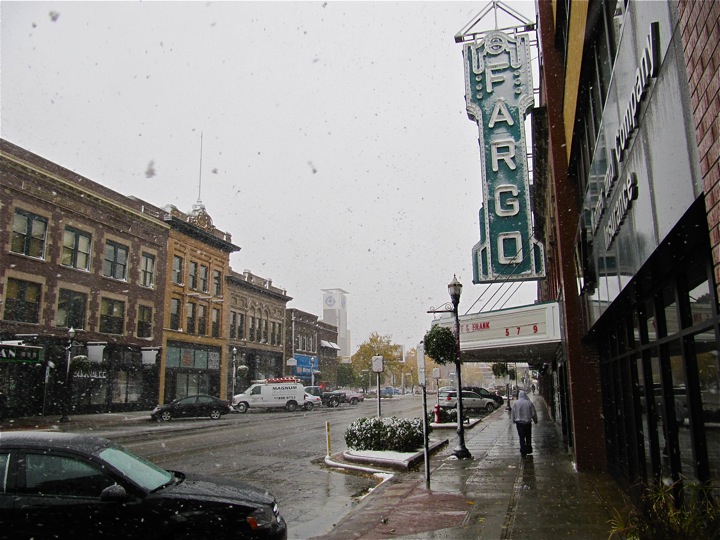
The iconic Fargo theater signage in downtown Fargo, North Dakota. ESPN's College Game Day is looking to use this as a backdrop for their coverage of Saturday's game.

The iconic Fargo theater signage in downtown Fargo, North Dakota. ESPN’s College Game Day is looking to use this as a backdrop for their coverage of Saturday’s game. Photo by Aaron Barth, from October 2012.

In the realm of Fargo, Slate.com ran a short piece on a proposed skyscraper to be built in downtown, Fargo (about 6 blocks from where I live). Skyscrapers (and grain elevators for that matter) on the prairie, I argue, look all the more cool because they are set against the horizontal backdrop of the Great Plains. Fargo, and North Dakota, are indeed booming, and not just because of petroleum. This Saturday, ESPN’s College Game Day is coming to downtown Fargo, to broadcast the football game between North Dakota State University and Delaware State University. While NDSU and the University of North Dakota (Grand Forks) no longer play one another in the historic regional football rivalry, I think both universities are getting more mileage for the state by playing non-North Dakota audiences. Even if a North Dakotan has absolutely no affiliation with NDSU or UND (which, considering the state is about 700,000, would be almost impossible), all of non-North Dakota watching this ESPN game may at some point attach said game to future encounters with North Dakotans. It’ll be up to us to figure out how we want to respond to that. I’m all for it.


Punk Practice Last Night

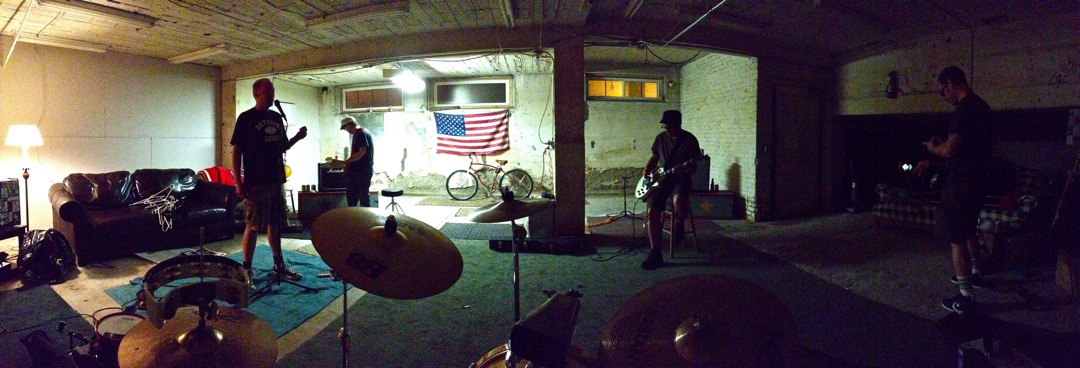
I’m about ready to dash out the door, pick up Molly from work and grab lunch at Lucy’s with two long-time friends, Tiffany Johnson and Justin Vinje. But I wanted to upload a photo from last night, my second practice with Fargo-based punk band, Les Dirty Frenchmen. Last January-February, two of the Frenchmen, Todd and Troy, collaborated with the Punk Archaeology un-conference at Sidestreet Grille and Pub. A couple months after that, they said their drummer was moving to a non-Fargo location (I think the Twin Cities), and they asked me to consider taking up the drums for LDF. I said sure, I’d be glad to.

LDF


I keep fiddling with the panoramic feature on my iPhone 4s, and so here is what it looked like from the drummer’s perspective last night in the LDF top secret practice space. I think we might start working on some new songs, too. One of those is titled, “Budget Fracking,” a kind of absurdist nod to the Bakken of western ND. Long live local punk.