Some Anthropology of Concrete

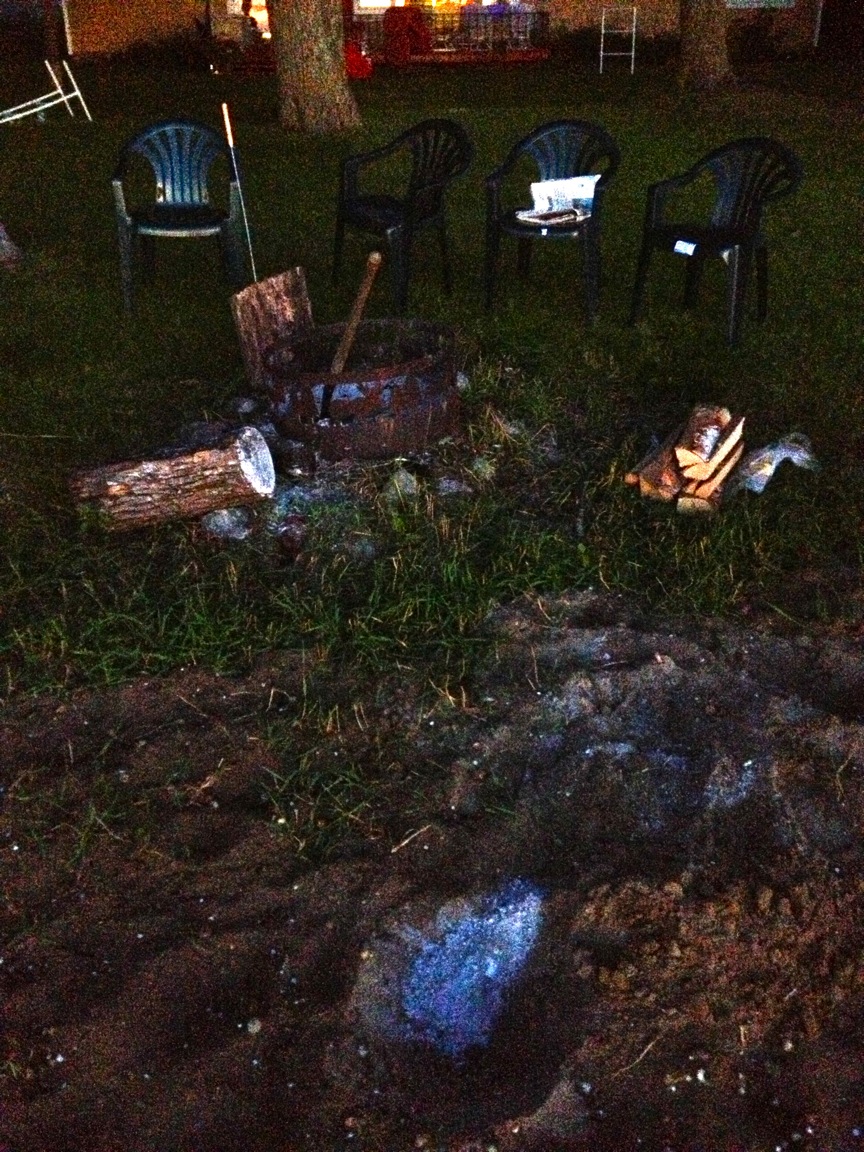
A photo of the dry ash I dumped in the shallow sand pit on the shores of Detroit Lakes, Minnesota. It got me thinking about the potential origins of concrete.

A photo of the dry ash (bottom-center) I dumped in a shallow sand pit on the shores of Detroit Lakes, Minnesota. It got me thinking about the potential origins of concrete.

A couple days ago I prepped a fire pit on the sandy shores of Detroit Lakes, Minnesota. As I shoveled dry ash made from previous fires out of the pit and into a shallow hole in the sand, I imagined myself in pre-Vitruvius days on a Mediterranean coast doing the same thing, or something similar. “Perhaps this is one of the origins of the recipe for concrete?” I thought. I envisioned someone thousands of years ago dumping ash into the sand in a similar way (with lime as well). Maybe it was volcanic ash, or that from a former campfire.

The Romans used this concrete stuff for infinite reasons — from building underwater docks to linear roads to fortifications and infrastructure in general. The architect Vitruvius was the first to scribble down the recipe for concrete. But certainly this knowledge circulated amongst laborers and masons before hand.

One of the concrete secrets is in the texture and quality of the sand. Here is what Vitruvius said in Book 2, Chapter 4: Sand for Concrete Masonry:

In concrete structures one must first inquire into the sand, so that it will be suitable for mixing the mortar and not have any earth mixed in with it. These are the types of excavated sand: black, white, light red, and dark red. Of these the type that crackles when a few grains are rubbed together in the hand will be the best, for earthy sand will not be rough enough. Likewise, if it is thrown onto a white cloth and then shaken off, if it neither dirties the cloth nor leaves behind a residue of earth, it will be suitable.

Thus, keep the soil out of your sand when mixing concrete, this whether you are mixing for a foundation of a tool shed or trying to impose your imperial will on others around you.


The Ethics of Plains Indigenes

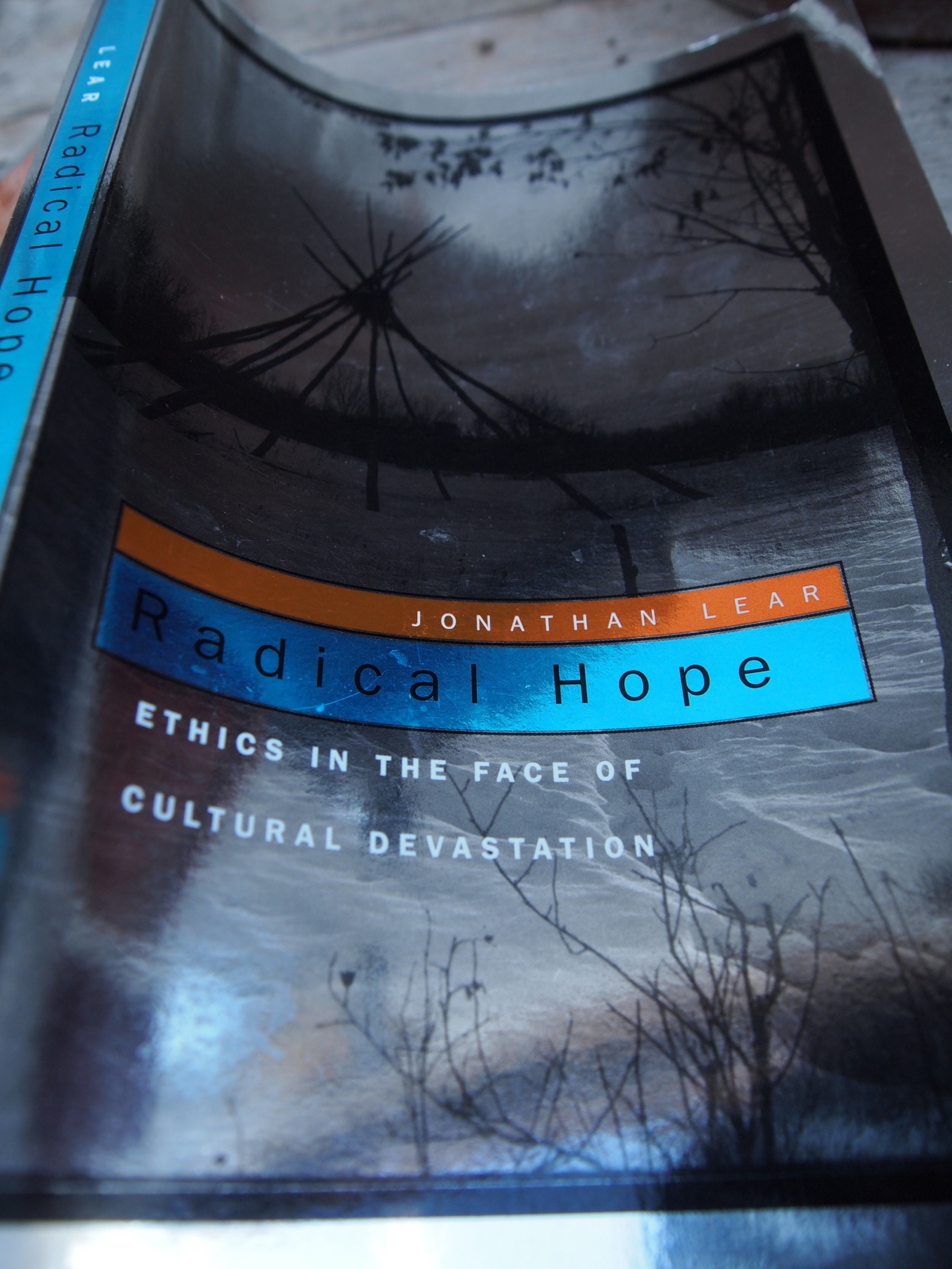
Radical HopeHere on the northern Great Plains, we are increasingly considering what the Dakota Wars from 150 years ago meant then and what it means today. A piece of scholarship I stumbled across while visiting the bookstore of Pompey’s Pillar in eastern Montana (where, famously, an Anglo-American incised his graffiti on some tall rock) is Jonathan Lear, Radical Hope: Ethics in the Face of Cultural Devastation (Harvard University Press, 2006). Lear uses the historical documents from Plenty Coups, a Crow leader who helped his people navigate the turn of the 19th century. What makes Lear’s monograph interesting is how he uses his training in philosophy and ethics to approach a previously unexplored topic of the Crow.

Throughout this book, the Dakota/Lakota/Nakota are mentioned, and how they and the Crow were ferocious enemies in the 19th century. Lear looks at this philosophically, though, and says,

One of the ironies that comes to light is that groups of people can be bitterest of enemies in real life, yet ontologically they are on the same side; and a real-life ally can turn out to be one’s ontological nemesis. The Crow and Sioux were bitterest of enemies… Still, their standoff sustained a world in which battles, planting coup-sticks, and counting coups all made sense. One has only to read Chief Sitting Bull’s pictorial autobiography to see that he was every bit as much concerned with counting coups as Plenty Coups was. And yet, with the United States as an ally — a questionable and unfaithful one to be sure, but still an ally in many ways — the Crow moved into a position in which their world fell apart. (Lear, 2006: 50-51)

The rearrangement of this way of life came to an end due to the advanced encroachment of Euro-Americans who, among other things, obliterated the bison food source of the Plains indigenes. Lear doesn’t just stop with the known history of how the bison were wiped out, though. Instead, he expands and explains how the bison food source was a serious component of the Crow’s cultural and ethical telos. Bison had been incorporated into nearly every element of the Crow way of life, and Lear gives excellent examples by unpacking phrases that Crow used for dinner. For example, Lear notes that there was no such thing as simply cooking a meal. Instead, the cooking of a meal had a greater social-psychology behind it. The phrase cooking and eating dinner was inextricably bound to “the cooking-of-a-meal-so-that-those-who-ate-it-would-be-healthy-to-hunt-and-fight.” (Lear, 2006: 40) See how the telos — the psychological extension of an immediate act providing a base for the future — is connected to the food, and that the food comes largely from the bison? Yes, of course. And so when Euro-Americans — whether Sully at Whitestone Hill, or Euro-American riflemen — obliterated the bison, it struck not only at that food source, but at the very culture of Plains indigenes. In short, read this book.


Visiting the Bear River Massacre Site

A photo from a July 15, 2013 visit to the Bear River Massacre site.

A photo from a July 15, 2013 visit to the Bear River Massacre site in southeastern Idaho.

A couple days ago Molly and I made a site visit to the Bear River Massacre in southeastern Idaho. The massacre happened in late-January 1863 when a U.S. Army group of California Volunteers led by Col. P.E. Connor attacked a domestic, non-combatant encampment of Shoshone. It is interesting to contextualize this site with others throughout the United States.

Nine months later, General Alfred Sully described his actions at Whitestone Hill against families of Lakota, Dakota and Nakota as a “murderous slaughter” of a “promiscuous nature.” This action happened on the northern Great Plains (in presentday North Dakota) only 9 months after the Bear River Massacre. Massacre was, sadly and to put it mildly, a part of the Total War battle rubric (check out John Fabian Witt’s latest work on Lincoln’s rules for war). It is called genocide and ethnocide today.

Today, 150 years later, the Bear River Massacre site remains active with memorials of all kinds. If you are driving from Salmon, Idaho to Salt Lake City, Utah, take exit 36 off of I-15 onto Highway 91. You’ll need to follow the exits, because there isn’t any signage that will guide you to this painful chapter in American history. At the site is a stone obelisk, and for the last 150 years different groups have brought different interpretations to the site.

Some items of remembrance at the Bear River Massacre site. Photo from July 15, 2013.

Some items of remembrance at the Bear River Massacre site. Photo from July 15, 2013.

The Bear River Massacre site was designated a National Historic Landmark in 1990. Today a beautiful memorial tree has taken on the task of an anchor for remembrance and mourning. A variety of individuals have placed items in the tree. A cursory sample of items observed on the July 15, 2013 day of my visit to the site included numerous dream catchers; tobacco pouches; a pair of glasses; a penny; beads on leather necklaces (one read “HOPE”); a wood flute; synthetic flowers; a tin pale filled with beads and chewing tobacco; pieces of rawhide with art on them; and suspenders. The tree is active and alive, as are the memories.

In addition to this, if you want to read up on contemporary scholarship specific to the Bear River Massacre, check out Kass Fleisher, The Bear River Massacre and the Making of History (Albany: State University of New York Press, 2004) and John Barnes, “The Struggle to Control the Past: Commemoration, Memory, and the Bear River Massacre of 1863” in The Public Historian, Vol. 30, No. 1 (February 2008).

Photo from July 15, 2013.

Photo from July 15, 2013.


World War I Memorials: Missoula, Montana and Wahpeton, North Dakota

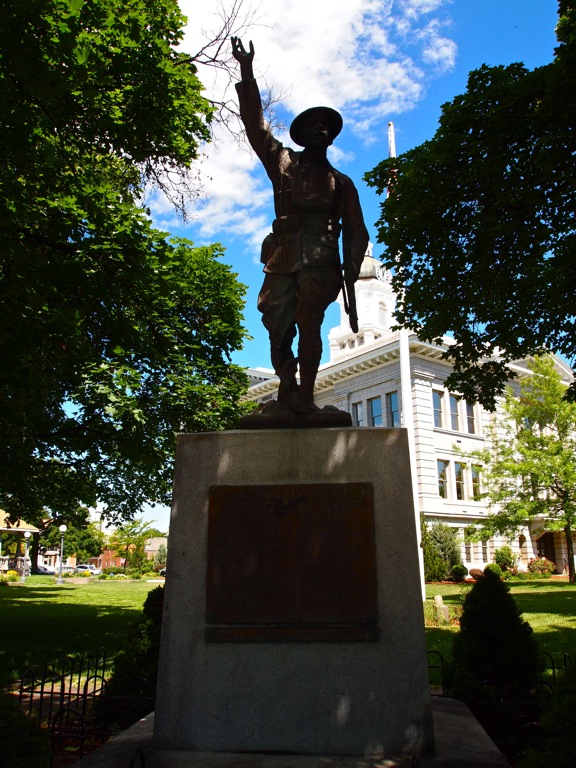
The other day I took some photos of the World War I memorial situated outside of the Missoula County Courthouse in Missoula, Montana. Once I saw the statue, I started snapping photos like crazy because I thought one or two of them would figure into a comparative presentation some day on the public remembrance of World War I in American History. I have also snapped photos of the WWI statue outside the Richland County Courthouse in Wahpeton, North Dakota. This got me re-visiting one of the infinite ideas of history.

If one wanted to, one could organize the historical record in two ways: the events that actually happened, and the long historical and never-ending process of how and why those events are remembered. I haven’t much to say beyond that point, so I’ll just upload some photos of the two related WWI statues from Missoula, Montana and Wahpeton, North Dakota.

The WWI statue outside of the Missoula County Courthouse. Photo from 07/13/2013.

The WWI statue outside of the Missoula County Courthouse. Photo from 07/13/2013.

The WWI monument outside of the Richland County Courthouse in Wahpeton, North Dakota. Photo from November 2012.

The WWI monument outside of the Richland County Courthouse in Wahpeton, North Dakota. Photo from November 2012.


Some Rough Notes on War

I’ve been coming into the topic and conversation of war in the last week. Twice at least. On Sunday I chatted with a Kurdish friend and got some thoughts on his perspective of the Second Gulf War. Being Kurdish, it was understandable to hear him say that yes, he is glad the United States went at the Ba’ath regime, Saddam Hussein and his two sons (I reminded myself out loud that Saddam was, to put it mildly, a super-jerk and no friend of the Kurds). As John Stuart Mill reminds us, though (and this is paraphrased), when the bullets start flying in a war, all chaos breaks loose and there is barely a modicum of reason, restraint and control. Innocent people die. And it is terrible and it needs to be acknowledged. I have found that it is best to chat with individuals about their individual experiences in war when it comes down to it: ears open and mouth closed. Wars are complex and terrible things. This last Sunday, my Kurdish friend had some remarks on it all but he had to take off. He said we’ll sit down and have a dinner and a conversation about it all some time. I agreed.

Waltz with Bashir (2008)

Waltz with Bashir (2008)

The second encounter was yesterday evening when I had a chance to watch Ari Folman’s 2008 film, Waltz with Bashir, this a work of remembrance of the First Lebanon War (1982). The film eventually takes the viewer to the horrors of the Sabra and Shatila massacre. If you haven’t seen this movie already, you should. Note: it is an adult topic — war, and the horrors intrinsic to it and remembrance thereof.

Within the film, a female psychiatrist (at least I think she was a psychiatrist) was having a conversation with a friend or patient, and she was remarking on how a soldier dealt with war by treating it, in his mind, as one would treat a vacation. She referred to this as the soldier’s “camera,” and psychologically the soldier was able to deal with processing the immediate carnage this way (think Christopher Browning’s 1998 monograph, Ordinary Men: Reserve Police Battalion and the Final Solution in Poland).

When the soldier came across a Hippodrome of slaughtered and mangled Arabian horses (ravages from the war), the soldier’s psychological camera, she said, broke. This mental shift caused the soldier to look at everything as it was, the change in perspective pulling him into the reality of what was going on. I thought about this and Ari’s use of cartoon to tell this story of remembering The First Lebanon War: impressionistically, a viewer of the film understands this is a serious topic of war. But Ari’s use of cartoon gives the viewer distance. And then toward the end of the film, gravity returns as Ari uses actual footage from the Sabra and Shatila massacre, this carried out by Lebanese Christian Phalangist militia in Beirut. Once again, see this film. It is important.


Modern Archaeology of Grilling

The sun is just starting to set and I’m sitting in the back yard of a residence in Valley City, North Dakota, and thinking that it is worthwhile to both upload a pic of and put some thoughts down on the material culture in front of me. I was thinking this because archaeologists often come across assemblages that have either no voice, or they consciously or unconsciously ascribe a voice to the assemblage through the construction of typologies and interpretations. Archaeologists will find themselves thinking, “I seriously would like to have a conversation with the individual who created this Mandan-Hidatsa pot sherd,” or “If I could only chat with the person who made this Scythian arrowhead…” To counter that, at least in the here and now, I’m going to quickly expand on the domestic assemblage that goes hand in hand with a Saturday evening grill on the northern steppe of North America in the first week of July, 2013.

A contemporary archaeological domestic assemblage from the evening of July 6, 2013, Valley City, North Dakota.

A contemporary archaeological domestic assemblage from the evening of July 6, 2013, Valley City, North Dakota.

Big Picture: This residence is, today, on that proverbial edge of town, a kind of gateway between the rustic countryside and the city or village. To borrow from Raymond Williams, the countryside has been characterized as representing purity and a re-engagement with the wilderness and also backwardness and idiocy (from Virgil, Thoreau and Muir to the Industrial and Post-Industrial H.L. Mencken and beyond). The city as well has been represented as cosmopolitan, where citizens of the world unite to exchange ideas and culture and conversation. Cities also are known to be bastions of corruption and vice. This is the kind of intellectual borderlands where I sit at tonight.

Immediate: with what archaeologists call a “domestic assemblage,” to my right is an aim-and-flame; a can of Miller High Life (the new hipster beer that my friend Troy Reisenauer said may be poised to usurp the hipster Pabst Blue Ribbon beer, if not already); a small bowl of apple wood chips soaking in water; a large coffee cup with a small amount of shucked peas from the Valley City farmer’s market; an iPhone and MacBook Pro, presumably made somewhere in a factory in East Asia by a team of workers who have un-imaginable hours to work; a crumpled up paper bag; and tongs to work the coals on the fire. Music playing is Bruce Springstean, “Mansion on a Hill” from the Nebraska album (appropriate for the Great Plains for sure).

Background: center-right is a make-shift grill (one of those portable backyard firepits, this also made in some East Asian factory by workers with un-imaginable hours); a slender grate; and a bag of Our Family hardwood lump charcoal. I don’t have a proper charcoal grill here (at my girlfriend’s sister’s place), so I just started using the firepit. It has worked quite well.

Far background: behind that (even more blurred) is a pre-WWII home shrouded in modern siding and asphalt shingle with aluminum downspouts, a lawnmower, a plastic gas can (a petroleum product that contains petroleum), a quasi-rusted stool and chair, an A/C unit (which is humming), and toward the back of the house is the beginning of the sparse tree line that separates the country from the city (as mentioned at the outset of this blog).

I better get after putting the steaks on the grill, as these coals are primed and ready. In any case, note how much stuff in this assemblage is industry, factory-made, and whether or not it originates from East Asia or North America (or beyond). The only thing that is produced locally (that I can think of) are the peas I’m shucking, the steaks from Valley Meats I’m readying to put on the grill, and this blog entry. The center of the globe’s gravity continues moving from the Atlantic to the Pacific World, this whether we know it or not. Happy evening to you all. Here is that Springsteen song:


Historic Fireworks in Mandan, North Dakota

A Bismarck Daily Tribune story from July 6, 1913.

A Bismarck Daily Tribune story from July 6, 1913.

As we recover from the pyro-mania hangover associated with America’s Independence (no doubt, celebrated with hundreds of millions of dollars of Chinese fireworks), I came across this 100-year-old local story from The Bismarck Daily Tribune, front page, July 6, 1913. If you have ever witnessed the residential and professional fireworks displays on July 4th in Mandan, North Dakota, this little snippet may resonate with you. It feels somewhat like a war zone. Somewhat. Here is a bit of deep cultural backdrop on things that blow up, and have blown up, in Mandan, North Dakota around the first week of July. Enjoy.


Central Asian Shashlyk

Shashlyk on the grill during the 237th American Independence Day. Note: photo does not show the eagles bursting through American flags just above this patio grill out.

Shashlyk on the grill during the 237th American Independence Day. Note: photo does not show the eagles bursting through American flags just above this patio grill out.

I want to do whatever I can to encourage the preparation and spread of shashlyk — Central Asian or former-Soviet state kebabs, the wikipedia link here — on the northern Great Plains. Considering how the landscape is infused with German-Russian and Levantine (among others) ethnicities, and considering how North Dakota was a frontline of the Cold War, a person could easily make an argument for themselves as to why they should be preparing shashlyk for their families and friends this weekend. So here are a couple photos of what I did for America’s Independence Day, July 4th (237 years and still kicking).

Last Wednesday I grabbed a half bottle of grapefruit juice from the fridge (this leftover from the Kingsley Amis-style salty dogs I prepared the week prior), dumped this in with olive oil and raw lamb chunks. To that I added a whole bunch of herbs and spices that dominate Central Asia and the former Ottoman Empire (I’m not going to list them all, but just think cumin and curry and paprika and rosemary and even a dash or two of ground cinnamon). Skewer these with the bamboo, and also add to that red bell peppers, onion, tomatoes and mushrooms.

For grilling: use a charcoal grill if you have one handy. If all you have is a propane hibachi (which is what I had at the time), then obviously that is what you’ll have to use. During the actual grilling process, douse or spritz the shashlyk skewers with some apple cider vinegar. This will enhance the end flavor, and also get everyone’s taste buds roaring from the smell. The important thing about shashlyk preparation: first, think about this at least 2 days prior, because you’ll need the prep time. Also, the citrus and/or vinegar as central to the overnight soak for the lamb meat.


Cultivating the Humanities

This morning I am sitting down to my usual coffee, and thinking about several responses to the latest report issued by the American Academy of Arts & Sciences, “The Heart of the Matter: Report of the Commission on the Humanities and Social Sciences,” that of which is linked to here. I was checking in with my buddy Bill Caraher’s blog today and I noticed he linked to a few responses to this report as well, here and here, and another Wall Street Journal piece here. While reading all of these, a sort of anxiety started building up in me, this resulting from the following thought: why not read a scholarly monograph or a novel instead of reports on whether or not the humanities and social sciences is in a fatalistic state of decline?

I also thought about how the humanities are everywhere, and then I wondered how people who complain about having gotten nothing out of college spent the majority of their time in said college. Were they doing keg-stands, or were they in the library stacks, perusing used book stores, reading-reading-reading, having coffee and conversation and beer and more conversation about interests with others, writing, re-writing and looking over the papers of one another or, once again, strictly doing keg-stands? Did their schooling look like this, as in Bluto from Animal House? Or did it look more like this, as in Max Fischer from Rushmore? (Max Fischer, of course, was in preparatory and private school, but the idea is there: he received mediocre marks, but he was involved in an endless amount of extracurricular activities).

I also wondered about the state of communities immediate to university campuses. For example, I stumbled into an undergraduate program (at the University of Minnesota in downtown Minneapolis-St. Paul) where the humanities (not even defined as such) were happening arguably more outside of the classroom and off campus than they were on campus. At least between 1999-2002, Dinkytown had two to three used book stores, at least two coffee shops (the Purple Onion was one of them), several hole-in-the-wall taverns, a used CD/record store with an endless selection of everything, a liquor store, pizza shops, an Afghanistan cafe, and so on. And this didn’t include the other stretch of coffee shops and cafes and taverns immediate to the intersection of Washington Avenue and Harvard Street. I did the majority of learning outside of class, and I figured out that you take these ideas into classroom discussions, at least those classrooms where professors allowed it (there are, of course, professors that command students to strictly focus on the required readings and nothing else, which is a different tangent all together).

What isn’t addressed in this Harvard-published work is how universities might work with their local community planning boards to develop an immediate off-campus culture(s) that allows students to explore said humanities on their own. Historic preservationists might get involved for sure, as this would require the renovation of those pre-WWII homes (please don’t tear them down for 2013 asphalt strip mall construction) just across the street from campuses to be converted into those excellent used book stores and coffee shops and hole-in-the-wall diners, local and ethnic. Make sure students can walk to these places rather than drive. If need be, use Dinkytown as a model or framework.

Also notice that the board of this Harvard report lacks students and graduate students. Every contributor to the board is some kind of established, high-powered professional. They are required to fatalistically bemoan the disappearance of the humanities and social sciences (I’m not big on fatalism, to be fair), and they should be doing this because that is what they see at their professional level. It’s important to keep that in mind. A future report would benefit from bringing more voices in from individuals who are in that liminal space between getting their undergrad and graduate degrees in the humanities and social sciences, and figuring out how to locate jobs or start entrepreneur-ing (not a word) themselves.


Ideas of Fermentation and Distilled History

On this 4th of July morning (which, in America, is a secular holiday, or holy day), I finally got around to one of my short reading lists that concerns the scholarly study, specifically, of beer, and broadly of fermentation, booze and alcohol (or what academics sometimes refer to as ethyl). The four books in front of me include The Oxford Companion to Beer (Oxford University Press, 2012), two monographs by Patrick McGovern including Ancient Wine: The Search for the Origins of Viniculture (Princeton University Press, 2003) and Uncorking the Past: The Quest for Wine, Beer, and Other Alcoholic Beverages (University of California Press, 2009). The fourth work is The Archaeology of Alcohol and Drinking (University Press of Florida, 2008) by Frederick H. Smith, and this is perhaps the one that speaks most pointedly to the July 4, 2013 day since it is a part of The American Experience in Archaeological Perspective series.

Some booze studies scholarship.

Some booze studies scholarship.

Of all these books, the Oxford companion is put together like an encyclopedia rather than a narrative or anthology, and Oxford sensationalized it a bit by asking Tom Colicchio to write the short forward. Because I am in the dark on many facets of contemporary culture (it all moves and changes so fast, though; and Tom would have to Google our names as well), I had to Google Colicchio’s name, but when an image of his face appeared I recognized him immediately as one of those celebrity chefs. Tom noted how as he matured from his teens up to 2012, so did his appreciation toward beer. Of this work, though, I thought Oxford would have benefitted more to get a brew master to write the forward, or even a monk at a monastery that is renowned for beer. Tom works in the trade of acquiring James Beard Awards, culinary rage and sensationalism (which is how you make it in that business) whereas a monk devotes time to brewing, reflection, and self-reflection (in large part for humanity and the sustainability of the abbey or monastery). Brooklyn Brewery brewmaster Garrett Oliver drafted the preface to this work, and he speaks a bit more to the beer trade.

The Oxford companion is huge like an encyclopedia, numbering 919 pages, or around 2″ thick. I think the only way you’d go about using this book is to check up on a pointed question with the index, look at the topical features just after the preface, or to open it up to a random page. On page 674, the entry “public houses (pubs)” appears, noting that the institution of the pub did not have much renown outside of the U.K. until business owners decided to bring Irish Disneyland to the world with Irish-themed pubs (I suppose the idea was that not everyone can make it to Ireland to visit a pub, so might as well bring the Irish-themed pub to the non-Ireland world). It is moderately surprising to not see Kingsley Amis referenced in the index of this work, but I suppose if a person is building a scholarly library on beer and booze, they already know about it (Amis knew his booze, and he could be accused of being just as interested in its effect as he was the flavor and body of the stuff).

On the first page is the entry “abbey beers,” and this expands on the brewing expertise of the Belgian Trappist monks, and the established “appelation (controlee)” which lets everyone know where the monastic beer originated (time, space and chronology is important to the monastic tradition for many reasons). In reading and writing about this passage, for at least a couple years I have hoped that the monks of Assumption Abbey in Richardton, North Dakota, might at some point down the line consider brewing beer with North Dakota grains, barley and hops. And even better, sharing it (but that’s totally up to them).

As for the works by McGovern, I first came across his name in a popular history of booze put out by the Smithsonian in July-August 2011 (the great article linked to here). McGovern focused on fermentation in Western Civilization (the region of Mesopotamia is the cradle of fermentation), and he also made the case that we today are part of a long fermentation process (the long durée of beer drinking). In McGovern’s scholarship, he is a bit heavy-handed in his testimonies to the irrefutability of the archaeological record or the interpretation thereof (“There is no hidden bias lurking in a pottery sherd or a stone wall, as there might be in a written document.” [McGovern, 2003: 5]). But that sophomoric understanding of philosophy and theory is outweighed by a broad knowledge of the history of beer and wine.

German-produced Bartmann wine bottle from the British settlement site of Jamestown, Virginia. (Smith, 2008: 12)

German-produced Bartmann wine bottle from the British settlement site of Jamestown, Virginia. (Smith, 2008: 12)

Of the four books, the best on the subject is by Frederick H. Smith. And I define best in the sense that it is an academic treatment of the subject that tracks both the subject itself and what other scholars from the academy have said about it (like brewing, the origins of this tradition is monastic in and of itself). The first chapter to this work alludes to numerous scholars in alcohol studies (a kind of subfield in history and anthropology), and the subsequent chapters go on to discuss the Iberian storage vessels first used to transport the sauce throughout the Atlantic World, from the Old to the Jamestown colony in the New, and here to the production of alcohol to its trade and consumption and so on. By the 16th and 17th centuries, hand-blown glass bottles surpassed the ceramic vessels, and Smith notes that when these bottles are recovered, so is the booze. For example, an early 17th century glass bottle of wine was once recovered by marine archaeologists, and it turned out that the Dutch warship had wine at 10.6% alcohol content, this within the same range as the content of wine today.

The final chapter in Smith’s monograph stems from a 2005 study he did on the role alcohol played in the 1816 slave revolt in Barbados (four decades after elite Anglo-America got its start). These case studies are a more effective way to explore the social history of booze in all of its variety and nuance. Specific to this are the caves on Barbados, a place where self-liberated slaves could escape to on an island and carve out an underground existence. Without going too much further into these works, it seems that on July 4th it is important to acknowledge the philosophical substance of America’s Declaration of Independence, but more importantly to know that it was a document prepared by an elite minority on the backs of an enslaved majority.