Author Archives: Aaron Barth

More Notes on Clell Gannon: 1920s Census and Cultural History

Just pecking out some more notes to add to the texture of the Clell Gannon project, working on revisions with The Digital Press at the University of North Dakota (Grand Forks).

After revisiting Willa Cather’s 1923 (September 5) essay, “NEBRASKA: The End of the First Cycle” in The Nation (117: 236-238), and particularly after reading Cather’s demographic cross section slice of a day in the life of 1923 Nebraska: “On Sunday we could drive to a Norwegian church and listen to a sermon in that language, or a Danish or a Swedish church. We could go to the French Catholic settlement in the next county and hear a sermon in French, or into the Bohemian townschip and hear one in Czech, or we could go to church with the German Lutherans. There were, of course, American [meaning American English] congregations also… I have walked about the streets of Wilber, the county seat of Saline County, for a whole day without hearing a word of English spoken.” And, a couple sentences later, Cather notes that “Our lawmakers have a rooted conviction that a boy can be a better American if he speaks only one language than if he speaks two.”

North Dakota, in the year 1900, also had a diverse immigrant population with a greater percentage of foreign-born than any other state at that time in the Union. I don’t have the percentage number right in front of me. But from memory it is something like 78% foreign born. Prairie Mosaic is the reference I’ll double check to confirm that number, as this provides ethnohistoric ground-truthing, research that took place from the 1960s through the decades following said 1960s.

U.S. Census 1920 bulletin on North Dakota. Page 1.

This returns to Clell, and thinking about the context in which he wrote his Songs of the Bunch Grass Acres, and the reading audience who had want or access to his 1924 Western Americana poems. In 1920, Orin G. Libby’s article, “The Arikara Narrative of the Campaign Against the Hostile Dakotas — June, 1876” ran in North Dakota Historical Collections (Bismarck, North Dakota, Volume 6). Aaron McGaffey Beede collaborated with Libby on this. Beede was the interpretive and translation conduit between the Arikara scouts and Libby. Libby’s approach was one that would speak to Custer-philes, with an angle that may appeal to Custer-philes who may have had a broad brush stroke (see racist) outlook on all of Native America. With Libby popularizing how Arikara fought alongside the U.S. Military in 1876, he was making a pitch (fortified with numerous data points) that demonstrated their patriotism. In 1918, two years before Libby published his Arikara narratives, the Great War ceasefire (armistice) happened. Up to 12,000 Native American soldiers participated in World War I, this at a time when Native Americans still didn’t have the right to vote. The Indian Citizenship Act of 1924 would change all of this, allowing tribal citizens the Federal status of voting. However, the U.S. Constitution still left it up to individual states to decide who had the right to vote. So Libby’s narrative that set down the Arikara memories of the 1876 Battle of Little Bighorn/Greasy Grass would also have spoken to that political activist line of thinking.

So what does all this mean of and for Clell Gannon’s 1924 Songs of the Bunch Grass Acres? I don’t have much more to say beyond the above, other than this is some of the context in which Clell wrote. A multitude of ethnic languages from the immigrant populations could be encountered in the urban and rural of the Great Plains and American West. Tribal citizens were granted another incremental federal right to vote. Libby lobbied on the Arikara behalf through historical memory and narrative. And Clell continued his relationship with the major shapers of the early State Historical Society of North Dakota, making his poetic contribution to the love of northern plains place through said poems.


Armistice Day 2024

Over the course of the last 100 years, Armistice Day evolved (things evolve, it’s okay) into the November 11 day that is called Veterans Day. I really do enjoy re-centering Veterans Day by returning to the sort of pieces of the past that pulls from its origins as Armistice Day. Earlier today, I texted this to a friend:

…the 11th hour of the 11th day of the 11th month, the machine guns fell silent and the cease fire was put into place. The geopolitical axes would continue to grind against the sharpening wheel, as the ‘surrender’ terms were too intense and could never have been accepted by the German-speaking people. The Austro-Hungarian Empire had imploded. In its wake, all sorts of nations emerged, and with that ethnicities that started asserting themselves as having the “birthright” origins of those nations. “No, my people were here first. Here’s a history that proves it.” All kinds of insanity like that. This also gave rise to internal political infighting, creating a power vacuum that allowed for the rise of insane political groups.

The above is where my mind drifts on the 11th hour of the 11th day of the 11th month. It was the Great War (there wasn’t supposed to be a second Great War, just the First).

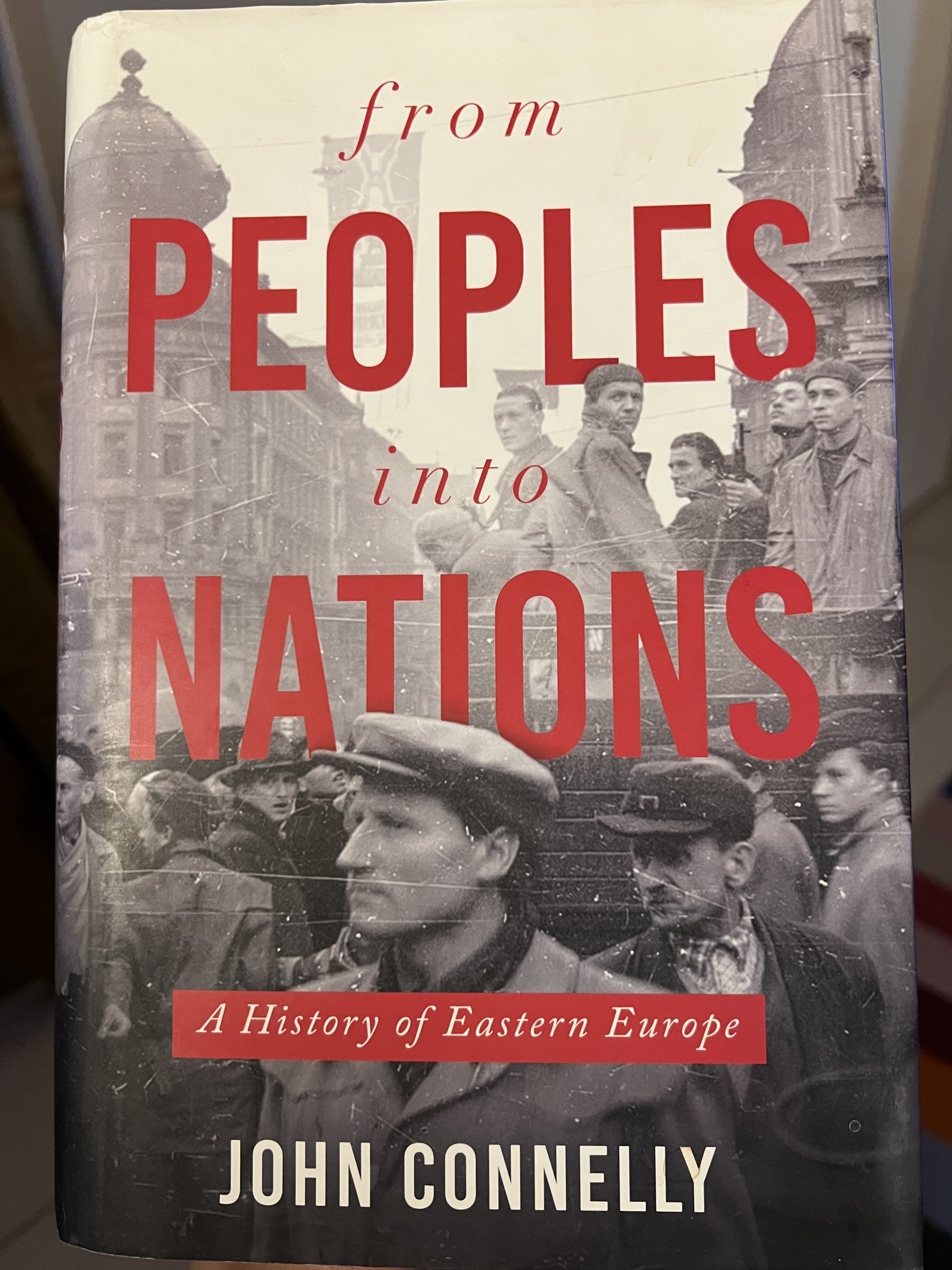
Of the First World War, one rather particularly good monograph (and recent) that I’ve gotten into the first couple introductory pages is John Connelly, From Peoples Into Nations: A History of Eastern Europe (Princeton University Press, 2020).

An excerpt below:

“War broke out in Europe in 1914 because of a deed carried out in the name of a people no one had previously heard of. That June, after years of internecine turmoil and armed conflict in southeastern Europe, a Bosnian Serb named Gavrilo Princip shot and killed Franz Ferdinand, heir to the Habsburg throne, in Sarajevo. The assassin said he was acting to defend the interests of the Yugoslavs, or South Slavs, who were seeking independence from the Austro-Hungarian monarchy.”

Connelly pulls the reader paragraph after paragraph through the decades following 1914:

“When the war ended in 1918, statesmen and revolutionary activists made a new Europe, drawing on the impulse that had taken hold of Gavrilo Princip and his friends: that peoples should govern themselves. Clothed in the words of national self-determination, this impulse was raised as a high political standard by both Bolshevik leader Vladimir I. Lenin and US President Woodrow Wilson, denoting socialism for the first, liberal democracy for the second.”

Ideological lines, whether they existed in reality or not, were drawn in the geopolitical sand. Here’s another zinger from Connelly:

“…nationalists are no more resistant to understanding than any other actors in history. They are guided by motives that are open to reconstruction and analysis. What seemed rational to one side of the nationality dispute usually seemed irrational to the other, and in fact their deeds confound any attempt to divide reason from unreason. Take Gavrilo Princip. On one hand, his act is easy to understand. When Austrian authorities apprehended him, he said he knew ‘what was happening in the villages.’ Thanks to education provided by the Austrian regime, which had ruled Bosnia since 1878, he knew that Austria had done little to alter traditional patterns in the countryside according to which poor Christian sharecroppers — like his parents — worked on properties owned by Muslims and were condemned to second-class lives. He was one of nine children, but five of his siblings had died in infancy. His father worked several jobs, one of which was lugging heavy bundles of mail up and down mountains, even at an advanced age.”

It just goes on and on like this, unpacking the late 1910s until he pulls us up into the 1970s. Get Connelly’s book on your shelf. Or in your local library shelf. Each reader gets to kind of tease out how to bring it from the 1970s into the 2020s.

During Armistice Day, my brain also (invariably) wanders toward The Pogues rendition of “Waltzing Matilda.” It poetically unpacks the global scope of the Great War. Lyrics of it all below:

“When I was a young man I carried my pack
And I lived the free life of a rover
From the murrays green basin to the dusty outback
I waltzed my matilda all over
Then in nineteen fifteen my country said son
It’s time to stop rambling ’cause there’s work to be
Done
So they gave me a tin hat and they gave me a gun
And they sent me away to the war
And the band played Waltzing Matilda
As we sailed away from the quay
And amidst all the tears and the shouts and the
Cheers
We sailed off to Gallipoli…”


Clellification for Halloween, 2024

I’m currently working on a project with Bill Caraher who is the pilot of The Digital Press at University of North Dakota. For a year, or beyond a year now, Caraher and I have been thinking about Clell Gannon, and Gannon’s 1924 publication, Songs of the Bunch Grass Acres (SoBGA). I’m working on revisions from a first draft submitted to The Digital Press, and after letting editorial comments sit with me for a while, I have decided to recalibrate a bit of the original narrative. Like it is the case with many texts, the more you read, revisit, and think about SoBGA, the more the text starts speaking to the reader in different ways. The recalibration of the first draft will look something like this:

  1. Clell Gannon intellectually situates (indirectly and directly) his 1924 SoBGA into the current of Romanticism. And not the romanticism that you’re thinking about. Like he’s not poeming (poem is now a verb) the reader to go pick flowers and let your feelings rather than your brain dictate your moment to moment actions. Rather, in the original intellectual vein of Romanticism (which was a counter balance to the, ahem, Enlightenment), he’s saying (I’m paraphrasing here), Hey, this northern plains and Great Plains and Western Americana place we all live in: this place is completely worth living in. And not only is it worth living it, it deserves our contemplation, and this place is deserving of a sustained relationship with us.
  2. Who else did Clell Gannon roll with at this time? He was a mover and shaker. Also one who was a joy to be around. Thoughtful. And nothing that is in his writings, or others who have written about him, suggests he was a chest thumper. He was friends with Russell Reid and George Will (son of Oscar Will and his vegetable seed empire). The same Russell Reid who acted as secretary of the State Historical Society of North Dakota for decades: when it evolved from the basement of one of the buildings on the State Capitol Grounds eventually to the building that today houses the State Library. Clell would likely lose his mind (in a good way) if he saw the geothermal-heated footprint of today’s State Historical Society of North Dakota, and in-motion expansion of the Military Wing.
    • Clell was unable to physically make the requirements to be mustered into World War I. I do wonder what contributions he might suggest for interpretive exhibits in the 21st military wing following the Great War of the 20th century? Might they have read something along the lines of what Willa Cather spoke of in 1922? “…the world broke in two in 1922 or thereabouts…” In 1922, Cather had seen veterans return from the Great War, and as returned veterans, they were told (not even really told) to navigate the ascent of the industrial capitalistic roaring 20s.
  3. In conversations with Shadd Piehl (ahem, recognized poet of the American West, cowboy poet, teacher, listener, encourager of the written and spoken word, and former bronc rider, etc), Piehl noted that Clell reminded him of the poem American Names that Stephen Vincent Benét set down in 1927, or 3 years after publication of SoBGA. So the revisions of this draft will take into greater account a couple other datum points, including Willa Cather and Stephen Vincent Benét.
  4. Clell Gannon’s introduction (very short) of SoBGA is good.
    • In the first paragraph he sets out his flag of love of regional place. Not nationalistic love. But of the regions within this nation: northern plains. Great Plains. American West.
    • The second paragraph is on about poetic structure, meter to be exact, and with a sampling of how a west of the Mississippi River person pronounces “coyote”: say ki’ot, Clell instructs, as two syllables. Don’t get all sophisticated and say “ki’ot’eee.” Don’t do that. Nobody would ever do that. Use two syllables to say coyote, and the meter of the poems will flow.
    • The third paragraph calls out Florence Harriet Davis, librarian in 1924 of what would have been the beautiful Carnegie Library in Bismarck (it was completely razed in the 1970s or 1960s for progress. Poetically, a parking ramp is located there today.). Who is Florence? In a word search in the Library of Congress searchable newspaper database, she surfaces here and there in Bismarck Tribune articles.
    • Clell’s final poem in SoBGA is to Hazel Dell Gannon, who at 17 years old passed away in what Clell describes as Grand Valley, South Dakota. Maybe she was preparing to attend teachers college? Or something? I Google’d Grand Valley, and the closest thing that surfaces is place names in Lincoln County, southeastern South Dakota.
    • Clell signs off on his short introduction with “Bismarck-by-the-river, North Dakota.” Today, in 2024, this is another great reminder to readers to recenter their view of North Dakota’s capital city as one that is a river city as well. Clell understood the importance of the Missouri River to the early history of the region and, eventually, to the state.

Okay, that’s all the Clell-ification I have for the moment. Gotta get after the other items for this Thörsdag, October 31, 2024, Halloween Day (the pumpkins were carved last night).


Present Reality and Past Memory: Scandinavian Diaspora, Then and Today

Over the weekend, I was able to attend the Norsk Høstfest, a long running annual festival in Minot, North Dakota that, as the self-descriptor says, is a celebration of “Scandinavian culture and heritage of the five Nordic countries of Denmark, Finland, Iceland, Norway, and Sweden.” This is a good descriptor (descriptors are difficult when trying to communicate in very short and sweet verbiage what one is trying to communicate to potential readers who don’t have a lot of time to sit and read long form or short form journalism, let alone slopped out blog posts on diaspora theory).

I’m not entirely satisfied with this interpretation just remaining as is. While at Høstfest, I texted a bit with a friend of mine in Helsinki (yes, Finland, not Minnesota). He texted back a couple times (when I texted him, it was around 2-3pm central standard time, which with the 8 hour difference, meant it was 10-11pm Helsinki/eastern Baltic Sea time).

We got to a bit of spirited back and forth on authenticity: always a theme in any kind of cultural experience. Like when you return from an experience, sometimes the question was, “Was it authentic?” or the statement assertion is that, “That experience was authentic.” The text message exchange got me thinking about authenticity, the perception thereof, and trying to tease out a universal definition of what authenticity could mean. The word authenticity appears to me to be related to authority, and the word author, too. But these three words — authenticity, authority, author — are interconnected in the capacity that they assert through one (or a collective) of past memories and present experience the way things are or ought to be. Which when an author is asserting something, here’s a way in which to experience that: it’s okay to accept the author’s assertion. But one doesn’t have to agree with them.

Anyhow, texting with my friend in Helsinki, it appeared a bit odd how Finland was reflected in Minot, North Dakota (stay with me, here). So that returned to the topic of diaspora: peoples who have been spread from what they call their “original homeland” (but in the long history of people migrations, what does “original homeland” even mean), and the peoples who retain slivers or linear board sections of the culture they departed within the new spaces they settle and occupy.

Here’s where the cultural Instapot gets weird: the culture that left the homeland continues in the mindset of the migrating people, but the homeland culture continues to evolve in its own, new directions. So the Helsinki friend of mine, this morning, said something similar: he left Finland over 25 years ago, and when he returns he cannot seem to see the country he left behind. So the Finland he knows is in his mind. The present Finland, isn’t that. Because he recalls Finland in 1999 or so. The Finland today in 2024 is something different. Here we have two mental Finlands: the past memory of a Finland in the mind of the person that doesn’t live regularly in Finland, and the Finland Finland of today.

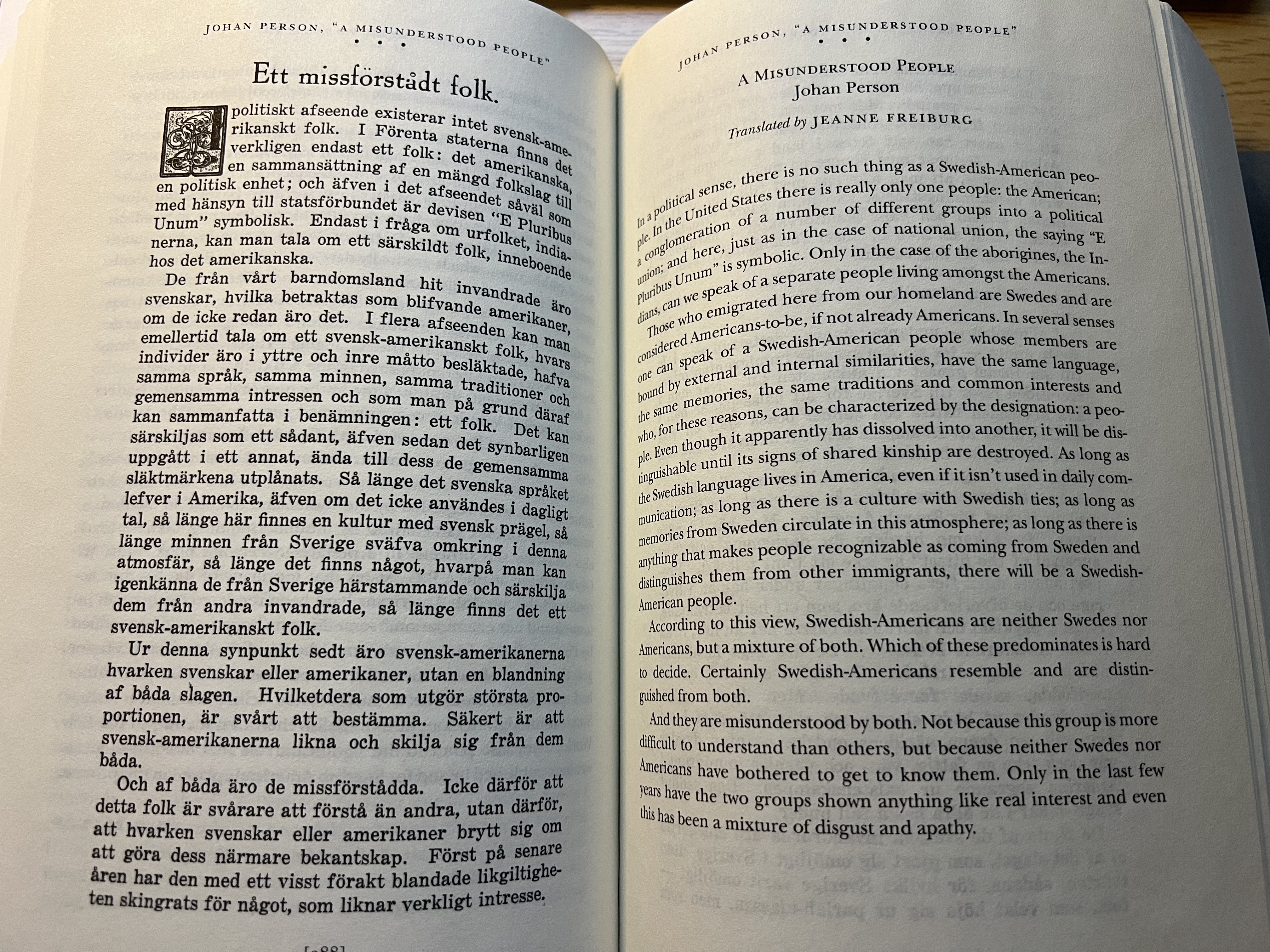
Here’s an historical case study on that, too: in The Multilingual Anthology of American Literature: A Reader of Original Texts with English Translations, edited by Marc Shell and Werner Sollors (New York and London: New York University Press, 2000), the section on Swedes, the opening page looks like this:

The third paragraph in reads this: “…Swedish-Americans are neither Swedes nor Americans, but a mixture of both.” So the diaspora cultural barges continue to float and evolve in their own directions and ways. And so do the host countries of their origins. Does it mean one group gets to really get in the face of another group and let them know, “This is how it is supposed to be!!!” I suppose. But it seems to reflect more of the insecurities of the assert-er than it does about anything else. And insecurities are okay, too: no human is human without them. It would appear the assertions are more grounded in a person’s or people’s want to have a cultural anchor of some sort, especially in a present that perceptively seems so out of control. Perceptively. Okay, that’s all I got on that. On with my day.


Northern Plains Rural Bohemia

Yesterday (Sunday, August 25, 2024), our family accepted the invitation out to the Bohemian farmstead of the Suchy (pronounced “Sue-Key”) family, not too far south of Mandan in Morton County, North Dakota, northern Great Plains, North America. These broader descriptors of geography are warranted, as Chuck, the farmer-rancher-musician unpacked a bit of oral history for me in narrating a bit how his Bohemian grandfather came to this place from said Bohemia (today’s Czech Republic), and decided to invest in this place to make a life and family.

Chuck (r) explaining the A-frame idea of the modern Suchy house, how it was born out of a plan with other friends on a bar napkin before or after a volleyball game.

I thought I’d give just a bit of my own sensory perceptions from what I remember in the drive to the rural Suchy stead. One rolls up the raised and ditched approach (that has the genuine bumps here and there). Beyond the island of thick trees and brush set in front of a hill in this Bohemian valley (lots of Bohemian chain migration entered this place — yes, legit, like you’re reading Willa Cather’s My Ántonia), one cannot view much. Until you get not through the clearing, but into the past. We drove up in our 2022 vehicle, and entered through the arched clearing: it perceptively felt like we were at once time traveling back to decades past, into historic Bohemian diaspora global migration, all while knowing this informed how one moved and moves about the landscape, step by step, in the present.

August 24, around 8:45PM (CST), north elevation, historic free thinkers Bohemian Hall, rural Morton County, North Dakota.

Chuck and his wife Linda live in a modern A-frame on the Suchy stead, and a historic row of lilacs separate their modern home with the historic Suchy residence (which Chuck uses as, among other things, his studio).

Zinnias in the garden. Zinnias are also known at the Suchy stead as Mexican sunflowers, an endearing nod to the southern neighbors in the context of the saturated and vibrant colors of the bloom. In the far far horizon distance is the North Dakota state capitol building (across the Missouri River in Bismarck, Burleigh County, North Dakota).

The night prior (Saturday, August 24, 2024), Chuck and family played their annual August event at the rural and historic Bohemian Hall. The Bohemian Hall isn’t too far from the Suchy stead. It’s position in the landscape has restrictive or non-existant WiFi/5G (or whatever is beaming through and to all of the individual super computers we gaze at way too much). So when one sits and listens and watches and a few dragonflies zip in between the viewer and Chuck and company playing on the north elevation of the historic free thinkers Bohemian Hall, a bison stampede of historic thought rolls through the brain and body. Thoughts of how much the top soil has witnessed. Not just with the arrival of historic Bohemians. But much prior, with First Nations. And thousands of years prior at the edge of the glacial advances and retreats.

Bohemian Hall, southeast elevation, August 24, 2024.

Landscape Memory of Dill: Baltic Sea and Central North America

This early morning, while in the kitchen, I was cutting the leafy hats off the strawberries (jordgubbar) to make a larger bowl for the family breakfast (frukost). I opened the little lid to the compost Tupperware vessel we keep on the countertop. Once open, a waft of dill ran up my nose and into my brain, activating my mental hard drive.

I was at once in farmor’s kitchen. She was standing at the sink, back always to us as all single filed through the entry door opposite of the kitchen that led us past and into the efficient dining area. “Hello!” she would greet us with, smiling.

I text messaged this memory to a couple friends, one living in the desert southwest. And another who spends time in the Atlantic World, a large chunk along the eastern Baltic Sea and the United States.

The latter texted me back, noting how the Baltic Sea area is replete with dill and the landscape. Lots of dill on new/small potatoes and herring.

Dill. Ancient Mediterraneans noted how rosemary was and remains an herb of memory. But so is dill, the memory herb of the steppes, the Baltic Sea, and central North America.

A photo below of the dill growing in our own backyard garden. This dill was a starter early this season from Forager Farm. It has produced many delicious cold potato salads and cucumber salads already this summer.


Northern Plainsing Summer 2024

I’m on site at the University of North Dakota this week for professional work and research. While on site, walking across the campus mall, it was a pleasure to see the memorial tree of the late Joel Jonientz, professor of art and design who, in the inscription of his eternal self descriptor, always “loved a bad plan.” Other phrases that come to mind when recalling Joel (he and I interacted directly like 2-5 times in the course of us walking the earth at the same time): “You wanna know how you accomplish something?” This was a rhetorical line of questioning from Joel. He said this to me in like February of 2013 while we were at a high top table at the used-to-be HoDo, now the remodeled BlarneyStone in downtown Fargo. This as we were ramping up with collaborators to carry forward the first global Punk Archaeology Un-Conference at the historic and since bulldozed Sidestreet Tavern (one finds as the decades proceed, one is saying “the old one, not the new one” a lot more and more). He’d follow this by saying something to the effect of, “Ninety-eight percent of it is will power. That’s it.” Not all in one big shot will power. Like sustained will power. Willing power, making incremental gains, sometimes of the magnitude that could be similarly gauged by clipping a hang nail.

Anyhow, some description of the landscape architecture and my own mental point of entry where Joel’s memorial tree resides. The tree itself is a silver maple. I rant the tree image through the PictureThis app on the iPhone. Joel (and the ripple effect of his collaborators) liked detail. So here is some detail. The silver maple is also known as soft maple, water maple, river maple, white maple, creek maple. The latter name, the creek maple, is fitting, as his memorial and this tree is planted near English Coulee (aka creek; and aka “English” as in a departmental discipline) on UND’s campus. The Latin (“It’s a dead language!”) name is Acer saccharinum. It is one of the most common deciduous tress in the United States and southeast Canada. So hardiness zones of 5-9, sustaining Fahrenheit temps from -4 to 100 degrees. It can get vertical from 5-9 stories high. I looked up and snapped this photo of the canopy that arches out over the sweet granite memorial to Joel. It’s okay to lay in the grass and look up at tree canopies.

Also, there are several families of geese with their teenage geese offspring hanging out around the English creek. This just east of the Hughes Fine Arts Center (same Hughes namesake fellow of the Hughes Junior High I attended in the early 1990s in Bismarck — he invented or popularized some kind of electric stove for the world).


Juneteenth in Bismarck

Yesterday (06/19/2024) we attended Bismarck’s Juneteenth celebration at Shelter 1, Sibley Park. Some brief notes on that here, along with some digitized (how else would I put this information online?) items of the educational exhibits at the event.

The Bismarck City Commission provided an official proclamation for Juneteenth (below) read into the Bismarck City Commission official meeting minutes ahead of the event on June 11, 2024 (the city commission convenes every two weeks, so this was the week leading up to the event).

Below here is what was posted on the official City of Bismarck website.

And now a few photos below of the Juneteenth civics celebration.

Bismarck Veterans Memorial Public Library informational booth here.

Vendor booths.

First Presbyterian Church of Bismarck informational booth.

Ephemeral art installation for the Juneteenth civics celebration in Bismarck.


Meditations Between 1st and 2nd Sleeps

Subscribe to continue reading

Subscribe to get access to the rest of this post and other subscriber-only content.


Biking Back to Work

After lunch today, I decided to bike back to work. Non-motorized bike. It was good. I’ve been around the sun well over 45 times, now, and the lure of incremental healthy (and fun) decisions has overridden any other decisions that seemed to intersect with the metabolic rate of my 20s and 30s. I’ve also been recalling in my memory some time ago hearing the phrase, “Well, every 7 years we are somebody different than we were 7 years prior.” That also links up with the understandable IRS requirement of retaining 7 years of records (kind of non-related aside). While on my ride, I was thinking about where I was 7 years ago, on the planet, and frame of mind. It indeed was different. None of which really is necessary to go into here (maybe it’s kind of secular spiritual for everyone to think of where they were 7 years ago, keeping it to themselves of their own record).

While pumping the pedals of the bike, I also enjoyed how much more audible the urban setting is from historic downtown Bismarck to the Missouri River front (audible even while my bluetooths allowed me to hear Ray Cappo discuss his spiritual journey through India in the early 1980s and such).

Photo below is from the Chief Looking Village overlook (Chief Looking Village was one of several interconnected Mandan-Hidatsa villages circa 1500s). In the photo you can see the horizontal light blue Interstate 94 bridge that spans the Missouri River at Bismarck (check out the Missouri River Heritage Mural on the visible pier at left). In the distance, with all the floating cranes, you can see the Ames contractors of BNSF, the floating cranes, as they are ramming pilings into the river to build a new rail bridge that can accommodate stacked rail cars for all those one-click Amazon orders that bring stuff from the Pacific World to Chicago, and everywhere in between. Once finished, BNSF will disassemble the 1905 bridge superstructure and the 1883 rail bridge piers (they were built with Minnesota granite). It will change the landscape viewshed of the river. Off in the distance of this photo, mid-right, you can see little dots on the horizon butte. Those little dots are the 1930s Civilian Conservation Corps reconstructions of the 1870s Fort McKeen/Fort Abraham Lincoln (today’s busiest state park in all of North Dakota). Bottom center you can also see the contour of a mountain bike trail, one of many that our Burleigh County Bicycle Cult friends maintain for everyone’s overland bicycling pleasure.