Tag Archives: Wyoming

Reading Joseph M. Marshall III’s Hundred in the Hand

Some weeks or months ago, while in conversation, Dakota Goodhouse mentioned the name of the late Joseph M. Marshall III. I scribbled it down and got to searching on the webs. Turns out he went to the other side in April 2025, but before that he set down a magnificent body of history, cultural history, and novels in the original sense of the word: new ideas.

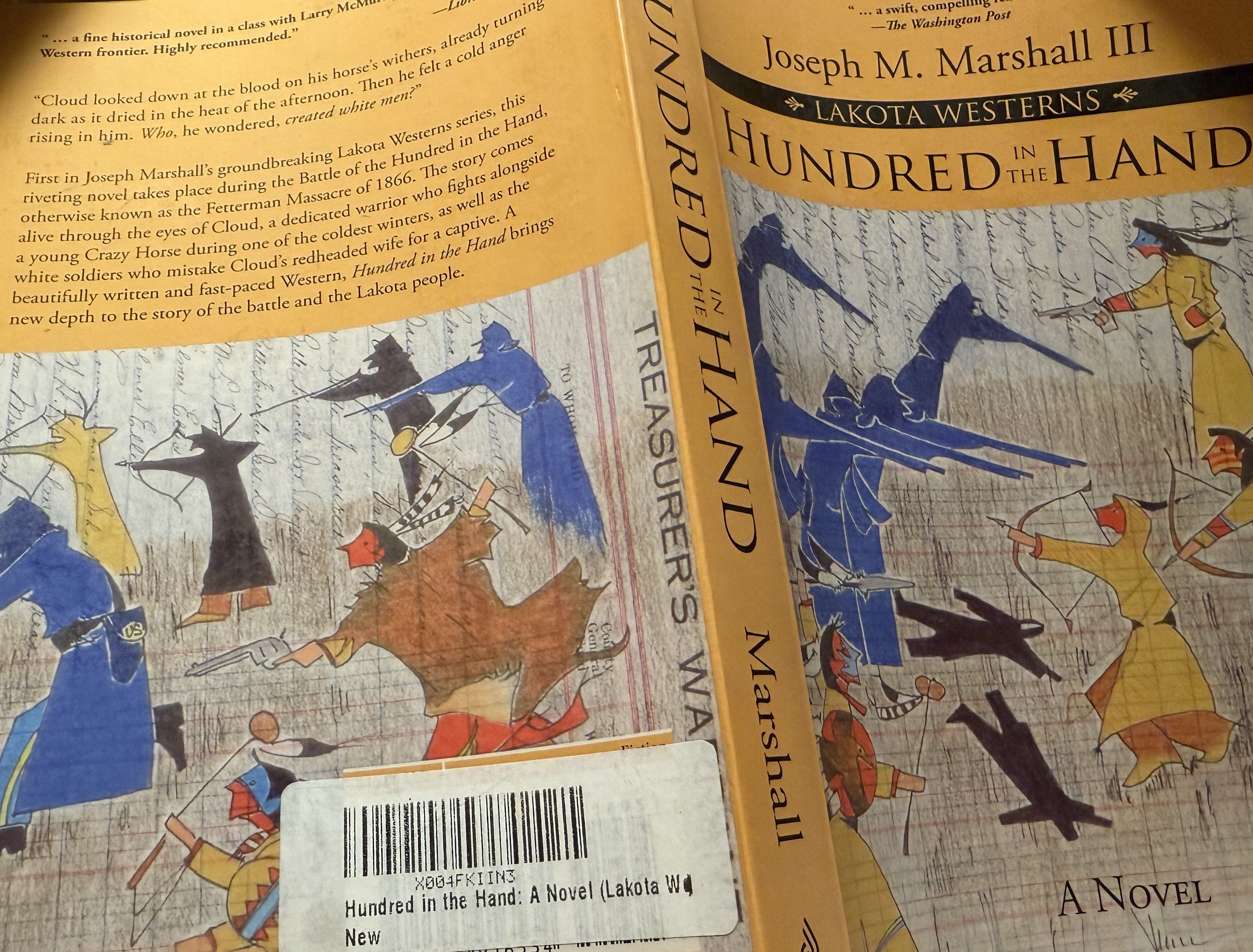
Last night, and in between first and second sleeps, I continued cruising through Marshall’s Hundred in the Hand (Golden, Colorado: Fulcrum Publishing, 2007), described on the coverpage, appropriately, as Lakota Westerns (it’s good to read the plural, as it suggests there is, or will be, more than one).
Reading Marshall III got me thinking about analogies: finding out about Marshall III was similar to finding out about the late Peter La Farge’s work of folk songs, and how Johnny Cash took up numerous songs of La Farge and popularized them. The analogy my brain was running is like this: it seems I’m only now finding out about this amazing historian, artist, folk singer, novelist. It is good stuff.

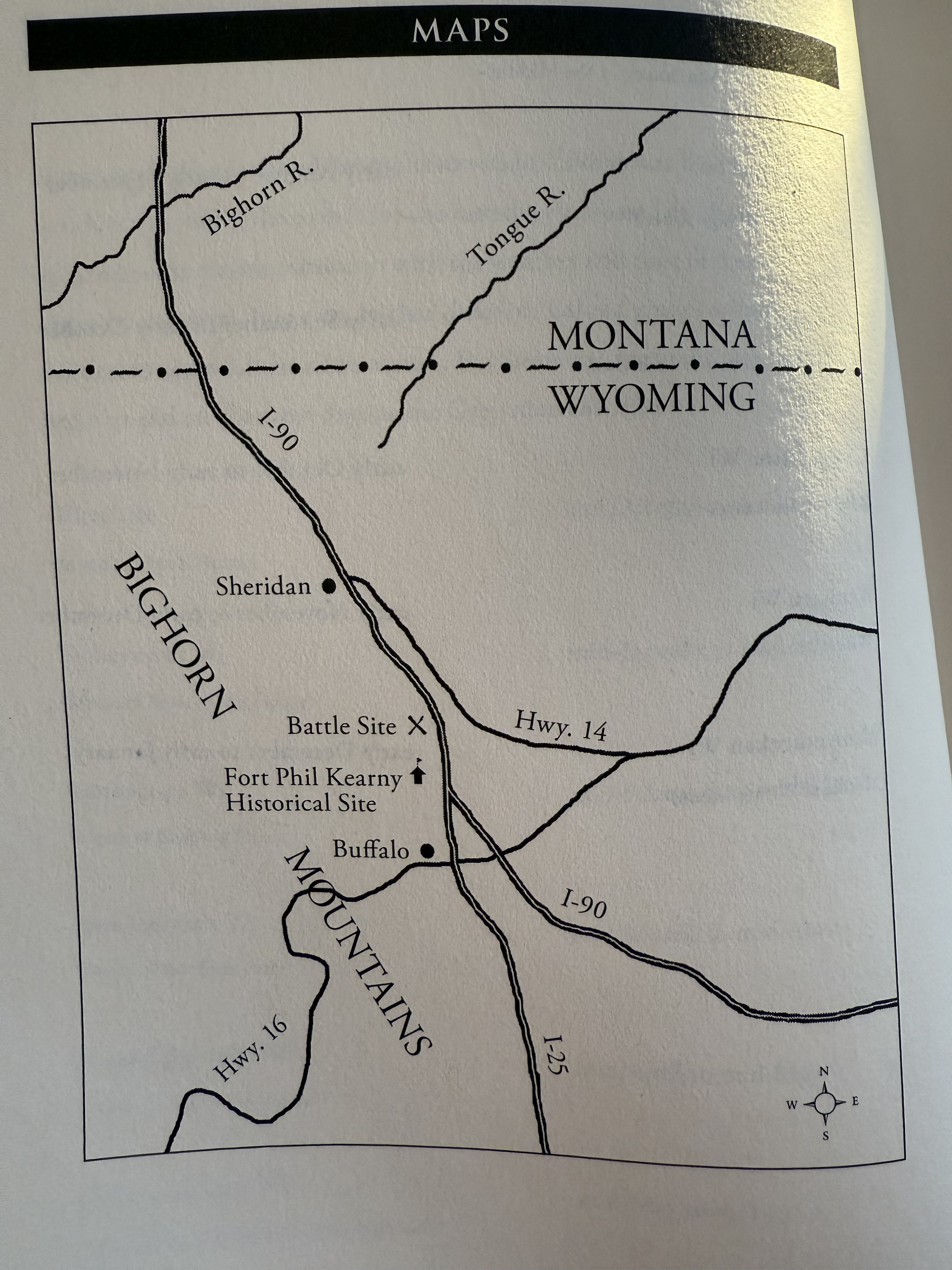
As to Marshall III’s Hundred in the Hand: this morning I texted Goodhouse, “It paints Lakota culture across the 1860s northern plains landscape. Daily lives. It’s good.” The novel takes a reader into a post-American Civil War landscape where the Great Plains mingles with the eastern elevation of Rocky Mountains in today’s Dakotas, Wyoming, Montana, and Nebraska with the characters involved with the specifics of the Bozeman Trail, or what Marshall III notes was called the Powder River Road or, as described in the introductory Lakota to Euro-American glossary, Makablu Wakpa Canku. Marshall III also dictionaries (now a verb) several other landscape names: He Wiyakpa or He Ska (Shining Mountains or White Mountains) = Bighorn Mountains; Canku Wakan Ske Kin (The Road Said to be Holy or Holy Road) = Oregon Trail; Hehaka Wakpa (Elk River) = Yellowstone River; and several others.
The geological river and creek valleys and buttes filled in with the small islands of cottonwoods, amidst a sea of scrub grasses, sage, and cacti. Layered into and upon this is the day to day lives of Lakota, circa 1866, who are understandably frustrated with watching increasing waves of Euro-American gold-seekers migrate through and post up in their country. Without going too much further into it all (save that for reading it yourself), I’d recommend reading Marshall III’s Hundred in the Hand. It adds a greater layer of texture to the region it describes. Needed layers. Historical works often narrate the historical events informed by historical documents (those primary sources) that are created by and for historic bureaucracies: the structures of nation states. Marshall III’s novel allows a reader into the cultural window of a regional northern plains landscape. The smells. The feel of summer heat. The cool of summer night. The tastes of elk stew in the surround of a hide tipi.

The takeaways from this novel thus far? I’ll work in groups of three. The first is that 1866, and Red Cloud’s defense of his people’s country that culminated in the Fetterman Fight, was one of several prologues to the Battle of Greasy Grass/Little Bighorn a decade later. Lakota who fought in 1866 would remember this as one of many as the spring of 1876 approached. Why is this important? As we approach America 250, it will forever coincide with the centennial observance of the June 25, 1876 Battle of Greasy Grass/Little Bighorn, and the various conversations had in the Anglo-American Sphere when news hit the newspapers just after the Bismarck Tribune wired narratives to the New York Herald on July 5, 1876, and the subsequent days after. A second reason take away is the perceptive shift the novel takes the reader on: it reminded me a bit of what Patrick Byrne would like, or would have liked to read, the author of Soldiers of the Plains, a 1926 publication that brought a native perspective to an Anglo-American readership fifty years after the Battle of Little Bighorn. Byrne, who emigrated from Ireland as an orphan, and eventually arrived to Bismarck, Dakota Territory, would understand what Anglosphere Colonization looked like, having seen and heard the recent memories of the potato famines in Ireland, and the Anglosphere’s complete inability to respond in a humanitarian way.

Where are we at with the 3rd takeaway? Regionalism. Unique things have happened, and continue to happen, in the various regions of the world. It’s not that one region is better than another. It’s that things happen in regions. People live out lives in these regions. They are worth considering and thinking about. This, as it goes, leads to an appreciation of regions, and it gives those regions infinite cultural depth in the face of standardized horizontal and vertical strip mall culture (which has its own value of standardized consistency, don’t get me wrong).


If College Football Was History

Over the weekend I wrote some more of my dissertation on why and how the US-Dakota Wars have been remembered on the northern Great Plains. But things beyond my dissertation also happened at North Dakota State University, including the announcement from football head coach Craig Bohl that he just took a job with the University of Wyoming. You can read one of the stories in The Fargo Forum here.

Since I’m a practitioner and fan of the arts and humanities, I thought it would be fun to modify and render the story. If you swap out the word “coach” with “professor,” the word “football” with the word “history department,” and “Craig Bohl” with an NDSU professor of history, it reads like a pretty tense story coming out of the liberal arts in the American West.

Since Bohl is moving to the University of Wyoming, and since NDSU’s Mark Harvey received his PhD history training at the University of Wyoming, it seemed appropriate to use Mark’s name in the rendered, fictional story below. You can find one of Mark’s excellent works of historical scholarship here.

One version of the modified, fictional story would read as follows:

The Mark Harvey history professorial era at North Dakota State ended abruptly, if not shockingly. The 11th-year history professor will be introduced today as the next head professor of history at the University of Wyoming.

NDSU students through social media on Saturday night were stunned and surprised that CBS reported Harvey is taking the head professor of history position with the University of Wyoming. At the heart of the matter: Who will profess history at NDSU?

Harvey and the history department chair did not return text messages Saturday night.

Bruce Feldman, senior college history analyst from CBS, first broke the story that Harvey will be introduced tonight as the next head historian of the University of Wyoming. NDSU called a 9 a.m. departmental history meeting for today, which is unusual.

Wyoming has called a news conference for 6 p.m. (CDT) today to announce a new professor of history.

It left everybody surprised, including the students after Harvey dominated the Western Historical Association‘s conference with a lecture from Gate City Bank Auditorium. Harvey convinced people not even interested in history that it was in fact important.

On their Twitter accounts, PhD Student of History Troy Reisenauer wrote, “Tell me this isn’t true.”

Said PhD student of History Derek Ystebo: “Please say this is a joke.” Later, Ystebo tweeted he was happy for Mark Harvey and “sad it had to get leaked like this.”

Graduate Student Chad Halvorson tweeted, “this is a little weird.”

Harvey, as has been his customary response, did not comment about the speculation after the lecture. 

It would be a considerable bump in pay for Harvey to at least $1.2 million per year if not more. The previous professor of history made $1.2 million and reports from Laramie media indicate the next professor of history would be paid higher, perhaps as high as $1.5 million…


Ernest Staples Osgood, “The Day of the Cattleman” (1929)

Central to Ernest Staples Osgood’s 1929 scholarship is how cattlemen in Wyoming and Montana ignored previous perceptions of the Great Plains as an uninhabitable desert, and instead recalibrated their perspective to make a life on the North American steppe. Once the cowboy got to the Great Plains, Osgood said,

The solitude of the desert passed, and men began to realize that this, our last frontier, was not a barrier between the river settlements and the mining communities in the mountains but an area valuable in itself, where men might live and prosper. (Osgood, 1929: 9)

The chapters that follow elaborate on how the nineteenth-century Euro-American pushed west of the Mississippi River to initially make their way across the Great Plains and into the Rocky Mountains and the Pacific Coast. By the time enough overland wagon trains arrived to the mountain basin, though, frontier fur traders and trappers had come down out of the Rockies to form encampments, and these settlements became stopping points and places of trade. The fur trader and trapper sold supplies to the wagon trains, swapping out locally-grazed cattle with emaciated wagon train cattle, the latter worn out from walking the hundreds of miles west. Once traded, the emaciated livestock revived themselves on the lush grasslands of the Great Plains, and they would fatten themselves up to be traded, sold or slaughtered.

Osgood LivestockThe increased arrival of the railroad supplanted the need for overland wagon trains, but the railroad itself brought laborers hungry for beef and protein. By this time, rumors about frontiersmen J.R. (Jim Bridger), Captain Richard Grant, and the firm Russell, Majors and Wadell making $15,000-to-$75,000 as cattlemen had landed in the ears of investors back east. (Osgood, 1929: 12-16) The response was profound in the post-Civil War world of the Great Plains. Texas ranchers utilized the warmer climes of the southern Great Plains as a place to breed cattle. After growing the herd, they then drove the cattle north to the lush grasslands of Wyoming, Montana and the Dakotas. After fattening up the cattle, the cowboy would drive them to railroad loading points and ship the livestock to markets in Chicago and beyond. Osgood explains a local Wyoming example of this, as in 1873 approximately 286 railcars of cattle were shipped from Wyoming to eastern markets. By 1877, only four years later, the number of rail cars shipping cattle east had increased to 1,649. (Osgood, 1929: 51)

Between 1879 and 1885, the Federal government did not care to impose legislation to manage the chaos intrinsic to the ranching industry on the Great Plains. This gave rise to local cattle and stockmen associations that sought, at least in ideal, to preserve an individual’s ownership of the herd, protect the herd, and regulate public grazing to prevent overcrowding. (Osgood, 1929: 114-115) In this vein, Osgood’s scholarship sets a stage for later works that might consider what the industrialization of the Great Plains meant for a growing world population, and this also speaks to World and Public historians. Today, non-American restaurants can be seen advertising “American” beef, and ruins of yesterday’s mining towns — Bannack, Montana included — still dot the landscape.

The ruins of the mining town of Bannack, Montana. Photo by archaeological comrade Brian Herbel of Missoula, Montana.

The ruins of the mining town of Bannack, Montana. Photo by archaeological comrade Brian Herbel of Missoula, Montana.

The big idea in Osgood’s book is that the large-scale Euro-American perception of the Great Plains had altered, once thought of in the first decade of the nineteenth century as a desert and by mid-century as an oasis for cattle and cowboy. Published in 1929, this book also reflects the language of the times, as Chapter 4 is titled “The Indian Barrier.” Whether the Euro-American understood it or not, they appropriated the positive perception of the Great Plains that the Native American already had. This is something Osgood could have drawn out quite a bit more in his work, but 1929 is far enough removed from 2013 that it makes a bit more sense to understand this piece of scholarship as history as much as it is understood as central to Great Plains historiography.