Tag Archives: World History

N. Scott Momaday, “The Way to Rainy Mountain” (1969)

N. Scott Momaday, The Way to Rainy Mountain (1969) set the Kiowa oral history to print, and in the 1994 preface, Momaday explains how the work is split into three voices. The first voice is that of Kiowa oral and ancestral history, the second is a type of historical commentary, and the third is the personal memoirs of Momaday himself. For this reason the entire work is a kind of historiography, or the way in which historians remark, opine and reflect on the works of their predecessors. The importance of The Way to Rainy Mountain is not only that it sets an oral history to print, but also that it allows non-Kiowa individuals access to the depth and scope of Kiowa culture. Momaday demonstrates how the Kiowa interacted with the Great Plains over generations and have a genealogical investment in the landscape.

Like many cultures throughout the world, the Kiowa were nomadic, and their oral history and legend reflects this. Genesis for the Kiowa took place when the Kiowa as a people emerged from a hollow log in the “bleak northern mountains” of today’s Montana. (Momaday, 1969: 3) They eventually ended up in central Oklahoma, but along the way they impressed stories of themselves into the land. The Kiowa, for example, “made a legend” at the base of Devil’s Tower in northeastern Wyoming, and connected this legend with the astronomy configuration known as the Big Dipper. Momaday’s grandmother said:

Devil's Tower illustration by Al Momaday in N. Scott Momaday, "The Way to Rainy Mountain" (1969), 9.

Devil’s Tower illustration by Al Momaday in N. Scott Momaday, “The Way to Rainy Mountain” (1969), 9.

Eight children were there at play, seven sisters and their brother. Suddenly the boy was struck dumb; he trembled and began to run upon his hands and feet. His fingers became claws, and his body was covered with fur. Directly there was a bear where the boy had been. The sisters were terrified; they ran, and the bear after them. They came to the stump of a great tree, and the tree spoke to them. It bade them climb upon it, and as they did so it began to rise into the air. (Momaday, 1969: 8)
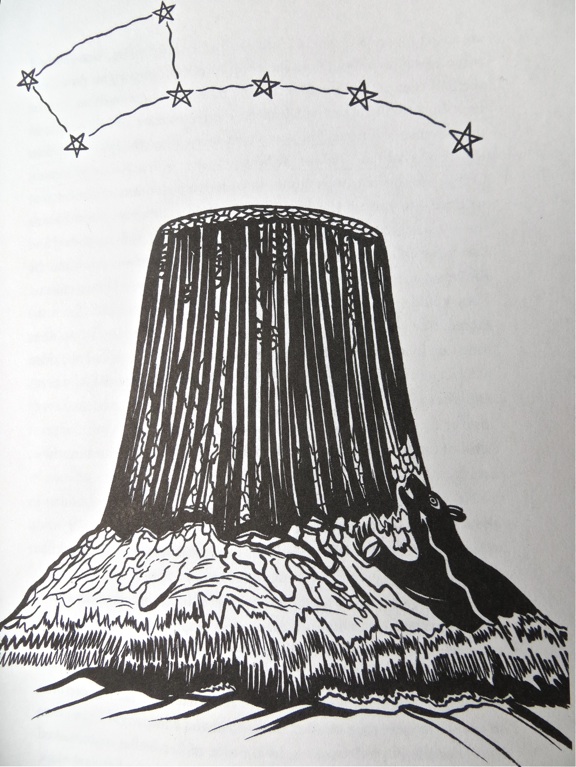
The bear scraped its claws along the base of the tree stump, and eventually the seven sisters rose from the top of this stump into the sky to become the Big Dipper. This story allowed the Kiowa to immediately identify with the Big Dipper, and with today’s Devil’s Tower. So long as the Kiowa were under a clear sky at night, the sight of seven ancestors shining starlight down on them could always provide them with comfort.

The second segment of the book, “The Going On,” opens with anecdote, a story about an old man, a wife and child. The child, innocent to the workings of the world, repeatedly asks his mother for food, leaves the house with it, and returns empty handed only to ask for more food. The third time the child returns, but with an enemy. This enemy tells the family of three, “There are many of us and we are all around. We came to kill you, but your son has given me food. If you will feed us all, we will not harm you.” (Momaday, 1969: 44) The old man is highly suspicious of this offer. His wife obliged the enemy’s request and began cooking while the old man secretly led his horses upstream. After bringing his possessions out of danger, the old man “called out in the voice of a bird” to his wife. She then set fire to the animal fat and tallow, threw it on the enemies, picked up her child and ran to the old man. The story might be used to explain the innocence of children, as enemies or malicious people can easily manipulate them. It could also be used to explain how it is wise to be skeptical of outsiders. In the kinship sense, this story also explains how the family of three looks out for one another.

The utility of anecdotes and stories such as these in any culture is multifaceted, and even biblical. To understand the Kiowa requires a degree of analogy (In The Landscape of History, [2002] Lewis Gaddis remarked on the importance of analogy for this and other reasons). The Kiowa and other cultures throughout the world infused stories and oral history into the physiography, and by this the culture became interconnected with the landscape and surroundings. Momaday’s 1969 The Way to Rainy Mountain was published almost 25 years after the revolt of the provinces, and almost 4 decades after the publisher of the University of Oklahoma Press called on academics and scholars to study Native America with the same intellectual rigor that they had brought to bear on Mediterranean culture.

Momaday’s work also communicates a kind of finality to this culture and others, and this also smacks of Stegner’s Wolf Willow (1955) and Kraenzel’s Great Plains in Transition (1955). Yet at the same time, it also brings about the notion found in Dorman’s Revolt of the Provinces (1993), specifically with John Joseph Mathews, Wah’Kon-Tah: The Osage and the White Man’s Road (1932). When the artists, scholars and literary figures revolted in America’s provinces and periphery during the interwar years (between WWI and WWII), Mathews finally found that the way to preserve and become a proponent of a culture was not necessarily to just recount and study it. (Dorman, 1993: 70-71) This was a part of it, but to truly locate authentic culture required the individual to become a practitioner and contributor to that historic cultural process. In this way, Mathews solved his 1930s dilemma through art, and specifically through Native American Art. Considering that Momaday published The Way to Rainy Mountain in 1969 raises the question as to whether a second volume is necessary to expand on and continue what Dorman ended in 1945. I certainly think so.
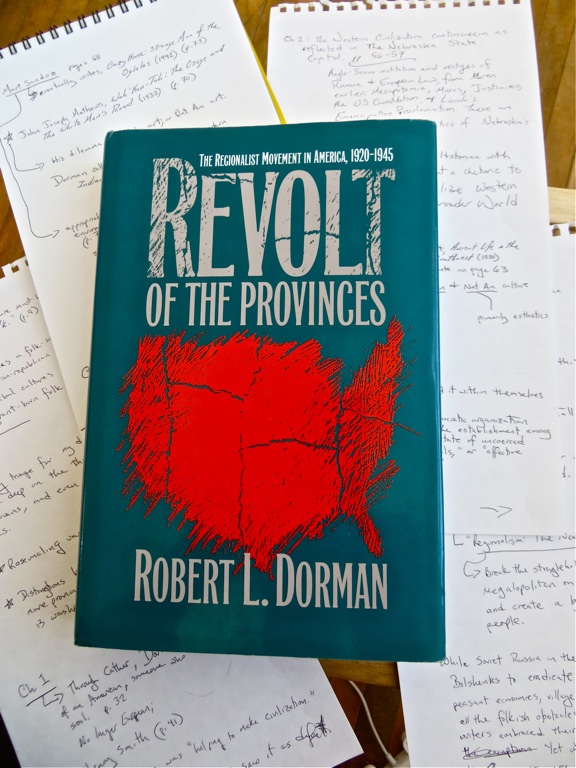
Robert L. Dorman, “Revolt of the Provinces: The Regionalist Movement in America, 1920-1945″” (1993)

In the 1993 work, Revolt of the Provinces, Robert L. Dorman defines “regionalism” in his introduction with trans-historical discourse between 18th century J. Hector St. John de Crèvecoeur and 20th century Lewis Mumford. In the pre-Industrial and Industrial cases, Dorman says Crèvecoeur and Mumford spoke of “the transformation of the immigrant into the indigenous,” or the way in which the recently arrived abandoned or restructured previous ways of doing things. In Crèvecoeur’s time, this meant the European, once they stepped on to the eastern American seaboard, was no longer shackled by the “medieval synthesis” of the Old Country. Approximately 200 years later, Mumford, in 20th century Industrial America, worried how the increasingly hyper-Industrialized world fragmented Crèvecoeur’s 18th century America. Writing from an “enclave in the midst of an industrial desert,” Mumford said “Something of value disappeared with the colonization of America,” where industrialization and modernity had ruptured a common “social heritage.” Mumford then proceeded to ask why it, the common social heritage, disappeared? (Dorman, 1993: 1-7)

DormanThis draws attention to the impetus for the regionalists’ approaches between 1920-1945. It was both a searching out for and cultivating of that lost common, social heritage. Both Crèvecoeur and Mumford could agree that heritage was “a genuine American culture,” and this culture was “grounded on the concept of the folk.” (Dorman, 1993: 9) In the first half of the twentieth century, a regionalist began to think of folk and folk traditions as

organic, but not merely in the sense that they enfold and help to constitute the personal identity of the individual. They are organic as well to a place, symbiotic and indigenous to a specific regional environment… The folk are settled, stable, a veritable human “climax-community,” to borrow a term from ecology. (Dorman, 1993: 9)

To a regionalist, the folk embodied a kind of cultural stability. Following the Great War, regionalists throughout America gained a greater collective intelligence as to exactly what they wanted to do, and they ultimately turned regionalism into a civic religion. The regionalist movement sought to emancipate individuals from the industrial, scientific and standardized shackles of mass culture. Dorman explains how academics, novelists and scholars captured and cultivated the civic religion of regionalism throughout America between the first and second world wars. His first chapter opens with a Willa Cather quote from O Pioneers!, and that is how “The history of every country begins in the heart of a man or a woman.” In this singular sentence, Cather is remarking how individuals in their own particular localities have a particular spirit, a genuine love or heart for a place, and through this a sense of history and community is cultivated.

We see this in Cather’s My Ántonia (1918), and also in Walter Prescott Webb’s The Great Plains (1931). In this latter case, Webb’s work is no doubt tinged with Anglo-Ameri-centrism (what we might call Social Darwinian Racism-Light). But what Webb also attempted to do with The Great Plains was to cultivate historical memory in a particular region of America, and through this forge a common identity. By doing this, perhaps, the folk from the physical Great Plains could indeed have their differences — amongst the southern, central and northern Plains — but also be capable of a kind of unity. Through this unity, the folks on the Great Plains could identify with one another, and thereby oppose, navigate or manage non-Great Plains folks all the more (in many ways, this was a mission of Bernard DeVoto’s, a contemporary of Webb’s. At every opportunity, DeVoto played the America West, a plundered province, off of the east coast Fat Cat Tycoons and the Federal Government). Dorman’s monograph also can be contextualized with the 1950s works of Wallace Stegner and Carl Kraenzel. When Stegner wrote Wolf Willow (1955) and Kraenzel wrote The Great Plains in Transition (1955), they both considered the Great Plains and the American West in what they thought of as a kind of failed afterglow of the regionalist movement from 1920-1945.

In a closing (but by no means a final) remark, it is also interesting to consider Dorman’s subjects in a broad theoretical, history-of-ideas scheme of things. This regionalism was a part of a global movement, something that could be likened to R.G. Collingwood’s idealist and aesthetic reaction to the late-19th century “scientific positivism.” In a way, Dorman hints at this global movement when he compares American Regionalists to what was happening at the time in the Soviet Union. But he would have been better to compare Cather, Webb, Henry Nash Smith and Mari Sandoz to, for example, Vasily Grossman and his humanism, this instead of comparing American regionalists to official Soviet policy. While Soviet Russia in the 1930s encouraged Bolsheviks to eradicate regionalisms — peasant economies, village ties, languages, churches, all the folkish obstacles — so did Washington, D.C. encourage a much softer version of such policy, one that is laid out, for example, in Margaret D. Jacobs, White Mother to a Dark Race: Settler Colonialism, Maternalism, and the Removal of Indegenous Children in the American West and Australia, 1880-1940 (2011). In the first half of the twentieth century, Industrial Capitalism and Industrial Communism — or, to capture them both, Industrial Modernity — imposed itself on the world and its regions. In our post-Cold War, 21st century world, scholars are perpetually in a position to push global, regional and public historical knowledge in infinitely new directions, and Dorman’s 1993 work has set down an excellent foundation.


Woody Guthrie Defines Folkways and Folklore

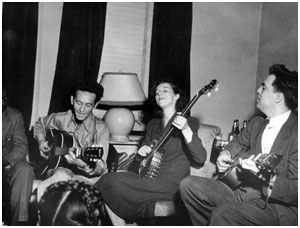
I’m currently revisiting Robert L. Dorman’s 1993 monograph, Revolt of the Provinces: The Regionalist Movement in America, 1920-1945 (Chapel Hill & London: University of North Carolina Press). Remarks on Dorman are on the way, but I wanted to pass the Guthrie excerpt along first. At the outset of chapter 5, Dorman opens with a piece of correspondence Woody Guthrie sent to Alan Lomax on September 19, 1940. Within, Guthrie expanded on the philosophy, or the why, of a folk song. Verbatim, as the tail end of the Great Depression slipped further and further in to the Second World War, Guthrie said,

Left to right, Sonny Terry (obscured), Woody Guthrie, Lilly Mae Ledford and Alan Lomax in New York, 1944. Photo online with The Library of Congress, Alan Lomax Collection.

Left to right, Sonny Terry (obscured), Woody Guthrie, Lilly Mae Ledford and Alan Lomax in New York, 1944. Photo online with The Library of Congress, Alan Lomax Collection.

A folk song is what’s wrong and how to fix it, or it could be whose hungry and where their mouth is, or whose out of work and where the job is or whose broke and where the money is or whose carrying a gun and where the peace is — that’s folk lore and folks made it up because they seen that politicians couldn’t find nothing to fix or nobody to feed or give a job of work. We don’t aim to hurt you or scare you when we get to feeling sorta folksy and make up some folk lore, we’re a doing all we can to make it easy on you. (Dorman, 1993: 145)

That is the power of a good folk singer: someone who can speak and sing in a focused enough way to reflect the localized realities of the times, and with enough abstraction to speak to the ages. In this regard, Guthrie was a genius creator and producer of folklore, certainly a reflection of the folk of his times. Note: Woody’s acoustic guitar and folk songs killed fascists, too.


Willa Cather, “My Antonia” (1918)

In 1918, Willa Cather published My Ántonia. It is a novel loaded with Euro-American homesteading experiences from the Great Plains, and it demonstrates how a seemingly isolated place can in fact have international scope. Without saying it so directly, Cather gives the reader a sense of how the Atlantic World brought itself to the Great Plains, and how these individual immigrants faced an endless amount of new frontiers. After developing the characters in the countryside, Cather moves the cosmopolitans in the country from the landscape of the Burden Homestead to a neighborhood in the town of Black Hawk, Nebraska. In this way it is also a novel that considers the contrasts between the country and the town.

Because Cather was a sharp author, it is fairly easy for a reader to reconstruct the landscape of the Burden Homestead. The landscape was inundated with international settlements, with the Russian neighbors of Peter and Pavel to the north, the Bohemian Shimerda family to the west, and the German neighbors to the south. Six miles east of the Burden homestead was the post office, a vestige of an Anglo-American institution that continuously crept further and further out onto the Great Plains and Euro-American frontier. The Burden Homestead itself was a white frame house on a hilltop, and the terrain gradually sloped westward to where the barn, corncribs, and pond were located. (Cather, 1918: 12-13, 15, 20-21) While reading this work, I reconstructed the Burden Homestead landscape from the text, and sketched it out on paper with pen.

Burden Homestead My Antonia 01.30.2013 Reduced SizeOn page 42, Cather also makes brief reference to the material cultural remnants left by Plains Indians, or what may have been a potential Sun Dance. The Euro-Americans are all in disagreement over what it could represent, and this is how Cather explained it. “Beyond the pond,” west of the Burden home, Cather said Jim Burden noticed that,

…there was, faintly marked in the grass, a great circle where the Indians used to ride. Jake and Otto [two hired hands, the latter from Austria] were sure that when they galloped round that ring the Indians tortured prisoners, bound to a stake in the centre; but grandfather [Burden] thought they merely ran races or trained horses there. Whenever one looked at this slope against the setting sun, the circle showed like a pattern in the grass; and this morning, when the first light spray of snow lay over it, it came out with wonderful distinctness, like strokes of Chinese white on canvas. The old figure stirred me as it had never done before and seemed a good omen for the winter.

In this singular paragraph passage, Cather’s piece of fictional prose exposes the reader to several different Euro-American perceptions and theses. There is the stereotypical perception of the “brutal” or “savage” Indian, the wise grandfatherly ballast that considered the plains Indians and their horses, and the mystic and romantic foreshadowing that Jim Burden felt when he viewed the circle in the landscape. In this way Cather’s statement inadvertently touched on several questions raised by humanities scholars and social scientists (historians, anthropologists and archaeologists).

Novels are fantastic in that they help a reader explore the infinite range of human emotion in a way that scholarship often cannot, and this is why My Ántonia is a central piece of fiction in Great Plains and world literature. There is much more to say about this work, and it certainly compliments Ernest Staples Osgood’s 1929 scholarship, The Day of the Cattleman, and Gilbert C. Fite, The Farmers’ Fronter, 1865-1900 (1966).


Cultural Landscapes on the Northern Great Plains: From 1862 to 2012

This evening while toying around with Google Earth’s image overlay feature, I thought it would be interesting to see what a 2012 map would look like in contrast to the map of the 1860s in Mark Diedrich’s, Mni Wakan Oyate (Spirit Lake Nation): A History of Sisituwan, Wahpeton, Pabaksa, and Other Dakota That Settled at Spirit Lake, North Dakota (Fort Totten, North Dakota: Cankdeska Cikana Community College Publishing, 2007). I was keeping in mind how we — the Royal We — are all born into particular sets of cultural values that we consciously or unconsciously bring to bear on everything we process, do, and see. So in 2012, it’s a given that we can hop Eisenhower’s Interstate 94, lean heavy on the gas peddle, and within 1 to a dozen hours find ourselves anywhere between Minneapolis, Minnesota, Billings, Montana, Omaha, Nebraska, or Winnipeg, Manitoba. In 1862, the reality would have required weeks worth of time to cover that amount of space. One hundred fifty years is quite the temporal gap. But Google Earth reconnects us with the spatial, or what we might consider as that sense of place.

Here, for example, is the Diedrich map imported into Google Earth with an approximate transparency of 20-40%. This is laid on top of a 2012 map (some specifics don’t quite line up, but considering that this took 3 minutes to put together, it’s not bad, and the general idea is conveyed).

1862 sans 2012 Geopolitic

Note the non-existence of the 2012 place names. We get the large type of Dakota in the east, Nakota in central Dakota Territory, and the Lakota primarily west of the Missouri River. Imbedded within that are several sub-national sets, including the Ihanktuwana, Sisituwan, Pabaksa, Assiniboin, Mandan (“Gros Ventre”), Arikara, and Blackfeet Lakota. It might be worthwhile to filter our 2012 mindsets through an 1862 landscape in the same way that we would consider today’s landscape in Central Asia, western Europe, or eastern Asia. To an outsider, “it all looks the same.” But try telling someone who hails from Hong Kong that Bangkok and Ulaanbaatar are just the same. Or try telling someone from Tashkent that they’ve experienced something similar because they once saw a picture of Moscow, they talked to a guy who visited Kabul, or they heard about the cultural mecca of St. Petersburg. Or try telling a Parisian that Germany is just like Italy. Or try… yes, the idea is conveyed. And this doesn’t even begin to touch on the dynamics of Africa, Australia and so on.

In 1862, North Dakota was northern Dakota Territory to Abraham Lincoln, Minnesota Governor Alexander Ramsey, and any immigrant Euro-American back east (many of our great- or great-great grandparents included). The names of Bismarck, Williston, Dickinson, Jamestown, Fargo, Casselton, Valley City, Grand Forks, Watford City, New Town, Devils Lake, Minot, Ellendale and so on wouldn’t have been on anyone’s cultural radar. Between the 1860s and today, though, several generations have come and gone. And through this amount of time, our perception of the landscape has altered as well. This Google Earth gadget is amazing in that regard. Here is Diedrich’s map with Eisenhower’s Interstate System and the industrial Geopolitics imposed on the landscape:

1862 and 2012

Above, the 49th parallel is quite pronounced, as is our national (or international) system of highways and byways. Today’s 2012 I-94 blasts east-west through former Native America. You can travel from Minneapolis through the 1860s Dakota (Red River Valley now), Nakota, Mandan, Hidatsa, Arikara (upper Missouri River) and Lakota country (now the Bakken Oil Fields) to Billings in about 20 hours (I cannot recommend any more efficient time). In North Dakota, we can sail past these 1862 landscapes at no less than 75 miles an hour, thermostat pumped full tilt, iPods routed through the speakers. This is the push and the pull between culture and landscape throughout time. I think that’s all I have for now.


No Smoking in North Dakota: Local History and the Atlantic World

North Dakota Smoke Free announcement retrieved from the mail box on December 5, 2012.

North Dakota Smoke Free announcement retrieved from the mail box on December 5, 2012.

This evening from my post office box I retrieved several envelopes, one of which was the “SmokeFree!” announcement to inform North Dakotans of the latest smoke free Century Code 23-12-9 to 23-12-12. This got me thinking about tobacco in both a local and global historical context. Tobacco as a cash crop is one of the reasons Great Britain continued colonizing Virginia, and tobacco was cultivated by Native America long before the Columbian Exchange.

As for a local historical context, tobacco appears in a variety of sources. One of them is through Guy Gibbon’s thorough work on the Sioux. Gibbon indexed the word “tobacco” seven times in The Sioux: The Dakota and Lakota Nations (Malden, MA and Oxford, UK: Blackwell Publishing, 2003). Gibbon notes the archaeological sites around Mille Lacs Lake in east-central Minnesota as yielding a variety of botanics, or plant remains, including locally cultivated tobacco.

A cultural and socio-religious story concerning tobacco in the Lakota historical record comes in the form of “The White Buffalo Calf Woman,” a story set down by Black Elk, an Oglala wicasa wakan (“holy man”) and Catholic catechist. In 1931 and in the late 1940s, Black Elk embraced a hybridized version of Euro-American Christianity and Native ways, and he narrated a story where “the sacred messenger of the Great Spirit, brings the People the peace pipe, tobacco, and seven rites.” Students of American literature have considered this story for quite some time, and as Gibbon also notes, “A popular current trend is to devalue Black Elk’s teachings because they seem compromised by Christianity.” (Gibbon, 2003: 149) Whether it is used in customs on behalf of old and new ways, the role of tobacco remains central throughout Native America.

The second history of tobacco text to come to mind upon receiving the update to the new ND tobacco free century code was from James VI and I, a primary source from 1604 entitled, “A Counterblaste to Tobacco.” As the English found ways to bring this cash crop across the Atlantic from the new to the old world, King James felt provoked to respond for the sake of the mainland British common wealth. The paradox remained: England profited financially from tobacco on the one hand, and yet the aristocracy critiqued it on the other. Keeping in mind his use of elitist language, and his complete and raging mischaracterization of the use of tobacco throughout Native America, in 1604 the King of England, verbatim, said,

“…For Tobacco being a common herbe, which (though vnder diuers names) growes almost euery where, was first found out by some of the barbarous Indians, to be a Preseruative, or Antidot against the Pockes, a filthy disease, whereunto these barbaous people are (as all men know) very much subject, through the intemperate heate of their Climat: so that as from them was first brought into Christendome, that most detestable disease, so from them likewise was brought this vse of Tobacco, as a stinking and vnsavourie Antidot, for so corrupted and execrable a Maladie, the stinking Suffumigation whereof they yet vse against that diesease, making son one canker or venime to eate out another.

And this goes on for some length.

Don’t smoke cigarettes, kids, because yes, they do stink, they are unhealthy for you, and they no doubt will cause and/or contribute to cancer. Yet also remember that not every culture uses or has used tobacco the same way, individually and throughout history. Every cultural historical perception toward tobacco is always in flux. And also there is a difference between cigarettes and leaf tobacco: the former are jammed with additives (even with fiber glass, they tell me!) while the latter is not.