Tag Archives: travel

More Landscape Memory of Driscoll, Burleigh County, North Dakota

The last couple days I have been on a text message thread with a descendant of settlers who activated and ran Driscoll, Burleigh County, North Dakota, in the first couple decades of the twentieth century (let’s say from 1900 to 1920s or so). The text message thread came about as many months earlier I had been reading and blogging Era Bell Thompson’s memoir (some more here), one of two she wrote and published, American Daughter (University of Chicago Press, 1946).

In 1946, Era Bell, on page 21, provides a description of how she remembered Driscoll in the 1910s:

“Driscoll was a typical small North Dakota town, population about one hundred. Main Street, a broad, snow-packed road, was lined on both sides with frame store buildings, and its few homes were scattered out to the west of Main and south toward the Lutheran and Protestant cemeteries. A four-room consolidated school sat upon a hill, midway between the cemeteries and town.”

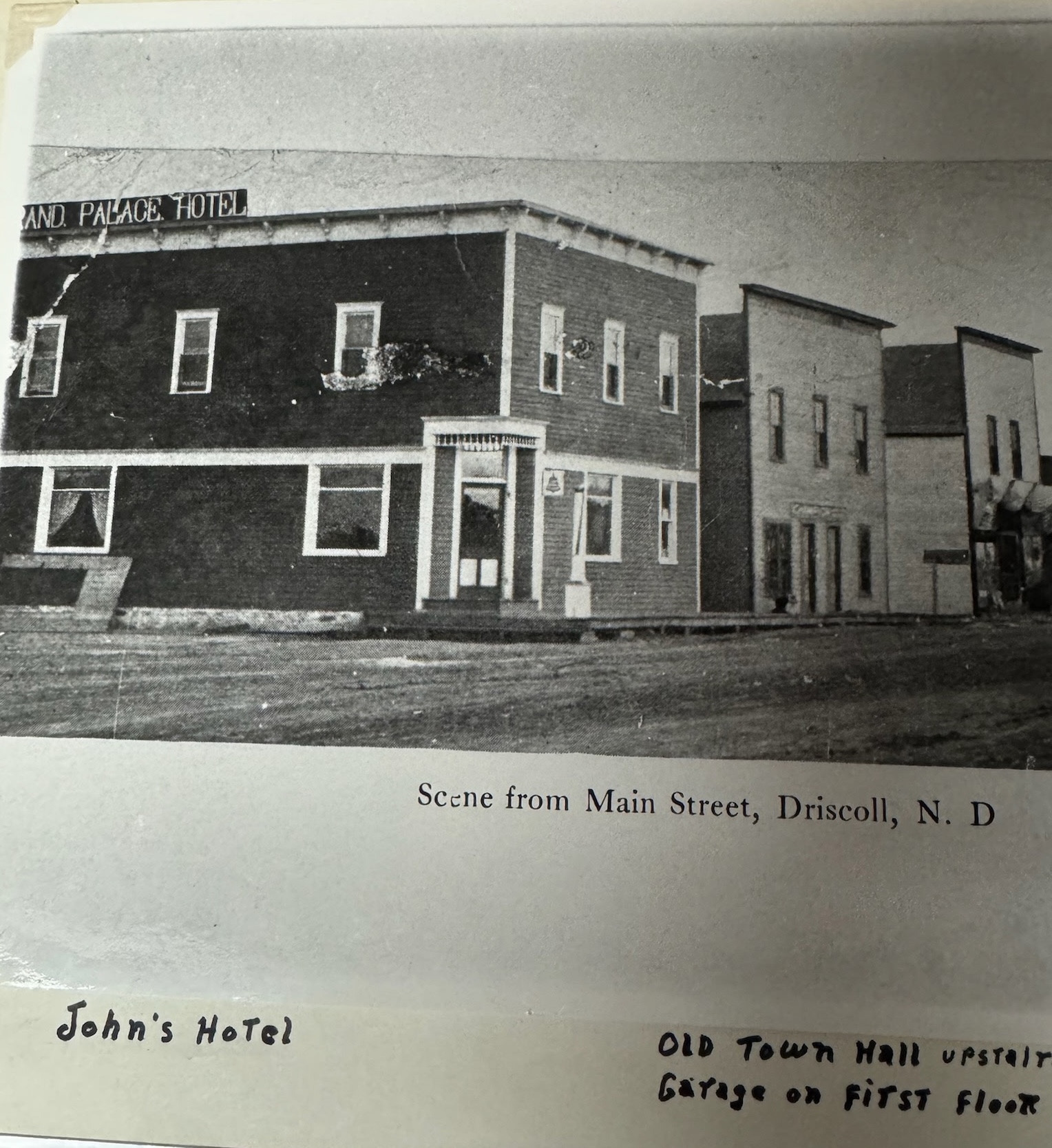
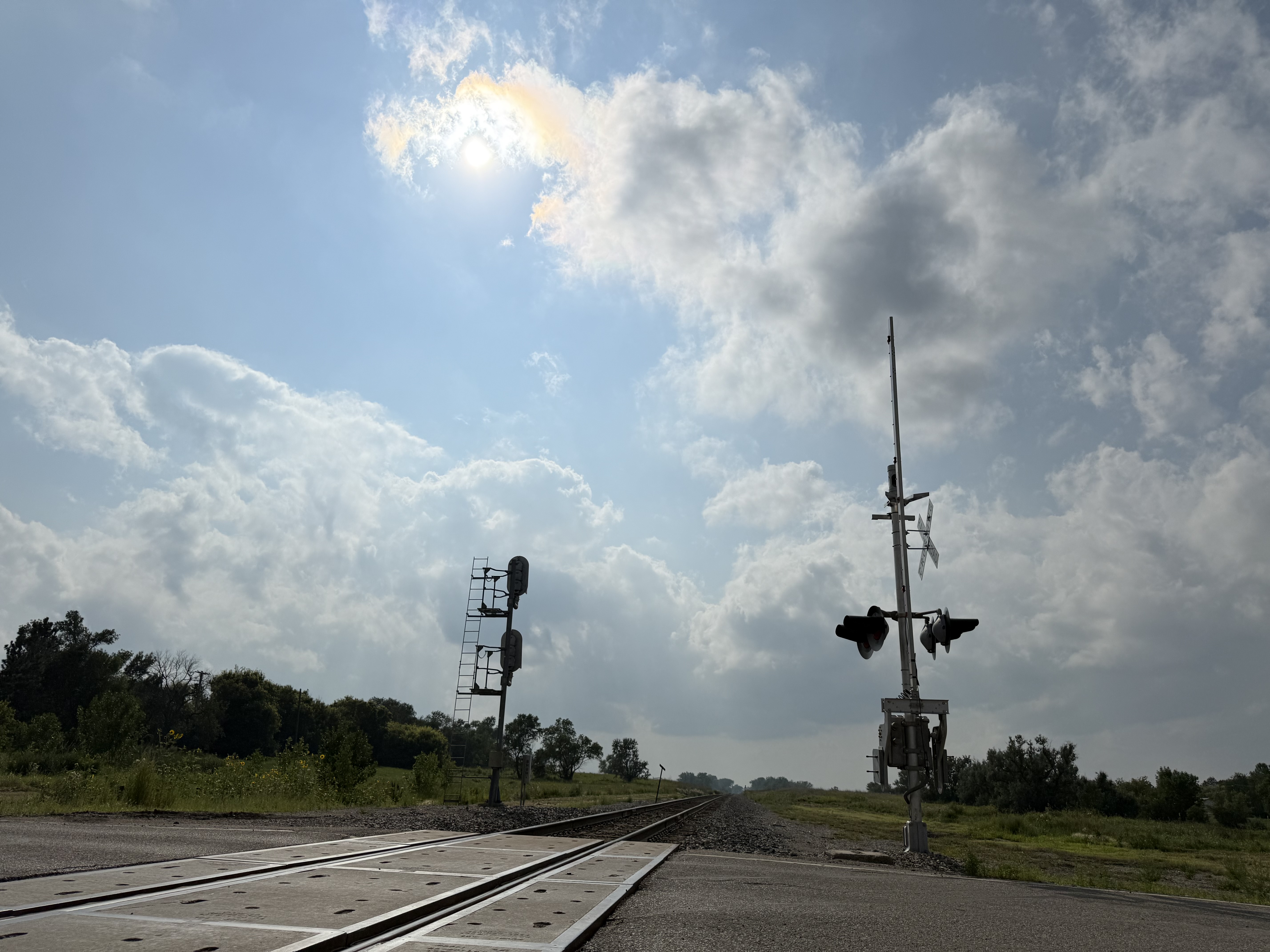
On August 3, 2025, I had a chance to stop along where the north-south automotive road crossed the east-west railroad tracks at Driscoll in an attempts to better acquaint myself with the landscape, and imagine what had been 110 years prior. Fast forward to this week of December 14, 2025, and the text message thread: Kate Herzog (also a commissioner for Bismarck Parks & Recreation District) mentioned some of her great grandparents owned the Grand Palace Hotel, she thinks in the 1910s. Perhaps a bit later. Now cut back to Era Bell Thompson’s 1946 memory of her family relocating from a house “to the empty hotel on the edge of town” (page 26 of American Daughter). Was this the same hotel? I mean, how many hotels could have a town of approximately 100 people supported in the 1910s?

Of the hotel, Era Bell said,

“The hotel was an old, eighteen-room barn of a building, bare and cold, but we set up living quarters in the spacious kitchen, and that night Pop made southern hoecake on top of hte gigantic range and fried thick steaks in butter. The tightness was gone from the corners of his eyes as he threw his head back and sang, ‘I’m so glad, trouble don’t last alway, Oh, I’m so glad, trouble don’t last alway.'”

Kate Herzog texted me this digital image of this hotel week of December 14, 2025.

Also within Era Bell Thompson’s memoir is a Norwegian store owner and clerk identified as “Old Lady Anderson.” Herzog mentioned she had Norwegian kin in Driscoll with the surname Hanson. Are these interconnected somehow? Era Bell also mentioned an Oscar Olson, and a Hank Hansmeyer, the local blacksmith who offered the Thompson family land to share crop on a quarter section that had yet to be picked clear of glacial rock deposits. Era Bell recounted the agreement (page 29): “Hank… would furnish the land, the buildings, and the horses if we… would furnish the seed, do the work, and give him half the profits.”

There’s nothing definitive from this blog entry of mine. Only a continued fascination of the layers of meaning on a particular landscape. A landscape that could otherwise feel “like nothing is HERE!!!” We’ve heard this all too many times from visitors of our rural, or “rural.” Without this meaning, without the intentional and sustained want of us in the present to incrementally scratch the layers away to find out what has happened here in the written, published, and oral historical record, it may well remain a superficial place of “nothingness.” But there’s a lot going on here. A lot today. A lot from yesterday. It’s a model used by the fancier Simon Schama in his Landscape and Memory (Vintage, 1996). I’ll keep chugging on this. But for now, at least I’ve been able to locate in the present the person (Kate Herzog) who will help lead any real or imagined future landscape memory bus tours to Driscoll in eastern Burleigh County, North Dakota.


Era Bell Thompson Local and Global: Windshield Reconnoiter in Driscoll, Burleigh County, North Dakota

A week or so ago (August 3, 2025), I pulled off a section of Interstate 94 in North Dakota, I-94 Exit 190, in eastern Burleigh County. I’ve been reading the two published works by Era Bell Thompson, American Daughter (Chicago: University of Chicago Press, 1946), and Africa: Land of My Fathers (Garden City, New York: Doubleday & Company, Inc.: 1954).

Published in Post-WWII America, in a span of 8 years, these works take the reader from the Iowa to the Northern Plains to Chicago, and across the Atlantic Ocean to Thompson’s attempts at ancestral genesis locus. While reading the latter, last night Thompson was navigating 1950 (or thereabouts) Dar es Salaam, Tanzania, and layers upon layers of colonization that arrived to the present.

At page 201, Thompson republished verbatim the slip of paper that prevented her from being able to freely see this section of East Africa:

“NOTICE TO PROHIBITED IMMIGRANT

…Take notice that I have decided that you are a prohibited immigrant on the grounds that your entry in Zanzibar is undesirable. You are hereby ordered to remain on board and to leave Zanzibar by the aircraft in which you arrived at Zanzibar.” 

Thompson says it was signed by an agent of the Principal Immigration Officer of Zanzibar. Reading this felt like similar wine, but different bottle. History resonates that way.

It also got me thinking about how, as the time barge continues pulling us into new iterations of the present, how historians might think of ways to communicate the past to present and future generations. And provide theoretical models in which to understand those infinite pasts. How does one, for example, teach the long nineteenth century to, say, a 4th or 8th grader? It can, at that last sentence, initially feel just completely overwhelming. I mean, so much happened: empires (British, French, Spanish, Portuguese, Netherlands) duking it out. Locals and globals on the ground, perhaps carrying the flag of their dwindling empire, or hoisting a new flag of this or that nation or nation state. And all this, trying to navigate the rubric of global capitalism, locals with traditional barter trade systems that remained relevant for generations upon generations, these same barter systems now swimming in similar waters as industrial global capitalism. 

But getting back to it: this is where sense of place really matters. A person should pick up Era Bell Thompson’s books. Read them. And then consider relocating themselves, in the present, as approximately close as they can safely and legally get to her global and local footprints. I’ll keep on that course. 

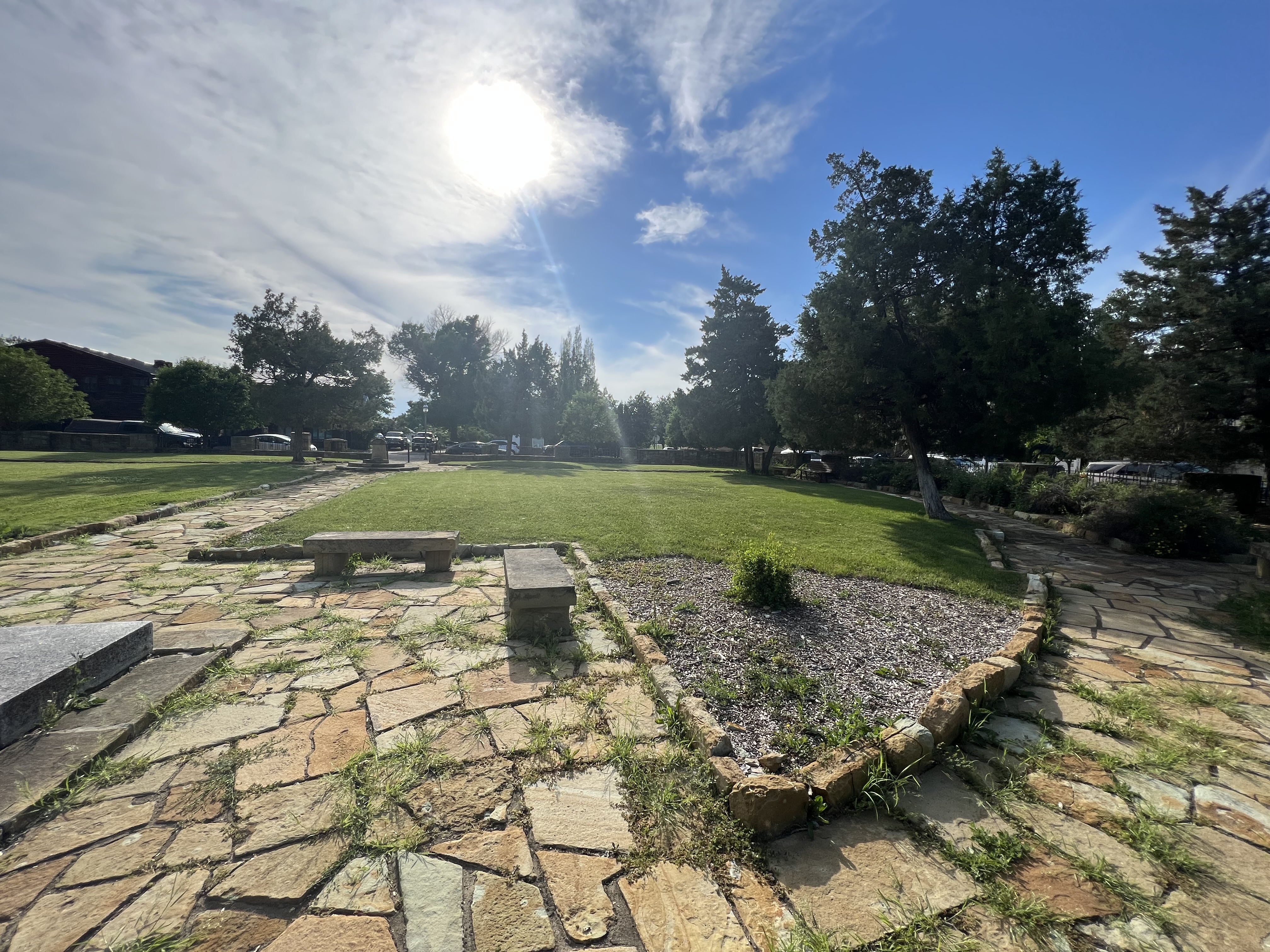
View to the west, at Driscoll, along a section of the historic Northern Pacific Railroad, the historic linear corridor that would have been used by passenger rail car and brought Era Bell Thompson’s family to this area of Driscoll, Burleigh County, North Dakota, in the 1910s.

Present Reality and Past Memory: Scandinavian Diaspora, Then and Today

Over the weekend, I was able to attend the Norsk Høstfest, a long running annual festival in Minot, North Dakota that, as the self-descriptor says, is a celebration of “Scandinavian culture and heritage of the five Nordic countries of Denmark, Finland, Iceland, Norway, and Sweden.” This is a good descriptor (descriptors are difficult when trying to communicate in very short and sweet verbiage what one is trying to communicate to potential readers who don’t have a lot of time to sit and read long form or short form journalism, let alone slopped out blog posts on diaspora theory).

I’m not entirely satisfied with this interpretation just remaining as is. While at Høstfest, I texted a bit with a friend of mine in Helsinki (yes, Finland, not Minnesota). He texted back a couple times (when I texted him, it was around 2-3pm central standard time, which with the 8 hour difference, meant it was 10-11pm Helsinki/eastern Baltic Sea time).

We got to a bit of spirited back and forth on authenticity: always a theme in any kind of cultural experience. Like when you return from an experience, sometimes the question was, “Was it authentic?” or the statement assertion is that, “That experience was authentic.” The text message exchange got me thinking about authenticity, the perception thereof, and trying to tease out a universal definition of what authenticity could mean. The word authenticity appears to me to be related to authority, and the word author, too. But these three words — authenticity, authority, author — are interconnected in the capacity that they assert through one (or a collective) of past memories and present experience the way things are or ought to be. Which when an author is asserting something, here’s a way in which to experience that: it’s okay to accept the author’s assertion. But one doesn’t have to agree with them.

Anyhow, texting with my friend in Helsinki, it appeared a bit odd how Finland was reflected in Minot, North Dakota (stay with me, here). So that returned to the topic of diaspora: peoples who have been spread from what they call their “original homeland” (but in the long history of people migrations, what does “original homeland” even mean), and the peoples who retain slivers or linear board sections of the culture they departed within the new spaces they settle and occupy.

Here’s where the cultural Instapot gets weird: the culture that left the homeland continues in the mindset of the migrating people, but the homeland culture continues to evolve in its own, new directions. So the Helsinki friend of mine, this morning, said something similar: he left Finland over 25 years ago, and when he returns he cannot seem to see the country he left behind. So the Finland he knows is in his mind. The present Finland, isn’t that. Because he recalls Finland in 1999 or so. The Finland today in 2024 is something different. Here we have two mental Finlands: the past memory of a Finland in the mind of the person that doesn’t live regularly in Finland, and the Finland Finland of today.

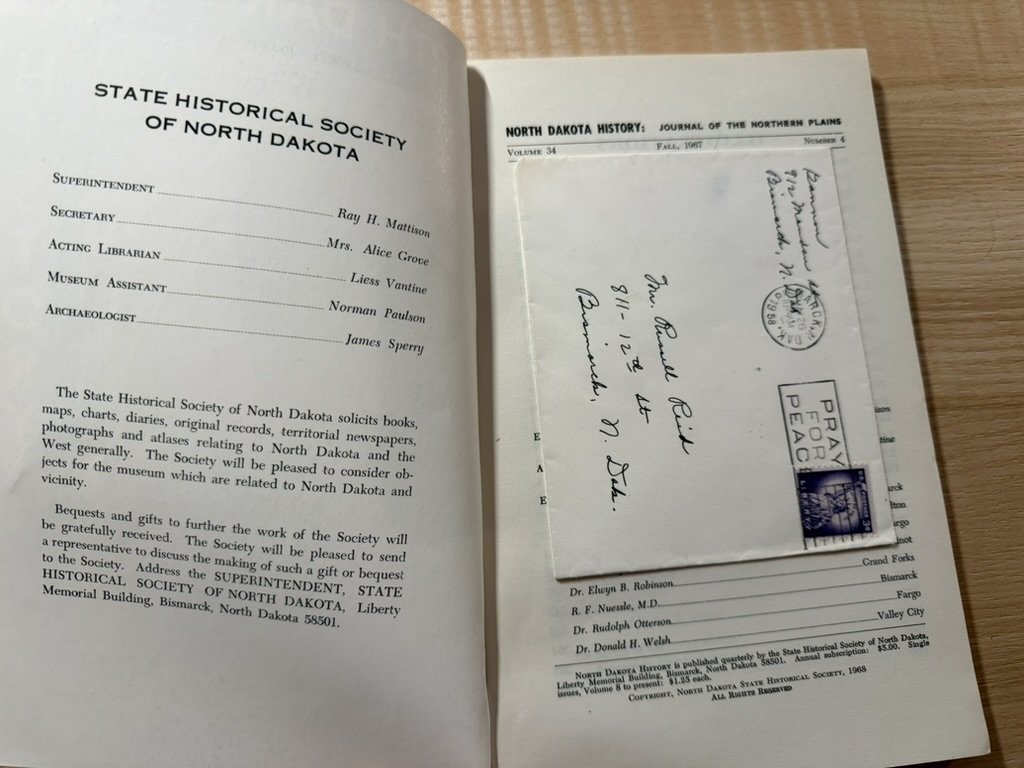
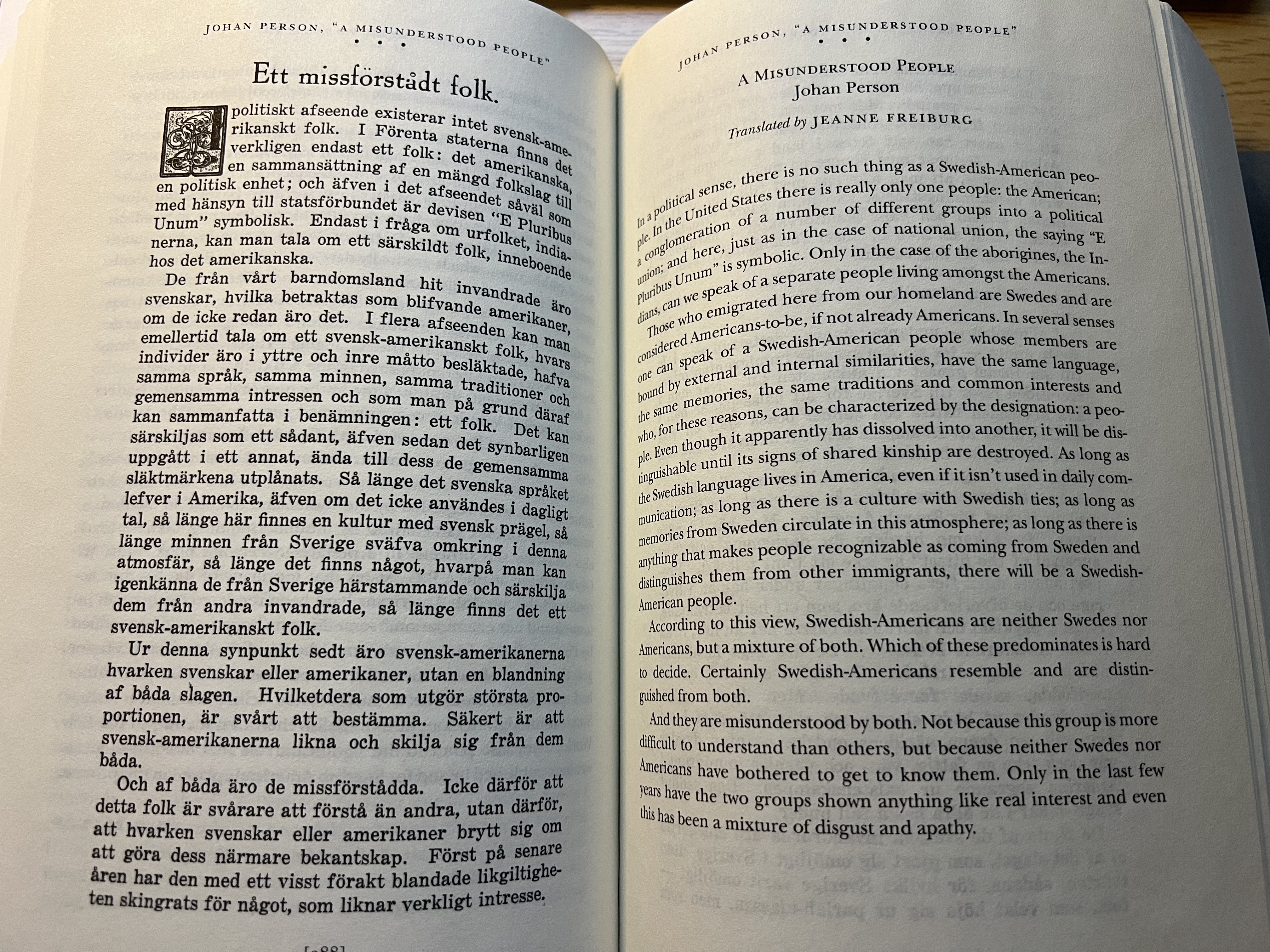
Here’s an historical case study on that, too: in The Multilingual Anthology of American Literature: A Reader of Original Texts with English Translations, edited by Marc Shell and Werner Sollors (New York and London: New York University Press, 2000), the section on Swedes, the opening page looks like this:

The third paragraph in reads this: “…Swedish-Americans are neither Swedes nor Americans, but a mixture of both.” So the diaspora cultural barges continue to float and evolve in their own directions and ways. And so do the host countries of their origins. Does it mean one group gets to really get in the face of another group and let them know, “This is how it is supposed to be!!!” I suppose. But it seems to reflect more of the insecurities of the assert-er than it does about anything else. And insecurities are okay, too: no human is human without them. It would appear the assertions are more grounded in a person’s or people’s want to have a cultural anchor of some sort, especially in a present that perceptively seems so out of control. Perceptively. Okay, that’s all I got on that. On with my day.


Biking Back to Work

After lunch today, I decided to bike back to work. Non-motorized bike. It was good. I’ve been around the sun well over 45 times, now, and the lure of incremental healthy (and fun) decisions has overridden any other decisions that seemed to intersect with the metabolic rate of my 20s and 30s. I’ve also been recalling in my memory some time ago hearing the phrase, “Well, every 7 years we are somebody different than we were 7 years prior.” That also links up with the understandable IRS requirement of retaining 7 years of records (kind of non-related aside). While on my ride, I was thinking about where I was 7 years ago, on the planet, and frame of mind. It indeed was different. None of which really is necessary to go into here (maybe it’s kind of secular spiritual for everyone to think of where they were 7 years ago, keeping it to themselves of their own record).

While pumping the pedals of the bike, I also enjoyed how much more audible the urban setting is from historic downtown Bismarck to the Missouri River front (audible even while my bluetooths allowed me to hear Ray Cappo discuss his spiritual journey through India in the early 1980s and such).

Photo below is from the Chief Looking Village overlook (Chief Looking Village was one of several interconnected Mandan-Hidatsa villages circa 1500s). In the photo you can see the horizontal light blue Interstate 94 bridge that spans the Missouri River at Bismarck (check out the Missouri River Heritage Mural on the visible pier at left). In the distance, with all the floating cranes, you can see the Ames contractors of BNSF, the floating cranes, as they are ramming pilings into the river to build a new rail bridge that can accommodate stacked rail cars for all those one-click Amazon orders that bring stuff from the Pacific World to Chicago, and everywhere in between. Once finished, BNSF will disassemble the 1905 bridge superstructure and the 1883 rail bridge piers (they were built with Minnesota granite). It will change the landscape viewshed of the river. Off in the distance of this photo, mid-right, you can see little dots on the horizon butte. Those little dots are the 1930s Civilian Conservation Corps reconstructions of the 1870s Fort McKeen/Fort Abraham Lincoln (today’s busiest state park in all of North Dakota). Bottom center you can also see the contour of a mountain bike trail, one of many that our Burleigh County Bicycle Cult friends maintain for everyone’s overland bicycling pleasure.