Tag Archives: Public History

Memories and Material Culture for the State Historical Society of North Dakota

This is a historic pony truss railroad bridge that spans the Missouri River between Bismarck and Mandan. It is a cultural icon, and has an infinite amount of individual stories attached to it. If someone were to destroy or replace this bridge in the name of "progress," it would seriously hurt and damage the living local history and culture of Bismarck and Mandan.

This is a historic pony truss railroad bridge that spans the Missouri River between Bismarck and Mandan. It is a cultural icon, and has an infinite amount of individual stories attached to it.

Think of this for a second: one of the primary interests and concerns of historians is that memories are fixed to the stuff we use and live with. Memories are also fixed to the stuff that our parents, grandparents, and great grandparents used (landscapes, homesteads, historic buildings and structures included).

I recently received an e-mail forward from archaeological comrade and colleague Amy Bleier, Research Archaeologist with the State Historical Society of North Dakota (SHSND). As the lot of us within range of Bismarck already know, the SHSND is experiencing a much-needed expansion. This also means that Len Thorson, the Registrar with the SHSND, is looking for material culture, or 3-dimensional objects, or what we call “stuff.”

Stuff is much more meaningful if it has those stories and memories fixed and secured to it. And it allows historians to do what historians are trained to do: track change through time.

Thorson sent out the following e-mail the other day. It is cut and pasted below. In Thorson’s words:

The Museum Collections Committee is looking for contemporary items from North Dakota businesses and organizations that you have purchased and/or used… or someone you know who would be willing to donate objects to the SHSND. The items should be relatively small (for space considerations). A history of the object(s), along with appropriate documents and photographs, would add much historical significance to the objects.

Examples include product packages from Cass Clay, Hugo’s Family Marketplace, Dakota Pasta, Noodles by Leonardo, Red River Commodities/SunGold Foods (SunButter), HIT Inc. products, or many other products listed on the Pride of Dakota webpage: http://www.prideofdakota.com/

Other items (used in ND) we are seeking include: beekeeping equipment and supplies; Highway 10 memorabilia; items showing ND school consolidation; solar power devices; objects from the Bank of North Dakota; contemporary powwow related items; contemporary immigration related items; and modern agricultural items such as GPS equipment, and air seeder/drill parts, etc.

If this is something you wish to participate in, please let us know, but PLEASE don’t bring objects in for us to view. Simply reply to this e-mail, or even better, provide the information requested below. The information requested by us may also be sent online via the form at http://www.history.nd.gov/data/padq_emailform.html

Consider this. It is important. If you have some sweet modern artifacts — in the business, we often call this contemporary or modern archaeology and history — with a memory attached to it, you might contact Registrar Thorson, or anyone from the SHSND Museum Collections Committee. It is by and for North Dakotans.

N. Scott Momaday, “The Way to Rainy Mountain” (1969)

N. Scott Momaday, The Way to Rainy Mountain (1969) set the Kiowa oral history to print, and in the 1994 preface, Momaday explains how the work is split into three voices. The first voice is that of Kiowa oral and ancestral history, the second is a type of historical commentary, and the third is the personal memoirs of Momaday himself. For this reason the entire work is a kind of historiography, or the way in which historians remark, opine and reflect on the works of their predecessors. The importance of The Way to Rainy Mountain is not only that it sets an oral history to print, but also that it allows non-Kiowa individuals access to the depth and scope of Kiowa culture. Momaday demonstrates how the Kiowa interacted with the Great Plains over generations and have a genealogical investment in the landscape.

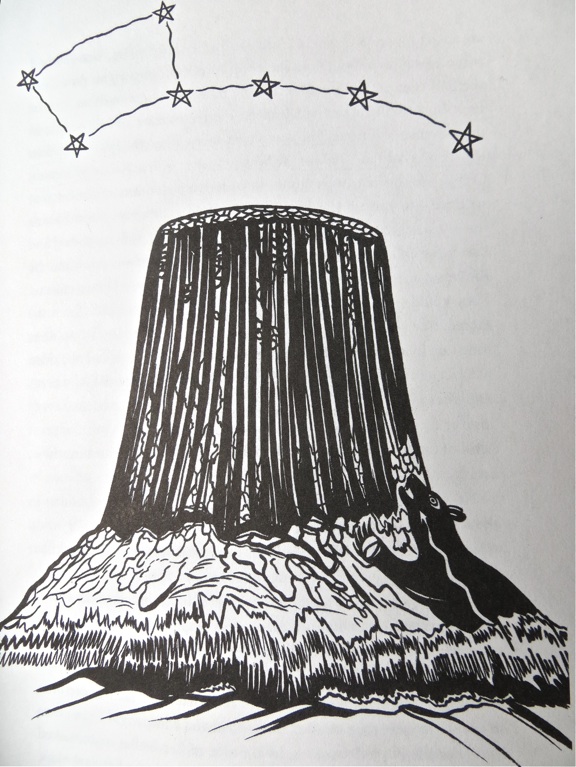
Like many cultures throughout the world, the Kiowa were nomadic, and their oral history and legend reflects this. Genesis for the Kiowa took place when the Kiowa as a people emerged from a hollow log in the “bleak northern mountains” of today’s Montana. (Momaday, 1969: 3) They eventually ended up in central Oklahoma, but along the way they impressed stories of themselves into the land. The Kiowa, for example, “made a legend” at the base of Devil’s Tower in northeastern Wyoming, and connected this legend with the astronomy configuration known as the Big Dipper. Momaday’s grandmother said:

Devil's Tower illustration by Al Momaday in N. Scott Momaday, "The Way to Rainy Mountain" (1969), 9.

Devil’s Tower illustration by Al Momaday in N. Scott Momaday, “The Way to Rainy Mountain” (1969), 9.

Eight children were there at play, seven sisters and their brother. Suddenly the boy was struck dumb; he trembled and began to run upon his hands and feet. His fingers became claws, and his body was covered with fur. Directly there was a bear where the boy had been. The sisters were terrified; they ran, and the bear after them. They came to the stump of a great tree, and the tree spoke to them. It bade them climb upon it, and as they did so it began to rise into the air. (Momaday, 1969: 8)

The bear scraped its claws along the base of the tree stump, and eventually the seven sisters rose from the top of this stump into the sky to become the Big Dipper. This story allowed the Kiowa to immediately identify with the Big Dipper, and with today’s Devil’s Tower. So long as the Kiowa were under a clear sky at night, the sight of seven ancestors shining starlight down on them could always provide them with comfort.

The second segment of the book, “The Going On,” opens with anecdote, a story about an old man, a wife and child. The child, innocent to the workings of the world, repeatedly asks his mother for food, leaves the house with it, and returns empty handed only to ask for more food. The third time the child returns, but with an enemy. This enemy tells the family of three, “There are many of us and we are all around. We came to kill you, but your son has given me food. If you will feed us all, we will not harm you.” (Momaday, 1969: 44) The old man is highly suspicious of this offer. His wife obliged the enemy’s request and began cooking while the old man secretly led his horses upstream. After bringing his possessions out of danger, the old man “called out in the voice of a bird” to his wife. She then set fire to the animal fat and tallow, threw it on the enemies, picked up her child and ran to the old man. The story might be used to explain the innocence of children, as enemies or malicious people can easily manipulate them. It could also be used to explain how it is wise to be skeptical of outsiders. In the kinship sense, this story also explains how the family of three looks out for one another.

The utility of anecdotes and stories such as these in any culture is multifaceted, and even biblical. To understand the Kiowa requires a degree of analogy (In The Landscape of History, [2002] Lewis Gaddis remarked on the importance of analogy for this and other reasons). The Kiowa and other cultures throughout the world infused stories and oral history into the physiography, and by this the culture became interconnected with the landscape and surroundings. Momaday’s 1969 The Way to Rainy Mountain was published almost 25 years after the revolt of the provinces, and almost 4 decades after the publisher of the University of Oklahoma Press called on academics and scholars to study Native America with the same intellectual rigor that they had brought to bear on Mediterranean culture.

Momaday’s work also communicates a kind of finality to this culture and others, and this also smacks of Stegner’s Wolf Willow (1955) and Kraenzel’s Great Plains in Transition (1955). Yet at the same time, it also brings about the notion found in Dorman’s Revolt of the Provinces (1993), specifically with John Joseph Mathews, Wah’Kon-Tah: The Osage and the White Man’s Road (1932). When the artists, scholars and literary figures revolted in America’s provinces and periphery during the interwar years (between WWI and WWII), Mathews finally found that the way to preserve and become a proponent of a culture was not necessarily to just recount and study it. (Dorman, 1993: 70-71) This was a part of it, but to truly locate authentic culture required the individual to become a practitioner and contributor to that historic cultural process. In this way, Mathews solved his 1930s dilemma through art, and specifically through Native American Art. Considering that Momaday published The Way to Rainy Mountain in 1969 raises the question as to whether a second volume is necessary to expand on and continue what Dorman ended in 1945. I certainly think so.