I snapped some photos this last Saturday during a hike along the upper Missouri River bottoms. Here is a brief collection of some of the shots.
The Missouri River bottoms just below Mandan-Hidatsa Chief Looking Village in Bismarck, North Dakota.
The second photo is the historic steel truss railroad bridge that spans Bismarck-Mandan, and it reminded me of the aesthetics that today are appropriated by steam-punk artists. If you want to know what steam punk might be, click here on this link.
A close up of the historic railroad bridge spanning Bismarck-Mandan.
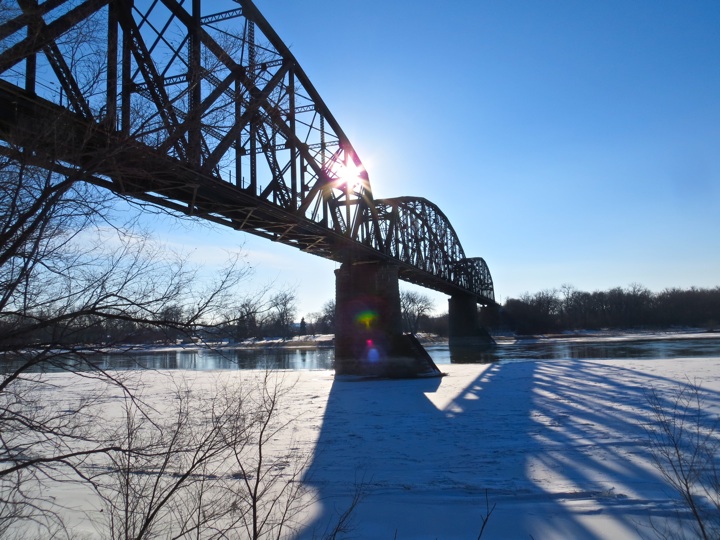
This next photo is an overview of the railroad bridge, with the winter sun setting in the late-afternoon.
Historic railroad bridge, looking west toward the winter sun getting ready to set.
And this final photo is of the icefishing that takes place on the Missouri River at the Grant Marsh boat landing. The I-94 Grant Marsh Bridge is also in the photo, but it does not look 1/64th as nice as the historic steel truss railroad bridge from three and four generations ago.
Sabir’s in Valley City, North Dakota, is owned and operated by a Kurdish family. It is an excellent place, just off I-94 (by the AmericInn motel exit). On occasions such as New Years Eve, Valentine’s Day, and Mother’s Day, a Kurdish-Levantine cuisine is rolled out, and the salads look like this:
After finishing the main course (we had seafood-stuff shrimp and calgary-seasoned ribeye), a dessert cart is rolled around so a person can gorge on sweets that look like this:
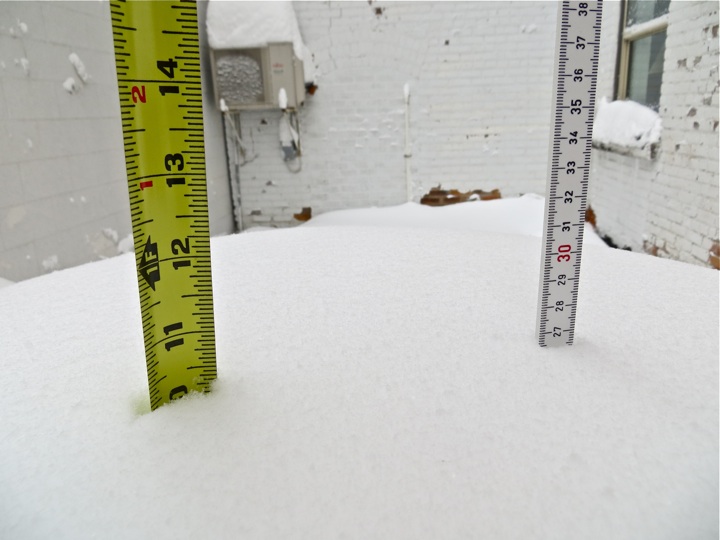
Readings of the snowfall at 8:30AM (CST) in downtown Fargo, North Dakota on February 11, 2013.
I’m not only talking about the weather just because it’s a safe topic of conversation. It is healthy for the mind and soul to discuss unsafe topics, and it is necessary to revive and invigorate culture. For example, it may be prudent to hold off on opening the conversation at Christmas Eve dinner with, “Hey, what do you all think about politics and religion, and can you pass me the gravy?”
But in any case, here is a very safe topic of morning conversation, a snap shot of the local patio readings from Blizzard Orko (the name ascribed to this blizzard, and not to be confused with Gandolf the White Blizzard, but certainly connected with Willa Cather’s thoughts on blizzards). These were taken at 8:30AM, CST, in downtown Fargo, North Dakota. Looks like just over 10″ in downtown Fargo as of this morning (centimeters are to the right).
Snow measurements from February 10, 2013, at 7:00PM (CST) in downtown Fargo, North Dakota.
Last week I revisited Walter P. Webb’s 1931 work, The Great Plains. In the coming days, I’ll blog a bit more on Webb’s work. For now, though, Blizzard Orko (as of 7:03PM [CST], February 10, 2013) induced several departments of transportation to close sections of Interstate 29 and Interstate 94 on the northern Great Plains: north-south from Grand Forks, North Dakota to Sioux Falls, South Dakota, and east-west from Jamestown, North Dakota in to Minnesota (the MNDOT’s road condition map I found is more general than decisive about exactly what sections are closed). These closures, or specifically this blizzard, reminded me a bit about Webb’s remarks on Great Plains blizzards, or what he pulled from Clement A. Lounsberry, the Civil War veteran who started The Bismarck Tribune in the 1870s. Of blizzards, Lounsberry (via Webb) referenced that historically they were known as a
…mad, rushing combination of wind and snow which neither man nor beast could face. The snow found its way through every crack and crevice. Barns and stacks were literally covered by drifting snow, and, when the storm was over, cattle fed from the tops of stacks. Persons lost upon the prairie were almost certain to meet with death, unless familiar with the nature of these storms… I learned of many instances where persons were lost in trying to go from the house to the barn, and of other instances where cords were fastened to the house so that, if the barn should be missed, by holding onto the cord the house could be found again (Webb, 1931: 25)
With this in mind, this evening I took some measurements of snowfall in downtown Fargo. At least 7 1/4″ of snow has fallen (it is now 7PM, CST). Tomorrow winds are expected to intensify, as is snow removal and book reading.
Rob Sand, a landowner immediate and local to the Killdeer Mountains, testifies in support of SB 2341.
A follow up to today’s hearing today at the capitol in Bismarck on Senate Bill 2341, spear-headed by North Dakota Senator Rich Wardner, and co-sponsored by a host of legislators. Individual archaeologists, Native historians, historians and local Killdeer Mountain land owners that testified in support of this bill included Tamara St. John, Dakota Goodhouse, Ladonna Brave Bull Allard, Waste Win Young, Tom Isern, Richard Rothaus, Kimball Banks, Rob Sand, Fern Swenson, Merl Paaverud, Tim Reed, and Mary Hoff (and I also testified, the synopsis of my testimony here). Private land owner issues mentioned in this article linked here are being addressed. Amy Dalrymple brings a more balanced angle to what happened here today linked here. Our conversation afterwards re-emphasized how private land owner rights are and continue to be protected throughout North Dakota, and our dutiful legislators said it may be a good idea to re-emphasize this in the bill. So there you have it. Props to all who came out today (there were many more in the crowd), and props to all of those that were there in spirit.
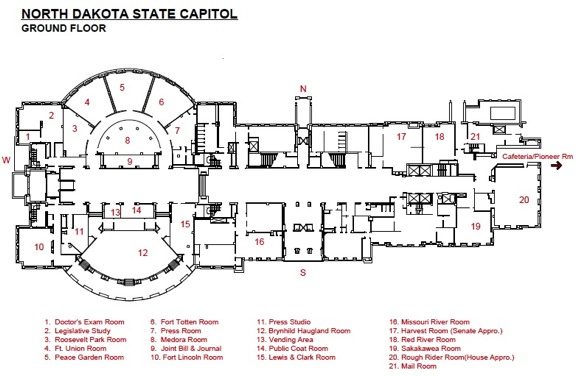
North Dakota State Capitol meeting room locations. Missouri River Room is #16, bottom-center of map.
Tomorrow, Thursday, February 7, 2013, at 1400 hours (CST), North Dakota Senator Connie Triplett (District 18, Grand Forks) will collaboratively sponsor SB 2341, a bill that seeks to carry out an archaeological and historic-archaeological study on the Killdeer Mountains in Dunn County, western North Dakota. I’ll be attending this hearing (it will take place before the Senate Government & Veteran’s Affairs Committee in the Missouri River Room), and Triplett has circulated an e-mail asking historians, landowners, archaeologists, Natives and others for testimonies to support this bill. The Killdeer Mountains figure into our nation’s history and the US-Dakota Wars that spanned from 1862 in the Minnesota River Valley, and carried on through 1864 at Killdeer Mountains in western North Dakota.
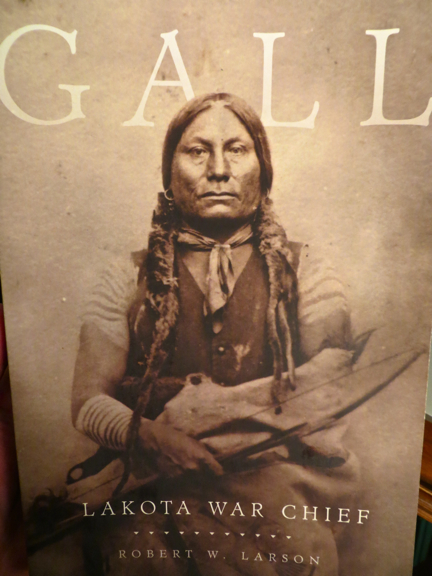
Taken from the cover of Robert W. Larson, “Gall: Lakota War Chief” (Norman: University of Oklahoma Press, 2007).
What we know right now about Killdeer from 1864 is limited (the State Historical Society of North Dakota has a nice and thoughtful write up of it here), and further archaeological and historical research is needed. It was an action between the Union Army and various Dakota nations, and some key players involved were Sitting Bull, Inkpaduta, Gall (among others), and General Alfred Sully and his Union soldiers. In many ways, just as this nation recognizes and respects fallen Union and Confederate combatants and non-combatants, this nation owes it to honor the Dakota soldiers and non-combatants killed in Dakota Territory during the Civil War. To extend this honor requires and necessitates a deliberate and culturally sensitive systematic archaeological and historical study like the one proposed in SB 2341. We understandably honor Americans that have fought and died in 21st century warfare, and we ought to also be honoring and rescuing those fallen and forgotten from the Killdeer Mountains from July 1864.
A quick concluding note on the punk archaeology unconference from this weekend at Sidestreet Grille and Pub in downtown Fargo, North Dakota. Since history, archaeology and life require us to put ourselves in the shoes of others, I wondered if it would be interesting for non-drummers to have access to a drummer’s view during a sound check. So here is a still photo of the stage from the vantage of the Audio-Video team from the University of North Dakota.
View of the stage from the Audio-Video sound station.
And here it is from another angle, a drummer’s view of the sound check (this brings up the fact that there are always more than two sides to a story, or history):
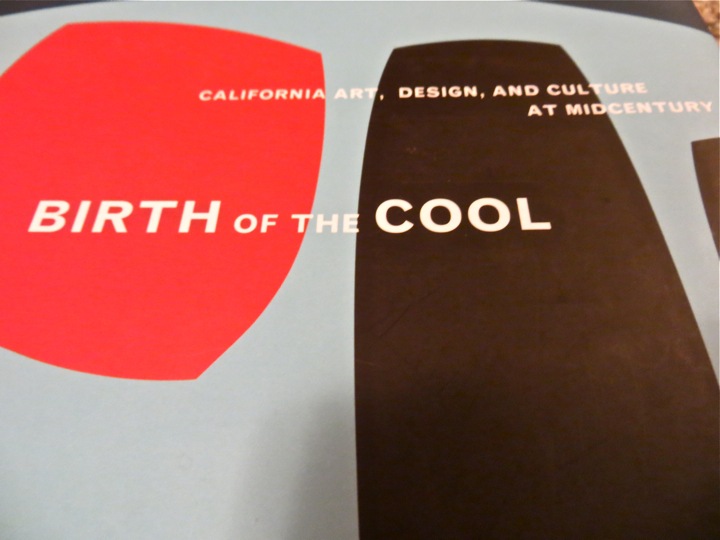
“Birth of the Cool: California Art, Design, and Culture at Midcentury” (Orange County Museum of Art: Prestel Publishing, 2008).
This weekend marks the day the music died. I’ve been reading Birth of the Cool: California Art, Design, And Culture at Midcentury, edited by Elizabeth Armstrong and issued by the Orange County Museum of Art (Prestel Publishing) in 2008. It is a kind of work that explores the genesis (or amplification) of “cool” from southern California, and this raises a chicken or the egg question: in the post-WWII world, did southern California create “cool,” or did southern California appropriate cool, embrace it, and then turn it up to — in the words of Spinal Tap — eleven?
It’s not cool to talk about cool, and that is a primary working definition of cool from the post-WWII world (captured in many ways by Anatole Broyard’s 1948 essay, “Portrait of the Hipster”). In Armstrong’s words, cool is “an attitude that eludes those who try too hard to achieve it.” (Armstrong, 2008: 1) In the essay “Cold War Cool” by Thomas Hine (also in this work), he says “Those who speak and write most about it — including most of those quoted in this essay — don’t have it. Truly cool people know enough to keep their mouths shut. (Nevertheless, I shall proceed.)” (Hine, 2008: 194) So shall I.
Buddy Holly in the 1950s.
Anyhow, and to not get too far off the topic of Buddy Holly, here is a photo of Buddy used in Birth of the Cool. The caption beside Buddy Holly notes his influence on The Beatles and Rolling Stones, among others (including Jonathan Richman). So in thinking about all this, it’s appropriate to say that my S-10 Chevy is snowed in an alley parking spot just 2.5 blocks from the levy, and this Friday evening I’m going downtown Fargo for a bit of whiskey rye. And to think a bit about the weekend day that the music died. The world sure missed out on a lot of great tunes because of that plane crash in Iowa on February 3, 1959. They were trying to get to a show in Fargo-Moorhead. At least Buddy continues to echo throughout the rock and roll ages, whether we know it or not, aesthetics and rhythm and all. Thanks Buddy.
Speaking of winter in My Ántonia (1918), Willa Cather noted that “man’s strongest antagonist is the cold.” As I type (on 01/31/2013, just before noon), the dry temp in Fargo, North Dakota registers right around -9 F, around -9 in Grand Forks, -17 in Jamestown and Dickinson, -18 in Towner, -13 in Valley City and Bismarck, -20 in Williston, and, for international scope, -11 in Irkutsk, Russia (a Siberian city with a population of over 1/2 million).
On the walk to work today I was thinking back to some of my elementary school days in the context of cold winter weather. The phrase “blizzard warning” often triggered the following thought — with an anxious question mark at the end — of “school closings due to severe winter weather?” in my earlier elementary school mind. When superintendents and sometimes governors yielded to the winter and Boreas, and they finally decided to shut institutions (sometimes the entire state) down for a day or two, the next thought that went through my elementary school mind was, “With school canceled, now I’ll have time to try and convince my mom that it’s still not bad enough for us to get outside to go sledding, work on that winter fort…” and so on.
Winter driving on Interstate 94 in North Dakota, February 2013.
In a big way, winter is dealt with by getting out in it (bundle up, of course).
The large snow piles heaped in the middle or on the edge of parking lots also reminded me of first grade “King of the Hill” matches on playgrounds. For whatever reason, students who partook in these matches had recess privelidges revoked (at least for that recess), and they got a stern talking to. What never made sense to me, though, was how an elementary school student was supposed to look at a giant heap of snow piled high in the middle of the playground and not feel hard-wired to climb it. I don’t know how today’s elementary schools deal with snow removal and snow piles. But looking back at it, I suppose those early piles of snow taught me some rudimentary basics of Darwin, and the blowback of cultural and institutional regulations imposed by those watchful recess supervisors.
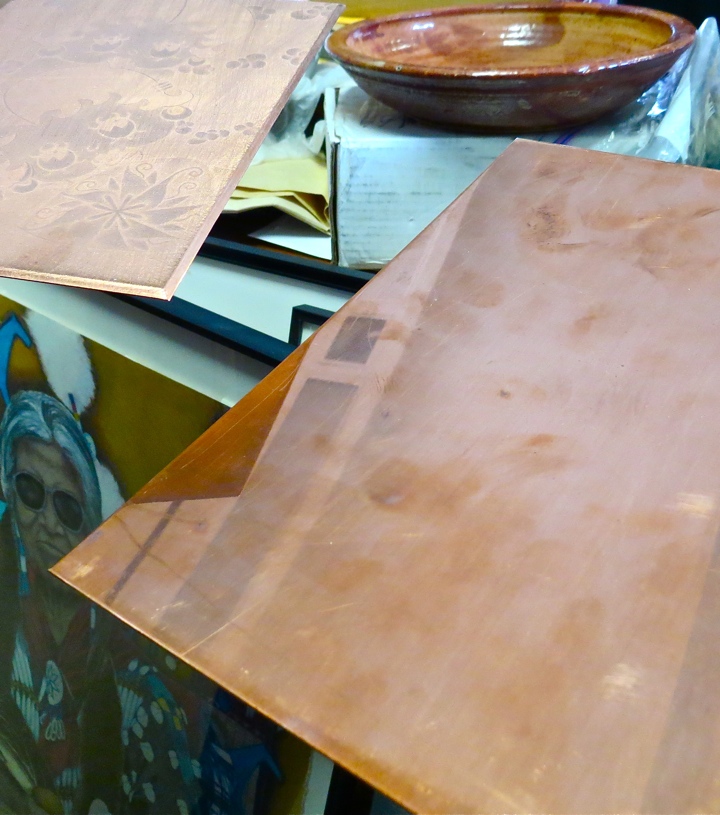
Early this morning I restructured my schedule to respect the snow that had melted and turned to ice overnight on Eisenhower’s Interstate System (the I-94 part). This meant that instead of driving up to the Chester Fritz Library at the University of North Dakota for research, I decided to stay put and spend the morning in Valley City. After inhaling an omelette with Molly at Vicky’s Viking Room, we drove over to Valley City State University to visit Linda Whitney, professor of art at said university. Linda is an accomplished artist, and she has been working with copper plates and creating mezzotints.
This evening, while revisiting the White Stripes “Get Behind Me Satan,” I set into a bit of research on the origins of mezzotint. The name Martin Schongauer (c 1448 to February 2, 1491) is bound to the history of the mezzotint, and he arguably is its principle founder.
The actual art of mezzotinting (now a verb) requires a sharp degree of skill, as artists often were charged with producing as exact a copy as possible of an original, painted work of art. Perhaps one of the greatest known mezzotint prints in America is that of Ben Franklin, a mezzotint created from a painting, thus popularizing the image. And this pushes an individual to consider how a standardized image could provide a large group of people with a common icon to rally around. We have mezzotint to thank for that.
So without going too far into the history of Schongauer (note: in 1491, he did die on the same day that Punk Archaeology in 2013 is happening — it will be awesome), here is a 2-minute audio-video from January 28, 2013, of Linda Whitney explaining the mezzotint process in her printing studio at Valley City State University.
A famous mezzotint of Franklin by Johann Will after a painting by Cochin.
Linda said the mezzotinting keeps her busy, and she often puts a year’s worth of master artist labor into each copper plate — one mezzotint rock after another, to get the precise etch into the plate, so the plate takes on the correct amount of ink, and transfers it to paper to make an intelligible image.
I pressed her with a question to get some kind of hourly grasp of what this type of labor meant. I asked her if she was putting in 40 hours/week on each mezzotint. She said it was more like 60-to-65 hours/week. I thought about that on the drive over from Valley City to Fargo today, and the rough equation went like this: if a large copper mezzotint plate takes about a year’s worth of work, that means 65 hours X 52 weeks = 3,380 hours. Now take 3,380 times the hourly amount of a master craftsman’s wage (ahem, or -woman, or craftsperson), and only then do we start to understand what these copper plates are worth, now and throughout time. To run an analogy between yesterday’s mezzotint and our ability today to digitize any image ever, the mezzotint was important back in the day because one singular image could be reprinted in the same way over and over again, on numerous sheets of paper. Thus, the same idea could be communicated to a large swath of individuals (this could be important for matters of theology like in Schongauer’s day, but also, for example, in matters of technology and crop rotation and philosophy and paper money and so on — stuff that made and makes societies run smoothly).











 The Edge of the Village