Tag Archives: North Dakota State University

Great Plains East vs. West

In the last couple weeks, or in the last week, I’ve noticed how the national and international news have ran stories on Sioux Falls, South Dakota and Fargo, North Dakota. Sioux Falls and Fargo fall along the north-south Interstate 29 corridor in far eastern Dakotas, and they originally served as railroad gateways to the northern portion of the Great Plains and American West. They share some similarities because of this. As well, they got one of the earliest urban foot-holds, and they also attracted colleges (back when the distinction between college and university was still quite distinct — a college could be a part of a larger university).

In the first pieces — here, and here — on the “Fringe City” of Sioux Falls, The Atlantic Monthly’s James Fallows compared and contrasted this South Dakota city with Burlington, Vermont. The problem with this, of course, is realized when one looks at the history of both cities. Burlington, Vermont is a place with a dense population, and dense populations surrounding it. Sioux Falls and Fargo, in contrast, are places with comparatively dense populations, and they serve a rural surround that is much more sparsely populated. If you’re from Bismarck, ND (like I am), you will have in your collective memory stories about certain economically privileged friends in grade school and junior high and high school regularly getting to go to Fargo for the weekend so their parents could purchase them designer clothes. These friends could then return and inform the rest of us what was hip and cool. This, I have found, is one of the personal historical memories that I use to argue why I would be totally cool with a return to the school uniform (something Angus Young appropriated and continues to own on stage quite well). But that is another topic for another blog.

The main point is that it reflects the reliance and tension, at least from the 80s and 90s, that Fargo and Sioux Falls and the rural surrounding areas generated: individuals living in these cities both loved them, and they loved to have contempt toward them as well. This, in turn, is a larger theme of the Great Plains, as you’ll hear similar stories from what central and western Nebraskans and Kansans have to say about their eastern cities.

In the second piece, Fallows opines on the architectural history of Sioux Falls, and this reflects the larger theme of architectural history in the American West. Go to any town in the Dakotas, and a large chunk of the monumental architecture dates from before and just after the turn of the 19th century. This is often the period when the wood structures either succumbed to city-wide fires, or were torn down to make way for superstructures with sturdy granite and brick foundations (Fallows mentions the Richardsonian Romanesque architecture of Sioux Falls, and a comparable building in Fargo would be North Dakota State University’s Putnam Hall). This is also a period of history that had some of the greatest economic and un-ashamed monopolistic magnates, individuals with operations based out of the Twin Cities (for example, one of the prime reasons North Dakota has a state bank and a state elevator has to do with big Twin Cities bankers knowingly or unknowingly fleecing North Dakota farmers — eventually, North Dakota farmers said we’ll just create our own bank and mill if we can’t get decent rates and grain prices from Minneapolis and St. Paul).
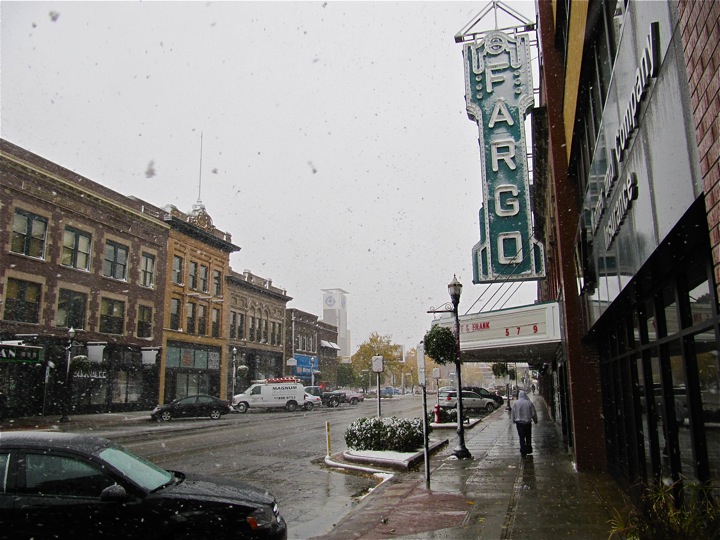
The iconic Fargo theater signage in downtown Fargo, North Dakota. ESPN's College Game Day is looking to use this as a backdrop for their coverage of Saturday's game.

The iconic Fargo theater signage in downtown Fargo, North Dakota. ESPN’s College Game Day is looking to use this as a backdrop for their coverage of Saturday’s game. Photo by Aaron Barth, from October 2012.

In the realm of Fargo, Slate.com ran a short piece on a proposed skyscraper to be built in downtown, Fargo (about 6 blocks from where I live). Skyscrapers (and grain elevators for that matter) on the prairie, I argue, look all the more cool because they are set against the horizontal backdrop of the Great Plains. Fargo, and North Dakota, are indeed booming, and not just because of petroleum. This Saturday, ESPN’s College Game Day is coming to downtown Fargo, to broadcast the football game between North Dakota State University and Delaware State University. While NDSU and the University of North Dakota (Grand Forks) no longer play one another in the historic regional football rivalry, I think both universities are getting more mileage for the state by playing non-North Dakota audiences. Even if a North Dakotan has absolutely no affiliation with NDSU or UND (which, considering the state is about 700,000, would be almost impossible), all of non-North Dakota watching this ESPN game may at some point attach said game to future encounters with North Dakotans. It’ll be up to us to figure out how we want to respond to that. I’m all for it.


Learning Dakota

Tom Isern and I (among others) are taking an introduction to the Dakota language with Dakota elder Dr. Clifford Canku (pronounced “Chanku,” with emphasis on the first syllable; the word Canku means “the way” or “the road” in Dakota). I thought I’d snap a panoramic photo of what class room looks like, at least from my seat.

Canku and Isern

More on this all in future posts. As an aside, folks can go on-line and hear Canku learn Dakota at this website here. Okay. Tokesta ake (“See you later.”).


The Killdeer Mountain Battlefield Landscape

Basin Killdeer Proposed Route

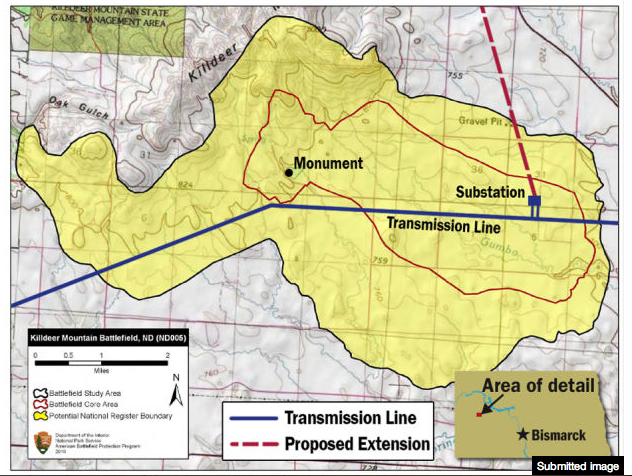
The Bismarck Tribune’s graphic of the proposed route through what essentially is the Gettysburg of the Northern Great Plains, the Killdeer Mountain Battlefield from 1864. Historical actors involved included Sitting Bull, Inkpaduta, Gall, Sully, among others.

This morning a story broke in The Bismarck Tribune on a proposed transmission line route directly through the core area of the Killdeer Mountain Battlefield. North Dakota State University’s Center for Heritage Renewal, led by Professor Tom Isern, responded with the following media release:

Aug. 30, 2013

Media Advisory

The Center for Heritage Renewal at North Dakota State University is preparing a submission for the North Dakota Public Service Commission hearing in Killdeer on Sept. 4. The subject is an electrical power transmission line and substation proposed to be built, by Basin Electric, in the core area of the Killdeer Mountain Battlefield. The topic has been covered by North Dakota media, starting yesterday.

The Center for Heritage Renewal was established to identify, preserve and capitalize on the heritage resources of North Dakota and the northern plains. One of the center’s objectives is to assist state agencies, private organizations and the people of the state and region in generating prosperity and quality of life from heritage resources. Another objective is to provide expertise and action in the fields of historic preservation and heritage tourism.

The center recognizes the efforts of Basin Electric to support regional development but is concerned that the environmental impact statement for the project takes no cognizance of the historical significance of Killdeer Mountain. 

The center has signed a contract with the National Park Service to survey and study the Killdeer Mountain Battlefield, which the park service has identified as a significant Civil War-era site in North Dakota. The contract is with the American Battlefield Protection Program of the National Park Service.

Killdeer Mountain was the chosen ground on which Dakota and Lakota fighters, including Inkpaduta and Sitting Bull, confronted the Northwest Expedition, commanded by General Alfred Sully, on July 28, 1864. This was the largest military engagement ever to take place on the Great Plains of North America, and a crucial episode in the Dakota War of 1862-1864.

University Distinguished Professor Tom Isern, founding director of the center, observes, “Killdeer Mountain is the Gettysburg of the Plains. It is, arguably, the most significant historic site in all of North Dakota.”

Isern is available to discuss this issue. He can be reached at 701-799-2942

More to come…


Cultivating the Humanities

This morning I am sitting down to my usual coffee, and thinking about several responses to the latest report issued by the American Academy of Arts & Sciences, “The Heart of the Matter: Report of the Commission on the Humanities and Social Sciences,” that of which is linked to here. I was checking in with my buddy Bill Caraher’s blog today and I noticed he linked to a few responses to this report as well, here and here, and another Wall Street Journal piece here. While reading all of these, a sort of anxiety started building up in me, this resulting from the following thought: why not read a scholarly monograph or a novel instead of reports on whether or not the humanities and social sciences is in a fatalistic state of decline?

I also thought about how the humanities are everywhere, and then I wondered how people who complain about having gotten nothing out of college spent the majority of their time in said college. Were they doing keg-stands, or were they in the library stacks, perusing used book stores, reading-reading-reading, having coffee and conversation and beer and more conversation about interests with others, writing, re-writing and looking over the papers of one another or, once again, strictly doing keg-stands? Did their schooling look like this, as in Bluto from Animal House? Or did it look more like this, as in Max Fischer from Rushmore? (Max Fischer, of course, was in preparatory and private school, but the idea is there: he received mediocre marks, but he was involved in an endless amount of extracurricular activities).

I also wondered about the state of communities immediate to university campuses. For example, I stumbled into an undergraduate program (at the University of Minnesota in downtown Minneapolis-St. Paul) where the humanities (not even defined as such) were happening arguably more outside of the classroom and off campus than they were on campus. At least between 1999-2002, Dinkytown had two to three used book stores, at least two coffee shops (the Purple Onion was one of them), several hole-in-the-wall taverns, a used CD/record store with an endless selection of everything, a liquor store, pizza shops, an Afghanistan cafe, and so on. And this didn’t include the other stretch of coffee shops and cafes and taverns immediate to the intersection of Washington Avenue and Harvard Street. I did the majority of learning outside of class, and I figured out that you take these ideas into classroom discussions, at least those classrooms where professors allowed it (there are, of course, professors that command students to strictly focus on the required readings and nothing else, which is a different tangent all together).

What isn’t addressed in this Harvard-published work is how universities might work with their local community planning boards to develop an immediate off-campus culture(s) that allows students to explore said humanities on their own. Historic preservationists might get involved for sure, as this would require the renovation of those pre-WWII homes (please don’t tear them down for 2013 asphalt strip mall construction) just across the street from campuses to be converted into those excellent used book stores and coffee shops and hole-in-the-wall diners, local and ethnic. Make sure students can walk to these places rather than drive. If need be, use Dinkytown as a model or framework.

Also notice that the board of this Harvard report lacks students and graduate students. Every contributor to the board is some kind of established, high-powered professional. They are required to fatalistically bemoan the disappearance of the humanities and social sciences (I’m not big on fatalism, to be fair), and they should be doing this because that is what they see at their professional level. It’s important to keep that in mind. A future report would benefit from bringing more voices in from individuals who are in that liminal space between getting their undergrad and graduate degrees in the humanities and social sciences, and figuring out how to locate jobs or start entrepreneur-ing (not a word) themselves.


The Archaeology of Refrigeration

Plans to a root cellar from Summer 1976, No. 68, North Dakota State University Extension Service.

Plans to a root cellar from Summer 1976, No. 68, North Dakota State University Extension Service.

The ability to both produce and store food is a central component to the sustainability of any society. I got to thinking about this while reading Grand Forks Herald article earlier this morning on root cellars, and this in turn got me thinking about depressions archaeologists come across during pedestrian surveys. At first, a depression in the landscape simply looks like that: a depression. But this is why it is important to look to the written and oral history of a place, lest a former root cellar or a cache pit continue to go unnoticed.

Before the Second World War, and prior to the post-WWII shift of artificially conditioning the air to our homes and refrigeration devices within the homes (this is all connected with the cultural inertia that today has us searching and exploiting the world for petroleum), our grandparents and great grandparents kept food and drink cool with root cellars and cache pits. Using a subsurface pit (or a cave, which is how Europeans refined and perfected the wine and beer processes) for storage takes just a bit of planning, thought, and foresight. It can be done, though. Some call them root cellars while others call them cache pits (those bell-shaped subterranean pits used by Mandan and Hidatsa cultures).

After reading the Herald piece this morning, I shot an e-mail to a North Dakota State University extension agent to see if I could get a digitized copy of a 1976 plan for a root cellar. Within the hour the extension agent responded with “Electric Farm Power: Vegetable Storage” (Summer, 1976, No. 68), this prepared by the NDSU Agricultural Engineering Department, Cooperative Extension Service, and North Dakota Power Use Council Cooperating (yes, note the keyword “cooperative,” as cooperatives and cooperation are central to getting things done).

The illustration here is the design of a root cellar, and these also dub for tornado shelters in the summer. This is something to increasingly think about considering how Oklahoma has taken on serious tornados already this year, and also how a tornado came close to hitting the Denver International Airport not but a week ago. Anyhow, here above and to the left are the unadulterated plans to a root cellar.


Hoarfrost at North Dakota State University

Hoarfrost at NDSUEvery now and then, a celebration of winter aesthetics is in order. Here is a photo taken on the afternoon of February 26, 2013, on the campus of North Dakota State University, Fargo.