Tag Archives: History

Historic Scandinavian Log Cabins: Then and Now

Yesterday I visited a project area in the Sheyenne River Valley in southeastern North Dakota, and on the way back from fieldwork I stopped by some static public historical signage and historical Scandinavian-American log cabins on one of America’s Scenic Byway routes. I snapped some photos, downloaded them in the computer last night, and then started to do a bit of research on the archaeological project area: history often informs the archaeology, since much happens with the history of an archaeological site before archaeologists have a chance to descend on it.

While looking through a series of digitized photos, I came across a historic photo in the Digital Horizons/ND Institute for Regional Studies archive. The photo is titled, “Building at Fort Ransom, N.D.,” and it is a log cabin today located some miles north of Fort Ransom, N.D. I compared the historic with the modern this morning. Below are the photos I’ve looked at: one is a 1950s photo of the cabin, and below that is a June 16, 2013 photo. Note the gable-end elevation, and compare the shapes of the logs, and the seams of the logs. You’ll notice that they match one another.

A photo of the Slattum cabin in the 1950s.

A photo of the Slattum cabin in the 1950s.

A June 16, 2013 photo of the Slattum Cabin. Note the gable end elevation, and compare the seams of the log cabin with the seams of the gable elevation in the 1950s photo. They are the same.

A June 16, 2013 photo of the Slattum Cabin. Note the gable end elevation, and compare the seams of the log cabin with the seams of the gable elevation in the 1950s photo. They are the same.

As the public historical signage said, this cabin was built in 1879 by Norwegian immigrant Theodore Slattum, and he originally hailed from Christiana, Norway. He immigrated to Fillmore County, Minnesota in 1870, and he and his wife, Jorgine, relocated to the Sheyenne River Valley in 1879, where they built this cabin. They also raised nine children in the cabin (they modified the original cabin from what it looks like here in the photos). In 1945, this cabin was moved to the Fort Ransom Historic Site, and then moved back to this original location at some point around the turn of the 20th century (this is likely why the description of the cabin’s provenience is what it is within Digital Horizons/NDIRS; and this is also an example of how history informs archaeology, and not the other way around).

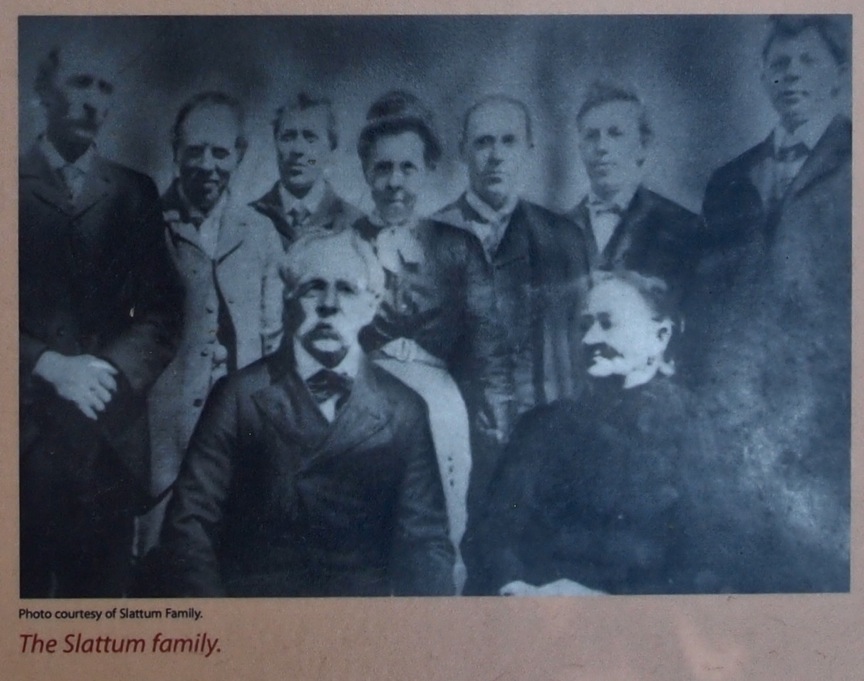
The Slattum family, this photo from the public historical signage at the cabin site. Photo taken on June 16, 2013.

The Slattum family, this photo from the public historical signage at the cabin site. Photo taken on June 16, 2013.


Some Philosophies of Histories

In a couple hours I will be taking what is called the oral component of the comprehensive exams. This is the business of academia, what I sometimes think of as the codification of intellect (everyone is sharp, or has potential to be sharp, and universities are designed with a goal of proofing and validating that sharpness). In that case, I am engaged in my morning ritual of visiting, revisiting and reading through some broad conceptual thinkers in final preparation for this upcoming, mid-morning fun.

A potential railroad metaphor for the various and competing tracks of time cultures and societies are hurtling along. This, we historians argue, is why world history is increasingly important in our increasingly global age.

The railroad as metaphor for the various and competing tracks of time cultures and societies are hurtling along. This, we historians argue, is why the study of history and the philosophies of histories is increasingly important to study in our increasingly global age.

In the largest scheme of things, these big-picture thinkers — from R.G. Collingwood to E.H. Carr to John Lewis Gaddis to Michael Shanks — force a reader to contemplate not just the technical hows of a discipline, but also the philosophical whys: for example, why would anyone be engaged in the efforts of history or archaeology or, more broadly, any discipline or trade for that matter? To contemplate this provides a variety of conceptual frameworks in which to filter data through, and these are the substructures of any discipline and trade. While keeping this in mind, it is also important to keep in mind that the disciplines and trades are by and for an infinite variety of culture and subculture and subaltern culture (and so on). Whether conscious of it or not, the collective memory within these groups influences to varying degrees the ways the substructures are built (if looking at the archaeology of language, for example, it quickly becomes apparent that languages are built out of previously established bodies of presumptions and assumptions).

With that said, in revisiting R.G. Collingwood, The Idea of History, (1946) R.G. says in his introduction that “Philosophy is never concerned with thought by itself; it is always concerned with its relation to its object, and is therefore concerned with the object just as much as with the thought.” This entire idea pertains to developing philosophies that disciplinarian doctors (which, to be pedantic, is Greek for “teacher”) train cadets and recruits with, so the latter understands that two thinkers can take the same body of evidence and can arrive at completely disparate conclusions. In the case of history, this is what 18th century Voltaire called a “philosophy of history,” and what 20th century E.H. Carr referred to as a dialog with the past. This philosophy and dialog is important — at least I’ll make the argument here — since the world has and always will be in a perpetual state of crisis. If met with crisis, we have to get used to the idea of re-calibrating and re-adjusting. This is not necessarily to accept the crisis, but to figure out ways through and around it. In some of Carr’s concluding remarks in chapter 5 of What Is History? (1961), he identifies three types of history (using the Royal “You” to bring his case home):

[1] You can, if you please, turn history into theology by making the meaning of the past depend on some extra-historical and super-rational power. [2] You can, if you please, turn it into literature — a collection of stories and legends about the past without meaning or significance. [and 3, which is where Carr is at his best, a proper definition of the historian.] History properly so-called can be written only by those who find and accept a sense of direction in history itself. [and in the copy on my shelf, the following is what I underlined] The belief that we have come from somewhere is closely linked with the belief that we are going somewhere. A society which has lost belief in its capacity to progress in the future will quickly cease to concern itself with its progress in the past.

Thus, for Carr (and myself), to engage in history proper is to engage in the faith of the future of society, and the discipline of history itself. This as well is why history is never “complete.” If history was complete, society would be complete, and both that society and history would be finished and at an end with itself. This, of course, is only theoretically possible, since nothing is ever truly at end. Rather, we humans impose the boundaries and limitations, demarcating a beginning and end for what is otherwise quite gradual and transitionary. This is why in the first two decades of the 21st-century we are having conversations about how we humans engage 2- and 3-dimensional objects. In the words of Michael Shanks, “the past has to be worked at,” (Hunter Thompson sometimes referred to journalism as analogous to chopping wood) and it is just as important to look at the past as it is to look at the way historians have sought to make sense of the past.

I keep thinking that, to use metaphor, as we stand on the 21st century dock and watch the 20th century Cold War — that barge of history — drift further and farther away from us, a host of new crises will continuously arise. Our ability to react to them will be predicated on not just how we know the past, but also of how and why those before us knew the past. And how and why they understood the past is also filtered through the ways in which we remember and know the past, and so on, ad infinitum. 


Getting Students to Like School

In Daniel T. Willingham, Why Don’t Students Like School?: A Cognitive Scientist Answers Questions About How the Mind Works and What It Means for the Classroom (Wiley, 2009), a reader is at once subjected to a subtitle with 19th-century length (for example, click here to check out the length of 19th century titles). More importantly, though, the reader is reminded how reading and studies shape and reconfigure the mind, that “three-pound mass of cells, approximately the consistency of oatmeal, that reside in the skull of each of us” (Willingham’s opening words). In the fourth paragraph of the conclusion, Willingham says, “Reading is a mental act that literally changes the thought process of the reader.” (Willingham, 2009: 207)

Get this book. It is good.

Get this book. It is good.

When I read this I thought, “Of course!” immediately re-remembering the way reading alters our way about the world (my mind was changed to remember how the mind changes when reading). This, in turn, caused my brain to recall conversations years ago from the University of Minnesota-Twin Cities, chatting with fellow undergrads and agreeing with the statement, “Whenever I read something, it often changes my mind.” At its best this is the power of a classical liberal education, or a liberal education, an ability to allow students to wander around in the infinite of ideas and build arguments and perspectives about the world. It is up to the teacher, though, to consider how they might best teach this to students. This requires historians to embrace the methodological ethos of thinking about thinking, or thinking about the way another person might understand the world, including students. And this in turn leads to pedagogical considerations about how to teach, which in turn leads to how to engage students with narratives and stories (aka, histories).

Willingham brings about one approach, a broad 4-part outline used by good and great screen-writers in Hollywood. It is building a narrative around the four Cs: causality, conflict, complications, and character. In Willingham’s book, he uses the example of Star Wars as a narrative to explain to the reader how important narratives are to telling a story worth remembering, and how this model can be used to teach memorable science, math and history (come to think of it, as an adolescent in school, mathematics became amazingly interesting when it was humanized with the founding thinkers of particular theorems and formulas. At once it was not just a Cartesian grid, but instead a grid work developed by this insanely intelligent Renaissance thinker, René Descartes… this information was crucial, at least to break up the 50-minute monotone lectures presented on overhead projectors in junior high and high school).

With the Star Wars example, Willingham answers the title of Chapter 3, a question laid out as, “Why Do Students Remember Everything That’s on Television and Forget Everything I Say?” To answer this with “Because you’re boring” would be true but incredibly unhelpful. The reason students remember Star Wars is because screenwriters have modeled the story or narrative around the 4 Cs (and also because Star Wars has permeated every facet of global culture, and also because of Star Wars dorkdom which propels some kind cult of Star Wars, but that’s another tangent for another time).  In Star Wars, there is a strong character development that is Luke Skywalker and Princess Leia. The overarching cause or causality is hinted at in the opening: find the plans for the Death Star so the rebels can blow it up. Throughout the story, though, Luke, Leia and others face a variety of complications, including a show-down with Darth Vader, this played by the voice of James Earl Jones, and learning from Obi-Wan Kenobi, Yoda, and so on. Still, the overarching theme remains: find a way to destroy that bloody Death Star. What Willingham is telling teachers is to be sure to put time into organizing lesson plans to develop those overarching themes. Conflict and character development will push and pull a listener or student through the narrative, and the end-goal will not change. Students will appreciate these well-organized narratives and lesson plans. And if they appreciate that, the teacher will have their attention.