This Saturday, Jessica Christy (an artist who also happens to be one of my cousins) will be showing her work at DK Gallery in downtown Fargo, North Dakota.
This is a copy of the official handbill she is circulating. I figured since she is doing these spectacular Warhol-Factory-esque prints of the USDA’s finest canned beef w/ juices, then it would be okay for me to copy the handbill and post it on my blog.
According to the USDA description, canned beef with juices (USDA item #110),
…consists of coarse ground beef cooked in its own juices for use in a variety of applications, including barbecue beef, pizza, soups, stews, spaghetti sauce, vegetable stir-fry, casseroles, and similar items.
That does sound juicy.
One might make the argument that we, as an increasingly hybridized digital corporate-nation, are becoming a bit disconnected from where our stuff comes from, food included. This in turn is problematic because a government is, as laid down by our founders, a nation by the people, for the people, whereas a corporation is beholden to do one thing and one thing only: make money for the shareholders. I of course would not make this argument, and I would advise against bringing up the idea in polite company. But if someone else wanted to, they certainly could.
Never mind all of that, though. We need to move product here, folks, so let’s get to it. See you Saturday! Don’t forget to bring your Andrew Jacksons!
What it looks like when for the first time attempting to gchat an unconference talk from Cyprus in the eastern Mediterranean to Fargo, North Dakota.
This last Friday the board of the North Dakota Humanities Council met for a regular meeting, and after a solid morning’s work (sweat on everyone’s brow, of course), we thought we would experiment at lunch with an attempt to beam Ancient Historian Bill Caraher (his blog here) from the Levant/Cyprus (for context, Cyprus is approximately 140 miles from the coast of Syria) into our meeting room at the Ramada in Fargo, North Dakota (for context, Fargo, North Dakota is 140 miles from Bemidji, Minnesota), this to give a short talk on some modern archaeology of man camps in western North Dakota (stay with me here).
Of course, before any idea becomes a reality, experimentation has to happen (this is where I start to explain what went wrong). Remember: all those polished talks are the result of a lot of experimentation and planning. In our case, the talk was cut short due to lack of band-with. While I’m uncertain what the band-with strength was like in Cyprus, I can say that on the Fargo Ramada conference room end of things it was dodgy — at best.
So what happened was this: while trying to establish a gchat connection with Bill Caraher in Cyprus, I texted and instant messaged back and forth a bit. While gchat struggled to keep up with beaming the powerpoints from Cyprus to the Ramada in Fargo, I messaged Bill to explain how things looked on our end (this in contrast to how things looked on his end: note, this is a metaphor and reality for life). Here is an excerpt from the messaging:
Aaron to Bill:
Your audio cuts in and out. You sound like a droid. And the power points aren’t synching on our end. Other than that, everything is great.
So the next time around, here is what needs to happen, at least beyond abandoning this technology all together (we have to keep trying: technology is supposed to save us from ourselves someday, right?). Establish relationships with the IT people at conference room establishment. Get a secure internet connection with heavy band-with. Use that. Also, what we did right in this case was exactly what we did: we experimented with it in an informal setting (at lunch) to see how it would work. Bill is scheduled to appear real-time at the next board meeting. The council, no doubt, will have more questions and thoughts for him then. As they say in the digital humanities, to be continued…
Every now and then, a celebration of winter aesthetics is in order. Here is a photo taken on the afternoon of February 26, 2013, on the campus of North Dakota State University, Fargo.
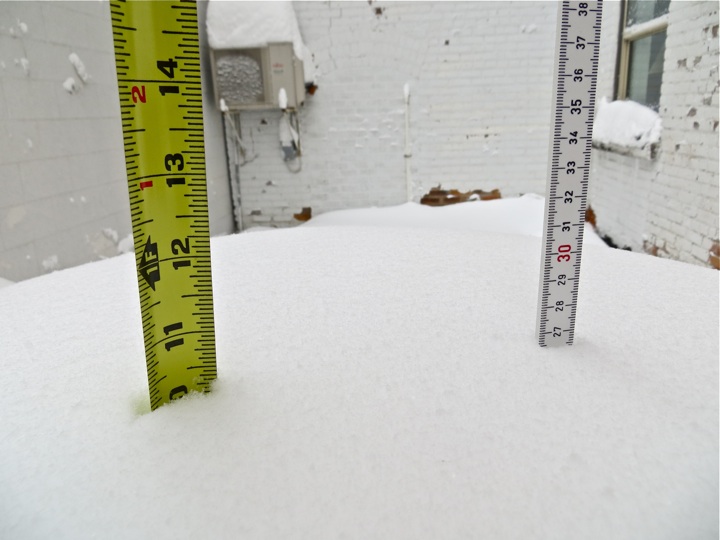
Readings of the snowfall at 8:30AM (CST) in downtown Fargo, North Dakota on February 11, 2013.
I’m not only talking about the weather just because it’s a safe topic of conversation. It is healthy for the mind and soul to discuss unsafe topics, and it is necessary to revive and invigorate culture. For example, it may be prudent to hold off on opening the conversation at Christmas Eve dinner with, “Hey, what do you all think about politics and religion, and can you pass me the gravy?”
But in any case, here is a very safe topic of morning conversation, a snap shot of the local patio readings from Blizzard Orko (the name ascribed to this blizzard, and not to be confused with Gandolf the White Blizzard, but certainly connected with Willa Cather’s thoughts on blizzards). These were taken at 8:30AM, CST, in downtown Fargo, North Dakota. Looks like just over 10″ in downtown Fargo as of this morning (centimeters are to the right).
Snow measurements from February 10, 2013, at 7:00PM (CST) in downtown Fargo, North Dakota.
Last week I revisited Walter P. Webb’s 1931 work, The Great Plains. In the coming days, I’ll blog a bit more on Webb’s work. For now, though, Blizzard Orko (as of 7:03PM [CST], February 10, 2013) induced several departments of transportation to close sections of Interstate 29 and Interstate 94 on the northern Great Plains: north-south from Grand Forks, North Dakota to Sioux Falls, South Dakota, and east-west from Jamestown, North Dakota in to Minnesota (the MNDOT’s road condition map I found is more general than decisive about exactly what sections are closed). These closures, or specifically this blizzard, reminded me a bit about Webb’s remarks on Great Plains blizzards, or what he pulled from Clement A. Lounsberry, the Civil War veteran who started The Bismarck Tribune in the 1870s. Of blizzards, Lounsberry (via Webb) referenced that historically they were known as a
…mad, rushing combination of wind and snow which neither man nor beast could face. The snow found its way through every crack and crevice. Barns and stacks were literally covered by drifting snow, and, when the storm was over, cattle fed from the tops of stacks. Persons lost upon the prairie were almost certain to meet with death, unless familiar with the nature of these storms… I learned of many instances where persons were lost in trying to go from the house to the barn, and of other instances where cords were fastened to the house so that, if the barn should be missed, by holding onto the cord the house could be found again (Webb, 1931: 25)
With this in mind, this evening I took some measurements of snowfall in downtown Fargo. At least 7 1/4″ of snow has fallen (it is now 7PM, CST). Tomorrow winds are expected to intensify, as is snow removal and book reading.
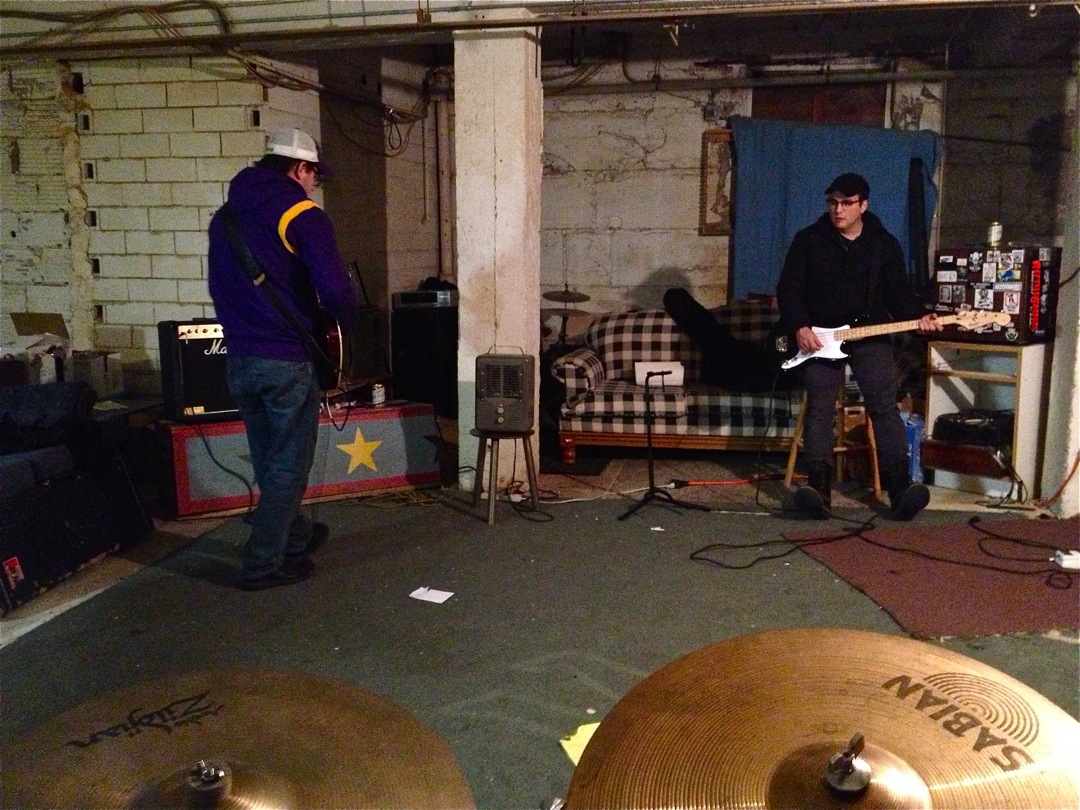
A quick concluding note on the punk archaeology unconference from this weekend at Sidestreet Grille and Pub in downtown Fargo, North Dakota. Since history, archaeology and life require us to put ourselves in the shoes of others, I wondered if it would be interesting for non-drummers to have access to a drummer’s view during a sound check. So here is a still photo of the stage from the vantage of the Audio-Video team from the University of North Dakota.
View of the stage from the Audio-Video sound station.
And here it is from another angle, a drummer’s view of the sound check (this brings up the fact that there are always more than two sides to a story, or history):
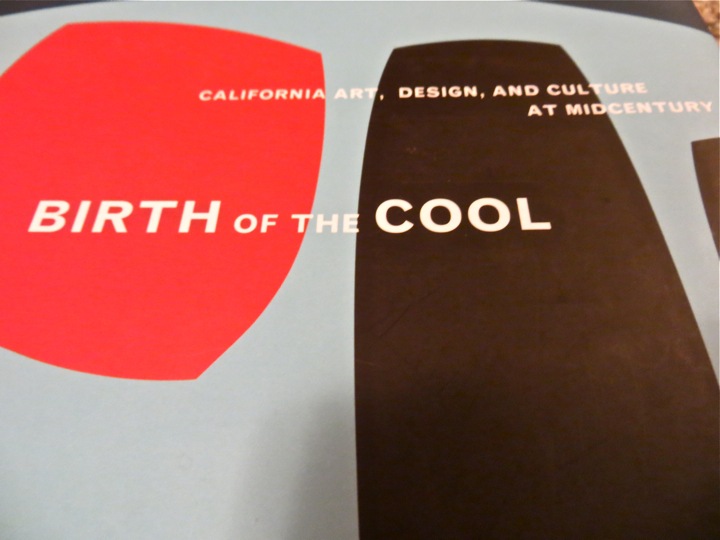
“Birth of the Cool: California Art, Design, and Culture at Midcentury” (Orange County Museum of Art: Prestel Publishing, 2008).
This weekend marks the day the music died. I’ve been reading Birth of the Cool: California Art, Design, And Culture at Midcentury, edited by Elizabeth Armstrong and issued by the Orange County Museum of Art (Prestel Publishing) in 2008. It is a kind of work that explores the genesis (or amplification) of “cool” from southern California, and this raises a chicken or the egg question: in the post-WWII world, did southern California create “cool,” or did southern California appropriate cool, embrace it, and then turn it up to — in the words of Spinal Tap — eleven?
It’s not cool to talk about cool, and that is a primary working definition of cool from the post-WWII world (captured in many ways by Anatole Broyard’s 1948 essay, “Portrait of the Hipster”). In Armstrong’s words, cool is “an attitude that eludes those who try too hard to achieve it.” (Armstrong, 2008: 1) In the essay “Cold War Cool” by Thomas Hine (also in this work), he says “Those who speak and write most about it — including most of those quoted in this essay — don’t have it. Truly cool people know enough to keep their mouths shut. (Nevertheless, I shall proceed.)” (Hine, 2008: 194) So shall I.
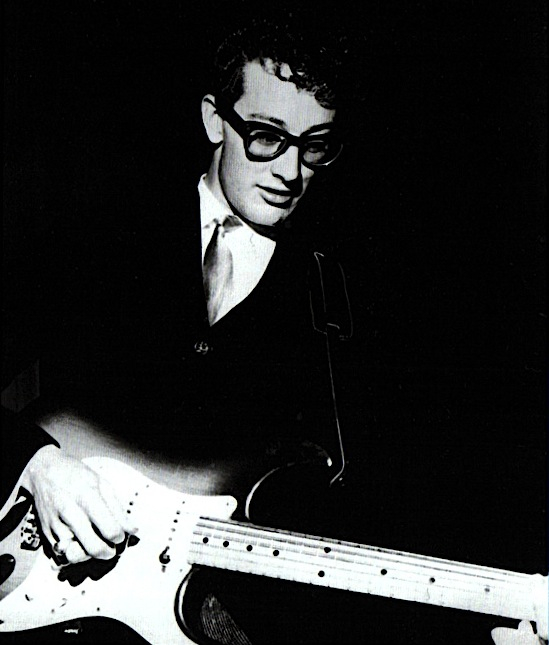
Buddy Holly in the 1950s.
Anyhow, and to not get too far off the topic of Buddy Holly, here is a photo of Buddy used in Birth of the Cool. The caption beside Buddy Holly notes his influence on The Beatles and Rolling Stones, among others (including Jonathan Richman). So in thinking about all this, it’s appropriate to say that my S-10 Chevy is snowed in an alley parking spot just 2.5 blocks from the levy, and this Friday evening I’m going downtown Fargo for a bit of whiskey rye. And to think a bit about the weekend day that the music died. The world sure missed out on a lot of great tunes because of that plane crash in Iowa on February 3, 1959. They were trying to get to a show in Fargo-Moorhead. At least Buddy continues to echo throughout the rock and roll ages, whether we know it or not, aesthetics and rhythm and all. Thanks Buddy.
Todd Reisenauer and Troy Reisenauer of Les Dirty Frenchmen.
The other night, Troy Reisenauer and Todd Reisenauer invited me over to the Les Dirty Frenchmen practice space for the first of our get-together of practices, this for the February 2, 2013 Punk Archaeology un-conference at Sidestreet Grille and Pub in downtown Fargo, North Dakota. Through the randomness inherent to the music world, this assembly happened — come to think of it, every band I’ve ever played in has never been planned. It was a process that came together over a matter of several conversations and days or weeks — the important thing, though, was each individual’s willingness and desire to play for the love of playing. Todd and Troy offered to bring their slaying punk guitars to back the songs and lyrics of Andrew Reinhard, and the keyboard of Michael Wittgraf. Andrew’s original punk archaeology tunes are available here, and free for download.
As Reisenauer, Reisenauer and I bounced around from one song to another, there certainly were tunes we favored. Todd rightly pointed out that we ought to stick with a theme, though, and that Reinhard’s tunes definitely have a garage punk sound. So this helped us narrow and focus our practice, as earlier we considered other classics such as Bobby Fuller’s “I Fought the Law” and Velvet Underground, “Sweet Jane.” We decided to not play those. At least not this time.
Eventually, Team Reisenauer, Reisenauer & I decided on a short list of punk archaeology songs. Some classic go-tos include covering “Nervous Breakdown” by Black Flag, “Loser’s Club” by The Humpers, and “I Wanna Be Your Dog” by Iggy Pop and The Stoogies. We also ran through two Reinhard originals, including “History,” and “Publish and Perish,” a segment of this latter song appropriating a punk-abilly sound that might be familiar to Social Distortion fans.
Around the Fargo-Moorhead area, here is a glimpse of some of the first Punk Archaeology handbills to go up. This one is secured to the entrance of the Rhombus Guys Pizza joint on Main Avenue in downtown Fargo in Cass County, North Dakota. For more details, click here. On February 2, 2013 (a Saturday) at Sidestreet Grille and Bar in downtown Fargo, ND, music will kick off around 7:17pm, and the panel discussion just a bit later. And like any quality un-conference time, it may start just a little before, or a little after. Swing on down if you’re in town. It is happening. And it will be awesome.
Various handbills in the entrance of Rhombus Guys in downtown Fargo, North Dakota. Punk Archaeology handbill lower right.
It is the evening of January 11, 2013, and I am on the second floor of The Arts Center in downtown Jamestown, North Dakota. In the past couple days the Weather Channel and regional meteorologists have been psychologically preparing the public for the first intense blizzard of the year. The Weather Channel has subsequently named this blizzard Gandolf — yes, I’m serious. Originally I intended on making the Eisenhower Interstate 94 drive from Fargo to Jamestown after an NDSU departmental meeting concluded in the late afternoon, but eureka rattled through my brain earlier in the morning and I thought it would be better to make the drive then and there. My hope was to beat the thermometer from Fargo to Jamestown, knowing that the light rain would turn to ice as the temps dropped below 32 F. And if I didn’t make it to Jamestown, how would I be able to attend the art gallery reception for Walter Piehl on Saturday evening with Molly at The Arts Center? Yes, I needed to act.
Ice forming on the windshield and radio antenna during the early stages of Gandolf the White Blizzard.
The drive turned into a white-knuckled affair, a ’93 Chevrolet S-10 rear-wheel drive pickup providing joyous stress. I found that by keeping the speedometer at no more than 40mph, the rear wheels would stay secure to the pavement. During the drive, I also thought about how author Chuck Klosterman killed off several main characters (spoiler alert!) with a blizzard in Downtown Owl, this piece of fiction set in a small town in rural North Dakota in 1984. Then I thought about the book, Children’s Blizzard. Then I tried to stop thinking such thoughts, and I continued driving.
Note: when driving in winter rainstorms that are turning to ice, there are two opposing thoughts that bash at each other in the brain. It goes something like this: after a driver is 30 miles into a 90 mile drive, and just after the rear wheels slip a little at 50mph (the pick up will jerk a bit), the driver considers two options: turn around and endure another 30 mile drive back, or press on and gain another 30 miles. In the long term, if the driver retreats and makes it back home, they will have logged 60 miles, which, essentially means one could have been 2/3s the way to the destination. So I pushed on. Would I end up sliding off the road and into the ditch? Stop thinking about these thoughts. I did, and I made it to my destination. My advice: don’t do this. Ever. Anyhow, the photo pictured above is what the windshield looked like in the early stages of Gandolf the Grey, this between 8:30AM-to-12PM in Cass, Barnes and Stutsman counties, North Dakota.
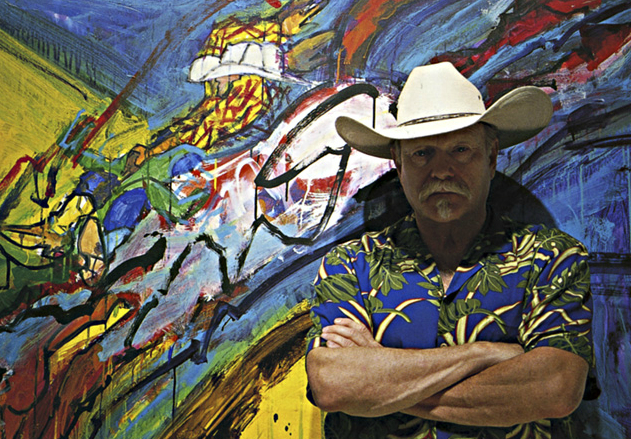
Walter Piehl and his art.
The below short video clip is an intensified Gandolf, when a winter rain storm receives more training to ultimately become Gandolf the White Blizzard. As I re-visit the video over and over from a historic building in downtown Jamestown, North Dakota, I can’t help but thinking how 100 years ago an individual in the building would have heard similar sounds from this very vantage. Note, for example, the subtle chug-chug-chug in the audio, this coming from a train just a block north. The large grain elevator (not visible) is located along the tracks. Yup, 100 years ago it was possible during a winter blizzard to hear the same blasts of shivering whispers blow through the small cracks in commercial brick construction, and also hear the thump-thump-thump of the iron horse on the Northern Pacific Railroad. Historically, it is important to respect White Blizzards — lest they teach us mortality instead of just humility.

 This Saturday, Jessica Christy (an artist who also happens to be one of my cousins) will be showing her work at DK Gallery in downtown Fargo, North Dakota.






 The Edge of the Village