Joel’s art, the February 2013 Punk Archaeology un-conference poster, hangs in the front entryway of our apartment.
Yesterday I learned that Joel Jonientz passed away. His great friend, Bill Caraher, has an excellent write up linked to here. Joel and I didn’t know each other beyond the 5 or 6 times we hung out, usually over some conversation and excellent beer. When we did hang out, Joel always asked the first person who tried departing to stay. I think this is one of the infinite reasons it was so terrible to hear of Joel’s passing.
Earlier this month I chatted a bit with Joel, and someone at our table (perhaps it was me) asked, “How do you go about starting a digital press at a university?” Joel responded with two words: “Will power.” And this is true with just about anything. You have to get up every morning knowing that this is what you want to and are going to do, and you will strategize in every way possible — directly or through chess maneuvers — to make it work. The goal is to keep pushing forward. At the table Joel explained this while smiling.
Thank you friend. You will be missed, but never forgotten.
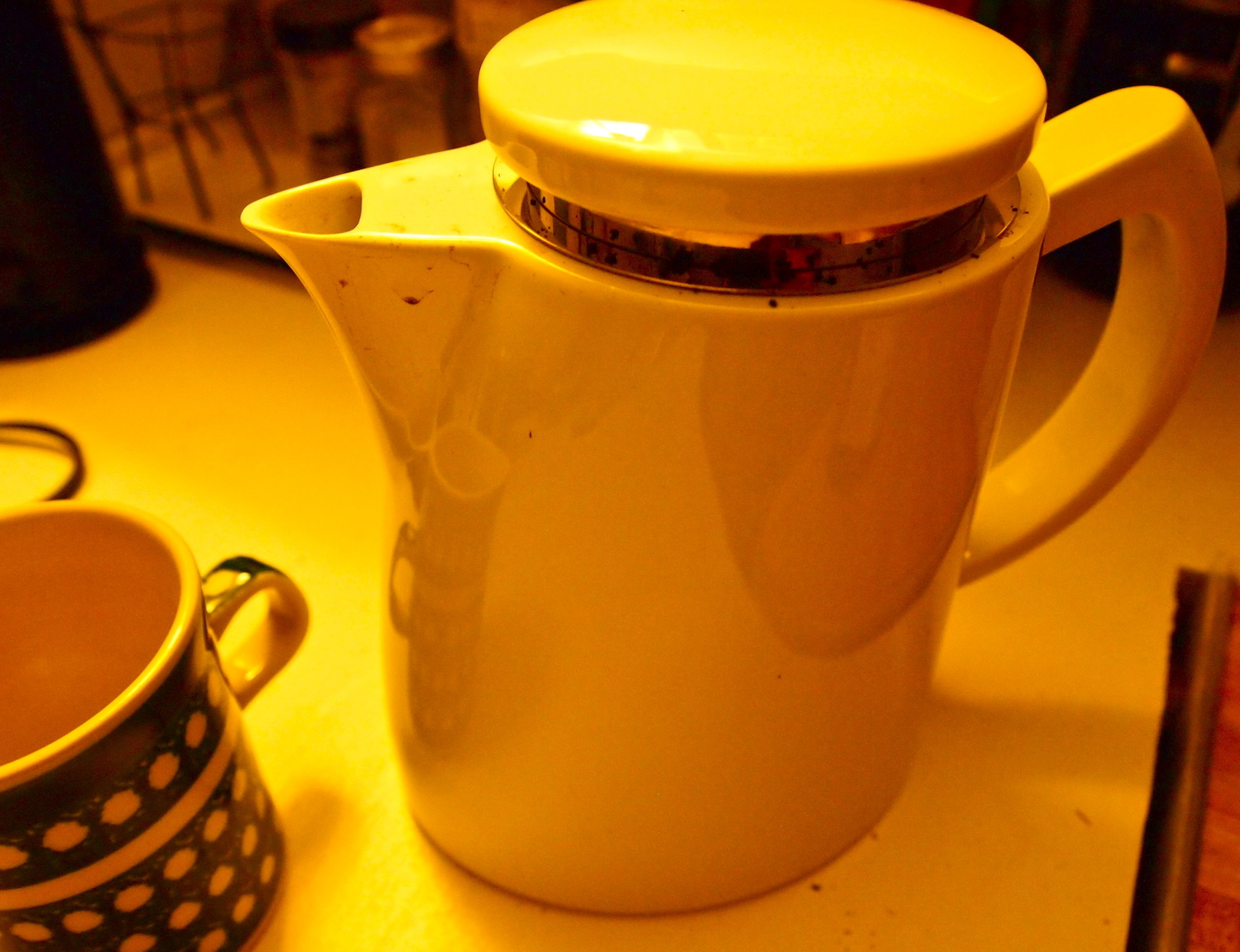
The only known photo Aaron Barth has ever been taken before consuming morning coffee.
It’s Friday evening, and the pre-industrial (organic) chicken — prepared modified Greek-style with oregano-lemon-melted-butter-paprika-salt-pepper with slight dashes of crushed rosemary and thyme — is about an hour into roasting in the oven. I have three books to my left, including Michael Mann’s The Dark Side of Democracy: Explaining Ethnic Cleansing (Cambridge, 2005); Ben Kiernan, Blood and Soil: A World History of Genocide and Extermination from Sparta to Darfur (Yale, 2007); and Greg Smithers, Science, Sexuality, and Race in the United States and Australia, 1780s-1890s (Routledge, 2009). And I’m close to getting into those. But I’ve been meaning first to talk about coffee for almost a month now.
This last month of March, Molly gifted me a Sowden Softbrew coffee pot. It is outstanding. I first came across it in an Atlantic Monthly article linked here. Before Sowden (or BS, as we call it around the apartment), Molly and I had fixed our morning coffee with a ceramic funnel and paper filter. It worked well for two, but we discovered that when we had small gatherings at our place, we spent more time making individual coffees instead of hanging out and conversing with our guests. So it was fantastic to find the Sowden. In The Atlantic article, Corby Kummer notes that it has “the comforting sturdiness of an English teapot.”
A second photo was discovered.
Out here west of the Mississippi (or what we call the Great Plains and the American West), however, we notice different things. For example, I noticed that the Sowden produces a cup of coffee you’d expect from a fusion of the French press with the methods of making cowboy coffee. By this I mean the coffee grounds (after you grind them) are allowed to sit in a metal steeping cylinder laser-blasted through with a billion 21st-century microscopic holes. So the grounds just sit in this cylinder and steep, contained, so you don’t need a French coffee plunger. And you don’t need to be as careful pouring from the Sowden as you would pouring a cup of cowboy coffee: again, the grounds are contained. The coffee by the way is extra ordinary.
I’m going to go back to checking up on the Greek-style chicken, now, and I’ll get back to these books in the morning with a cup of coffee prepped in a Sowden that Molly gifted me. Huzzah.
Photo by Holly Anderson Battocchi by Tricia Fossum.
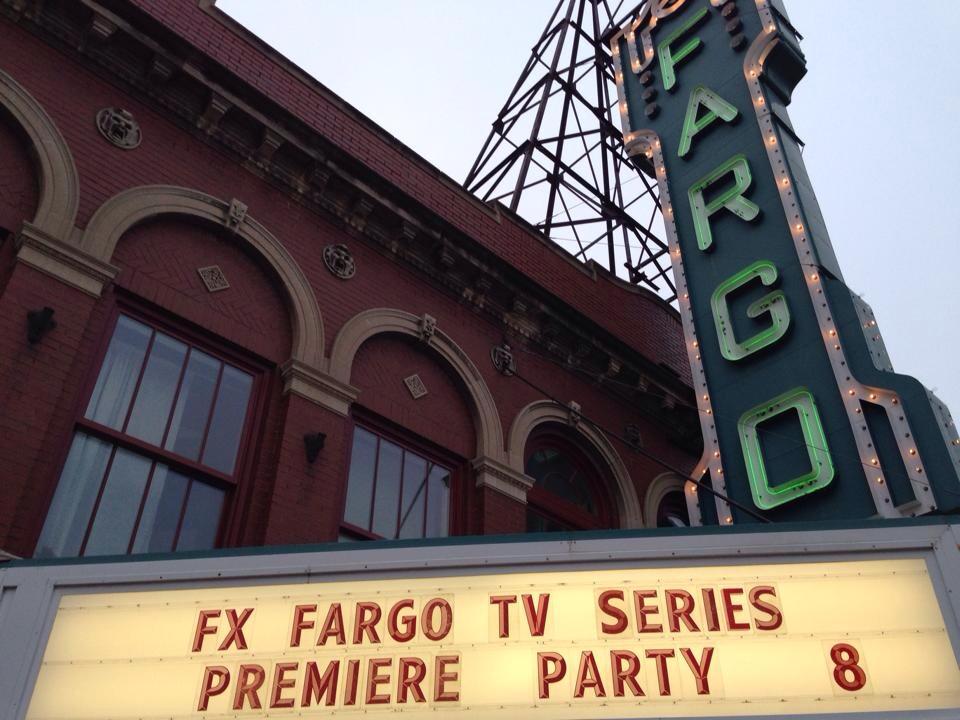
As the title of this blog entry suggests, since Molly and I live in historic downtown Fargo, we (like many Fargoans) decided to host a pre-game get-together before the 9:00PM (CST) sharp showing of FX’s “Fargo” television series at The Fargo Theater in downtown Fargo, North Dakota. Yes, a kind of Fargo-Fargo-Fargo post-modernity, or something along those lines. My mind is still reeling about the implications, since every North Dakotan knows that the glorious Coen brothers film Fargo was almost entirely filmed in Minnesota. You betcha. But that is less and less transparent the further one is from Fargo. So I am convinced and know that some kind of global Fargo diaspora has developed, and is only reshaped and pushed in different directions with this television series. It’s kind of like when someone who is born in Chicago with Irish genealogy listens to modern Irish music and says, “I’m Irish.” Actually, it’s not anything like that. Nevermind. On to the Fargo evening, though.
Hot dish and jello salad photo by Molly McLain. Hot dish and jello salads provided by Fargoans.
Yesterday evening Molly picked me up after work and we made it back to our apartment in just enough time for two things to happen before company arrived: we decided that I would make this fancy hot dish recipe while Molly would straighten up the dining and living room. It worked dontchaknow. Guests started pouring in our door just after 7:00PM, and there was much back-slapping and guffawing. Since we were celebrating Fargo and midwestern and northern Great Plains culture, there was also large amounts of passive-aggressive acknowledgement, and commands phrased as questions punctuated with a “then” at the end; as in, “Do you want to pass the hot dish then?”
The conversation flowed, as did the hot dish and jello salads last night. So much that I didn’t get a chance to snap any photos of the event. But several friends did. I pulled a few of the photos from the social media this evening. That is why you get a picture of the hot-dish spread, taken by Molly. The other photos are from our highly trained professional photographer friend, Holly Anderson Battocchi (yes, her Italian-American husband Dante lives in Fargo too). At the end of our get-together, one large group left the pre game Fargo-Fargo-Fargo get-together to take in the FX “Fargo” premiere. A smaller group (that’s us) decided to stay behind at our apartment. We rationalized us not attending “Fargo” by saying we don’t need to see “Fargo” because we are and live and create Fargo, everyday. Aw, geez.
Bill Caraher (r) introduces a digital Ed Ayers (l), streamed live from the University of Richmond to give a talk to the University of North Dakota.
Yesterday in the late afternoon I found myself finished up with fieldwork in Grand Forks, so I thought I’d drop in and catch the digital Ed Ayers being beamed in from the University of Richmond to the University of North Dakota. To history nerds, Ayers is a big deal. Bill Caraher mostly if not entirely lined up the talk. Bill received his undergraduate training in Latin and Classics at the University of Richmond, and today Ayers is the president of said U of Richmond. They met on that common ground.
It was great to hear Ayers chat about his foundational website in digital history. At some point in 1993, The Valley of the Shadow went on-line. You can link to it here. And there is even a Wikipedia page to it here. Ayers noted that with digital projects, it is not only important that they be started, but also that they come to completion. So this, as he pointed out, is why we see 1993 and 2007 at the bottom of the web site. Ayers also noted that in the 1980s, historians thought they could revolutionize the discipline through qualitative analysis. Ayers said that qualitative idea “lasted three weeks.” History certainly requires data. But it is in large part about stories and narratives, and about figuring out ways to make the raw data accessible.
Through this, says Ayers, we are now witnessing what he calls generative scholarship. By this, it is meant that scholarship does not come to some sort of final conclusion. Instead, generative scholarship encourages anyone and everyone to engage with the historical data, or texts, and speak up and out about what they see. This, in turn, adds to the dialog, thus keeping it alive.
Life is a series of short and long term stories. This is how we make sense of it all, and also how we make sense of lives lived. This is what I thought about on my drive back from Grand Forks to Fargo.
We live in a world of social media, and when things happen in our personal and professional lives, we post them. Yesterday, before Molly set off on some business in D.C., she updated what her and I have savored personally for some weeks now: we made our engagement to one-another Facebook public. Yes: a status update, so you know it’s official. I thought the update would garner quite a few likes, and it did: just over 600 in a 36-hour period. We felt blessed and fortunate, and a friend of mine, John Ward, predicted that the actual wedding will be huge. Molly and I are waiting to plan all that out in due course. Here’s to blessing Molly for blessing me, and to our family and friends for reciprocating the same.
Over the weekend I located some Dungeness crab at the Costco in West Fargo, North Dakota. To clear it up for non-Fargoans and non-North Dakotans, yes, Fargo is large enough to have a West Fargo (perhaps an idea for a second Coen Brothers film entitled West Fargo, which Molly says is on the east coast of North Dakota). The crab was so sensibly priced that I couldn’t avoid it. A small contingent — Mira McLain and Ben Simonson — from Valley City, North Dakota, came as well, bringing fresh-caught North Dakota walleye and sauger. Aunt Chris McLain also joined us, as did Matthew Trefz and Karis Thompson.
North Dakota walleye and sauger fish fry.
While eating the crab, I noted a couple things: first, fresh crab eaten in the middle of North America almost confuses one’s sense of place. It’s something that tastes like the ocean but it is so far removed from that locale. So if you’re in Fargo, or Ohio, and if you locate delicious and sensibly priced Dungeness crab, go for it. You get to taste the ocean while on a sea of prairie.
The second thing the royal we noted was that eating whole crab is an event: it takes patience and effort, and plenty of melted butter. Up to this point in time, the lot of us were land-lubbers the most if not the majority of our lives. Sure, one or two of us had the occasional deep-sea fishing experience, but that was more exotic than frequent.
After the feast, even the Chihuahuas were exhausted.
Like I said, Ben, who often squeezes 25 hours of ice fishing into his 24-hour vacation days, brought the North Dakota walleye and sauger. And the feast was just that, a combination of steamed crab from the Pacific Northwest and North Dakota freshwater fish, fried up on the spot to absolute perfection. Aunt Chris provided a homemade fudge and ice cream desert, something she learned from her mother. Heritage dinners are real, and they often involve statements such as, “My mother used to make this.” I thought about that, and how the Sunday evening meal created a memory we could someday look back on 20 years from now.
Note: Twenty-four hours later, a March 31-April 1 blizzard is going full tilt. I just wanted to document it all. Here’s a video short of Matt Trefz offering a balanced assessment of Dungeness crab.
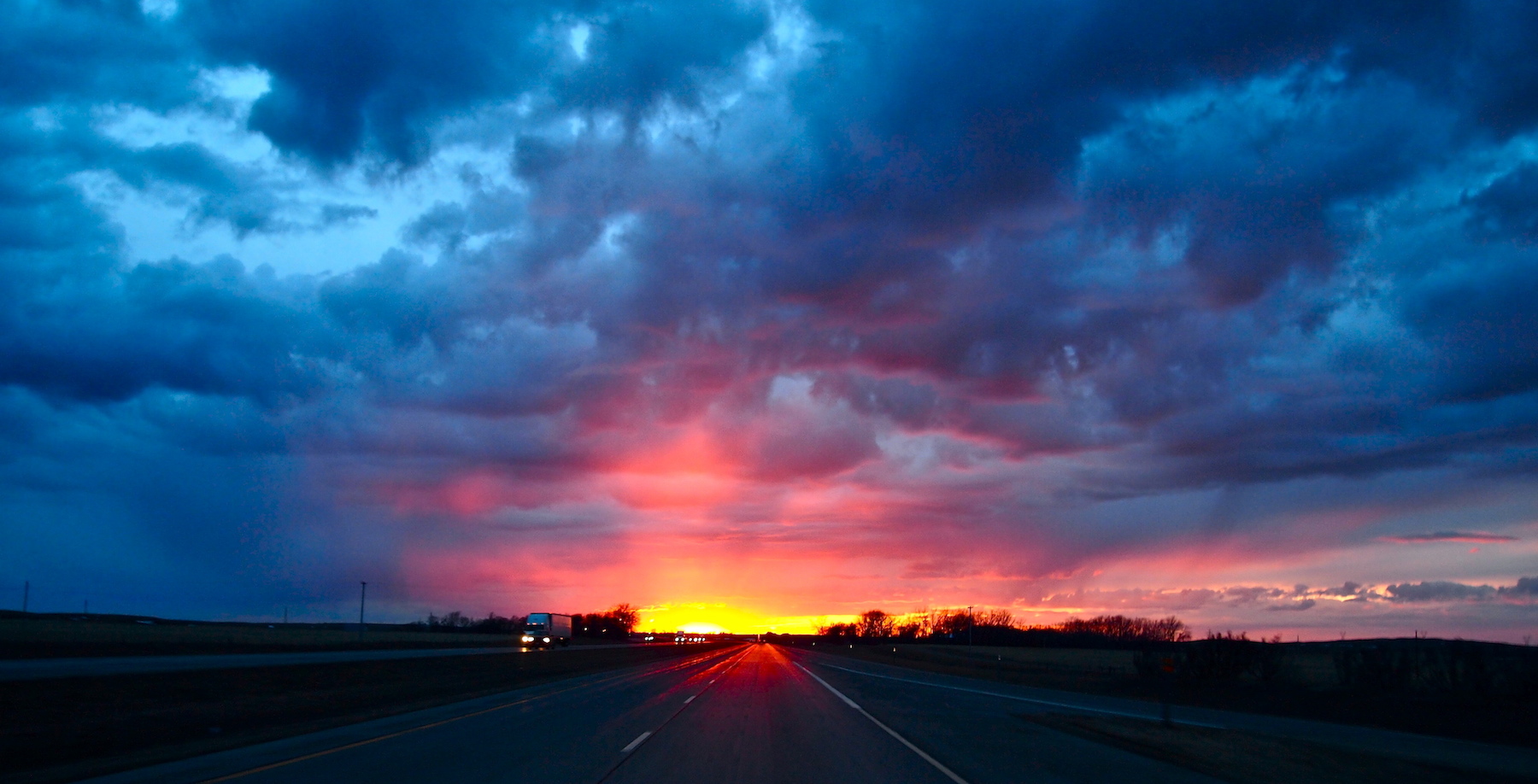
North Dakota sunset from March 20, 2014, near the Crystal Springs exit on I-94.
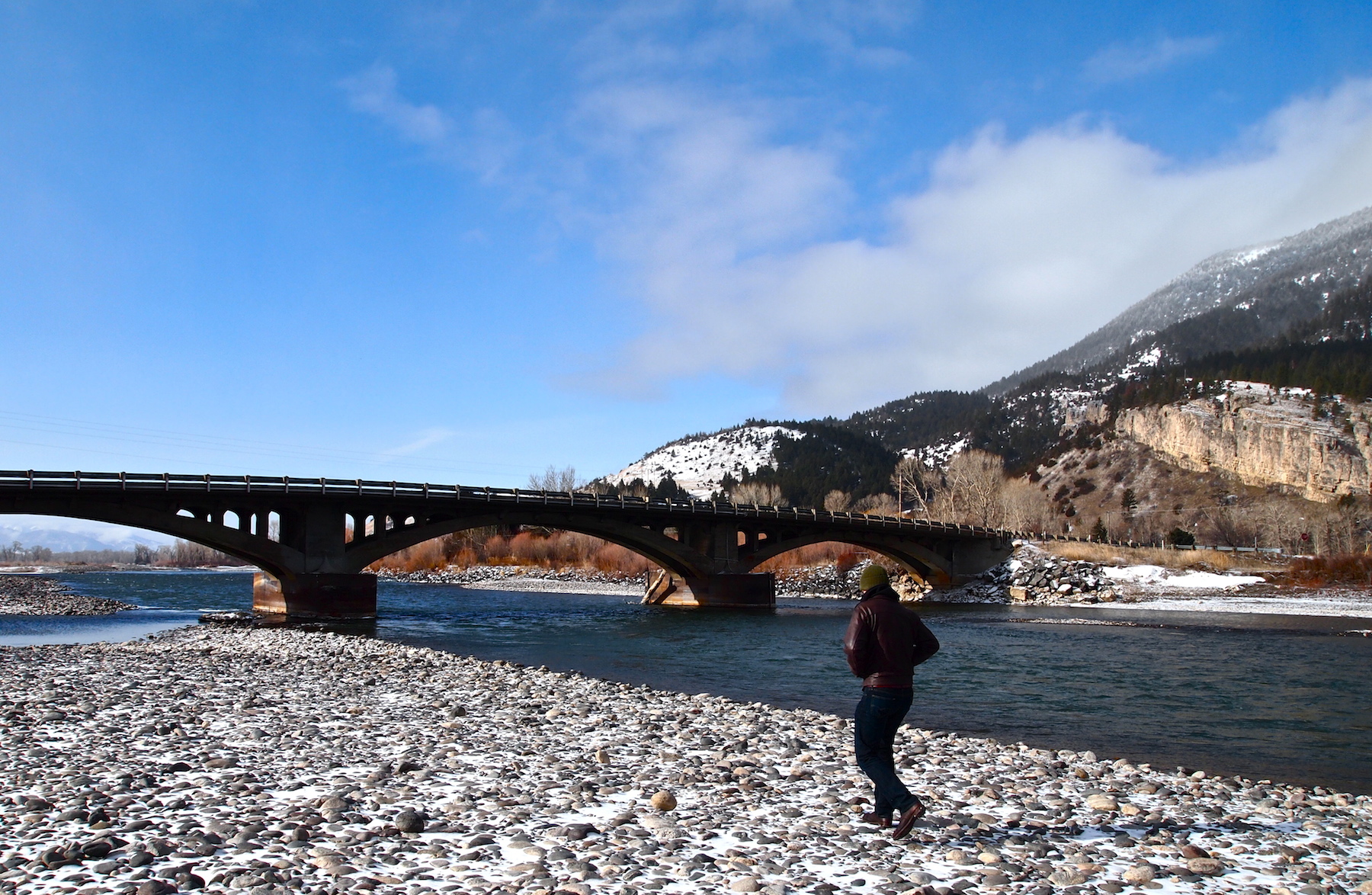
I’m currently blogging from downtown Bozeman, Montana, after Molly and I hit up Chico Hot Springs (click here for a history of Chico Hot Springs) last night and earlier today, visiting her uncle in Livingston, and a scattering of her family in Paradise Valley. While at Chico we relaxed, and reflected on how Molly’s late father, Harley, loved this place. Harley grew up in Livingston, and Molly explained how her dad used to love taking summer time dips in the Yellowstone River throughout his entire life.
Of that Yellowstone, yes: the mountain runoff feeds it direct. This water meets up with the upper Missouri River near the Montana-North Dakota border. For the long hydrology of it all, this water eventually empties into the Mississippi near St. Louis, and then it runs to the Gulf of Mexico. It’s nice to catch it fresh up here in the glorious Rockies, though.
A short walk along the Yellowstone River in Paradise Valley, just south of Livingston, Montana.
Here are a couple photos from when we left Fargo up to Bozeman. The above photo is the evening sky from March 20, 2014, around the Crystal Springs exit on I-94 in North Dakota. What the photo didn’t catch (or what we just observed rather than photographing) was the sun reflecting off the aqua blue of the melting ponds (kind of like a light turquoise, and highly reflective from the couple inches of water on the surface of the ice).
Gil’s Goods in downtown Livingston, Montana.
The middle photo is the Yellowstone River from earlier this morning, and the final is from downtown Livingston, Montana. If you visit Livingston, go to Gil’s Goods for food. It is good at Gil’s. I think tonight we’ll try to track down one more hot springs dip, this at the Bozeman Hot Springs. Yes: make a vacation out of the hot springs scattered throughout our glorious American West. It is good for the muscles and spirit.
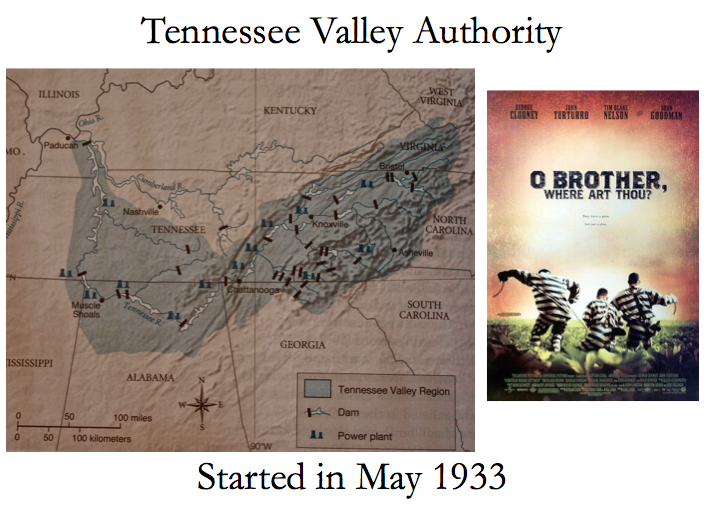
I call this slide, “TVA O’ Brother,” a combination of the map from Roark, et al., “The American Promise” (2012, p. 726) and the handbill for “O’ Brother, Where Art Thou?” (2000)
For the second lecture on the Great Depression tomorrow at North Dakota State University in Fargo, I’m showing a map of the Tennessee Valley Authority with the handbill for “O’ Brother Where Art Thou,” (2000) the backdrop of the movie set in the TVA of the 30s. My reasoning is that 1) this is a fun visual; 2) the Coen Brothers are great; and 3) students in the future are much more likely to see “O’ Brother” than a TVA map. The idea is that both of these visuals will leave a singular imprint, and from here on out when they hear George Clooney lip sync, there’s a greater possibility that they’ll think about the history of the TVA, the Great Depression, FDR’s responses, hydroelectric power dams, etc.
This is a great write-up on Mandan-Hidatsa Theodora Bird Bear, linked here, and on the complexities of life in the Bakken of western ND. She currently keeps the books for a church, this after spending 19 years working for Indian Health Services. I have had the privilege of hearing her speak about the living history and genealogical attachment to the landscape (every word deliberately chosen and delivered to the audience with respect for herself and others). This was last year, January 2013, before the ND Industrial Commission.
It’s about 3:23PM, so I thought I’d break just a moment for tea and a blog entry to throw out a little PR for some colleagues and friends.
Two events are going down in Fargo this Saturday, March 15. Well, wait a minute: certainly there are more than two events going down in Fargo this Saturday. But here are the two events that I know of right now, this Monday afternoon. The two that I’m going to talk about. You should definitely go see other events, too, above and beyond this.
The first event is a benefit for a friend and scholar, Mike Casler. Mike was diagnosed with thyroid cancer in 2011, and he’s been through a battery of surgeries and radiation treatment. Mike, along with a bunch of us, are gathering at The Bowler in Fargo (2630 South University Dr.) anywhere from 4:00-11:55PM for the official Mike Casler Benefit Fund — again this Saturday, March 15. Also, Mike is the author and historian of several upper Missouri River scholarly works, including Steamboats of the Fort Union Fur Trade: An Illustrated Listing of Steamboats on the Upper Missouri River, 1831-1867 (Ft. Union Association, 1999); and he regularly collaborates and conspires (in a good way) with the Great Plains titan of anthro, archaeology and history, W. Raymond Wood (some of Ray’s works here, here, and here, and his memoirs here).
And also on Saturday, March 15, Keith Bear will be playing Mandan-Hidatsa flute at 8:15PM in The Avalon. This is a part of the larger Great Winter Crow Show organized by Dawn and the Spirit Room Galleries. Also check that out from 5:00-10:00PM. You can read more about Keith at this link here. The event is sponsored by the Avalon Event Center, the Lake Region Art Council, and the North Dakota Humanities Council.
Okay, that was a 5-minute blog post update. Back to it.






 The Edge of the Village